Yahoo’s New CEO Marissa Mayer Having A Baby In Four Months

On his radio show July 18, 2012, Dennis Prager said: “She is going to have a baby in October. Employers are not allowed to ask a prospective employee if she is pregnant or planning on having children.”

“My favorite line in the WSJ article is this: ‘No Yahoo directors expressed concern about her pregnancy.’ Maybe that is part of the reason Yahoo is in trouble because they have such a board? It’s according to her that none of them expressed concern.”

Mayer says she worked 90 hour weeks at Google. That’s six days a week, working from 7 am to 10 pm.

“There are three things in a married working woman’s life — wife, mother, work. If you work 90 hours a week, when can she be a mother and wife? On the seventh day?

“That this did not matter to Yahoo?”

“You’ll notice that it is never pointed out that there is this third role. It’s always motherhood and career. It’s never pointed out that it is juggling motherhood, career and being a wife. For feminism, the role of being a wife is old fashioned.”

Posted in Dennis Prager | Comments Off on Yahoo’s New CEO Marissa Mayer Having A Baby In Four Months

My Contempt For Spirituality

When people use certain words and phrases such as “I’m spiritual, not religious” and “inclusive”, I tend to dismiss them.

I’m not into touchy feely talk. Healing the wounded inner child within gives me the willies.

In my experience, most people who proclaim themselves spiritual but not religious are wanting the benefits of belonging to an organized religion without paying the price of its behavioral constraints.

I decided to convert to Judaism at the end of 1989. Since then, I’ve noticed that most of my fellow seekers wanted spirituality. They wanted to feel intoxicated with God.

My concerns were more pragmatic. What would make the world a better place? What would make me a better man?

I tended to dismiss spirituality as narcissism.

Over the past few months, however, I’ve come to see that my addictive emotional needs distort my noble intentions. I may tell myself that I want to be a good man, but when push comes to shove and I have the opportunity to get high (not from drugs or alcohol, but from romance and sex), I seize the highs, even if they’re not good for me and for others.

So according to the 12-step literature I read, I need spirituality.

I’ve swapped one organized religion for another and my addictions and my tendencies to use people are unchanged.

I hate the term “spirituality”, but without it, apparently, I am lost.

Where do I go from here?

Greg Leake emails: Hi Luke,

I am impressed by whatever 12-step course you are taking, because the emphasis on “spirituality” suggests that they know what they are doing and are too wise to pass off real requirements with some shibboleth about institutional religion.

Let me just offer some conceptual models simply for the purpose of pointing in the direction.

Moving from one religion to another is like rearranging the furniture.

Spirituality is finding your own soul.

One of the first things worth considering is that spirituality doesn’t have to have a bad connotation. In fact, this is one of the few places I disagree a little with Dennis Prager.

If you say the word “Baptist,” you can narrow that definition down to a very concrete set of ideas. If you say “spirituality,” it can mean virtually anything and is too nebulous a term. If you have contempt for “spirituality” that involves guys running out in the woods, beating drums, and reading poetry, I would share your contempt. But “spirituality” is a term that can take in a lot of territory.

For example, for some the Alexander Technique would be considered by some as “spirituality”. Various forms of meditation can be seen as “spirituality”. The history of religions at the University of Chicago, originated by Mircea Eliade, might be considered “spirituality” even though it is more meticulous than most other subjects.

So I think it would be wise to limit your contempt for things that deserve it.

Both Carl Jung and Paul Tillich were in general agreement that divinity was transcendental to creation and yet was also immanent in creation.

Transcendental divinity is, of course, beyond any thought, any philosophy, any conception, any possibility of man to grasp.

However, if divinity is also immanent, that means divinity is within me and within you and within others.

So because that divine spark is within us, we have a potential for being able to discern and discover our own “spirituality” because that divine spark is a part of the transcendental divinity.

The way that we can find transcendental divinity is through the virtue of finding that divinity within ourselves.

And this business of finding our own divine nature is the part where “spirituality” comes into it.

Religions can help or hinder or be indifferent to this process of discovering our own divine nature. Too often finding our divine nature has been dismissed to an extent by our religions which insist on finding G-d “out there”… somewhere as the author of the material universe. Sometimes we get so busy following the rules, and the observances, and trying to live up to benevolent social interactions and behavior, we forget to look for our own divine nature where our own “spirituality” can be found.

I could say a lot more about this if it were of interest or useful to you. Obviously, a 12-step program does not survive unless it produces results. And because of this, it cannot pass people off into collectivist institutional categories unless those categories can really come through in helping the bottom line — the bottom line, of course, being actual change.

Posted in Addiction, Judaism, Personal | Tagged , , , , , , , , | Comments Off on My Contempt For Spirituality

Prager University: Hiroshima — Why America Dropped the Bomb

Posted in Dennis Prager | Comments Off on Prager University: Hiroshima — Why America Dropped the Bomb

Man Stabbed To Death At Corner Of Robertson Blvd/18th Street

A press release from LAPD:

“On Sunday, July 22, 2012, at approximately 8:25 p.m., LAPD, West Los Angeles Patrol Officers were summoned to a stabbing that occurred in the 1700 block of Robertson Boulevard in the city of Los Angeles. The Victim was found in the street with obvious stab wounds. He was seen running on Robertson Boulevard and then collapsing. The Victim was a male Black approximately 50 years old. The Victim’s name cannot be released at this time pending positive identification.

The motive for this crime is unknown at this time. Detectives are seeking help from the community on this case.

This case is being investigated by West Bureau Homicide Detectives. Anyone with information regarding this incident should contact Homicide at 213-382-9470. Anonymous tips can be directed to “Crime Stoppers” at 800-222-TIPS (8477).” (via SORO NC – South Robertson Neighborhoods Council)

Posted in Crime, Pico/Robertson | Comments Off on Man Stabbed To Death At Corner Of Robertson Blvd/18th Street

White Girl Bleed A Lot: Colin Flaherty Interview

I talk to Colin by phone Sunday afternoon. His new book is called — White Girl Bleed a Lot — The return of racial violence and how the media ignore it.

Colin: “My brother and I host a talk show in Wilmington, Delaware. We saw all this information coming over the newswire about flash mobs in Philadelphia. It didn’t sound right. I looked at it on Youtube and what I saw on Youtube was totally different from what I was reading about in the newspapers. If you looked at it on Youtube, it was a race riot. There was hundreds and thousands of black people on the streets of Philadelphia beating people up, pulling people out of cars, destroying property, threatening police. All nasty stuff.”

“I said this is not a typical kid’s night out. This is a race riot.”

“It kept happening over and over and over again.”

“I thought the world needed a book where people could read it and not deny this epidemic of racial violence.”

Luke: “Is this epidemic new?”

Colin: “I’m not sure. Some people say no. Bobby Rush, the former Black Panther leader and the only guy who beat Barack Obama in an election, says this has been happening for a while in the black community and the only reason people are paying attention to it now is that it is spilling into the white community.”

Luke: “Why do you think the news media has been reluctant to write accurately about this?”

Colin: “Everybody’s afraid to talk about race. Nobody wants to talk about racial violence. Wherever your community paper is, pick it up and you’ll see stories about the Black Caucus and black student groups, many of these stories will be written about by the Association of Black Violence, but to talk about black violence is to risk being drummed out of the public square as a racist.”

“Maybe I’m just a guy who has his eyes open. The book asks more questions than it opens. The book says we’re past the point where we can deny this. Because of Youtube and Twitter, we can’t. We might as well start talking about it.”

“I used to be the ghostwriter for the chair of the U.S. Commission on Civil Rights.”

Drudge links to these stories but he just links. He doesn’t say what it is and neither do many of the stories. Drudge might link to a story in Philadelphia but the story won’t say that one thousand black people were running down the streets of Philadelphia creating havoc and this is the 20th time this exact thing has happened in the last six months. They’re running out of words to describe people who do this. They’re unruly youths. They’re drunken teenagers. At some point, we’ll have to come to grips that these are black people in these riots.”

“Psychiatrists will tell us that we’re only as sick as our secrets. This topic is so buried, so secret for so many people, it shows how sick racial attitudes are for so many people.”

“There was an incident on the Fourth of July. That’s what the LA Times calls it. There were some people throwing fireworks at police in Watts. I called around. It sounded like there were ten, twenty, thirty people and they ran away when the cops came. That’s what I got from the story.”

“I emailed a firefighter who was Tweeting from the scene. He said there were 300 cops at this incident and 800 black people involved and those numbers did not get any attention in the Los Angeles Times. Eight hundred people throwing explosive devices at police officers is not a story?”

“When you hear about stuff happening in Las Vegas and smaller mid-West towns, some people say those are black people who were driven out of Los Angeles by the Mexican gangs. On the street level, it is nasty out there [between black and latino gangs in LA].”

Luke: “When did you realize you had a book here?”

Colin: “The minute one of the other talk show hosts said that my reporting on the matter was ‘despicable.’ I thought this was worth a book because it is happening all over the country. It’s too juicy.”

Luke: “My perception of America is that the worst thing you can do for your social standing is to say anything that can be regarded as racist.”

Colin: “This is how I avoid that. I don’t generalize and I don’t stereotype. I also don’t apologize. My book is fact driven. There’s nothing in there you could point to and say is racist.”

Posted in Blacks, Colin Flaherty, Journalism, Race | Comments Off on White Girl Bleed A Lot: Colin Flaherty Interview

Harvard Professor Says You Shouldn’t Report Black, Muslim Atrocities

Colin Flaherty writes: MSNBC’s new golden girl was in a pickle: If someone sees a black person committing rape or domestic violence, should he report it if it makes black people look bad?

Or if Muslims see wife-beating, genital mutilation and childhood sexual abuse, should they just keep it to themselves, because saying something gives ammunition to the “Islamophobes”?

The questions appear to be simple. But they posed a challenge for the host of the new “Melissa Harris-Perry” show when guest Mona Eltahawy talked about her Foreign Policy magazine cover story about abuse of women by men in the Muslim world.

Eltahawy speaks from experience: She had her arms broken in a demonstration in Egypt and was tortured and raped in an Egyptian jail cell.

So she seemed surprised to find Harris-Perry questioning her right to draw attention to “traditions” such as involuntary female circumcision, wife-beating and childhood sexual abuse.

“I start with a little bit of trepidation in this conversation,” the host said, “in part because I know some of the critiques of this. The very idea that Western press, those that are not from these nations, who are not Muslim ourselves, who are not part of these traditions can look at your article and say ‘ahhh, look at how horrible those men, or those societies, or that religion is.’

“And that is part of the reason why, for example, we have an under-reporting of rape and domestic violence in African American communities,” Harris-Perry continued. “Because we know the violence enacted on black men by police, so we often don’t call. Right?”

Then the MSNBC host brought in Harvard professor Leila Ahmed, who questioned whether Eltahawy should have written the article at all. Not because it was false, but because it made Muslims look bad.

“You began, Melissa, by noting that some things in the African-American community are not publicized precisely because of the racism,” said Ahmed as Harris-Perry nodded in agreement on a split screen.

“Mona, I appreciate what you do,” continued Ahmed. “I would love it if – I understand if you want to get your message across. It’s an important message. But if possible [you should not] give fuel, fodder to people who simply hate Arabs and Muslims in this climate of our day.”

Posted in Blacks, Colin Flaherty, Journalism, Race | Tagged , , , , , | Comments Off on Harvard Professor Says You Shouldn’t Report Black, Muslim Atrocities

Racial Violence On The Fourth Of July

On July 4, I walked through a black neighborhood south of 18th Street in 90035. I noticed firecrackers going off and several police cars in the area.

Little did I know that in Watts about 700 black youths threw firecrackers at about 300 police and firemen.

The story merited only two benign paragraphs in the LA Times.

Colin Flaherty writes:

In Watts, Calif., a crowd of dozens of black people setting off fireworks at the Nickerson Gardens public housing project did not take kindly to police and firemen who showed up to stop it.

During the incident, the suspects allegedly tossed rocks, bottles and live fireworks at Los Angeles police officers, according to City News Service.

On Twitter, both sides were represented:

A fireman said, “Cops in riot gear and the locals shooting fireworks at the cops pretty funny until u drive through it. … Eh.”

But one of the residents of Watts thought it was funny:

“Niggas in the niccersons had the riot squad out there … throwin fireworks n roccs at police lmfao yall did that fasho,” said @HerFavDrugg.

Several officers were hit by fireworks.

Posted in Blacks, Colin Flaherty, Journalism, Race | Comments Off on Racial Violence On The Fourth Of July

America’s Race War

Black economist Thomas Sowell at the Hoover Institute writes: When I first saw a book by Colin Flaherty with the title “White Girl Bleed a Lot,” I instantly knew what it was about, even though I had not seen the book reviewed anywhere, and knew nothing about the author.

That is because I had encountered that phrase before, while doing research for the four new chapters on intellectuals and race that I wrote for the revised edition of my own book Intellectuals and Society, published this year.

That phrase was spoken by a member of a mob of young blacks who attacked whites at random at a Fourth of July celebration in Milwaukee last year. What I was appalled to learn, in the course of my research, was that such race riots have occurred in other cities across the United States in recent years — and that the national mainstream media usually ignore these riots.

Where the violence is too widespread and too widely known locally to be ignored, both the local media and public officials often describe what happened as unspecified “young people” attacking unspecified victims for unspecified reasons. But videos of the attacks often reveal both the racial nature of these attacks and the racial hostility expressed by the attackers.

Posted in Blacks, Colin Flaherty, Journalism, Race | Comments Off on America’s Race War

White Girl Bleed a Lot: The Return of Race Riots to America by Colin Flaherty

Brett Stevens writes: We trust our newspapers, who have a profit interest in reporting things we like to read, to interpret that interest as a mandate for telling the truth as they see it.

However, as we find out with each generation, newspapers often filter “truth” through two sieves to withdraw upsetting information: first, what is politically de rigeur at the time, and second, what their advertisers and vocal interest groups want to hear.

In addition, we are literally drowning in news. There are now thousands of papers, millions of blogs, uncountable podcasts and citizen journalist outfits on the information waves, each thrusting forth its best eye-catching headlines.

Through these two filters, we lose sight of what happens and rely on the spin and opinion-shaping abilities of the news. Scan the big headlines, then see what the pundits say, and find a nice tidy conclusion to seal the deal.

Colin Flaherty, an acclaimed reporter, approaches the news as a giant set of data points. By themselves, these data points are easily lost in the flood or explained away with political or commercial rhetoric.

However, when Flaherty goes through with his highlighter and connects the dots for us, a pattern emerges. This pattern contradicts the “official story” which explains away the pattern in favor of focus on single points, and punditry to justify what happened as not what the pattern says it is.

In this case, he offers a simple thesis: the race riots of the 1920s, 1960s and 1990s have returned, but in a new form. This time, they are micro-riots. Flash mobs, or groups of a few dozen to a few thousand people, emerge spontaneously to rob, assault, batter and steal — but none dare call it a “riot.”

This is not a racist book. Flaherty does not make any conclusions about why this is happening, or blame all African-Americans for the actions of some African-Americans. He does however make two compelling points:

Race riots have returned in the form of flash mobs.
Our media is unwilling to report this but will explain it away.

Posted in Blacks, Colin Flaherty, Journalism, Race | Comments Off on White Girl Bleed a Lot: The Return of Race Riots to America by Colin Flaherty

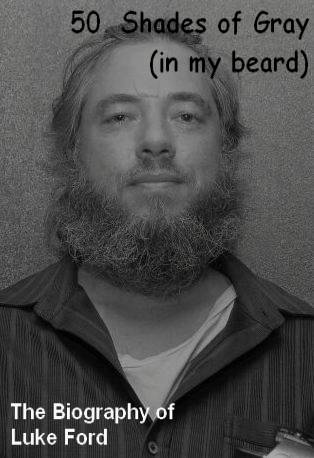
50 Shades Of Grey In My Beard

I’m a little unsure of how my publishers have decided to reissue my magnum opus, but what can I say?

Posted in Personal | Comments Off on 50 Shades Of Grey In My Beard