
I was looking at the entry for Christopher Caldwell and I saw something new on the page – he’s listed with a series of conservative commentators.
I find the list hilarious.
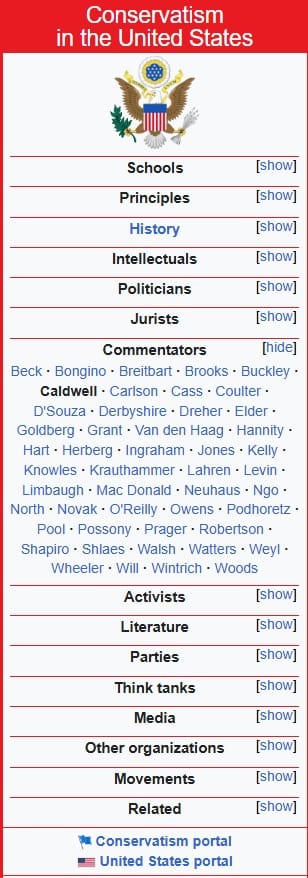
What other august names are linked with Caldwell? These galaxy brains:
Beck ·
Bongino ·
Breitbart ·
Brooks ·
Buckley ·
Caldwell ·
Carlson ·
Cass ·
Coulter ·
D’Souza ·
Derbyshire ·
Dreher ·
Elder ·
Goldberg ·
Grant ·
Van den Haag ·
Hannity ·
Hart ·
Herberg ·
Ingraham ·
Jones ·
Kelly ·
Knowles ·
Krauthammer ·
Lahren ·
Levin ·
Limbaugh ·
Mac Donald ·
Neuhaus ·
Ngo ·
North ·
Novak ·
O’Reilly ·
Owens ·
Podhoretz ·
Pool ·
Possony ·
Prager ·
Robertson ·
Shapiro ·
Shlaes ·
Walsh ·
Watters ·
Weyl ·
Wheeler ·
Will ·
Wintrich ·
Woods ·
Placing Christopher Caldwell next to Tomi Lahren, or Ernest van den Haag next to Jesse Watters, or Richard John Neuhaus next to Dan Bongino, suggests a categorical flattening that serves a particular purpose — it implies that conservatism is a single phenomenon rather than a set of very different intellectual and cultural formations that happen to share a directional label. A serious taxonomy would distinguish at minimum: the intellectual conservatives (Caldwell, Will, Krauthammer, Buckley, Podhoretz, Hart), the religious conservatives (Neuhaus, Herberg, Novak, Robertson), the populist media conservatives (Limbaugh, Hannity, O’Reilly, Ingraham, Carlson), the younger media-political hybrids (Shapiro, Walsh, Knowles, Owens, Pool), and the genuinely heterodox figures who fit poorly in any of these categories (Derbyshire, Dreher, Weyl).
Several names are noteworthy for specific reasons.
Will Herberg is the most intellectually significant figure most people on this list have never read. His Protestant Catholic Jew (1955) remains one of the most penetrating analyses of American civil religion ever written — a sociological and theological argument about how the three faiths became vehicles for a common American Way of Life that was itself a kind of religion. He was a former Marxist who became a Jewish theologian and a National Review contributor, which is an unusual enough trajectory to deserve serious attention. He connects directly to your interests in religious sociology and the custodianship question.
Ernest van den Haag is similarly underread. A Dutch-born Jewish sociologist and psychoanalyst who became one of the most rigorous defenders of capital punishment and a sharp analyst of mass culture, his The Jewish Mystique (1969) is a serious if contentious attempt to analyze Jewish intellectual and cultural achievement in sociological terms.
Stefan Possony is almost unknown outside specialist circles — a Viennese Jewish émigré and Stanford Hoover Institution strategist who worked on psychological warfare and was one of the early theorists of what became the Strategic Defense Initiative. His presence on this list is curious.
Richard John Neuhaus is the most important religious intellectual on the list. His The Naked Public Square (1984) argued that the exclusion of religious reasoning from public discourse produced not a neutral secular space but a vacuum filled by ideology. His conversion from Lutheran pastor and civil rights activist to Catholic priest and neoconservative intellectual is one of the more remarkable intellectual trajectories of the era.
Michael Knowles and Brittany Lahren being on the same list as Caldwell and Neuhaus is the list’s most significant intellectual problem. It suggests Wikipedia’s categorization is driven by political valence rather than intellectual substance, which tells you something about how the category conservative functions as a sorting device in contemporary discourse — it groups by tribal affiliation rather than by the quality or character of the thought.
Caldwell himself is one of the two or three most serious political journalists in America and belongs in a different conversation from most of the names surrounding him.
This list makes the argument for the wisdom of David Pinsof’s Alliance Theory, which dismisses the importance of ideas for practical politics except in the instrumental sense.
The range of intellectual content represented is staggering in its breadth and its shallowness simultaneously. Neuhaus spent decades working through the relationship between natural law, democratic legitimacy, and religious pluralism at a level of genuine philosophical seriousness. Herberg brought genuine sociological and theological learning to bear on American civil religion. Caldwell reads European political philosophy and demographic data with a rigor that most academics cannot match. Van den Haag was a trained social scientist who engaged seriously with criminology and jurisprudence.
They share a list with Alex Jones.
What unites them is not ideas but coalition membership — the signal they send to a particular political tribe that they are on the right side of the primary social division that organizes American public life. Pinsof’s point is precisely this: the content of the ideas is largely irrelevant to their political function. What matters is that invoking them marks you as a member of the coalition, and that the coalition’s enemies recognize the marking. Neuhaus and Jones are both useful to the same alliance for the same structural reason, which has nothing to do with the quality or content of what either of them thought.
The list is also a small demonstration of how coalitions handle the tension between their high-status intellectual members and their mass-market ones. Buckley understood this problem acutely — his famous purging of the Birchers from National Review was precisely an attempt to maintain the coalition’s intellectual credibility while expanding its electoral base. The current list suggests that project has been largely abandoned. The coalition no longer needs its Neuhauses and Caldwells to perform intellectual legitimacy for a mainstream audience because it has given up on that audience and reorganized around a different kind of solidarity.
The deeper Pinsof point is that this was probably always the underlying reality, and that the intellectual conservatives were always serving a coalition function even when they believed they were engaged in political philosophy. The difference is that the current coalition is less embarrassed about the fact, which makes the mechanism more visible. Buckley needed to seem like he was arguing. Hannity does not.
