
- https://PayPal.Me/lukeisback
"Luke Ford reports all of the 'juicy' quotes, and has been doing it for years." (Marc B. Shapiro)
"This guy knows all the gossip, the ins and outs, the lashon hara of the Orthodox world. He’s an [expert] in... all the inner workings of the Orthodox world." (Rabbi Aaron Rakeffet-Rothkoff) LATEST POSTS:
- Scenes from a Documented Life: Mickey Kaus
- Scenes from a Documented Life: Eugene Volokh
- Scenes from the 155 IQ Life
- Scenes from the 105 IQ Life
- Scenes from the 75 IQ Life
- Scenes from the 85 IQ Life
- Scenes from the Passport Question
- Scenes from Human Resources
- Scenes from the Unsubscribe Economy
- Donny Pauling: The Producer Who Sold His Repentance
- Are There Any Serial Killers In 90035?
- Karl Taro Greenfeld: The Brother, the Correspondent, the Fire
- Bret Stephens
- My Stanley Fish Reading List
- Why So Much Elite Enthusiasm For The Odyssey?
- Are There Realistic Ways Of Unifying America?
- Scenes from the Chokepoint Economy
- Robert Putnam: The Man Who Counted What America Lost
- W. Bradford Wilcox: The Sociologist Who Tells America to Get Married
- Peter Moskos: The Cop Who Talks to People
BEST POSTS:
- * The Enlightenment Wasn’t Enlightened (6-23-26)
* Mr. Burge Draws The Line (6-23-26)
* 'Improving on Democracy' (6-17-26)
* People Leak To People Who Are Fun (6-11-26)
* Why Does Australia Produce So Many Great Journalists? (6-11-26)
* Steve Wynn and the Press: Power, Litigation, and the Contest Over Las Vegas (6-3-26)
* Sheldon Adelson and the Journalists (6-3-26)
* The Vigilant Animal: Thinkers Who Reject the Myth of Human Gullibility (6-2-26)
* The Cost of Refusing the Misunderstanding Myth (6-2-26)
* Show Me How It Travels (6-2-26)
* The Norm Explainers (6-2-26)
* Centering Marginalized Voices (6-1-26)
* What would it look like if the Washington Post put its reader first? (6-1-26)
* What would it look like if the Financial Times put its reader first? (6-1-26)
* What It Would Mean for the Los Angeles Times to Put the Reader First? (6-1-26)
* What It Would Mean for The New York Times to Put the Reader First? (6-1-26)
* Why Wembanyama Lives on the Perimeter (5-31-26)
* The Emotional Palettes Of San Diego, Los Angeles, San Francisco & Sacramento (5-27-26)
* The Administrative Capital: Sacramento Legal Culture (5-27-26)
* San Diego - The Quiet Republic (5-27-26)
* The Quiet Bar: San Diego Legal Culture (5-27-26)
* SF v LA Legal Culture (5-27-26)
* Why Talent Travels Poorly Between San Francisco and Los Angeles (5-27-26)
* San Francisco and Los Angeles as Rival Models of Urban Access (5-27-26)
* Social Cliques in New York, 2026 (5-25-26)
* Social Cliques in San Francisco, 2026 (5-25-26)
* The Rival Courts of Washington (5-25-26)
* The City of Private Rooms (5-25-26)
Jews & Charity
Mark Arax writes in January 2018:
Stewart Resnick is the biggest farmer in the United States, a fact he has tried to keep hidden while he has shaped what we eat, transformed California’s landscape, and ruled entire towns.
Together, the Resnicks have wedded the valley’s hidebound farming culture with L.A.’s celebrity culture. They don’t do agribusiness. Rather, they say, they’re “harvesting health and happiness around the world through our iconic consumer brands.” Their crops aren’t crops but heart-healthy snacks and life-extending elixirs. Stewart refers to the occasional trek between Lost Hills and Beverly Hills — roughly 140 miles — as a “carpetbagger’s distance.” It seems even longer, he says, if you add in the psychological distance of being an East Coast Jew in a California farm belt where Jews are few and far between. Lynda is making the trip on the company jet more often these days. She’s done giving big gifts to Los Angeles museums and mental health hospitals that name buildings after her and Stewart. The south valley — its people and poverty, its obesity and diabetes — is her newest mission.
In Lost Hills, they call her “Lady Lynda.” She shows up in high fashion and stands in the dust and tells them about another charter school or affordable-housing project she is bringing to them. They have no way to grasp the $50 million to $80 million a year that the Resnicks say they are spending on philanthropy. This is a magnitude of intervention that no other agricultural company in California has ever attempted. The giving goes to college scholarships and tutors. It goes to doctors and nurses, trainers and dietitians, who track the weight of workers, prod them to exercise, and wean them off soda and tortillas. As she announces the newest gift, the men and women in the back of the crowd smile and applaud politely and try not to show their faces to the publicity crew she has brought with her to film the event. Many are here without documents, after all.
Posted in California, Jews
Comments Off on Jews & Charity
Quillette: The Dangers of Ignoring Cognitive Inequality
Wael Taji writes: “The connection between intelligence and behavioral problems, such as Conduct Disorder (CD) or Antisocial Personality Disorder (APD), was well-known around the time of the Port Arthur Massacre. A review by biostatistician and UCSD professor Sonia Jain cites contemporaneous studies to suggest that low IQ scores in childhood should be considered a risk factor for APD and CD. In 2010, several psychologists published results from a longitudinal study containing data on over a million Swedish men, who were tracked from conscription for a little over 20 years. They found that IQ scores tested during conscription were a significant and robust predictor, not only for APD or CD, but for all categories of mental disorders. Conscripts with low IQ were substantially more likely to be diagnosed with one or more mental disorders, to suffer from mood and personality disorders, and to be hospitalized for mental illness. Those in the lowest band—like Bryant—were most at risk of severe psychological disorders.”
Professor Linda Gottfredson wrote:
1. IQ (as long as it's a good measure of g) predicts a broad range of life outcomes better than does SES [socio-economic status], from GPA to longevity. Corollary: You can wash out IQ's apparent predictive superiority only if you load your SES battery with additional surrogates for parents' or own g.
2. The phenotypic correlations between IQ and measures of social class (education, occupational prestige, income) are from a half to two-thirds genetic in origin.
3. SES cannot explain the big IQ differences among siblings growing up in the same household: They differ two-thirds as much in IQ, on the average (11-12 points), as do any two random strangers (~17 points). This is a glaring fact that SES enthusiasts have studiously ignored.
4. Adult functional literacy (e.g., see the fed's NALS survey) predicts life outcomes in exactly the same pattern as does IQ, though they won't tell you that. Functional literacy is measured by having subjects carry out everyday life tasks, such as using a menu to figure out the price for something. Persons scoring at levels 1-2 (out of 5) have been described as not having the ability to use their rights or meet their responsibilities in the modern world (40% of whites, 80% of blacks). Pick out a few NALS tasks at various levels and ask your critic what % of adults s/he thinks can perform them. They will be shocked and so will you when you see the data–go to my 1997 "Why g matters" article for NALS, or my 2002 "highly general and highly practical" chapter for health literacy items–e.g., on diabetes.
5. IQ predicts on-the-job performance better overall than any other single predictor (SES isn't even in the running), it predicts better when performance is objectively rather than subjectively measured, and when the tasks/occupations are more complex in what they require workers to do. At the same cognitive complexity level, IQ predicts job performance equally well in manual and non-manual jobs (e.g., trades vs. clerical. The exact same complexity pattern is found with functional literacy–the hardest items are the most complex (require more inference, are abstract rather than concrete, contain more distracting irrelevant information, etc.)
6. A large followup of Australian veterans found that IQ was the best predictor of death by age 40 (had 50+ predictors). Vehicle fatalities were the biggest cause (as is typical), and, compared to men with IQs of 100+, men of IQ85-100 had twice the rate and men IQ 80-85 had three times the rate. (Remember, SES could not explain this.) The US (and apparently Australia) forbid induction of persons below IQ 80 because they are not sufficiently trainable–found out the hard way.
7. Finally, if you succeed in describing g as a general learning and reasoning ability (one that gives high g people an increasing edge when tasks are more complex), then it is easy to show g's life and death relevance when you describe how health self-care and accident prevention are highly dependent on learning and reasoning. Consider what it takes to be an effective diabetic–lots and lots of judgment on a daily basis, or you're likely to lose your sight, your limbs, etc.
Gottfredson wrote:
Of all human traits, variation in general intelligence (g) is the functionally most important in modern life. The first question that behavior genetics tackled was ‘‘how heritable are within-group differences in intelligence?’’—the answer: ‘‘very.’’
Gottfredson said: "Keep in mind that false belief in infinite human malleability led to some of the worst horrors of the 20th century. I also think it is patronizing and usually self-serving when elites contend that the American public cannot be trusted with certain facts."
Gottfredson wrote:
If all 13‐year‐olds took the same 15‐minute test (WASI), I could give you each child’s odds for all these adult outcomes without knowing anything else about them.
– Drops out of high school,
– Holds mostly unskilled jobs, skilled jobs vs. professional jobs
– Performs those jobs well
– Lives in poverty AND
– Can find a particular intersection on a map, or grams of carbohydrate per serving on a food label
– Adheres to a medical treatment regimen for diabetes or other chronic illness
– Dies prematurely
Gottfredson wrote:
The first step in assessing the real-life importance of g/IQ is to determine whether scores on highly g-loaded tests (tests that measure g well) predict differences in valued life outcomes. Correlations do not prove causation, but they are a first step in doing so. The most studied outcomes are performance in school (such as school marks and achievement test scores), performance on the job (mostly supervisor ratings), socioeconomic advancement (level of education, occupation, and income), and social pathology (adult criminality, poverty, unemployment, dependence on welfare, children outside of marriage). The relations of intelligence to health, health behavior, resilience in the face of extreme adversity, longevity (length of life), and functional literacy (the ability to do routine reading, writing, and arithmetic tasks in modern societies) have also begun to draw much attention. Thousands of studies have looked at the impact of mental abilities on school and job performance, and large national longitudinal studies in both Europe and the United States have shown that IQ is related to various forms of socioeconomic success and failure. Here are their most general findings about g’s association with life outcomes.
Correlations with IQ are pervasive. IQ predicts all the foregoing outcomes to some degree. Subjective well-being (happiness) is the rare exception: it is regularly found not to correlate meaningfully with IQ level. In general, g relates more to instrumental behavior than emotional reactions.
Correlations with IQ vary systematically by type of outcome. IQ’s predictive value ranges widely, depending on the outcome in question. For example, when averaged over several years, performance on standardized tests of academic achievement correlates about as highly with IQ as two IQ tests do with each other (over .8 on a scale of -1.0 to 1.0). In contrast, correlations with IQ are closer to .6-.7 for school marks, years of education completed, and longevity. They are about .5 with prestige level of occupation, .3 to .4 with income (the correlations rising with age), and .2 with law-abidingness.
Correlations with IQ are higher when tasks are more complex. To illustrate, when jobs are ranked in overall complexity of work, the correlations between IQ and job performance rise from .2 for simple, unskilled jobs, to .5 in middle-level jobs (skilled trades, most clerical work), to .8 in the most complex (doctors, engineers, top executives). Stated another way, it matters little how intelligent workers are in low-level jobs, but it matters a great deal in high-level jobs, regardless of whether the job seems academic or not.
IQ/g is best single predictor, mental or non-mental. IQ/g usually predicts major life outcomes better than does any other single predictor in broad samples of individuals. For example, whether IQ predicts strongly (educational performance) or weakly (law-abidingness), it predicts better than does social class background…
Social privilege theory also predicts that the impact of environmental conditions will accumulate with age, but longitudinal studies show that IQ actually becomes more heritable over the life span (from 40% before entering elementary school to 80% by mid-adulthood). Perhaps most surprising of all, differences in family advantage have no lasting effect on IQ by adolescence, at least in the U.S. and Europe, so family members are no more alike in IQ by adulthood than their genetic relatedness would predict…To take one example, the post-World War II communist government of Warsaw, Poland, assigned families of all social classes to the same housing, schools, and health services, but this social leveling failed to narrow intelligence differences in the next generation…
The pattern is that, when two groups differ in average IQ, the proportions of their populations found at each point on the IQ distribution differ most at the extremes, or tails, of the IQ distribution. This is seen most clearly by looking at the ratios in the bottom three rows of Figure 3. Take, for example, blacks and whites above IQ 100. Blacks become progressively rarer, relative to whites, at higher IQ levels: 1:3 above IQ 100, 1:7 above IQ 110, and only 1:30 above IQ 125…
IQ 75 signals the ability level below which individuals are not likely to master the elementary school curriculum or function independently in adulthood in modern societies. They are likely to be eligible for special educational services in school and for Supplemental Security Income (SSI) from the U.S. government, which is financial support provided to mentally and physically disabled adults. Of course, many do marry, hold a job, raise children, and otherwise function adequately as adults. However, their independence is precarious because they have difficulty getting and keeping jobs that pay a living wage. They are difficult to train except for the simplest tasks, so they are fortunate in industrialized nations to get any paying job at all. While only 1 out of 50 Asian-Americans faces such risk, Figure 3 shows that 1 out of 6 black- Americans does.
IQ 85 is a second important minimum threshold because the U.S. military sets its minimum enlistment standards at about this level. Although the military is often viewed as the employer of last resort, this minimum standard rules out almost half of blacks (44%) and a third of Hispanics (34%), but far fewer whites (13%) and Asians (8%). The U.S. military has twice experimented with recruiting men of IQ 80-85 (the first time on purpose and the second time by accident), but both times it found that such men could not master soldiering well enough to justify their costs. Individuals in this IQ range are not considered mentally retarded and they therefore receive no special educational or social services, but their poor learning and reasoning abilities mean that they are not competitive for many jobs, if any, in the civilian economy. They live at the edge of unemployability in modern nations, and the jobs they do get are typically the least prestigious and lowest paying: for example, janitor, food service worker, hospital orderly, or parts assembler in a factory.
IQ 85 is also close to the upper boundary for Level 1 functional literacy, the lowest of five levels in the U.S. government’s 1992 National Adult Literacy Survey (NALS). Adults at this literacy level are typically able to carry out only very simple tasks, such as locating the expiration date on a driver’s license or totaling a bank deposit slip, but they typically cannot perform more difficult tasks, such as locating two particular pieces of information in a sports article (Level 2), writing a brief letter explaining an error in a credit card bill (Level 3), determining correct change using information in a menu (Level 4), or determining shipping and total costs on an order form for items in a catalog (Level 5). Most routine communications with businesses and social service agencies, including job applications, are thus beyond the capabilities of persons with only Level 1 literacy. Their problem is not that they cannot read the words, but that they are not able to understand or use the ideas that the words convey…
IQ 105 can be viewed as the minimum threshold for achieving moderately high levels of success. It has been estimated to be the point at which individuals have a 50-50 chance of doing well enough in secondary school to be admitted to a four-year university in the United States. People above this level are highly competitive for middle-level jobs (clerical, crafts and repair, sales, police and firefighting), and they are good contenders for the lower tiers of managerial and professional work (supervisory, technical, accounting, nursing, teaching). Figure 3 shows that Asian-Americans are 6-7 times more likely than blacks to exceed the IQ 105 threshold. The percentages are 53%, 40%, 27%, and 8%, respectively, for Asians, whites, Hispanics, and blacks.
IQ 115 marks the ability threshold for being competitive as a candidate for graduate or professional school in the U.S. and thus for high levels of socioeconomic success. Partly because of their higher educational promise, individuals above this IQ level have the best prospects for gaining the most coveted occupational positions in a society. This is the IQ range in which individuals can be self-instructing and are, in fact, expected to instruct, advise, and supervise others in their community and work environments. This is therefore the IQ range from which cultural leaders tend to emerge and be recruited. The percentages exceeding this threshold are, respectively, 40% (Asians), 28% (whites), 10% (Hispanics), and 4% (blacks).
Posted in IQ
Comments Off on Quillette: The Dangers of Ignoring Cognitive Inequality
Jews Love To Give Charity
Some people like to be recognized for their good works to a degree that will seem distasteful to northern Europeans. To a moderate degree, Jews and other Middle Easterners like to be complimented while many northern Europeans like to deflect compliments. Jews wear their emotions on their sleeves, northern Europeans repress.
Mark Arax writes: “In Lost Hills, they call her “Lady Lynda.” She shows up in high fashion and stands in the dust and tells them about another charter school or affordable-housing project she is bringing to them. They have no way to grasp the $50 million to $80 million a year that the Resnicks say they are spending on philanthropy. This is a magnitude of intervention that no other agricultural company in California has ever attempted. The giving goes to college scholarships and tutors. It goes to doctors and nurses, trainers and dietitians, who track the weight of workers, prod them to exercise, and wean them off soda and tortillas. As she announces the newest gift, the men and women in the back of the crowd smile and applaud politely and try not to show their faces to the publicity crew she has brought with her to film the event. Many are here without documents, after all.”
Posted in Jews
Comments Off on Jews Love To Give Charity
Trump Vs Google/Facebook/Twitter & The Left (8-29-18)
00:00 Trump vs left-wing bias in Big Tech
10:00 Alt Hyp cancels, Richard Spencer goes ahead with JF Gariepy, denies cucking Greg Conte’s GF, RS blames me and Irony Bros for spreading rumors about him. When will Greg Conte come forward to tell us why he left Richard Spencer?
20:00 How’s Jeff Sessions doing?
30:00 Stephen Miller running immigration policy
45:00 Samuel Huntington vs Francis Fukuyama
57:00 2020 election, a rundown of the Democratic contenders
1:10:00 Sarah Palin banned from John McCain’s funeral
1:24:00 The Hill: US cracking down on citizenship for hundreds of Hispanics along border: report
1:30:00 Richard Spencer’s gal Rosie Gray reports: Emails Link Former Homeland Security Official to White Nationalists
1:34:00 Justin Trudeau loves a gay pride parade
1:40 Porn star complains about Evil Angel treating her like a piece of meat.
* Four Ways Trump Could Go After Google
#StopTheBias pic.twitter.com/xqz599iQZw
— Donald J. Trump (@realDonaldTrump) August 29, 2018
* Stephen Miller’s takeover of immigration policy.
* CNN: Sessions ‘irreplaceable’ on immigration to base
* Francis Fukuyama Postpones the End of History
* Breitbart: Sarah Palin, Loyal Running Mate, Excluded from John McCain’s Funeral
What is it like to have an IQ of 130?
I test in the 130 range.
People in this range are approximately in the 95% percentile, or 1 out of 20. That is, 19 out of 20 random people you interact with will have a lower IQ.
One thing about IQs is that it’s far easier to spot someone with a lower IQ than a higher IQ. It’s easy to spot something you understand, that the person with a lower IQ is missing, but it’s very hard to spot something you don’t understand, when you see it in a person with a higher IQ. This gives us all a natural blindness to people that sharper, but clear vision for picking out the slow people.
This effect means to all of us, the world seems to be filled a few slow people, and everyone else that is “smart like us”. We are blind to how slow we seem to others.
When you are sharper brain than 19 out of 20 people you meet, it’s obvious the world is filled with people that are slow to learn things, and often just can’t understand the things you do.
One example of how I was made aware of this was in a high school geometry class. The teacher asked us as an exercise to try and derive the formula for the sum of the fist N integers (without looking at the next chapter in the book where we given the formula). I was able to do this, using visual models of stacked blocks. The teach asked me to get in front of the class and explain how I had derived it. I got up and talked for 10 minutes, and NOBODY, not even the teacher, was able to understand my explanation. It was shocking to me, that something that seemed “so clear” to me, was just invisible to them. Even when I expand how I “saw” the answer they couldn’t follow along.
I’ve since seen better ways to describe the answer, that had I know that way to describe it, I’m sure nearly the whole class could have followed along, but the main point, was that I was looking at 20 people staring at me, and clueless to grasp something that was obvious to me.
A good bit of my life has been like that. I understand some things, that I know, most people around me have no understanding of. And no matter how hard I try to share this knowledge, most people can’t understand it.
If you have an average IQ, you will be mostly blind to the fact that half the population has a sharper mind then you do. And those near your IQ, will just be perceived as equals. So with an average IQ, the world seems to have a few slow people, but everyone else is “about the same”. A higher IQ, like 130 and above, leaves one feeling most people are slow, and few are about the same. If you have a lower IQ, everyone seems to be “about the same”. A low IQ person will have trouble understanding how different they are from everyone else.
The higher your IQ, the more isolated you will feel in society because of this effect. The higher your IQ, the more you will feel like society is populated with dim witted children.
At a IQ of 130, you won’t have much trouble finding others in your range (5% of the population is a lot of people), which is good. And those of an average IQ aren’t so slow that it’s painful to interact with them. So you can get along with a average IQ person well enough and have plenty to talk about. But the higher your IQ, the more isolated you will feel and the harder it will be to find equals to interact with.
Having a higher IQ doesn’t mean you are better at all mental tasks. Some metal skills I’m very much below average at. I can’t spell. My verbal skills are very low for both language and audio understanding (this is unique to me — not related to IQ), but my visual comprehension and memory is far above average. I tend to use visual images and graphs more than many as a tool for understanding the world. I can solve visual and spatial problems at an above average rate.
But what I notice about IQ is that all sorts of problems I can see answers to faster than the average person — and I can find better answers than they can, such as with engineering problems which is what I do a lot of. It makes me want to just go re-do their work all the time, which I have to resist the urge to do. If you get to work in a group of people with the same or higher IQ, you don’t feel the need to do that.
Your IQ level very much changes your perspective on the rest of society.
Posted in IQ
Comments Off on What is it like to have an IQ of 130?
#64 Trump Shifts Big Tech Bias, We’re No Longer Shadow-Banned On Twitter (8-28-18)
00:00 Trump vs Big Tech
35:00 Original sin of conservatism – race denialism
46:00 Brown University retracts press release on research into early onset gender dysphoria
59:00 Ron Unz on Holocaust revisionism
1:10:00 Cocks vs kids
1:14:00 Conservative Catholics revolt against Pope Francis
1:16:00 Pedophilia in church
1:28:00 Trump’s private meeting with evangelical clery
1:38:00 Better Call Saul S4E4
2:05:00 Australia vs New Zealand
* https://www.cnbc.com/2018/08/28/trump-accuses-google-of-rigging-search-results-in-favor-of-bad-coverage.html
* The original sin of elitism: http://thezman.com/wordpress/?p=14886
* http://www.unz.com/isteve/more-science-denialism-brown-u-kiboshes-rapid-onset-gender-dysphoria-study/
* http://www.unz.com/runz/american-pravda-holocaust-denial/
* http://voxday.blogspot.com/2018/08/aristotle-and-holocaust.html?m=1
* https://anepigone.blogspot.com/2018/08/inverse-relationship-between-number-of.html
* https://www.nytimes.com/2018/08/27/world/europe/vatican-power-struggle-bursts-into-open-as-conservatives-pounce.html?action=click&module=Top%20Stories&pgtype=Homepage
* https://www.weeklystandard.com/mary-eberstadt/the-elephant-in-the-sacristy
* https://www.nytimes.com/2018/08/28/us/politics/trump-evangelical-pastors-election.html
* http://www.orthodoxytoday.org/articles/DaileyHomosexualAbuse.php
* https://www.lifesitenews.com/news/report-shows-link-between-homosexuality-and-child-abuse
* https://remnantnewspaper.com/web/index.php/fetzen-fliegen/item/4053-voris-is-now-the-larry-flynt-of-spiritual-porn
* https://www.nytimes.com/2018/08/27/arts/television/better-call-saul-recap.html
* From CNBC: “Trump said in a tweet that Google’s search engine had “rigged” news story search results to show mostly “bad” stories about him and other conservatives. He later criticized Facebook and Twitter.
He says Google is prioritizing left-leaning outlets and warns that the situation “will be addressed.”
The president’s comments come a week before Google, Facebook and Twitter testify before Congress.
Larry Kudlow, Trump’s economic advisor, says the White House is “looking into” whether Google suppresses positive articles about the president.”
* ZMAN: The original sin of conservatism.
* Ron Unz on Holocaust revisionism.
* Vox Day on Holocaust revisionism.
* Inverse relationship between number of partners and number of children
* New York Times: Vatican Power Struggle Bursts Into Open as Conservatives Pounce
* Homosexuality and child abuse. More. Mary Eberstedt in Weekly Standard.
* NYT: Trump Privately Urges Pastors to Help Him From the Pulpit in Midterms
Posted in Google
Comments Off on #64 Trump Shifts Big Tech Bias, We’re No Longer Shadow-Banned On Twitter (8-28-18)
John McCain, RIP (8-27-18)
* What Was John McCain’s True Wartime Record in Vietnam?
* Pope: ‘I Will Not Say a Single Word’ About Allegations of McCarrick Cover-Up
* Former Vatican official claims Pope Francis knew of abusive ex-cardinal, calls for his resignation
* Conor Daly loses Lilly Diabetes sponsorship over remark his father made over 30 years ago
Posted in America
Comments Off on John McCain, RIP (8-27-18)
Why do Jews have more wealth than Christians?
* Book: Wealth in America
* Higher IQ predicts higher performance.
* Linda Gottfredson on IQ and achievement.
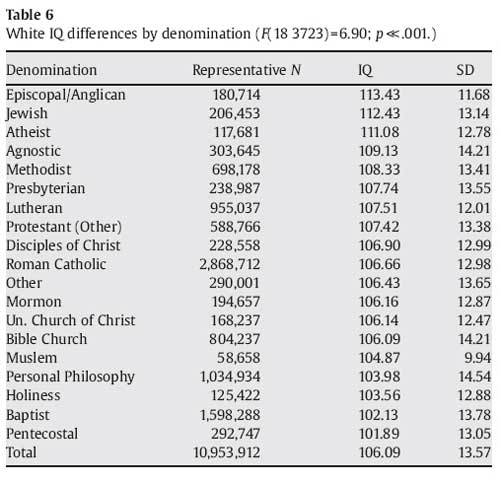
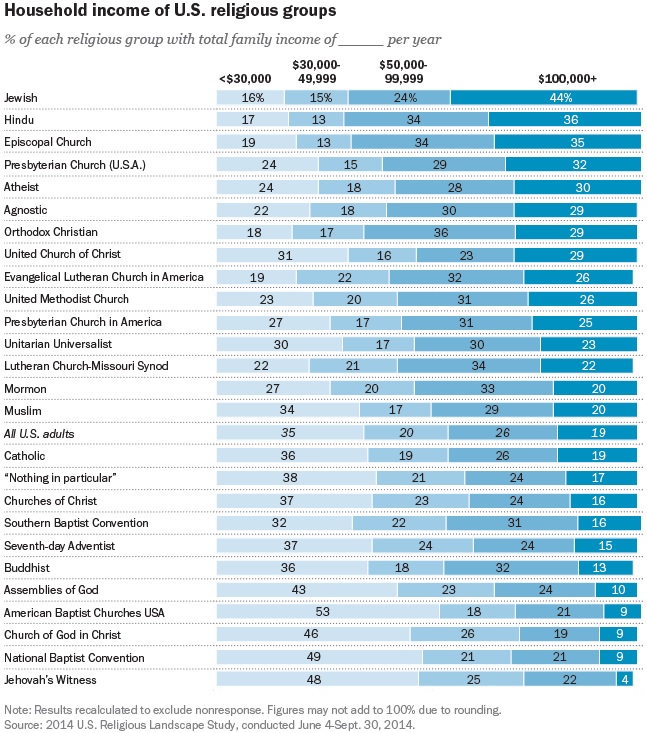
Audacious Epigone: “A paper by Helmuth Nyborg tracking white adolescents by religious denominational membership, IQ, and income by way of the NLSY, reveals that people who belong to more dogmatic religious traditions tend to be less intelligent than those who belong to more liberal traditions are, with atheists and agnostics falling on the higher-IQ end of the liberal spectrum.”
Posted in Christianity, Economics, IQ, Jews
Comments Off on Why do Jews have more wealth than Christians?