What Happened to the Hysteria About Trump-Induced Anti-Semitism?

Dennis Prager writes:

Perhaps the individual who most spread the lie of Trump-induced anti-Semitism was a previously unknown man named Steven Goldstein, executive director of the previously unknown Anne Frank Center for Mutual Respect in New York.

They became famous for a few months when the media had to trot out a Jew with an official title — and no Jewish title is as sacrosanct as one with the name Anne Frank on it.

Goldstein has publicly commented on “the cancer of Antisemitism that has infected his own Administration.” He said: “Make no mistake: The Antisemitism coming out of this Administration is the worst we have ever seen from any Administration.”

And he said to Trump, “The most vicious anti-Semites in America are looking at you and your administration as a nationalistic movement granting them permission to attack Jews, Jewish institutions and sacred Jewish sites.”

Almost as hysterical about anti-Semitism in America was Jonathan Greenblatt, the CEO of a considerably more significant Jewish institution, the Anti-Defamation League, or ADL.

As reported by the Israeli newspaper Haaretz in December, “Anti-Semitic rhetoric in the United States has reached levels unprecedented since 1930s Germany, Anti-Defamation League CEO Jonathan Greenblatt warned a gathering of Israeli lawmakers in Jerusalem on Monday.

“‘Anti-Semitism has wound its way into mainstream conversations in a manner that many Jews who lived through Nazi Germany find terrifying,’ he said at the Knesset meeting, which was convened to discuss the plight of American Jewry under the incoming Trump administration.”

(Note Haaretz’s inflammatory description, “the plight of American Jewry under the incoming Trump administration,” made six weeks before there was a Trump administration!)

Aside from fomenting hysteria about an almost nonexistent outbreak of anti-Semitism, all Greenblatt’s allusion to Nazi Germany did was diminish the evil of Nazism and the Holocaust.

In December, Greenblatt told NPR, “we found it so deeply problematic when some of the images and some of the rhetoric seemed to evoke longstanding anti-Semitic conspiracies.”

And Greenblatt repeated this charge in February in an op-ed he wrote for the Washington Post. He said: “Trump could have said he condemns anti-Semitism and takes incidents, such as the dozens of threats made to Jewish Community Centers, seriously. But instead, he lashed out against those asking the question. … Last year, we watched as the Trump campaign repeatedly tweeted and shared anti-Semitic imagery and language, allowing this poison to move from the margins into the mainstream of the public conversation.”

Well, guess what. It turned out that President Trump was entirely right: There was no eruption of anti-Semitism in America, let alone one emanating from the White House. Furthermore, “those asking the question” did indeed deserve to be “lashed out” against.

Posted in Anti-Semitism | Comments Off on What Happened to the Hysteria About Trump-Induced Anti-Semitism?

’10 Jewish LGBT Leaders You Need to Know’

The Torah describes male homosexual sex as an abomination, but non-Orthodox Jews have long been at the forefront of the “equality” movement.

From New Voices: News and Views of Campus Jews:

As double minorities, LGBT Jews are small in number but have left a profound mark on the course of history.

It’s not surprising that Jews have played a monumental role in erasing bigotry in all shapes and forms. Inherent in Jewish identity is a drive for social justice, or tikkun olam, the belief in repairing the world. From the initial battle for decriminalization and workplace protections to the fight against AIDS and the pursuit for marriage equality, LGBT Jews have been at the forefront of the equality movement.

In honor of Pride Month, here are ten influential LGBT Jewish leaders you need to know:

1. Magnus Hirschfeld

Born in 1868, the German physicist is widely regarded as the first advocate for LGBT rights. Dubbed the “Einstein of sex,” he supported in his research the validity of sexual diversity and transgender identity. In 1919, Hirschfeld co-founded the Institute for Sexual Research in Berlin where he performed the world’s first sexual reassignment surgery. The institute and its library were later destroyed in 1933 when the Nazis took control of Germany.

2. Harvey Milk

As California’s first openly gay person to hold public office, Milk quickly moved to sponsor a bill outlawing discrimination against gays and lesbians in the workplace that, when signed into law, became the most progressive such measure in U.S. history. His tragic assassination coincided with the dramatic and unprecedented emergence of gay activism during the 1970s. In 2009, he was posthumously awarded the Presidential Medal of Freedom.

4. Larry Kramer

Launching his career as an Academy Award nominated screenwriter (Women in Love) and later a Tony Award winning playwright (The Normal Heart), Kramer would become best known as the central figure in AIDS activism. Dubbed “the angriest man in America,” he channeled his firebrand style of activism to combat anti-LGBT forces and expose bigotry during the AIDS epidemic. In 1982, he co-founded GMHC (Gay Men’s Health Crisis), the nation’s first and largest HIV service organization. Then, in 1987, he founded ACT UP (AIDS Coalition to Unleash Power), a more radical group that pressured government agencies to focus on resolving the crisis. In 1988, he organized a protest in front of the FDA’s Wall Street office, blocking entrances from all sides. The incident garnered widespread media attention, resulting in hundreds of activists being arrested, but was ultimately successful in making government agencies change the way they test HIV medications.

Posted in Homosexuality, Jews | Comments Off on ’10 Jewish LGBT Leaders You Need to Know’

Do We Want The Likes Of Norman Podhoretz Running Our Culture?

Jews tend to put more value on success than other groups do. It’s not enough in much of Jewish life to just do your best. You have to succeed to be a real Jew. This pressure leads some people to take shortcuts to success. They don’t care what crap they have to pull to get ahead. It’s ugly and it creates resentment. The truly smart Jews, on the other hand, probably feel less need to cheat.

Benjamin Balint writes:

“Benjamin Balint has a Norman Podhoretz problem. He appears not to have been able to decide if Podhoretz is a good or bad hombre.” Such was the verdict of longtime Commentary contributor Joseph Epstein, in an incisive 5,000-word review of my book, Running Commentary (2010). “What Balint cannot quite make up his mind about is whether Podhoretz is a main-chancer looking to promote himself through his magazine or, instead, a man of high principle devoted to his country, to fellow Jews, and to staving off barbarians who, often during the years of his editorship of Commentary between 1960 and 1995, seemed not at but well inside the gates.” Mr. Epstein had long since made up his mind in favor of the latter view.

On the fiftieth anniversary of Making It’s publication, the New York Review Books has just reissued the first of Podhoretz’s four memoirs—the sequels being Breaking Ranks (1979); Ex-Friends (1999); and My Love Affair with America (2000). The occasion not only compels a reassessment of the book and its author, now 87 years old, but also presents me with a chance to offer Mr. Epstein a reply.

Equal parts memoir and polemic, Making It is not a success story tranquilly recollected, but, according to its author, “a frank, Mailer-like bid for literary distinction, fame, and money all in one package.” It is a study in careerism, in the unabashed pursuit of ambition and esteem, and in the contradictions inherent in that pursuit. Podhoretz writes:

On the one hand, our culture teaches us to shape our lives in accordance with the hunger for worldly things; on the other hand, it spitefully contrives to make us ashamed of the presence of those hungers in ourselves and to deprive us as far as possible of any pleasure in their satisfaction. Nothing, I believe, defines the spiritual character of American life more saliently than this contradiction…. I may perhaps lay claim to a particularly good vantage point from which to report on how the two warring American attitudes toward the pursuit of success are likely to reveal themselves concretely in the details of an individual career.

Podhoretz focuses on those elites who frown on brash ambitiousness as something tasteless and tawdry: “People capable of the most brutal honesty in other areas would at the mention of the word success suddenly lift their eyes up to the heavens and begin chanting the most horrendous pieties imaginable.” In response to their hypocrisy, he recounts his appetite for fame and money, for power and position, for “the perquisites of rank,” as he says—the chief aims and rewards of worldly ambition.

Podhoretz opens his account in Brownsville, Brooklyn. As a son of Yiddish-speaking immigrants (a “filthy little slum child”), but also “a boy of literary bent” driven by “the vulgar desire to rise above the class into which I was born,” he was preoccupied with gaining approval and embraced the role of teacher’s pet. Winning a Columbia College (class of 1950) scholarship, he sat at the feet of Lionel Trilling, the first Jew in the English department. Here the young man discovered the “life of the mind,” and what Trilling called “the bloody crossroads where literature and politics meet.” As a Fulbright Scholar and a Kellett Fellow, he attended Clare College, Cambridge, where he studied with the combative British literary critic F.R. Leavis, founding editor of Scrutiny. “Studied” is perhaps too neutral a word: the disciple learned “how to respond in terms of [Leavis’s] temperament, to think in terms of his categories, to judge in terms of his values.”

After a two-year stint in the U.S. Army—“a world built to all my weaknesses and not a single one of my strengths”—Podhoretz gained entree to the New Yorker and the Partisan Review, the highbrow journal founded in 1934 that married Marxism to literary modernism.

Partisan Review was the arbiter and embodiment of intellectual sophistication, and the New Yorker was the arbiter and embodiment of worldly sophistication. I was therefore presumed, even by people who had never read a word I had written, to be uniquely endowed with both—and the more so as I had with such rapidity and apparent ease moved into the pages of both magazines.

In early 1960, aged thirty, the “young man from the provinces” (Trilling’s phrase )—or in this case from the outer boroughs—took over Commentary’s editorship. Recalling this experience gives rise to some of the memoir’s best passages:

“It was as though I had been editing manuscripts all my life in the Commentary way; it was as though the peculiar pleasure of getting inside someone else’s mind, and yet managing to keep a firm enough hold on one’s critical sense to prevent oneself from being swallowed up by that other mind once inside, had been a lifetime craving of my soul which had at long last found its object and been satisfied.”

And yet even in his thirties, a self-confessed “childish desire for everyone to love me” never quite left him. “I could not bear the idea of not being great,” he admits. Podhoretz craved invitations to parties for Partisan Review, the Congress for Cultural Freedom, and Random House; to Hannah Arendt’s New Year’s Eve soirees; to Mary McCarthy’s Upper East Side gatherings; to Park Avenue salons. These parties, where literary celebrities mixed with “beautifully begowned women,” he says, “served as a barometer of the progress of my career.”

Elsewhere in the book, Podhoretz shifts metaphors:

“Every morning, a stock-market report on reputation comes out in New York. It is invisible, but those who have eyes to see can read it. Did so-and-so have dinner at Jacqueline Kennedy’s apartment last night? Up five points. Was so-and-so not invited by the Lowells to meet the latest visiting Russian poet? Down one-eighth. Did so-and-so’s book get nominated for the National Book Award? Up two and five-eighths. Did Partisan Review neglect to ask so-and-so to participate in a symposium? Down two.”

Podhoretz published his first book Doings and Undoings in 1964, a collection of appraisals of the Beat Generation, covering “the Negro problem,” Saul Bellow (“perhaps the greatest virtuoso of language the novel has seen since Joyce”), Hannah Arendt, Edmund Wilson, Mary McCarthy, Norman Mailer, and others. Doings and Undoings was his attempt “to be a critic of the contemporary rather than a browser among masterpieces or a reverent.” In Making It, he reports on the high hopes he had set on this collection of essays: “I had been dreaming that the appearance of the book would become the occasion for a general proclamation of my appointment to the office of ‘leading young critic in America.’”

The qualities that Norman Podhoretz embodies are quite different from the Anglo-Saxon ideal (the major Jewish cultural contribution to America has been the overthrow of Anglo-Saxon rule). They are quite different from the norms of Orthodox Judaism. They are quite different from the norms of any religion or spiritual path of which I am aware. Perhaps it is Norman’s nihilism that accounts for the overall uselessness of his work (with exceptions such as his essay “My Negro Problem – And Ours“).

Incidentally, statistically speaking, Jews are less nihilistic than the gentiles around them.

All minority groups are likely to hold a burn against the majority, particularly if there is a religious dispute. Social identity theory holds that the more we identify with our group, the more likely we are to have hostile feelings towards out-groups. That means that as long as Jews or Muslims maintain their identity in the West, they are likely to have negative feelings towards the majority. They may well speak the language of the majority, learn his history and culture, and use his modes of dress, but they won’t forget that inside they are different and superior. Every group thinks it is the center of the universe and looks at the world in ways in which their own superiority is constantly confirmed. If the minority group has a higher average IQ and cohesion than the majority, they will in certain times and ways, become the master of the majority group.

Martin Heidegger wrote: “To appropriate ‘culture’ as a means of power and thus to assert oneself and affect a superiority is at bottom Jewish behavior. What follows from this for cultural politics as such?”

The great thing about being an Orthodox Jew is that you know who you are. You have your own culture. You don’t need the goyim’s. You’re not a Norman Podhoretz. You have a specific identity and are consequently not as dependent on your wider social status to give you meaning in life. Your status as an Orthodox Jew comes from your place within the Orthodox community.

Tom Wolfe’s 1975 book, The Painted Word, examined art criticism.

Wikipedia:

Wolfe’s thesis in The Painted Word was that by the 1970s, modern art had moved away from being a visual experience, and more often was an illustration of art critics’ theories. Wolfe criticized avant-garde art, Andy Warhol, Willem de Kooning and Jackson Pollock. The main target of Wolfe’s book, however, was not so much the artists, as the critics. In particular, Wolfe criticized three prominent art critics whom he dubbed the kings of “Cultureburg”: Clement Greenberg, Harold Rosenberg and Leo Steinberg. Wolfe argued that these three men were dominating the world of art with their theories and that, unlike the world of literature in which anyone can buy a book, the art world was controlled by an insular circle of rich collectors, museums and critics with outsized influence.[1]

Wolfe provides his own history of what he sees as the devolution of modern art. He summarized that history: “In the beginning we got rid of nineteenth-century storybook realism. Then we got rid of representational objects. Then we got rid of the third dimension altogether and got really flat (Abstract Expressionism). Then we got rid of airiness, brushstrokes, most of the paint, and the last viruses of drawing and complicated designs”. After providing examples of other techniques and the schools that abandoned them, Wolfe concluded with Conceptual Art: “…there, at last, it was! No more realism, no more representation objects, no more lines, colors, forms, and contours, no more pigments, no more brushstrokes. …Art made its final flight, climbed higher and higher in an ever-decreasing tighter-turning spiral until… it disappeared up its own fundamental aperture… and came out the other side as Art Theory!… Art Theory pure and simple, words on a page, literature undefiled by vision… late twentieth-century Modern Art was about to fulfill its destiny, which was: to become nothing less than Literature pure and simple”.

Wolfe argues that parvenu Jews have destroyed modern art.

Heidegger attributes to Judaism the “principle of destruction.” I think he is correct. Judaism came into being denying the false gods of the ancient world and Jews to the present continue to degrade and deny what the goyim worship. Sometimes Jews offer worthy alternatives to the deities of the goyim, sometimes they don’t.

Douglas Rushkoff, author of Nothing Sacred: The Truth About Judaism, says: “The thing that makes Judaism dangerous to everybody, to every race, to every nation, to every idea, is that we smash things that aren’t true. We don’t believe in the boundaries of nation states, we don’t believe in these ideas of individual gods that protect individual people, these are all artificial constructions and Judaism really teaches us how to see that. In a sense, our detractors have us right in that we are a corrosive force, we’re breaking down the false gods of all nations and all people because they’re not real and that’s very upsetting to people.”

Posted in America, Art, Commentary Mag, Jews | Comments Off on Do We Want The Likes Of Norman Podhoretz Running Our Culture?

Politics & The Clergy

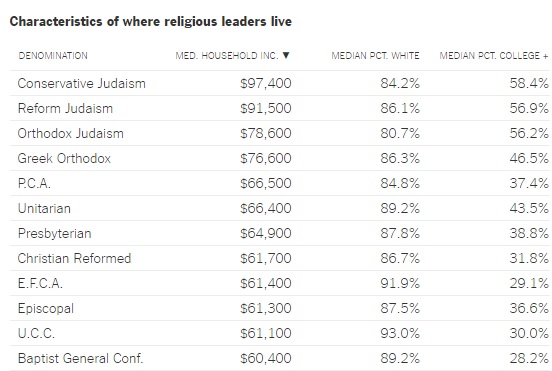
More than any other group of clergy, rabbis choose to live in white neighborhoods.

Orthodox rabbis are apparently split between Democrat and Republican.

Posted in Politics, Rabbis | Comments Off on Politics & The Clergy

The world’s ten best selling English language authors

Comments: However, here’s a list of the world’s ten best selling English language authors.

Agatha Christie – English
William Shakespeare – English
Barbara Cartland – English
Danielle Steel – Half Jewish Half Portuguese
Harold Robbins – Jewish
Sidney Sheldon – Jewish
Enid Blyton – English
J. K. Rowling – English, minor French ancestry
Dr. Suess – German American
Gilbert Patten – English American

So 2.5 of the top 10 indicates a lot of ability to write what the public wants to buy. Also on the list are #11 Jackie Collins (half Jewish/half English), #13 R.L. Stine (Midwestern Jewish), #23 Stan and Jan Berenstain (Jewish-American husband and English-American wife, raised their children Jewish).

* Never understood the appeal of this author. Portnoy’s Complaint is just about an extremely whiny, nebbishy Jewish guy who masterbates too much and drones on forever about his psychological complexes.

* Unfortunately, that does explain his “appeal.” Jews control a large portion of the Megaphone, and did even back when Roth was starting out. Roth’s works appealed to them, as he was a “voice” of Jewish-Americans of that period. They thus promoted the turd out of him, and shoved him down the throats of others until he became a standard contemporary “great” author.

As Steve explained, this is rather similar to how The Graduate became a hit: Jews in New York and LA kept going to screenings, keeping it theaters, until gradually it was talked up to goys and became a hit, although the Jewishness, as Steve has noted, was downplayed to goys, and the “Generation Gap”/Baby Boomer aspects were uptalked.

The quite open Freudian nature of Portnoy’s Complaint makes it rather laughable to anyone not in the Freudian cult, and hence it hasn’t aged well. However, the Jewish obsession with sex, assimilation, their mothers, and shiksa women remains, so many young Jews can still pick it up and be enthralled by how much he “gets” them.

Much of Roth’s work is really insular to Jews, and it’s rather funny to think of him as anything other than a niche author. I was forced to read Goodbye, Columbus in high school and couldn’t find a bit of it to relate to. I realize why now: Roth’s work doesn’t even attempt to explain to outsiders the assimilation-with-American-goys Jews were obsessed with, and merely assumes you know what he’s talking about as he writes. Since that’s the major theme and metaphor of the book, it doesn’t resonate with non-Jews.

Reading Goodbye, Columbus was rather like reading a story about space travel where it’s assumed you know all the mathematics and physics and historical theories behind launching a rocket and is really obsessed with faster escape velocity theories in detail; it’s going to go over the heads of most readers unless you skillfully get them up to speed.

Broadly, if you’re ever puzzled why certain artists are extolled despite rather mundane outputs and low popularity, check if the reviewers extolling the artists share some sort of personal/ethnic connection with the artist. This rather explains why a lowly-rated, badly-written show like Girls got so much press: lots of ugly twenty-something and thirty-something Jewish American female critics living or from Brooklyn liked Lena Dunham’s depiction of fat, ugly Jewish broad having meaningless sex in Brooklyn.

* I have to laugh at whoever said Jews aren’t good at writing fiction. They punch so far above their weight that it’s not funny. Heller, Bellow, Roth, Salinger, Potok, Wiesel. Popular writers like Asimov, Ephron, Sendak, and Maria Doria Russell. Name me a genre and I can find you a zillion successful writers.

Compare their output to Mormons, and see what you get.

* You could also throw in highbrows like Bernard Malamud, Norman Mailer and Paul Auster if you like, plus more popular writers like William Goldman, Ira Levin, Leon Uris, Herman Wouk, and Irwin Shaw. In science fiction I particularly liked Alfred Bester, but there are loads of others. Lots of great children’s books, too; The Giving Tree is a heartbreaker.

* I would add to this, the case of Lenny Bruce. I never understood his status until I understood how Jews regard themselves vis-a-via the goyim. Watch videos of Bruce. He wasn’t funny, not in the way, say, similar lefty Jewish comics of the era were–e.g. Mort Sahl, Jackie Mason. What he was, was a Jewish martyr. What Jews (and their subordinate goys who mimic them) love about him is his subversiveness. To paraphrase Malcolm X, telling the WASP, and his Institutions, to his face just what he thinks of him and his hypocritical 1950s American values. This made him a hero to similarly adverse, highly self-identified Jews like Woody Allen and Howard Stern. Norman Mailer whose writing I do admire, was similar. He sent a copy of The White Negro to William Faulkner and Faulkner told him he needed to see a psychiatrist. Not coincidentally, Bruce, Mailer, Stern and Allen were all sexual degenerates very much into degrading the shiksa!

* “Goodbye, Columbus” makes a lot more sense if you read it as someone who throws away a relationship with a beautiful woman from a prosperous family–a family that welcomes him, instead of rejecting him as an outsider–because it wouldn’t allow him to feel like a victim anymore.

See the movie. Ali MacGraw’s Brenda may be spoiled, but she genuinely cares about him and he could influence her if he took the trouble. What he’s really afraid of is that HE will be the one to be influenced and assimilated.

Posted in Books | Comments Off on The world’s ten best selling English language authors

Forever Pure – Beitar Jerusalem

Published on Apr 16, 2017: “Documentary which follows events at Israel’s most notorious football club. Beitar Jerusalem FC is the most popular team in Israel and the only club in the Premier League never to sign an Arab player. Midway through a season the club’s owner, Russian-Israeli oligarch Arcadi Gaydamak, brought in two Muslim players from Chechnya in a secretive transfer deal that triggered the most racist campaign in Israeli sport and sent the club spiraling out of control.

Forever Pure follows the famous football club through the tumultuous season, as power, money and politics fuel a crisis and shows how racism is destroying both the team and society from within.”

Hollywood Reporter:

In 2008, Russian oligarch Arcadi Gaydamak was hoping to become the new mayor of Jerusalem. His ownership of Beitar, secured a few years earlier, could potentially have been used as a campaigning tool but Gaydamak finally received just a few percent of the votes. Zinshtein’s on-camera interviews with the oligarch, who barely seems to speak any Hebrew, are chilling to behold, as the man has no problems in admitting what his plans were.

What is less directly addressed, but nonetheless suggested through the expert editing credited to Justine Wright and Noam Amit, is how the owner’s political defeat is related to his decision to bring on board to young Chechen players for the 2012-13 season. Foreign players aren’t unusual in Israeli soccer — and indeed Beitar already had a player from Latin America — but Gaydamak’s unexpected move was a shock for the core group of Beitar fans, known as the Familia. They pride themselves on the fact that their club is the only national soccer team that has never signed an Arab player — the film’s title is their proud chant that underlines the club’s “racial purity” — and they are now confronted with not one but two Muslim players at once. A form of revenge? Possibly. A way to thoroughly agitate Israeli sports and society at large? Certainly.

Zinshtein’s film intelligently dissects the many contradictions at play here, starting with the fact that it is absolutely shocking that Israelis, just a couple of generations after the Holocaust, want to pride themselves on any kind of racial purity to the explicit exclusion of others. The way in which different things get conflated — “Muslim” and “Arab” are two distinctly different things and Chechens are Muslims but definitely not Arabs — so they can be boiled down into angry and hateful rallying cries is a tragic and recurring theme.

It is shocking to see how the core group of supporters manages to turn the legions of fans against the club they profess to love so much. And all this only because of the arrival of two largely innocent pawns, 19-year-old Dzhabrail Kadiyev and 23-year-old Zaur Sadayev, the devoutly religious Chechen players who clearly had no clue what they were in for. (One of the film’s best scenes shows them holed up in their hotel room, like caged animals unable to understand what’s going on around them.)

The supporters’ loudly voiced anger and incitements to hatred finally result not only in practically empty stadiums but also physical threats and completely demotivated players.

Variety:

When Arcadi Gaydamak, the Russian billionaire owner of the Israeli soccer team Beitar Jerusalem, known for being the only team in the league without Arab players, hires two Chechen Muslims in the middle of the 2012-’13 season, it sparks a catastrophic battle between the team leadership and its right-wing, extreme nationalist fan base. Granted amazing access to all parties in the story, producer-director Maya Zinshtein, a Russian-born investigative journalist, smartly places her shocking portrait of a team and its fans in a broader sociopolitical context, allowing it to surpass its token subject matter and explore issues such as racism and mob rule. Indeed, it provides a cautionary tale for countries like the U.S., where politicians have failed to thoroughly condemn hate speech. Loaded with stranger-than-fiction incident, this documentary should find robust festival play before seguing into international broadcast.

Zinshtein opens with a brief history of the team, founded in 1936 and one of the Israel Premier League’s most controversial because of its multitude of outspoken fans who provide the players with plenty of love, but who also incur penalties for the team because of their bad behavior in the stands. Traditionally the team of choice for those from lower socioeconomic backgrounds and Jews descended from communities in the Middle East, it is also known for a supporter’s group called La Familia that took over the eastern bleachers in Beitar’s Teddy Stadium back in 2005 and became notorious for chants that insult Arab players. The film’s title, “Forever Pure,” comes from a logo on one of their banners…

The members of La Familia take pride in being the most racist fans in the league and are able to instigate a boycott of the stadium. Certainly their absence seems preferable to their return when they boo their own team, fight with its new players, and threaten to kill the chairman.

Posted in Israel | Comments Off on Forever Pure – Beitar Jerusalem

Parasha Shelach (Numbers 13-15)

This week’s Torah portion covers the 12 spies sent in to the land of Israel, ten of whom come back with negative reports.

Listen here.

* We don’t see the world as it is. We see the world as we are. Didn’t God and Moshe know who they were sending out to spy on the land? If they knew they were sending fearful people, they should expect a fearful report.

* It was weird that Moses sent tribal leaders rather than trained spies. The mission was doomed from the start. In Josh. 2:1, Joshua sends two trained spies to scout out Jericho.

* Yes, I am sure Russia spies on America and tries to interfere in American affairs, just as America spies on other countries and interferes in their affairs. Spying on competitors is just how the world works. I’m not outraged when foreigners spy on America and try to hack into our databases. I know we do the same thing to them. Life is war. If you’ve got something good, other people will try to take it.

* If only there were some clues, some coded hints in appearance, that let you know who was different and therefore likely had different interests. Did these Hebrew spies have any morphological differences from the natives in the land and therefore did the natives know that it was ok to fear people who look different? Or were the Canaanites living under some terrifying form of political correctness that condemned noticing patterns?

* Nature has color-coded people for our advantage. A wise man notices patterns.

* LAT: “A grim pattern in European attacks: Missed chances to pinpoint terrorism suspects beforehand

* WP: “In Duterte’s home town, martial law is wildly popular — the selfies prove it”

* John J. Mearsheimer recommends that America do everything it can to slow the rise of China (including the removal of all Chinese students studying in America), because the more relatively powerful China gets, the more it will flex its muscles to push us out of its zones of influence.

* The Alt Right case for ISIS.

* Num. 13:32: A land that devours its people. Jacob Milgrom: “Thus this idiom can only mean that the nature of the land is such that it will perpetually keeps its inhabitants at war, perhaps a reflection of the geopolitical position of Canaan as a land bridge whose city-states were either fighting each other or stemming invasion fro Asia or Africa.” Wherever Jews go in the world, there is this perception that they tend to increase social tensions and division and multi-culturalism.

* Nobody can read the Torah and regard the Israelites as impressive. In Num 14:1: “They wept that night.” Num. 14:4: “They said to one another, “Let us appoint a leader and let us return to Egypt!” Is there any other people or religion that has a sacred text that makes their own group look so bad? I can’t think of one.

Stoicism is not typically a trait one associates with Middle Eastern peoples. They tend to be more emotional than Northern Europeans and they tend to have less shame about using their emotions to try to manipulate a competitor just as women tend to have less compunction about using emotional manipulation than do men.

* “Let us return to Egypt.” As a chronic under-earner, I’ve often preferred to return to under-earning jobs and abusive relationships because they were familiar. The older I get, the more I like routine. We have a profound affect on how other people treat us. If we’re willing to sell ourselves short, there will be no end of takers. I have friends who have noted to me that when it comes to interacting with others, I’m not flexible. I need to have things my way. That isolates me. It’s a reaction to growing up in foster care. Routine gives me a feeling of safety. The Israelites seem to have PTSD. They seem like losers. There wasn’t PTSD until that diagnosis was made popular, then large numbers of people had PTSD.

* I’ve never dated a woman above an 8. I just felt that 9s and above were out of my league. On the other hand, a GF who was a 6 asked me, “Why do you keep trying to date women who are out of your league?”

* Num. 14:5: “Moses and Aaron fell on their face before the entire congregation…” Can you imagine Winston Churchill or Charles DeGaulle or Adolf Hitler doing this?

* Num. 14: 11-20. Moshe manipulates God with an emotional appeal. How do you prefer to think about God? Through dogmatic theology or through stories? Christianity emphasizes theology, Judaism emphasizes stories.

* Num. 14:34. God sounds like Donald Trump: “Thus you shall know what it means to thwart me.”

* Num. 15:16. One law for everyone. But this will only work if the people are homogeneous. If the people are diverse, they will chafe against the law. Some will find it too strict, others too loose. If America is to have one law, it will be the white man’s law and other peoples will hate it.

* Num. 15:32-36. They find a man gathering wood on the Sabbath and they put him to death. This is an army on the march. They need discipline. The Torah is not libertarian.

Published on Apr 16, 2017: “Documentary which follows events at Israel’s most notorious football club. Beitar Jerusalem FC is the most popular team in Israel and the only club in the Premier League never to sign an Arab player. Midway through a season the club’s owner, Russian-Israeli oligarch Arcadi Gaydamak, brought in two Muslim players from Chechnya in a secretive transfer deal that triggered the most racist campaign in Israeli sport and sent the club spiraling out of control.

Forever Pure follows the famous football club through the tumultuous season, as power, money and politics fuel a crisis and shows how racism is destroying both the team and society from within.”

Posted in Torah | Comments Off on Parasha Shelach (Numbers 13-15)

Trump’s Judicial Picks Are Keeping Republicans Happy—and Quiet

The New Republic:

In a rare show of competency, he’s tapped five times as many judges as Obama had at this point—and conservatives are delighted.

The most critical government document released on Wednesday—the one that’ll have the most wide-ranging impact in the future—was not James Comey’s prepared testimony for the Senate Intelligence Committee about his interactions with Donald Trump. It was a simple press release, issued by the White House, announcing a “fourth wave” of judicial nominations since the Trump inauguration. The eleven nominations included four district court judgeships, three for the U.S. Circuit Court of Appeals, three for the Court of Appeals for Veterans Claims, and one for the Court of Federal Claims. Conservatives were uniformly delighted.

All told, Trump has nominated 22 judges to fill vacancies across the federal bench. Thus far, only two—Supreme Court Justice Neil Gorsuch and Sixth Circuit Court Judge Amul Thapar—have been confirmed. But the prospect of filling vacancies over time explains a lot about why congressional Republicans have stood by Trump, despite the erratic and stormy start to his presidency. As long as Trump keeps funneling a steady supply of conservative jurists to the Senate, in a bid to dramatically reshape the federal courts, Republicans can go to bed happy that they’re fulfilling at least one major element of their political project.

Judicial nominations are the one area where the Trump administration is “running like a fine-tuned machine,” as the president boasted in February. In fact, Trump’s team has far outstripped the efforts of his predecessor. By this date eight years ago, President Obama had made just four judicial nominations: Supreme Court Justice Sonia Sotomayor, and three nominations for the Court of Appeals.

Posted in America | Comments Off on Trump’s Judicial Picks Are Keeping Republicans Happy—and Quiet

57yo Australian Conservative Pundit Andrew Bolt Fights Back Against Antifa

Comments at Steve Sailer:

* Some background on Bolt for the benefit of Steve’s readers:

Bolt is one of Australia’s best-known conservative commentators, and the most prominent in Melbourne. No other commentator is excoriated as much by the SJW left and its MSM enablers. It is therefore no surprise that leftist thugs would want to target him in particular.

A few years ago, Bolt was sued under a notorious law (section 18C of the Racial Discrimination Act, which operates much like section 13 did in Canada until Mark Steyn succeeded in getting it repealed) for two newspaper columns he wrote. In them he exposed the racket whereby middle-class individuals with small amounts of Aboriginal ancestry manage to win large numbers of government grants and jobs reserved for Aboriginal people, supposedly to compensate for their entrenched poverty and disadvantage.

Bolt lost the case due largely to the judge, a creature of the leftist political machine in this city, who perversely interpreted Bolt’s comments in a way that enabled them to be found in breach of section 18C.

While Bolt is understandably bitter about the case, he hasn’t slowed in his efforts to expose the hypocrisies and lies of the left, and champion conservative values. He is particularly concerned about the Muslim and African influx which has led to instances of terrorism and an endless wave of serious crime.

I long knew of his moral courage, but the physical courage he showed in the face of this attack on a Melbourne street is a revelation.

* Andrew Bolt’s masterful counter-attack starting at 40 seconds into the video must be taught as a fighting method. The Bolt Method was great. Bolt first pushed the first masked anti-free speech scumbag out of the way while preparing to deal with the other. This created the necessary torque in the torso to deliver a straight jab right to the face of the second masked anti-free speech scumbag.

Antipodean Andrew Bolt has had enough of the anti-free speech dirtbags. Bolt has made all Australia proud. I don’t know nothing of Bolt nor his politics, I don’t care. Bolt was sneakily attacked while his back was turned by masked anti-free speech rats. Andrew Bolt fought back brilliantly.

Bolt now begins the pushback period for Western Civilization. The masked anti-free speech rats have gone too far. Boltism in Australia is now combining with Based Stick Manism in the United States to form a new resistance to anti-free speech tyranny.

* Who took the video of the attack on Andrew Bolt? It opens with Bolt being attacked from behind, then shows him brawling with the masked men, successfully fighting back, one-against-two. Then a bystander shows up, and the assailants run down the sidewalk.

An accomplice must have filmed the incident, then posted the video on Facebook. But it sure paints Bolt as brave and effective, while his two (three) attackers start off by looking cowardly, and then graduate to weak.

Presumably this is antifa virtue signalling (“some of our family in solidarity were attacked by Andrew Bolt while they were protesting today”). They must see things somewhat differently than an outsider like me.

* There is no Second Amendment in Australia, or most other Western Countries… the Left controls the governments and self-defense is a crime in many jurisdictions, so the Left owns the streets.

Unfortunately, the same is pretty much true in ultra-leftist American cities like New York, D.C., and San Francisco.

Places where Second Amendment rights are ironclad (e.g., West Virginia, Indiana, Oklahoma, Arizona) don’t have any antifa problems whatsoever.

* The old cuckish Right couldn’t stand up to these Thugs.

Now the Right is getting a testosterone boost. One punch in self-defense and these clowns scatter.

* I live in rural Oklahoma and almost every person I know is armed. When a white police officer in Tulsa was recently acquitted after killing a black man there was some whining, but no street violence.

White men in Oklahoma (with the exception of a few hipster and yuppie enclaves in Tulsa and OKC) are still a pretty rough bunch. Nothing like the effete pansies I see portrayed in virtually every tv program or commercial I see.

* I’m from Seattle, and for years I watched these guys get away with all sorts of crimes. The only lefties who get treated with a rough hand are those who actually threaten the institutions that provide these cities with money and power. For example, a few leftist environmentalists sabotaged a biotech lab at the University of Washington about 15 years ago, and they got hammered. Every single one of them was picked up and prosecuted. One is still in prison, and another suffocated himself while in federal detention. This happened because the UW is Seatttle’s single largest employer and the largest recipient of tax funds in the state of Washington. If these guys had simply rioted and smashed up a bunch of franchises run by small businessmen the city would have looked the other way.

Given that white people who so much as verbally threaten blacks get up to 20 years in the slammer, you’d think the antifas who routinely violate people’s civil rights with actual criminal violence could at least spend a couple years behind bars, but it doesn’t happen. It’s obvious that Democrats have neither any interest in nor desire for prosecution if the victims are not clearly on their side.

Posted in Australia | Comments Off on 57yo Australian Conservative Pundit Andrew Bolt Fights Back Against Antifa

Jews are not nihilists

Audacious Epigone: On their most recent podcast, Kevins Grace and Steel asserted, in the context of a long discussion on George Soros, that Jews are particularly nihilistic.

If so, they sure are diligent, deliberate, and effortful in attaining meaningless worldly success. Come to think of it, Kefka’s character was based in large part on Soros!

The percentage who “strongly disagree” with the statement “In my opinion, life does not serve any purpose”, by religious identification (n = 3,756):

Generally belief in God and nihilism are inversely correlated but irreligious Jews are less nihilistic than religious goys are. So the GSS results are in line with that assertion.

COMMENTS:

* And that’s why Jews are so overwhelmingly represented in idealistic/outright utopian social/political movements. “Humanism” is mostly disdained by real conservatives, and hell, in the most gentile friendly wing of Leftism (Gaia), there is often animosity towards people for taking a dump on nature.

Gentiles are more likely to believe in limits to human ability and understanding; as is now depressingly obvious, cucks for the last 30-40 years have driven from influence grouchy paleos who believe that liberal elite driven intervention in both domestic and foreign affairs is bound to fail due to it’s ignorance of human nature and potential.

The highest IQ people (e.g., Jews), especially the most verbally oriented ones (e.g., Jews) are better at fooling themselves and the a lot of other people that one should be dedicated to the goal of “getting involved” so as to feel better about their sense of purpose in life.

I would think that proles and less verbally oriented groups don’t hear as much utopian blather so they’re more concerned with the nuts and bolts of day to day survival than they are with lofty socio-political goals. In other words, paying bills and not having my car or house get broken into are more important than gaining social status by spouting the most Marxist feel good crap possible.

And go figure, modern Protestants have cucked hard for Jews and also have been heavily involved in Neo-Conjobs. Prots are more involved in paranoid culture regarding good works to be done so that one can be saved in the Second Coming than are Catholics and of course, non-believers. Jews consider high social status among liberal elites to be their savior.

Derbyshire said some years back that conservatives started to falter when they ran from their pessimistic streak, making them susceptible to the kind of naive dreaming that should stick with the liberals where it belongs.

Attributing these problems to a knowing Jewish conspiracy to crap on everything is not something I necessarily agree with. I think the uniquely pernicious Jewish skill set of high IQ and high verbal orientation allows them to weave dense webs of pollyanna sophistry regarding human potential. And, as is often pointed out, if Jews really understood what they were doing, then they sure as hell would not want Muslims anywhere near them. Yet they insist on flooding Jew friendly Western countries with ethnic groups who detest Jews.

Posted in Jews | Comments Off on Jews are not nihilists