Extemporaneous Blending: Conceptual Integration in Humorous Discourse from Talk Radio

Cognitive Science professor Seana Coulson writes in 2005:

* When speakers produce language, listeners use that linguistic input along with background and contextual knowledge to set up simple cognitive models in mental spaces (Coulson, Semantic Leaps). Similarly, when people look at cartoons, or, indeed, the events of the world, they partition the input into different mental spaces, each structured by cognitive models from a relevant domain.

* Presumably, it is no accident that frame blends were first noticed in the context of humorous examples. The possibility of creating novel concepts from familiar ones is obviously conducive to humor. As Arthur Koestler writes: “To cause surprise the humorist must have a modicum of originality—the ability to break away from the stereotyped routines of thought. Caricaturist, satirist, the writer of nonsense-humour, and even the expert tickler, each operates on more than one plane. Whether his purpose is to convey a social message, or merely to entertain, he must provide mental jolts, caused by the collision of incompatible matrices. To any given situation or subject he must conjure up an appropriate—or appropriately inappropriate—intruder which will provide the jolt.”

* In a study of political cartoons, I have noted that blending is frequently used to project a modern-day politician into a ridiculous scenario that helps illustrate the cartoonist’s political position (“What’s”). For example, during the sex scandal that led to former U.S. President Bill Clinton’s impeachment, a cartoon by Jeff MacNelly depicted Clinton in a scene that most Americans associate with eighteenth-century President George Washington. Legend has it that when George Washington was a boy, he chopped down a cherry tree on his father’s farm. When his father discovered what had happened, he went, furiously, to his family and demanded to know who had chopped down the tree. Knowing that he would likely receive a spanking for his honesty, Washington stood up and said, “I cannot tell a lie. It was I who chopped down the cherry tree.” In the cartoon we see a toppled tree and Clinton, dressed in Colonial garb, wielding an electric chainsaw. He says, “When I denied chopping down the cherry tree I was legally accurate.” The use of blended structure in the cartoon thus highlights the disanalogy between public perception of Washington as honest to a fault and Clinton as someone who had appropriated legalistic tactics to deceive those around him.

* To address the use of conceptual integration in conversational jokes, an excerpt from the syndicated radio talk show Loveline is analysed below. The show, based in Los Angeles, encourages its listeners to phone the radio station to ask questions about sex, drugs, and relationships. The show has two hosts, Dr. Drew, a board certified physician who specializes in treating patients with drug addiction, and Adam Carolla, a comedian known for lowbrow humor. The show frequently has celebrity guests, such as actors and musicians, whom the hosts interview when there is a lull in the calls. The bulk of the show, however, consists of conversations between the hosts and their callers, as well as conversations between the hosts themselves, in which they make fun of their callers’ problems. Columnist Marc Fisher described the show in his column “The Listener” in the Washington Post: “A comedian, Adam Carolla, and an actual physician, Drew Pinsky, sit in the studio, trying to be unbelievably cool. Virtually anything goes in their moral universe. They talk about their own experiences with drugs and sex. They get serious when confronted with potential suicides, domestic abuse or fools having unprotected sex. But kids who want to know about which drugs to mix, young people boasting about their experience with threesomes and more, men and women looking for approval for promiscuity—all get a condoning, even celebratory welcome. Carolla is not above the occasional rape joke. And “Dr. Drew” seems to get his kicks out of young people describing their artificial ecstasies.”

The excerpt analyzed below comes from an episode of Loveline that aired live on 20 February 2002. The caller, a teenaged boy, after describing a sexual encounter he had, has asked the doctor if he might be suffering from a medical problem. The caller claims to have had two orgasms in a row during oral sex with his girlfriend. The somewhat incredulous hosts’ subsequent discussion of the boy’s experience runs as follows:
[1] Adam: Well listen, the Lord was kind to you that day.
[2] Dr. Drew: He spoke directly to him.
[3] Adam: Drew, do you think anything’s wrong with the guy?
[4] Dr. Drew: No, no, no.
[5] Adam: Well listen just enjoy it.
[6] It happened to you once.
[7] It’ll be like some sort of a Holy Grail you chase for the rest of your life.
[8] But y’know count yourself among the blest.
[9] It happened to you once and that’s more than it’s happened to me.
[10] Dr. Drew: Well this could be some kind of a Purgatory,
[11] sort of a Sisyphus like [pause]
[12] constantly trying to recreate that and
[13] never quite achieving it.
[14] Adam: It is sort of a strange thing that
[15] you have this incredible sort of never–ending orgasm once and then
[16] end up chasing it like it was Moby Dick for the rest of your life.
Even the most cursory reading of the transcript suggests that the hosts’ humor relies heavily on conceptual blending, as the caller’s sexual experience is construed with frames and cultural models that originate in religion, mythology, and literature. For example, in (1), Adam compares the boy’s second orgasm to a miracle bestowed by God. The mappings in this blend are outlined in table 3. In the generic miracle input, God bestows a miracle on a faithful member of his flock. Of course the precise characterization of the miracle differs from occasion to occasion. Famous miracles in Christian lore include turning water into wine, walking on water, and raising a man from the dead. The composition of the orgasm from the sex input with the miracle from the miracle input is part of what makes Adam’s comment in (1) funny. Moreover, hyperbolically framing the orgasm as an
act of God subtly conveys Adam’s skepticism about the boy’s story.

In (2), Dr. Drew expands on Adam’s joke about God by saying, “He spoke directly to him.” Again, the alleged experience is understood by blending a cognitive model of the boy’s sexual encounter with a model of God speaking to a faithful follower. Just as a miracle is construed as an unlikely occurrence, so too is an occasion of God speaking to a follower. In the Bible, God speaks audibly only to prophets such as Moses and saints such as Paul. By framing the caller as the recipient of a message from God, Drew somewhat ironically implies that the boy
has saintly properties that caused him to be singled out in this fashion. The irony derives from the fact that, in the modern era, claims to conversational interactions with God are treated as a sign of mental illness.

The Holy Grail is typically thought to be the vessel that Jesus Christ drank from at the Last Supper and that subsequently Joseph of Arimathea used to catch Christ’s blood as he hung on the cross. In the Arthurian legends, a knight (in some accounts Sir Percival and others Sir Galahad) is bound to go on a quest to retrieve the Holy Grail. In the Arthurian legends, this quest for the Grail was considered the highest spiritual pursuit. Consistent with the miracle and the message blends, Adam’s Holy Grail blend has the effect of imbuing the boy with knightly qualities and the orgasm with spiritual properties. The contrast between default affective responses to each of the inputs, coupled with the abstract commonalities needed to set up the blend, creates the comic effect.

The characterization of the boy as having been singled out by a deity for a unique experience is made explicit in (8) when Adam says, “But y’know count yourself among the blest.” Moreover, in (9) Adam’s utterance suggests a certain skepticism surrounding the possibility that the experience the caller described will ever be repeated.

Posted in Humor | Comments Off on Extemporaneous Blending: Conceptual Integration in Humorous Discourse from Talk Radio

JUST BE YOURSELF? TALK RADIO PERFORMANCE AND AUTHENTIC ON-AIR SELVES

When you are an actor, you are performing, and sometimes in the course of performance, you can allow natural parts of yourself to come through.

As a radio host, you are also performing, but you can often allow large parts of yourself to come through that would recognizable by friends and family.

I’ve rarely had anyone who knew me comment that my performance on Youtube was unrecognizable to them.

Dr. Helen Wolfendon writes in 2012:

* There is a standard piece of advice that talk radio presenters almost always get when they start working on-air: “Just be yourself”. It sounds easy, especially when you hear people every day who are good at it. But more often than not, as soon as you are sitting in the studio by yourself, trying to talk into the microphone, the words that come out and the way they come out sound nothing like you expect – or the way the advice suggests. There are exceptions to this; people who can step up to the microphone and sound as if they have been there forever. But for many people it is a struggle – and with good reason. The advice belies the complexity of the task at hand.

* The modern style of radio presentation has been described as “personality radio” (Geller, 1996; Guilfoyle, 2002). This refers to broadcasters who build a relationship with their audience, based on embedding their authentic self – their personality – into their on-air presentation. These presenters are highly desirable to radio managers because, the theory goes, they attract and keep audiences. The reality is likely to be much more complicated than that. Personality has always been a nebulous term and the “self” is also a tricky concept to unpack. But given that a radio presenter’s livelihood will depend on it, it is worth delving into the complexities.

* The essence of the problem is contained within the expression, “Be yourself”. It assumes that human beings have a single identity, a single personality. “Be yourself”, in the singular, does not leave any space for more sophisticated understandings of self, which have long gone beyond the unitary (Blumer, 1969; Cooley, 1922; Mead, 1934; Sullivan, 1953). So it would be reasonable for a presenter to ask: “Which self?” Added to the unitary self is the implied requirement for the “authentic” self. Montgomery illustrates the complexion of authenticity within a broadcasting context:

“Because broadcast talk by its nature takes place in the mediated public sphere, it is frequently – to a greater or lesser extent – staged for performance: and the performed character of the talk displays itself in various ways – for instance, in the pre-allocation of turns, in the reactions of a studio audience, or in a perceived sense of scriptedness. ‘Authentic talk’ in the public sphere might, by contrast, be seen as the reverse of this. It is a condition to which some kinds of broadcast talk aspire, in which traces of performance are effaced or supressed.” (2001, pp. 397-8)

* For the first decade of the 21st century, the ABC’s approach to presentation was encapsulated by the highly naturalistic imperative of “personality radio”. There had been a move away from the more remote, “objective” and authoritative presentation tradition inherited from the BBC. Now presenters were being encouraged to tell their own stories, to bring their lives and experiences into the programme content, and to allow listeners to build a connection with a “real” person – to have a “conversation” with the listener. Why the shift? The authentic self, as embodied by the conversational presentation style, is attractive to radio producers and station managers, “presumably because its verbal forms project in the public sphere in a cluster of values widely held to be desirable: egalitarianism, informality, intimacy, greater possibilities for participation, and so on” (Montgomery, 2001, p. 398).

* The radio studio is a very strange environment. As a presenter, your job is to sit in an often padded room, in front of a microphone and a complicated technological console, and speak to—as Paddy Scannell describes it—the “unknown, invisible absent listeners”. This is a challenge which Scannell describes as the “fundamental communicative dilemma for broadcasters” (2000, p. 10). But even though the radio “product” is produced in this strange environment, for the listener who hears it in his or her everyday listening context, it must feel warm and familiar.

* off-air, the appropriate self deployed to match social circumstances is much more automatically drawn out or elicited by the social context. By comparison, the on-air context, at least initially, has much or all of that information missing. What a presenter is required to do is appropriate his or her understandings from off-air social contexts to apply on-air…

* Jon Faine produces fresh talk by working largely unscripted. Faine presents Mornings and The Conversation Hour on 702 ABC Melbourne. Faine is something of a stalwart in the ABC and several participants reference him in their interviews and consider him a role model.

HW: Do you think of the on-air work as a performance?

JF: Oh there’s no doubt it is… Geoff Rush was on The Conversation Hour one day and at the end of it we sort of had a bit of a chat and you know I was star struck and terribly excited and he said “No no no. What I do,” – this is Geoffrey Rush speaking, he said – “someone writes a play and I learn it. I rehearse it for several weeks and then I perform it for maybe an hour and a half in front of three or four hundred people, night after night after night, for a season. And I think that’s hard.” He said, “But what you do, no one writes anything for you, you don’t have a rehearsal, you perform for three and a half hours live, in front of hundreds of thousands of people, and then you do a completely different show the next night, the next day.” (J. Faine, interview, January 23, 2008)

Faine is able to contrast his own performance with that of an actor – even better, he is able to have the actor, who is one of Australia’s finest, do the job for him. This exchange between Faine and Rush can be considered in the context of two people who are at the top of their respective crafts, contrasting the different elements of performance in each of their practices. Faine demonstrates the authenticity of his performance by highlighting the freshness of the content as well as the talk and the unrehearsed delivery. Faine would generally consider himself to be the “animator” and the “author” of his performance, but not always the “principal”. He recognises that the nature of the role means that sometimes he “has to ask the mongrel question”. Faine says, “I’m performing a role. I don’t mean performing a role theatrically, I mean performing a role in society. It’s… the ABC’s obligation and role of keeping people accountable in decision making…” He says that he is “not a belligerent person but on-air [he] can be” (ibid).

* The elements of unpredictability and risk are inversely proportionate to the familiarity of the space, and it is reasonable to claim that the more desirable kinds of “authenticity” become more available as a presenter becomes more relaxed and familiar with their programme.

* As a radio presenter you have a job to do, an obligation to the people who have bothered to switch you on. If you are in the chair, no matter what your personal dramas are at that point in time, you still have to meet your responsibilities to the audience and of course, the organisation who is paying you. It is a more complicated “set
of observers” that a presenter has to serve than just the “invisible absent listener”. Fidler also recognises that the fact that “it could all go horribly wrong at any given time” is part of the authenticity of the performance.

* James Valentine is the presenter of Afternoons on 702 ABC Sydney. Valentine offers a particularly articulate description of what is happening on-air:

JV: You’ve always got to think about it from the point of view of the listener. Here’s a person stuck in traffic with an AM radio in their dashboard. What does this sound like? And so unless you’re thinking about it in that sort of perspective all the time then you’re not going to be creating interesting things that come out of the dashboard and soon as you’re thinking like that you’re thinking as a performer thinks. That’s what performers think like.

According to Valentine, you effectively “perform as yourself” which is not the same as “being yourself”. “Performing yourself” further complicates the notions of authenticity and naturalness inherent in the “be yourself” injunction. Valentine points out that it takes time to learn how to do it; to become familiar with this strange social context and to work out an appropriate self for it. He says “With all of these sort of things, what… increases is your base level. The more you do it the higher your base level gets.” He also recognises that the presentational self must at some level, be other-directed, because it is only through reciprocity that the presenters needs are met.

JV: “I’ve got the biggest ego in the world, you know, but I also know that that ego’s not going to get served unless I’m there for the audience and unless I understand what the audience is wanting. And unless…it’s all about them. If I make it all about them I get my jollies.”

* Talk radio presenters in the ABC are often on-air for shifts of two hours, some as long as six. Over this daily duration, five days a week, forty weeks a year, it is difficult to sustain a self that is highly alien to the selves used in other social contexts.

* from a presenter perspective, it is critical that the presentation does not sound like performance – and in some cases cannot feel like a performance either.

So what is it? It is clear that for these presenters, there is an active projection of the self for the audience: a “best” self, a self at the top of their form. As in all such presentations of the self, the projection is a function of the relationship, and what the presenter would like the relationship to be, and what it will be allowed to be by their audience. The relationship is not of a friend or confidante or family member or new person you-met-at-a-party, though no doubt presenters cannibalise any or all of these for the purpose at hand. The relationship is of broadcaster to audience. The audience is known through the presenters’ own history in the community of listeners, through conversations with talkback callers, outside broadcasts, and the sheer imaginative cast of emotionally intelligent minds. This audience is understood and related to in the same instant as individual and community, and in the constantly shifting play of gender, class, culture, geography, in-group and out-group nuances within a conversation which is sometimes actually two-way, but is more often a complex and reflexive interactive process in which the audience can only be imagined.

Posted in Radio | Comments Off on JUST BE YOURSELF? TALK RADIO PERFORMANCE AND AUTHENTIC ON-AIR SELVES

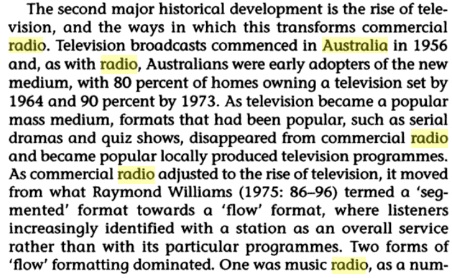
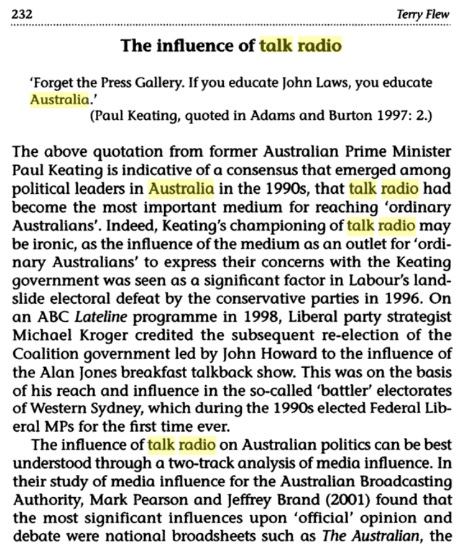
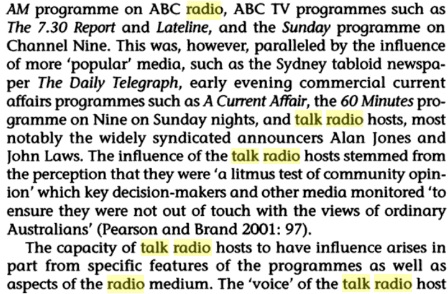
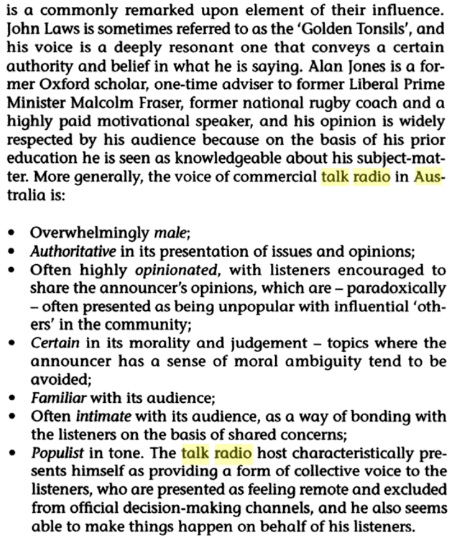
Australian Talk Radio

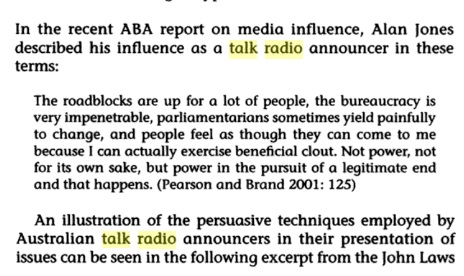
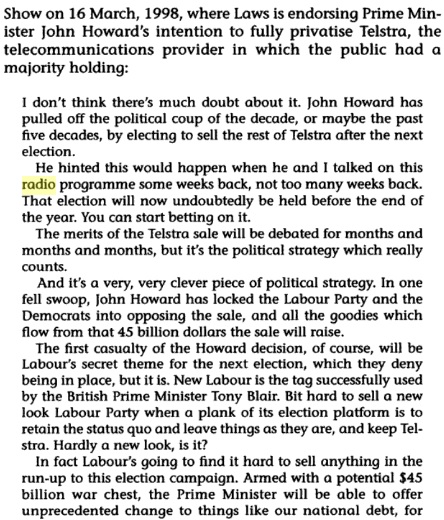
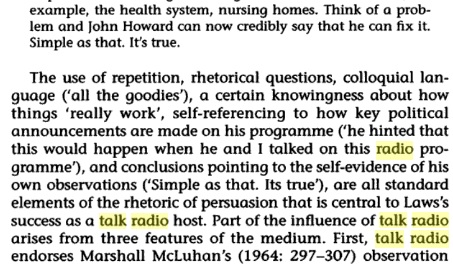
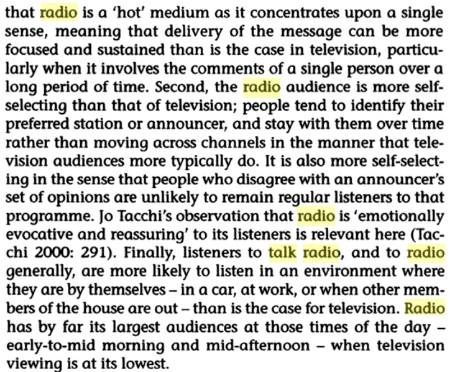
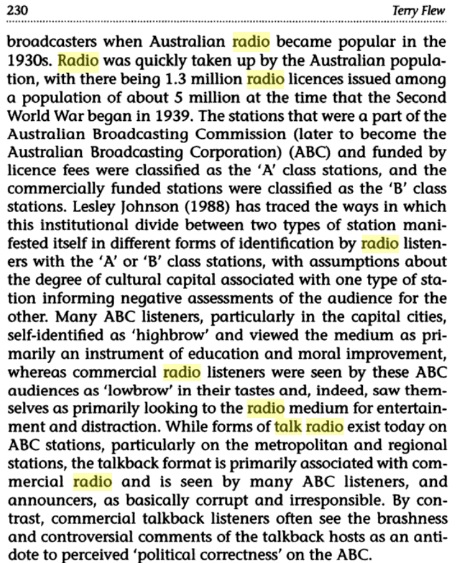
From the 2006 book, More Than a Music Box: Radio Cultures and Communities in a Multi-Media World:


Posted in Australia, Radio | Comments Off on Australian Talk Radio

Life After Globalization & The One-Year Anniversary Of The George Floyd Riots (5-30-21)

01:00 ‘We Will Not Be Frightened’: Young Israel Of Century City Synagogue Vandalized, https://losangeles.cbslocal.com/2021/05/28/we-will-not-be-frightened-young-israel-of-century-city-synagogue-vandalized/
11:00 ‘Mail-in Voter Fraud: Anatomy of a Disinformation Campaign’, https://lukeford.net/blog/?p=139307
19:00 Life After Globalization (Peter Zeihan), https://www.youtube.com/watch?v=kch4Z1GpNOQ
24:00 NYT: Efforts to Advance Racial Equity Baked In Throughout Biden’s Budget, https://lukeford.net/blog/?p=139726
29:00 The social conservative core of the Republican party
34:00 Why the lab leak theory matters, https://www.nytimes.com/2021/05/29/opinion/wuhan-lab-leak-theory-covid.html
39:10 Peter Zeihan says China will be a failed state in a decade, https://www.youtube.com/watch?v=yttug-a3sWI
40:00 Who will Dominate the Geopolitical System in this Decade?
45:00 China’s $18 Trillion Ticking Time Bomb Threatens ‘V-Shaped’ Boom, https://www.forbes.com/sites/williampesek/2021/05/25/chinas-18-trillion-ticking-time-bomb-threatens-v-shaped-boom/?sh=5b6ec53814af
48:00 Unrivaled: Why America Will Remain The World’s Sole Superpower, https://www.michaelbeckley.org/book-project
49:00 Michael Beckley essay on China vs USA, http://www.mitpressjournals.org/doi/pdf/10.1162/ISEC_a_00066
51:00 Why would America leave globalism?
53:30 China is not a Superpower | Professor Paul Dibb, https://www.youtube.com/watch?v=0TYgZkNWep0
1:04:45 China’s Economic and Demographic Problem, https://www.youtube.com/watch?v=P13r6teKIW4
1:19:45 The U.S.A. as a Rogue Superpower | Michael Beckley, https://www.youtube.com/watch?v=6LDMzqvEcBo
1:22:00 A Summer of China | George Friedman Interview 2021, https://www.youtube.com/watch?v=mCKRCtdAkNE
1:27:50 China will not attack Taiwan | George Friedman April 2021
1:49:00 Deep Rig, https://www.infowars.com/posts/new-film-deep-rig-proves-the-2020-election-was-stolen/
1:52:00 Patrick Byrne: pro-Trump millionaire pushing election conspiracy theories, https://www.theguardian.com/us-news/2021/may/29/patrick-byrne-trump-fundraiser-election-conspiracy-theories
2:02:00 Russian collapse
2:04:40 U.S. Alliances in the Western Pacific Archipelago, https://www.youtube.com/watch?v=JAco4W5kuUQ
2:12:00 Stained Steel And A Tricky Trade Truce, https://www.forbes.com/sites/phillevy/2021/05/18/stained-steel-and-a-tricky-trade-truce/?sh=2dc526d67709
2:14:00 Disunited Nations 2020, https://www.youtube.com/watch?v=RuwVaUntpNQ
2:15:00 Naftali Bennett Joins Forces with Yair Lapid to Form Unity Government
2:33:40 Peer-reviewed science papers
2:46:00 Mid-West vs Southern attitudes towards investment

Posted in America | Comments Off on Life After Globalization & The One-Year Anniversary Of The George Floyd Riots (5-30-21)

NYT: Efforts to Advance Racial Equity Baked In Throughout Biden’s Budget

From The New York Times:

Sprinkled throughout the president’s enormous spending plan are scores of programs amounting to tens of billions of dollars intended to specifically bolster the fortunes of Black people, Asian people, tribal communities and other historically underserved groups in the United States.

…That idea — of focusing special attention on the distribution of taxpayer money across racial groups — has never been approached as methodically as it has this year by Mr. Biden, advocates say.

…That approach has incited anger from conservatives, who accuse the president and his advisers of pursuing a racist agenda against white Americans. Fox News ran a headline accusing Mr. Biden of trying to “Stoke Nationwide Division With ‘Racial Equity’ Push.” And The New York Post published an editorial, titled “In Push for Woke ‘Equity,’ Biden Abandons Equality,” that accused the president of being “un-American.”

A group called America First Legal, which is run by Stephen Miller and Mark Meadows, two top aides to former President Donald J. Trump, won a preliminary injunction this week from a Texas judge against an effort by Mr. Biden’s Small Business Administration to prioritize grants from its $28.6 billion Restaurant Revitalization Fund to businesses owned by minorities or underserved groups.

“This order is another powerful strike against the Biden administration’s unconstitutional decision to pick winners and losers based on the color of their skin,” the group said in a statement.

Posted in America | Comments Off on NYT: Efforts to Advance Racial Equity Baked In Throughout Biden’s Budget

When The Gay Money Comes Pouring In

From the New York Times Book Review:

How the Religious Right Made Same-Sex Marriage a Gay Rights Crusade

THE ENGAGEMENT: America’s Quarter-Century Struggle Over Same-Sex Marriage By Sasha Issenberg

Money itself, especially the importance of “gay economic might,” also takes center stage in Issenberg’s book. “A galaxy of covert donors orbiting around Denver software millionaire Tim Gill remade the gay-rights movement in their own image,” he writes, “ideologically conservative and strategically radical.” Gay marriage activists, modeling themselves on corporate PACs, successfully transformed into a lobbying force one likened to a “Gay Pfizer,” using the carrot of political contributions and the stick of funding one’s opponents. The strategy worked: In 2011, three Democrats in the New York Legislature reversed their earlier positions on gay marriage after witnessing gay organizations’ ability to end political careers. In 2012, after President Obama announced his support of gay marriage, according to one campaign staffer, “You could literally hear the gay money pouring in.”

…Through Issenberg’s illumination of the donors, activists and attorneys on both sides of the saga, another aspect of the battle for marriage equality becomes starkly clear: its whiteness. Obama plays an important role, certainly, but nearly all of the individuals at the core of the narrative — dozens of them — are white. Issenberg doesn’t shy away from examining the role of race in electoral politics (the loss of the Black vote against Proposition 8, he concludes, was merely the symptom of a more widespread messaging problem), but we don’t learn why, exactly, queer Black activists were such a rarity in the upper echelons of the marriage fight.

They have long told us the reasons: In addition to broader racism and transphobia within the mainstream gay rights movement, marriage was always primarily a white, cisgender issue. “Gay marriage? Please,” wrote Jasmyne Cannick, a Los Angeles-based political strategist and journalist, after the passage of Proposition 8. “The white gay community is banging its head against the glass ceiling of a room called equality, believing that a breakthrough on marriage will bestow on it parity with heterosexuals. But the right to marry does nothing to address the problems faced by both Black gays and Black straights. Does someone who is homeless or suffering from H.I.V. but has no health care, or newly out of prison and unemployed, really benefit from the right to marry someone of the same sex?”

Posted in Homosexuality | Comments Off on When The Gay Money Comes Pouring In

NYT: ‘Pandemic Fuels Surge In U.S. Guns Sales’

I don’t think the pandemic fueled gun sales. It was the violence surge initiated by BLM/Antifa that has led to this.

America did not have a surge in murders until after the George Floyd death on May 25 and accompanying protest movement. Prior to that, crime was stable.

New York Times:

“There is a breakdown in trust and a breakdown in a shared, common reality,” said Lilliana Mason, a political scientist at the University of Maryland who writes about political violence. “There is also all this social change, and social change is scary.”

…Sales did not change much under former President Donald J. Trump, but they exploded in 2020, up by 64 percent from the previous year. The single highest month last year was in June, as protests swept across the country after the murder of George Floyd.

…But while research has shown that higher gun prevalence is associated with a higher rate of gun deaths — including suicide — the question of whether a sudden surge in gun sales prompts a corresponding rise in gun violence does not have a clear answer…

Violent gun death rates in the state dropped by about half from 1989 to 2019, said David Hemenway, director of the Harvard Injury Control Research Center, compared to a 13 percent drop for the nation.

Gary Kleck, a professor of criminology at Florida State University, said laws were often less effective than gun control advocates say. He said controls that targeted high-risk individuals, like mentally ill people, seemed to work better than those that sought to prevent young people from buying guns. Mass shootings, he said, were the least likely type of violence that laws would be effective against.

I suspect gun deaths dropped in California for reasons of changing demographics (fewer young people) and tougher sentences for criminals (three strikes law).

Posted in America | Comments Off on NYT: ‘Pandemic Fuels Surge In U.S. Guns Sales’

Just Be Yourself (5-30-21)

Posted in Personal | Comments Off on Just Be Yourself (5-30-21)

Disunited Nations: The Scramble for Power in an Ungoverned World (5-28-21)

00:00 My 55th birthday
03:00 Disunited Nations 2020, https://www.youtube.com/watch?v=RuwVaUntpNQ
06:00 The Inflating of Fears, https://www.youtube.com/watch?v=XwzU9MxmGy4
09:00 Life After Trump – China, https://us11.campaign-archive.com/?u=de2bc41f8324e6955ef65e0c9&id=bba991dfd7
27:00 Emotional Energy Levels, https://www.youtube.com/watch?v=gdga_AHBGv4
33:00 Who won the great debate? Nick Fuentes or Robert Barnes?
37:00 Whiteshift by Eric Kaufmann: A Video Review, https://www.youtube.com/watch?v=2R6MQVW35DU
41:00 Ehlers-Danlos Syndrome- causes, symptoms, diagnosis, treatment, pathology
44:30 Hypermobile Ehlers Danlos Syndrome: My Story, https://www.youtube.com/watch?v=YQr8Gu4WImg
49:00 “Sleep Disorders in Ehlers-Danlos and Related Syndromes: A Panoply of Paradoxes” – Alan Pocinki, MD, https://www.youtube.com/watch?v=Tr6Iv8_NVOw
54:20 Barricade Garage: “PLEASE SATISFY MY WHITENESS”, https://www.youtube.com/watch?v=t_IYNt79XIM
57:20 Opie & Anthony Was A Place For Men, https://www.youtube.com/watch?v=1r3P47R6sAg
59:20 Robert Barnes says Nick Fuentes hates Jews
1:00:10 Every Dr. Fauci Interview
1:01:50 Jewish matchmaking
1:04:00 The Opie & Anthony Show – Anthony “Dice” Seinfeld
1:06:45 Jewish girl prank calls her parents on Z100
1:11:00 Vaush Reacts To A MASK OFF “Pro-White Europe” Video, https://www.youtube.com/watch?v=8N9UILCQ53A
1:15:00 What if there is no such thing as character?, https://medium.com/stoicism-philosophy-as-a-way-of-life/what-if-there-is-no-such-thing-as-character-f71f02a75f02
1:19:00 Lack of Character: Personality and Moral Behavior, https://lukeford.net/blog/?p=139670
1:24:00 Empirical approaches to moral philosophy, https://plato.stanford.edu/entries/moral-character-empirical/
1:32:00 The Accidental Superpower: The Next Generation of American Preeminence and the Coming Global Disorder, https://astralcodexten.substack.com/p/your-book-review-the-accidental-superpower
1:40:20 Israel is a Giant Machine for Generating Anti-Semitism, https://www.youtube.com/watch?v=zpurS8LyuLI
1:44:30 Fat acceptance
1:48:10 The Psychology of Israel and Palestine | Jordan B Peterson
1:55:00 Pilleater: An Introduction to Al Stankard (HAarlem VEnison), https://www.youtube.com/watch?v=1NcKRIWrIMc
1:56:30 Tucker Carlson on the Left’s war on science

Posted in America | Comments Off on Disunited Nations: The Scramble for Power in an Ungoverned World (5-28-21)

Addicted To Livestreams

From this 2021 paper:

* Indian users spend eight hours on various live streaming platforms, which is far more than the average six-hour trend globally (Ganjoo, 2018). These trends are visible on a regular basis. Recently, an incident was reported in India regarding a 26-year-old man who sought medical help to control his heavy viewing of streaming videos. He admitted that he used to watch streaming videos on an average 12 hours a day to avoid his unemployment issue and family pressure (Ganjoo, 2018).

* Four hours or more of viewing every day is defined as heavy viewing and may interfere with real-life relationships…

Posted in Streaming | Comments Off on Addicted To Livestreams