* Richard Spencer’s White nationalism is a product of the European melting pot of America, but there is no evidence that it is particular or culturally specific enough to be able to create a deep-rooted sense of identity that tugs at the heart in the way that being English or French does. In fact I sometimes wonder whether the ‘white guilt’ religion of white liberals in American society is itself a curious attempt to create a racial identity in a land where whites have lost much of their old European national and regional identities. But whether that is the case or not, it is a mistake to transplant the racial situation of the New World onto Europe, which, while there are paralells, is also quite different.
In reality the EU is bad for whites and bad for European civilisation. One only has to look at the enemies ranged against the Brexit vote–Obama, Merkel, the IMF. It’s like a who’s who of ISteve.
The EU is a Utopian dream, as was the Soviet Union. Totalitarian societies are created by people who, like Merkel with her refugees–’if I can’t do this then this isn’t my Germany’ believe so strongly in the goodness of their own feelings and instincts that it allows them to over-rule any law or restriction that stands in their way. If you accept the logic of the EU then you will probably accept the logic of a one world government and the steamrollering of race, culture, family, and morality that this will carry in its wake by those who will will enfore their rule with ruthless piety. For me a world stripped of all the glorious quirks of human culture for the sake of global capital and leftist religion is a nightmare not a fantasy. It’s like wanting to see all the rainforests and all its natural wonders pulled up and covered in tarmac. I want the globalists to lose, and it can’t come soon enough.
So I’m voting to leave.
* It’s a mistake to transplant the white nationalism of America onto Europe which still has particular ethnic identities which seem to have a depth and emotional pull that ‘whiteness’ has not yet proved itself to have in America. In fact I do wonder if the ‘white guilt’ religion of white American liberals is an attempt to try and fill this void with what amounts to a new basis for a shared sense of history and common future of white Americans.
The EU is a utopian dream just as the soviet union was. Totalitarian societies are created by the kind of leftist idealists who are dangerous because they have such a high regard for their own idealism and moral goodness that it allows them to over-rule any law or restriction because they trust so deeply in the goodness of their own instincts, just like Angela Merkel and her ‘if I can’t do this it’s not the Germany I know’ approach to re-writing German immigration law–the liberal version of the ‘Fuhrer principle’ if you will. Such are the people that govern the EU. If you accept the logic of one-Europe government you will also probably accept the logic of one world government, and the steamrollering of all race, culture, family, religious and moral difference that will come in its wake and which will be enforced with ruthless piety.
So I’m voting to leave to put a spoke in the wheel of international capital and left wing religious utopianism.
* In the EU, crops that were not on a list of approved varieties were forbidden. It takes a considerable amount of money to get a vegetable variety on that list, so anything people aren’t willing to shell out huge amounts of money for cannot be sold.
And when I say “cannot be sold”, I mean that gardening businesses that sold old ‘heirloom’ and open-pollinated varieties were raided by armed men wearing body armor and carrying assault weapons. Because they were selling types of beans and peas and rutabagas that weren’t approved.
These weren’t foreign plants being brought across national borders, these were old and familiar vegetables that had been grown for decades if not centuries and posed no conceivable risk to anyone. All those gardeners were turned into criminals.
I don’t understand why the British thought entering the EU was a good idea, and I have no idea why they’d think leaving wasn’t the obvious choice. They should regain their own sovereignty in all matters, from immigration to what sorts of seeds should be sold, and scrap trying to centrally plan their economy.
* I’ve been expecting all along that Remain would win by a slim majority, similar to the Scottish referendum recently. I am absolutely committed to escaping from the EU, but I just think the referendum was called too soon, before we had achieved significant Parliamentary representation for the Leave camp. Such a vote will always in Britain tend to stick with the status quo, imo, and especially when the leadership hierarchies of all the mainstream political parties are arguing for that.
But I have been pleasantly surprised by the strong showing of the Leave campaigners in the polls. It seems clear they have won the arguments and shifted opinion. It feels like a cruel dangling of hope, though, for me.
Whatever the result though, it ends nothing. The goal was never to have, or to win, a referendum. The objective was always, and remains, to escape from the birthing United States of Europe before we are faced with only the options available to Carolinans and Virginians in 1861. There’s a long way to go from even a reasonably strong Leave victory (55%, say) to actually getting out, when the forces against getting out are so powerful and so entrenched in the business, media and political high ground. A referendum result, of course, is not binding on Parliament. And even then of course, having dealt with the priority threat, we have to face the issues of getting out from under US “influence”……
It won’t be the end, or even the beginning of the end, but it might perhaps be the end of the beginning (to use my favourite political quote yet again).
Much the same applies, of course, to a defeat for the British patriots, if that is the result tomorrow. The fight goes on, because it must go on. There can be no compromise or acceptance of defeat when the very existence of the nation as an independent entity is at stake.
* I would counter that the EU is not only anti-nationalist but also hostile to indigenous Europeans. The machinery of the EU is designed to break down national barriers and blur individual European identities by bringing in non-Europeans and mixing up the different European ethnicities the best they can. I hope that the UK exits the EU and this causes a domino effect where other nations break away until the EU finally crumbles. I don’t see this happening, call me cynical (and I hope I’m wrong), but I think the vote will be rigged. The political elite has a lot riding on this experiment.
A united Europe of course can be a great thing, but this Union is dangerous to Europeans as a whole. Especially with people like Merkel and Junker in charge.
* There is a certain irony, I think, in the fact that mass immigration from outside the EU, in the end, might prove to have been (hopefully) the final downfall of the Eurocrats. (Whichever way this particular vote goes, I think the resurgence of nationalist politics in Europe will hopefully eventually do for the EU project, one way or the other).
Free movement within the EU is a necessary part of their superstate project, but there’s nothing driving their dogmatic (and positively demonic, imo) insistence on backing mass migration from other continents except their own antiracist and internationalist ideologies. British moaning about Poles and central European complaints about gypsies, etc, would in itself probably have been containable. If they’d been a little more pragmatic and cynical (Lord knows, they are certainly cynical enough on other issues and in other ways), they might have gotten away with it.
Perhaps it really was just sheer arrogance.
* I will venture a prediction that the age of cynicism has drawn to a close and we all don’t know it yet. Brexit wins by a comfortable (i.e. unexpectedly large) margin. Global stock markets initially take a big hit but soothing tones emanating from Yellen and Draghi coax them back into the sideways channel that they’ve been plowing through for the last two and a half years. For the time being, and for several months into the future, nothing much else seems to change. There’s a lot of inertia in the system and no one, not even those in favor of the Brexit, know quite how to adjust to the new reality.
Those of us who support Trump should take careful note of this. Trump will win, but initially nothing will seem to change. The effects of these massive, narrative-shifting events will take years to manifest. It will be very difficult for we who are part of these processes to understanding them in the offing, for we ourselves are the events.
And let’s not forget my first (variously formulated) iron rule of sociology: All true social change is fundamentally driven, but fundamentally driven social changes take much longer to eventuate than originally supposed.
* I am a Finnish nationalist. I care more about Finns than I care about other people. And I care more about Europeans (“whites”) than non-Europeans. “Concentric loyalties” I believe is the term.
I certainly don’t want to fill my country with Iraqis, Somalis, or Afghanis, but neither do I want to fill it with immigrants from other European countries. Of course, if it must happen, I’d much rather have European immigrants. But I’d rather not.
Spencer says a lot of stupid shit about the EU and ethnic nationalists (he refers to us as “petty nationalists”). He sounds almost as bad as anti-nationalist open borders advocates. He’s just plain wrong about many things, e.g. saying that the EU has nothing to do with the refugee/immigration disaster, that the nation states are wholly at fault. For one, the so-called “freedom of movement” (i.e. lack of border controls) within the EU is a huge reason for it. The vast majority of the asylum seekers simply wouldn’t be able to reach their desired destinations in Northern Europe without it. We Finns wouldn’t have gotten 32,000+ asylum seekers last year without it. Spencer is just an ignorant armchair general with no skin in the game.
I hope that Brexit happens. It should make the federalists who control the EU less arrogant, less utopian, and less aggressive about pushing their stupidity on Europeans. It’s no panacea, but it’s a step in the right direction.
* 4 observations about from a British born Israeli.
1) Brexit can’t win. Google, Youtube, Facebook and a few others have the ability to influence voter turnout by way more than the margin of victory in the even the most optimistic polls. Given the importance of this referendum to the Cathederal its frankly inconceivable that they won’t exercise this power.
2) This referendum has been useful in distilling the latent divisions in the new politics. Right on millenials have spent the last month repeating IMF propaganda as if it was holy Writ, George Osborne has been calling everyone waysist so much would imagine he was smoking a bong. The Left and the globalists will, of course, try to go back to their phoney “1% way” after this, but it will be much harder after a an orgy of mutual backslapping consisting of ever more lurid attempts to demonstrate their disgust for ordinary indigenous Britons. This of course gives opportunities for a new anti-Left alliance. My preference is that this will take a Misesian free-market form, but, of course, other options are possible.
3) Similarly this referendum has been useful in separating the good from the crap in the alt-right. What a narcissistic twerp Spencer is. The independence of a millenium old country with arguably the greatest cultural heritage in the world is just some “petty” issue getting in the way of realizing his gaylord fantasies. More broadly, I think this demonstrates the real weakness of the WN variant of alt-right thought. White nationalism is both too broad and too rigid. It can’t accommodate “petty” nationalisms that actually mean something to people and so provide a basis for a decent social order, nor can it replace them because it can’t deal with the real issue that people actually quite like having a friendly Hindu running the corner shop and, as such, the basis of national identity, of which shared descent must play a part, must accommodate him too. I suggest, and I’m partly trolling here, that Jewish nationalism is a better model. In principle anyone can join, but its really hard, its you not them who gets to pick, and it’s understood by all that converts don’t make the rules. Now of course, getting to such a model is no easier than just going full white nationalist, arguably even harder, but it’s a more desirable destination.
* If one accepts the reality of the Deep State in Europe and North America as core to the world-wide Anglo-Saxon Empire (the United States, Britain, Australia and their European provinces), then it follows that MI5 and MI6 would be acting to skew the polls and otherwise take action to ensure that Britain continues to serve the interests of the Deep State. Hence, whether Britain stays in or leaves the EU will be determined by the interests of that State. “Facts” are impossible in the short term to prove this hypothesis one way or the other since it is usually years or decades before historians can dig out the facts.
All one has to do is look at the unfolding “real history” of Europe from the height of the British Empire through the post-WWII era as documented by historians to support the hypothesis of the Deep State. Indeed, Britain paved the way for Western industrial countries with the models for a “double” government as well as financialized, mercantile economies — in this case the government for public consumption (Parliament) and the hidden government making strategic economic and foreign policy decisions (the elite-ruled civil service).
* It’s time to leave. The UK participated in, and contributed enormously, to the historic experiment. The results are in and the experiment failed.
Unelected bureaucratic mandarins represented wildly divergent interests from the UK’s. Elected officials from other European countries represented wildly divergent interests from the UK’s. The European experiment denied the British people their fundamental right of democratic participation. It enforced confiscatory taxation on Britons. It literally, not figuratively, initiated a population replacement program of the native British people.
European Union was an enticing, romantic vision. Many, or most of us fell under its heady spell at one time or another. Free trade and free movement of our peoples. Cheap vacations to sunny beaches. Liasons with available, good-looking foreigners in exotic towns and villages. What could possibly go wrong?
Unfortunately, the native common sense of each country’s common people was over-ridden by the base instincts of those cultural and political elites who always find a way to line their own pockets. Those elites never do so without snidely discounting the legitimate fears and concerns of the common people.
A better future for the UK lies ahead. Independence and self-determination will bring political responsibility closer to home and closer to the commons. Local power will enforce political accountability and serve the best interest of the British people.
A representative government is an accountable one. An accountable government is a stronger one. The British will negotiate trade and strategic agreements with every remaining European Union country. None of those countries can afford the luxury of ignoring Britain – the fifth largest economy in the world. Britain will enhance its strategic relations and trade agreements with the Anglosphere – USA, Canada, Australia, New Zealand – as well as the fast-growing economies of India with its 125 million English speakers and African nations with 150 million English speakers. Global powers China and Russia will discover a new-found respect for Britain in its independence from the Eurocracy and its strategic solidarity with the Anglosphere. Really, it’s all good. Bring it on. It’s time.
It’s time for the Euro elites and the Eurocrats to thank Britain’s people for all they have given in The Great European Experiment. The blood, sweat and tears of our parents and grandparents who gifted Europe its freedom from tyranny – along with our Anglosphere brothers. The untold amounts of treasure Britain gifted Europe from its Exchequer – paid for with the brilliance, hard work and integrity of its industrious people. Britain’s ongoing and extraordinary contribution to science and technology. The outstanding, shining example of British political and social civility…Really, it’s ok, Europe.
* I am watching the BBC streaming on my PC. Several talking heads are lamenting about the falling Pound. But how many times do markets make large swings over a day or two only to come back to equilibrium in a few days? Does anyone seriously think the Pound’s drop tonight is permanent? I remember when the London subway was bombed and the US market dropped a couple percent. I was able to buy a stock I’d been wanting and within five trading days dumped it for a nice profit. The fear mongering never ends.
Heck if BREXIT wins tonight, then I will win tomorrow. I am sure there will be some buying opportunities tomorrow in the market.
* When the shooting happened there were still at least 6-7 hours of voting left. My (conspiracy) theory is that the German government didn’t want to remind British voters why they needed to get the hell out of the EU. The press seems to have really clamped down on refugee stories lately, probably for much the same reason.
It’s interesting to wonder how lopsided the vote for independence would be if the press and oligarchs didn’t have so many people fooled.
* Some American analysts on Fox Business Net, Stuart Varney and others, are pretty happy about the Exit while their guest, a silly little man who writes for the “Economist,” is quite chagrined. They just told him, “While everyone else was telling them to worry about the survival of the EU, the Brits just told them, “Worried about the EU? Hell, no, we’re worried about ourselves!”
Nice to know the country of Churchill still has it in them.
* Its tough for Jews in the West. Its like being a white Rhodesian. You know you are way smarter than the natives. You are too polite to say so. You know if Mugabe/Trump ever gets in office and you have to leave, everything will go to hell.
You tell the natives (nicely) that the infrastructure is going to crumble, the power plants shut down, the hospitals go dark, the food go unplanted and natives go hungry. Yet they look you in the eye, smile, and say “we know, but we would still rather rule ourselves”. How the hell do you deal with that?
* Please tell me this is satire.
You don’t really think “everything will go to hell” without jews in America, do you? Do you know that there are many European nations with small or almost non-existent jewish populations that haven’t “gone to hell,” or if they have gone to hell it’s solely because of third world immigration? Sweden, Denmark, Iceland, Finland, Norway, Belgium, Germany, the Netherlands, Austria, Switzerland, Italy (the northern part at least), the United Kingdom, Ireland? What about the United States before 1900 when they hadn’t even arrived in large numbers yet? We were doing pretty well. Why else would they show up?
The comparison with Rhodesia is totally foolish. Whites built a civilization for blacks which they couldn’t handle. Whites built a civilization for themselves which the jews invaded. Whites build and Whites maintain.
“You tell the natives (nicely) that the infrastructure is going to crumble, the power plants shut down, the hospitals go dark, the food go unplanted and natives go hungry.”
Wow, just wow. Get this, everybody: If Seth Rogen weren’t here blessing us with his presence, we couldn’t maintain a power plant or a hospital or even harvest crops. Mother of God.
* BTW, if Americans ought to know that so many self-made billionaires are Jewish, shouldn’t they also be told that Jews cured polio, created 95% of popular superheroes, and wrote roughly half of the most popular Christmas songs out there? (oh, and created everyone’s favorite web site, “unz.com”).
For example, I remember some weird Fox News segment about a Jewish mother protesting against Rudolph the Red-Nosed Reindeer, but I don’t recall anyone mentioning that Rudolph was created by a Jew, the song was written by a Jew, etc.
* Karl Marx, Sigmund Freud, Trotsky and the Frankfurt School; and BTW David Axelrod, Rahm Emmanuel, Jonathan Gruber and Ben Rhodes. Oh, and the ACLU, the SPLC, the law profession and funding the leftwing idiocy with our money.
We would not mind the disproportionate influence if it wasn’t accompanied by the relentless anti-Americanism, the demonization of whites and shifting the costs of social engineering from your fellows onto the middle class, while simultaneously rent-seeking to make yourselves fabulously wealthy (cf. Larry Ellison).
But when you need someone to arrest the progress of the demons you have summoned – you will find that the well-meaning, honest and virtuous northern European descendants you would have been able to rely upon are sitting on their hands.
Which is really too bad for you. Because it did not have to be this way.
* Tongans were lumped in with “Asia-Pacific Islanders” for decades. When the University of California limited “Asian” enrollment, the smartest “Asians” were accepted. One problem: Tongans are as dumb as a box of rocks. As a result, they never made the cut at UCLA. Koreans and Chinese always beat them out as the “smartest Asians”. So the Tongans asked to be separated out from the “Asia-Pacific Islander” quota group and given their own racial quota. UCLA agreed. It worked. Tongan enrollment jumped.
Europeans are the “dummy” white people … as compared to Jews, anyway. As long as Jews and Europeans are lumped together as “whites”, Europeans are always going to get the short end of the stick. When qualified “whites” have to give up seats at Harvard/Yale/Stanford to make room for lesser-qualified NAMs, it is the Europeans who are going to lose their seats, not Jews. Heck, even the Tongans could figure that out!
Think of proportional representation this way: does a US Supreme Court with four out of nine Jewish justices (and no WASPs) really “look like America” (to use SJW quota-speak). Four of nine justices is over two thousand and one hundred percent (2100%) Jewish “overrepresentation”! Yikes!
* Just look at how conservative all those countries with relatively little Jewish political influence turned out to be in comparison to the U.S. (i.e. Canada, Norway, Sweden, Denmark, the Netherlands, etc.).
* On immigration policy (i.e., what counts), they’re all way more “conservative” than the US, and long have been. Check demographics for details.
You guys should stop shooting yourselves in the foot on this issue.
I’ll take any of those countries’ demographics and political situation, any day of the week.
* South Africa is a tragedy. It’s the full on “should have picked our own damn cotton” debacle. They could have had a marvelous beautiful white nation there if they’d adopted a very hard “this is our land” policy and chased off the blacks from the get go. Since scattering of blacks who were there decreased substantially with the mfecane, the Boers might have been able to just push ‘em out. But you can’t really do any sort of slavery and still end up your own nation.
When apartheid became unsustainable was the time to be bold and realistic. Falling back to a white state in the Western\Northern Cape would have been the sustainable option. I suppose it was too hard for whites–living well–to give up their homes and businesses and for their community to reverse the Great Trek and all that. But taking the PC, kumbaya singing option means that in the long run they will all have to leave and have no nation at all. Whites can live around blacks when whites are in charge. But anything black run will decay to a level of disorder and dysfunction well below the norms most white people will want to tolerate.
* The proportion of Jews (or half, quarter, eighth Jews) in any position is an irrelevant topic because the Jews want the same policies as the gentile elites for basically the same reasons. If there are fewer Jews (Scandinavia, France) in positions of power or where the Jews lean conservative (Britain) the liberals still win with elite gentile support.
Desegregation would have definitely happened without Jews: The WASPy Earl Warren wanted to force the South to desegregate schools immediately during the Board v Brown implementation hearings in the 1950s. The only reason the South was able to fight against it for another decade was because Frankfurter inserted ‘with all deliberate speed’ into the ruling and against Warren’s initial preferences.
But of course, inconvenient facts such as the liberal WASPy SCOTUS from 1969 to 1994 had no Jews on it and WASPs were half of the liberal wing of the court from 1994 to 2009 never get mentioned by Stevie.
Nor does he ever mention the fact 80% of the Communist revolutionary leadership was gentile – only Jews are held collectively responsible as an ethnic group for their liberalism.
The fact gentiles ruined themselves, and that Jews participated with similarly negative consequences for their community, doesn’t raise tips.
No subject in psychology has provoked more intense public controversy than the study of human intelligence. From its beginning, research on how and why people differ in overall mental ability has fallen prey to political and social agendas that obscure or distort even the most well-established scientific findings. Journalists, too, often present a view of intelligence research that is exactly the opposite of what most intelligence experts believe. For these and other reasons, public understanding of intelligence falls far short of public concern about it. The IQ experts discussing their work in the public arena can feel as though they have fallen down the rabbit hole into Alice’s Wonderland.
The debate over intelligence and intelligence testing focuses on the question of whether it is useful or meaningful to evaluate people according to a single major dimension of cognitive competence. Is there indeed a general mental ability we commonly call “intelligence,” and is it important in the practical affairs of life? The answer, based on decades of intelligence research, is an unequivocal yes. No matter their form or content, tests of mental skills invariably point to the existence of a global factor that permeates all aspects of cognition. And this factor seems to have considerable influence on a person’s practical quality of life. Intelligence as measured by IQ tests is the single most effective predictor known of individual performance at school and on the job. It also predicts many other aspects of well-being, including a person’s chances of divorcing, dropping out of high school, being unemployed or having illegitimate children.
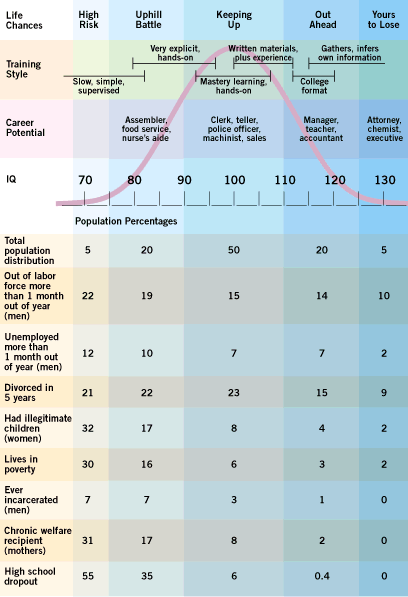
Correlation of IQ Scores … with occupational achievement suggests that g reflects an ability to deal with cognitive complexity. Scores also correlate with some social outcomes (the percentages apply to young white adults in the U.S.).
By now the vast majority of intelligence researchers take these findings for granted. Yet in the press and in public debate, the facts are typically dismissed, downplayed or ignored. This misrepresentation reflects a clash between a deeply felt ideal and a stubborn reality. The ideal, implicit in many popular critiques of intelligence research, is that all people are born equally able and that social inequality results only from the exercise of unjust privilege. The reality is that Mother Nature is no egalitarian. People are in fact unequal in intellectual potential–and they are born that way, just as they are born with different potentials for height, physical attractiveness, artistic flair, athletic prowess and other traits. Although subsequent experience shapes this potential, no amount of social engineering can make individuals with widely divergent mental aptitudes into intellectual equals.
Of course, there are many kinds of talent, many kinds of mental ability and many other aspects of personality and character that influence a person’s chances of happiness and success. The functional importance of general mental ability in everyday life, however, means that without onerous restrictions on individual liberty, differences in mental competence are likely to result in social inequality. This gulf between equal opportunity and equal outcomes is perhaps what pains Americans most about the subject of intelligence. The public intuitively knows what is at stake: when asked to rank personal qualities in order of desirability, people put intelligence second only to good health. But with a more realistic approach to the intellectual differences between people, society could better accommodate these differences and minimize the inequalities they create.
Extracting g
Early in the century-old study of intelligence, researchers discovered that all tests of mental ability ranked individuals in about the same way. Although mental tests are often designed to measure specific domains of cognition–verbal fluency, say, or mathematical skill, spatial visualization or memory–people who do well on one kind of test tend to do well on the others, and people who do poorly generally do so across the board. This overlap, or intercorrelation, suggests that all such tests measure some global element of intellectual ability as well as specific cognitive skills. In recent decades, psychologists have devoted much effort to isolating that general factor, which is abbreviated g, from the other aspects of cognitive ability gauged in mental tests.
The statistical extraction of g is performed by a technique called factor analysis. Introduced at the turn of the century by British psychologist Charles Spearman, factor analysis determines the minimum number of underlying dimensions necessary to explain a pattern of correlations among measurements. A general factor suffusing all tests is not, as is sometimes argued, a necessary outcome of factor analysis. No general factor has been found in the analysis of personality tests, for example; instead the method usually yields at least five dimensions (neuroticism, extraversion, conscientiousness, agreeableness and openness to ideas), each relating to different subsets of tests. But, as Spearman observed, a general factor does emerge from analysis of mental ability tests, and leading psychologists, such as Arthur R. Jensen of the University of California at Berkeley and John B. Carroll of the University of North Carolina at Chapel Hill, have confirmed his findings in the decades since. Partly because of this research, most intelligence experts now use g as the working definition of intelligence.
The general factor explains most differences among individuals in performance on diverse mental tests. This is true regardless of what specific ability a test is meant to assess, regardless of the test’s manifest content (whether words, numbers or figures) and regardless of the way the test is administered (in written or oral form, to an individual or to a group). Tests of specific mental abilities do measure those abilities, but they all reflect g to varying degrees as well. Hence, the g factor can be extracted from scores on any diverse battery of tests.
Conversely, because every mental test is “contaminated” by the effects of specific mental skills, no single test measures only g. Even the scores from IQ tests–which usually combine about a dozen of specific cognitive skills–contain some “impurities” that reflect those narrower skills. For most purposes, these impurities make no practical difference, and g and IQ can be used interchangeably. But if they need to, intelligence researchers can statistically separate the g component of IQ. The ability to isolate g has revolutionized research on general intelligence, because it has allowed investigators to show that the predictive value of mental tests derives almost entirely from this global factor rather than from the more specific aptitudes measured by intelligence tests.
In addition to quantifying individual differences, tests of mental abilities have also offered insight into the meaning of intelligence in everyday life. Some tests and test items are known to correlate better with g than others do. In these items the “active ingredient” that demands the exercise of g seems to be complexity. More complex tasks require more mental manipulation, and this manipulation of information–discerning similarities and inconsistencies, drawing inferences, grasping new concepts and so on–constitutes intelligence in action. Indeed, intelligence can best be described as the ability to deal with cognitive complexity.
This description coincides well with lay perceptions of intelligence. The g factor is especially important in just the kind of behaviors that people usually associate with “smarts”: reasoning, problem solving, abstract thinking, quick learning. And whereas g itself describes mental aptitude rather than accumulated knowledge, a person’s store of knowledge tends to correspond with his or her g level, probably because that accumulation represents a previous adeptness in learning and in understanding new information. The g factor is also the one attribute that best distinguishes among persons considered gifted, average or retarded.
Several decades of factor-analytic research on mental tests have confirmed a hierarchical model of mental abilities. The evidence, summarized most effectively in Carroll’s 1993 book, Human Cognitive Abilities, puts g at the apex in this model, with more specific aptitudes arrayed at successively lower levels: the so-called group factors, such as verbal ability, mathematical reasoning, spatial visualization and memory, are just below g, and below these are skills that are more dependent on knowledge or experience, such as the principles and practices of a particular job or profession.
Some researchers use the term “multiple intelligences” to label these sets of narrow capabilities and achievements. Psychologist Howard Gardner of Harvard University, for example, has postulated that eight relatively autonomous “intelligences” are exhibited in different domains of achievement. He does not dispute the existence of g but treats it as a specific factor relevant chiefly to academic achievement and to situations that resemble those of school. Gardner does not believe that tests can fruitfully measure his proposed intelligences; without tests, no one can at present determine whether the intelligences are indeed independent of g (or each other). Furthermore, it is not clear to what extent Gardner’s intelligences tap personality traits or motor skills rather than mental aptitudes.
Other forms of intelligence have been proposed; among them, emotional intelligence and practical intelligence are perhaps the best known. They are probably amalgams either of intellect and personality or of intellect and informal experience in specific job or life settings, respectively. Practical intelligence like “street smarts,” for example, seems to consist of the localized knowledge and know-how developed with untutored experience in particular everyday settings and activities–the so-called school of hard knocks. In contrast, general intelligence is not a form of achievement, whether local or renowned. Instead the g factor regulates the rate of learning: it greatly affects the rate of return in knowledge to instruction and experience but cannot substitute for either.
The Biology of g
Some critics of intelligence research maintain that the notion of general intelligence is illusory: that no such global mental capacity exists and that apparent “intelligence” is really just a by-product of one’s opportunities to learn skills and information valued in a particular cultural context. True, the concept of intelligence and the way in which individuals are ranked according to this criterion could be social artifacts. But the fact that g is not specific to any particular domain of knowledge or mental skill suggests that g is independent of cultural content, including beliefs about what intelligence is. And tests of different social groups reveal the same continuum of general intelligence. This observation suggests either that cultures do not construct g or that they construct the same g. Both conclusions undercut the social artifact theory of intelligence.
Moreover, research on the physiology and genetics of g has uncovered biological correlates of this psychological phenomenon. In the past decade, studies by teams of researchers in North America and Europe have linked several attributes of the brain to general intelligence. After taking into account gender and physical stature, brain size as determined by magnetic resonance imaging is moderately correlated with IQ (about 0.4 on a scale of 0 to 1). So is the speed of nerve conduction. The brains of bright people also use less energy during problem solving than do those of their less able peers. And various qualities of brain waves correlate strongly (about 0.5 to 0.7) with IQ: the brain waves of individuals with higher IQs, for example, respond more promptly and consistently to simple sensory stimuli such as audible clicks. These observations have led some investigators to posit that differences in g result from differences in the speed and efficiency of neural processing. If this theory is true, environmental conditions could influence g by modifying brain physiology in some manner.
Studies of so-called elementary cognitive tasks (ECTs), conducted by Jensen and others, are bridging the gap between the psychological and the physiological aspects of g. These mental tasks have no obvious intellectual content and are so simple that adults and most children can do them accurately in less than a second. In the most basic reaction-time tests, for example, the subject must react when a light goes on by lifting her index finger off a home button and immediately depressing a response button. Two measurements are taken: the number of milliseconds between the illumination of the light and the subject’s release of the home button, which is called decision time, and the number of milliseconds between the subject’s release of the home button and pressing of the response button, which is called movement time.
In this task, movement time seems independent of intelligence, but the decision times of higher-IQ subjects are slightly faster than those of people with lower IQs. As the tasks are made more complex, correlations between average decision times and IQ increase. These results further support the notion that intelligence equips individuals to deal with complexity and that its influence is greater in complex tasks than in simple ones.
The ECT-IQ correlations are comparable for all IQ levels, ages, genders and racial-ethnic groups tested. Moreover, studies by Philip A. Vernon of the University of Western Ontario and others have shown that the ECT-IQ overlap results almost entirely from the common g factor in both measures. Reaction times do not reflect differences in motivation or strategy or the tendency of some individuals to rush through tests and daily tasks–that penchant is a personality trait. They actually seem to measure the speed with which the brain apprehends, integrates and evaluates information. Research on ECTs and brain physiology has not yet identified the biological determinants of this processing speed. These studies do suggest, however, that g is as reliable and global a phenomenon at the neural level as it is at the level of the complex information processing required by IQ tests and everyday life.
The existence of biological correlates of intelligence does not necessarily mean that intelligence is dictated by genes. Decades of genetics research have shown, however, that people are born with different hereditary potentials for intelligence and that these genetic endowments are responsible for much of the variation in mental ability among individuals. Last spring an international team of scientists headed by Robert Plomin of the Institute of Psychiatry in London announced the discovery of the first gene linked to intelligence. Of course, genes have their effects only in interaction with environments, partly by enhancing an individual’s exposure or sensitivity to formative experiences. Differences in general intelligence, whether measured as IQ or, more accurately, as g are both genetic and environmental in origin–just as are all other psychological traits and attitudes studied so far, including personality, vocational interests and societal attitudes. This is old news among the experts. The experts have, however, been startled by more recent discoveries.
One is that the heritability of IQ rises with age–that is to say, the extent to which genetics accounts for differences in IQ among individuals increases as people get older. Studies comparing identical and fraternal twins, published in the past decade by a group led by Thomas J. Bouchard, Jr., of the University of Minnesota and other scholars, show that about 40 percent of IQ differences among preschoolers stems from genetic differences but that heritability rises to 60 percent by adolescence and to 80 percent by late adulthood. With age, differences among individuals in their developed intelligence come to mirror more closely their genetic differences. It appears that the effects of environment on intelligence fade rather than grow with time. In hindsight, perhaps this should have come as no surprise. Young children have the circumstances of their lives imposed on them by parents, schools and other agents of society, but as people get older they become more independent and tend to seek out the life niches that are most congenial to their genetic proclivities.
A second big surprise for intelligence experts was the discovery that environments shared by siblings have little to do with IQ. Many people still mistakenly believe that social, psychological and economic differences among families create lasting and marked differences in IQ. Behavioral geneticists refer to such environmental effects as “shared” because they are common to siblings who grow up together. Research has shown that although shared environments do have a modest influence on IQ in childhood, their effects dissipate by adolescence. The IQs of adopted children, for example, lose all resemblance to those of their adoptive family members and become more like the IQs of the biological parents they have never known. Such findings suggest that siblings either do not share influential aspects of the rearing environment or do not experience them in the same way. Much behavioral genetics research currently focuses on the still mysterious processes by which environments make members of a household less alike.
g on the Job
Although the evidence of genetic and physiological correlates of g argues powerfully for the existence of global intelligence, it has not quelled the critics of intelligence testing. These skeptics argue that even if such a global entity exists, it has no intrinsic functional value and becomes important only to the extent that people treat it as such: for example, by using IQ scores to sort, label and assign students and employees. Such concerns over the proper use of mental tests have prompted a great deal of research in recent decades. This research shows that although IQ tests can indeed be misused, they measure a capability that does in fact affect many kinds of performance and many life outcomes, independent of the tests’ interpretations or applications. Moreover, the research shows that intelligence tests measure the capability equally well for all native-born English-speaking groups in the U.S.
If we consider that intelligence manifests itself in everyday life as the ability to deal with complexity, then it is easy to see why it has great functional or practical importance. Children, for example, are regularly exposed to complex tasks once they begin school. Schooling requires above all that students learn, solve problems and think abstractly. That IQ is quite a good predictor of differences in educational achievement is therefore not surprising. When scores on both IQ and standardized achievement tests in different subjects are averaged over several years, the two averages correlate as highly as different IQ tests from the same individual do. High-ability students also master material at many times the rate of their low-ability peers. Many investigations have helped quantify this discrepancy. For example, a 1969 study done for the U.S. Army by the Human Resources Research Office found that enlistees in the bottom fifth of the ability distribution required two to six times as many teaching trials and prompts as did their higher-ability peers to attain minimal proficiency in rifle assembly, monitoring signals, combat plotting and other basic military tasks. Similarly, in school settings the ratio of learning rates between “fast” and “slow” students is typically five to one.
The scholarly content of many IQ tests and their strong correlations with educational success can give the impression that g is only a narrow academic ability. But general mental ability also predicts job performance, and in more complex jobs it does so better than any other single personal trait, including education and experience. The army’s Project A, a seven-year study conducted in the 1980s to improve the recruitment and training process, found that general mental ability correlated strongly with both technical proficiency and soldiering in the nine specialties studied, among them infantry, military police and medical specialist. Research in the civilian sector has revealed the same pattern. Furthermore, although the addition of personality traits such as conscientiousness can help hone the prediction of job performance, the inclusion of specific mental aptitudes such as verbal fluency or mathematical skill rarely does. The predictive value of mental tests in the work arena stems almost entirely from their measurement of g, and that value rises with the complexity and prestige level of the job.
Half a century of military and civilian research has converged to draw a portrait of occupational opportunity along the IQ continuum. Individuals in the top 5 percent of the adult IQ distribution (above IQ 125) can essentially train themselves, and few occupations are beyond their reach mentally. Persons of average IQ (between 90 and 110) are not competitive for most professional and executive-level work but are easily trained for the bulk of jobs in the American economy. In contrast, adults in the bottom 5 percent of the IQ distribution (below 75) are very difficult to train and are not competitive for any occupation on the basis of ability. Serious problems in training low-IQ military recruits during World War II led Congress to ban enlistment from the lowest 10 percent (below 80) of the population, and no civilian occupation in modern economies routinely recruits its workers from that range. Current military enlistment standards exclude any individual whose IQ is below about 85.
The importance of g in job performance, as in schooling, is related to complexity. Occupations differ considerably in the complexity of their demands, and as that complexity rises, higher g levels become a bigger asset and lower g levels a bigger handicap. Similarly, everyday tasks and environments also differ significantly in their cognitive complexity. The degree to which a person’s g level will come to bear on daily life depends on how much novelty and ambiguity that person’s everyday tasks and surroundings present and how much continual learning, judgment and decision making they require. As gamblers, employers and bankers know, even marginal differences in rates of return will yield big gains–or losses–over time. Hence, even small differences in g among people can exert large, cumulative influences across social and economic life.
In my own work, I have tried to synthesize the many lines of research that document the influence of IQ on life outcomes. As the illustration above shows, the odds of various kinds of achievement and social pathology change systematically across the IQ continuum, from borderline mentally retarded (below 70) to intellectually gifted (above 130). Even in comparisons of those of somewhat below average (between 76 and 90) and somewhat above average (between 111 and 125) IQs, the odds for outcomes having social consequence are stacked against the less able. Young men somewhat below average in general mental ability, for example, are more likely to be unemployed than men somewhat above average. The lower-IQ woman is four times more likely to bear illegitimate children than the higher-IQ woman; among mothers, she is eight times more likely to become a chronic welfare recipient. People somewhat below average are 88 times more likely to drop out of high school, seven times more likely to be jailed and five times more likely as adults to live in poverty than people of somewhat above-average IQ. Below-average individuals are 50 percent more likely to be divorced than those in the above-average category.
These odds diverge even more sharply for people with bigger gaps in IQ, and the mechanisms by which IQ creates this divergence are not yet clearly understood. But no other single trait or circumstance yet studied is so deeply implicated in the nexus of bad social outcomes–poverty, welfare, illegitimacy and educational failure–that entraps many low-IQ individuals and families. Even the effects of family background pale in comparison with the influence of IQ. As shown most recently by Charles Murray of the American Enterprise Institute in Washington, D.C., the divergence in many outcomes associated with IQ level is almost as wide among siblings from the same household as it is for strangers of comparable IQ levels. And siblings differ a lot in IQ–on average, by 12 points, compared with 17 for random strangers.
An IQ of 75 is perhaps the most important threshold in modern life. At that level, a person’s chances of mastering the elementary school curriculum are only 50-50, and he or she will have a hard time functioning independently without considerable social support. Individuals and families who are only somewhat below average in IQ face risks of social pathology that, while lower, are still significant enough to jeopardize their well-being. High-IQ individuals may lack the resolve, character or good fortune to capitalize on their intellectual capabilities, but socioeconomic success in the postindustrial information age is theirs to lose.
What Is versus What Could Be
The foregoing findings on g‘s effects have been drawn from studies conducted under a limited range of circumstances–namely, the social, economic and political conditions prevailing now and in recent decades in developed countries that allow considerable personal freedom. It is not clear whether these findings apply to populations around the world, to the extremely advantaged and disadvantaged in the developing world or, for that matter, to people living under restrictive political regimes. No one knows what research under different circumstances, in different eras or with different populations might reveal.
But we do know that, wherever freedom and technology advance, life is an uphill battle for people who are below average in proficiency at learning, solving problems and mastering complexity. We also know that the trajectories of mental development are not easily deflected. Individual IQ levels tend to remain unchanged from adolescence onward, and despite strenuous efforts over the past half a century, attempts to raise g permanently through adoption or educational means have failed. If there is a reliable, ethical way to raise or equalize levels of g, no one has found it.
Some investigators have suggested that biological interventions, such as dietary supplements of vitamins, may be more effective than educational ones in raising g levels. This approach is based in part on the assumption that improved nutrition has caused the puzzling rise in average levels of both IQ and height in the developed world during this century. Scientists are still hotly debating whether the gains in IQ actually reflect a rise in g or are caused instead by changes in less critical, specific mental skills. Whatever the truth may be, the differences in mental ability among individuals remain, and the conflict between equal opportunity and equal outcome persists. Only by accepting these hard truths about intelligence will society find humane solutions to the problems posed by the variations in general mental ability.
LINDA S. GOTTFREDSON is professor of educational studies at the University of Delaware, where she has been since 1986, and co-directs the Delaware-Johns Hopkins Project for the Study of Intelligence and Society. She trained as a sociologist, and her earliest work focused on career development. “I wasn’t interested in intelligence per se,” Gottfredson says. “But it suffused everything I was studying in my attempts to understand who was getting ahead.” This “discovery of the obvious,” as she puts it, became the focus of her research. In the mid-1980s, while at Johns Hopkins University, she published several influential articles describing how intelligence shapes vocational choice and self-perception. Gottfredson also organized the 1994 treatise “Mainstream Science on Intelligence,” an editorial with more than 50 signatories that first appeared in the Wall Street Journal in response to the controversy surrounding publication of The Bell Curve. Gottfredson is the mother of identical twins–a “mere coincidence,” she says, “that’s always made me think more about the nature and nurture of intelligence.” The girls, now 16, follow Gottfredson’s Peace Corps experience of the 1970s by joining her each summer for volunteer construction work in the villages of Nicaragua.
Posted inIQ|Comments Off on Despite some popular assertions, a single factor for intelligence, called g, can be measured with IQ tests and does predict success in life
Shouldn’t they want more testing? As a progressive and Radical Jew, I want as much peer-reviewed testing as possible to prove once and for all that evolution didn’t lead to any variance in brain development and cognitive ability between races/breeds/tribes of humans. Why don’t they trust in the limitations of the last few millions of years of evolution the way I do?
Goy Philosopher says: “Just noticed your brief post on Janet Kourany’s disgusting anti-scientific views. Sadly, people like this are now pretty much in charge of academic philosophy. In other words, academic philosophy is not a kind of philosophy anymore. It’s interesting that she is saying some “knowledge” should be forbidden. Knowledge has to be true. You can’t know that 2 + 3 = 4. So she seems to be tacitly or unconsciously conceding that much of the research she wants to shut down is actually true. But she thinks it doesn’t matter whether it’s true, I guess.”
* If an AirBnb guest refuses to leave, it can take 2 months or more to evict him. You have to be very wary who you rent to, much more than a hotel.
* Are Black guests more likely to trash the place, clog up the toilets, and or steal items & furniture from the Airbnb houses and apartments that they vacation at?
There has to be a reason why Black guests on average have a bad reputation in the world of Airbnb.
If Black lives matter, than Black manners should also matter.
* How close are we to shaming people for racial and sexual discrimination on “dating” apps?
If a white woman has never accepted any black men on Tinder, isn’t it in everyone’s best interests that she be exposed as a racist?
“Racism somewhere (including a bedroom) is racism everywhere” – MLK
* I wonder which racial and ethnic groups on average make for the best Airbnb house guests? Meaning they don’t leave your place in a pigsty when they leave and they didn’t steal anything.
* I wonder if Uber drivers are discriminating against hails from MLK Boulevards across the country?
* I just can’t imagine having strangers in my house. Irritating relatives are bad enough. Not a snowball’s chance in hell some tranny is staying for a couple of nights.
Shots rang out at a rented Lynnfield mansion last month, and dozens of party guests scattered.
Officers who raced to the gated property tried to intercept the fleeing crowd just after 3 a.m. May 29, but no one would stop. Some hurled expletives at police as they jumped into cars or ran from the party at 8 Needham Road.
Inside the gates, officers found a man lying face up near the pool. Keivan Heath, 33, had suffered two gunshot wounds to the chest and was left for dead.
* Can you demand a certain credit score like owners do when they rent apts?
It might take you longer to rent the room but it most likely will give you a better renter.
* I am willing to bet sex discrimination is even more prevalent than race discrimination. A single woman would likely be wary of sharing her home with an unknown male. I think sex discrimination is perfectly reasonable.
* Was 1964 before 2008?
Because, as far as letting strangers rent rooms in your home, I recall, as a boy, seeing numerous small “Room to Let” signs in the windows of houses along highway 41, which was then a major north/south arterial from Duluth to Miami.
Evidently back then, people had few qualms about renting rooms to transient long-haul truck drivers. I wonder what’s changed?
Mmmm, what was that message I saw earlier today on the Telescreen right after the Two Minute Hate?…..Oh yes, “Diversity is Strength, Every One is Everyone, My Home is Your Castle”…hmm, I’ve got to remember to take my pill, now where did I leave them? It’s getting so hard to remember things anymore…..
* Eventually we’ll be back to colonial days, when you couldn’t refuse lodging to anybody the king sent you.
* Speaking of B&E, I am a host, and after 4 years had my first B&E this weekend. Guest checked out, but kept his key and came back in the next night and passed out drunk on the couch after checking if his room was available at 3am. It was not.
I won’t go into all the details, but to make a long story short, the guest was still drunk in the morning and refused to leave for a while as he made phone calls. He complained to his girlfriend who complained to me that my wife was “behaving badly” and that’s why after offering to pay for this additional night, he rescinded his money.
I am going to try to make them pay for new locks for the entire building and 4 sets of keys for 45 units–several thousand dollars. As he is Turkish, I will try to lock him out of the country forever if it comes to a court case.
My larger point on race and AirBnb was going to be this. I’ve hosted about 1000 people over the last 5 years. I’m a pretty trusting and friendly person or this wouldn’t be possible. Despite the story I lead with, I’ve had very few negative experiences and quite a number of especially positive ones.
But I will tell you this. With White guests, I have problems about 1 in 50 guests. With Black guests, I have problems with half of them. Roughly half. And there are some rather funny stories out of those. Quite a few who never got through the front door as they started off with a story of how their suitcase was lost and wallet stolen and needed a place to pay in cash cause they were just in town for their father’s funeral (and apparently had no one to stay with–not even the “dead father’s” empty bed, I guess.) For six months already, I have been keeping a file of positive reviews from Black guests so that I have a case when I am inevitably accused of treating the group who causes problems 50% of the time from the group who causes problems 2% of the time.
I can tell you this with experience of 1000 guests. When I book a straight, white male, I shout hallelujah. Never a problem. Never ask for a discount. Friendly and courteous. If I had to choose from a foreign country, I would say that French are the meekest, Swedish are the most self-sufficient, Dutch are super easy.
In my experience, 1000 guests, probably 5% black (I mostly keep them at bay by being priced out of their range in Manhattan), here is what the problems are:
1. Asking for a discount (Israelis are worse, though, and I try to avoid them just as bad).
2. Some totally unreasonable request: Can I bring 12 friends over, they’ll be out before bed, so they’re not staying as overnight guests (this is in a shared 3-bedroom apartment).
3. Some sketchy pity story that I know is a set-up for something worse: my credit card was stolen, can I pay you in cash?
4. Mistakes: Didn’t realize it was a shared apartment. Got the dates wrong. Came home drunk and left pizza in the oven and it caught fire.
5. Surly. Just surly.
6. Accusing you of discrimination.
7. Scams. One kid, looked about 17, shirt-off with a neck tattoo in his profile pic and a confrontational gesture to the camera. He did Instant Book, the only time I requested to cancel an automatic booking. I called him back with the name he gave, but changed the last name and he confirmed that it was his last name. I don’t know what he thought he was going to do when he got into my apartment, but I wasn’t going to let it happen.
You do judge people by their photos and their language. There are some whites (and Israelis) that get the boot right off the back. But Blacks are subject to extensive background checks, and sometimes, when I just don’t have the energy, I decline straight off the bat.
* It is absolute lunacy that a business can’t discriminate however it wants, including race, religion, sex, age, sexual disorder, etc. The fact that the government outlaws it is in violation of natural law. Sheer lunacy, I say.
The 14th A. really needs to be repealed. It has long been used by the left to promote nonsensical discord and misery.
* We are constantly involved in the War on Poverty.
And the War on Racism.
And the War on Inequality.
And the War on Terror.
So we are always in a time of war . So—presto!—the government can now just pass a law and stick a soldier in everyone’s home. To keep us safe, of course.
And don’t think this idea isn’t being bandied about in lefty legal academia right now.
* Univision appears to be doing the job that American journalists just won’t do. After seeing this guy’s apartment, I now believe he was gay. He has a perfume collection worthy of Liberace.
Notice how his concealed carry license is right there on the kitchen counter.
His father, an apparently failed perennial candidate for the President of Afghanistan, has a pretty sweet fleet of cars. I spot what looks like at least two Mercedes and one BMW. Where does the money come from for these cars? Might he be a protected intelligence asset? Otherwise, if this is the lifestyle that one can afford as a cornball Youtube crank in St. Lucie, Florida LARPING as a Presidential candidate for one of the poorest countries in the world, then maybe I need to move down there.
The shooter’s former lover is straight out of Brian DePalma’s Body Heat.
* This is like San Bernardino when the cops didn’t secure the killers’ apartment.
And now they say the FBI has lost track of Mateen’s widow, who may be guilty of abetting him.
As someone noted on Twitter, losing the widow would avoid an embarrassing trial of her.
* I’m sure the Airbnb people understand exactly why this is happening, and also understand that any serious pressure to make people accept guests they don’t want in their own homes will simply lead to hosts bailing out of the service. They also know that they have to be seen to be saying the right things, and hiring the right sort of people–especially since they can’t actually do anything effective about it without destroying their business.
There are probably a couple cushy executive-chair-of-diversity jobs and some nice donations to the right sort of political foundations ahead, as well.
* Maybe Noor Salman is in an AirBnB somewhere.
She is officially missing, per Loretta Lynch today at her presser. Clips from that presser are all over the news but not the tidbit about Noor, widow of Mateen:
https://news.grabien.com/story.php?id=364
Attorney General Loretta Lynch admitted today that the FBI is unaware
of the whereabouts of Omar Mateen’s wife, Noor Salman.
Salman has indicated she suspected Mateen was about to commit a
terrorist attack, and even accompanied him to buy the weaponry he used
to carry out the massacre. She insists, however, that as he left she
tried to hold onto his arm so he wouldn’t leave.
If the FBI believes she was aware of the impending attack, she could
be prosecuted.
“Has the shooter’s wife left the state of Florida?” a reporter asked
Lynch during her press conference Tuesday.
“Right now, I don’t know exactly the answer to that,” Lynch candidly
replied. “I believe she was going to travel but I do not know exactly
her location now.”
* I just looked at airbnb.com for the first time. The revolving home page has a smiling, young black female as the presumed guest of a smiling, clean-cut, White male welcoming her into the home.
* AirBnB is like a newspaper – the law prohibits them from publishing explicitly discriminatory listings, but since they do not control the decision-making with respect to accepting guests at any of given property, they are not liable for any discriminatory decisions the landlords make. Though if a particular landlord is sued, they could be compelled to turn over records relating to him.
And the law for landlords is that one can discriminate as much as one likes if the rental is a space within the dwelling unit actually occupied by the landlord, but discrimination is prohibited when renting out self-contained units.
I vaguely recall hearing about a four-unit rule, but it’s not in the federal statute. It could be that as an interpretive/enforcement matter if you own a building with four or fewer units and live in one of them you can treat the other three self-contained units as part of your own occupied dwelling (that is, allowed to discriminate), but I don’t know if that’s still current practice in the Obama administration. Federal mortgage programs traditionally treated owner-occupied buildings of four or fewer residential units like single family homes, so it could be a category holdover from that area.
AirBnB is still well advised to get out ahead of the bad press by hiring the right insiders and making the right political donations, of course. The usual sort of low-grade corruption found in over-regulated economies.
Posted inBlacks, Crime|Comments Off on Steve Sailer: Airbnb Says It Can’t be Discriminatory Because It Was Born Without Original Sin in the Year Obama Was Elected
In March, a party led by a neo-Nazi won 14 parliamentary seats in elections in Slovakia, accounting for more than 200,000 of the ballots cast and almost a quarter of first-time voters. Marian Kotleba, the mustachioed politician at the helm of the ultra-nationalist People’s Party Our Slovakia, was known for his propensity to don distinctly fascist attire, his admiration for the Third Reich and his contempt for the European Union, NATO and other institutions of the West.
Like other far-right politicians of the moment in Europe, Kotleba has inveighed against the supposed perils posed by immigration and seeks to ban Islam from Slovakia, where the majority of the population of 5.4 million is Catholic. But before he championed anti-Muslim sentiment, Kotleba’s political success was in part anchored in the demonizing of another group of people: the Roma.
He came to prominence in regional elections in 2013, leading marches against “Gypsy criminality” and grandstanding over Bratislava’s supposed coddling of the community. “We don’t like the way this government deprives polite people in order to improve the position of parasites,” he said at one rally.
Kotleba tapped into prejudice that is widespread throughout much of Europe. The Roma, the descendants of an ancient migration from India who number about 10 million to 12 million people across the continent, still face considerable discrimination in virtually every country where they live. The bias against the Roma is both systemic and societal, stepped in centuries of distrust. Recent polls in different parts of Europe have found that huge proportions of people hold unfavorable views of the Roma.
Those attitudes have dovetailed with growing anti-Muslim sentiment. A survey published last week in Germany found attitudes hardening against differing minorities in the country. “The focus of resentment toward asylums seekers, Muslims as well as Sinti and Roma, increased,” the study’s authors said.
It’s perhaps most acute in nations where the Roma are most populous, including Slovakia, the Czech Republic and Hungary, despite concerted E.U. efforts to promote Roma inclusion.
In Hungary, for example, the far-right Jobbik party has pushed the envelope for years against minorities, including the Roma. Its brand of ultra-nationalist populism has led more mainstream politicians, such as Prime Minister Viktor Orban, to also inveigh against the perils of Islam and refugees.
“The reason why Hungarians are anti-immigrant is that we live in a place where people who speak our language and share our religion have not integrated with the rest of society,” Marton Gyongyosi, a Jobbik lawmaker, wrote in a 2015 op-ed that spells out the link between anti-Roma and anti-Muslim views. “It’s natural that we don’t want to integrate with some sub-Saharan immigrant who might be a member of a terrorist organization and could have some disease I’ve never even heard of before.”
Unlike countries to the West, Eastern and Central Europe have little experience of Muslim immigration. When warning against Syrian refugees, Orban had to resort to talking about the invasions of Ottoman armies hundreds of years ago.
“Both Muslims and Roma are seen as barbarian, as non-modern,” says Cas Mudde, a Dutch political scientist and author of “On Extremism and Democracy in Europe,” which examines the present gains of the populist far right. “The threat is in the numbers rather than the individual.”
Gee, why would anyone have negative views of gypsies and Muslims? Hmm. That’s tough to figure out.
WASPs are the best behaved group. They are the best at waiting in line and they are the best, in general, in acting like good citizens. They create the best countries (think England, Canada, USA, Australia and New Zealand).
[Robert] Putnam began by telling us about one result he encountered that was thoroughly upsetting to him—the more ethnically diverse a community is, the less social capital it possesses. When a person lives in a diverse community, he trusts everyone less, including those of his own ethnic group.
So how did Putnam come to conclude that ethnic diversity is so problematic? The answer begins with the notion of “social capital,” which Putnam defines in simple terms—“social networks and the associated norms of reciprocity and trustworthiness.” Social capital turns out to be an exceptionally valuable commodity. Building complex networks of friends and associates, trusting others to keep their word, and maintaining social norms and expectations all grease the wheels of business by enabling cooperation.
But the value of social capital goes well beyond economics. Many of the activities from which people draw the most deep and lasting satisfactions are stronger and more prevalent in areas with high social capital. People living in these places tend to have more friends, care more about their community, and participate more in civic causes. Where social capital is greater, Putnam says, “children grow up healthier, safer, and better educated; people live longer, happier lives; and democracy and the economy work better.”
Gypsies have lived in Europe for hundreds of years and they still have not assimilated. Is that Europe’s fault? Gypsies, like Muslims, have low IQs and are not assimilable.
Jews have assimilated to Europe in superficial ways, but as long as a Jew identifies as a Jew, his primary identity, in all likelihood, will be as a Jew, as a nation within nation if he lives in the diaspora and his primary loyalty in all likelihood will be to his fellow Jews, not to his Gentile nation.
Jews see themselves as a people apart. As long as they maintain their identity, they will only assimilate in superficial ways.
All peoples assimilate in only the most superficial ways. In the end, they tend to act like their genetics. Blacks act black, the Japanese act Japanese, and Jews act Jewish, wherever they live.
Christians have been struggling with Jews and Muslims for over a millennia because these individual groups have different interests that repeatedly clash with each other. You can argue about whether or not Jews are conducive to a Christian country, but there is no argument that Muslims are a bad fit.
Let’s take a sort-of metrics-based analysis. I worry that the author of this thesis – Dr. Peter Hammond, who wrote “Slavery, Terrorism and Islam: The Historical Roots and Contemporary Threat”- may be/ is a biggot. But it’s hard to argue with these numbers:
As long as the Muslim population remains around or under 2% in any given country, they will be for the most part be regarded as a peace-loving minority, and not as a threat to other citizens. This is the case in:
United States — Muslim 0.6%
Australia — Muslim 1.5%
Canada — Muslim 1.9%
China — Muslim 1.8%
Italy — Muslim 1.5%
Norway — Muslim 1.8%
At 2% to 5%, they begin to proselytize from other ethnic minorities and disaffected groups, often with major recruiting from the jails and among street gangs. This is happening in:
Denmark — Muslim 2%
Germany — Muslim 3.7%
United Kingdom — Muslim 2.7%
Spain — Muslim 4%
Thailand — Muslim 4.6%
From 5% on, they exercise an inordinate influence in proportion to their percentage of the population. For example, they will push for the introduction of halal (clean by Islamic standards) food, thereby securing food preparation jobs for Muslims. They will increase pressure on supermarket chains to feature halal on their shelves — along with threats for failure to comply. This is occurring in:
France — Muslim 8%
Philippines — 5%
Sweden — Muslim 5%
Switzerland — Muslim 4.3%
The Netherlands — Muslim 5.5%
Trinidad & Tobago — Muslim 5.8%
At this point, they will work to get the ruling government to allow them to rule themselves (within their ghettos) under Sharia, the Islamic Law. The ultimate goal of Islamists is to establish Sharia law over the entire world.
When Muslims approach 10% of the population, they tend to increase lawlessness as a means of complaint about their conditions. In Paris, we are already seeing car-burnings. Any non-Muslim action offends Islam, and results in uprisings and threats, such as in Amsterdam , with opposition to Mohammed cartoons and films about Islam. Such tensions are seen daily, particularly in Muslim sections, in:
Guyana — Muslim 10%
India — Muslim 13.4%
Israel — Muslim 16%
Kenya — Muslim 10%
Russia — Muslim 15%
After reaching 20%, nations can expect hair-trigger rioting, jihad militia formations, sporadic killings, and the burnings of Christian churches and Jewish synagogues, such as in: Ethiopia — Muslim 32.8%
At 40%, nations experience widespread massacres, chronic terror attacks, and ongoing militia warfare, such as in:
Bosnia — Muslim 40%
Chad — Muslim 53.1%
Lebanon — Muslim 59.7%
From 60%, nations experience unfettered persecution of non-believers of all other religions (including non-conforming Muslims), sporadic ethnic cleansing (genocide), use of Sharia Law as a weapon, and ***ya, the tax placed on infidels, such as in:
Albania — Muslim 70%
Malaysia — Muslim 60.4%
Qatar — Muslim 77.5%
Sudan — Muslim 70%
After 80%, expect daily intimidation and violent jihad, some State-run ethnic cleansing, and even some genocide, as these nations drive out the infidels, and move toward 100% Muslim, such as has been experienced and in some ways is on-going in:
Bangladesh — Muslim 83%
Egypt — Muslim 90%
Gaza — Muslim 98.7%
Indonesia — Muslim 86.1%
Iran — Muslim 98%
Iraq — Muslim 97%
Jordan — Muslim 92%
Morocco — Muslim 98.7%
Pakistan — Muslim 97%
Palestine — Muslim 99%
Syria — Muslim 90%
Tajikistan — Muslim 90%
Turkey — Muslim 99.8%
United Arab Emirates — Muslim 96%
100% will usher in the peace of ‘Dar-es-Salaam’ — the Islamic House of Peace. Here there’s supposed to be peace, because everybody is a Muslim, the Madrasses are the only schools, and the Koran is the only word, such as in:
Afghanistan — Muslim 100%
Saudi Arabia — Muslim 100%
Somalia — Muslim 100%
Yemen — Muslim 100%
Unfortunately, peace is never achieved, as in these 100% states the most radical Muslims intimidate and spew hatred, and satisfy their blood lust by killing less radical Muslims, for a variety of reasons.
COMMENT: This led to a book on Amazon and a review of the contents of said book: “Among the interesting items in the book:
– one of Muhammad’s wives was 6 when he married her and 9 when he consummated the marriage.
– most of the historical Biblical stories related in the Koran are factually incorrect.
– Muslims are forbidden from having Jewish or Christian friends.
– Jihad is the second most important duty of every Muslim.
– only 5% of all slaves involved in the slave trade were sold in the United States.
– half of all children born today in Belgium are Muslim.
– there may be as many as 25,000 Al-Qaeda supporters in the UK.
– Muslims comprise 4% of the population in Denmark, but consume 40% of the welfare spending.
– 75% of the convicted rapists in Denmark are Muslim.
– Muslims comprise 95% of the convicted rapists and 85% of the convicted murderers in France and Italy.
– the average European woman has 1.5 children, the average Muslim woman living in Europe has 7 children.
– non-Muslims have virtually no rights in Muslim countries.
– since 1948, the 21 Arab countries have been involved in 30 wars, 63 successful revolutions, at least 75 failed revolutions, and the assassination of 36 heads of state.”
I never spent much time thinking about gypsies. I had assumed that gypsies were gypsies, lived in caravans, bred horses and played violins in restaurants. People do stuff. It is probably better to earn money in a restaurant than to spend it there. With the passage of time I became more curious, particularly when definitional battles began to rage about travellers, itinerants, and the Romany peoples, with various spokespersons claiming priority in representing their interests, which often seemed in direct contradiction to other more settled people’s rights. Although all peoples are as ancient as other peoples in chronological fact, the Roma sometimes seemed to be claiming chronological priority, at least as far as their nomadic way of life was concerned.
So, it was with interest and some trepidation that I opened Jelena Cvorovic’s “The Roma: A Balkan Underclass” Ulster Institute for Social Research, 2014…
Cvorovic concentrates on the Serbian Roma, with whom she has worked for 10 years. I had previously seen a film she had produced, in which different gypsy leaders spent much of their interview time explaining that their particular group were the real thing, and that the other gypsy groups lacked racial purity, and were giving the true Roma a bad name. Somehow, this clashed with the narrative I was expecting, and was possibly willing to support, that they were a minority who had been given a hard time. The film showed disordered settlements, and children living in severe poverty, some giving every appearance of mental backwardness.
Books are a better medium than film to get into details (though the film certainly had an impact). Cvorovic gives the quick background: the Roma are socially excluded (and exclude themselves) with life expectancies 10 to 15 years lower than the European norm, high infant mortality, and an 80% unemployment rate. The Roma, Gypsies, Travellers, Cigani, Manouches, Sinti showed up in Europe from the North West of India between the ninth and fourteenth centuries. No-one knows why. There are an estimated 10 to 12 million living on the margins of European society, either in niche occupations or “living off the land” which in some cases means living off other people’s property. Their code of conduct minimizes contact with non-gypsy people, and particularly abjures marriage with non-gypsies.
With great craftiness they found that Europeans in the Middle Ages received them with Christian charity, and deduced that these kind Europeans would sympathise with Egyptians, who after all had left Egypt searching for the promised land, as the Bible explained. Hence, they called themselves Egyptians, from which eGypt-sies derives, and cast themselves as dispossessed dukes, kings and princes from that land. Christians required documentary proof that these early asylum seekers were legitimate, and the gypsies willingly proffered a forged document from King Sigismund of Hungary, which represented them as penitent pilgrims atoning for their ancestors in Egypt who had rejected Christianity. As a result of the sins of their ancestors they were reduced to wandering the earth as pilgrims seeking charity.
Call me naive, but I think this an intelligent strategy, deficient as it may be in a moral sense. Incidentally, Roma morality is flexible on these sorts of matters: Non-Roma are seen as unclean and polluting, interactions with them are to be avoided, and theft and crimes against non-Roma are not morally wrong…
Assume, if only for a moment, that the Roma are not, as they are painted, a dependent lot of good–for-nothings, but a plucky minority who have been set upon by Europeans, though not set upon so badly that they wish to return to India. In terms of cultural theory, if the locals despise you and won’t let you participate, then you stick to your own kind and your own ways, and do the jobs the locals will not do or cannot do, and charge them the highest prices they can afford. On that account, the Roma should have gone on to great things: specialist crafts, entertainment, controlling the music business, money-lending, gambling, casinos and the like. Their schools should have been hothouses of talent. Indeed, they should have turned out like European Jews.
On the contrary, assessments of their abilities are uniformly low. Cvorovic explains that Roma children are assessed pre-school, and about two thirds diagnosed with “light mental retardation”. She gathers together published intelligence results, mostly using Wechsler tests, on reasonably sized samples and with local populations as comparison groups. After some 8 centuries one ought to be able to put aside the notion that the results are due to delayed acculturation. Adult Roma have intelligence scores very similar to the South Asian stock from which they separated centuries ago. Integration was not sought, and successfully rejected when imposed, programs of improvement failing to have any impact, even under strict Communist command.
For a wide variety of samples the average adult IQs are in the IQ 70 range. There is variation in terms of the countries assessed but as a rule of thumb the scores appear to be two standard deviations below the local norms. This is a very sizeable difference….
Scholastic attainments are usually 1 standard deviation below the mean. However, Roma children seem to be street wise, particularly on their home territories, and observation not investigated further. Their poor scholarship seems to be due to a mixture of low ability and a strong belief that education beyond primary school is of no interest or benefit. Their behaviour in school is often very disruptive. The table below shows English data for school exclusion…
To my mind it shows that if a group of immigrants stick to their own extended family for marriage partners, restrict contact with the host population to the absolute minimum, and stick to their own cultural practices, there is almost zero impact from living in Europe for almost 8 centuries. The climate has done nothing detectable to them for 32 generations, nor has the spurned European culture rubbed off on them by some osmotic process.
The contrast with European Jews is instructive: both are minorities with distinctive cultures and world views; both have inbred to some degree; both have been subject to prejudice, ostracism and very much worse; both have struggled to find a niche in Europe, and yet both have (mostly) remained in Europe. However, there the similarities end, and the differences multiply. European Jews venerated scholarship, the Roma cannot see its purpose. Jews made themselves useful at the highest levels of the economy, barely tolerated but sourly respected for their financial and scholarly acumen. Gypsies made themselves resented at the lowest levels of the economy (though some recently became metal recycling millionaires after the fall of Communist heavy industry) and little respected for wheeling and dealing. Here is a thematic apperception test: what made the difference?
Perhaps it was only a difference in root stock: Roma from India, Jews from Italy.
Although they have made very modest contributions to European culture, and even less to the economy, there is one way the Roma have met with contemporary approval: they have maintained their genetic and cultural purity for roughly 32 generations, the essence of multiculturalism.
Posted inEurope, Gypsies, Islam|Comments Off on WP: ‘Before they opposed Muslims, Europe’s far right targeted a different minority’
Google, Inc., isn’t just the world’s biggest purveyor of information; it is also the world’s biggest censor.
The company maintains at least nine different blacklists that impact our lives, generally without input or authority from any outside advisory group, industry association or government agency. Google is not the only company suppressing content on the internet. Reddit has frequently been accused of banning postings on specific topics, and a recent report suggests that Facebook has been deleting conservative news stories from its newsfeed, a practice that might have a significant effect on public opinion – even on voting. Google, though, is currently the biggest bully on the block.
When Google’s employees or algorithms decide to block our access to information about a news item, political candidate or business, opinions and votes can shift, reputations can be ruined and businesses can crash and burn. Because online censorship is entirely unregulated at the moment, victims have little or no recourse when they have been harmed. Eventually, authorities will almost certainly have to step in, just as they did when credit bureaus were regulated in 1970. The alternative would be to allow a large corporation to wield an especially destructive kind of power that should be exercised with great restraint and should belong only to the public: the power to shame or exclude.
If Google were just another mom-and-pop shop with a sign saying “we reserve the right to refuse service to anyone,” that would be one thing. But as the golden gateway to all knowledge, Google has rapidly become an essential in people’s lives – nearly as essential as air or water. We don’t let public utilities make arbitrary and secretive decisions about denying people services; we shouldn’t let Google do so either.
Posted inGoogle, Homosexuality|Comments Off on ‘I really just want to be left alone. I don’t want billionaires lecturing me every time I use their stupid products.’
Steve Sailer writes: Seriously, the reason the conventional wisdom has such trouble making sense out of the Simpson story is because O.J. epitomizes how beloved blacks had become by American whites in the last third of the 20th century…and how often blacks then let whites down…
There is an interesting story of an adolescent O.J. endangering his athletic career in San Francisco due to his gangbanging tendencies, so the San Francisco Giants’ all-world center fielder Willie Mays called him up. Willie didn’t try to argue the young O.J. out of being a thug. He just had the kid hang out with him for a day. Mays’ implicit message to Simpson was: This kind of life can be yours, too…if you don’t screw it up.
Eventually, after being given countless second chances by white society, O.J. screwed it up.
* Steve has written about this at various times, but it’s really striking how different California’s racial consciousness was in the 50s and 60s from the rest of the country; that was part of Willie Mays’s story (my dad grew up in the Bay Area worshipping Mays). I was looking up something and ended up watching a 1957 montage of local San Francisco TV news and there’s one part where the Governor of the US Virgin Islands comes on as part of the Debate on Segregation and talks about how much he valued being in integrated schools in California growing up. Racial progressivity was something Californians were obviously expected to be proud of even in 1957.
My favorite book about education and race, The Way It Spozed To Be, about teaching school in a black school in Oakland in 1958, makes clear that while the school is a mess, it’s not because of material deprivation or obvious discrimination. It’s very short and might be of interest to iSteve readers- pdf here.
* Juiced athletes of the 1960s become enraged psychopaths 30 years later… It would make for a great plot, on the model of “Concussion.” In fact, maybe it will turn out that the two delayed-reaction syndromes are related?
* Norm MacDonald hosted the ESPY awards a long time ago, when the OJ trial was still fresher in people’s minds. At one point during the ceremony he congratulated the recent Heisman winner, saying, “You’ve won something that no one can ever take away from you… unless you kill your wife and some waiter.”
The camera panned to the audience and there were some looks of shock. It was glorious.
* Violent jealousy of a particularly black male kind. Which is partially why he went free—the prosecution couldn’t mention it, because political correctness kept them quiet.
Let me explain.
If you read black message boards on these here interwebs, black women are constantly trying to ward white women off from dating black men. One thing black women bring up a lot is the fact that black men get frighteningly possessive of white women once they date them, even after break ups.
Black women tell white women that a black man sees a white woman as a “prize” and as proof they are better than other blacks and better than whites; subsequently, if the white woman breaks up or leaves him, or is seen with another man, black women say the black man will get extremely violent, thinking they have lost the ultimate prize and are not worthy anymore.
The countless incidents involving black men and their estranged white girls attest to this stereotype being more than a little true.
Anyway, this kind of stereotype about black men who had white women used to be more prevalent in society. The Black Buck stereotype (google it) was part of this: the stereotype of black men who’ve tasted a white women becoming crazed in protecting it and utterly bloodthirsty if it’s taken away.
Had this been an earlier time, the motive would have been easily grasped and spoken of: OJ walked in in on his blond ex-white wife with another white man, and despite the fact that he wasn’t her husband, he snapped and flipped out on them due to his sexual embarrassment at losing possession of her and being cuckolded by another man (and a white man at that)—he had gone back to the ghetto and been degraded.
However, by the 1990s not only was this stereotype not prevalent in any non-black community, the prosecution couldn’t even mention it. Much like the stereotype of “rough trade” about gays was known, but as Steve pointed out, pcness has purged from our GoodThinking minds, so if we hear about a gay killed in seedy circumstances, we only think “hate crime.”
* Having OJ try on the gloves was Christopher Darden’s idea. No one, including fellow prosecutor Marcia Clark and at least one member of the jury, thought it was a good idea.
In the ESPN documentary (which is really good) they interview two jurors, both black. One is an ice-cold elderly woman who freely admits that her vote of “not guilty” was intended, at least in part, as revenge for the Rodney King beating (she claims “about 90%” of the jury was similarly motivated.) The other is a comparatively reasonable woman in her 40′s.
Here’s the younger juror recounting the day OJ tried on the gloves (brackets added to explain what the filmmakers communicated through courtroom footage):
It was later in the afternoon. The person who they had giving the testimony regarding the glove- you could see where it was leading up to. Obviously it was too big [when Johnnie Cochran put it on.]
At 24 years old, I could see: “This is a trick. Don’t fall for it. We could see that that glove is big on his [Cochran’s] hand. You don’t have to do anything.”
Defense lawyer F. Lee Bailey tells of baiting Christopher Darden into asking OJ to put on the gloves: “You’ve got the balls of a stud field mouse … If you don’t [ask him], I will!”
Marcia Clark begs Darden not to fall for it: “I told him in no uncertain terms why we should not be doing this. He said, ‘If we don’t, then they will,’ and I said, ‘Then let them.’” “It was the biggest fight I think Chris and I ever had.”
We then see the footage of OJ struggling to put the gloves on. As another member of the defense puts it, OJ goes into “Naked Gun mode.”
The juror’s reaction afterwards:
I looked at him [Darden] like, “I can’t believe you did it. You let him play you. You are the weaker one. And you didn’t have to be.”
… If OJ never put that glove on, I would have assumed it fit. I saw how big it was. And that’s when I just knew, you know- “Why is this guy here? He’s ruining this case.”
* But the primary reason that the Bay Area beat the East Coast metros for tech supremacy is because California courts don’t enforce non-compete agreements. This makes it far easier for workers to jump from firm to firm, dispersing innovation. Best practices tend to spread quickly raising the average quality across all firms.
The reality is that 99%+ of non-competes don’t exist for their explicit legal purpose. The notion that a 22-year old college graduate is somehow essential to the existence of the enterprise is laughable. Non-competes exist as small print so that large corporates can use their extensive legal departments to discourage workers from looking for higher-paying jobs. Thus keeping wages down.
If any state wanted to compete as a major tech center, they’d adopt California’s policy and recognize non-competes as restraints of trade. But it’s highly unlikely: corporate lobbyists would obviously be opposed, Democrats have no interest in labor issues affecting white-color workers, and Republicans would somehow conceptualize it as anti free-market.
* The comparison between the two urban areas on the immigration front is even worse than it looks, and goes beyond illegal immigration from Latin America. Immigration to each place from outside the Western Hemisphere looks very different. In the Bay Area, you get high-IQ, high-productivity, “symbolic analyst”-type workers drawn by the tech industry. LA’s immigrants (not counting illegals from Latin America): more likely to be cutthroat small-businessmen, or out-and-out scammers, from the Middle East, former Soviet Union, and other low-trust, institutionally weak societies. This is increasingly a factor in doing business in the LA area, and is probably going to be an increasing factor of life other places that follow the LA demographic and urban model: count the silver and don’t risk more than you can afford to lose when you get ripped off. Places like the Bay Area may look like Star Trek. Places like LA will look more like the souk or bazaar.
* It’s partly that Southern Californians believe in individual taste, usually with unfortunate results. Beverly Drive in Beverly Hills is hilariously non-cohesive. The movie business meant that rich moguls would call in their set designers to design their mansions and tell them whatever crazed inspiration would come to mind to distinguish themselves from their neighbors : e.g., Think 12-bedroom Tongan hut!
I can recall visiting Florence, Italy in 1980 and realizing with a shock that centuries of Florence citizens had cared about what their ancestors had thought about design and tried to put up building that complemented the great buildings that were already there in order to make the entire city a unified work of art rather than each building as an assertion of ego and whim as in Los Angeles.
* Reverse snobbery is at war with admiration for architectural standards protected by well thought out regulations that protect quality of life. Reverse snobbery always settles for the safe middle ground which in a production/consumption culture based on human rights minus high culture apparently leads to a surfeit of duller, poorer people.
* Southern California has become like Italy south of Rome, while northern California has become like northern Italy. Once you acquire a large population of low-IQ black or brown people, your region becomes economically unremarkable and stays that way for hundreds of years.
But I’m not betting against the drooling and voracious real estate market. After seeing what’s happened to many coastal areas of the US in the last 30 years, I doubt LA can avoid hardcore gentrification. It has a good location, good weather, plenty of culture, and certain areas of the city are noticeably cheaper than others. The Hispanics now giving the boot to the blacks may have inadvertently cleared the way for younger whites fleeing expensive areas like San Francisco to give the boot to the Hispanics, move in, and start gentrifying the place well beyond the economic reach of any brown or black person in California.
Whites won’t move into a black area, but some of them have no problem with Hispanic areas. Once the wedge is in the door, other whites are more likely to follow once an affordable neighborhood becomes safer and the public schools whiter.
* As a Bay Area native (actually born in SF), this whole idea of Frisco beating out LA strikes me kind of amusing. When I was a child we were actually jealous of LA, because it got all of the attention, and why not, successful sports franchises, Hollywood, all of those rock groups on the Strip, etc., while SF could barely muster 750 K people (I think it’s still around there) and no one paid attention to us. That’s how it seemed, anyway.
I started to notice a change in the late ’70′s, before I left. I think it was because SF became the site of a larger financial sector. At any rate, that’s when things seemed to become more expensive and perhaps more decadent. The general vibe you were supposed to have was loyalty to the Bay Area, and a respect for its seafaring/prospecting roots, which also involved broad tolerance for weirdos and eccentrics. The general sense was that the economy was depressed because Harry Bridges had destroyed it as a port city during the longshoreman’s strikes.
But by the late ’70′s that had all morphed. Financial centers were everywhere, prices were rising, gays, who were once tolerated as “our weirdos” became practically oppressive (hence, PC evolution), bean sprouts started turning up in tunafish sandwiches, and the overgrown small town loyalty of the old days turned into the smugness ever since, usually by people who weren’t even natives.
In terms of development, remember there’s only so much you can do with all the hills around, and the threat of another devastating earthquake. It’s true that they didn’t build subdivisions all over Marin or Mt Diablo or the Berkeley Hills, but but that would be hard work to do so, and because of the configuration of the land, there would be a lot of traffic bottlenecks wherever you built. It’s not surprising that most of the expansion has been on the bayshore peninsula, the bayshore East Bay, and the San Jose area: nice and flat.
Again, I think the financial sector and then the fortuitous siting of the computer sector is what has made SF a winner. And that’s a rising tide that floats all boats.
* The fortuitous circumstance of Stanford and the pioneers of electronic circuitry being located in Santa Clara was critical in making the Bay Area the tech capital of the world but San Francisco was the banking and finance capital of the West Coast. Bank America, Wells Fargo,Crocker bank and the Pacific Coast Stock Exchange were in SF. Southern California was savings and loan territory.
There was also the LA smog. I well remember people in Northern California refusing to take jobs in LA because of it. It was unnerving to be unable to see more than a few blocks down the street on a sunny day and toss in the burning sensation in one’s eyes and other deleterious health effects I wouldn’t underestimate the adverse impact smog had on Southern California’s economic development at this critical time when California transitioned to a post industrial economy.
While LA kept the film and entertainment industry it is really not that big of an employer. I’ve read that the entire film and TV industry accounts for fewer than 250,000 jobs nationwide.
* It’s not just “blacks and poor Mexicans” who are being priced out of LA, at all.
As far as downtown LA in particular, many people with good-paying professional jobs (disproportionately white and Asian) are also having trouble affording to live here.
And by the way, there are still plenty of obnoxious, intimidating, rude Africans all over downtown LA, many of them homeless. So one can have the privilege of paying $2,000 to $3,000 per month in rent and still being aggressively panhandled and sometimes harassed by the Bruthas on a daily basis, smelling urine on the sidewalks, and having trash float by.
* If he [Steve Sailer] starts hustling now, he can get it [novel] out in time for the thirtieth anniversary of The Bonfire of the Vanities.
Wolfe’s novel is often said to have captured perfectly the vibe of the go-go Reagan ’80s.
What’s a good title for a book encapsulating the zany zeitgeist of the multiculti transformative Obama teens? The Brushfire* of the Inanities?
*How does this plot sound?
In August 2012, with the president’s re-election campaign about to heat up, a Mexican laborer casually tosses a cigarette onto some trash that he dumped on the ground. His carelessness sparks a raging wildfire that torches large parts of Southern California.
The police launch a massive manhunt for the accidental arsonist. They find him hard at work, scrubbing toilets in a stadium at which a heavily-attended, nationally-televised college-football game is being played on Labor Day. When they swoop in to arrest him, he runs into the crowd and tries to make his escape. A white cop shoots at him, but misses.
At the moment that the cop fires the shot, the game is in its final moments. The home team’s star black running back is making an 82-yard rush for a game-winning touchdown, and the crowd leaps to its feet in anticipation.
The bullet hits a 300-pound black woman, standing on the edge of a balcony in the nosebleed section, in the head. Her body falls to the ground. Incredibly, she lands atop the running back as he rushes by below. The impact leaves him grievously injured. He does not make the touchdown, and the home team loses the game.
The angry (mostly-white) crowd turns on the cops. One cop misfires his gun, killing an 82-year-old white man, sitting in a seat on the 50-yard line, who happens to be the team’s biggest booster. In the ensuing chaos, the Mexican immigrant escapes.
(All of this is broadcast live as part of ESPN’s exclusive prime-time coverage of America’s favorite pastime.)
Overnight, an overworked Filipina nurse at the hospital accidentally administers an overdose to the paralyzed running back, killing him.
This incident sparks massive BLM-type protests around the country, and opens up fissures between blacks, Hispanics, and Asians that threaten to split the Democratic anti-white-man coalition. Black anger is stoked by the attorney general, who makes a series of inflammatory speeches.
The president attends the black football star’s funeral. There, his brilliant Jewish chief-of-staff meets the black football star’s hot-and-slutty-but-not-totally-brainless Hispanic girlfriend. They begin having a torrid love affair – a relationship driven solely by his lust and her greed. He draws up a plan to parlay her inadvertent fifteen minutes of fame into a political career.
In the weeks before the election, she headlines a series of rallies designed to draw blacks *and* Hispanics to the polls to END (Eliminate Nefarious Discrimination) the Hate and EARN (Eradicate All Racism Now) a Brighter Tomorrow. (Hispanic turnout at the rallies is disappointingly low, but black turnout is even heavier than expected.)
Her career is threatened when, on the Friday before the election, her father-in-law (a white, mentally-unstable bodybuilder transitioning into transwomanhood) goes berserk and shoots up the biggest EARN rally to date. (Ironically, it is being held in the same stadium as the fateful football game.) He escapes. A massive manhunt fails to find him.
The Democratic Party now threatens to burst apart at the seams.
On Sunday evening, the girlfriend makes a dramatic prime-time speech in which she tearfully claims that her father-in-law was physically, emotionally, and sexually abusive toward her, her mother, and her sisters for years and that she is a victim of white-male racism and sexism. At the end, she announces that she is bisexual.
This speech stops the political hemorrhaging, but the election is now too close to call.
On the day before the election, a white computer nerd living in Los Angeles uncovers documents suggesting that the whole sequence of events, beginning with the wildfire, is a black-ops scam designed by the president’s chief-of-staff and implemented by the CIA. The operation is designed to create enough chaos in the country to give the president a pretext to suspend the Constitution and cancel the election.
The final twist in the plan is this: On the morning of Election Day, the girlfriend will attend an END/EARN prayer breakfast with a bunch of Jesse Jackson and Al Sharpton types. The deranged transsexual bodybuilder – a CIA operative – will set off a bomb at the event, and issue a declaration that he has struck the first blow in the Great Patriotic War* for White Supremacy. The crime will spark massive race riots, disrupting voting all across the country. The president will declare a state of national emergency, institute martial law, announce that he is postponing the election “until calm returns”, and establish dictatorial rule.
As the nerd is about to post the documents on his WikiLeaks-ish site, henchmen burst into his house and start shooting. They blow up his house.
He barely escapes with his life and the documents (on a USB stick) and hops in his old, beat-up car, with the henchmen hot on his trail. He has no phone or computer, having had no time to grab either, and he cannot stop, even for red lights. He must keep on driving, or die.
CIA operatives issue a false report that the nerd is, in fact, the deranged transsexual bodybuilder, and that he killed three police officers while making his escape. The cops pursuing him are given orders to eliminate him with extreme prejudice. (These orders come directly from the president’s chief-of-staff himself.)
Within minutes, the cops’ pursuit of the nerd turns into a massive televised chase.
As fate would have it, at the very moment that the cops are about to stop the nerd once and for all, the Mexican immigrant who started the wildfire, drunk out of his mind, is driving home on the same freeway, but in the opposite direction. When he sees the dozens of police cars and helicopters, he assumes that they are coming for him, freaks out, and loses consciousness. His car swerves across the median and plows into the police car directly ahead of the nerd’s car; both cars erupt in a massive fireball. The nerd, his reflexes honed by many lonely nights playing video games, swerves to the right at the last second and careens down into a ditch. The cops on his tail simply plow head-on into the wreckage. The chain-reaction crash leads to a 152-car pileup.
When the nerd comes to, he is shaken but unhurt, and he realizes that, in the confusion, he has a narrow window of opportunity to escape.
After a few frantic seconds, he finds the USB stick and makes his getaway mere seconds before the car explodes. After peering through several windows of a nearby apartment building, he spots a laptop. He smashes the window, grabs the laptop, and runs to a nearby McDonald’s, to access its free WiFi.
Crouching in a bathroom stall, he finds that the WiFi is agonizingly slow – almost as bad as an early-’90s dial-up connection. It will take several minutes to upload the 100K worth of documents, and the upload page hasn’t even finished loading yet. But he dares not leave.
Preoccupied by his bandwidth troubles, he fails to notice that the stall next to him is now occupied by a petite Filipina – the same Filipina who administered the overdose to the football player at the hospital. He also fails to notice that she is holding a syringe, and that she is reaching under the stall, preparing to stab the syringe into his leg…
What happens next? You’ll never know, unless someone writes an ending.
*In the end, the U.S. government will expose the bodybuilder as a Russian operative, giving the president an excuse to launch World War III.
* My guess is that Asians can tell that Conquistador-Americans have Miami locked up tight via ethnic nepotism and won’t play fair with Asians, much less let Asians get away with ethnic nepotism.
Posted inCalifornia|Comments Off on Why NorCal Beat SoCal
"This guy knows all the gossip, the ins and outs, the lashon hara of the Orthodox world. He’s an [expert] in... all the inner workings of the Orthodox world." (Rabbi Aaron Rakeffet-Rothkoff)