Election Open Thread

Comments to Steve Sailer:

* He is not a flake. All you have to do is look at his wife, or wives, and his kids. The kids seem well adjusted. The wives have been pretty sharp and attractive ladies. Just because one has money doesn’t mean he gets the nicest girl. Just look at Jeb!

Trump is also a successful businessman who has the support of guys like Icahn. He wouldn’t get that support if he were a flake.

The reason you think he is a flake is because he has been under the microscope for 9 months. Not only that, but he has been under a hostile microscope. Think about how your perception of Trump would be if he were treated like the media treated Obama. Every hour of every day, every time he speaks, the media is out for that gotcha moment on Trump. That is a lot of pressure that I don’t t think many of us could handle.

The fact that Trump has not had a nervous breakdown is quite telling. He travels non-stop, sleeps 4 hours per night and almost never gives guarded answers. If anything that is his problem. He doesn’t know when to pipe down. But I suppose he is learning. From his Hannity interview last night I think he realizes the last couple of weeks were tough and that he contributed to it.

So no I don’t think he is a flake. He is just a guy who has undergone more attacks than any other politician in recent memory. From his own party, the democrats, the president, the loons in the British parliament and even the pope, who hasn’t attacked him? And he is still in first place and hasn’t lost his mind yet!

* BW: And why did Lincoln succeed? Thought about that at all?

DT: Well, I think Lincoln succeeded for numerous reasons. He was a man who was of great intelligence, which most presidents would be. But he was a man of great intelligence, but he was also a man that did something that was a very vital thing to do at that time. Ten years before or 20 years before, what he was doing would never have even been thought possible. So he did something that was a very important thing to do, and especially at that time. And Nixon failed, I think to a certain extent, because of his personality. You know? It was just that personality. Very severe, very exclusive. In other words, people couldn’t come in. And people didn’t like him. I mean, people didn’t like him.

* Trump is his own worst enemy but I’m not seeing any other option for change.

The Republicans are intent on Hispanic outreach but how, exactly, do they achieve this without going the racial bribes route? If Trump loses the powers that be will treat that as a voter repudiation of his agenda and they’ll feel empowered to go full steam ahead with amnesty and other racial bribes which they think will work to bring in Hispanics.

Also repudiated is white identity as a basis for a political movement. What follows is the racial bribes business comes at the expense of whites, in a who, whom contest.

Everyday I wish there was a candidate other than Trump who was positioned with his popularity, independence and positions, but there isn’t and because Trump’s candidacy is such a black swan event, I can’t see a path forward for a more typical politician who will have to depend on funding in order to get air time, so institutional interests are always going to be favored.

It’s Trump or bust. There is no upside to any other candidate and society is going to have to be more destabilized before institutional interests can be brought around to some of Trump’s policies. I saw a report today that 70% of voters supported the Muslim ban. Trump is the only one who is independent enough to actually dare put something like that in place.

Trump may well flake if he gets into office, but that’s a better outcome than not getting into office, for his defeat repudiates his policies, while his reneging on the policies doesn’t undermine their validity and appeal, the reneging simply becomes a reflection of Trump, the man, not the policy agenda he ran on.

* Never underestimate the stupidity of the average Republican. They voted for Ford over Reagan in ’76. 40% voted for Bush over Reagan in 1980. And they nominated:

– Bush in ’88
-Dole in ’96
-McCain in ’08
-Romney in ’12

And about 40% wanted McCain in 2000 ’cause Bush II was too ‘radical’ for them. Seriously, about 40% of Republicans are status quo, don’t rock the boat, everything’s fine, let’s just cut the capital gains tax and pray to Jesus dimwits.

Take away Reagan and you’re looking at the party of Nixon and 50 years of failure. And loving it.

* This is the first time I can remember a political party trying to damage their own leading candidate. It is not that they are backing someone else, that has happened before, but they are trying to damage Trump. They want him to lose, if he wins the nomination. Their criticism is relentless and is having an effect. I hear people questionong Trump’s conservatism. These were Bush voters. Well I would not vote for Cruz in the general. He reminds me of a tent preacher and he is just as phony. He is a complete fraud on immigration and his recent paean to NATO, an utter waste of money designed to give generals a good tour of duty in Europe, was the kind of robotic thinking that has walked America to the edge of a cliff. Trump was right, although it might have been better to simply ask why are we paying money to defend a wealthy Europe from …a Soviet tank attack?

* Trump’s bravado; his showiness, vindictiveness, self-aggrandizement, etc doesn’t play very well in the upper Midwest or Mormon territories.

* If the Establishment plays the long game, they challenge Trump brutally during the primaries, but avoid stealing his nomination outright. Disaffected Establishment Republicans, Neocons and 4 months of media onslaught from the New York Times to Fox News, The National Review and The Wall Street Journal would defeat Trump without destroying the system. Then the Republican Establishment can say that they gave the new realignment a chance and it failed miserably.

If the Establishment tries to run Paul Ryan at the convention, it seems like a high risk strategy with little potential pay-off and a high degree of downside if Trump voters abandon the Republican Party. If you view the political parties first and foremost as businesses, the Republican Party will have to assume low revenues in 2016 in order to reap the benefits after the Trump campaign. A Hillary Presidency would likely be great for fundraising, but have little downside in terms of policy for the Republican Establishment. Of course, it is quite possible that the Republican Party cannot think that far ahead and will spite its future prospects just to maintain the gravy train in 2016.

* If you can, watch a rerun of last night’s (4Apr16) Hannity show on Fox. Trump was on the full hour. He acknowledged he should not have tweeted out that stuff that caused the big distraction over the past two weeks. His wife was on as well and she said Donald’s problem is he tweets too much and she wants to keep him off twitter.

I took this to mean that Trump and his wife know that he hosed things up with his impulsiveness. Hopefully he learns and focuses in on NY. Trump thrives off winning. It juices him up. And NY is the next battle and he stands to win big. Hopefully he will regain his mojo.

* Everyone else has a personality like drying paint, so they’re not going to get coverage. Trump is newsworthy in his own right and so gets coverage one way or the other, the problem is that Trump is shooting himself in the foot so damn often that the coverage he was going to get anyway gets diverted onto his cock-ups.

It’s these screw-ups which are playing a large part in alienating people who could/should vote for him. There are, essentially, two groups of opponents, those who disagree with what he’s saying and those who think he’s unfit for office. He could address the concerns of the latter group by showing that he can, indeed, master the nuance of policy. I was cutting him a lot of slack, I figured that he was bombastic in the beginning in order to clear the field, that this way buying him time to go deep on policy, to build up the campaign staff, and that we’d see a more in-depth Trump, but my patience is running thin.

People ragged on Palin but I defended her because I had actually seen her demonstrate mastery on Alaska’s energy politics, so I knew she could go deep on policy and perform her job and once schooled on other topics could do the same. I’m not seeing even unschooled Palin, winging it, kind of policy mastery from Trump. In the tread on Elizabeth Holmes and Theranos someone posted a video of her giving a presentation and the buzzwords were flying and that’s what I’m seeing from Trump. I’d bet that there are hundreds of us in the Steve-o-sphere who could take his issues and clean the clocks of opponents who challenged his positions but Trump isn’t doing that.

Trump is going to get covered because he has a big personality and he’s engaging. He’d be doing us all a favor if that coverage was focused on substance rather than tweeting pictures of Cruz’s wife or alienating the pro-life crowd. Talk more about disbanding NATO. Show us that there is some damn thought behind the idea. Let’s talk about what a post-NATO world would look like. That’ll get lots of coverage. Talk about SCOTUS precedent for the Executive banning people from entering/immigrating to the US due to ideological positions and then make the case that Islam, religion of any kind, is simply a subset of a larger category we call ideology. Explain why the freedoms we extend to religion within the US do not have to be extended to people outside of our borders. I guarantee you that Trump talking about any of that is going to stir up controversy and will get lots of coverage but it will recast him to be a more substantive man instead of a boor.

* His failure to fund a serious ground game in the fly over states hurt him badly – all because he’s a cheap ass, his failure to address certain issues in some degree of specificity in public in a non flip flop manner like H1-B visa workers. In one debate he said he supported bringing in more H1-B workers then said the opposite afterwards.

I suspect he doesn’t listen to his advisers much or even read his position papers.

His rallies are all the same, he gives a generic rah, rah speech with next to zero specifics. It’s not bad, but with no ground game and ad campaign to follow it up, it fails to bring him the wins he needs.

His interviews aren’t much better, broad generalities and no specifics on much of anything. It’s not a confidence builder at all.

And what the hell was he doing even talking to Chris Matthews anyways. Was Trump taking his stupid pills or something? Mr. Tingly hates Trump and ambushed him good. And abortion is a serious hot button issue and he blew it. Even Roger Stone said as much in a polite manner.

And yeah on delegate selection he’s totally blown it. He let Cruz carve him up on this. I guess he couldn’t be bothered to hire the talent and invest the resource to make sure delegate flipping didn’t happen.

He’s so desperate for free PR he goes on every two bit radio or tv talk show he can find. All it does it bite him.

All these little wounds add up.

One other thing, He needs to show a more presidential persona in his rallies and selected interviews, he needs to tone down the rah, rah stuff and start talking like a statesmen. It really does impress a lot of people when it’s done right.

* The women in my family find Cruz repulsive and reptilian. These are GOP voters. I see what they mean. He looks in-bred to me. Every time he speaks I expect him to take a banjo out and begin playing the theme from Deliverance.

* I think it’s pretty obvious that, because Cruz is running against The Demon Trump, he is profiting from a premature Strange New Respect. Should he ever become the favorite, the powers-that-be will savage him every bit as much as Trump, and, I expect, he will crash and burn twice as fast.

* In the GOP civil war Cruz just had his Chickamauga, his last hurrah before a long, grueling and exhausting campaign that will end in what in hindsight will have been seen an inevitable defeat(just like the real Civil War). There are simply no states coming that are favorable to him, save New Mexico perhaps, and in recent polls in some of them he is trailing 20-30 points.

The worst part for Cruz is, that unlike the Civil War for the South, this campaign was actually winnable for him. Right from the begining it was obvious to everyone except GOPe (not for nothing is it known as “The Stupid Party”) that this is going to be a Trump vs. Cruz race. It wasn’t just the numbers, it was the fact that only Cruz understood what it takes to beat Trump: co-opt his message and present himself as a more credible messenger. GOPe in it’s arrogance and aloofness, however, insisted on their traditional platform of amnesty, open borders, free trade, tax cuts for the rich and perpetual war that was immensely unpopular as well as morally and ideologically bankrupt. They wen all-in with their boy Rubio who, on top of it all, was not the wonderful candidate he was made out to be. The decisive tactical mistake by GOPe was their desperate attempt to resuscitate the Rubio campaign between New Hampshire and First Super Tuesday. They tried to do it at the expense of Cruz and it only resulted in the latter being derailed just long enough (and in states that had favorable demographics for Cruz) to make the Trump Train unstoppable. Had a fraction of energy of what was spent to prop-up a dead end candidate like Rubio been used on helping Cruz, we propably would have been looking at a neck-and-neck race now where all bets would be off.

Cruz will lose and his supporters are deluding themselves if they think otherwise. He is a very capable politician in many ways, however. Unlike Rubio, I can actually see him rebounding from this loss however this race turns out.

Posted in Donald Trump | Comments Off on Election Open Thread

The Scientist Vs The SPLC

Steve Sailer writes:

In 1999, I started an email group to discuss human biodiversity. Fortuitously, my project happened to bring Henry into contact for the first time with the physicist Gregory Cochran, who had developed an interest in applying and extending evolutionary theory. Together, they went on to set off sparks that might someday be recognized as the leading intellectual development of the early 21st century.

Their overarching breakthrough was the realization that the rapid development of human culture since the invention of agriculture roughly 10,000 years ago doesn’t mean that Darwinian evolution slowed down, as was nearly universally assumed in the late 20th century. Instead, the development of new and different cultural pressures on different continents implied that selection must have sped up, increasing the biodiversity of humanity.

In 2005, they illustrated their general thesis with a stunning paper on “The Natural History of Ashkenazi Intelligence.” One of the great scientific papers of the age, it elicited admiring attention from Steven Pinker and Nicholas Wade. Henry and Greg noted that the proliferation of European Jewish genetic diseases such as Tay-Sachs and torsion dystonia are likely offshoots of selection pressure for literacy and numeracy in white-collar occupations in medieval Europe. Just as black Africans are more prone to sickle-cell anemia because it’s a quick and dirty malaria-fighting mutation, European Jews may have evolved IQ-boosting mutations that extract a medical price.

Posted in HBD | Comments Off on The Scientist Vs The SPLC

America’s Institutionalized Racism

Libby Hill writes in the Los Angeles Times:

Johnnie Cochran (Courtney B. Vance) as depicted by “American Crime Story” understands the way the world works better than just about anyone. A complex man, driven by equal parts Christian charity and vanity, Cochran intuits the prosecution’s actions before they do, understands the perceptions of the jury before they can and generally luxuriates in the fact that he’s unquestionably the smartest person in the room.

But the series is careful to illustrate how Cochran’s brilliance isn’t enough to effortlessly free Simpson, as the lawyer’s true opponent isn’t Clark or the court or even public perception; it’s America’s institutionalized racism.

For all his insight and acumen, Cochran still fell victim to perceptions centered on the color of his skin. In “The Race Card” episode we see a flashback in which Cochran is pulled over by an unwitting LAPD officer who handcuffs the assistant district attorney in front of his daughters.

Race was always going to be central to the story “American Crime Story” was telling, but it’s difficult to say if the producers had any idea just how resonant the themes of the Simpson trial would remain in these modern times.

In “Manna From Heaven,” the Dream Team receives word that Ito is disallowing the inclusion of Fuhrman’s inflammatory recordings, outside of proof that he perjured himself while on the witness stand. It’s a decision that enrages Cochran, undermining his argument that the detective and LAPD potentially falsified evidence to strengthen their case.

He rages and co-counsel Robert Shapiro (John Travolta) tries to soothe him, saying, “I’m sorry you’re disappointed. I understand everything you’re going through,” only for Cochran to assure him, “There’s no way you could understand what this is like, Bob.”

Cochran understands the plight of being a person of color in America, particularly when it comes to matters of law enforcement. What “American Crime Story” wants us to realize is that, for Cochran, and for many Americans, the trial was the continuation of a conversation that began a handful of years before with the recorded police beating of Rodney King, the acquittal of the officers involved and the riots that followed.

When I read this, I immediately wondered, what kind of ugly person would write something like this? So I clicked on her name and found this:

“Libby Hill is a television reporter for the Los Angeles Times. Her TV analysis has appeared at Salon, Vulture, Rolling Stone and the New York Times. Hill, a native of South Dakota, has a passel of cats, too many books and a perpetually full DVR.”

Wow, she’s a reporter.

la-bio-libby-hill

Who would’ve guessed she was a cat lady?

Posted in Race | Comments Off on America’s Institutionalized Racism

JTA: Meet the ‘intensely neurotic’ Jew saving the world’s refugees

She doesn’t feel any need to bring them to Israel. Only the West must absorb these refugees.

Physiognomy is destiny.

These are the women destroying Western civilization. She’s absorbed with tikkun olam and the refugees she’s bringing over will rape, torture and slaughter countless Jews and non-Jews. But at least she gets to feel good about herself.

I wonder how many refugees she shelters in her home? How many does Andrew Silow-Carroll shelter in his home?

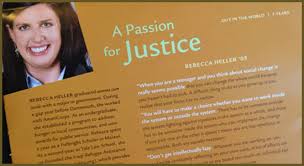
According to Yale Law School: “Rebecca M. Heller is a Visiting Clinical Lecturer in Law at Yale Law School. She graduated from Yale Law School in 2010 and received her B.A. from Dartmouth College. She founded and directs the International Refugee Assistance Project (formerly the Iraqi Refugee Assistance Project) at Yale Law School, an organization that assists refugees in applying for resettlement from abroad and adjusting to life in the United States.”

Tina-Brown-e1459903592737-635x357

download

download (1)

download (2)

heller

Andrew Silow-Carroll writes for JTA:

Rebecca Heller awarded Charles Bronfman Prize for work providing free legal services to those fleeing war, persecution.

John Oliver was in the audience Monday night for the awarding of The Charles Bronfman Prize, and here’s the crazy thing – he may not have been the coolest or even funniest person in the room.

That’s because the honoree at the Manhattan ceremony was Rebecca Heller, the director and co-founder of the International Refugee Assistance Project, which wrangles law students and pro bono attorneys to provide legal assistance to refugees.

The Charles Bronfman Prize, established in honor of the philanthropist by his children, honors Jews under 50 who distinguish themselves in humanitarian work. As Rosalie Silberman Abella, justice of the Supreme Court of Canada, put it in her introductory remarks, Heller represents the “alchemy of passion, fearlessness, resoluteness, entrepreneurship … and feistiness” shared by previous prizewinners.

Heller was at Yale Law School when she travelled to Israel in 2008. In neighboring Jordan, she met with refugees from Iraq and realized in order to navigate a “deeply entrenched” and patchwork system of resettlement, they needed – what else — a good lawyer. The student organization she founded upon her return became IRAP, which has provided legal assistance to more than 10,000 refugees and claims an 85 percent success rate with resettlement. (Oliver featured an IRAP client, an Afghani translator stranded after assisting US forces, on his HBO show “Last Week Tonight.”)

Among those resettled by IRAP was Farah Al-Khafaji, who spoke at the Manhattan ceremony. An Iraqi, Al-Khafaji and her father started an engineering and construction company that assisted American forces in building helipads, roads and security barriers in the wake of the 2003 invasion. This, as you’d imagine, was not a universally popular vocation in Iraq, and in 2006 she was assaulted, her father was kidnapped, and her husband was killed.

After waiting almost six years for the US to award sanctuary to her and her two children, Al-Khafaji had almost given up hope when she heard about Heller and IRAP. Heller got her an interview at the US Embassy, a safe home in Baghdad and eventually a one-way flight to Washington Dulles International Airport.

“My boys and myself would be dead and buried in Iraq” without IRAP, she said at the award ceremony.

In an on-stage conversation with publishing titan Tina Brown, Heller came across less like a global crusader than, I don’t know, a writer for Oliver’s show. (Oliver laughed as loudly as anybody in the audience.)

She recalled a colleague’s advice on making IRAP more professional: “‘We need a better intake system than running into me on the street.’” She described how the US would reject the claims of Iraqi asylum seekers because of dubious charges leveled against them during Saddam Hussein’s reign of terror — compounding their suffering because we “forgot to burn down the Iraqi Ministry of Justice.”

And she ridiculed the torturous screening process that makes refugees from Syria, Africa and Colombia have to prove, over and over again, that “the worst thing that ever happened to you happened.

“And this is the way we are saving people,” she deadpanned.

The award ceremony, postponed from last year so Heller could give birth to her daughter, took place in the genteel surroundings of the New York Historical Society. Meanwhile, a nasty and often misinformed national debate rages on immigration and refugees. Heller, who described herself as an “intensely neurotic and self-critical Jew,” decried the “false conflation between terrorism and refugees” and tied her work to Jewish history.

Today’s refugees are no different from those who wandered from “port to port” during World War II seeking safe harbor, she said. “What’s different is that we are calling them terrorists.”

Lest anyone fail to make that connection, Justice Abella described her Jewish family’s story. Her father survived Theresienstadt, her mother Buchenwald. Her father, a lawyer, was appointed by the Americans as head of legal services at the displaced persons camp where Abella was born.

Abella recalled when Eleanor Roosevelt visited the DP camp, and Jacob Silberman got to offer an official greeting. “These few children are our fortune, and our sole hope for the future,” he told the first lady.

“I was one of those children,” said his daughter, the first Jewish woman to sit on Canada’s high court.

Mike emails: “How appropriate. The Bronfman family has gone from bootlegging booze during prohibition to honoring human bootleggers today.”

Posted in Immigration, Jews | Comments Off on JTA: Meet the ‘intensely neurotic’ Jew saving the world’s refugees

How Come Israel Gets To Use Remittance Weapon And Trump Can’t?

Peter Brimelow writes:

VDARE.com has been discussing the utility of taxing remittances from legal and illegal immigrants back to Mexico for years e.g. National Data | A Supply-Side Solution For Illegal Immigration by Edwin S. Rubenstein, January 26, 2004. So we are naturally delighted by Donald Trump’s just-released proposal to tax remittances to finance his Great Wall of Trump [Trump reveals how he would force Mexico to pay for border wall, by Bob Woodward and Robert Costa, Washington Post, April 5, 2016. A facsimile of the actual proposal is reproduced here].

The MSM, which more than any politicians really has emerged as the Official Opposition and Enforcer of the Narrative, is reacting with its usual outrage and incredulity when confronted with a new and unwelcome idea—just like the famous apes in Kubrick’s 2001: A Space Odyssey trying to scare away the mysterious Monolith:

But if Trump holds his ground, as he will, the MSM will eventually calm down and, like the 2001 apes, start to look at the monolith more carefully, if reluctantly. We went through exactly this cycle with Trump’s proposal to put a hold on Muslim immigration—which, of course, turned out to be immensely popular with, you know, Americans.

Normally, I ascribe this MSM cycle to stupidity and groupthink. But it happens that Israel has successfully used the remittance weapon to get control of illegal immigration, as we have repeatedly documented, for example here.

Yet I can find no mention of this obvious parallel in current coverage. And I don’t believe that no-one in the U.S. MSM is aware of it.

Posted in Immigration, Israel | Comments Off on How Come Israel Gets To Use Remittance Weapon And Trump Can’t?

Dennis Prager: A Note to Conservatives Who Are Secular

Dennis Prager’s idea of who is profound is profoundly revealing:

The most profound thinkers in America are conservative. There are, of course, bright liberal and leftist thinkers, but I can’t think of one who approaches the depth and wisdom of the best conservative writers and thinkers. What liberal historian, for example, approaches the understanding of life and history that author Paul Johnson has exhibited in his many works of history? Who on the left matches psychiatrist/writer Theodore Dalrymple’s insight into the underclass? What left-wing columnists understand human nature, the state of mankind, or contemporary America as do George Will, Charles Krauthammer and Thomas Sowell, or many of the leading columnists at publications such as National Review, City Journal, Commentary Magazine or the Wall Street Journal?

…The vast majority of leading conservative writers, just like their liberal colleagues, have a secular outlook on life. With few exceptions, the conservative political and intellectual worlds are oblivious to the consequences of secularism. They are unaware of the disaster that godlessness in the West has led to.

Most leading Republicans and most of the wealthy donors to the Republican Party — in addition to virtually all libertarian politicians and think tank scholars — are either uninterested in the death of Judeo-Christian religions and values in America and the West, or they’re OK with it. They think that America can survive the death of God and religion, that fiscal and other forms of conservatism without social conservatism can preserve America.

Posted in Conservatives | Comments Off on Dennis Prager: A Note to Conservatives Who Are Secular

Trump Is Nasty and Probably Stupid, Too — but Better than Hillary

I don’t hear much introspection from Dennis Prager about how he totally missed the rise of Donald Trump, how he never expected Trump to dominate the race. This column doesn’t get it. Trump’s stand is on nationalism, protecting America from unfair trade and from illegal immigrants. Ill advised tweets are not that important.

Dark Enlightenment tweets: “The late great @LawrenceAuster called Prager “the silliest man in America”, he continues to live up to that moniker.”

Dennis Prager writes March 31, 2016:

I have said from the outset that I would vote for Donald Trump if he is the Republican candidate. I am contemptuous of much of what he does, I don’t trust what he says, and I have no reason to believe he holds conservative values, but . . .

The “but” is that if he is the Republican nominee, he will be the only alternative to the Left’s further ruining America for another four years — and really for much more than four years, because with two or three more left-wing Supreme Court justices, the Left won’t need to win the presidency or Congress in order to “fundamentally transform the United States of America,” as candidate Barack Obama promised in 2008. With a left-wing Supreme Court, the Court will transform America by simply legislating from the bench; leftist jurists regard their role as promoting “social justice,” not judging according to the rules of justice and within the constraints of the Constitution. As far as domestic policy is concerned, with a left-wing Supreme Court, the presidency and the Congress will become irrelevant. Because I can chew gum and walk at the same time, I can vote for Donald Trump in the general election while at the same finding much of what he does and says unacceptable. As I explain to all those who ask, between a Republican I don’t want and a Democrat I don’t want, I will vote for the Republican I don’t want…

Having said that, whenever I begin to hope that Trump, even if he continues to act indecently, will at least begin to act intelligently as the possibility of his being nominated approaches reality, he does something so stupid that my heart sinks again.

His latest outrage was a tweet with a photo of his wife looking like the beautiful model she is next to an unflattering photo of Ted Cruz’s wife (who, as it happens, in a similarly professionally posed photo, would look very attractive) with the caption (in caps): “THE IMAGES ARE WORTH A THOUSAND WORDS.” Yes, I know Trump did this in reaction to an utterly objectionable Facebook ad by a pro-Cruz PAC targeting Utah voters featuring a nude GQ model photo of Melania Trump from 16 years ago (five years before she married Trump).
Nevertheless, any man who feels compelled to announce to the world that his wife is more beautiful than another man’s wife combines meanness, immaturity, and insecurity. But it is a lack of intelligence — or, if you will, intelligent judgment — that may actually most stand out in his sending out that tweet to humiliate Heidi Cruz. Does he give any thought at all to winning the general election? It would seem that he doesn’t. Because if he did, he would understand what everyone except his most fervent supporters understands — that such a tweet repulses most Americans, both male and female.

How would Trump respond if an aide asked him, “Donald, do you think that tweet will help convince an undecided voter to vote for you?” The answer is that Trump apparently has few or no aides who would ask such a question. In fact, at least with regard to foreign policy, Trump has boasted about consulting with himself. As Politico reported: “Asked on MSNBC’s Morning Joe who he [Trump] talks with consistently about foreign policy, Trump responded, ‘I’m speaking with myself, number one, because I have a very good brain and I’ve said a lot of things.’”

In addition to meanness, immaturity, and personal insecurity, the my-wife-is-more-beautiful-than-your-wife tweet revealed that Trump either is not very intelligent or lacks intelligent judgment. And the latter is actually more disconcerting than the former. The argument that only a very bright man could have been such a successful businessman only reveals the understandable fact that few Americans have ever interacted with billionaires. Very bright billionaires exist, but they are no more common than very bright professors or plumbers or doctors. I don’t know what Ted Cruz’s chances are of winning the general election. But he won’t come close to losing 50 states. With more tweets like this, Donald Trump could. Proving that intelligence without intelligent judgment is worthless.

Posted in Donald Trump | Comments Off on Trump Is Nasty and Probably Stupid, Too — but Better than Hillary

Ties Of Blood And Soil

Steve Sailer tweets: “NYT writer can’t quite figure out Joe Lieberman and GW Bush came up with “Homeland” because the word sounds Israeli.”

There’s a great exchange in the Robert DeNiro movie The Good Shepherd about the creation of the CIA:

Joseph Palmi: Let me ask you something… we Italians, we got our families, and we got the church; the Irish, they have the homeland, Jews their tradition; even the niggers, they got their music. What about you people, Mr. Wilson, what do you have?
Edward Wilson: The United States of America. The rest of you are just visiting.

All culture is the product of particular genes and a particular environment.

Nationalism is the most powerful political force in the world today. Donald Trump is unleashing its power in America. The United States is not just an idea, it is a concrete political state created by a particular people.

James Traub writes for the New York Times:

In 2010, the screenwriter and producer Alex Gansa finished the script for a political thriller involving a deeply troubled C.I.A. agent and a soldier who had been turned by the Taliban, and began thinking about a title. He recalls that he wanted a word or phrase to conjure an atmosphere of “creepy subversion” — something sinister, xenophobic, un-American. “Shadowland”? No, not quite. “Homeland”? Perfect.

Ever since President George W. Bush, in the aftermath of Sept. 11, vowed to “strengthen the homeland” and authorized the establishment of a Department of Homeland Security, this peculiar coinage has burrowed its way into the American lexicon as if it were an earwig. In the current presidential campaign, “homeland” fills the air. In a December debate, both Senator Ted Cruz and Gov. John Kasich included among a president’s core obligations “protecting the homeland.”

Yet as Gansa intuited, a word ostensibly deployed to offer a sense of comfort instead unleashes deep undercurrents of anxiety. When the D.H.S. was first proposed in June 2002, the conservative columnist Peggy Noonan complained that the president should have found some less spine-chilling entity to secure from attack. Even Tom Ridge, the department’s first director, conceded that he had heard grumblings that “homeland” was un-American.

What is it about “homeland” that feels more like a violation than an affirmation of American identity? In traditional usage, the word evokes the link between a people and the state that is theirs, or that they wish to be theirs. With the founding of Israel in 1948, Jews gained a homeland. Palestinians lost one. “Homeland” throbs with the primal forces of state formation. The word points to a world of solidarity forged through blood ties, through ancient ritual and legend.

Posted in America | Comments Off on Ties Of Blood And Soil

The WASP Question

A review of Andrew Fraser’s book in the 2012 Salisbury Review:

‘The few proudly Anglo-Saxon patriots scattered around the world are now political pariahs’, declares Andrew Fraser in The WASP Question. ‘In an age of diversity, they are the invisible race. But their fate is not foreclosed; neither the gene pool nor the spirit of the Anglo-Saxon race is doomed to extinction.’ This former Australian university teacher, after analysing the present predicament of people of English ancestry in an era of commercial materialism and compulsory multiracialism, assesses their chances of survival and revival.

The ‘White Anglo-Saxon Protestant’ acronym, which began as an epithet for US wealthy founder dynasties, now stretches to anyone of British descent. Quite correctly Fraser regards all ‘Wasps’ within the United Kingdom, Australia, New Zealand and North America – as a large ethnic group. They generally possess all four characteristics of ethnicity – phenotypic subspecies (Caucasian), ancestral territory (England), mother tongue (English), and religious tradition (Christian).

The Germanic tribes who founded our Saxon kingdoms absorbed many blood-related Britons, Danes and Normans; Scots, Welsh and Huguenots subsequently strengthened the heartland patrimony. And the transatlantic settlers had undeniably varied ethno-religious backgrounds. Compare Pennsylvania, Maryland, Virginia, and Utah, whose English descended Mormons today combine a bizarre theology with civic achievements.

The faith of the Venerable Bede’s ‘Gens Anglorum’ has transmuted from Thomas Arundel’s medieval ‘Marian Dowry’, through Arthur Bryant’s imperial ‘Protestant Island’ to Cole Morton’s currently abysmal ‘Everywhere and Nowhere, Baby’ with ‘black’ archbishops confronting lesbian ‘priests’, while churches become mosques or museums, and secularists try to clear the faithful from the public space.

The crucial problem is that Wasps, however precisely classified, either no longer possess a positive self-identity as a specific group, or see themselves collectively only in a guilt-relationship towards other communities, who blatantly assert their own ethnicities. In ‘societies’ obliged to ‘celebrate’ intrusive and incompatible ‘cultures’ and fund their grievance obsessed organisations, the erstwhile majority is losing both legitimate self-esteem and effective power within each homeland. ‘The roosters have become featherdusters.’

Particularly serious is Wasp demographic decline, aggravated by non-stop mass-immigration. Whether politicians attempt to preserve the heritage by incompetently ‘assimilating’ newcomers, or to betray it by ‘equality’ and dissolve it through ‘diversity’, it is indeed fallacious to think any distinctive civilization can indefinitely outlive its biological basis.

Fraser brings his formidable expertise in constitutional law to describe government structures from 9th century Wessex down to 21st century Washington, reinforcing his analysis with an erudition that embraces Hannah Arendt, Robert Bellah, Harold Cruse and John Milbank. He shows how a system once shaped by Anglo-Saxon folkways has been perverted into one that nullifies them, and contends that rescuing the founderrace and restoring control over its own future is morally justified. He envisages a future alternative: a worldwide self-sustaining network of English-speaking kinsfolk with their own guilds and churches, fondly recalling countryside villages and prairie homesteads.

Fraser believes the world economy is heading for a prolonged crisis and violent extremism. He is hardly alone; for instance, the economist Nouriel Rubini predicts a ‘perfect storm’ in 2013 from Eurozone chaos, American recession and Middle East war. Such retribution for managerial multiracialism, welfare parasitism, anomic consumerism, and the global nomadism of a mixed multitude, would consequently provide an opening for effective rebellion against the failed propositions and disintegrating structures of the ruling racketeers. However, any deliberate switch amid the wreckage, from hollowed-out constitutionalism towards an Anglo-Saxon ‘racial’ resurrection, requires, especially in our cyberwarfare era, realistic early preparation. There is little sign of that.

Reconsidering Viscount Bolingbroke (Henry IV), Fraser anticipates the emergence of a ‘patriot king’, freed from the conventional advice of ‘godless ministers’. And who can rule out completely someone of royal lineage and personal wisdom eventually seeing his sacred duty in sweeping away corruption, during a severe emergency, and restoring ‘Crown, Church, and Country’?

Nevertheless, serious questions arise: First, will Fraser’s Anglo-Saxon remnant, however united and therefore strengthened, stay as a self-sustaining archipelago, or develop its people-hood into a territorial state-hood, thereby regaining hegemony over urban centres largely occupied by foreigners; and if so, how? Secondly, he draws on the notion of evolutionary competition, which threatens conflict with rival communities on an increasingly overpopulated, resource-depleted planet. Fraser’s plans would require partnership with fellow-Europeans, from Catholic Irish to Orthodox Greeks, at least for common self-defence in any forthcoming major clash of civilizations. He opposes a comprehensive ‘white nationalism’ as vacuous and egalitarian, but surely it is prudent to preserve not merely ourselves from catastrophe but other western Caucasians and their creative elites? Thirdly, Fraser regards religion as decisively important. Without prescribing its detailed liturgy, ministry or doctrine, he proposes an exclusive Anglican ‘Volkskirche’. Unfortunately it resembles a ring-fenced sect, his fusion of ethnicity with worship complicating rather than resolving the spiritual exigencies of our time.

Despite the negative impact of modern scholarship on the credibility of scripture, the author pushes his religious remedies even further with ‘biblical’ arguments against racial intermarriage and an idiosyncratic exegesis of the ‘second coming’ in terms of the ancient destruction of Jerusalem. Nearly two millennia of ecclesiastical experience after Saint Paul ‘turned to the Gentiles’, Fraser too readily invokes the Holy Spirit for his private interpretation and Divine Wrath for his novel mission. However his lucid prose style sparkles with striking imagery and neat alliterations. His book is also beautifully printed. Eccentric even in the heretically pagan Arktos list, it makes a refreshing change from the usual C-of-E bookstall pap. Whether or not by ‘imagining the whole of life – at work and at play, at home, school, and church, in law and even politics – as a form of prayer, the Old Faith will help to hasten that happy moment’ when AngloSaxons themselves are ‘reborn as a people of destiny’, remains debatable. So why not debate it?

Posted in WASPs | Comments Off on The WASP Question

THE ANGLO-SAXON AS PARIAH

Andrew Fraser writes in his 2011 book The WASP Question:

This book seeks to explain why WASPs (a subtly, perhaps deservedly
derogatory acronym coined sometime in the late Fifties to
denote White Anglo-Saxon Protestants) rarely rise to the conscious,
principled defence of their collective biocultural interests, even in the
face of obvious aggression from their racial, ethnic, and religious rivals.
One expects to find Anglophobia among other ethnic groups,
most notably perhaps the Irish and Jews; such antagonism is the natural
and ordinary consequence of inter-ethnic competition. WASPs,
however, simply absorb such hostility; they, too, hold their ancestors
responsible for uniquely monstrous crimes against humanity. Accordingly,
self-loathing WASPs no longer look to an ethnoreligious community
of memory as the indispensable source of collective meaning,
value, and purpose.
Indeed, the few proudly Anglo-Saxon patriots scattered around the
world are now political pariahs. By contrast, the thoroughly deracinated
WASPs who eschew atavistic tribal loyalties are generally welladjusted,
other-directed characters eager to go with the flow. Few
such ^organization men_ and even fewer ^liberated_ women possess
the psychological independence necessary to flout convention and
think for themselves, much less to express genuine solidarity with
their co-ethnics, past and present. Denouncing and despising every
explicit expression of in-group solidarity among their own kith and
kin, WASPs have lost their collective soul. In an age of diversity, they
are the invisible race. But their fate is not foreclosed; neither the gene
pool nor the spirit of the Anglo-Saxon race is doomed to extinction.

Over the next century, a saving remnant of Anglo-Saxon Protestant
ethnopatriots, outcasts from a society in which the normal has become
abnormal, will become a highly visible minority. Sooner or later, they
will step out of the shadows to speak for a people reborn, an ethnonation
like any other, requiring its own place in the sun.
Admittedly, such a prophecy is counter-intuitive. In present circumstances,
any WASP who tries to revive older traditions of ^British
race patriotism_ immediately breaches the bounds of acceptable political
discourse. Paradoxically, pariah status is now an essential precondition
to the rediscovery of collective identity among people of
British ancestry. Useful comparisons can be made between the newly
emancipated Jewish parvenu in Europe during the nineteenth century
and the novel situation facing WASPs who have become strangers in
their own lands. Upwardly-mobile Jews such as Karl Marxws father in
Germany often foreswore open solidarity with their own race and religion
so as to gain admission to polite society and the professions.
Only a few isolated individuals insisted that the emancipation of the
Jews must amount to more ^than an opportunity to ape the gentiles;_
they sought instead the ^admission of Jews as Jews to the ranks of humanity._
In rejecting the ^opportunity to play the parvenu,_ such men
became ^conscious pariahs._ Today only a small minority of WASPs
dare to become conscious pariahs by refusing to renounce their racial
particularity. According to the Jewish scholar Hannah Arendt, this is
an intolerable state of affairs. In her view, it is a fundamental truth of
the human condition that an individual of any nation or race can enter
the ^world history of humanity only by remaining and clinging stubbornly
to what he is._ The systematic denial of that truth reveals the
spiritual emptiness at the heart of modernity: The ^normal,_ welladjusted
and utterly deracinated liberal WASP passing in polite society
as a cosmopolitan and enlightened ^citizen of the world_ is actually
^no less a monster than a hermaphrodite._1 The question arises: Why
are so few WASPs willing to cling any longer to who they are. The answer
lies in the Anglo-American tradition of constitutional patriotism,
a civil religion that transformed the abnormal renunciation of in-
group solidarity among Anglo-Saxon Protestants into the touchstone
of political normality.
In her private and social life, Hannah Arendt clung stubbornly to
the particularistic bioculture and historic folkways of the Jewish people
even as she publicly prescribed a thoroughly secular and cosmopolitan
tradition of civic republicanism for her adopted country. She
dismissed as fanciful the notion that America is or ever was a Christian
republic. She claimed that the religious roots of the American republic
are to be found not in ^the Christian faith in a revealed God_
nor in ^Hebrew obedience to the Creator who was also the Legislator
of the universe._ If the founders ^can be called religious at all,_ Arendt
argued, it was only in ^the original Roman sense_ of the word
^religion._ According to Arendt, Roman religion had little to do with
participation in the divine; it was more concerned with a pious respect
for the halo of time shrouding the origins of the republic. One wonders,
however, whether Arendt ever made the conscious calculation
that the ethnic interests of her fellow Jews are best served by detaching
the American republican tradition from the Anglo-Saxon blood
and Christian faith of the nationws founding people.
Arendt, of course, is far from being the only political theorist to
draw a bright line between the Christian faith and classical republicanism.
JGA Pocock, a New Zealand-born WASP, is perhaps the most
accomplished historian of the Atlantic republican tradition. He, too,
distinguished between Christians who include the whole of humanity
in their quest for eternal life and civic humanists. For the latter, the
republic was universal only in that ^it existed to realize for its citizens
all the values which men were capable of realizing in this life;_ it remained
^particular in the sense that it is located in space and time._
Both Arendt and Pocock presented the classical republic as a secular
association of persons ^formed with a view to some good purpose._
Race and religion play little or no role in the work of either writer. Arendt
concentrated on the abstract categories of work, labor, and action
in her analysis of the constitution of the public and private realms in
the Athenian polis.2 In effect, she discovered the prototype of the
^proposition nation_ in the city states of pagan antiquity. In fact, she
offered her modernist rendition of civic humanism as an antidote to
the primeval urge to discover the divine in the blood and spirit of a
particular people. She found a ready market for that prescription
within the WASP intelligentsia. Certainly, both Arendt and Pocock
exercised a profound influence on my own intellectual development.3
Having fallen under the sway of their purely political civic humanism,
I was ill-prepared to comprehend the scale of the immigration disaster
unfolding before my eyes in Australia, Canada, and the United
States.4
Arendt sought to liberate political theory from the biological imperatives
of natural necessity while providing a secular alternative to
the alleged ^wordlessness_ of apolitical ethnoreligious communities
grounded in Christian charity. Accordingly, she rejected the ^Germaninspired
nationalism_ that regarded ^a nation to be an eternal organic
body, the product of inevitable natural growth of inherent qualities,_
and explained ^peoples, not in terms of political organizations, but in
terms of biological superhuman personalities._ Renouncing ^all neoromantic
appeals to the volk,_ Arendt ^maintained that onews ethnic,
religious, or racial identity was irrelevant to onews identity as a citizen,
and that it should never be made the basis of membership in a political
community._ Arendt was no less hostile to the theological image of
the nation as ^the incarnation of a divine absolute on earth,_ observing
that ^America was spared the cheapest and most dangerous disguise
the absolute ever assumed in the political realm, the disguise of
the nation._ She recognized, of course, that the price homo Americanus
paid for that release was severance from the blood and faith he shared
with his kinfolk in the Old World.5
As a callow legal scholar steeped in both the chronic ethno-anaemia
characteristic of the Canadian WASP and the civic culture of the
American Republic south of the border, I, too, was proof against romantic
appeals to the Volk. Indeed, in the earnestly bilingual and bi-
cultural atmosphere of Canada in the late 1960s and early 1970s, I was
simply bewildered by the ethnic grievance-mongering of newly empowered
Québécois activists billing themselves as ^the White niggers
of America._ It was perhaps natural to seek succor in Arendtws irenic
vision of a political religion brought down to earth, one capable of
creating public spaces in which the civic virtues of a self-selecting aristocracy
would transmute the raw facts of social plurality into a common
world transcending ^the life-span of mortal men._6
My first encounter with Arendtws civic humanism came through
two books, The Human Condition and On Revolution. I was only dimly
aware of Arendtws Jewish identity; she barely mentions Jews or Judaism
in either work. In retrospect, however, her political philosophy
was inseparable from her identity as one of many German Jewish intellectuals
transplanted to America as political refugees. It was easy
for Arendt to conclude that a pariah people such as the Jews were safer
in a pluralistic republic founded upon universal principles of constitutional
law than in an organic nation grounded in the racial identity
of a gentile majority.
To her credit, Arendt sought to hold Jews to the same standards she
set for the American republic. She criticized Zionists repeatedly, both
because they accepted the idea of ^the Jew in general_ as a biological
creature and because they tied the goal of a Jewish homeland to an
absolutist political theology of sovereignty. She insisted that ^The real
goal of the Jews in Palestine is the building up of a Jewish homeland.
This goal must never be sacrificed to the pseudo-sovereignty of a Jewish
state._ Zionists, she believed, ought to recognize the rights of the
Arabs already living in Palestine; turning the Palestinians into another
pariah people in their own country could never be justified. Indeed,
she held up America as a model for the sort of polity that should be
created in Palestine.7 It now seems clear that we were both doomed to
disappointment; modern political and social life is utterly resistant to
a revival of classical republicanism for reasons that are both biological
and theological.

For those prepared to heed its lessons, the last fifty years have
taught us a great deal about the intractable biocultural reality of racial
differences and the consequent limits on pluralism in a modern republican
polity. Certainly, the bloody and interminable conflict between
Zionists and Palestinians suggests a certain naiveté in Arendtws
view that ^the very category zJeww is a human convention masquerading
as a biological fact._8 On the other hand, she had good reason to
fear that the political theology of sovereignty would exacerbate racial,
religious, and ethnic conflict in a self-proclaimed Jewish state ruling a
multi-ethnic society. Meanwhile, experience in the ^Anglo-Saxon
countries_ strongly suggests that European man alone bears the spirit
of civic republicanism, a tradition still largely alien to other races and
peoples.
The civil rights revolution combined with the reverse colonization
of the West by the Third World has undermined the very possibility
of a common world presumptively shared by the citizens of a republican
polity. The corporate welfare state celebrates diversity, and thereby
fosters, deepens, and strengthens the myriad biocultural divisions
between men and women, homosexuals and heterosexuals, blacks and
Whites, Jews and Christians, Muslims and the entire Western world. It
has become an axiom of postmodern politics that the perspective of
any one group is incommensurable with that of others. Representation
of individuals must give way therefore to the representation of
groups. The common good has been deconstructed as an illusion conjured
up by powerful and privileged groups to protect their own particular
interests.
Between-group competition is now an inescapable and ubiquitous
feature of life for WASPs in a multiracial society. Unfortunately, even
as racial and ethnoreligious tensions spill over into a low-intensity
civil war, well-meaning but ineffectual WASPs remain resolutely
blind to both the biological and the theological dimensions of their
collective identity.
NATION OF NATIONS
The major premise underlying this book was best articulated by
Harold Cruse, easily the most incisive black nationalist thinker of the
Sixties. Cruse recognized what most Americans of Anglo-Saxon ances-
try are still loath to admit; namely that America is ^a nation of nations,_
(an observation now equally applicable to Australia, Canada,
New Zealand, and the United Kingdom.)9 He identified AngloSaxons,
Negroes, and Jews as the main players in the inter-ethnic
struggles shaping the (re)distribution of prestige, power, and resources
in American society and politics.
For my purposes, Crusews most important insight is the following
deceptively innocuous but explosively unorthodox proposition:
American WASPs require and deserve explicit recognition as an ethnocultural
group comme les autresfas an ethnonation in itself, if not
yet for itself.10 Unfortunately, as Cruse knew all too well, America is a
nation that habitually lies to itself. Moreover, WASPs are the worst
offenders. America is indeed a polyethnic nation of nations but AngloSaxon
Protestants havefever since the foundation of the Republicf
refused to incorporate that patently obvious reality into their political,
constitutional and theological discourse. The myth of the proposition
nation has a long history.
In the well-ordered multinational America of Crusews dreams, each
of the major ethnic groups would ^produce a native radicalintellectual
trend, which trends should complement one another._11 In
effect, intellectuals provide each ethnonation republic with a corporate
identity; every people acquires its own legal personality empowered
to invoke as it is bound to respect three fundamental constitutional
conventions of the multiracial republic: mutual recognition,
consent, and continuity.12 On Crusews theory, it is the civic duty of
every Anglo-Saxon, Negro, and Jewish intellectual to participate in
the collective consciousness of his ethnonation. In practice, members
of the Jewish intelligentsia alone volunteeredfeagerly and oftenfto
serve as the common (if rarely contrite) conscience of their proudly
ethnocentric people. Highly educated Jews take their communal responsibilities
seriously, ceaselessly working to promote a powerful
spirit of in-group solidarity among their co-ethnics. As a consequence,
the American Jewish community is not just a nation in itself; it is also
an ethnic group famously ready, willing, and able to act for itself. In
pursuit of their self-proclaimed mission to heal the world, Jewish activists
moved quickly and decisively to forge an alliance with black
Americans against an allegedly common foe, Americaws hegemonic
WASP elites.13
The vast majority of American Negroes followed Jewish advice to
forswear black nationalist strategies, as advocated, inter alia, by Booker
T Washington, Marcus Garvey, and Harold Cruse. Such counsel
may have been ^good for the Jews_ but Cruse was convinced that it
poisoned the well-springs of political, cultural, and economic autonomy
in black America. Negroes are now an ethnonation for itself only
in the degraded sense that their leaders clamour incessantly to increase
their entitlements under the federal Leviathanws racial spoils
system. A race so (dare one say, slavishly) dependent upon governmental
largesse hardly counts as a nation in itself.
Those enjoying the WASP lifestyle, on the other hand, represent a
national group only in itself. Americans of British ancestry have never
constituted an organic whole prepared to act for itself. Cruse predicted
that the USA would pay a heavy price for the failure of WASP intellectuals
(and their Negro counterparts) to recognize, promote, and defend
their distinctive ethnonational identity. Cruse took it for granted
that, in a multinational republic, every self-respecting, morally upright
racial, religious, and ethnic group will shoulder its collective responsibilities
in the process of identity politics.
Jews were quick to grasp the proffered opportunity vigorously to
defend their distinctive ethnocultural, economic, and political interests.
Jewish leaders demanded and received public recognition of their
right to a front row pew in the sacramental shrine of the Constitutional
Republic. Accordingly, a triumvirate of Protestant, Catholic, and
Jewish worthies now typically presides over the ceremonial expression
of Americaws constitutional faith. And because corporate membership
in the religion of the Republic carries certain privileges, it became
axiomatic that Jews must consent to social and economic policy
decisions affecting their group interests. Finally, Jewish intellectuals
enlisted private, corporate, and governmental support to ensure their
continuity as a self-governing ethnonation. Unfortunately, they have
not always accorded reciprocal recognition to the biocultural interests
and constitutional claims of other ethnic groups. On the other hand,
neither Anglo-Protestant nor Catholic Americans have been particularly
adept, much less highly principled players in the game of interethnic
competition.
In The Slaughter of Cities E Michael Jones describes the successful
campaign by WASP and Jewish elites to cleanse American cities of
Catholic ethnic enclaves.14 Relocated to the suburbs, Polish, Irish, Italian
and other Catholic ethnic identities were flattened into a homogeneous
Whiteness supposedly shared with Protestants and Jews. Like
Cruse, Jones believes that America would be a better place today if
Catholic ethnic intellectualsfnot least of all those in the Churchfhad
done their job, thereby enabling each of those distinctive ethnic
groups to survive in and for itself. Instead, Catholic ethnics like
WASPs and Negroes before them fell lock, stock, and barrel for utopian
promises of health, wealth, and personal power marketed by the
corporate welfare state as the American Dream. That Faustian bargain
exacted a heavy price, spiritually if not materially, from Americaws
constituent ethnonations.
This book is not, therefore, a narrowly ethnocentric piece of proWASP
advocacy. On the contrary, it mounts an attack on my coethnics;
namely the American WASPs who for over two centuries now
have waged a reckless, revolutionary, and relentless cultural war on
the ethnoreligious traditions which once inspired the Anglo-Saxon
province of Christendom to greatness. American WASPs and their unruly
ancestors have done much for which they ought to fear the wrath
of God. Their salvation may depend upon their willingness to renounce
not just the statist idolatry rampant in the religion of the Republic
but also the enchantments of Mammon for which they have
sold their collective soul. It is well past time for WASPs to accept the
responsibilities and burdens of ethnonationhood. In return, they will
earn the right to bear, once again, the ethnonym of their illustrious
Anglo-Saxon ancestors.
Americaws constitutional faith has been not good for the WASPsf
or any other population group. In the medium- to long-term, even
highly successful Jews will suffer if the WASP disease goes untreated.
Anglo-Saxon Anglophobia is a spiritual disorder whose morally debilitating
symptoms are highly contagious. Should WASPs fail to regenerate
their historic ethnonation, such morbid ethnomasochism is sure
to bring out the worst in other racial, religious, and ethnic groups.
Already Americaws rainbow republic exhibits dangerously high
levels of Jewish hubris, Negro criminality, and Hispanic/Mexican aggression,
as well as chronic moral decay within a rootless Catholic
^faith community_ desperately searching for its lowest common denominator
in the mobile mass of the global multitude. The ethnopathology
which laid homo Americanus low has spread to Anglo-Saxon
Protestants outside the United States. Whether they realize it or not,
the mental and physical well-being of WASPs in Australia, Canada,
New Zealand, and even in England, is inextricably bound up with the
fate of their co-ethnics in America.
Educated WASPs everywhere are remarkably resistant to suggestions
that they, too, are an ethnic group. They prefer to imagine themselves
as autonomous individuals. Sometimes f if the thorny issue of
race comes upfthey will, reluctantly, self-identify as ^Whites;_ but
mostly WASPs regard themselves as ^plain vanilla_ Americans, Australians,
Canadians, and Britons. WASPs around the world disapprove
of ethnonationalism f especially when it rears its ugly head
among their own kith and kin. This book offers intellectual support to
recovering WASPs in their inner spiritual struggle to overcome their
ethnologically peculiar but politically correct and etymologically
sound strain of homophobia.
ANGLO-SAXON ANGLOPHOBIA AND THE NEW TRIBALISM
WASPs are the canary in a multiracial mineshaft. Cracks and fissures
snake around them as the transnational corporate welfare state
digs ever-deeper into the precious stocks of social capital accumulated
over centuries in the ^Anglo-Saxon countries._ Predictions of global
anarchy are rife as nations break down into warring races and tribes.
Ironically, bereft of a powerful sense of collective identity, WASPs
face a future of individual isolation even as ^the quest for the memory
and spirit of the specific ethnic past has once again been renewed._ It
seems likely, according to Kotkin, that a new ^tribalismvforged by
globally dispersed ethnic groups_ will shape the twenty-first centu-
ry.15 This book comes to a similar conclusion: Adapting themselves to
the chaotic challenges of the twenty-first century, prudent WASPs will
re-invent themselves as a global network of Anglo-Saxon tribes.
The only alternative to the self-conscious reconstruction of AngloSaxon
ethnohistory, indeed of an Anglo-Saxon ethnotheology, is everdeepening
demoralization. The secular-minded WASP is now a tragicomic
figure, the object of both pity and contempt. Unless WASPs
somehow recover the tribal spirit of early Anglo-Saxon Christians
they will sink still further into ignominious impotence. A once-proud
people will have been swept aside without a fight, just another sad
story of defeat and dispossession ending not with a bang but with a
whimper. But they may yet find their way back to an alternative future.
During the first Dark Age, the Church served as the seedbed of
the English nation; in our New Dark Age WASPs may discover that
their salvation, on earth as in heaven, lies in a return to the Old Faith
of medieval Christendom.
In Deuteronomy 26: 16s19, God recognized Old Covenant Israel as
his ^special possession._ Biblical prophecies of a New Covenant creation
were fulfilled in AD 70 when Christ came ^on the clouds of heaven
with great power and glory_ (Matthew 24:30) to oversee the destruction
of the Jerusalem Temple. The covenant world of the rebellious
and stiff-necked Jews who had rejected Christ perished along
with the physical structure of the Temple. A new heavens and a new
earth appeared in which every nation (ethnos) was invited to enter into
the Kingdom of God. The rulers of the pagan tribes of Anglo-Saxon
England jumped at the chance. Alfred the Great and other AngloSaxon
kings gladly recognized Jesus the Christ as their Lord. Their
subjects soon conformed to the ways of the King of Kings.
By keeping his commandments, England became the Christian prototype
of a holy nation; indeed the nascent English nation aspired to
be a new Israel. In return, God raised England ^high above all the nations
which he has made,_ if only for a time. Contemporary WASPs
must follow the example set by their remote ancestors in bringing
^praise and fame_ to God. By so doing, they can be reborn as ^a people
holy to the Lord._ Unfortunately, most WASPs today remain
wedded to secular humanism, the civil religion which underpins the
political economy of the modern state. So long as that bloodless faith
survives, the lost souls of the invisible race fall under a collective life
sentence of spiritual servitude.
WASPs are dead not just to their ancestral Christian faith but to the
civic virtues essential to the constitutional health of the body politic.
Forty years ago, Cruse charged that the then ^dominant and representative_
White ethnic group, ^the Anglo-Saxons and their Protestant
ethic_ had abdicated ^their creative and intellectual responsibilities to
the internal American commonweal._ Nothing since then has overcome
the spiritual bankruptcy and ideological hubris, the ^threadbare
cultural heritage,_ associated with the steady hollowing out of AngloSaxon
prestige, power, and influence.16 The three-cornered ethnic
competition between Negroes, Jews, and old-stock Anglo-Americans
continues unabated, but with the addition of many new protected minorities
an ever-expanding diversity industry now honeycombs the
structures of state and corporate power.
In the business of inter-ethnic competition, there must be winners
and losers. Cruse was not surprised when upwardly mobile Jews
quickly stepped into the gaping intellectual vacuum left unattended
by feckless WASPs; before long, he predicted, Jews would ^dominate
scholarship, history, social research, etc._ WASP weakness was a critical
factor in the vector of forces generated within the ^fateful triangular
tension_ between Anglo-Saxons, Negroes, and Jews. Cruse was
right to warn Anglo-Saxons that their ^group must produce its representative
radical-intellectual trend; or else social progress in America
will be ethnically retarded, if not checkmated._17 Well ahead of his
time, he stressed that in at least one crucially important dimension the
biocultural phenomenon of race is, indeed, a ^social construct._
Race is a biological reality but not every racial difference represents
the automatic, physical expression of particular gene pools. In fact, the
social construction of race is always a work in progress, a job that can
be done well or badly. A people can use its God-given genetic capital
for good or for ill. WASP intellectuals deserve to be chastised severely;
they refuse to pay attention to the peerless skill with which American
Jews crafted a collective identity solidly anchored in the ancient moral
imperatives of tribal loyalty. Well-schooled WASPs also turn a blind
eye to shortfalls in the performance of non-European peoples. Con-
spicuous displays of altruism directed toward out-groups are valuable
status markers for educated WASPs indifferent to the claims of ingroup
solidarity. The ^selfish gene_ has become incarnate in WASP
intellectuals who routinely defect to the other side(s) in the game of
identity politics.
Over the past century, the sheer ubiquity of such opportunistic behavior
produced the terminal crisis of the Anglo-Saxon intellectual.
Anglo-Saxon Protestants were on the ropes by the mid-Sixties. The
collapse was not confined to the USA. Cruse probably never took
much notice of Canada where Anglo-Saxons did manage, for a time,
to create a native, conservative intellectual trend, under the aegis of
the British monarchy. But, there too, Anglo-Saxonism had taken several
body blows by 1965. That year marked the publication of George
Grantws Lament for a Nation, a book mourning the defeat of an EnglishCanadian
nationalist movement grounded in ancestral loyalty to British
institutions rejected by the American Revolution. Around the same
time, Britainws entry into the European Common Market broke the
grip of ^British race patriotism_ on the politico-cultural imagination of
opinion leaders in Australia and New Zealand, as well as on the English
themselves.18
Anglo-Saxon Anglophobia is a mysterious affliction, becoming
pandemic among WASPs in tandem with the rise of managerial multiculturalism.
Official multiculturalism destroyed the common civic
culture that WASPs absorb with their motherws milk. Apart from
WASPs, it is now normal for virtually every significant social group to
conceive its racial, religious, ethnic, gender, or lifestyle interests in accordance
with the tribal logic of identity politics. WASPs stand outside
the new tribalism. They cling instead to the scrupulously secular,
color-blind, and gender-neutral norms of civic nationalism. WASPs
donwt ^do_ identity politics; their sense of belonging is based not on
blood but on citizenship. Nor, needless to say, do they regard ingroup
solidarity as a sacred obligation. Unsurprisingly, therefore, in
the second half of the twentieth century, Australia, Canada, New Zea-
land, the UK, and the USA ceased to be Anglo-Saxon countries, spiritually
if not demographically.
IN SEARCH OF AN ANGLO-SAXON VOLKSGEIST
What is at work here is arguably a collective not an individual neurosis.
In search of the deeply repressed Volksgeist of a disappearing
people, we traverse the mundane domain of sociobiologyfto establish
that religion has secular utilityfbefore ascending into the headier
realm of Christian ethnotheologyfto establish that a religion of secular
utility is bad for the Anglo-Saxons.
Our story begins with the emergence of the English people as a socially
cohesive ethnoreligious community; it also tells of their overseas
expansion. The entire narrative recounts an ongoing historical process
in which genes and culture co-evolve; throughout, the biocultural evolution
of the Anglo-Saxon peoples, ^at home_ and in the diaspora, is
evaluated in accordance with the orthodox Christian doctrine of nations.
In other words, we look for the spirit animating the laws of God
and man as it shines through or recedes from Anglo-Saxon biocultures
widely separated in space and time.
The spirit of Anglo-Saxon Christendom manifested itself most publicly
in laws and constitutions. This book rests upon a historiographical
axiom laid down by Walter Ullman: ^The history of jurisprudence
is the history of civilization._ Medieval Europe created a legal civilization,
nowhere more obviously or successfully than in its Anglo-Saxon
province. The English, like other Christian peoples, ^were given their
religion, their faith, their dogma in the shape of the law._19 Accordingly,
this book assumes that there is no better introduction to any period
in Anglo-Saxon history and no more reliable mirror of their character
than a study of the law enacted and practiced, first, in their island
homeland and, now, throughout what remains of the civilization established
by the British diaspora.
Another overarching theme revolves around the quest for the tragic
flaw in the Anglo-Saxon character. How did a once-heroic people
bring about their own downfall? Was the fatal flaw somehow encoded
in their genes or their culture, or even both at once? My thesis is the
social psychology of the Anglo-Saxons evolved in three stages, in a
process of ^punctuated equilibrium._ The primitive, magicoreligious
influences on the social character of the early Anglo-Saxon tribes were
suppressed, first, by formal institutions (embryonic states and the
Church) that fostered the dominant ^tradition-directed_ character
type of medieval England; second, by the development of an ^innerdirected_
character adapted to the early modern bourgeois market
economy; and, third, by the emergence of the ^other-directed_ character
type among WASPs in the service of the modern corporate welfare
state.
As we enter a period of deepening economic crisis, hitherto suppressed
social and political tensions generated by the deliberate demographic
transformation of the Anglo-Saxon countries seem certain
to become more acute. Unmistakeable symptoms of acute racial polarization
are already evident under the Obama administration in the
USA. In this threatening atmosphere of political instability and economic
insecurity, old-stock Americans, along with their co-ethnics in
England, Canada, and Australasia, will be compelled, sooner or later,
to join in the high-stakes game of identity politics. This book provides
them with a game plan; it points, as well, to their greatest weaknessf
the disgraceful absence of the team spirit so central to the old-time religion
of the fabled ^island race._
Ten years ago, John Higham, a prominent WASP historian, observed
that the full story of the ^shattering defeat_ of his own ethnic
group in the mid-twentieth century ^has never been told._ Shortly afterwards,
Eric Kaufmann set out single-handedly to fill that void with
a masterful book on the rise and fall of Anglo-America. One reason for
the previous absence of academic interest in the decline of American
WASPs, Kaufmann remarked, is the unexamined presumption that it
was ^a demographic inevitability of only limited relevance to todayws
debates about Whiteness and multiculturalism._20 The conventional
wisdom holds that WASPs were bound to be overthrown, sooner or
later, by subaltern ethnic groups. In rejecting the dominant interpretation,
Kaufmann took a giant step forward. This book builds upon his
approach.
In several important ways, however, it represents a radical departure
from Kaufmannws work. The most obvious difference between the
two books is in their respective historical and geographic scope.
Kaufmann confines his narrative and analysis to the rise and fall of
homo Americanus. This book examines the ethnogenesis of the English
nation; it also discusses the growth of the state and the companion
system of political economy that powered English colonial expansion
around the world.
Kaufmann and I agree that ^the primary engine of dominant ethnic
decline_ is to be found in ^cultural and ideological changes originating
from within the Anglo-Protestant community._21 But when Kaufmann
celebrates the decline of the WASP, I decline to follow suit. Instead,
this book laments the fall of Anglo-America (along with AngloAustralia,
Anglo-Canada, etc). Kaufmann sees in the ^expressive individualism_
of ^the New York Intellectuals_ positive signs that WASPs
were reforming themselves over the course of the twentieth century.
In my view, the rise of that cultural revolutionary movement signalled
the onset phase of a malignant ethnopathology decked out in the rituals
and trappings of a false religion. On my analysis, the cosmopolitan
creed embraced by Kaufmann is a clear and present danger to the inclusive
fitness of WASPs everywhere, not least of all because it severs
them from their ethnoreligious roots in the ancestral homeland of Anglo-Saxon
Christianity.
My interpretation of world-wide WASP decline, therefore, reflects
what might be termed an ^insiderws_ perspective on Anglo-Saxon ethnohistory.
Kaufmann, on the other hand, remains an ^outsider_ sympathetic
to the demographic weight and biocultural interests of the
Other, an interpretative stance explicitly linked to his ultracosmopolitan
hybridity. He describes himself as ^entirely secular and
zneww immigrant in origin: part postwar Jewish, part Chinese, part
Hispanic._ Born in Hong Kong, Kaufmann holds Canadian citizenship
and apparently passes for a White, North American ^Anglo._ Wearing
the latter hat, Kaufmann rejects the explicitly anti-WASP attitudes of
the radical left; instead he upholds ^the validity of both WASP and
zAmericanw as important ethnic options,_ open in principle to anyone.
Significantly, however, he denies Anglo-Saxon Christians an exclusive
proprietary claim to the WASP brand.22
In advanced societies, Kaufmann believes, WASPs will become an
upper-class status group in which Whites and Asians (as well as
mixed Eurasians) remain overrepresented. Ancestral ties to the British
Isles will matter little: ^In terms of authenticity, light skin and Anglo
cultural characteristics might serve to dignify WASP ancestryf
however partial and distant._ In fact, he declares, ^increasingly race
and ethnicity is being superseded by transethnic cleavages based on
status and ideology._ He predicts ^that racial boundaries, as with ethnic
boundaries, will continue to weaken, thereby generating a symbolically
fluid, highly privatized, post-ethnic social environment._23
Kaufmannws optimistic take on the future of managerial multiculturalism
is a dangerous illusion. WASP identity is more than the leading
lifestyle preference of the rich and famous; it is the biocultural expression
of a deep-seated ethnopathology. We need to take sociobiology
seriously. Contemporary WASP behavior is profoundly dysfunctional
in circumstances of economic scarcity, social disorder, and political
instability. If they are to survive and prosper, Anglo-Saxon ethnoreligious
communities must refuse to reward individuals engaging
in conspicuous public displays of out-group altruism. No longer can
they afford to impose a high social price on the practice of ethnic nepotism
within their own tribal networks. Moral vanity of that sort is a
sin; it is also a maladaptive mistake threatening the survival of an entire
race.
Kaufmann believes that Anglo-Protestant culture can survive even
if Anglo-Protestants cease to exist as a people. Of course, he is neither
an Anglo-Saxon nor a Christian; nobody expects him to be moved either
by the mystic moral magnetism of an ancestral faith or by the biological
bonds of blood brotherhood to mourn the passing of a oncegreat
people. It is quite another matter when prominent WASPs coolly
contemplate the socially engineered extraction of the spiritual essence
incarnate in the flesh and bone of their co-ethnics and its professionally
managed transplantation into the dead heart of an ever-more alien
nation. In such men, we see textbook examples of Anglo-Saxon Anglophobia.
A case in point: a recent, best-selling book by the late Samuel
P Huntington.24
Unlike Kaufmann who is, at most, an honorary ^Anglo_ by virtue
of his Canadian childhood, Huntington was an über-WASP directly
descended from early New England colonists. Despite his antecedents,
Professor Huntington appeared unconcerned for the future of his
people, expressing confidence that enlightened public policies can en-
sure the ideological hegemony of Anglo-Protestant culture in America
even as those carrying the genes of the first English settlers shrink to
an insignificant and voiceless minority. The thesis of this book is clear
and unambiguous: In the absence of a really existing Anglo-Saxon
Christian people, the civilizing influence of Anglo-Saxon Christian
culture will be extinguished. Anglo-Saxon Christians are already an
endangered species; their ethnoreligious community may simply
wither away, leaving behind only a few scattered remnants of the
faithful.
In its blindness, the rest of mankind will barely notice the cosmic
tragedy implicit in the death and destruction of a unique bioculture
born in the sacred light of faith, hope, and charity. In recalling the
birth of Old Englandws Volksgeist, tracing its life cycle to its apparent
end in modern America, and imagining its regeneration many decades
hence, this book resurrects the long-since buried and forgotten
corpus of orthodox Christian ethnotheology.
The novus ordo seclorum proclaimed at the creation of the American
Republic was a major turning point in Anglo-American political and
constitutional history; it also sealed the sorry fate of Anglo-Saxon
Christendom. Until then, colonial Americans formed the vanguard of
the Anglo-Saxon diaspora, thereby laying the biocultural foundation
for a trans-Atlantic ethnonation. My argument, following in the footsteps
of George Grant and his Loyalist forefathers, is that by renouncing
their ancestral allegiance to throne and altar, American revolutionaries
committed something worse than a political or constitutional
blunder. It was a mortal sin to deny and disown sacred bonds of faith,
blood, and honour. (I do not mean to imply that King and Parliament
were as pure as the driven snow. Readers will find ample evidence
below to discourage any such inference.)
This book reminds contemporary WASPs that their advanced state
of decay is visible proof that the wages of sin is deathfa theological
truth that applies to bodies politic no less than to bodies natural. But
the death of the WASP is not the predestined end of this story. Like
the risen Christ, the Anglo-Saxon people will be born anew as they
shed the desiccated skin of the worn-out WASP. The final part of this
book suggests that such a miracle may come to pass through the
twenty-first century revival of Anglo-Saxon identity politics.
Writing in 1992 when the prospect of a ^progressively more integrated
worldwide economic system_ seemed unstoppable, Joel Kotkin
was convinced that ^dispersed groups such as global tribes,_ along
with ^their worldwide business and cultural networks_ were ^particularly
well adapted_ for success. Today, as we ponder the impending
collapse of our ever more unsustainably complex socio-economic systems,
tribal networks offer an even more attractive bolt-hole. Tribesf
the ^organizational cockroach of human history_fhave shown themselves
to be highly adaptive collective survival mechanisms.25 If only
for such pragmatic reasons, WASPs might recall yet another age-old
adage; charity begins at home. In the final analysis, however, home is
where the heart is. Not so very long ago, the heart of the British diaspora
remained ^at home_ in Old England. The natal narrative of that
blessed realm can still provide much-needed inspiration to the postmodern
rebirth of Anglo-Saxon tribalism.


Posted in WASPs | Comments Off on THE ANGLO-SAXON AS PARIAH