Do Body Counts Determine Morality?

Orli writes on Facebook: Sanders may be a decent man, but psychological research in moral development shows us that using only a body count to determine morality, reeks of moral confusion at best, and is immoral at worst. Decades of research in the hierarchy of moral judgments show us that most children before the age of six are not able to include intention in their moral judgments. It is only as brain development proceeds, that children are able to. Even outside the field of psychology, moral systems across the world view the concept of intentionality as so fundamental that nearly all legal systems in the world may reduce, or completely excuse, punishment for harm that was unintentional. This is not a minor point; it is fundamental.
Hamas officials have admitted to using their citizens as human shields, and they have admitted to purposefully targeting Israeli civilians when they fire missiles into Israel. On the other hand, a report submitted to the UN by a multi-national group of former generals and chief of staffs found that “Israel not only met a reasonable international standard of observance of the laws of armed conflict, but in many cases significantly exceeded that standard.”They wrote that “in some cases Israel’s scrupulous adherence to the laws of war cost Israeli soldiers’ and civilians’ lives.” (The UN Human Rights Council, led by Saudi Arabia and containing some of the world’s most egregious human rights violators, necessarily ignores these reports and continues to blame Israel.) So if one wants to use a standard of moral judgment devoid of intentionality, a standard that children less than six years of age primarily use, Israel is to blame for it’s citizens lower body count.
Furthermore, if we are going to regress to measures of moral judgment that are used by children less than six, then we must acknowledge two things. First, in this crude measure, countries will be judged as more moral if they allow an increase in killings of their own citizens. If Israel did not spend millions of dollars in bomb shelters and let their citizens be killed by the tens of thousands of rockets fired upon them, then Israel would be more moral. Second, if we are to regress to these low levels of moral judgment, we must also reassess our history and proclaim that we were more immoral than the Nazis in any battle where we killed more Germans than they killed Americans, and we must now cease from buying and designing any shields that protect our citizens, so that we can go to our graves insuring we had the higher moral ground.
If we apply a kindergarten level of moral judgments, an assessment that only looks at body count and not intention, we will collapse as a civilization. That’s where the moral judgments of five year olds will take us.

Posted in Israel | Comments Off on Do Body Counts Determine Morality?

How Does The World Work?

These ruminations were inspired by a recent David Klinghoffer blog post.

I assume that you accept evolution. (With Dennis Prager, I believe that God created evolution.)

I notice that the more I use evolution to explain the world, the less I think about God. The more I study natural reasons for reality, the less I reach for supernatural reasons.

I believe in God and Orthodox Judaism, but I notice a shift in my thinking about how the world works the past two years from studying evolution. When one type of moss wipes out another type of moss in a pond, that’s how the world works.

When one sub-species wipes out another in a particular place, that’s how the world works. You don’t find two subspecies in the same place in nature.

It’s easy to extrapolate from these facts to people, but humans have capabilities that other sub-species do not, and there have been multi-racial, multi-religious empires that worked.

It’s natural for people to die young of type one diabetes but we now have medicine such as insulin that allows these people to live almost a normal life. So what is natural is not necessarily good.

If I were to think morally, I would find slavery abhorrent. If I think realistically, I assume that stronger groups wipe out and enslave weaker groups.

Most of the intellectual leaders of the Alt-Right are not religious. They are not monotheists. Evolution shapes their worldview.

I am wondering if I am becoming morally desensitized by studying evolution. Slavery used to upset me. It seemed horrible. Now it seems like a fact of life, like group struggle over scarce resources.

Most of the time I prefer to ask — how does the world work? I try to avoid emotion and moral judgment. I prefer to look at people as another form of animal and accountable to many of the same principles that organize the animals. This way I stay calm and I am able to see the different perspectives of various warring groups.

But this is very different from coming at the world from a Torah point of view.

I feel like I can bounce back and forth between the two perspectives. The one perspective is realistic and naturalistic. The other comes from God.

For analyzing reality, I prefer the naturalistic POV. I can easily avoid getting emotionally caught up. First, I try to see what is real and true and natural. Second, I try to apply the moral system I learn from Torah.

Goy Philosopher emails me:

This is very interesting! I do accept evolution, I think. Micro-evolution for sure, though I’m not so sure about macro-evolution. Looking at people as animals is possible, and can be illuminating; it can also be illuminating to look at animals (and other things) as people.

But I don’t really know how to think of slavery as _not_ something abhorrent and just a ‘fact of life’. Much of life seems abhorrent. Predation, for example. Or death, if there’s nothing more than this. (Early death, at least.) It seems we’re placed in a world where ‘the way the world works’ is bound to be horrifying to a moral intelligent being.

I find it hard to understand how God could have created evolution, assuming God is both omnipotent and morally perfect. Evolution depends essentially on mostly random events, and (therefore) it has no teleology. Why would God have used an essentially random non-teleological process to bring about human life, or whatever it is that the process is supposed to accomplish? Also it’s a process that depends essentially on massive amounts of evil — animal suffering, for example — that would be unnecessary (I assume) for an omnipotent creator who wanted to bring about the results of evolution. But a morally perfect being wouldn’t allow gratuitous evil. So I suspect that if macro-evolution really did happen in the way we’re told, either God doesn’t exist or God doesn’t have the properties traditionally ascribed to Him. What do you think? How would you reconcile God’s existence and evolution?

Luke: I believe God plays a role in human history and yet human suffering is off the charts and has always been so. I don’t think there is any extra challenge in reconciling belief in the God of the Bible with macro evolution going back billions of years.

There are a few special problems with macro-evolution (I think). Presumably God allows or causes macro-evolution for some reason. It’s a pretty nasty process so He must have some reason for it. But whatever the reason might be, it seems that an omnipotent morally perfect being would bring about his goal in some other way. The last 6000 years of human history aren’t quite so problematic, because so much of the suffering involved in the history can be chalked up to free human choices (and since God arguably couldn’t bring about human freedom without allowing the possibility we’d do evil with it). But millions of years of macro-evolution seems to be mainly a matter of massive suffering that would be gratuitous if God existed. Of course it can always be claimed we just can’t know the good reasons that He had for allowing it.

But what about the randomness problem? I can imagine that God would allow randomness to some degree within micro-evolution. But in macro-evolution, getting from algae to people (or whatever) on the basis of random processes would seem like a very irrational and — at best — highly unreliable and inefficient process for bringing about the life forms we have now, including humans. In Judaism, at least, humans are very special; God created us and wanted us to exist. But then why would such a being use a largely random ‘method’ in order to do that — a method that could never be more than likely to bring about the intended result? Wouldn’t God necessarily have some faster, more effective and reliable method? These aren’t rhetorical questions, by the way. I just honestly find it hard to understand.

Luke: I don’t see what’s more random about evolution over the past billion years compared to human history over the past 10,000 years. How is that evolution more nasty than human history the past 10,000 years? Much perhaps most of human suffering over the past 10,000 years was inherent to life. Just look at the world around us right now. It’s hard to see the hand of God in it.

Posted in Alt Right, Eugenics, Evolution, Personal | Comments Off on How Does The World Work?

The Intellectual Origins Of The Alt-Right

Roman Dmowski writes: The 9/11 attacks found only two groups with a coherent explanation and proposed strategy: paleoconservatives, who suggested a limited punitive campaign coupled with immigration restriction, and the neoconservatives, who supported an ambitious and “idealist” campaign deliberately designed to destabilize the Middle East and usher in democratic change. The latter won out, but the Iraq War’s results proved lacklaster at first and eventually turned into an undeniable quagmire. Similar results transpired in Afghanistan. The disaster of Arab Democracy appeared in full flower in the Arab Spring, where relatively stable and friendly (or at least manageable) regimes became increasingly hostile, such as Egypt and Libya. And attacks in Boston, Fort Hood, San Bernardino, and Chattanooga were reminders of the importance of immigration restrictions, particularly of Muslims, to any effective containment of the Islamic extremist threat.

The failed campaigns of McCain and Romney also suggested something out of kilter about the Republican message. The prior emphasis on free market capitalism appeared increasingly tone death to the realities of globalization, where immigration and off-shoring rendered a great swath of the economy net losers, especially among the working class. The 2008 economic crisis rendered many once middle class people impoverished, and their own struggles were easily contrasted with the continuing big bonus culture of Wall Street, who obtained massive government assistance to keep their speculation going. Further, there are cultural factors: the decline of marriage and the increasingly Darwinian dating scene, the harsh suffocating effects of political correctness, perennial racial tensions exacerbated by Obama’s leftist message, and the realization among Baby Boomers, who did so well in the 80s and 90s, of their fragile economic position, coupled with the change in the texture of everyday life wrought by immigration and cultural leftism. These changes to the country have all conspired to bring about a strong feeling of dissatisfaction. The Republican Party’s continued embrace of neoconservative foreign policy also fell on increasingly deaf ears, made wise by the unfulfilled promise of the Iraq and Afghanistan campaigns. Finally, the occasional pushes of the GOP’s establishment wing for immigration amnesty, first by Bush in 2005, and then later during the Obama years, added alienation to this dissatisfaction, and amnesty was for many the last straw.

The Alt Right emerged from a combination of these structural and intellectual factors. All of the changes above made core Republican voters–middle class whites–more nationalist in tone and orientation. At the same time, the declining intellectual integrity and influence of the Right’s flagship publications have left lacunae that have been filled from a combination of samizdat sources, ranging in quality, but all of which have been magnified in influence by the weakening power of gatekeepers. On Facebook, Twitter, Reddit, and numerous blogs, wide-ranging “forbidden” ideas have gained currency, including the Mens’s Rights Movement, the nationalist views set forth in Richard Spencer’s Radix publication, the race realism of American Renaissance magazine, Steve Sailer, and Vdare, foreign policy skepticism, and anti-feminism. These heterodox ideas have been further amplified by internet-savvy, alienated, and undeniably mischievous young activists, who are also energetic and sharp, and have been behind such diverse phenomena as the “chalkening,” #gamergate, and #NROrevolt.

Ironically, the increasingly ideological and unrigorous laundry list of official “conservatism” propagated by National Review and the mainstream Republican Party, is less intellectual than ever. The often Catholic intellectual forbears of Reagan’s New Right views are now unread and forgotten for the most part, including by the Alt Right. Instead, we have ended up with the shrill John Podhoretz and unserious Jonah Goldberg, whose main influences appear to be pop culture, in which both are immersed. The new leadership, often Jewish, is frequently reflexively hostile to the ethno-nationalist strains of conservatism that existed even in the very recent past. Further, the devolution of National Review–which has purged such stalwarts as John Derbyshire and Peter Brimelow for their “politically incorrect” musings on race–is engaged in purges on explicitly liberal grounds.

The early National Review did not represent nearly as dramatic a break with the Old Right of H.L. Mencken, Robert Taft, and the American Mercury magazine. Just as the Cold War created a new phenomenon–Soviet sponsored aggressive international socialism– that supported abandoning the traditional isolationism of the Old Right, the new phenomena of globalization, mass immigration, and crony-capitalism collectively demand the revival of the national unit, as well as a privileged position for its core historical demographic (white people), as an adaptation to new circumstances.

Like the occasional New Right thinker such as Erik von Kuehnelt Leddihn, the Alt Right has a more continental and authoritarian view than the classically liberal free market views of the New Right. But even this distinction can be overstated. Reagan embraced the Chrysler bailout and pushed for increasing exports to Japan. Further, Reagan continued the Nixon realpolitik rapprochement with China to weaken our number one foreign policy threat, the Soviet Union. Reagan had the good sense to withdraw from Lebanon after the Beirut Barracks Bombing. No one thought, as many Republican leaders do today, that we were honor bound to stick around the Middle East for 15 years pursuing the impossible, as we have done in Iraq and Afghanistan. Further, our ties to Israel made sense when the Soviet Union went “all in” for Arab Nationalism after 1967, but have become less useful, and positively dangerous in certain cases, after the end of the Cold War.

The modern Republican Party’s “True Conservatism” is an ideologically rigid series of positions on taxes, trade, and foreign relations that proponents imagine, but do little to prove, is coextensive with the interests and flourishing of the American people. Indeed, in characters ranging from Rubio to Jeb to the annoying Kevin Williamson at National Review, we see passionate support for jobs-destroying trade policy and fomenting unnecessary conflict with Russia and Assad’s Syria. We also see a fever pitch of opposition to Trump, who has not signed on to this ossified political ideology, but whose patriotism and right-leanings are undeniable.

Posted in Alt Right | Comments Off on The Intellectual Origins Of The Alt-Right

What Will Follow Donald Trump?

From Vox.com:

It also opens the door for a more sophisticated future candidate, one reared on alt-right arguments rather than stumbling into them the way Trump has. Such a candidate could effectively whip up an alt-right base of support, but potentially use it more intelligently and effectively than Trump. If this sounds fantastical, it’s worth remembering that open white supremacists like Strom Thurmond and James Eastland were serving in the US Senate 40, 30, even 20 years ago. Our current period without avowed white nationalists in power, backed by an organized constituency of the same, is the exception, not the norm.

“Trump is a flashlight. Trump shines a light on forgotten truths,” the neoreactionary Ryan Landry writes. “Trump shines a light on the fact that we truly have reached a point where a candidate who implicitly advocates for whites is considered dangerous and a cause for protest. … Those on the edge have known this anti-white mania is out there, but the protest-riot made it real for millions more.”

That’s exactly it. Neoreaction is on the edge, as is the alt-right as a whole, but Trump is not. Trump is decidedly mainstream. He’s scaring mainstream conservative outlets like National Review and Commentary. And like Gamergate before him, he suggests that the ideas of neoreaction and alt-rightism could potentially break through, and that candidates supported by alt-right elements have a bright future ahead of them.

Posted in Alt Right | Comments Off on What Will Follow Donald Trump?

What Is Neo-Reaction?

From Vox.com:

proxy

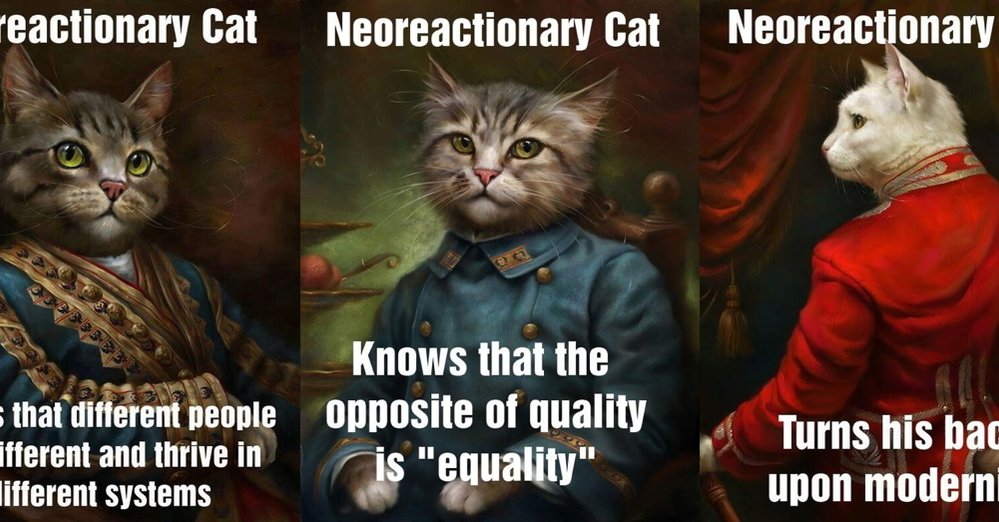
Let’s start with the most theoretically minded, and probably most interesting, branch of the alt-right: the neoreactionaries.

In 2007, a writer with the pen name Mencius Moldbug (né Curtis Yarvin) started a blog called Unqualified Reservations. He proceeded to write essays that would inspire a whole movement of online political writers. The neoreactionaries drew inspiration from earlier paleoconservatives like Pat Buchanan and Joseph Sobran but with a tech-y twist. Moldbug, for one, is a veteran Bay Area programmer currently working on a startup he cofounded called Urbit.

And the core contention of Moldbug and the other NRx thinkers is one that’s been common in technolibertarian circles for a long time: Democracy is a failure.

“Democracy is — as most writers before the 19th century agreed — an ineffective and destructive system of government,” Moldbug writes. Moldbug doesn’t actually like the term “democracy.” He prefers “demotism,” or rule of the people, a label under which he sweeps modern-day developed democracies like the US or Western Europe but also the former Soviet bloc, Nazism, and fascism. “Universalist lawful democracy is the least demotist of demotisms, Demotism Lite if you will,” he writes. “Compared to Communism and Nazism, there’s much to be said for it. But this is a rather low bar.”

The purpose of government, in the view of neoreactionaries, isn’t to represent the will of the people. It’s to govern well, full stop. “From the perspective of its subjects, what counts is not who runs the government but what the government does,” Moldbug explains. “Good government is effective, lawful government. Bad government is ineffective, lawless government. How anyone reasonable could disagree with these statements is quite beyond me. And yet clearly almost everyone does.”

And democratic government, the neoreactionaries insist, is not effective, lawful government. Because the will of the people is arbitrary and varying, it cannot have the consistency of real. durable law, and it creates incentives for wasteful and, worse still, left-wing government. Moldbug started as an Austrian-school libertarian, and most neoreactionaries have general small-government sympathies and express a fear that democracy inevitably leads to ever greater taxation and redistribution, and otherwise encroaches on individual liberty.

“Democracy and ‘progressive democracy’ are synonymous, and indistinguishable from the expansion of the state,” Nick Land, the next most influential neoreactionary thinker after Moldbug, writes. “Since winning elections is overwhelmingly a matter of vote buying, and society’s informational organs (education and media) are no more resistant to bribery than the electorate, a thrifty politician is simply an incompetent politician, and the democratic variant of Darwinism quickly eliminates such misfits from the gene pool.” The result is a government that grows larger and larger.

Moldbug is even blunter: “Cthulhu may swim slowly. But he only swims left.”

This is a strain of thinking that more mainstream libertarians have expressed in greater and greater numbers of late. In 2007, George Mason economist Bryan Caplan argued in The Myth of the Rational Voter that democracy will inevitably lead to suboptimal economic policy because the general public is systematically biased against markets, increased productivity, and trade with foreigners. Peter Thiel, the libertarian billionaire who co-founded PayPal and Palantir and was the first outsider to invest in Facebook, declared in 2009, “I no longer believe that freedom and democracy are compatible.”

But while mainstream libertarians are outspoken about democracy’s deficiencies, they rarely propose an alternative. The neoreactionaries do: monarchy. Well, not monarchy specifically, but some kind of nondemocratic system with rule-driven succession. Moldbug likes to use the term “formalism,” or “neocameralism,” a reference to “cameralism,” the philosophy of government embraced by Frederick the Great of Prussia. Moldbug’s vision is corporatist, where instead of a nation belonging to a royal family, it belongs to corporation with shareholders to whom it is accountable. “To a neocameralist, a state is a business which owns a country,” he writes.

When asked who should lead it, Moldbug’s tech roots come through. “It’s easy to say ‘put Elon [Musk] in charge, he’ll figure it out,’ and he might well,” he tells me via email.

Posted in Alt Right | Comments Off on What Is Neo-Reaction?

What Is The Significance Of 4Chan?

From Vox.com:

The leading actual neoreactionaries are not fans of Donald Trump. “Trump appears to have no ideology at all and very little historical/intellectual awareness of his context,” Moldbug — who now just goes by his birth name, Curtis Yarvin — writes in an email.

“I would love to see a CEO with a real track record of strategic execution in a large enterprise — an Elon Musk or Jeff Bezos — running against Trump. I don’t even think the ideology matters that much; once someone competent got in that office, and felt a real sense of both authority and responsibility, ideology would start to matter a lot less.”

Instead, the alt-right’s affiliation with Trump comes from another group that blended paleocon-ish ideas with internet culture. I speak, of course, of 4chan.

4chan is mostly still a forum for trolling and random nonsense. It was started to discuss anime, and insofar as it’s been political it’s been in a not strictly left-right way, and usually through the avenue of Anonymous, the activist group that split off from 4chan to do direct action. Protesting Scientology and leaking information on the Steubenville rapists are definitely political acts, but they’re not identifiably left-wing or right-wing.

But in recent years, a vocal right-wing contingent has popped up. As New York magazine’s Brian Feldman explains, part of this is an artifact of 4chan gaining popularity and its popular catchall board — /b/ — losing ground to alternatives, notably /pol/, or the “Politically Incorrect” chat board. “To the extent that there is a shared political ideology across /pol/, it’s a heavily ironic mix of garden-variety white supremacy and neo-reactionary movements,” Feldman writes.

“Most days,” the Daily Beast’s Jacob Siegel writes, “/pol/ resembles nothing so much as [white supremacist blog] The Daily Stormer with the signal to noise dial turned only slightly.” The Southern Poverty Law Center has taken notice, with fellow Keegan Hankes telling Siegel, “You can’t understate 4chan’s role. I constantly see 4chan being mentioned by the more Internet- and tech-savvy guys in the white nationalist movement. They’re getting their content from 4chan.”

Hankes has noticed this trend on Reddit as well, noting in a Gawker essay that “Reddit increasingly is providing a home for anti-black racists — and some of the most virulent and violent propaganda around.”

This has channeled into the Trump movement. Milo Yiannopoulos, the Breitbart writer and major Trump defender who’s perhaps the most vocal exponent of alt-rightism online, famously employs an army of interns, a lot of whom he says are “young 4chan guys.” In their own alt-right explainer, Yiannopoulos and co-author Allum Bokhari argue that /pol/’s alt-righters have embraced racism purely for shock value:

Just as the kids of the 60s shocked their parents with promiscuity, long hair and rock’n’roll, so too do the alt-right’s young meme brigades shock older generations with outrageous caricatures, from the Jewish “Shlomo Shekelburg” to “Remove Kebab,” an internet in-joke about the Bosnian genocide. Are they actually bigots? No more than death metal devotees in the 80s were actually Satanists. For them, it’s simply a means to fluster their grandparents … Young people perhaps aren’t primarily attracted to the alt-right because they’re instinctively drawn to its ideology: they’re drawn to it because it seems fresh, daring and funny, while the doctrines of their parents and grandparents seem unexciting, overly-controlling and overly-serious.

For good measure, they quote Moldbug/Yarvin: “If you spend 75 years building a pseudo-religion around anything – an ethnic group, a plaster saint, sexual chastity or the Flying Spaghetti Monster – don’t be surprised when clever 19-year-olds discover that insulting it is now the funniest fucking thing in the world. Because it is.”

This branch of the alt-right has also played an important role in the Gamergate movement, an ongoing effort to harass women in the video game industry until they shut up about equality and representation. Yiannopoulos, who before the controversy called gamers “pungent beta male bollock-scratchers and twelve-year-olds,” jumped on it as a cause with reactionary potential. “GamerGate is remarkable — and attracts the interest of people like me — because it represents perhaps the first time in the last decade or more that a significant incursion has been made in the culture wars against guilt-mongerers, nannies, authoritarians and far-Left agitators,” he wrote in late 2014.

The affinity between gamers and right politics makes sense. “It’s not hard to see why this ideology would catch-on with white male geeks,” Klint Finley writes in his excellent explainer on neoreaction. “It tells them that they are the natural rulers of the world, but that they are simultaneously being oppressed by a secret religious order. And the more media attention is paid to workplace inequality, gentrification and the wealth gap, the more their bias is confirmed.”

“While GamerGate started off as a very diverse, vocal opponent to what they saw was unethical journalism (before it was debunked), many of the anonymous /pol/ rightists would take advantage of its anti-left character by creating sock-puppets,” an anonymous 4channer and ex-Gamergater wrote last year. “Today it is hard to find a 4chan user that doesn’t have an attachment to far right politics.”

And this enthusiasm for far-right politics has bled into Trumpism. JaredTSwift, an alt-righter who got his start on 4chan, gushed to Motherboard’s Oliver Lee, “Trump was meme-able and entertaining, and something like a ban on Muslim immigration would never have been considered before him.”

r/The_Donald — the alt-right dominated home of Trump supporters on Reddit — wracked up 52 million pageviews in March, way more than the 35 million at r/SandersForPresident. The driving force behind the subreddit is CisWhiteMaelstrom, a user whose very name includes the kind of purposefully offensive trolling that defines the Channer alt-right. “Clicking through r/The_Donald is like walking into a rowdy clubhouse for (mostly) men who feel under siege from ‘political correctness,'” MSNBC’s Beny Sarlin reports. Scrolling through the Reddit page, one sees reference after reference to “cuckservatives,” an alt-right term of art which analogizes mainstream conservatives to cuckolded husbands.

Posted in Alt Right | Comments Off on What Is The Significance Of 4Chan?

Before the neoreactionaries, there were the paleocons

From Vox.com:

The neoreactionaries are a distinctly ’00s and ’10s phenomenon, but they draw on the racialist and traditionalist arguments of a much older movement: paleoconservatism.

The term “paleoconservatism” is a retronym coined in the 1980s to characterize a brand of conservatism that was by then going extinct, a brand exemplified by Robert Taft, the Ohio senator and legendary isolationist who lost the 1952 Republican nomination to Dwight Eisenhower, and by Pat Buchanan in his 1992, 1996, and 2000 presidential runs.

Paleocons agree with mainstream conservatism on social issues — they tend to be stridently anti-abortion, anti-LGBTQ rights, pro-school prayer, and disproportionately traditionalist Catholic — and on the evils of the welfare state, but part ways on international affairs, including immigration, trade, and warfare.

Paleocons are largely isolationist, warning America against foreign entanglements and dismissing neocon attempts at democracy promotion as hubristic and doomed to failure. They were overwhelmingly against the Iraq War, and tend to be heavily critical of Israel. They’re also more fervently nationalist than mainstream Republicans. That translates into a very negative view of immigration, both due to its perceived economic harm to Americans and because of the “damage” it does to American culture, and into more support for tariffs and trade protection.

But since Buchanan, the movement hasn’t had a loud national voice. After 9/11, paleocon isolationism became anathema among conservative intellectuals and politicians. Mainstream conservatives like George W. Bush and Marco Rubio embraced immigration reform that offered unauthorized immigrants citizenship. Free trade opposition within the GOP went extinct.

There are a number of reasons the paleocons lost ground, but a big one was that the movement had a huge racism problem. In particular, skepticism of foreign entanglements and of the alliance with Israel specifically would occasionally bleed into overt anti-Semitism.

The saga of Joseph Sobran is a case in point. A longtime columnist at National Review, he was fired by William F. Buckley in 1993 following years of open clashes about his attitude toward Israel and Jewish people in general. In 1991, Buckley had dedicated an entire issue of the magazine to a 40,000-word essay he wrote, “In Search of Anti-Semitism,” in which he condemned Buchanan (then challenging President George H.W. Bush in the GOP primaries) and his employee Sobran for anti-Jewish prejudice. Buckley had a point. Sobran really was a world-class anti-Semite, writing in one National Review column , “If Christians were sometimes hostile to Jews, that worked two ways. Some rabbinical authorities held that it was permissible to cheat and even kill Gentiles.”

After leaving NR, Sobran’s writing, in the words of fellow paleocon and American Conservative editor Scott McConnell, “deteriorated into the indefensible.” He started speaking at conferences organized by famed Holocaust denier David Irving and the denial group Institute for Historical Review, asking at the latter, “Why on earth is it ‘anti-Jewish’ to conclude from the evidence that the standard numbers of Jews murdered are inaccurate, or that the Hitler regime, bad as it was in many ways, was not, in fact, intent on racial extermination?”

He wasn’t alone. John Derbyshire, perhaps the last real paleocon left at National Review, was canned in 2012 after writing a piece addressed to children full of advice like, “Avoid concentrations of blacks not all known to you personally,” “Stay out of heavily black neighborhoods,” and, “If planning a trip to a beach of amusement park at some date, find out whether it is likely to be swamped with blacks on that date.”

After that, Derbyshire started writing at VDARE, an anti-immigration white nationalist site named after Virginia Dare, the first white Christian born in British North America. The article that got him fired wasn’t actually posted at National Review but at Taki’s Magazine, an outlet run by millionaire paleocon Taki Theodoracopulos that was formerly edited by outspoken white supremacist Richard B. Spencer and has run articles by Theodoracopulos in support of the Greek neo-Nazi party Golden Dawn.

This has been the trend for paleoconservative writing in the past decade or two. It’s largely turned from mainstream conservative outfits to openly racist venues like VDARE, Taki’s, American Renaissance, and the Occidental Observer. Admirably, the American Conservative has held the line and resisted crossing over into open white nationalism, but they’re basically alone in that.

Meanwhile, Pat Buchanan, the paleocons’ great political hope, has more or less always been this openly bigoted. In 1990 he infamously insisted that 850,000 Jews couldn’t have died at Treblinka from diesel fumes. In 2007 he declared, “If you want to know ethnicity and power in the United States Senate, 13 members of the Senate are Jewish folks who are from 2 percent of the population. That is where real power is at.” In 2008, he wrote an entire book arguing that the Second World War was basically Britain’s fault and Hitler was largely blameless. So it’s no surprise that he, too, has been increasingly marginalized, losing his MSNBC position in 2012.

The neoreactionaries are not simply heirs to the paleoconservatives. The paleocons are ultimately more religious, and more loyal to the US Constitution and basic small-r republican ideals. But the neoreactionaries share with the paleocons a belief in tribalism and racial difference, and a deep sense that the mainstream is trying to crush them. Joseph Sobran didn’t use the term “Cathedral,” but he’d surely think it to blame for his marginalization.

COMMENTS ON RADIX:

* This represents the normalization of White Nationalism and the Alt-Right and hence its acceptance and eventual victory–and the elites are terrified.

The folks at Radix are doing the right thing. It’s working.

Posted in Alt Right | Comments Off on Before the neoreactionaries, there were the paleocons

What Is A Hate Group?

From the perspective of Amalekites (and those who identify with them), Jews are a hate group.

From the perspective of Palestinians, Jews are a hate group.

From the perspective of white nationalists, Jews are a hate group.

From a Jewish perspective, white nationalists are a hate group.

From the perspective of at least a third of Muslims worldwide, Jews are a hate group.

For much of Christian history, Jews have been regarded as a hate group.

From the perspective of Haman, Mordecai and the Jews comprised a hate group. From the perspective of the Jews in the Book of Esther, Haman and his cohorts represented a hate group.

From the perspective of the ancient Pharoah in the Book of Exodus, the Jews were a hate group. From a Jewish perspective, the Egyptian hierarchy was a hate group.

From the perspective of the Nazis, the Jews were a hate group.

From the perspective of the Jews, the Nazis were a hate group.

From a Jewish perspective, much of Muslim identity is based on hate.

From a Tibetan perspective, the Chinese invading their country are a hate group.

During the Cold War, I thought of the communists as a hate group.

If you love something, you are going to hate that which threatens it. All groups are engaged in a competition for scarce resources. When another group threatens your well-being, you are naturally going to hate it.

Posted in Diversity | Comments Off on What Is A Hate Group?

Time Magazine Covers The Alt-Right

THE BILLIONAIRE AND THE BIGOTS

HOW DONALD TRUMP’S CAMPAIGN BROUGHT WHITE NATIONALISTS OUT OF THE SHADOWS

BY ALEX ALTMAN

TIME, APRIL 25, 2016

The men eased past the picketers and police barricades, through a security-studded lobby and up to the eighth floor of a federal building named for Ronald Reagan. Inside an airy rotunda, guests in jackets and ties mingled over pork sliders and seafood tacos served by black waiters in tuxedos. There were celebratory speeches during dinner, crème brûlée for dessert. Apart from the racial epithets wafting around the room, the Saturday-night banquet seemed more like a wedding reception than a meeting of white nationalists. The event was sponsored by the National Policy Institute (NPI), a tiny think tank based in Arlington, Va., dedicated to the advancement of “people of European descent.” NPI publishes pseudo-scientific tracts with titles like “Race Differences in Intelligence,” runs a blog called Radix Journal (sample post: “My Hate Group Is Different Than Your Hate Group”) and holds conferences on topics like immigration and identity politics. This time it had gathered a group of 150 sympathizers in downtown Washington to discuss what the rise of Donald Trump has meant for the far right. Since the start of the 2016 campaign, Trump has built a broad coalition of supporters, attracting voters with his forceful personality and his willingness to challenge party doctrine. And while the vast majority are driven by reasons other than race, Trump has also emerged as a hero to white nationalists. “Trump has energized us,” says Richard Spencer, president of NPI. For the first time since George Wallace in 1968, far-right activists in the U.S. are migrating toward mainstream electoral politics, stepping out of the shadows to attend rallies, offer endorsements and serve as volunteers. “It’s bound to happen,” Spencer says of white nationalists’ running for office one day.
“Not as conservatives but as Trump Republicans.”

Extremists have latched on to Trump as a rallying cry and recruiting tool. Attendance at NPI events has jumped 75% over the past year, Spencer says.

[ . . . ]

THE ALT RIGHT

A billionaire mogul from multicultural Manhattan makes an unlikely tribune for a white-grievance movement. But in more than a dozen interviews, extremists described why they feel galvanized by Trump’s candidacy. They love his calls for walling of the southern border and barring Muslim immigration. They find his salvos against political correctness refreshing. And they interpret his laments of national decline as a dog whistle about demographic change.

Now they’re hoping a powerful and ubiquitous messenger can spread their ideas. “It used to be that nobody would say these things,” says Richard, a Maryland resident in his 20s wearing a wispy beard and a black knit tie. “Trump has opened the door to nationalism in this country—not American nationalism but the white race. Once that door has fully swung open, you can’t close it.”

Trump’s ascendancy comes at a moment of reinvention for the far right. A new generation of leaders like NPI’s Spencer are trying to recast white nationalism as a 21st century movement steeped in social media. The NPI meeting was dominated by young men under 30, many of whom said they were part of an online network known as the Alt (for Alternative) Right. Originally rooted in antipathy to mainstream conservatism, the Alt Right has morphed over the past year into a virtual pro-Trump army. It’s a loose collection of furies who range from provocative Twitter trolls to white-rights activists, garden-variety anti-Semites, proto-fascists and overt neo-Nazis.

Like any other movement that peddles belonging to the alienated, the Alt Right has developed its own lexicon. The protesters holding anti-racist signs on the sidewalk below were classic “SJWs” (a derisive acronym for social-justice warriors). Establishment Republicans are known as “cuckservatives,” a term designed to connote emasculation. Both groups fall into the category of people whom members of the Alt Right refer to on Twitter and in blogs like the Right Stuff as “ovenworthy.”

Though they often disagree on tone and tactics, members of the Alt Right are bound by a few core beliefs. They regard most Republican politicians as Zionist puppets, captive to corporations seeking cheap labor. They tend to be protectionist on trade, isolationist on foreign policy and unmoved by cornerstone conservative issues like free markets or the Constitution. They reject the benefits of diversity and view demographic trends as an existential threat.

Over $10 cocktails at the NPI event, white nationalists described U.S. population dynamics with a sense of dread. “In a democracy, the majority rules,” said Jefrey, a 27-year-old soap entrepreneur from Louisiana. “If we become a minority in our own country, we will be stripped of our power.” Others suggested that they could face systemic persecution if white birthrates remain low and immigration isn’t curtailed.

“Diversity brings differences, and sometimes those differences are so irreconcilable, they cause conflict,” said Nathan Damigo, a 29-year-old student from Oakdale, Calif., who blogs about incidents of alleged anti-white bias. To Damigo, a former Marine who fought on the sectarian battle fields of Iraq, the rise of a candidate like Trump was inevitable. “This is what happens in all multiracial, multi-religious, multiethnic societies,” he said. “Identity politics trumps everything else.”

[. . . ]

THE WHITE ETHNOSTATE

Richard Spencer is ready to seize the moment. Spencer, 37, has devoted much of his adult life to forging a new path for white nationalism. “We need to present ourselves as serious and attractive,” he explains. “The type of people who can rule a country one day.”

Spencer is clean-cut, polite and solicitous. He spends his days on Twitter and Slack and peppers his paragraphs with academic jargon picked up during postgraduate studies at Duke and the University of Chicago. At the NPI meeting, where the tables were decorated with images of Trump’s golden mane, he wore a dark suit, a purple vest over a pink dress shirt and a distinctive haircut—shaved on the sides, longish on top—that has been widely mimicked by white nationalists.

Spencer strives to soften the edges of his ideology. He says he rejects white supremacy and considers slavery “abhorrent.” He calls himself an “identitarian,” a belief system that emphasizes racial identity and has much more in common with European far-right movements than anything cooked up by William F. Buckley and his cohort. But the preppy demeanor belies a radical vision: the establishment of a whites-only “ethnostate.”

It’s still just a fantasy, Spencer admits. But he’s not wrong to suggest that the rise of Trump, coupled with demographic trends and social crosscurrents, has imbued this cause with new momentum. The Black Lives Matter movement that took root in Ferguson, Mo., has fed a broader white-persecution complex. About 4 in 10 Americans—and nearly 75% of Trump supporters—say discrimination against whites is now as big a problem as discrimination against blacks, according to a November study by the Public Religion Research Institute.

Attempts to stifle free speech on college campuses—where students seek out “safe spaces” and complain that chalking “Trump 2016” on the quad is an act of intimidation—seem to validate the candidate’s jeremiads against political correctness. Meanwhile, the GOP’s perpetual pursuit of policies like free trade, entitlement cuts and lower taxes for the wealthy has widened the gulf between party bosses and the base. “Conservatism is committing suicide,” Spencer says. “We want to fill that space.”

In the age of Trump, the emergence of a new nationalist third party no longer seems impossible. The GOP front runner has shattered so many taboos, smashed so many conservative idols, that to Spencer it feels as if a movement rooted in race and identity, rather than the Constitution and capitalism, is gathering steam. It may take years of fitful progress, he predicts, capped by some seismic shock—a sudden war, a stock-market crash. Or maybe just the arrival of a candidate like Donald Trump.

Posted in Alt Right, Jews | Comments Off on Time Magazine Covers The Alt-Right

Why Can’t Jews Have Safe Spaces?

Why can’t Jews have communities where they can be free from Palestinian attacks? The only way to do that is to have communities from Palestinians.

Why should not all Israel be free from Palestinian attacks? The only way to do that would be to ban all Muslism from the Jewish state.

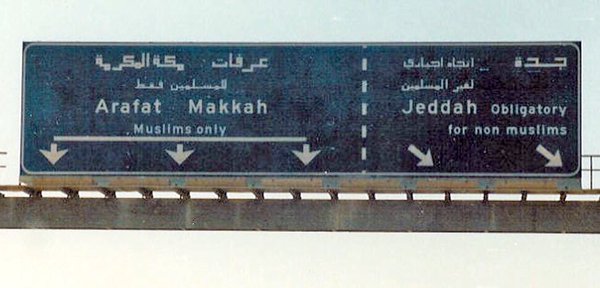
The Muslim state of Saudi Arabia has no problem banning non-Muslims from many of its sacred spaces. Why can’t the Jewish state do the same?

Ccr93ozUAAAJqgw

Ccr93ooUsAIFVVa

Why can’t all peoples have safe spaces? Why can’t the Japanese have spaces free of non-Japanese? Why can’t Tibetans have spaces free of non-Tibetans? Why can’t whites have neighborhoods free from non-whites? If gentiles want to have social clubs and hotels free from Jews, why should not the goyim have safe spaces?

Saudi Arabia’s set-up of banning non-Muslims from sacred spaces does not bother me in the least. Saudi Arabia’s decision to ban the practice of Judaism and Christianity on its soil is fine with me too. In this case, I think the Saudis are shining the light. Distinctive civilization requires exclusion. Let’s do such things the Saudi way.

Posted in Islam, Israel | Comments Off on Why Can’t Jews Have Safe Spaces?