Biblical Rhetoric of Separatism and Universalism and Its Intolerant Consequences

Professor James W. Watts writes in 2020: “Studies of the distant past, however, have one big advantage over studies of contemporary cultures: history allows us to trace the effects of religious rhetoric and practices over centuries and millennia to reveal not only their influence, but also their unintended consequences.”

How do you trace the effects of religious rhetoric and practices in ancient times? For that matter, how do you do it in modern times? How do you distinguish this influence from other things? There’s never “religion” without reference to its source in a particular “culture” that in turn comes from a particular people in a particular environment dealing with particular challenges.

There was no “religion” in the ancient world. Jewish history, for example, has never had “religion” nor has Islam.

“The specific reactions I will describe here, separatism (or particularism) and universalism, have both generated intolerant violence, often within the same religious tradition.”

How do you know that separatism and universalism generated intolerant violence? Maybe that sprung from other factors?

“I believe that this history, that juxtaposes some of the deleterious effects of both separatism and universalism,
needs to be repeated to show how moral judgments on others’ religious practices can generate even worse abuses.”

There’s nothing that can’t have deleterious effects, including going for a walk and enjoying a thorough defecation.

“I offer this review as a cautionary tale of how opposite religious ideals embraced at the origins of two traditions can go unexpectedly and badly wrong.”

Wrong for whom? Wrong according to whom? James W. Watts?

“The first five books of the Bible, called the Torah or Pentateuch, and later the whole Hebrew Bible, also called the Tanak or Old Testament, were among the tools used by Judah’s priestly class to weld together ethnic identity and national aspirations into a religious identity as Jews.”

Jews don’t know of religion. This is so goyish.

“The influence of the Bible’s rhetoric of separation from the Canaanites and other peoples has been especially evident in the cultures of the American continents over the last five centuries…”

If there was no Bible, would there be any significant difference in European conquest of the Americas? How has this conquest been different from other conquests? It has not been to the defeated. The rhetoric that people use to justify their behavior is of rhetorical interest, but does not demonstrate real world influence.

Posted in Religion | Comments Off on Biblical Rhetoric of Separatism and Universalism and Its Intolerant Consequences

Why Do White Evangelicals Support Trump?

From the New York Times:

Evangelicals did not support Mr. Trump in spite of who he is. They supported him because of who he is, and because of who they are. He is their protector, the bully who is on their side, the one who offered safety amid their fears that their country as they know it, and their place in it, is changing, and changing quickly. White straight married couples with children who go to church regularly are no longer the American mainstream. An entire way of life, one in which their values were dominant, could be headed for extinction. And Mr. Trump offered to restore them to power, as though they have not been in power all along.

“You are always only one generation away from losing Christianity,” said Micah Schouten, who was born and raised in Sioux Center, recalling something a former pastor used to say. “If you don’t teach it to your children it ends. It stops right there.”

…The years of the Obama presidency were confusing to her. She said she heard talk of giving freedoms to gay people and members of minority groups. But to her it felt like her freedoms were being taken away. And that she was turning into the minority.

“I do not love Trump. I think Trump is good for America as a country. I think Trump is going to restore our freedoms, where we spent eight years, if not more, with our freedoms slowly being taken away under the guise of giving freedoms to all,” she said. “Caucasian-Americans are becoming a minority. Rapidly.”

She explained what she meant. “If you are a hard-working Caucasian-American, your rights are being limited because you are seen as against all the races or against women,” she said. “Or there are people who think that because we have conservative values and we value the family and I value submitting to my husband, I must be against women’s rights.”

Her voice grew strong. “I would say it takes a stronger woman to submit to a man than to want to rule over him. And I would argue that point to the death,” she said.

She felt freer as she spoke. “Mike Pence is a wonderful gentleman,” she said. “This is probably a very bad analogy, but I’d say he is like the very supportive, submissive wife to Trump. He does the hard work, and the husband gets the glory.”

* “We are making this huge issue of white versus Black, Black Lives Matter. All lives matter,” she said. “There are more deaths from abortion than there are from corona, but we are not fighting that battle.”

“We are picking and choosing who matters and who doesn’t,” she said. “They say they are being picked on, when we are all being picked on in one shape or form.”

* There is a straight line from that day at Dordt four years ago to a recent scene at a chapel in Washington, where armed officers tear-gassed peaceful protesters in Lafayette Square and shot them with rubber pellets. They were clearing the way for Mr. Trump to march from the White House to St. John’s Episcopal Church and hold up a Bible, a declaration of Christian power.

“We have the greatest country in the world,” he said. “We’re going to keep it nice and safe.”

It was another instantly infamous moment, covered by cable news and decried by Democrats as an unseemly photo op. But in Sioux Center, many evangelicals once again received a different message, one that echoed the words uttered by a long-shot presidential candidate in a sanctuary on a cold winter morning.

“To me it was like, that’s great. Trump is recognizing the Bible, we are one nation under God,” Mr. Schouten said. “He is willing to stand out there and take a picture of it for the country to see.”

He added: “Trump was standing up for Christianity.”

Posted in Christianity | Comments Off on Why Do White Evangelicals Support Trump?

Is Nothing Sacred? Religion and Sex

From Psychology Today:

For adults, their sexual strategies appear to determine their level of commitment to religion. People who are inclined toward monogamy choose to be religious, because traditional religions provide support for a family lifestyle, and discourage promiscuity. Promiscuity poses problems for family life from both the husband’s and the wife’s perspective. If there is a lot of promiscuity in the local society, then husbands (and their resources) may be easily tempted away from the responsibilities of fathering and family.

Men are, after all, notoriously easy, as attested to by data suggesting they have very low thresholds for a one-night stand, for example (Clark & Hatfield; Li & Kenrick, Kenrick et al., 1990; 1993). But if so, why would men, married or otherwise, want promiscuity discouraged? Weeden links that to paternal uncertainty: a married man is investing heavily in his offspring, and in a totally promiscuous society, the odds would be higher that his female partner’s children might not be his.

Not everyone wants strong constraints on sexuality, though. Highly educated people often wait many years past puberty to settle down, as they delay starting a family for up to a decade while attending college and graduate school. Those individuals do not want strong prohibitions against premarital sexuality and birth control because it would mean they’d need to remain celibate for many years, and completely suppress their post-pubertal sexual urges until they get their Ph.D., M.D., or law degree, and then wait a little longer until they find a partner with whom to settle down. Weeden has suggested that the links between religion and reproductive strategy account for many of the heated moral conflicts between the religious right and the irreligious academic elitists on the left.

Several large data sets now provide results consistent with this view of reproductive religiosity, suggesting that people’s preferred mating strategies strongly influence their attraction toward, or repulsion from, religion. Weeden finds that the normally high correlations between religious beliefs and other moral attitudes shrink if you control for people’s attitudes towards sex. And Mike McCullough, another prominent expert on the psychology of religion, finds that many people tend to become especially religious during the years when they have children, and then to become less devout later in life.

The reproductive religiosity model helps solve another logical puzzle. It has often been presumed that men use religiosity to control women’s sexuality. But then why is it that women are much more likely to embrace religious beliefs than are men? This becomes less puzzling when one considers that, because of their intrinsically higher initial investment in offspring, women are less likely to benefit from a sexually unrestricted strategy, and more likely to benefit if men’s unrestricted inclinations are kept in check. On this view, women may be actively choosing religion rather than being passively enslaved by it.

* people trust religious people more than non-religious people. However, they did a clever study in which they gave judges information not only about someone’s religious beliefs, but also about their mating strategy. The results suggest that, if you know an atheist also happens to be a committed monogamist, you would trust that person more than you’d trust a religious person who is non-monogamous. Those findings suggest that the distrust of atheists is driven in large part by presumptions about their mating strategies

* Our ancestors’ reproductive success depended not only on finding a mate, but also on maintaining a long-term relationship with that mate, caring for their children, developing a network of friends and relatives to protect and assist one another, and winning the respect and trust of those friends and relatives. And religion has intimate connections to every one of these fundamental human goals.

Posted in Religion, Sex | Comments Off on Is Nothing Sacred? Religion and Sex

Paul Johnson’s A History Of The English People

In his prologue to the 1980 edition, Johnson wrote:

* A third objection to this book is that, in its exclusive preoccupation with the English, or rather with the peoples who have occupied the land we call England, it presupposes that history is Anglocentric, and is therefore irrelevant in an age when the centres of world power have shifted elsewhere. Many modern historians, notably Professor Geoffrey Barraclough in his admirable book, History in a Changing World, have urged that we should abandon the habit of writing history based on the assumption that a particular race is the sole active agent. Such advice has been widely followed. One American scholar notes sadly the decline of English historical studies in the United States in a period when the subject has to fight hard for a toe-hold in curricula in which students are invited to study such topics as the dynamics of Soviet power, under-development among the African peoples, the renascence of Moslem culture, or parliamentary institutions in Asian countries, and when English history has been dropped altogether from the curriculum of most schools.

Now I object strongly to this drift away from English history, which is part of a wider movement away from European and North Atlantic history. Virtually all the ideas, knowledge, techniques and institutions around which the world revolves came from the European theatre and its ocean offshoots; many of them came quite explicitly from England, which was the principal matrix of modern society. Moreover, the West is still the chief repository of free institutions; and these alone, in the long run, guarantee further progress in ideas and inventions. Powerful societies are rising elsewhere not by virtue of their rejection of western world habits but by their success in imitating them. What ideas has Soviet Russia produced? Or Communist China? Or post-war Japan? Where is the surge of discovery from the Arab world? Or liberated Africa? Or, for that matter, from Latin America, independent now for more than 150 years? It is a thin harvest indeed, distinguished chiefly by infinite variations on the ancient themes of violence, cruelty, suppression of freedom and the destruction of the individual spirit. The sober and unpopular truth is that whatever hope there is for mankind – at least for the foreseeable future – lies in the ingenuity and the civilised standards of the West, above all in those western elements permeated by English ideas and traditions. To deny this is to surrender to fashionable cant and humbug. When we are taught by the Russians and the Chinese how to improve the human condition, when the Japanese give us science, and the Africans a great literature, when the Arabs show us the road to prosperity and the Latin Americans to freedom, then will be the time to change the axis of our history.

* The English responded to strong central government, invested with majesty and colour, and operated by a self-confident will. Henry VIII’s last speech to Parliament was an astonishing performance. His government had nothing to report but failure, but the King subjected the assembly to a magisterial harangue, in which all sections of the community were in turn soundly rebuked for their shortcomings. He contrived to give the impression that the nation was entirely to blame for any evils which had befallen it, and that it was exceedingly fortunate he was still prepared to remain at the helm and protect it from the worst consequences of its folly. The speech was heard in breathless admiration, and was never forgotten by all those present. Many of them, we are told, actually wept
tears of love, penitence and gratitude.

This gift of royal showmanship Henry passed on, in all its plenitude, to his dazzling daughter Elizabeth. To be sure, she supplemented it with an enviable range of qualities and accomplishments: a subtle intelligence, industry and self-discipline, prudence and deliberation, a warm heart and a virtuous mind. But without it she could not have
kept her throne, let alone given a divided, weak and desperately vulnerable nation the strength which comes from unity and a common purpose. No woman had ever presided successfully over a medieval court, whose function was to associate the chief landed proprietors with the business of government, and determine a fair division of its
spoils. Their animal energies found natural expression in violence, whether civil or international; such energies could only be diverted into more useful channels by the cynosure of the throne, whose authority sprang from its tenant’s ability to epitomise and transcend the ruffianly virtues of a military aristocracy. A woman’s sex was thus a daunting handicap. Elizabeth’s political genius consisted in turning it into an asset. She did not attempt to disguise her sex; on the contrary she emphasised it. In her great speeches, she always reminded her hearers that she was a woman. But she was a woman sui generis. They could turn her out in her petticoats, she said, and she would make a living anywhere in Europe. She had a woman’s body but ‘the heart and stomach of a king’. She was careful not to say ‘of a man’. She was not an emancipationist ; she did not believe in woman’s liberation. She did not seek to play a masculine role, and so injure the men she had to control in their pride. The English had burnt Joan of Arc for precisely that mistake.

Elizabeth vaunted her sex. Her weapons were an astonishing wardrobe, a collection of jewels which even the popes envied, false hair, paint and powder, and the universal knowledge that behind these trappings lay a resolute and imperious spirit which it was perilous to challenge. Elizabeth did not need men, unlike her wretched half-sister Mary, and her still more unhappy cousin Mary of Scotland. She was chaste by choice, and virtuous by policy and inclination. The mystique of her court – the cult of the Faerie Queen, the sexual favourites, the pretend love-affairs, the political minuets she danced with the popinjays who surrounded her – was an elaborate and calculated exercise in royal diplomacy, designed to replace the licensed gangsterism of masculine chivalry by a non-violent system which a woman could manipulate. It seems to us in retrospect shameful that this noble and virtuous queen, whose intelligence soared above her courtiers’, and whose ability and sense of responsibility rivalled that of even her most devoted and accomplished advisers, should have felt it necessary to demean herself to this masquerade. But there was no other way.

* The truth is, the English had a particular order of priorities in the way in which they invested their brain-power, and industry certainly came low down the scale. The elite education system was geared to produce, above all, politicians, lawyers and churchmen.* It inculcated habits of thought peculiarly well adapted to these professions. It deliberately and systematically encouraged the ablest young men to aspire to be prime ministers, lord chancellors, archbishops. And, within the limitations of its terms of reference, it was conspicuously successful.

It is no accident that England was able to move from oligarchy to democracy, and then to social democracy, without revolutionary violence – the only country in the world to do so. It is no accident that England had, and has, the most stable political system of any major country. Equally, England acquired, and in time dismantled, the
largest empire the world has ever seen, with the minimum of bloodshed. The English created, and still maintain, a uniquely resilient and efficient judicial system, distinguished both for its fairness and its dispatch. They have contrived to avoid religious warfare, and to confine doctrinal battles to the realm of scholarship. None of this came about by chance.

It reflects the extent to which the English were prepared to invest their abilities in these particular fields of endeavour, and in the institutions which dominate them. To become a Member of Parliament, Anthony Trollope correctly observed, was the height of ambition of every decent Englishman. This helps to explain the vigour and flexibility of English political life. The same remark could not conceivably have been made in the United States or Germany. In neither was politics a uniquely attractive and honoured career, absorbing a regal share of the best
brains in the country. And the consequences were, and indeed are, evident. The German nation, then and now the best educated in the world, industrious, dutiful, splendidly organised and equipped, twice surrendered itself to political imbeciles who led it to disaster.* America, also, has under-invested her talents in politics: this explains her long failure, from 1900 to 1941, to accept the world democratic leadership which her physical power made desirable, and her very indifferent performance since she has reluctantly shouldered the task. Much of what happened in, and to, Germany, much of what is now happening inside America, and to her efforts overseas, is the consequence of a particular set of priorities in the allocation of &lite human resources.

The history of modern Japan reflects a similar choice. The English put stability and non-violence before industrial performance: and they got what they paid for, no more, no less. The price they paid in wealth has been a heavy one. When Lord Birkenhead was negotiating with both sides of the coal industry in 1921, he remarked that he would have thought the miners’ leaders were the stupidest men in the country, had he not had occasion to meet the owners. What did he expect? He himself, to use Lord Beaverbrook’s phrase, was ‘the cleverest man in the kingdom’.

As such, he would never have contemplated going into the coal-mining industry. Naturally, and inevitably, he sought the glittering prizes in the law and politics; a century before he might have aimed, equally, at Lambeth Palace. The English education system was not designed to produce a happy and prosperous coal industry: it scarcely taught the miners how to read and write, and to the owners it gave, at best, a modest fluency in dead languages.

In the light of this, it is not surprising that the English, confronted by growing evidence that they were no longer the world’s leading industrial power, sought redress and relief not in an economic solution but in a
political one. They did not use the State to become more efficient. They used the State to enlarge the area in which their inefficiency would matter less. In short, they invented modern imperialism.

Posted in English | Comments Off on Paul Johnson’s A History Of The English People

Thousands Feared Dead In Lebanon Explosion

Posted in Lebanon | Comments Off on Thousands Feared Dead In Lebanon Explosion

Sexual Consent In Talmud

Posted in Talmud | Comments Off on Sexual Consent In Talmud

Achievements That Can’t Be Quantified

Comments at Steve Sailer:

* Years ago, PJ O’Rourke remarked that liberals tend to admire achievements (or ‘achievements’) which cannot be quantified. His example was ‘the achievement of Winnie Mandela’. What we’re seeing is that (with some qualification) those who are young and those who are female simply have no regard for the accomplishments which are the foundation for the comfortable world in which they live (and, sometimes, have no regard for the people keeping that world running in the here and now). A while back, Camille Paglia offered a vignette of her experience of having a flat tire. She noted that every single person involved in the enterprise of getting her car back on the road was male, and that professional feminists are simply dead to this reality. Being dead to this reality (and, really, any reality) lies behind this notion that you abolish the police in favor of social workers (which may be the salaried occupation most disfigured by undefined goals and an absence of operational measures of competence).

* In my progressive high school we learned that Crispus Attucks was one of the most important people ever.

His contribution to history was being black and part of the mob that taunted British soldiers and pelted them with snowballs/rocks in 1770. The red coats finally got pissed and shot him along with a few of the other troublemakers.

This of course was the “Boston Massacre.” And John Adams later got the Brits acquitted.

So Crispus was kind of like a proto-BLM martyr. I can’t remember though if he said “hands up, don’t shoot” or was a “gentle giant.”

* Bethann McLaughlin is a White, lesbian science prof that heads #MeTooStem. If you go to the website, you can see on their front page that they proudly “Removed 12 Scientists from Grants” and “Barred 55 Individuals from Peer Review.” In other words, the organization’s sole purpose is to destroy the careers of men in academia they don’t like.
Her cosplay Native American account (sciencing_bi) went on for four years, and repeatedly tweeted out all of the racism and sexism “she” faced in academia. When Covid-19 hit, “she” naturally came down with it, becoming a so-called long hauler (someone who is plagued by symptoms long after the infection has left). Then Bethann killed “her” off. Maybe she got tired of the burden of carrying on a fake life. Whatever happened, it all quickly unraveled because everyone went looking for some mention of the professor at ASU that died of Covid-19.
These hoaxes are the ultimate red-pill, and should be spread far and wide.

* “More Density” is not a winning platform in the suburbs, BLM or no. Density is exactly the WRONG way to pitch this because it gives liberals a non-racist out – “We’re not against having Black people living in my neighborhood. Diversity is wonderful! Black Lives Matter! I have the yard side to prove it. However, density – I am against density. It will destroy our environment, blah, blah, blah.”

Posted in America | Comments Off on Achievements That Can’t Be Quantified

22 Minutes Of Unconditional Love

Posted in America | Comments Off on 22 Minutes Of Unconditional Love

The Rise And Rise Of Kerry Packer: Uncut

Here are some highlights from this 2007 book by Paul Barry:

* Clyde was an intellectual who liked to talk about books. People in Santa Barbara, where he lived, did not talk about books, said one close friend; they did not even have them in their houses.

* [Kerry] seemed, for all his wealth and power, to be a desperately lonely and unhappy man. He liked people around him all the time, and was always ready to sit up and talk till the small hours if he could find someone prepared to listen. In one such late-night conversation with Philip Adams, they got round to the subject of astronomy and black holes. Adams explained what they were and Packer said, ‘That’s what I have: a black hole inside me.’

To keep boredom and loneliness at bay, he needed constant excitement.

* Nowadays the TV networks will tell you that international cricket is ideal for commercial television. It has bright colours, gladiatorial action, Australian nationalism, thumping the Poms and sixty seconds of advertisements at the end of every four-minute over. Best of all it is extremely profitable, because it is tremendously cheap to broadcast and rates better than almost anything on the dial.

Posted in Australia, Books | Comments Off on The Rise And Rise Of Kerry Packer: Uncut

The Growth, Scope, and Spatial Distribution of People With Felony Records in the United States, 1948–2010

From a 2017 paper:

* Western and Pettit have shown that incarceration has become a routine life event for low-skilled black men—more common than serving in the military or earning a college degree (Pettit and Western 2004; Western 2006). The cumulative risk of imprisonment for black men ages 20–34 without a high school diploma stands at 68 % compared with
21 % of black men with a high school diploma and 28 % for white men without a high school diploma.

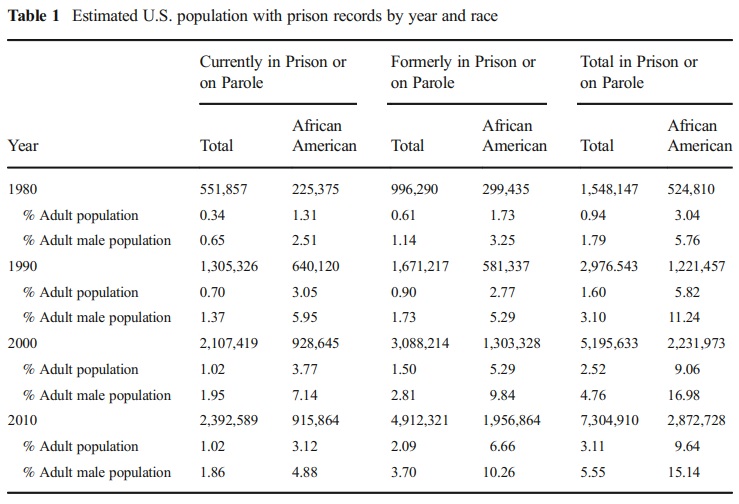
* In 1980, nearly 6 % of the adult male African American population had been to prison at some point (total prison/parole) compared with just less than 2 % of all adult men. By 2010, 15 % of African American adult males had spent time in prison versus 5.6 % of all adult males.

* These estimates are generally comparable with those obtained by other researchers applying different demographic techniques. Bonczar (2003) estimated that in 2001, 3 % of adults, 5 % of adult males, and 17 % of African American adult males had been to prison. Pettit and Western (2004) found that black men born between 1945 and 1949 had an 11 % chance of imprisonment, relative to a 21 % for the cohort of black men born between 1965 and 1969. These figures are generally congruent with our overall estimate that 15 % of black men had experienced imprisonment by 2010.

* California leads the nation with about 12 % of African American adults having a prison record.

* In California and Indiana, we estimate that at least one in four of all adult African Americans had a felony conviction history. Although it may seem implausible that more than 20 % of the African American adult population has a felony conviction history in such states, recall that at least 5 % of the African American population was currently under felony supervision in these states in 2010.

* Nationwide, approximately 8 % of all adults had a felony conviction as of 2010, but approximately 23 % of African American adults shared the same distinction. A staggering 33 % of African American adult males had a felony conviction by 2010.

Posted in Crime | Comments Off on The Growth, Scope, and Spatial Distribution of People With Felony Records in the United States, 1948–2010