The Sailer Strategy

Andrew Marantz writes in chapter ten of his new book, Antisocial: Online Extremists, Techno-Utopians, and the Hijacking of the American Conversation:

A dozen years earlier, Steve Sailer, a prolific opinion columnist with a small but passionate online audience, had reached the opposite conclusion. Sailer, then a forty-one-year-old living in Southern California, had retired early from a successful career in marketing in order to write full time. When the venerable conservative magazines would publish his work, he wrote for them; when they wouldn’t, which was more often the case, he posted his columns on his own blog. On November 28, 2000, while the Bush and Gore campaigns were still arguing over hanging chads in Florida, Sailer wrote a blog post. Citing exit-poll data, he demonstrated that if Bush had increased his share of the white vote by just 3 percent—if 57 percent of white Americans had voted for him, rather than 54 percent—he would have won in a landslide. Sailer then expanded his hypothetical: what if, in order to win those additional white votes, Bush had embraced a platform so caustic, so openly hostile to racial minorities, that he lost every nonwhite vote? “Incredibly,” Sailer found, “he still would have won.”

By Sailer’s lights, this meant that Republicans should drop their disingenuous disingenuous platitudes and campaign openly as a white-identity party. Then, once they were in power, they could enact prowhite policies—deporting undocumented immigrants, reducing immigration quotas, retracting birthright citizenship—thus maintaining a white majority that could deliver future elections to the GOP. He knew the mainstream counterarguments, which all seemed to boil down to the same thing: White people shouldn’t organize in their own interest, because that would be racist, and racism is bad. That argument didn’t matter to Sailer. He maintained that a prowhite campaign strategy would work, and that it was the best way to save the country from ruin. By 2012, he had been making this argument so vociferously for so long that, in ultra-right-wing circles, it was called the Sailer Strategy.

The American dream is for everyone. This was the sort of gauzy logic that Sailerloved to tear apart. On the contrary, he argued, the American dream is only for Americans; moreover, politicians should enforce strict rules about who was allowed to become an American, revising those rules, if necessary, to privilege immigrants from certain regions over others. “An immigration policy, by its very nature, is about discriminating, about selecting whom we should admit and whom we should keep out,” he wrote. Without such policies, he strongly believed, the United States would cease to be an Anglo-Christian nation, which would lead to poverty, crime, and internecine struggle. “But intelligence is discrimination, so intelligence is racist,” he continued sarcastically. “In contrast, suicidal stupidity isn’t racist. So it’s better.” This was a worldview he called “citizenism,” distinguishing himself from the paleoconservatives, radical traditionalists, white nationalists, and white separatists with whom he had subtle doctrinal differences.

Many minorities wrongly think that Republicans do not want them in the country. Well, Sailer felt no particular animus toward any individual, unless the individual had done something to earn it, and yet some minority groups—say, undocumented gang members—would be right to think that he didn’t want them in his country. Nor, frankly, did Sailer take for granted that all men were created equal, that European Americans and African Americans were born, on average, with identical levels of intelligence and work ethic and proclivity to violence. He didn’t take it on faith that racial groups differed intrinsically in these ways; he was just posing the question, following the facts wherever they happened to lead.

After the 2012 election, Sailer showed, again using exit-poll data, that Romney could have won without making any overtures to Hispanic voters, or to any other minority voting blocs. All he needed, again, was more white votes—specifically, more support among working-class white men in the Rust Belt. “The hidden story of the 2012 election just might come down to Romney not appealing to blue-collar white guys in this swing region,” Sailer wrote. How could Romney have appealed to them? Sailer suggested one way: a hard-line stance on border security. In states like Michigan and Wisconsin, he wrote, “Immigration should be the perfect issue for the GOP to use to split the rank and file from their Democratic bosses.”

Sailer still considered himself a conservative, although the arbiters of palatable conservative opinion, such as the editors of National Review and The Weekly Standard, had long ago stopped commissioning his work. Many of his
peers in dissident right-wing punditry—John Derbyshire, Peter Brimelow, Ann Coulter, Jared Taylor—had been cast out of the conservative establishment for similar intellectual heresies. A few of them embraced their outcast status, gaining attention through confrontational acts of televised sophistry. (Ann Coulter was especially adept at this tactic, tiptoeing just close enough to the you-can’t-say-that-on-television line to ensure that she would always be invited back on television.) The others kept blogging, biding their time.

Sailer felt confident that no part of the Sailer Strategy was unconstitutional or illegal. In more than a decade, no one had been able to point out any serious mistakes in his arithmetic or his logic. The real problem, as far as he could tell, was that his ideas made powerful people uncomfortable.

Conservatives often referred to the Overton window, or to political correctness. Sailer went a step further. Of all the malign forces that he perceived in the world, perhaps the most pernicious was what he called “the Narrative”—a nonnegotiable vocabulary that every member of polite society was required to learn. Political correctness was just a small part of it. Americans absorbed the Narrative every day—in their schools, in the media, through mass entertainment, through thousands of tiny social cues. The brainwashing was so total as to become invisible; people internalized the axioms so deeply that, after a while, they couldn’t think without them. Simply to point out the existence of the axioms, much less to call their truth into question, was to become a dangerous brute, a pariah.*

According to the Narrative, Islam is a religion of peace; therefore, the mullahs calling for bloodshed had to be ignored or explained away. According to the Narrative, race and gender are social constructs; therefore, newspaper articles and car commercials had to avoid depicting any meaningful difference between European Americans and African Americans, or between men and women. According to the Narrative, American citizenship is a civil right that is owed to every one of the world’s seven billion inhabitants—Sailer called this the Zeroth Amendment, because “it’s not in the Constitution, but it’s treated as if it were”—so anyone seeking high office had to speak about immigration in magnanimous platitudes. This, Sailer believed, was why the Sailer Strategy was never invoked in The Economist or The Wall Street Journal, or on CNN or Fox News, or in official GOP reports. It defied the Narrative.*

On his blog, he referred to his ideas as “crimethink”—the word George Orwell used, in 1984, for any thought that Big Brother didn’t want you to have. By that analogy, of course, Sailer was Winston Smith, a vigilante hero struggling against tyranny. He understood that the analogy was melodramatic. He had no reason to assume that anyone at the NSA was even aware of his blog, much less conspiring to censor it or arrest him for its contents. The tyrannical force in the twenty-first-century United States was not a Ministry of Truth but the pervasive reach of the Narrative. “It’s naive to imagine that a government would have to pay people to do this kind of thing,” Sailer wrote. “In the current year, we now know that plenty of people would join the Volunteer Auxiliary Thought Police for free.”

It seemed obvious that the marketplace of ideas was rigged against him. He was free to write what he wanted, but a small contrarian blog was no way to spark a national movement. Many normal American voters, Sailer thought, might consider his views quite unobjectionable, even obvious. But first normal Americans would have to be exposed to his ideas, and the guardians of the Narrative—the gatekeepers who controlled the movie studios, the ad firms, and the mainstream press—would never allow that to happen.

Steve Sailer responds.

Posted in Andrew Marantz, Steve Sailer | Comments Off on The Sailer Strategy

Surviving Peace – John Mearsheimer full interview

Posted in John J. Mearsheimer | Comments Off on Surviving Peace – John Mearsheimer full interview

Genesis

Here are some excerpts from Dennis Prager’s commentary on Genesis:

The first verse of Genesis is, in some ways, the most important verse in the Bible. While many Torah verses influenced history, Genesis 1:1 changed history in monumental ways.

• First, the verse posits a Creator of the universe. That means, among many other things, there is meaning to existence. If there is no Creator, there is no ultimate purpose to existence, including, of course, human existence. We humans can make up a meaning because we are the one species that cannot live without meaning. But the fact remains that we made it up.

• Second, the word “created” (bara) implies nothing preexisted Genesis 1:1. When bara is used in the Torah, it is used only with reference to God—because only God can create from nothing. Human beings cannot create; they can only “make,” like making something from something, such as wood and paper from trees.

• Third, everything—with the exception of God—has a beginning. Prior to God’s creating, there was nothing. That includes time. Thanks to Einstein, we know that time, too, had a beginning. God, therefore, also created time, which means God exists not only outside of nature but outside of time. God precedes time and will outlive time.

• Fourth, for the first time, a creation story has but one Creator. The moral and intellectual consequences of the Torah’s monotheism have changed the world. They are listed in detail in the commentary to Exodus 8:6 (and summarized in the commentary to Genesis 35:2).

• Fifth, unlike pre-Bible creation stories, there is complete silence regarding a birth of the deity. The God of Genesis 1:1, the God of the Bible, is not born.

• Sixth, for the first time in history, we are presented with a god who is completely separate from nature—because God created nature. God, for the first time, is not part of nature.

Here are some excerpts from a Christian commentary: The Book of Genesis, Chapters 1-17 (New International Commentary on the Old Testament) by Professor Victor Hamilton:

* Genesis is obviously a book concerned with origins—the origin of earth’s creation, of humankind, of institutions by which civilization is perpetuated, of one special family chosen by God as his own and designated as the medium of world blessing. Transcending all of these emphases on beginnings is God. There is no génesis theoú (theogony) in Scripture’s introductory book, nor any theobiography. He is one without rē’šîṯ (beginning) and ’aharîṯ (end).

* This proposal suggests the discovery in Genesis of eleven literary units or tablets, to which the Joseph narrative has been appended: Tablet 1: 1:1-2:4: The history/origin of the cosmos
Tablet 2: 2:5-5:2: This history/origin of Adam/mankind
Tablet 3: 5:3-6:9a: The history/origin of Noah
Tablet 4: 6:9b-10:1: The history/origin of Noah’s sons
Tablet 5: 10:2-11:10a: The history/origin of Shem
Tablet 6: 11:10b-27a: The history/origin of Terah
Tablet 7: 11:27b-25:12: The history/origin of Ishmael
Tablet 8: 25:13-19a: The history/origin of Isaac
Tablet 9: 25:19b-36:1: The history/origin of Esau (and Jacob)
Tablet 10: 36:2-9: The history/origin of Esau
Tablet 11: 36:10-37:2a: The history/origin of Jacob’s family

* It is hardly accidental that four-fifths of Genesis (chs. 12-50) describes the history of only four generations (Abraham to Joseph), while one-fifth of Genesis (chs. 1-11) describes the history of twenty generations (Adam to Abraham). Why is Genesis preoccupied maximally with the four generations, but only minimally with the first twenty generations?22 As an extension of this point, why does the Creation story, certainly an indispensable part of Genesis and all of Scripture for that matter, receive only two chapters, while the Abraham story is allotted thirteen chapters and part of two others? Why is the account of the “Fall” limited to one chapter, while the Joseph narrative occupies the last third of Genesis?

* Discussion about Genesis’ composition has run in cycles—in two uneven cycles at least—for the last two millennia. For almost eighteen hundred years (the first cycle) hardly anyone questioned the unity of Genesis, whether the writers were the rabbinical scholars of Judaism or the ecclesiastical scholars of Christendom. Thus a Maimonides within Judaism, an Augustine within Catholicism, and a Calvin within Protestantism shared no disagreement on the point of Genesis’ origin and composition. For all of them Genesis was a unified work, and more specifically, the work of Moses. It is now fashionable to label such an approach approach as “traditional” or “precritical.” The latter term especially is an opprobrious one, for it suggests that modern scholars consider such writers of only slight usefulness in the interpretation of the biblical text, essentially limited to showing how such commentators of old fill in the gaps in one’s treatment of the history of Genesis’ interpretation. Thus their contribution to the whole is primarily archaic.

* The second cycle of interpretations is approximately two centuries old. So dominant is it today that it has replaced the older precritical approach as the traditional one. To challenge it is to wade into the waters of heterodoxy, to risk the charge of hopeless obfuscation, or at worst, to be labeled “fundamentalist.”

* In brief, this [Julius Welhausen documentary] approach identifies four major literary strands behind the present canonical shape of the Pentateuch. In chronological order these are:

1. The Yahwist (J) (850 B.C.—Wellhausen; 960-930 B.C.—post-Wellhausen scholars), written anonymously in Judah during the reign of Solomon. This source traces Israel’s history from its patriarchal beginnings to its preparation for entry into Canaan; narratives from prepatriarchal times were added at some point. It may have functioned as the national epic for the Davidic/Davidic/Solomonic kingdom. “J” is the symbol for this document, primarily because of its almost exclusive use of “Yahweh.”29

2. The Elohist (E) (850 B.C.), also written anonymously in northern Israel, shortly after the collapse of the united monarchy. It covers substantially the same period of Israel’s history as J, but it starts with the patriarchs and not with creation. Because it prefers the name “Elohim” for God, it is styled the Elohist.30

3. Deuteronomy (D), written at least by the Josianic reform (ca. 620 B.C.), but perhaps as old as E, and originally from northern Israel, as was E. It is confined obviously, as far as the Pentateuch is concerned, to Deuteronomy.

4. The Priestly Writer (P) (550-450 B.C.), heavily concerned with chronological, liturgical, and genealogical matters. Wellhausen’s major innovation here was to shift the Priestly code from the earliest document to the latest document, written sometime after the Babylonian exile. Unlike J and E, P is not concerned with presenting presenting history as such, but with establishing the basis of Israel’s sacral institutions through their connection with history.

Thus, the Creation story provides the reason for the Sabbath’s instititution (Gen. 1), and the covenant with Abraham (Gen. 17) establishes the reason for circumcision. Today debate on P focuses on two issues: (1) Is it post-D (JEDP) or is it pre-D (JEPD)? (2) Is P a source or a redaction? These issues will be examined further below.

An analogy for this hypothesis might be an electrical cord. The wiring on the outside, visible to the eye, gives the impression of unity, one substance. Once the outer casing is removed, however, one detects immediately several different wires, indicated by color, inside the casing.

There are a number of reasons for positing the existence of a multi-traditional Pentateuch. In descending order of significance, they are:

(1) The different names for God. This is apparent, for example, in the Creation story, which uses “Elohim” consistently in 1:1-2:3 and “Yahweh Elohim” in 2:4-3:24, and in the Flood account (Gen. 6-9), which uses both “Elohim” and “Yahweh.”

(2) The presence of duplications, a story told twice (or thrice), but in such a way that the two accounts are irreconcilable. Thus there are two Creation accounts (1: 1-2:4a and 2:4bff.), two Flood accounts (meshed in chs. 6-9), two accounts of God’s covenant with Abraham (chs. 15 and 17), two accounts of Hagar’s banishment (chs. 16 and 21), two accounts of Jacob’s name change to Israel (chs. 32 and 35), two accounts of Joseph’s sale to merchants bound for Egypt (37:25-27, 28b and 37:28a, 36), three accounts of wife abduction (chs. 12, 20, and 26), and so forth.

(3) The presence of anachronisms, which must be dated much later than the patriarchal or the Mosaic period. One thinks, for example, of references to Abraham’s Ur as “Ur of the Chaldeans”—the “Chaldeans” do not appear in Mesopotamia until long after the patriarchal period; or of the mention of “Philistines” and domesticated “camels” in the Genesis narratives. The list of Edomite kings in Gen. 36 is interesting, especially in the light of the fact that the Edomites did not settle in Transjordan before the 13th century B.C.

(4) The detection in Genesis of distinctive literary styles or religious ideology within a section or unit. For instance, P’s style is reckoned to be more formal and repetitious, while J’s is more simple. Or again, J, with his anthropomorphic tendencies when talking about God, presents the contact between God and the patriarchs as direct, while E tends to dilute this contact by introducing dreams and angels as intermediate factors.

* Putting together, then, the perspective of Wellhausen-Gunkel-Noth, one arrives at the scholarly consensus that Genesis (and Exodus-Numbers as well) evidences the following stages of composition: 1. The oral formation of small narratives, 1800-1200 B.C. (Gunkel) 2. The assembling of these smaller narratives into larger complexes around history-like themes, as part of a liturgical affirmation of faith in community acts of worship, 1200-1000 B.C.38 (Noth) 3. The writing of the J source, 950 B.C. 4. The writing of the E source, 850 B.C. 5. The redaction of JE 6. The writing of the P source, 550 B.C. or later 7. The redaction of JEP, either by P himself or by an independent editor, ca. 400 B.C. (nos. 3-7, Wellhausen)

* Until the rise of source criticism in the 18th century, the unity of Genesis was taken for granted, with an occasional disclaimer to be heard only here or there. A concomitant of this position was the teaching of the Mosaic authorship of Genesis (and of the rest of the Pentateuch). It is accurate to say that those in the 20th century who have advocated that position are in the minority. To argue for the Mosaic authorship of Genesis was akin to arguing for the flatness of the earth. Among Jewish scholars, Benno Jacob, Umberto Cassuto, and M. H. Segal have been most vocal in their defense of the unity of Genesis’ authorship and composition.68 …In our judgment Cassuto has mounted the most convincing case against JEDP, and yet most of his conclusions have been ignored by the establishment of biblical scholarship, primarily because in their opinion his conclusions are rooted in polemics and apologetics, rather than in undistilled scholarship.

* Many biblical scholars would dispute the attempt even to discuss a theology of Genesis.

* Jacob, however, has a number of experiences with his brother and father before God enters the picture. Only after an encounter with Esau and Isaac is there an encounter with God. The interesting point here is that not one word is spoken by God about Jacob’s previous behavior with Esau (exploitation) or with Isaac (duplicity). It is ignored. Instead, Jacob becomes the recipient of an unsolicited series of divine promises. He is promised land, descendants, spiritual influence, and the presence of God. If election were based on merit and not on grace, Jacob would never have qualified!

* The point is frequently made throughout these chapters of Genesis that the selection of these patriarchs is not based on their behavior. They are not chosen because they are good. They are chosen on the basis of God’s sovereign will. Even when they are guilty of highly unethical behavior, God remains true to his promise. It is clear to the reader of Genesis that the patriarchs are not above engaging in highly questionable behavior. On two occasions Abraham encourages his wife to lie about her identity and places her in a very vulnerable position—in fact, makes her an adulteress (12:10-20). At his wife’s suggestion Abraham cohabits with another woman (ch. 16). Isaac imitates his father’s duplicity when he too finds himself an alien on foreign soil (ch. 26). Jacob exploits his brother (25:29-34), deceives his father (ch. 27), and even after his spiritual transformation and renaming still lies to Esau (33:12-18). Judah fathers twins by his daughter-in-law, who is disguised as a harlot (ch. 38). And Joseph brings false charges against his brothers (“you are spies”) and acts clandestinely to make them look like thieves. The interesting point in all of these instances of aberrant behavior is that God never clearly rebukes any of the patriarchs. He sends no voice of conscience after them, no Nathan with his condemning “you are the man.”

* All readers of Genesis have noticed the often dubious, even immoral, antics of the three patriarchs. By itself, this immorality is not unique, for Scripture is loaded with similar incidents in the lives of others of its characters. Witness a Saul, a David, a Solomon, one of the kings, or Israel as a whole (often portrayed as a harlot). In each of those instances, however, the culpable one pays a high price for disregarding God’s law. But the patriarchs escape prosecution. In fact, after the Tower of Babel story in Gen. 11, one does not encounter any story before Exod. 32 in which the followers of God experience the voice of judgment (except for Er and Onan, the sons of Judah, Gen. 38).

* If Gen. 12-50 is punctuated with stories highlighting unconscionable behavior in the lives of the major actors, so is Exod. 1-31. Why, for instance, does God give his people manna in the desert when they murmur and complain (Exod. 16)? God answers prayer; does he answer grumbling too?

* N. Sarna has correctly observed, “If Abraham’s migration can no longer be explained as part of a larger Amorite migration from east to west, it should be noted that what has fallen by the wayside is a scholarly hypothesis, not the Biblical text. Genesis itself presents the movement from Haran to Canaan as an individual, unique act undertaken in response to a divine call, an event, not an incident, that inaugurated a new and decisive stage in God’s plan of history. The factuality or otherwise of this Biblical evaluation lies beyond the scope of scholarly research.” In other words, events of salvation history can be neither proved nor disproved.

How then does Thompson understand the place of these patriarchal narratives in Israel? He believes that they were created ex nihilo by early Israelite communities in which an illusory past was imaginatively formed for the purpose of giving encouragement in the present and hope for the future. In other words, according to Thompson, it is the faith of the religious community that creates Abraham. This perspective is the direct opposite of the biblical writers’ view that it is Abraham who stimulates the faith of the religious community.120 How shall we account for the fact that the events of both the Exodus under Moses and the conquest under Joshua are grounded in the patriarchal events of Genesis? If the latter are fictional, then the grounds of faith are no more for the former—unless we have fictional events that are rooted in additional fictional events. We are not saying that the patriarchal traditions have to be true to be of value. Of course they do not. If they are not true, what is surrendered is the canonical witness of Genesis that biblical history at the covenant level begins not with an exodus from Egypt to which a patriarchal tradition has beeen appended, but with a patriarchal tradition out of which an exodus and conquest themes develop. We must also consider what is lost for the biblical message of redemption, the NT included, if the patriarchs are nonexistent. According to the biblical revelation Abraham is the first link in that program and Jesus Christ, the son of Abraham, climaxes God’s provision for the redemption of humanity.

* Is not the religion of the patriarchs self-evident, and therefore not in need of elaboration? Did not Abraham worship the same God as Moses? Did not John, Peter, and Paul worship the same God as Moses? Therefore, may not the modern believer, Jewish or Christian, claim that his God is Abraham’s God? The answer to all these questions is obviously yes. Yet the critical reader of Scripture might remind us that centuries passed between the time in which the patriarchs practiced their religion and the time in which these practices were actually committed to writing. Thus one might ask, “Do we know the religion per se of the patriarchs?” or only J’s, E’s, and P’s version of that religion? Is it possible that in the canonical structuring of the Torah, an otherwise complicated picture has been simplified? Several things separate patriarchal religion from Mosaic religion. For one thing, Abraham in particular is rooted directly, via his family, in a pagan, polytheistic milieu. It is one thing for Abraham to leave his world geographically. But how shall he leave it theologically? Nothing in Abraham’s background prepares him for that revolutionary transition. If Samuel did not recognize the voice of God and confused it with Eli’s, what means did Abraham possess in Ur or Haran for recognizing the voice of God when it called him? Is it possible that Abraham’s shift from a polytheistic faith to a monotheistic one was not an abrupt, overnight shift? If that is the case, one might expect to discover vestigial remains of that original faith throughout Gen. 12-50.


In Joseph Telushkin’s 666-page book, Biblical Literacy: The Most Important People, Events, and Ideas of the Hebrew Bible, there are four mentions of the word “theology.” By contrast, in the Victor Hamilton book referenced above, there are 104 mentions and in Prager’s commentary on Genesis there are 22 mentions. This is an example of why many traditional Jews find Prager’s commentary on the Torah “Christian” because he often sounds more Christian than Jewish. Traditional Jews do not talk about theology, they talk about what God demands of man, which is action aka mitzvot (divine commandments). What reconciles God to man in the Jewish view is behavior while in the Christian view it is faith (and works in the Catholic perspective).

The most widely used chumash (Pentateuch with commentary) used in Orthodox synagogues in the West is The Chumash: The Stone Edition, Full Size (ArtScroll) (English and Hebrew Edition) The Torah: Haftaros and Five Megillos with a Commentary Anthologized from the Rabbinic Writings. It contains no reference to the term “theology.”

Posted in Bible | Comments Off on Genesis

The Path To Recovery

Posted in Addiction | Comments Off on The Path To Recovery

Twitter: ‘Legendary journalist and political commentator Cokie Roberts has died at 75’

I’ve spent many hours listening to Cokie Roberts on NPR and watching her on TV. I can’t remember anything memorable she ever said or did. What exactly makes her legendary? One hundred thousand American journalists could have performed her job at least as well. I’m told she was a pioneering woman, so does that mean we should grade her on the curve?

A friend says: “The reason Cokie Roberts is so highly thought of is because she put NPR news on the map. When I first started listening to NPR (when it was on KUSC) the had their two shows: Susan Stamberg held down the evening slot and Bob Edwards the morning one. This was pre cable news and NPR couldn’t compete with the big networks for national talent. NPR instead hired Cokie Roberts and others. Because of Roberts’ background she was able to get her fair share of scoops as a congressional beat reporter.Her father Hale Boggs before he was killed in a plane crash had been the House Majority Leader and her mother succeeded him in his seat. Her brother Tommy Boggs is and has been one of Washington’s top lobbyists and her then husband (I don’t know if they are still married) Steve Roberts was also a respected political reporter. There is no doubt that NPR’s national news became a go to news source for many because they had hired Cokie Roberts. Later she also worked for ABC. But she benefited from being a woman, when at the time she began reporting most reporters were men, and from her connections.”

Posted in Journalism | Comments Off on Twitter: ‘Legendary journalist and political commentator Cokie Roberts has died at 75’

The Outsider

Matthew Rose writes for First Things:

Francis was right about many things. He was right that elites seek to subvert the institutions and ideas that resist their power. He was right that their promise to deliver us from the unfreedoms of the past creates a tyranny of its own. He was right that no society is purely liberal, especially the one that aspires to become so. But he was wrong to imagine that the racial identities that divide us are more important than our common filiation as children of God. He denied the transcendent horizon that is the greatest enemy of the managerial ideology. It inspires rather than satiates, and evokes loyalties that bind us together rather than condemning us to be “individuals” manipulated by marketers and bureaucrats. Francis accused religious traditionalists of playing by house rules, seeking dialogue rather than conflict, preferring to be “beautiful losers” rather than ugly winners, and surely his criticism had some merit. But he failed to see that they offer a more fundamental challenge to liberalism than he ever did, by seeking to unite people in a shared love, a common covenant ordered to the highest good. The nationalist and populist movements that Francis anticipated will succeed in challenging liberalism only to the extent that they abjure Francis’s racial resentments and assert the common goods and transcendent horizon his materialist thinking denies.

Francis claimed that he sought only to defend Western culture. It is impossible to believe him. He displayed no feeling for literature, art, music, philosophy, or theology. He did not see, because his ideology prevented him from seeing, that our culture’s greatest achievements have come in pursuit of ideas that transcend human differences. Francis’s failure of gratitude and wonder made him more than incompetent about power. It made him an outsider to his civilization.

Posted in Samuel Francis | Comments Off on The Outsider

Jewish Influence

Politico posts:

Israel accused of planting mysterious spy devices near the White House

he U.S. government concluded within the past two years that Israel was most likely behind the placement of cellphone surveillance devices that were found near the White House and other sensitive locations around Washington, according to three former senior U.S. officials with knowledge of the matter.

But unlike most other occasions when flagrant incidents of foreign spying have been discovered on American soil, the Trump administration did not rebuke the Israeli government, and there were no consequences for Israel’s behavior, one of the former officials said.

From posts at Steve Sailer:

* The law of life is that losers always say they finished last because they were too nice a guy. Jews are good at influencing elites, but they are so successful at it, that everyone assumes Jewry’s success must be due to them employing unscrupulous methods. Jews are most dangerous and effective when they are using freindly persuasion and the language of mutual advantage, or to put it differently: trade. At the James Bond stuff, Jews are comparatively poor.

Like the Rothschilds’ fortune that got started by them gaining the confidence of a coin collecting prince by selling to him at silly low prices, the Jewish way is to place under obligation by acts of apparent selflessness. Epstein rang rings round everyone not by blackmail, but by seeming to be a nice guy and gracious intelectuals’ salon host who was loyal to his many eminent friends, which they reciprocated even after he was exposed. Ehud Barak was unaware of what Epstein had actually been convicted of, having obviously trusted and been misled by him.

Intelligence services rarely do anything useful, but being the subject of an intense espionage effort by their opposite number makes everyone feel terribly validated and significant.

* Why would anything secure be sent in the clear over an ordinary cell phone? If the Israelis can sprinkle these devices around Washington, then why can’t the Russians and the Chinese and those branches of the Permanent Government that hate Trump (i.e. all of them) do the same?

Stingrays are used a lot by police. Washington has a whole alphabet soup of police agencies – the DC Police and the Capitol Police, etc., not to mention a whole bunch of intelligence agencies – the FBI and the CIA and military intelligence, etc.

Many of these agencies don’t really like Trump and would love to get the goods on him. When Comey met “privately” with Trump, Comey was peeing in his pants he was so anxious to leak the details of the meeting to the press. (Trump asked for his loyalty – can you imagine that? The President asking for high officials of the Executive Branch to be loyal to the Administration – how dare he? Doesn’t he know that the FBI is accountable to no one?) The FBI always liked being in a position to blackmail the President going all the way back to Hoover days. Maybe they were still trying to prove that Trump was talking to the Rooshians.

If I had to bet, the Stingrays belonged to one of those agencies. Maybe the Israelis were tasked to plant them to preserve deniability and that’s why they haven’t been rebuked. Israeli intelligence and US intelligence are frenemies.

Posted in Jews | Comments Off on Jewish Influence

Forbes: Why California Keeps Making Homelessness Worse

Michael Shellenberger writes:

California is home to some of the world’s toughest environmental and public health laws, but skyrocketing homelessness has created an environmental and public health disaster. The 44,000 people living, eating, and defecating on the streets of L.A. have brought rats and medieval diseases including typhus. Garbage is everywhere. Experts fear the return of cholera and leprosy.

And homelessness is making people violent. “We are seeing behaviors from our guests that I’ve never seen in 33 years,” said Bales. “They are so bizarre and different that I don’t even feel right describing the behaviors. It’s extreme violence of an extreme sexual nature. I have been doing this for 33 years and never seen anything like it.”

Bales says he was one of the people who urged the US Government’s Federal Emergency Management Administration (FEMA) to intervene. “We’ve been crying out for a National Guard-like response,” said Bales, whose church provides food, showers, and shelter to 1,350 people camped nearby. In 2016 Bales lost the lower half of his leg to a flesh-eating bacteria from contamination on Skid Row.

How did things get so bad in California? The state has long prided itself on being humanistic and innovative. It is home to some of the world’s largest public health philanthropies, best hospitals, and most progressive policies on mental health and drug addiction. The Democrats have a supermajority. What went wrong?

According to Bales and other experts, California made homelessness worse by making perfect housing the enemy of good housing, by liberalizing drug laws, and by opposing mandatory treatment for mental illness and drug addiction.

Other states have done a better job despite spending less money. “This isn’t rocket science,” said John Snook, who runs the Treatment Advocacy Center, which advises states on mental health and homelessness policy around the country. “Arizona is a red state that doesn’t spend a ton on its services but is the best scenario in every aspect. World-class coordination with law enforcement. Strong oversight. They don’t let people fall apart and then return to jail in 30 days like California does.”

What happened in California isn’t the first time that we progressives let our idealism get the better of us. To understand how the current disaster unfolded, we have to go back in time, back to the post-World War II era when progressive reformers convinced themselves and others that they could destroy the country’s system for dealing with the mentally ill and replace it with a radically different and wholly unproven alternative.

Posted in California, Homeless, Los Angeles, San Francisco | Comments Off on Forbes: Why California Keeps Making Homelessness Worse

Report: Rabbi Gets Six Years For Sexually Assaulting Woodcliff Lake Boy 20 Years Ago

From DailyVoice.com:

A rabbi formerly from Woodcliff Lake was sentenced to a plea-bargained six years in state prison for sexually assaulting a local boy in 1999 when he lived in town.

Menachem M. Weiss, 47, must serve at least three years of the sentence handed down Monday in Superior Court in Hackensack before being eligible for parole, authorities said.

He also must register as a sex offender and avoid contact with the victim or his family.

“It was heart-wrenching to hear the victim describe [during the sentencing] how the abuse turned his life upside down and how it has impacted him for two decades,” said Meyer Seewald, founder and director of Jewish Community Watch.

“At the same time, hearing this warrior’s incredible determination inspired me tremendously and I am thankful to have been there to witness his courage,” Seewald added in a statement. “No one can imagine what kind of bravery it takes to stand up and speak your most painful truth.

“It took superhuman courage for this victim to come forward, and he and the other alleged victims deserve overwhelming support from the community,” Seewald’s statement continued.”

“Mendy” Weiss had moved to Los Angeles, was married and worked as a teacher when he was taken into custody by Port Authority police and brought to Bergen County in March 2018.

Four months earlier, Woodcliff Lake police “received information that a juvenile male was sexually assaulted by Rabbi Menachem Weiss between January and June 1999, while Rabbi Weiss resided in Woodcliff Lake,” according to a release issued at the time by the Bergen County Prosecutor’s Office.

An investigation produced a grand jury indictment that charged Weiss with two counts of first-degree aggravated sexual assault of the boy, who records show was in his mid-teens.

Weiss secured a deal with prosecutors in which he pleaded guilty earlier this year to one of the counts.

Menachem Weiss worked in Los Angeles schools and shuls for many years prior to his arrest.

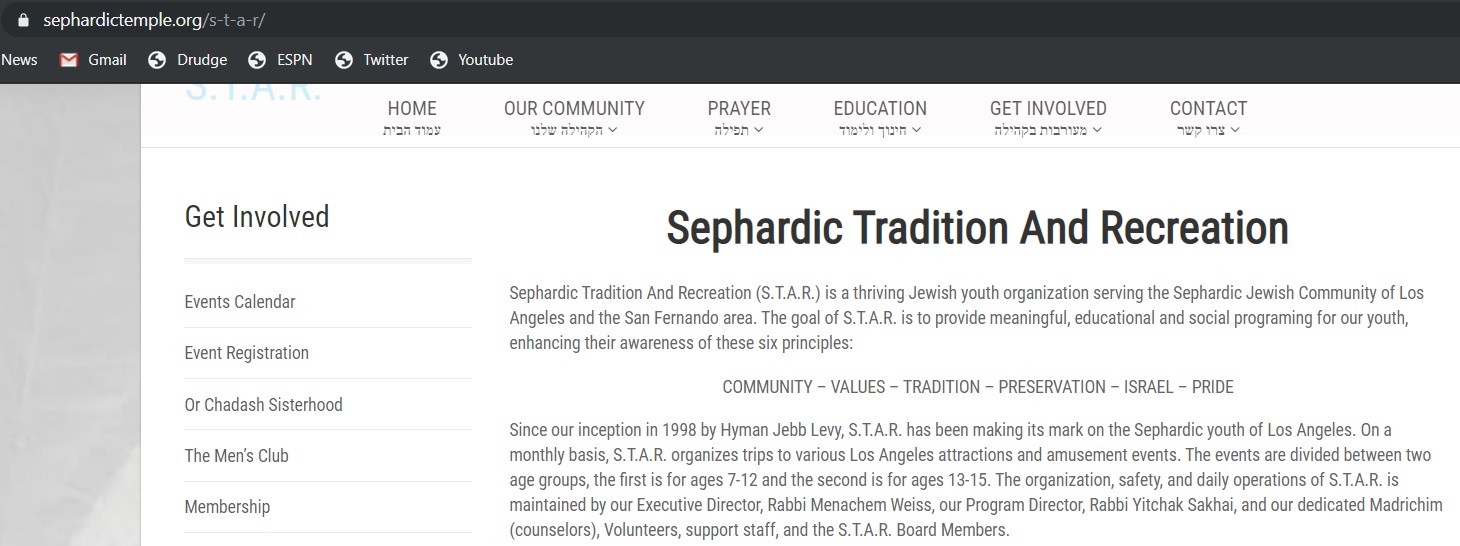
Various Los Angeles Jewish institutions still list Menachem Weiss on their websites, including the Nessah synagogue and the Sephardic Temple in Westwood:

Posted in Abuse, R. Menachem Weiss | Comments Off on Report: Rabbi Gets Six Years For Sexually Assaulting Woodcliff Lake Boy 20 Years Ago

New Yorker: A Town for People with Chronic-Fatigue Syndrome

I came down with mono in January of 1986 and it was severe for a few weeks and kept me weak until June. I didn’t drop any of my commitments. I kept up with my 15 units at Sierra Community College (got a B average) and my 16 hours a week at the radio stations KAHI/KHYL. Other than that, however, I stayed in bed.

In the summer of 1986, I made a full recovery.

However, in February of 1988, this mono type thing came back and never left. In April 1989, I got the diagnosis of Chronic Fatigue Syndrome and in June I left UCLA and never returned.

Mike Mariani writes:

In December of 2012, I came down with what at first looked like a bad case of mononucleosis. I felt tired and had a sore throat, a cough, and a slight fever. At the time, I was twenty-six and working as an adjunct English professor at a small college in Westchester, New York. It was Christmas break, so I thought that I would sleep it off and feel better by the New Year. But over the next few months my symptoms grew to include muscle pain, migraines, and occasional vertigo. The cough went away but the tiredness got worse, and by the summer I was spending half my time resting in bed. I was used to playing pickup basketball several times a week after work, but now a few pushups left me exhausted. I couldn’t figure out what was happening. One afternoon, as an experiment, I went for a run near my apartment, in uptown Hoboken. I clipped my iPod Shuffle to my mesh shorts and jogged past Italian delis with dry-cured sausages in their windows and along a pier that hugged the Hudson. It felt amazing. But the next day, while grading papers with a few other teachers, suddenly, I became dizzy and weak. I left the office without explanation, and, for the next several days, I barely left my bedroom.

After a year of these symptoms, I visited an internist in Manhattan, who gave me a diagnosis: I had chronic-fatigue syndrome. According to the National Academies of Sciences, C.F.S. (sometimes referred to as myalgic encephalomyelitis) affects between eight hundred thousand and two and a half million Americans and is characterized by extreme exhaustion. Patients with severe cases are bedridden for years and rarely move or speak. Doctors are still not sure what causes it. For decades, many thought that it was psychosomatic. (My symptoms were so odd that, over the preceding year, I, too, had wondered if I was going crazy.) This sense lingers in popular culture. In the pilot episode of “House,” from 2004, a patient comes to the clinic complaining of C.F.S., and Dr. House successfully treats him with mints from the vending machine. In a standup set in 2007, Ricky Gervais joked about people who say they have C.F.S. because they “don’t feel like going to work.” Today, though, most doctors who study C.F.S. think that its symptoms are caused by a dysfunction of the immune system, which is typically triggered by an infection, such as the Epstein-Barr virus (which causes mono) or viral encephalitis. Still, they don’t understand why, even as most people bounce back from these ailments, a small percentage of them never recover. Because there’s no clear biological cause, doctors recognize the disease by gauging symptoms subjectively, which makes diagnosis, in the eyes of skeptics, unreliable, and has kept away funding for research. There are currently no F.D.A.-approved medications to treat C.F.S.

Over the following three years, I saw a dozen doctors, who prescribed a range of treatments. The internist in Manhattan put me on injections of an amino acid derived from the livers of Argentine cows. On a few occasions, leaving his office, I experienced an energizing high that was either a temporary response to the cow liver or a marvellous placebo effect; it always wore off within a day, and I was later taken off the drug. An endocrinologist gave me a medication that stimulated my thyroid. Some patients resort to folk remedies, like kombucha tea or licorice, or riskier treatments, such as amphetamines or shots of hydrogen peroxide. I tried testosterone creams, antiviral pills, blood-plasma infusions, and so, so many nutritional supplements. Nothing stuck, except the medical bills, and I was running out of specialists in the area who could help.

In 2016, I heard about an internist named Daniel Peterson, who was treating patients in Incline Village, Nevada, with an experimental medication called Ampligen. Few outside the isolated network of C.F.S. patients, caregivers, and specialists have heard of Ampligen, but, within the illness’s sphere, the drug has developed a fabled reputation. In 2012, the F.D.A. provisionally rejected Ampligen’s application for approval, because trial results had not conclusively proved that it was effective; Peterson is gathering more evidence to re-apply. Because data is limited, the drug’s reputation hinges on anecdotal evidence, which should, of course, be considered with caution. But C.F.S. patients are very active in online message boards, and, when I Googled Ampligen, I came across powerful stories about the drug’s effects. In a patient testimony from 1998 that was posted online, a woman named Karen, who was functionally disabled by C.F.S., wrote that, after three months on Ampligen, she was well enough to do her taxes again and go skiing with her son. A blogger named Kelvin wrote on a Web site called The New Ampligen Diaries that, after getting on the drug, he “started to experience a taste of ‘normal’ life—a free life—for the first time in a very long time!” The Web site for the American Myalgic Encephalomyelitis and Chronic Fatigue Syndrome Society quoted Kenny De Meirleir, a doctor based in Belgium, as saying that eighty per cent of his patients reported “complete clinical recovery” on Ampligen. (De Meirleir later told me that, in fact, only a small subset of his patients had fully recovered.)

Posted in CFS | Comments Off on New Yorker: A Town for People with Chronic-Fatigue Syndrome