This Is Your Brain on Sports: The Science of Underdogs, the Value of Rivalry, and What We Can Learn from the T-Shirt Cannon

Here are some highlights from this book:

* We like our signal-callers handsome. The quarterback may not have existed before Camp and his contemporaries descended upon the Massasoit House 135 years ago, but his brainchild has since evolved into the most glamorous position in all of sports (North American jurisdiction, at least).

The storied lineage spans from Broadway Joe Namath to Joe Montana and Dan Marino to Brett Favre to Tom Brady, Aaron Rodgers, and Russell Wilson. The polarizing, short-lived cult of Tim Tebow? Even his biggest detractors must concede: not the worst-looking guy. As we write this, the attractiveness of Texas Tech coach Kliff Kingsbury is an Internet meme. (Hot Kliff Kingsbury Flirts with Moms of Recruits.) Naturally, Hot Kliff Kingsbury is a former college quarterback.*1

Pop culture has cemented this image. Name a leading man (Burt Reynolds, Kurt Russell, Warren Beatty, Keanu Reeves, Dennis Quaid, Jamie Foxx) and odds are good he has played the role of a quarterback. There are examples of the reverse, too. Before he was Special Agent Leroy Jethro Gibbs on NCIS, Mark Harmon was a quarterback at UCLA.

In fact, the allure of being an alluring QB can be enough to motivate a position change. Brad Grayson—father of Garrett Grayson, a Saints rookie as we write this—described his son’s decision several years ago to switch from running back to quarterback as a calculated one. “Gotta consider the ladies,” explained the elder Grayson with a smile.

The inevitable question, then: Why are quarterbacks so damned good-looking?

As he tends to do, radio host Colin Cowherd offers a theory that is based less on specific research studies and more on the effort to play provocateur. Cowherd reckons that quarterbacks are good-looking because of natural selection. As he once put it, “When boys growing up are picking teams and positions, they always pick a good-looking kid to be quarterback. They never pick an ugly kid. That…sets up the pattern.” In other words, the best-looking kids in the schoolyard are selected for the glamour position. They are put on a “quarterback track,” and by the time they begin playing organized football, they are experienced at the position. It’s akin to a self-fulfilling prophecy.

* researchers found that the more symmetrical a QB’s face was, the more money he made.

* VAN GILDER, the economist, nailed it when she said, “Socially, we’ve been trained to think that the quarterback is the most beautiful person on the team.”

* Quarterbacks are likely groomed for the job. Except this isn’t based on the perceptions of their attractiveness; it’s based on perceptions of leadership. When we, collectively, talk about how good-looking QBs are, we are probably, thanks in no small part to the halo effect, conflating looks with leadership.

* 1. We always think we’re the center of attention. We’re convinced that every slight variation in our appearance or performance is immediately noted by everyone around us. Researchers have dubbed this the spotlight effect, and it’s the reason many of us spent junior high convinced that that cafeteria table full of kids breaking up in laughter was doing so at our expense—that they must have noticed that giant pimple on our nose, our latest bad hair day, or the ridiculous new pants Mom made us wear. Even when, in fact, no one was actually paying us much attention at all.

In one clever study, researchers at Cornell put participating students in the unenviable position of reexperiencing those adolescent insecurities. Each subject was forced to march into a group of peers wearing something embarrassing: in this case a T-shirt with a gaudy Barry Manilow photo (as if there were any other kind) splashed across the front. The student then had to sit and complete a written survey while surrounded by conventionally clad peers. Afterward, the Manilow wearers were asked how many people around them had noticed what they had on. They wildly overestimated how noticeable and memorable the embarrassing shirt had been.

As the researchers concluded, “People tend to believe that the social spotlight shines more brightly on them than it really does.” Welterweight boxers and tyrannical rulers aren’t the only ones who think the world revolves around them. Most of us do—it’s a consequence of spending much of our day engaged in internal conversation but lacking insight into the monologues everyone else is producing.

2. We think we’re more powerful than we are. We regularly succumb to the illusion of control, overconfident in the role we play in outcomes around us.

* We can’t help but see ourselves as the center of attention and as masters of our own fates, despite rational evidence to the contrary. These and a variety of other egocentric biases help us stay optimistic even when the going gets tough. In fact, some psychologists argue that illusions like these are essential components of mental health—that looking at life without such ego-friendly lenses is a recipe for despondency.

In much the same way, the athlete’s belief that “no one respects me” plays an adaptive psychological role. That’s why it persists: A false narrative must serve a function in order to perpetuate itself.

* I’m not as good as people say I am; our opponents are much better than you think they are—is another false narrative that serves a clear psychological function. Several functions, in fact. For one, it’s a close cousin of “nobody respects us” as a motivational ploy that competitors use to keep themselves sharp and that coaches employ to maintain their players’ focus. As Nadal explained, it’s a way to make sure you don’t drop your guard.

* THE false narrative told well is an invaluable tool for motivation and ego protection. It can help us ward off complacency as well as pressure. It can preempt disappointment and magnify success. The trick is figuring out for each scenario the right combination of psychological ingredients to produce the desired outcome.

* The better we get at a task, the worse we often become at articulating what we’re doing. So it is that the Great Ones are often beset by what is sometimes called the curse of expertise: They struggle to communicate what has always come naturally to them.

* human nature is surprisingly state-dependent. That is, depending on the circumstances, we think and act like very different people. (Or, to invoke the title of Sam’s previous book, Situations Matter.) For example, we operate in a “hot state” of mind (and body) when we’re angry, hungry, in pain, or generally aroused. Other times we’re in a “cold state.” Our thought processes and behavioral tendencies vary dramatically from one state to the other, often in ways that we don’t fully appreciate. Cold-state self has a hard time predicting how hot-state self will react, and vice versa.

* “Even the most brilliant and rational person, in the heat of passion, seems to be absolutely and completely divorced from the person he thought he was. Moreover, it is not just that people make wrong predictions about themselves—their predictions are wrong by a wide margin.”

* Asked what he would have been if not a soccer player, the British striker Peter Crouch paused for a moment. Then he replied memorably, “A virgin.” Jason Giambi, the baseball slugger, had a slightly less decorous take on the considerable overlap between sex and sports. While playing for the Oakland A’s, he wore a T-shirt underneath his No. 16 jersey that bore this bit of (horn)doggerel: Party Like a Rock Star. Hammer Like a Porn Star. Rake Like an All-Star. When Wilt Chamberlain famously boasted of having slept with 20,000 women, it triggered a round of guffaws—as well as a memorable Saturday Night Live sketch starring M.C. Hammer. (“I remember Cheryl. Number 13,906. But in my heart she was number 2,078. Cheryl was so full of life, love, and laughter.”)

* In 2012 [Timothy Olson] wrote a post for the site irunfar.com titled “My Path to Contentment: From Addict to Awakened Ultrarunner.” In it he told his deeply confessional story with bracing candor: “Running was my lifesaver. I first started back running to detox, clean out my body and pass that fun, pee-in-a-cup drug test. I ran to forget, I ran for peace, I ran because it was all I could do and it healed me. Running helped me look inside myself, forgive myself, trust myself, and learn from my past. Running let out all sorts of emotions; I found myself crying, laughing, screaming and puking through this road of recovery.”

* Spend only a few moments online going down the endurance-sports rabbit hole, and it’s hard not to be struck by the high incidence of recovering addicts. Blake Anderson of Chico, California, is a star on the Ironman triathlon circuit. He also speaks about his past, starting with experimentation with marijuana that led to experimentation with cocaine, which led to full-blown drug and alcohol addiction. He didn’t connect with a formal recovery program, but as he told his local newspaper, he found a different path to sobriety. He says, “My meetings are every time I lace up my running shoes; every time I clip my cleats into the pedals on my bike; every time I crush those laps in the pool.”

Rich Roll was a former college swimmer and a successful litigator at a prominent law firm in southern California—until he developed what he calls “a mean case of alcoholism.” His days began with a vodka tonic in the shower. “What started out as all fun and games,” he writes on his website, “morphed into scenes out of Leaving Las Vegas.” Why does he have a website? Because, after spending 100 days in an Oregon treatment center, he became one of the top endurance-sports athletes. A veteran of the Ultraman (a three-day event on the Big Island of Hawaii consisting of a 10K ocean swim, a bike ride of more than 260 miles, and a double-marathon run), he was named one of the “25 Fittest Men in the World” by Men’s Fitness…

It doesn’t take a licensed psychologist to suggest that many ultrarunners seem to be swapping one addiction for another (albeit far healthier) one. Here’s Timothy Olson’s take: “I’ll use this as an addiction instead of that wasn’t my [conscious] thought process, but subconsciously it felt good. I’d go for a big run and I’d come back feeling pretty damn high. It was natural. It was a good thing.”

* Confronted with tragic or painful events, we humans often cope well. Really well. Within days, even hours, of trauma, we can regain our equilibrium and baseline function. Grief is not always the paralyzing force it’s built up to be.
When we encounter an emotionally turbulent event such as a death in the family, a primitive set of brain and hormonal responses is activated. We get a surge of cortisol, the stress hormone. This can be disorienting; after a rush of cortisol, people describe a feeling akin to an altered state of consciousness, as the brain/body system kicks into emergency mode. This feeling subsides after a few hours, however, allowing us to continue with life as we know it fairly quickly. “There’s that emergency response state, and then it’s kind of done and we can think clearly again,” explains George Bonanno, a Columbia University professor who specializes in trauma and grief. “Durability is the norm, not the exception.”
How so? Bonanno has proposed and found evidence of four distinct trajectories of response in the wake of a potentially traumatic event (chart, below). There’s chronic distress, an immediately high level of dysfunction that never really goes away. There’s delayed reaction, whereby an individual initially experiences only a moderate level of grief and disruption but then gets worse rather than better as time goes by. There’s recovery, the gradual process of working through acute distress, in the “let nature run its course” manner. And, finally, there’s resilience, the absence of major symptoms or dysfunction. Those first three types of response—chronic, delayed, and recovery? None is as common as resilience. In fact, resilience is more common than the other three types combined. In the typical bereavement case, research indicates that no more than 15 percent of people experience chronically elevated states of grief that disrupt regular functioning.

* the vast majority of New York City residents showed no symptoms of trauma in the months after the [9-11] attacks. Even among those who lost loved ones, rates of resilience were high.

* Grief doesn’t move in a straight line or arc. It comes and goes. It oscillates. During bereavement it’s actually quite normal for people to smile or laugh as they talk about their loved one. In fact, this is one of the main reasons for the high rate of resilience: Grief usually isn’t static or relentless. If it were, it wouldn’t be as tolerable. Here’s Bonanno again: “Fluctuation is adaptive because it allows us to engage in contrasting activities. We can’t inhale and exhale at the same time, so we breathe in cycles.” So it is with grief. “We can’t reflect on the reality of a loss and engage with the world around us at the same time,” he writes. “So we do that in cycles too.”

* In one study, college students in dating relationships were asked to imagine how they would feel two months after the relationship ended. Their predictions overshot the mark dramatically: They thought they’d be far more miserable than they really would be. Which we know because the researchers compared their emotional forecasts to the reported happiness levels of other college students whose relationships had ended months earlier.

* The same goes for positive life events. That old yarn about people who win the lottery being no happier than the rest of us? It’s usually tied to a 1978 study of 22 lottery winners, who reported happiness levels that were no greater than those of a control group (and who rated a variety of ordinary daily activities as less pleasurable than did the comparison group). Recent research tells a more complicated story: Lottery winners are at least a bit happier than the rest of us, and people with higher incomes typically report better mood than those who make less, but the differences are much smaller than you’d expect. Even with a positive event such as winning money, we return to emotional equilibrium much sooner than conventional wisdom suggests. “Winning the lottery is a happy event,” writes Daniel Kahneman, author and Nobel Prize–winning behavioral economist. “But the elation does not last.”
That even our intuitions about what makes us happy are flawed is a sobering realization. After all, so many of the choices we make—what neighborhood to live in, whom to marry—are largely based on such assumptions. Similarly disconcerting is the idea that even the greatest of life’s spikes in happiness can be short-lived.

* The brain works backward from the finish line, calculating—and recalibrating on the fly—how hard to let the body work, depending on how much more work remains to be done.

* If you don’t know the finish line, you can’t allocate the physical resources to do the job effectively.

* “You hear about these teams of programmers…who end up pulling, say, five all-nighters in a row in order to get a new piece of software to ship on time. It’s knowing that the software has to ship on a certain date that allows them to draw on these previously unimagined reservoirs of effort, capacity, and talent.” On a regular basis, seemingly ordinary people pull off feats like these—it’s just that Al Michaels isn’t there to do the play-by-play.

* goals are powerful in small doses but have been dangerously overprescribed. In a paper titled “Goals Gone Wild” (that’s right, even academics have a sense of humor), researchers identify a litany of problematic side effects when organizations become too goal-happy. For example, goals narrow your focus and can promote risk-taking and even unethical behavior. The auto executive concerned about hitting a release date might overlook safety-test results in the rush to get a car to market.

* Our general sense of morality is, in a word, flexible. One of the clearest examples is that we cut ourselves a great deal of slack when evaluating our own morally ambiguous behavior.
Posted in Sports | Comments Off on This Is Your Brain on Sports: The Science of Underdogs, the Value of Rivalry, and What We Can Learn from the T-Shirt Cannon

Defenders of the Race: Jewish Doctors and Race Science in Fin-de-Siècle Europe

Here are some highlights from this 1994 book:

* In Germany, for example, Jews went from being called and calling themselves Jews in the eighteenth century, to Israelites in the nineteenth, to German Citizens of the Mosaic Faith into the twentieth.

* In his justly famous Essay on the Physical, Moral, and Political Regeneration of the Jews (1788), the pro-emancipationist Abbe Gregoire argued that Jews possessed a number of unique characteristics that set them off from other Europeans. For example, despite his adherence to the Enlightenment concept that the environment has the power to change people, he believed this was not really the case with the Jews: “Climate has scarcely any effect on them, because their manner of life counteracts and weakens its influence. Difference of periods and country, has, therefore, often strengthened their character, instead of altering its original traits. In vain has their genius been fettered; it has never changed; and perhaps there is more resemblance between the Jews of Ethiopia and those of England, than between the inhabitants of Picardy and those of Provence.”

Citing Shaftesbury’s Characteristics (1711), Gregoire noted that the Jews appeared “naturally gloomy and melancholy.” On the basis of a report… Gregoire was assured that “the Jews in general had sallow complexions, hooked noses, hollow eyes, prominent chins, and that the constrictory muscles of the mouth were very apparent. There were sexual charges as well. The Jews were concupiscent because of the accumulation of many acrimonious particles in the mass of humours contained in their bodies. Moreover, Jewish women “would be very subject to nymphomania, did they not long pine in a state of celibacy,” and Jewish males were chronic masturbators.

* Cosmopolitan ideas of universal brotherhood and inherent equality had gone out of vogue, replaced by a biological determinism that saw differences in bodily forms as the key to the unfolding of human history.

* Despite great variations of interpretation about the meaning of such biological differences, few questioned the legitimacy of such distinctions.

* “Science? That is what one Jew cribs from another.” (Mayor Karl Lueger)

* [Gustav] Klemm posited that the active races were masculine, thriving in cold climates, while the passive ones, residing in warm climates, were effeminate.

* …it was the mathematization of physical anthropology that assisted in the development of scientific racism and the reaffirmation of preexistent prejudices. For example, numbers that indicated lower brain weights or smaller cranial dimensions were cited as proof…

* The kind of threat the Jews posed [to Germany] varied according to the ideologies of the different power groups in society… To nationalists, Jews still formed a state with a state and therefore were a potentially traitorous enemy. To groups touting a volkisch ideology, lamenting the rapid and unprecedented changes that Germany was undergoing due to unification and industrialization, the Jews were charged with being responsible for…those changes. To many on the left, the Jew represented the interests of capital and therefore, exploitation. Conversely, the Jews were often denounced as the bearers of socialism, and promoters of revolution.

* Although they classified Jews as members of the white race, German medicine and anthropology also isolated Jews and referred to them as a group apart, thus reflecting the Jews’ dual position of being German but not being fully part of German society.

* Fritz Lens: “Jews do not transform themselves into Germans by writing books on Goethe.”

* Until the end of the nineteenth century, German anthropology unanimously regarded the Jews as racially pure.

* Lord Acton: “The most certain test by which we judge whether a country is really free is the amount of security enjoyed by minorities.”

* If England can be said to have had an antisemitic tradition, it is most clear in the image of the Jew in English literature. From Chaucer’s Prioress’s Tale and Shakespeare’s Shylock to Rebecca in Walter Scott’s Ivanhoe and Dicken’s Fagin, the Jew had been presented as an alien figure consumed by vengefulness, miserliness, and avarice.

* Nationalities, empires, and monarchies are plastic and ephemeral, “human contrivances often held together by fraud and violence.” Races, however, are stable and permanent. Any people can become members of a nation and display its national character, but they can never…become members of a race… This type of thinking was rare among German and French race scientists who hardly distinguished between race and nationality.

* [Joseph] Jacobs gave as the historical reasons for the prevalence of first-cousin marriage among Jews the absence of theological prescriptions against the practice (such as obtained in the Catholic church), “the existence of small communities scattered about, the rare communion between the sexes, and, above all, the absence of any ideal of pre-nuptial love.” He adduced several other reasons for its prevalence in England, whose room lay in the particular historical conditions under which English Jewry lived. These were the absence of a shadkhan (marriage broker), who would have brought people together from different parts of the country, the relative wealth of English Jews, which led the wealthier families to marry among themselves; and the practice of what he termed “shoolism” or limiting one’s circle of friends and acquaintances to one’s own synagogue.

* “The Jewish poor have never been a burden to the general population but have been entirely supported by the Jews themselves.”

* “Jews do not lead “dangerous” lives in the insurance sense (sailors, soldiers, firemen, miners, etc.). The trades which they do exercise, except that of tailoring, seem more long-lived. Further, the Jewish nature does not seem to require stimulants, and Jews are markedly free from alcoholism. The tranquilising effects of Jewish family life, the joyous tone and complete rest of the Sabbath and other festivals, the unworrying character of the Jewish religion, are all important in the difficult art of keeping alive. The greater care taken of Jewish women, who
more rarely take to manual labour, aids also in producing good results in the tables of mortality. I attribute much importance, too, to the strict regulation of the connubial relations current among Jews.”

* Samuel Weissenberg took pride in East European Jewry’s “high sense of family,” the extraordinarily low rate of illegitimate births, the minimal amount of sexually transmitted diseases, the low infant mortality rate, the moderate alcohol intake, and the apparent immunity to many infectious diseases, but asserted that none of this was due to any particular racial qualities. These features were not so apparent in the less traditional Jewish communities of Western Europe. This was proof, for Weissenberg, that any biological benefits the Jews might have enjoyed were solely founded in their religion.

* For the Zionists, Jewish life in Germany (and eventually the entire Diaspora) was threatened not only by the hostile mob but also by the prospects of “race suicide.”

* A significant proportion of German Jews by WWI had “gone beyond Judaism.”

* German socialist leader Karl Kautsky: “There is rising within Judaism, as a reaction against anti-Semitism, a similar tendency to accept and use the theory of race. It is a natural application of the principle: If this theory permits Christian-Teutonic patriots to declare themselves demi-gods, why should Zionist patriots not use it in order to stamp the people chosen by God as a chosen race of nature, a noble race that must be carefully guarded from any deterioration and contamination by foreign elements?”

* For many Zionists who redefined Jewishness in nationalistic terms, the concept of race was an alluring device.

* At the turn of the century, Europeans of all political and cultural backgrounds believed in the concept of race.

* …a Jewish racial instinct whose effectiveness had ensured racial exclusiveness and therefore Jewish racial purity, was reminiscent of much of the German volkisch literature being disseminated by nationalist (and often antisemitic) groups.

* the campaign of Jewish doctors such as [Felix] Theilhaber and [Magnus] Hirschfeld for the rights of homosexuals and women as well as those suffering from venereal diseases — all groups who at the turn of the century were labeled as outsiders — was related to their Jewishness. These men also felt themselves to be outsiders — professionally, because as Jews they were pushed to the periphery of medical science, and individually, Theilhaber because of his Jewishness, Hirschfield because of that and his declared homosexuality.

* Theilhaber maintained that the Jews of Germany were confronted with the inexorability of their own demise due to “low fertility, conversion, intermarriage, the increase in celibacy, venereal diseases, mental illnesses, the movement from the country to the big cities, and the entrance into free and commercial professions at the expense of artisanal work.”

* When involved in criminal activity [in 19th Century Germany], Jews were generally found to be most frequently guilty of non-violent crimes such as defamation, embezzlement, the receipt of stolen property, perjury, and the forgery of documents.

* Zionist race scientists would not, indeed could not, be too harsh on their people’s past, especially its biological past. This meant perforce that they would take a decidedly environmentalist view. If a Jewish anthropologist had detected a “flaw” in the race and had been a biological determinist, then what was the point to the entire Zionist enterprise?

* The origins of modern racial thinking are to be found in the eighteenth century. Continuing encounters between Europeans and aboriginals, colonialism, and the slave trade served to diminish the avowed Enlightenment commitment to human equality.

* …in the United States [after WWI], the rejection of scientific racism proceeded more slowly [than in Britain].

Posted in Jews | Comments Off on Defenders of the Race: Jewish Doctors and Race Science in Fin-de-Siècle Europe

Hot New Comic Pete Drysdale

When the covid-19 pandemic hit, I wondered how it would affect Westfield Shopping malls which I thought were operated by the Lowy family. Turns out they sold out last year.

From the Australian Financial Review March 1, 2020:

Another Australian-American billionaire, Westfield heir Peter Lowy, lived in Beverly Hills for many years (and hosted fundraisers for presidential candidate Hillary Clinton) – though now resides in Malibu and is building a home in the “bird streets” of the Hollywood Hills next door to Friends star Matthew Perry.

As Sydney’s Daily Telegraph revealed in 2018, Lowy is now having a downright ball pursuing his second act as a stand-up comedian. His stage name is Peter Drysdale.

Ring any bells? The Beverly Hillbillies’ banker was Mr Drysdale. Sure, his first name was Milburn, but we’re still calling it uncanny.

The Australian tendency would be to trash Peter Lowy for these efforts as Aussies love to cut down tall poppies. I think Yanks will give him a fair go.

Peter Lowy has attracted a little press in America.

According to the first result on Google:

Peter Lowy is a principal of The Lowy Family Group (LFG) a private investment business with offices in New York, Los Angeles and Sydney.

Peter Lowy is a principal of The Lowy Family Group (LFG) a private investment business with offices in New York, Los Angeles and Sydney. With a long-term focus on listed equities, real estate and technology, LFG also collaborates with select external firms to augment its direct investment activities.

Prior to the completion of its sale to Unibail-Rodamco in June, 2018, Mr Lowy served as Co-Chief Executive Officer of Westfield Corporation, the global leader in design, development and operation of iconic retail destinations in major world cities. Valued at $34.5 billion at the time of the transaction, the company held a portfolio of 35 shopping centres in the United States and United Kingdom, along with a seminal development site in Milan, Italy.

Mr Lowy has more than three decades of international investment and executive leadership experience in the REIT industry. Prior to his 35-year tenure with Westfield, he worked in investment banking in both London and New York. He holds a Bachelor of Commerce degree from the University of New South Wales, Australia.

Additionally, Mr Lowy serves as Chairman of the Homeland Security Advisory Council for Los Angeles County, is a Director of the Lowy Institute for International Policy, and is on the Supervisory Board of the recently combined Unibail-Rodamco-Westfield.

Posted in Peter Lowy | Comments Off on Hot New Comic Pete Drysdale

Compulsive Viewing: The Inside Story Of Packer’s Nine Network

Here are some highlights from this 2000 book by Gerald Stone about Australia’s leading TV network of the time:

* What does it take to become a television star? Performers may look like they are speaking directly to you — their eyes aglow with empathetic smiles and their voices bubbling over with bonhomie — but they’re merely addressing [a camera]. Some on-camera people never manage to get past this mechanical barrier. Though they are highly professional in every other way, they can’t bring themselves to pretend friendship with an unblinking eye. Their hesitancy is quickly detected by the audience radar, leaving viewers, too, feeling unconsciously ill at ease.

TV cameras…impose a distorting filter on human personality. Minor defects that would pass unnoticed in normal conversation are sometimes magnified on the home screen into a major distraction… Even widely admired characteristics are vulnerable to misinterpretation by the time they are electronically pulverised, blasted through space in a swarm of tiny dots… A voice that commands attention from a stage may sound too fruity or contrived in the cosy confines of a living room. Extraordinary intelligence can come across as just plain smugness… Performing on television often requires longish periods of delivering straight to camera, to give the effect of looking directly into the eyes of the person watching.

* Television can’t make individuals do what they would otherwise never dream of doing. But it can cause a very large number of people to express their feelings in a certain way. Similarly, when it comes to social trends, television doesn’t invent them but it certainly has the power to accelerate them.

* [60 Minutes] is living drama dressed up as current affairs, designed to cut through the mystique and jargon of traditional news gathering and uncover the human essence of any issue or event.

* Journalists tend to see the most important accolade as recognition by their peers rather than the public…

* Television doesn’t produce stars as much as personalities. The ultimate star — in the form of a great movie idol — is generally seen as distant and unapproachable, living apart in an enchanted world. TV celebrities, by contrast, draw their popularity from their ability to come across on the home screen as friendly and accessible, people like their viewers but with the special talent to articulate their audience’s expectations.

* All current affair programs seek to make theater out of real life, highlighting the drama, excitement or intrigue so often hidden away in everyday occurrences.

* The secret to capturing a mass audience is to focus on the gut issues that interest almost everybody.

* It didn’t take long after my arrival in Sydney in 1962 to learn the difference between Australians and Americans. My moment of truth dawned during an after-work drinking session with a group of journalists… I was listening to my colleagues complain about almost every aspect of their culture — from its steak-and-eggs provincialism to its she’ll be right unionists and bureaucrats. Americans are brought up to be very patriotic and I was starting to feel increasingly uneasy about the drift of the conversation. This was my new home, where I had chosen to settle as a migrant, and I genuinely loved everything I had seen so far — it seemed a safe, healthy environment populated by friendly, resourceful people you felt you could rely on.

“You know the trouble with you Aussies,” I interrupted, “you’re always knocking your own country.”

The chatter came to a dead stop… Finally, someone snapped, “If you don’t like it mate, why don’t you piss off?”

…Australians [are] more irreverent than most other English-speaking people…

There is something about life in hot, bright sunshine that chases away inner shadows, burns off the dewdrops of nuance. Aussies are known around the world as being refreshingly unsubtle and direct…

Posted in Australia, TV | Comments Off on Compulsive Viewing: The Inside Story Of Packer’s Nine Network

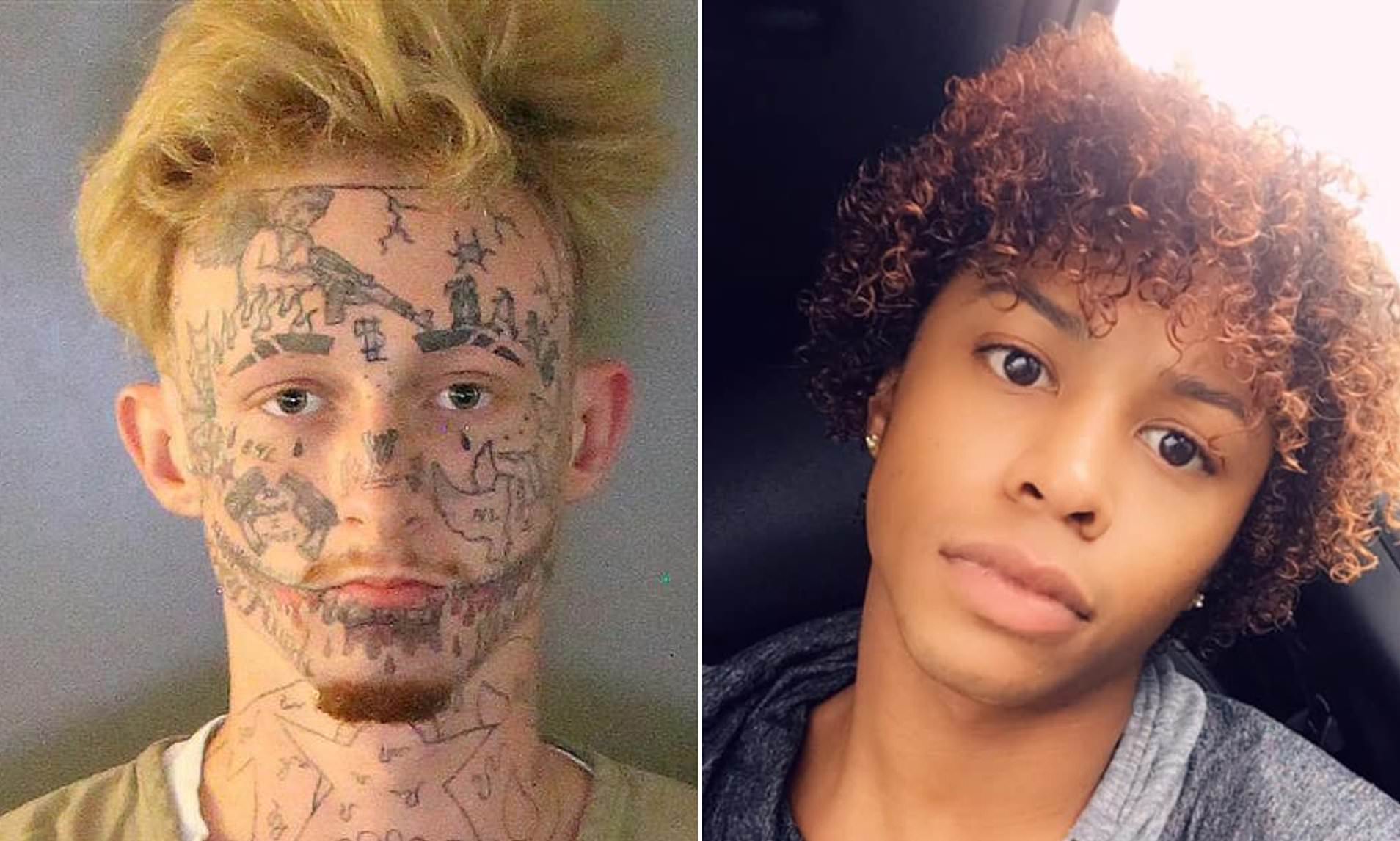
DM: ‘Violent thug’ with a face tattoo of an angel holding a machine gun is arrested after ‘killing his lover when he refused to delete explicit pictures’

Daily Mail article.

Comments at Steve Sailer:

* Long story short: Our friend, who had recently been released from prison, having completed his sentence, was having a sexual friendship with the victim, who had posted sexually explicit photographs online–as one does–and then refused to take them down as requested by the defendant. So he got a gun and killed him, regardless of the fact that as a felon, he was not allowed to have a gun.

Depressing as it is, the majority of murders are somewhat similar and involve young men of whatever race who have grown up completely unsocialized–mostly killing each other, although sometimes the violence does spill over into the noncriminal population.

They were invariably accidental babies who avoided abortion, born to acopic mothers and absent fathers of low inherited intelligence, raised in “the projects” or foster homes, failed abysmally in school where they presented behavioral problems right from the start leading to school exclusion, and fell in along the way with other delinquents.

This is a the problem that has to be addressed if we want to reduce the number of murders. Finding a way to get rid of the favelas of the United States.

* Gun control might be a dead issue for a generation.

* I think that in the US there is much less of a sense of local community outrage when someone does something that is completely beyond the pale.

I remember once, many years ago, seeing a British female TV reality show host appearing as a guest on a US TV reality show. It might have been Jerry Springer or Maury Povich, but I forget.

Anyway the remark she made that stuck in my memory was that she said to one of the participants something like “the people in your town must have the most extraordinary idea of what is normal to have allowed this to happen”, and it struck me that no American would have made this comment, because in America there is relatively little concept of place. You don’t have people on the Jerry Springer show saying things like “Is that how people behave in Idaho?”. In fact where people come from is never even mentioned.

In the UK, and perhaps other countries, people have (or used to have) much more of a sense of place and community, and would not want to bring shame on their family, home town, or county for fear of being held up as an example. There are more people in the US who don’t give a fuck.

* I guess this explains the massive outpouring of demonstrations, near riots, massive police action and punitive prison terms that followed the Rotherham revelation in the UK. You do remember that, don’t you old boy? How the British people rose up and roared like a lion, and the British elites responded with swift and sure punishment for all the grooming gangs? Because of that sense of community?

* In other city news, that racist Central Park dog lady has got her dog back because the police refused to take it. Good for her. It’s some small consolation for having your life destroyed by the Twitter mob.

* I never wanted to be a cop. I dealt with enough low lifes in construction that I knew I didn’t want to be involved in enforcing the law on them. So, people say, “You don’t know what it is like to be a cop, to deal with what they have to deal with daily.” And that is true. But right now, the governors and majors of the big cities racked by violence and, yes destruction, are paying the price for not letting cops be cops. A little late to back up and start over with enforcement after so much property damage. Problem is , we rolled over and let the governors and mayors control our lives with “Rules” during the pandemic. They loved that taste of power and now, when they should be enforcing “Laws” they are still proposing “Rules”, a curfew, a “soft touch”. It is going to be extremely hard going forward now with law enforcement.

Posted in Crime | Comments Off on DM: ‘Violent thug’ with a face tattoo of an angel holding a machine gun is arrested after ‘killing his lover when he refused to delete explicit pictures’

Thus Spake Kyle

Kyle Rowland, the only person under 27 whose opinions I seek out on politics and society (he has sharpened and challenged my thinking, I usually agree with him about 95%), responds to my questions:

It is difficult to estimate the importance of the riots, because we get tangled in the thorny discussion of symptom vs root cause. I think it is surely true that these riots are caused by a grave and deep problem with our country’s worldview/ideology but it seems to me they are the canary lying prone against the bars of its cage, not the deadly gas itself.

Seven is a fair rating for covid-19 on your scale. Once again, I am dismayed by what the dysfunction heralds: it is clear that the nation will survive however badly it mangles the response to covid. There will be tougher challenges in the future.

The riots shorn from all context are a 3. If we consider the economic and political context along with the broader “BLM” movement, I would say a 5. I think there’s a good likelihood that this will enlarge and sustain very dangerous ghettos, but the dysfunction will surely be isolated. The fear of hordes breaking into the suburbs is unreasonable, this behavior just isn’t viable in places where people respect and appreciate the police.

“Also, how much responsibility do you think I bear for what people do with books and ideas they hear on my show? I’d say less than 5%.”

How much responsibility does a sherpa bear for a climber carried away in an avalanche? Every man must decide what he is willing to risk.

Been thinking of Peter Thiel’s practical insight — you get a lot more done when people aren’t actively trying to oppose you. Looking at other online communities I see the same pathological dynamics as in the lukeosphere.
The uninteresting problem is that online communities have more than their share of confrontational people. The interesting problem is the cost of mobility. Once upon a time the ocean floor was covered with a thick mat of biomass which supported many organisms. this broke down when highly mobile burrowing creatures evolved, they broke down the mat and destroyed their own biome. When you can make a mess and leave it for others to clean up, you do it — even when it collectively leaves everyone much worse off. People are now capable of jumping social groups with cartoonish speed, but the relevant problems seem to emerge well below this level of mobility. Return to the old ways seems unlikely, but perhaps technology could eventually solve the problem. maybe it already has – credit score, for instance, might be a good-enough proxy to measure whether someone is in the habit of making messes and bouncing away.

Posted in America | Comments Off on Thus Spake Kyle

I Am My Show

I’m realizing that my Youtube show (preparation, delivery and aftermath) is about 50% of my life, and deleting a show is like deleting a part of myself. When the shows goes badly, I feel bad. When the show goes well, I feel well.

My therapist years ago said I was inflexible, that I have a problem dealing with frustration, and that I cut people out of my life too easily rather than negotiate with them.

I’m getting feedback that I get way too wounded from conflict on the show.

I have more empathy today for hosts who routinely cut people out of their life publicly and putting them in his black book if he feels they are deliberately sabotaging his show or trying to hurt him (as opposed to disagreeing or criticizing).

It’s exhausting rounding up people for a show, getting their sound and video levels right, and keeping up an interesting discussion within Youtube’s increasingly narrow terms of service.

Usually cutting people out of your life is self-destructive. I would like to think I no longer cut people out of my life, that I may pause or reduce the relationship instead, and I try to remember that time heals all wounds.

I’ve put a great deal of effort into getting the technical aspects of my show right, but the number one factor deciding how many people will watch is the guests. The care and maintenance of guests and panelists determines the success of shows like mine. When the content of a show is a vigorous discussion, it is easy to fall out with people. Also, most people who have the time and inclination to go on a Youtube show are anti-social.

To the extent that I’ve succeeded in this regard, I owe it to:

* Living up to my word (includes punctuality).
* Finding topics of mutual interest.
* Being a generous host. Not trying to hog the mic. Not being afraid of allowing others to shine and allowing myself to fade into the background at times.
* Getting clarity on my values so I can make the tough decisions.
* Staying out of feuds. I don’t trash people.
* When I passionately disagree, I try to focus my disagreement on specific words and deeds rather than the totality of a person.
* My code of conduct.
* If the show makes money, after the first $200 a month for my expenses, I share it 50-50 with my guests.
* Courtesy and empathy

Regulars on my show have felt betrayed when I have:

* Changed my mind on key issues.
* Decided to take the show in a new direction.
* Decided to part ways.
* Have not listened carefully and not bothered to respond to their points.
* Allowed conversations and shows to get off track and lose coherence.
* When I have interrupted them for stupid reasons.
* Lack of courtesy and empathy
* When my comments violate their sense of decency
* Made them look bad, left them feeling sand-bagged

When I am operating the show, much of my mind is taken up by the mechanics of the show and I have much less space for developing thoughts and listening to my guests. I love going on Joseph Cotto’s show as a guest because I can concentrate solely on ideas.

I notice that when I’m running a show and talking to guests, I tend to lose my own thoughts if I listen carefully, and if I compose my own thoughts en media res, I don’t listen carefully. I notice on many of my shows, we all tend to prioritize the development of our own thoughts over listening to each other.

I notice that the most easy going guests tend to be the least reliable and that the most reliable people are the least easy going.

Every person you add to a show is potentially explosive. It is not uncommon that adding one new person drives away other regulars. So often I am thinking that I am adding to my show by bringing on someone new but in the end, what has been added does not add up to what was lost. It is very easy to lose something good and very hard to recapture it. Also, as you bring on new people, you not only add viewers, you also lose viewers.

I need to bring about five times my normal amount of conversational energy to a show or it falls flat.

When you bring a friend on the show, there’s a good chance you’ll blow up the friendship.

There are rarely permanent friends or allies on a show, only shifting alliances.

I’ve heard that a marriage needs at least a 4-1 ratio of positive interactions to negative to stay on track. It’s similar for hosting a regular panel. Once that ratio drops below 4:1, you’re in trouble.

The more important a panelist is for my show, the more tempting it is to squelch myself to get along but this lack of courage on my part eats away at the foundations of the show.

The best conversations are one on one. The more people you add to a conversation, the more shallow it gets.

“Dangerous content is the best content,” says a friend.

The more I hype the importance of what I am discussing, the more excitement I generate, the more engagement I get, just like football announcers hyping a game that’s 30-3 in the second quarter. The more intense my emotions, the more engagement, but this bad for me as a host and bad for you as a viewer. I get more money, fame and viewership the more I go in an anti-social directions. You want to tune into a show where the host says the story they are discussing is the most important event in your lifetime but 99% of the time, this is bad for you. 

Never try to pull someone out of hiding. What do wounded animals do when you try that? They bite you. It’s not their fault. It’s just their instinct.

Posted in Personal | Comments Off on I Am My Show

Be Not Afraid

Be not afraid is my motto. There’s no idea or book or fact or theory I am not willing to confront and analyze (though some I don’t think are productive uses of my time). I have no sacred cows. To borrow a perspective from AA, there’s no place we can’t go if we have a good reason for going there.

I’ve read Mein Kampf three times. My happiness and sanity was not in the least affected. There were nights I let the audio version play for eight hours as I drifted in and out of sleep. I was always struck by Adolf’s childish desire for a magic key to unlock how the world works.

I’ve read The Communist Manifesto and The Prince and other dangerous books. I was not scathed.

Chaim: “Luke, just food for thought about responsibility when it comes to others behavior. What about ‘Lifnay Iver Lo titen michshole’ Leviticus 19: 14. “Do not curse the deaf or put a stumbling block in front of the blind, but fear your God. I am the Lord.” Should we consider the blindness (maturity) discernability/wisdom/ propensity for bad behavior by our intended audience before introducing material to them?”

It’s a beautiful admonition. We should be heedful of our affect on other people, but we should not cross over to believing that we are responsible for their choices. We can’t control anyone but ourselves. The first thing I learned about in therapy was boundaries. Lack of them has been a lifelong problem. I instinctively want to take responsibility for stuff that is not my responsibility and shirk responsibility for stuff that is my responsibility. I’m still learning where I end and others begin, and I still feel the old tug to feel guilty and involved in stuff that is not mine.

I’ve long found it easier to get all wrapped up in the lives of others instead of taking charges of my own. I still have vestigial tugs of this dysfunction, an inner voice that keeps popping up, saying you should feel guilty over what you suggested to XYZ and how that didn’t work out for him, and my pre-frontal cortex bats that voice back down and says let go.

Pete: “What if the audience is a minor?”

If the audience is a minor, you still can’t control them. Parents can’t fully control a 2yo. Minors have less agency than adults in general (some smart 11yos have more agency than some low IQ adults will ever have) so we need to be more careful with them. If a 12yo decides to kill himself, that’s not usually the primary responsibility of his parents or his friends.

Chaim: “But the biblical injunction would find ethical fault with someone for let’s say inviting out a former alchoholic for a beer.”

There’s a world of difference between “ethical fault” and responsibility. If you knowingly invite an alcoholic for a drink, you don’t have responsibility for him. You have however exhibited an ethical fault.

Pete: “One question I do have for Luke: now that you’ve seen how someone with a PhD could respond to Mein Kampf, do you have any reservations about suggesting others study MK? Because it seems like there is empirical evidence that it is equivalent to suggesting someone try meth.”

No. Anyone who loses his mind after reading Mein Kampf has a pathology that the book becomes an excuse to exhibit. Without the Kampf, the pathology would simply exhibit itself in other ways.

Former Orthodox rabbi David Gruber told me in 2008: “A year and a half into my three year contract, I’d always been very liberal and skeptical. I’d always asked questions that other people didn’t ask and troubled by stuff that maybe didn’t trouble other people. I was pretty comfortable knocking those square pegs into round holes from time to time.

“Then something clicked. It was The Limits of Orthodox Theology by Dr. Marc Shapiro. He’d probably be devastated but what are you going to do?

[Marc Shapiro replies to my inquiry: “One never knows how people will be affected by what you write. But I would think that the book would show him that you can still be Torah observant and not have to be so strongly bound to dogma.”]

John: “The first wave of Norwegians to leave for America in any numbers were nonconformist Protestants. This because in the early 19th century it was illegal for a Norwegian to be anything but the Church of Norway. So all nonconformist Protestants were essentially bullied to leave. I still don’t think Melchy is an extremist. I just think Melchy is an eccentric, and like R. Spencer he thinks aloud on livestream. Which is a mistake if you work in academia. I don’t have any problems with people talking about in and out groups. Every age has its own dogmas though. The only man who participated in Charlottesville who I’ve gained respect for afterwards is Jason Kessler. I still don’t know how Jason Kessler’s legal battles is gonna go, but he at least made the effort.”

Chaim: “There is a list of banned books that I made some headway into. But they are all novels written in English like Ulysses, Lady Chatterly’s Lover, Jude The Obscure. I read Who Wrote the Bible? by Richard Elliot Friedman at age 20, and realized I was not orthodox, or modern orthodox, not just lapsed but I’d say the book changed me in a profound way. I don’t know if this ‘redpilling’ was socially beneficial at the time. I was never the same again, but appreciated the bible in a new way, perhaps even appreciated its genius more as the work of men. I wanted to read it and feel confident I could expose myself to its questions. So I disagree there Luke.”

Do you think anyone who wanted to stay frum would have gone off the derech after reading that? I don’t.

Chaim: “Torah u’madah can’t survive critical theory of the bible, and the mocking of the Wellhausen model from then on seemed to be that of an ignoramus.”

Orthodox Judaism is the most powerful social model for Jewish life. Every other form of Jewish identity pales in comparison.

Pete: “The media bears responsibility too though. There is shared responsibility. People go there whole lives with repressed pathologies. Why help bring them it to the surface? I mean… who is inciting all these blacks to violence? Who is pushing false narratives of black victimhood on tv? Does Mein Kampf have a lesson for us here? Are there parallels?”

Nobody is rioting whose morals would preclude it. The only looters are those who want to loot and the media gives them blessing.

Chaim: “The enzyme metaphor is useful. It speeds up but does not cause a chemical reaction.”

“What if you gave an STD to someone?”

You harmed someone but the party that chooses to participate in sex with you bears some responsibility for their choice. If you give your wife an STD, that’s terrible and that’s on you, but it is also the price she paid for staying married to you despite your dysfunction and thus she chose to expose herself to a man who makes poor choices. If she had it all together, she would not have been with this man in the first place. Like attracts like. Yes, he gave her an STD, but this did not occur in a vacuum.

Posted in Personal | Comments Off on Be Not Afraid

LAT: As peaceful protests continue, LAPD budget could be cut by up to $150 million to reinvest in communities of color

LA mayor Eric Garcetti’s father Gil Garcetti let OJ Simpson get away with murder by moving the case to downtown Los Angeles. His son Eric takes a knee before the people looting the city. Now he wants to take away $150 million from law enforcement and give it to groups who fuel rioting.

Eric Garcetti threatened jail for people who dared to walk on the beach during the lockdown but he encourages these mass protests. Maybe Dennis Prager is right that the LA mayor and California governor are power mad and unhinged.

I like many things about our mayor. I like his calm demeanor, his understated sense of humor, and his grace. Lacking sufficient knowledge, I did not oppose or support the Covid-19 lockdown. I was willing to give the mayor and governor the benefit of the doubt on their Covid-19 response. Now I don’t know any positive way of looking at their Covid-19 choices given that they threw away everything they previously stood for when BLM (Black Lives Matter) came calling.

As for this media fetishization with “peaceful protests”, the riots and looting could not occur as extensively without the cover of these “peaceful protests.” The “peaceful protests” enable the looting and violence. They are a necessary pre-condition for the violence. And yet hundreds of corporations and Democratic politicians support BLM, which is a domestic terrorist group.

The Los Angeles Times described the protests yesterday as “peaceful.” Here’s an example of this “peaceful protest” from the afternoon of June 3:

From the Los Angeles Times:

As protests over police brutality and the death of George Floyd stretched into a sixth day, Los Angeles officials said Wednesday that they will look to cut $100 million to $150 million from the city’s police budget as part of a broader effort to reinvest more dollars into the black community.

In all, Mayor Eric Garcetti pledged that the city would “identify $250 million in cuts so we can invest in jobs, in health, in education and in healing,” especially in the city’s black community “as well as communities of color and women and people who have been left behind.”

Stand your ground doesn’t just apply to the use of guns. It’s a good philosophy for life when you consistently do the right thing.

Ashley Rae Goldenberg writes:

Here Are The Companies That Support Antifa, Black Lives Matter, and Want You Dead

Companies defending the rioters:
23andme: https://archive.is/Mjbwk
72andSunny: https://archive.is/B1x7Y
Abbey Road Studios: https://archive.is/AJlrg
The Academy (the Oscars): https://archive.is/cNRYf
Activision Blizzard: https://archive.is/qfRJ1
Adidas: https://archive.is/ezQ22
Airbnb: https://archive.is/GmMjl
Alaska Airlines: https://archive.is/wnICf
Amazon: https://archive.is/lBR4u
American Airlines: https://archive.is/XBwhw
American Express: https://archive.is/kzWXa
American Apparel: https://archive.is/ETfYw
Apple Music: https://archive.is/cj97E
Astro Gaming: https://archive.is/9aWhf
AT&T: https://archive.is/OzC04
Atlantic Records: https://archive.is/65QQq
AWS: https://archive.is/NXNAG
AXE: https://archive.is/Xpxhw
Barnes & Noble: https://archive.is/PCPKn
Bank of America: https://archive.is/FH1O0
Bergdorf Goodman: https://archive.is/nQiPA
Bethesda: https://archive.is/2xeNE
Ben & Jerry’s: https://archive.is/BqHRv
Billboard: https://archive.is/Ruuv8
BMW: https://archive.is/lRN51
Boost Mobile: https://archive.is/pLnAf
Bratz: https://archive.is/vOA1d
Bungie: https://archive.is/81KHV
Burberry: https://archive.is/ha0jP
Call of Duty: https://archive.is/DEJA6
Capcom: https://archive.is/S1BgN
Capitol Records: https://archive.is/jeUpY
Canada Goose: https://archive.is/y2nLo
Cisco: https://archive.is/fNvdP
Citigroup: https://archive.is/36fkF
Conde Nast: https://archive.is/ChMdI
Converse: https://archive.is//sKjmg
Crunchyroll: https://archive.is/q7Ucj
CW: https://archive.is/JumZU
CVS: https://archive.is/DbBSV
Dell: https://archive.is/IeI9j
Degree: https://archive.is/SItaW
Devolver Digital: https://archive.is/xcaEH
DIRECTV: https://archive.is/hhBG4
Discord: https://archive.is/hGtDw
Disney: https://archive.is/wldfM
Doritos: https://archive.is/nLHv0
DoorDash: https://archive.is/vhTW2
Doulingo: https://archive.is/v9Wpk
E! News: https://archive.is/3PJyz
EA: https://archive.is/92ALS
Eight Sleep: https://archive.is/IiV7n
ESPN: https://archive.is/1I5Tf
FedEx: https://archive.is/kKVJp
Fender: https://archive.is/OGjBM
Formula 1: https://archive.is/FCpBG
FOX: https://archive.is/p2BvT
Frosted Mini Wheats: https://archive.is/vrEYN
Funimation: https://archive.is/sfN8E
GameSpot: https://archive.is/zEkO3
Gibson: https://archive.is/qJYZY
Goldman Sachs: https://archive.is/TA2h0
GoFundMe: https://archive.is/Be0fJ
Google: https://archive.is/DK2T8
Gorilla Glue: https://archive.is/0R9ya
Grindr: https://archive.is/Z6KcW
Harry’s: https://archive.is/mE4NN
HBO: https://archive.is/oiUyY
HBO Max: https://archive.is/LGsPt
Help Scout: https://archive.is//D8DCs
Hershey’s: https://archive.is/ZQ5zD
H&M: https://archive.is/A9ONJ
HP: https://archive.is/BO2tc
Hulu: https://archive.is/4CyO2
Humble Bundle: https://archive.is/YXDb6
IBM: https://archive.is/ij3Q1
Indiegogo: https://archive.is/jrDZk
itch.io: https://archive.is/UTsTi
Intel: https://archive.is/93D5q
IKEA: https://archive.is/piwcs
ITV: https://archive.is/yD1pS
Kickstarter: https://archive.is/0zwng
Lego: https://archive.is/UKFhD
Levi’s: https://archive.is/KizLO
LinkedIn: https://archive.is/sX5zb
L’Oreal Paris: https://archive.is/Jfelo
Logitech: https://archive.is/vf6J7
Lululemon: https://archive.is/rjCRV
Louis Vuitton: https://archive.is/nGZe8
Lyft: https://archive.is/UXl3k
Madden NFL 20: https://archive.is/CTUoi
Marvel Entertainment: https://archive.is/Ptup6
MATTEL: https://archive.is/bvsqN
McAfee: https://archive.is/IGXA1
McDonald’s: https://archive.is/jOZ65
Mercedes Benz: https://archive.is/bs8y6
Metropolitan Opera: https://archive.fo/wecQ2
Microsoft: https://archive.is/A7Vjv
Napster: https://archive.is/fVY1s
NASCAR: https://archive.is/LG2hU
Netflix: https://archive.is/UVSEr
NFL: https://archive.is/G4yq4
NHL: https://archive.is/lYbyG
Niantic: https://archive.is/UdKYR
Nickelodeon: https://archive.is/JWSPQ
Nike: https://archive.is/UXYBy
Nintendo: https://archive.is/5UOjp
Nordstrom: https://archive.is/A7mUU
North Face: https://archive.is/rq1Cb
Old Spice: https://archive.is/1UK5d
Paramount Pictures: https://archive.is/ixXHd
Paramount Network: https://archive.is/BCAX3
Patreon: https://archive.is/wzfM5
Peloton: https://archive.is/d36k7
Playstation: https://archive.is/52Vvl
Pokemon: https://archive.is/p9zuP
Popeye’s Chicken: https://archive.is/CzlHd
Pop-Tarts: https://archive.is/8cMGG
Porsche: https://archive.is/VrmlZ
Pringles: https://archive.is/1WpA1
Procter & Gamble: https://archive.is/JSMO4
Reddit: https://archive.is/H09M8
Red Lobster: https://archive.is/aIUyy
Reebok: https://archive.is/v0nat
Reese’s: https://archive.is/Rc4pJ
Rice Krispies: https://archive.is/U4Zn9
Riot Games: https://archive.is/2XH97
Salesforce: https://archive.is/t1qZB
Sanofi: https://archive.is//ErmGO
Scholastic: https://archive.is/fFmX3
Sesame Street: https://archive.is/5he9K
Showtime: https://archive.is/YTPVw
Slack: https://archive.is/gF9ym
Sephora: https://archive.is/Gm7Rc
Skillshare: https://archive.is/JX5em
Snap: https://archive.is/HcGGQ
Snapchat: https://archive.is/5reL4
State Street: https://archive.is/gnqt0
Sony: https://archive.is/1PtlU
Spotify: https://archive.is/ufTeo
Square Enix: https://archive.is/qmPIX
STARZ: https://archive.is/eQ4YG
Starbucks: https://archive.is/EENlS
Star Wars: https://archive.is/xnSgt
Subway: https://archive.is/D5F8H
Taco Bell: https://archive.is/LLY9l
Target: https://archive.is/YoIrO
TBS: https://archive.is/N0QhU
Tesco: https://archive.is/hZS7B
Thatgamecompany: https://archive.is/7po1C
TikTok: https://archive.is/bt2vy
Timberland: https://archive.is/HZtxv
Tinder: https://archive.is/YaY2y
TMobile: https://archive.is//KB2lG
Twitch: https://archive.is/DAmR5
Twitter: https://archive.is/auIgi
Ubisoft: https://archive.is/0qMff
Uber: https://archive.is/RrScn
UnitedHealth Group: https://archive.is/rzQXF
Vans: https://archive.is/5nYag
Verizon: https://archive.is/hPZoJ
VERSACE: https://archive.is/wWsxK
Vevo: https://archive.is/MVtrR
Via: https://archive.is/fFIvU
ViacomCBS: https://archive.is/uCGXy
Virgin Records: https://archive.is/QiykN
Virta: https://archive.is/7e9KT
VIZ: https://archive.is/eMuIW
Warner Bros https://archive.is/F1Tqn
Warner Records: https://archive.is/Mm6qb
Wendy’s: https://archive.is/7X4Nu
XBox: https://archive.is/6zdVS
YouTube: https://archive.is/5qz6a
Zildijian: https://archive.fo/o6Tqi

Posted in Los Angeles | Comments Off on LAT: As peaceful protests continue, LAPD budget could be cut by up to $150 million to reinvest in communities of color

Drew Brees Apologizes For ‘Insensitive’ Comments on Kneeling During Anthem: ‘I Stand With the Black Community’

It takes great courage to be outside the consensus in your field.

Report:

New Orleans Saints quarterback Drew Brees apologized on Thursday for opposing kneeling during the national anthem amid nationwide protests over the death of George Floyd.

Brees faced heavy criticism on Wednesday over comments he made during an interview with Yahoo, where he said about kneeling, “I will never agree with anybody disrespecting the flag of the United States of America or our country.”

In an Instagram post on Thursday, Brees wrote, “I would like to apologize to my friends, teammates, the City of New Orleans, the black community, NFL community and anyone I hurt with my comments yesterday. In speaking with some of you, it breaks my heart to know the pain I have caused.”

In other words, please don’t hurt me.

Posted in Football | Comments Off on Drew Brees Apologizes For ‘Insensitive’ Comments on Kneeling During Anthem: ‘I Stand With the Black Community’