Afghan Migrant Brutally Raped And Burnt To Death Young European Because She Wanted To Break Up

From Breitbart: An Afghan migrant has been sentenced to life imprisonment in Finland for brutally murdering a teenage lover ten years his junior because she didn’t want to continue the relationship.

The 17-year-old Finnish girl had only dated Ramin Azimi for a month before she tried to end their relationship. The court heard how she had wanted to see another man, but Mr. Azimi demanded marriage and children of her. When she wouldn’t cooperate, Mr. Azimi attacked the young woman while she was out jogging.

Equipped with spare clothing, rope and gasoline, the Afghan asylum seeker raped his former lover in revenge for leaving him. Having completed this act, Mr. Azimi then tied the girl to a chair in an abandoned shed, poured petrol over her, and set her alight.

The body of the young woman was later discovered by dogs after her disappearance had been reported to police by her parents.

When arrested Mr. Azimi told police he had tried to commit suicide by burning himself, and his girlfriend had rushed to his aid. In doing so she herself was caught in the burning building but he escaped unharmed. The court rejected this version of events.

The prosecutor said Mr. Azimi killed because he was consumed with jealousy, and even said his struggles with obtaining Finnish citizenship had played a part in driving him to kill.

Judged sane by a court psychiatrist, the perpetrator — a long-time resident of Finland but without Finnish citizenship — has now been sentenced to life imprisonment for the sadistic killing.

Although this is his first criminal offence, he has not been averse to creating trouble. The court heard how he had recently knocked his own mother to the floor, fought with siblings, and punched a friend in the nose so “blood was pouring hard”, reports Iltalehti.fi.

Bizarrely, while Mr. Azimi was ordered to pay €60,000 to the parents of the deceased girl in compensation, he was ordered to pay an even larger amount — €69,000 — to the insurance company responsible for the building he burnt down with his victim inside it.

Posted in Africa, Blacks, Crime, Immigration | Comments Off on Afghan Migrant Brutally Raped And Burnt To Death Young European Because She Wanted To Break Up

Harvard On Jews (1922)

From The Nation Sept. 6, 1922:

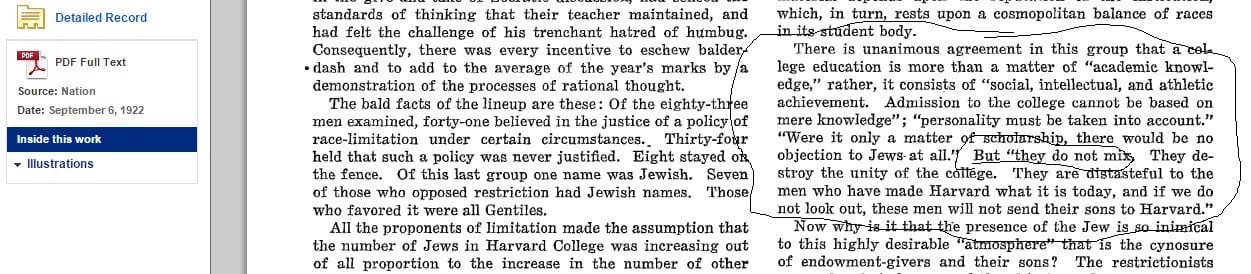
There is unanimous agreement in this group that a college education is more than a matter of “academic knowledge,” rather, it consists of “social, intellectual, and athletic achievement. Admission to the college cannot be based on mere knowledge”; “personality must be taken into account.” “Were it only a matter of scholarship, there would be no objections to Jews at all.” But “they do not mix. They destroy the unity of the college. They are distasteful to the men who have made Harvard what it is today, and if we do not look out, these men will not send their sons to Harvard.”

harvard1

This argument reminds me of the 1940 essay “The Reasoned Case Against Semitism” by Australian nationalist P.R. Stephensen:

Essentially, Jews are a minority, self-differentiated as such, a Race Apart not only from the rest of mankind, speaking generally, but also from any particular community in the midst of which they may reside. This fact makes the usual postulates of political discussion—namely, universal humanitarianism, or, alternately, the welfare of a National Unit, considered as a Whole—inapplicable to the Jewish Question. It is absurd for Jews to preach (as many of them do) that men are all of one Kind, while this preachment is belied by the fact that the Jews themselves, by their own Choice, remain a different Kind from all other kinds of men. Similarly it would be absurd for Jews to preach the welfare and advancement of any one nation as a paramount political consideration, while holding themselves racially apart from the majority in that nation. It can never be true that “all men are brothers,” either within one nation or in the world at large, while Jews continue to practice an extreme form of biological differentiation through rigid selective breeding.

Jews cannot “have it both ways.” They cannot expect to be listened-to with respect when they preach to Gentiles the Universal Oneness of Mankind, while at the same time they, as Jews, remain a Race Apart. It is when this discrepancy between their words and their actions is recognized, that Jews become disliked by non-Jews. Nobody likes to be humbugged, either by financial confidence-tricks, or by metaphysical and political verbal play. In brief, if Jews are going to persist in keeping themselves racially apart from the rest of mankind or from a particular nation, then they should also keep themselves politically apart. The Antisemite brings this point of view to the fore. He starts from the same premise as the Jews themselves—namely that the Jews, by their deliberate practice of Racialism, are differentiated from non-Jews. But, as soon as this differentiation is accepted as an unalterable fact, and is brought to the full consciousness of non-Jews, a prejudice is created against Jews, in the minds of non-Jews, which makes a further dispassionate or detached discussion of the entire topic virtually impossible. The implication of the Jewish practice of Racialism is unmistakably Themselves First—Themselves versus the Rest. Once understood, that constitutes a challenge to the Rest of Us which cannot conscientiously be disregarded.

The discussion, then, comes down to prejudice versus prejudice, the result of a clash of interests which cannot be resolved by any form of words. Carried further, this means propaganda versus propaganda—a process termed, by both sides, “enlightenment.” The most honest thing to do is to avow the prejudice, and stand on it. As a non-Jew, I avow that my prejudices are non-Jewish; and this means that, in any conflict of interests between Jews, on the one hand, and non-Jews on the other, my instincts place me naturally in the non-Jewish camp. When I see an organized minority of Jews, actuated by their self-interest, engaging in operations for their own sectional self-aggrandizement as against the interests of the community-as-a-whole or of the non-Jewish majority in it, then, as a non-Jew, I claim the same right to organize non-Jews as the Jews have claimed and obtained to organize themselves. The political validity of Antisemitism is thus on a plane no higher, or no lower, than that of Antisemitism; for, if there were no Semitism, there would be no need of Antisemitism to counteract it. While organized Semitism operates as a political activity in Australia, there can surely be no logical objection, among “Liberal” political thinkers, to the existence of the counteracting, or counter-balancing, activity of Antisemitism—provided always that the antidote is merely of sufficient strength to neutralize the irritant, and does not in itself become toxic.

Posted in Anti-Semitism, Australia, Harvard | Comments Off on Harvard On Jews (1922)

Hitler On America’s Immigration Policy (1933)

From The New Republic Feb. 15, 1933:

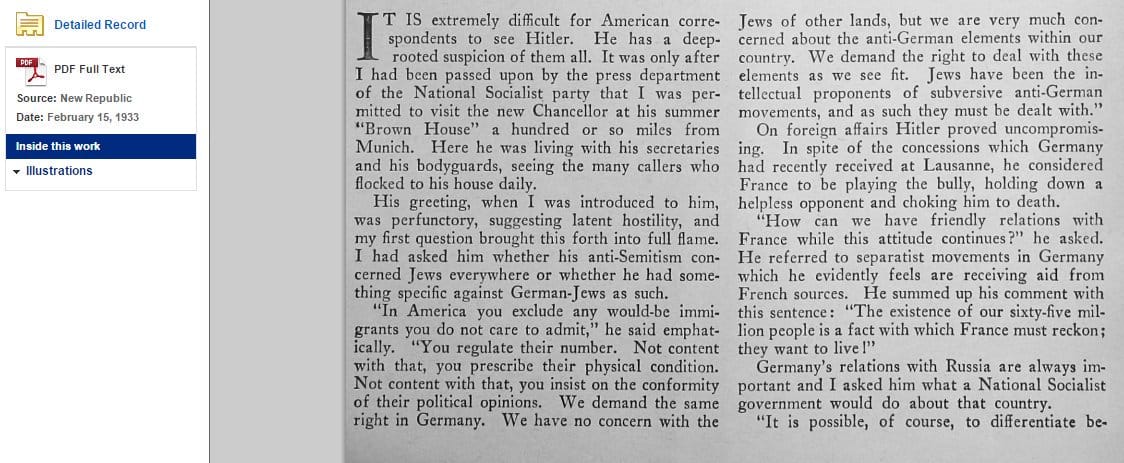
His greeting, when I was introduced to him, was perfunctory, suggesting latent hostility, and my first question brought this forth into full flame. I had asked him whether his anti-Semitism concerned Jews everywhere or whether he had something specific against German-Jews as such.

“In America you exclude any would-be immigrants you do not care to admit,” he said emphatically. “You regulate that number. Not content with that, you prescribe their physical condition. Not content with that, you insist on the conformity of their political opinions. We demand the same right in Germany. We have no concern with the Jews of other lands, but we are very much concerned about the anti-German elements within our country. We demand the right to deal with these elements as we see fit. Jews have been the intellectual proponents of subversive anti-German movements, and as such they must be dealt with.”

hitler

Posted in Adolf Hitler, Anti-Semitism, Germany, Jews | Comments Off on Hitler On America’s Immigration Policy (1933)

Newsweek: Non-Jewish Refugees Get a Cold Shoulder in Israel

I admire how Israel protects itself despite world pressure to diminish its Jewish state.

All nations should protect themselves from the importation of people who are not a good fit.

No country has a moral obligation to destroy itself (aka import the world’s trash).

Newsweek: Usumain Baraka was 9 when Arab Janjaweed militants destroyed his village in Darfur in 2004, killing his father and brother. After four years in a Sudanese refugee camp, Baraka says, he wanted a better future.

At the time, he says, he thought “Israel was the only democracy in the Middle East…. I really related to the Jewish people because of the Holocaust and thought they would identify with me because of the genocide in Darfur.”

At the age of 13, Baraka trekked from Sudan into Egypt, and then over the Egyptian border into Israel. Instead of a safe haven, he found himself in a country that wanted nothing to do with him. “They don’t even check our refugee requests,” says Baraka, who is now 20 and lives and volunteers in a youth village in northern Israel.

He is one of the nearly 65,000 Africans who, according to Israeli government figures, crossed into Israel illegally between 2006 and 2013. Approximately 45,000 remain. More than 33,000 of the asylum seekers in Israel are from Eritrea, while 8,500 are from Sudan—countries the UNHCR says are, respectively, the 10th and fourth largest sources of refugees in the world. Israel has granted refugee status to just four Eritrean refugees and not a single one from Sudan.

As European governments grapple with how to handle hundreds of thousands of refugees and migrants, mostly from Syria but also from Sudan, Eritrea, Afghanistan and other troubled countries, some in Europe are now looking to Israel for lessons in how to keep out asylum seekers.

The irony here is that it was the international failure to assist Jews during the Holocaust that led to the 1951 United Nations Refugee Convention, the first international agreement addressing the rights of refugees and states’ obligations to them. Today, 148 nations are signatories to this legal document, vowing to never again turn their backs on those fleeing persecution and genocide.

That tragic period also led to the establishment of Israel, a safe haven for oppressed Jews around the world. The Jewish state was among the first countries to sign the U.N. Refugee Convention, as its people, perhaps more than anyone, knew what it was like to be unwelcome.

While Israel remains a haven for Jewish refugees, Israeli officials and the media routinely disparage non-Jewish African asylum seekers. In August, Israeli Interior Minister Silvan Shalom declared, “I will not relent until we reach a framework that will allow the removal of the infiltrators from Israel.”

Posted in Israel | Comments Off on Newsweek: Non-Jewish Refugees Get a Cold Shoulder in Israel

Why isn’t Israel accepting more refugees?

Despite considerable pressure from outside and in, Israel’s government stands firm in its commitment to take no Syrian refugees. All nationalists should admire Israel’s dedication to its best interests.

The Jewish state is an ethno-state, perhaps the most successful ethno-state given its difficult circumstances (surrounded by enemies who want to destroy it). By necessity, Israel contains a couple of million Arabs. That diversity weakens it. Israel would be stronger as a 100% Jewish state. No state is strengthened by containing people who hate it.

From an op-ed on Al Jazeera Sept. 22, 2015:

Netanyahu’s hypocritical stance on asylum seekers reflects country’s long struggle over ethnic and national identity.

The European refugee crisis has not gone unnoticed in Israel. The media have been dominated by images of Syrian refugees enveloping Europe, and Israeli opposition Zionist Union chairman Isaac Herzog recently called on the government to allow Syrian refugees into Israel, saying, “Jews cannot be indifferent while hundreds of thousands of refugees are looking for safe haven.”

His remarks, however generous they may seem, expose the hypocrisy of Israel’s center left. He evokes Jewish heritage when convenient and abandons it when necessary. While Syrians qualify as refugees for Herzog, the 45,000 Sudanese and Eritreans in desperate need of asylum in Israel are labeled as infiltrators under Israeli law, detained, and in some cases even deported to third countries.

Israeli Prime Minister Benjamin Netanyahu quickly responded to Herzog’s PR stunt and rejected calls to accept Syrian refugees. In his statement, Netanyahu said that Israel is “a very small country that lacks demographic and geographic depth” and discussed his plans to construct a fence along the eastern border with Jordan.

His response is hardly surprising; when Israel faced an influx of African asylum seekers, the government erected a surveillance fence along the border with Egypt as, he said, “a strategic decision to secure Israel’s Jewish and democratic character.”

The recent refugee crisis in Europe brings to light once again Israel’s struggle to consolidate its values as a Jewish and democratic state. While Israel is party to the 1951 Refugee Convention, it never worked to establish a functional refugee system. As of March 2015, Israel recognized only four Eritreans and not a single Sudanese person as refugees.

While Israel is falling short in its obligations toward asylum seekers, the persecution of European Jews during the World War II remains an important part of Israel’s national narrative. The refugee issue has always been a politically loaded question in the Israeli context. At the same time that Israel acceded to the Refugee Convention in 1954, it adopted the Prevention of Infiltration Law. Under this law, all irregular border crossers are seen as infiltrators, and the Ministry of Defense is authorized to deport infiltrators, even before conviction. While the provisions of the law were directed primarily against the infiltration of armed fighters, the law is also invoked to prevent the entry of Palestinians into Israel or their return. Article 1(3) of the law defines an infiltrator as “a Palestinian citizen or a Palestinian resident without nationality or citizenship or whose nationality or citizenship was doubtful.”

Israel’s reluctance to incorporate the Refugee Convention into its laws may be explained by the context of the time. The vast majority of individuals arriving in the country in the 1950s were displaced European Jews, many of whom were Holocaust survivors, as well as Jewish refugees who fled to Israel from Arab states in the Middle East and North Africa. Since a central aspect of Israel’s identity is the notion that it belongs to Jews, Israel’s immigration laws automatically grant citizenship to the Jewish diaspora. Israel therefore has never dealt with the Jewish refugee population as refugees, because they are already perceived as integral parts of the Jewish nation.

But at the same time, Israel has been dealing with another refugee problem: the Palestinians it expelled in 1948. The Prevention of Infiltration Law provides a legal mechanism for preventing the return of Palestinian refugees. When African asylum seekers began arriving in the country, Israel quickly moved to amend the law to consider all irregular border crossers infiltrators, including asylum seekers.

Israel is constantly seeking to delineate its national narrative through amending its immigration policy; it has worked hard over the years to preserve the status of refugees solely for Holocaust survivors, and it has succeeded in doing so legally. Netanyahu’s recent refusal to accept Syrian refugees was a similarly motivated attempt graft security concerns onto humanitarian ones by labeling Syrian refugees as infiltrators before they even entered the country.

On Sept. 6, Netanyahu wrote on his Facebook page that Israel must control its borders “and prevent migrant workers, infiltrators or generators of terrorism” from entering the country. After stating that “Israel is not indifferent to the human tragedy of the refugees from Syria and Africa,” he quickly moved to call Syrians and Africans “infiltrators” and “terrorists.”

In a Cabinet meeting that took place that day, he further linked the recent refugee crisis to security concerns by discussing the Sept. 3 attacks against five young ultra-Orthodox American yeshiva students in Jabel Johar.

In his short statement on the refugee crisis, Netanyahu managed to link Israel’s security concerns with asylum issues while resealing the Pandora’s box of Palestinian refugees. Applying this line was particularly important for him, especially after Palestinian Authority President Mahmoud Abbas called on Saturday for the absorption of Palestinian refugees now fleeing the war in Syria to the Israeli-occupied West Bank. Even opposition leader Herzog did not dare refer specifically to Palestinian refugees in his calls for Israel to accept Syrians.

Israel’s apparent inability to come to grips with its duality as a Jewish and democratic state is at the core of its response to the refugee crisis. Israel’s refusal to absorb Syrian refugees, allow Palestinians from Syria’s Yarmouk camp into the West Bank or accommodate the 45,000 African asylum seekers in the country should all be viewed as a symptom of the same phenomenon: Israel’s assertion of its ethnic and national identity. In calling asylum seekers and refugees infiltrators, Israel chose to favor, once again, its demographic objectives over its commitment to international law.

Talya Sultana Swissa is a graduate of Columbia University pursuing her master’s degree at Sciences Po at the Paris School of International Affairs.

From the posted comments:

* The writer of this article is an idiot. Who in their right flipping mind would put their people at such high risk as to allow a bunch of Israel hating coo-coo nuts within their borders only for these nuts to attack and stab poor innocent citizens. Just like the current happening of those crazy insane brainwashed so-called ‘palestinians’ stabbing people, including children and toddlers at randoms these past few weeks.

* There is a reason they are not wanted. They are future problems for the country that accepts them. Israel knows this.

* Exactly! It’s not as if these refugees are Hebrews too, and part of the same family. No intelligent common sense leader would invite an army of sworn enemies onto their land, knowing without doubt that they’ll just be stabbed in the back, We all know it. Israel must put their people first and foremost always. These refugees are nothing but problems, cowardly men fleeing their country, then thinking they will deserve to go back once the Assad and real men have fought for it’s survival from the ISIS satanist and their buddies in arms, the criminal Syrian rebels.

* They are not just Syrian refugees, they are sworn enemies of Israel!!! Just as Pakistan is India’s sworn enemies. No good rational thinking leader would invite their KNOWN enemies into their cities and neighborhoods, now would they? Use your common sense.

* The West should investigate other routes. For instance, the Norwegian Foreign Ministry has calculated that because of all the social, health, housing and welfare benefits mandated by the state, supporting a single refugee in Norway costs $125,000 — enough to support some 26 Syrians in Jordan.

* How about the cowardly young and strong healthy Syrian men stay and fight for their country? How about that? This wouldn’t be happening now if it weren’t for those Syrian men being such low-life cowards.

* Israel is a tiny State; only 20 miles wide at the point Tel Aviv is located.

The Jews only have one country for refuge: Israel.

Also Israel does not want to lose it’s Jewish identity.

* Gee… you think maybe its because Syria is technically at war with Israel? Saudi Arabia has a lot more room for their Arab brothers. Let them settle there.

* For 70 years the Arab countries have not accepted even Palestinian refugees, whereas Israel is a country almost entirely populated by refugees.many of whom came from Arab, or other Muslim countries. Can you spell double standard?

* Is this a serious question/article? Not a single Arab country has agreed to accept any refugees from anywhere… Maybe we should be asking why Saudi Arabia, Qatar, Egypt, Yemen etc. aren’t accepting refugees? The world expects the larger European countries to absorb a large proportion of the refugees, so maybe we should also look at the larger Middle Eastern countries for a similar response.

* I keep hearing Israel likened to the Nazis. People who do that are seriously uninformed about the Nazis. They should do some reading. I suggest The Holocaust — a History of the Jews of Europe During the Second World War, by Martin Gilbert.

* Just want to remind you that Qatar, your financial backers, have accepted no refugees from Syria. Please pay attention to your own backyard before you criticize someone else. At least Israel have some legitimate reasons: culture is different and the fact that everyday Muslims aren’t fans of Israel.

* Israel is all is about building fences and borders to keep people out. Israel’s current government has a “bunker and war” mentality, incompatible with the compassion that is required to help other humans of “non-Jewish” origin. Even though the origins of this mind set are understandable, going down this road will not lead to positive outcomes for most Israelis. This is unfortunate.

* Israel has been providing free medical care to the wounded on all sides of the conflict in Syria.

* I just read in the Economist that israel has become a safe haven for rich (jewish) gangsters who want a second home where they will feel secure from prosecution. I guess if you have money you’re welcome anywhere no matter how you gained your wealth.

Posted in Immigration, Israel | Comments Off on Why isn’t Israel accepting more refugees?

Is sociopathy an illness?

I wonder how many people who read this essay will grasp its implications?

There’s no way that people who have evolved in different places are going to have identical abilities.

Anthropologist Peter Frost writes:

Is sociopathy an illness? We often think so … to the point that the word “sick” has taken on a strange secondary meaning. If we call a ruthless, self-seeking person “sick,” we mean he should be shunned at all costs. We don’t mean he should take an aspirin and get some rest.

Sociopathy doesn’t look like a mental illness, being much less incapacitating than schizophrenia and most mental disorders. A sociopath can deal with other people well enough, perhaps too well. As Harpending and Sobus (2015) point out:

It is a psychopathology because of what sociopaths do to us, and it has significant legal, political, and moral consequences for all of us. Most criminals are probably sociopaths according to some definition (the figure of 80% is often quoted).

Sociopaths regularly present the following characteristics:

  • onset before age 15, childhood hyperactivity, truancy, delinquency, disruption in school
  • early and often aggressive sexual activity, marital histories of desertion, non-support, abandonment
  • persistent lying, cheating, irresponsibility without visible shame
  • sudden changes of plan, impulsiveness, unpredictability
  • charm and a façade of sensitivity
  • high mobility, vagrancy, use of aliases

Sociopaths follow a life strategy that is adaptive for themselves but ruinous for society. Harpending and Sobus (2015) argue that they succeed so well because they know how to manipulate social relationships to their advantage.

Sociopathy is at least moderately heritable (Hicks et al., 2004). Interestingly, it seems to cluster with hysteria in first-degree relatives, with sociopathy being expressed in the males and hysteria in the females. Harpending and Sobus (2015) argue that “hysteria is the expression in females of the same genetic material that leads to sociopathy in males.” In short, “sociopathy in females is the result of a greater dose of the genetic material that leads, in smaller doses, to hysteria, namely, hysteria is mild sociopathy.”

If sociopathy is adaptive, why does it affect only a minority of us? It seems that the rest of us have developed counter-strategies of looking for signs of sociopathy and expelling suspects from society … and the gene pool. This is probably why sociopaths tend to be always on the move—if they stay too long with the same people, they risk being detected and dealt with.

Gene-culture coevolution

We adapt to our cultural environment as we do to our natural environment. More so in fact. The last 10,000 years have seen far more genetic change in our ancestors than the previous 100,000, this speeding up of evolution being driven by the entry of humans into an increasingly diverse range of cultural environments.

Sociopathy may thus propagate itself more easily in some cultures than in others, with the result that its incidence may likewise differ from one to another. In a small band of hunter-gatherers, a sociopath will not last long because he is always interacting with the same small group of people:

In a 1976 study anthropologist Jane M. Murphy, then at Harvard University found that an isolated group of Yupik-speaking Inuits near the Bering Strait had a term (kunlangeta) they used to describe “a man who … repeatedly lies and cheats and steals things and … takes sexual advantage of many women—someone who does not pay attention to reprimands and who is always being brought to the elders for punishment.” When Murphy asked an Inuit what the group would typically do with a kunlangeta, he replied, “Somebody would have pushed him off the ice when nobody else was looking.”(Lilienfeld and Arkowitz, 2007)

In a larger community, a sociopath may evade detection long enough to reproduce successfully and pass on his mental traits. Finally, in some cultures he can use his manipulative skills to dominate the community, becoming a “big man” and enjoying very good opportunities for reproduction.

This Pandora’s Box was opened when humans gave up hunting and gathering and became farmers. First, farming supported a much larger population, so it became easier for sociopaths to move about from one group of unsuspecting people to another. Second, farming created a food surplus that powerful individuals could use to support underlings of various sorts: servants, soldiers, scribes, etc. There was thus a growing class of people who did not directly support themselves and whose existence depended on their ability to manipulate others.

Finally, in the tropical zone, farming greatly increased female reproductive autonomy. Through year-round farming, women could provide for themselves and their children with less male assistance. Men accordingly shifted their reproductive strategy from monogamy to polygyny, i.e., from providing for a wife and children to inseminating as many women as possible. This kind of cultural environment selected for male seducers and manipulators rather than male providers. Conversely, it selected for women who feel only an intermittent need for male companionship and who from time to time are able to coax assistance from people who are not so inclined:

Ethnographic descriptions of women who live in social contexts of low male parental investment portray women who are very demanding. Young women demand help from kin on behalf of children. When the help is not forthcoming the mothers often summarily dump or deposit the child or children at the door of a relative who (in their judgment) will not turn the children away. Women demand gifts from boyfriends for themselves.(Harpending and Draper, 1988)

In women, this selection pressure favors a condition known medically as Briquet’s syndrome and more commonly as “hysteria”:

When males are not good risks for parental investment, females will adjust their behavior accordingly. A common clinical characterization of Briquet’s syndrome is a woman who exaggerates need, who demands high levels of attention and investment, who deceives herself and others as to her requirements. The strategy (learned or inherited) makes sense for a woman with high exposure to low investment males. These males, however, are so fickle and so mobile that they can be dunned only in the short run.(Harpending and Draper, 1988)

Sociopathic behavior, be it hysteria or full-blown sociopathy, is not favored in hunter-gatherers, since both sexes invest heavily in their offspring and in each other. The selection is for men and women who can bond strongly with one partner:

[…] abandonment of the pair bond by either partner is likely to be deadly for the offspring. Draper (manuscript) finds that men with more children spend more time hunting than men with fewer dependents; that is to say that more offspring are directly translated into more parental work for the male. Pennington and Harpending (manuscript) found that infant mortality among women who had more than one mate during their reproductive careers was nearly twice as great as infant mortality of women who had only one husband. […] In societies of this type the contexts for the anti-social trait are unfavorable. There will be no pay-offs for anti-social behavior and the bearer of the trait will be readily detected and ostracized. (Harpending and Draper, 1988)

Strategy and counter-strategy

Sociopathy is therefore not an illness but a strategy. It has been least successful in small societies where both sexes invest heavily in care for their partners and offspring. It has been more successful in larger societies, particularly those where men invest less in partners and offspring. Indeed, because sociopathy does so well in such contexts, it may have hindered the development of larger and more complex societies.

In most large societies, people seek out and expel sociopaths from their local kin group and treat everyone else with suspicion. The result is the “amoral familialism” we see throughout much of the world. People prefer to deal with relatives, hire only relatives for their businesses and, as a rule, act morally only towards relatives. Thus, the high-trust environment of the family cannot extend to society in general. Among other things, this is why the market economy has failed to develop spontaneously over most of the world and over most of history. Without strong-armed government intervention (military pacification, police, courts, etc.), markets remain marketplaces—places of exchange that are highly localized in space and time. The market principle cannot spread to most economic transactions.

Some humans have resolved this problem by freeing themselves from the straitjacket of kinship, by adhering to social rules that apply to everyone, and by ruthlessly expelling rule breakers wherever they may be. This is the adaptation that Europeans have developed to the north and west of the Hajnal line. The relative weakness of kinship ties and, correspondingly, the relative strength of individualism favored a complex of psychological traits that may be summarized as follows:

– capacity to internalize punishment for disobedience of social rules (guilt proneness).

– capacity to simulate and then transfer to oneself the emotional states of other people, especially when such people are affected by rule-breaking either by oneself or by others (affective empathy).

– tendency to frame moral rules in universal, absolute terms, i.e., moral universalism and moral absolutism, as opposed to situational morality based on kinship. Rule-breakers are likewise condemned in absolute terms and may be expelled from the entire community, as opposed to being ostracized by close kin.

The above mental package brought Northwest Europeans closer than other humans to the threshold where one could escape the limitations of kinship and organize society along other lines, notably the market economy, the modern State, and political ideology. It thus became possible to meet the challenge of creating larger societies while ensuring compliance with social rules and a high degree of personal autonomy.

COMMENTS:

* Do you think that modern society selects for sociopaths ?

It has never been easier to quickly move through social circles and from city to city.

Modern ethics condemns many mechanisms which punish sociopathic behaviour such as gossip, shunning, feuding between families and extralegal revenge.

The website Chateau Heartistes provides advice that suggests that sociopathy may be a plus in the modern dating game.

Social services provide for the offspring of abandoned children in a way that they did not for most of human history.

* A book of Carlton Coon told the story of a whaling ship’s black cook put ashore in Inuit territory to spend a few weeks making molasses, he impregnated a quarter of the women in the district.

Eysenck found the greatest predictor of psychopathy was ticking the box for “my mother is not a good person”.

* Apart from sociopathy as an adaption where an individual exploits the vulnerabilities of others in his own group, could there also be entire groups who have evolved sociopathic strategies to exploit the vulnerabilities of a larger group whose society they live within as a minority?

* Ordinary Westerners have been indoctrinated for several decades now to believe that there are no such things as out-groups and non-kin.

They think and behave differently when they believe otherwise, as can be seen in history or in contemporary Westerners who were formerly liberal until they became acquainted with HBD or racialist literature.

* Some aspects of modern western society suit the lifestyle of a mobile sociopath, but others present significant obstacles.

More casual social mores and weaker family ties makes it easier to live a “pump and dump” lifestyle but, integrated computer databases mean that travelling from country to country is now difficult for sociopaths, and the tight labour market makes it tougher for sociopaths to find reasonably high paying work. I’d imagine the number of successful middle class sociopaths is relatively low compared with 40 years ago, but the number of sociopaths among the working class is probably increasing. A working class sociopath could probably do quite well out of more informals types of work such as drug dealing, construction work or working in the sex industry.

* Sociopathy is low empathy. The hysteria-spectrum disorders, many of which are today known as conversion disorders, are also characterized by a desire to have other people drop everything they are doing to focus on the “victim”.
Perhaps that explains why the left is composed of sociopaths like JFK and Clinton on the one hand, and hysterical tumblerinas and BLM activists on the other?

* In the coastal PNW, Bundy’s MO was often to approach women of college age, feigning an injury (arm in sling, e.g.) and asking for help with something (appeal to empathy). All his known victims were white women aged 15 to 26, and most were students (in the PNW at least, that is very likely Northern European ancestry).

* My suggestion was that all human beings naturally treat some people in a way we describe as “sociopathic”. Everywhere and always – except for special groups such as the religiously enlightened or highly empathic – some out-groups and their members are systematically treated as almost subhuman. That is, their humanity is ignored as being irrelevant. Even hunter-gatherers, nomads and primitive farmers living in small villages regard all outsiders as enemies.

Today we mostly live in huge nation-states, and the inhabitants of each nation-state tend to treat the inhabitants of other nation-states as different, inferior, suspect and potential enemies. Americans, for instance, see almost all foreigners as inferior, and some – such as Russians, Chinese, and Arabs – as enemies by definition (regardless of their actual behaviour).

But, even within a single nation-state, those of sociopathic disposition treat their fellow-citizens like out-group members – but secretly, without appearing to do so. Game theory showed long ago that, when 19 out of 20 or so of a group behave altruistically and in a trusting way, there are distinct benefits for all group members. But, at about this level, a niche opens up for the remaining one out of 20 to behave cynically and exploitatively, pretending to be altruistic and trustworthy while in fact cheating and lying. This is the criminal class, plus the “secret” criminal class that runs business and government.

Posted in Anthropology, Diversity | Comments Off on Is sociopathy an illness?

Why Is AIPAC Silent on Syrian Refugees?

Like much of America, Jewish organizations have become increasingly inward and tribal over the past 40 years.

Peter Beinart writes:

Many American Jewish groups balance the Holocaust’s tribal and universal lessons. The most powerful one doesn’t even try.

The last two weeks have brought a festival of American ugliness. Since the attacks in Paris, virtually every Republican governor has declared their state off-limits to Syrian refugees. GOP presidential candidate Ted Cruz has called for allowing in Syrians only if they’re Christian. Donald Trump has mused about registering American Muslims and falsely accused them of celebrating 9/11. The bigotry and cowardice are jaw dropping. France, which lost 130 lives on November 13, has nonetheless committed to accepting 30,000 desperate Syrians. Barack Obama wants to accept 10,000 and the Republican Party has erupted in nativist hysteria.  

In this dark time, the organized American Jewish community has been a source of light. In 2011, during another spasm of Islamophobia, the Anti-Defamation League shamed itself by opposing the building of an Islamic Center near the site of the World Trade Center. This time, by contrast, it has joined with nine other American Jewish groups to pen a letter to Congress declaring that, “To turn our back on refugees would be to betray our nation’s core values.” Even the right-leaning Orthodox Union has declared that, “While security concerns must be paramount, our focus as a nation should be on ‘getting to yes’” and accepting Syrian refugees.

Why is an American Jewish establishment so untroubled by the denial of Palestinian rights in Israel so concerned about America’s treatment of Syrian refugees? Because human beings think analogically. When new events arise we scan our brains for similar events in the past and then use the lessons of those past events to determine how to respond. If the last time you ate carrot cake you got sick, you’re unlikely to eat anything that looks like carrot cake again.

For American Jewish leaders, the most powerful analogy is the Holocaust. But it contains two, radically different, lessons. Lesson number one is to be on the lookout for Nazis. Thus, when Iranian leaders call for the elimination of Israel, American Jewish leaders assume that, like Adolf Hitler, they will use any weapons at their disposal, no matter the risk, to murder Jews. Lesson number two is that anyone suffering a Holocaust—or some lesser persecution–deserves help, as long as they are not Nazis themselves.

The first lesson is tribal; the second is universal. The first inclines Jewish organizations to take a hard line against Iranian’s nuclear program and Palestinian nationalism. The second inclines them toward empathy for Syrians fleeing persecution and gays and lesbians who want the right to marry.

This summer, during the Iran fight, most American Jewish organizations activated the right sides of their brain. Now, this fall, during the Syrian refugee controversy, they’re activating their left. And in the process, they’re showing compassion when it’s needed most.

But there’s a problem. While the organizations that petitioned Congress on behalf of Syrian refugees respond to both halves of the Holocaust analogy, they don’t wield much power in Washington. They’re far less influential than AIPAC, which focuses only on the first. AIPAC leaders invoke the Holocaust constantly, but only to imply that Israel’s enemies are Nazis, never to suggest that non-Jews suffering oppression deserve help. That’s why AIPAC won’t weigh in on Syrian refugees. It’s also why AIPAC has repeatedly hosted the Reverend John Hagee, even though he’s said Hurricane Katrina struck New Orleans because the city was hosting a gay pride rally. For AIPAC, that doesn’t matter. All that matters is that Hagee supports Benjamin Netanyahu against Israel’s Nazi-like foes.

People in the American Jewish community take this for granted. But they shouldn’t. In the mid-twentieth century, the idea that American Jewry’s most powerful communal institution would ignore everything except Israel would have struck Jewish leaders as perverse. Back then, before AIPAC became the powerhouse it is today, America’s most influential Jewish groups cared about Israel. But they cared about civil rights and civil liberties inside the United States even more. J.J. Goldberg notes in his book, Jewish Power, that in the 1940s  American Jewish Congress employed more lawyers fighting racial segregation than either the NAACP or the Department of Justice.

In the 1950s, before it even opened an office in Israel, the American Jewish Committee funded the research by psychologist Kenneth Clark that helped sway the Supreme Court in Brown v Board of Education.

American Jewry’s values haven’t changed much since then. That’s why American Jews voted overwhelmingly, twice, for Barack Obama. But American Jewry’s distribution of power has changed. The “war on terror,” the rise of the mega-donor, the assimilation of liberal Jews, the growing influence of the Orthodox and the prime ministership of Benjamin Netanyahu have all tipped the balance in favor of a tribal interpretation of the Holocaust analogy.

It’s wonderful that so many American Jewish groups are expressing solidarity with Syrian refugees. And it’s tragic that AIPAC remains more powerful than all of them put together.

Posted in America, Immigration, Jews | Comments Off on Why Is AIPAC Silent on Syrian Refugees?

Why Russian-Jewish Refugees are Different From Syrian Refugees

Yuri Kruman writes:

In a recent op-ed entitled “I’m a Russian-born American Jew. My people’s rejection of Syrian refugees breaks my heart,” Ilya Lozovsky slanderously paints all Russian Jews as fascist hypocrites for failing to join his crusade to resettle Syrian refugees in America.

As a Russian-born American Jew, I beg to differ with his shallow smear campaign.

Let’s first be clear that as recent refugees ourselves, most Russian Jews in America know and remember well what it is like to be a refugee — not knowing where food or shelter may come from next, stuck in Austria or Italy on the way to the States or Israel. We get it like few others.

Humanitarian tragedies know no borders or nationalities, and deserve our help through the provision of food, temporary shelter, clothing, and medication.

But resettling refugees in the US is another matter altogether. The relevant policy questions to consider will have serious implications for our country. There is no place in this necessary and civilized argument for smears of racism and worse. Unfortunately, Mr. Lozovsky has stooped to this lowest of levels.

Do the proposed immigrants share our society’s values and respect the local rule of law? Given their average educational level, tolerance for other cultures and religions, as well as contributions to society back home, will they manage to integrate and succeed in America? Frankly, will they contribute significantly to the economy, civil society, and the preservation of democratic institutions? Lastly, do they have a core group of countrymen or co-religionists that will help them with integration, jobs and other big and little “logistics?”

With Russian Jews and with Syrians both, the situation was urgent and needed common-sense help immediately. We had only Israel as a challenging alternative. The Syrian refugees’ wealthy Gulf Arab brethren haven’t lifted a finger to help.

When it came to a community ready to help, Jewish organizations all over the country stood ready to help and indeed resettled hundreds of thousands of us successfully. We paid back our keep and much more by achieving high average educational level, high average salary, and strong participation in the economy and civil society. Syrian-Americans in Detroit, meanwhile, have remained reticent about accepting any Syrian refugees.

Do Russian Jews share American values? You bet.

Do Syrian refugees share our values? That’s a much more difficult question. Whether they’re rebels (Al-Nusra or Al-Qaeda), ISIS or just “regular folks,” they come from a society that’s deeply and universally misogynistic, intolerant of gays and other religions, profoundly anti-American and antisemitic, rife with conspiracy theories, etc. Every family’s case is different, but we must take their society of origin into account.

It’s true that most of this could well be said of Russian refugees, as well. However, Jews were long persecuted (and often killed) in the Soviet Union for religious practice, prevented from participation in civil society, filled the ranks of dissidents, and nevertheless managed high educational and scientific achievements despite state-sponsored antsemitism.

In short, as much as the Syrian refugees deserve our tactical help, they have other alternatives, don’t share our values to a large degree, and have little infrastructure ready to absorb them in the US. These are arguments that must be considered when debating the issue.

Posted in Immigration, Jews, Russia, Syria | Comments Off on Why Russian-Jewish Refugees are Different From Syrian Refugees

Israel Shows Us How To Deal With Unwanted Refugees

Israel is a light unto the nations with its serious commitment to its survival. Part of that commitment means keeping out people who are incompatible with a Jewish state. Would that America was similarly pragmatic.

Black Africans are incompatible with a Jewish state. The influx of over 100,000 Ethiopians claiming to be Jewish has been a disaster.

From the Jerusalem Post:

NGOs lodge appeal over policy for migrants denied refugee status

The legal decision over how to handle the issue of around 45,000 African migrants who crossed into the country illegally, but claim refugee status, is somewhat up in the air.

…The Supreme Court also essentially validated the state’s goals of trying to deter future African migrants and shrink their current population size via detention and pressure to self-deport.

This paved the way for Beersheba District Court Judge Rachel Lavi-Barkai to uphold the part of the state’s policy that depended on giving certain migrants the choice to self-deport or be indefinitely detained…

Around 33,000 of the 45,000 migrants are Eritrean, and the state has recently taken the position that most Eritreans in Israel are not refugees.

Posted in Africa, Immigration, Israel | Comments Off on Israel Shows Us How To Deal With Unwanted Refugees

Senate Dems meet with Jewish leaders, talk Iran and refugees

WASHINGTON (JTA) — Senate Democrats meeting with Jewish organizational leaders pledged to police the Iran nuclear deal and applauded Jewish backing for resettling Syrian refugees…

The senators were moved by presentations on the refugee crisis by Mark Hetfield, the president of HIAS, the lead Jewish agency handling immigration issues, and Greg Rosenbaum, the chairman of the National Jewish Democratic Council. The overwhelming majority of Jewish groups back Obama’s plan to settle 10,000 Syrian refugees in the United States over the next year, despite a swelling of GOP opposition to the program in recent weeks.

Other topics discussed included the boycott Israel movement. Sen. Dianne Feinstein, D-Calif., expressed alarm at its growth on California campuses.

Posted in Immigration, Jews, Syria | Comments Off on Senate Dems meet with Jewish leaders, talk Iran and refugees