
In the winter of 1972 a New York family drives through Italy. The father has come to settle a small legal matter for a client named Basil, a marijuana dealer, and the job takes a few days. Then the mother takes over the trip. She wants her children in front of the masters while the light moves across the canvas. In the title essay of his memoir Criminals, Robert Anthony Siegel (b. 1960) returns to the Uffizi at the height of a ten-year-old. The walls climb past him, packed top to bottom with dark paintings in gold frames, more than a boy can hold, and his chest tightens. His mother leans close and tells him they stand inside one of the great museums on earth. She means it as a gift. He wants to be down in the café with his father, his brother David, and his sister Perrin, eating a cannoli. He keeps the wish to himself.
The family runs along two lines that never meet. The father, Stanley, defends criminals in Manhattan and loves them more than the work allows. He wears cowboy boots and a beard and rides a motorcycle to court. His clients run to killers, drug dealers, and the Hells Angels, and he brings the boy along to meet them. The mother, Frances, trained for the law too, then walked away from it for symphonies, ballet, and good restaurants. She came out of Brooklyn and meant to leave it behind. She wants her children refined, fluent in the larger world, everything the father is not. The home holds together on the gap between these projects, and on the jokes that cover it.
The Angels give the father what the law cannot. They offer escape from middle-class routine, from fatherhood and appetite and his own Judaism, a borrowed wildness he can drive home at night. The family manages the danger with comedy. At the dinner table they turn the clients into harmless characters, silly men, a performance no one need answer for. When a neighbor confronts the father for defending killers, he answers by twisting the famous warning of Pastor Martin Niemöller (1892–1984). He recites it with the drug addict, the streetwalker, and the thief in the place of the persecuted, so that no one remains to speak when they come for him. The boy laughs along. Only as a grown man does he weigh the rest of it, that some of the men his father reveres ride through the city in Nazi insignia, that the Angels carry White-nationalist ties the jokes at home never named.
The contradiction collapses. Stanley goes to prison for crossing the line with the clients he cannot stop loving, for conduct bound up with representing them. The sentence runs short. It marks the family for good. He comes out diminished in reputation and income, sinks into depression, and tries to rebuild a practice while age and money close in. Years on, Alzheimer’s takes hold, long after the behavior has already turned strange. At the funeral the grown son meets Sandy Alexander, once president of the New York chapter of the Angels, a figure of fear from childhood, and finds a broken man across the room. The son reads the brokenness as a fair response to a life.
Long before the prison and the funeral, the boy looks for a way out, and he finds judo. In the essay “Choke” he sets the scene in the dojo of his sensei, the one adult in his world who carries no fear and no sadness. The man stands by the table where he eats, a glass of whiskey in his hand and a Soviet fur hat on his head, his six-foot black canvases stacked around him like characters written at speed. A friend of the boy’s mother once called him the most handsome man she had seen. The boy dreams of Tokyo as a return to a home he has never visited, a place where a truer self, a Japanese self, waits for him, where the big shaved-head fighters from the judo books take him in. He chokes a training partner named Brian into the dark and feels no blame for it. He studies Japanese and judo through high school, and becomes fluent in the first and a champion in the second.
He carries that hunger into his education. At Harvard he majors in East Asian studies and spends his junior year in Tokyo. He goes back to Japan on a fellowship from the Japanese Ministry of Education, from 1983 to 1985, and studies comparative literature at the University of Tokyo while he works on the side as a translator and a copywriter. He reads deep into Japanese literature and absorbs its restraint and its attention to small things. He earns a Master of Fine Arts from the Iowa Writers’ Workshop and holds a writing fellowship at the Fine Arts Work Center in Provincetown. The discipline of the mat and the discipline of the Japanese sentence both find their way into his prose.
He publishes his first novel, All the Money in the World, in 1997. A wealthy defense attorney and his Harvard-age son sit at the center, and a client’s false accusation pulls the father’s life apart. The book reads the family from the inside, the private bargaining over ambition and loyalty rather than the noise of the case. He returns to faith, memory, and self-invention in his second novel, All Will Be Revealed, in 2007, a blend of comedy, mystery, and family drama. In both books the inner reckoning outweighs the plot, and ambiguity does the work that resolution does in other writers.
Then, in July 2018, he turns the method on his own family in Criminals: My Family’s Life on Both Sides of the Law. He builds the book from linked essays rather than a straight chronology, and he treats memory as an act of imagination, a search for a story in material that refuses one. He will not sort his parents into heroes and villains. He loves them too much for revenge and sees them too clearly for myth. Reviewers reach for Geoffrey Wolff’s (b. 1937) The Duke of Deception and praise the spare sentences, set one at a time, and the comedy that carries the grief without softening it. Siegel says the first surprise was writing a memoir at all, since he had always counted himself a private man, and the second came fast behind it, that he had no more to hide than anyone else, only more shame.
His stories and essays run in the New York Times, the Los Angeles Times, Smithsonian, The Paris Review, The Drift, The Oxford American, Ploughshares, Tin House, Bookforum, and the Los Angeles Review of Books. “Sean” wins a Pushcart Prize. “The Right Imaginary Person” wins an O. Henry. “Thirteen Ways of Listening to the Rain” lands in The Best American Essays 2023, and his story “Ten Variations on a Staircase” runs in Five Points in the winter of 2024. The judo essays, “Choke” among them, turn the mat into a study of fear, endurance, and attention. He teaches creative writing at the University of North Carolina Wilmington for more than two decades and mentors a long line of first books, and he also teaches at Tunghai University in Taiwan on a Fulbright, at Hollins, at Catapult, and at the Center for Fiction in Brooklyn. He marries the novelist Karen E. Bender, and they raise two children, Jonah and Maia. After the long Wilmington years he moves back toward New York and keeps teaching workshops and coaching writers.
The same self stands in the Uffizi at ten and sits later at the writing desk. One subject holds the work together: the stories a family tells to survive itself, the line between knowing who you are and fooling yourself about it, the house where love and deceit live under one roof. Siegel does not settle the contradiction his parents handed him. He writes from inside it, and treats honest life within the ambiguity as the closest thing to self-knowledge a man gets.
The Vital Lie of the Honest Son
The Siegels eat out because home has turned to acid, and in a good restaurant they treat one another with a care they cannot manage at the kitchen table. Picture a night in Manhattan in the middle of the Seventies. The father takes them to a French place with white cloth and a captain who knows his name. He orders escargot for the table and tells the children which fork to take. He wears a good suit and Italian shoes, and on a lean month the jacket will not close over him, so tonight he sits large and content inside the cloth that still fits. Money from his clients buys the wine. His clients run to drug dealers and the Hells Angels and now and then a man who has killed. None of that reaches the table. At the table the father plays the host, generous, loud, loved. The mother watches the room and the children at once. She came out of Brooklyn and means for her son to leave it further behind than she did. She leans toward Robert and names what he should notice, the sauce, the painting on the far wall, the way a cultivated man carries an evening. His brother David wants the bread. His sister Perrin, who is four, wants to go home. The boy of ten sits between his parents and reads both of them, and keeps the reading to himself.
Two answers to the same fear sit at that table.
Ernest Becker (1924–1974) set the fear down in two parts in The Denial of Death (1973). A man knows he will die. Beneath that he suspects something worse, that he might not count even while he lives, that he is an animal who feeds and fails and rots and leaves no mark. The hero system answers both terrors with one move. It tells a man what significance looks like and promises the significance will outlast the body. A culture hands out many such scripts. A family hands out fewer, and the Siegels handed Robert two, at war across the bread basket. The interest of his life, and the reason he becomes a writer rather than a casualty, lies in his refusal to simply take one. He builds a third.
Begin with love, because the family runs on a surplus of it and cannot agree on what it is.
For the father, to be loved means to be needed by men the law hunts. The client’s devotion proves he counts. He drives a motorcycle to court and wears the beard and the boots, and he carries the boy into the clubhouse so the boy can see him welcomed there, where the danger lives. Love, in his system, is the wild thing that chooses you and lets you near. For the mother, love means rescue by elevation. She gave up the law for museums and concerts and the conviction that a child set in front of the masters will join their permanence and never be small. Love, in her system, is the gift of the eternal, handed down. For Robert the writer, much later, love becomes attention. To love a man is to set him down in sentences exact enough to survive him. One reviewer of the memoir describes its prose as hammered into place by love, and the phrase reads as a fair account of the method: the care is in the precision.
Three Siegels, one word, three meanings that do not overlap. Push past the family and the word splits further, because the world holds many hero systems and not one. For the hospice nurse, love is presence at the threshold, the easing of a death she has no power to stop, significance earned at the bedside. For the founder who stakes a fund on a stranger with a notebook, love is belief past the evidence, capital as faith. For the Mande griot, love is the keeping of names in song so the lineage does not fully die, the dead held in the mouth of the living. Each of them says love and means a sacrament the others would not recognize. Becker’s point arrives here with force. The sacred word is shared. The thing it names is local to the system that needs it.
Truth runs the same way, and the Siegel home shows why a man might fear it.
The household survives on a lie that is also the love. To say the true thing, that the clients are killers, that the money is dirty, that the father is sinking, would end the family in an afternoon. So the loving act is the joke that turns killers into bumbling characters, and truth becomes the threat the comedy holds off. The father trades on a second kind of truth at work, the account a jury will buy. He sells persuasion for a living and knows that the usable story and the accurate one part ways more often than the law admits. Robert grows up between these and arrives at a third truth, the story that refuses to lie. He will not hand his parents the redemption a tidy ending would give them. He looks for some semblance of truth in the memory of them and stops there.
Carry the word outward and watch it break apart again. For the forensic accountant, truth is the ledger that survives audit, the column that reconciles to the penny. For the field biologist, truth is the observation another worker can repeat. For the Talmudic student, truth is the disagreement preserved, the dissenting rabbi kept on the page beside the one who carried the ruling, machloket, the argument built to outlast the men who had it. Each of them serves truth. None would accept the others’ definition as the real one. The word is a flag many armies carry, and each marches under it toward a different permanence.
Then there is discipline, the value Robert builds himself out of when the two inherited systems fail him.
He finds judo as a boy and finds on the mat a way to become a body that does not fear. His sensei carries no fear and no sadness, the only adult in his world who seems unbroken, and the boy studies him the way an apprentice studies a master, wanting the stillness as much as the throws. The work is shugyō, the slow making of a self by repetition, and it is the same labor he will later bring to the sentence, set down one at a time, refined by the thousandth attempt. The dojo and the desk run on a single article of faith, that practice can build a man who lasts. Discipline, for Robert, is self-cultivation as a bid against death.
The word does not hold still for others either. For the dancer in the corps de ballet, discipline erases the single body into the line, and the immortality on offer is the perfected ensemble in which no one stands out. For the free-solo climber, discipline is the margin that keeps him on the rock, mastery counted in survival itself. For the violinist raised under the daily Suzuki regime, discipline is the thousand cold mornings that buy a single tone. Each bows to discipline. Each means a different rescue from the same animal fact, that the body fails and time runs out.
Beneath love and truth and discipline sits the value that organizes all of them, and that Becker treats as the root. Shame.
Shame is the body’s verdict, the felt sense of creatureliness, the animal that fouls itself and gets seen doing it. The Siegels carry a heavy load of it. The father grows too large for the suits. He goes to prison for crossing the line with the clients he cannot stop loving, and comes home smaller in standing and in money. The family answers shame with the performance of decency in public, the good manners and the escargot laid over the rot at home, so they can hold themselves the normal ones. Robert inherits the load. Then, writing the memoir, he reports a discovery that turns the system over. He learns he is no more private than any other man, only more ashamed. So he publishes the shame. He names the creatureliness in print and survives the naming, and the survival is the victory. Exposure becomes the hero-act.
Once more the word travels and changes. For the penitent in the box, shame discharges through the priest and converts to grace. For the witness at a truth commission, shame and testimony braid into a public record that lets a nation go on living. For the man who films his own breakdown for a following, shame converts to intimacy and intimacy to reach. Each meets the same animal verdict. Each routes it toward a different kind of lasting.
The memoir reveals Siegel’s hero system.
Alzheimer’s takes the father before death does. The man dissolves while the body remains, significance leaking out of him in front of his son, and this is the terror at its worst, not only the end but the erasure that comes ahead of the end. Robert answers with authorship. He writes the father back. Criminals re-fathers the father, sets him down in language exact enough that the disease does not get the last word. The son becomes the author of the man who authored him. Becker called the deepest human wish the causa sui project, the dream of fathering oneself, of owing one’s being to no one. Robert performs a version more literal than Becker described. He gives birth to his own father, in sentences, after the father can no longer hold himself together.
Honesty is also a hero system. Siegel asks for some semblance of truth and not the truth. He refuses the moral redemption that would expose the book as a lie. His sacred value, in the end, is honesty about the limits of honesty, and that is the most a man gets while the body lasts. He takes it and builds a life on it.
Three places to watch. First, the love that he learned as attention he now turns on strangers, in workshops and on the page, and the open question is whether attention with no blood behind it still reads to him as love, or whether the work has become the only family that holds still. Second, he built the system on his father’s dying, and with the father gone the engine needs new fuel; the late essays on judo and on the aging body suggest he has found it in his own approaching creatureliness, which the frame predicts and the work confirms. Third, he has made honesty his immortality, which leaves one exposure he has not yet risked, the account in which he is not the gentle witness but the implicated son, the boy who also wanted the dangerous men to love him, and who got, from their money and their menace, everything that made his family feel chosen.
If John J. Mearsheimer is right in his anthropology, Siegel’s writing undergoes a major shift in interpretation. Siegel’s 2018 memoir, Criminals, looks at a family structure caught between legal enforcement and criminal activity. Mearsheimer’s assertion that individuals are profoundly social beings shaped by an enormous value infusion long before their critical faculties develop provides a strong framework for reading this kind of family history.
In Criminals, the standard liberal view might see individual actors making personal, rational choices to either uphold the law or break it, operating as autonomous agents responsible for their own moral calculus. Under Mearsheimer’s logic, however, these choices are largely illusions of autonomy. The individual members of the family are born into a highly specific micro-society—the family unit—that imposes its own intense socialization during a long, vulnerable childhood.
Mearsheimer argues that by the time an individual can reason effectively, his group has already instilled a foundational worldview. For Siegel’s subjects, the conventional societal boundary between legal and illegal behavior is subordinate to the internal logic, loyalty, and survival strategies of the immediate tribe. The family functions as the primary social group that dictates identity.
What looks like individual criminal defiance or individual ethical rebellion is instead a reflection of inborn attitudes and early socialization. The moral code is not chosen through independent reason; it is inherited from the surrounding structure. If Mearsheimer is right, the core of Siegel’s exploration is not a collection of personal moral failures or triumphs, but an illustration of how completely an individual remains embedded in, and shaped by, his primary tribe.
This tribal logic extends deeply into Siegel’s essays and his relationship with Japan, a culture he has spent decades studying and writing about. In a liberal framework, an American writer immersing himself in Japanese literature and expatriate life is an act of ultimate cosmopolitan individualism. It looks like a lone actor choosing his own intellectual path, free from the constraints of his birth culture.
Mearsheimer’s anthropology suggests something different. The impulse to look outward, to seek refuge or meaning in a foreign culture, is itself a reaction to the primary tribe. When the family structure or the native society infuses a young person with conflicting values, the individual does not escape into pure autonomy. He searches for an established social structure that might resolve those conflicts.
Japan operates as a society famously structured around collective obligation, where the social group explicitly takes precedence over the individual. For a writer shaped by the internal contradictions of an American household, the appeal of such a structure is not found through abstract reason. It is found through an innate sentiment, a search for a coherent tribe where the rules of belonging are clear.
Even the act of writing a memoir fits this pattern. Memoir writing appears to be the most individualistic project possible, an exercise in solitary self-examination and personal expression. Yet Mearsheimer notes that reason and individual choice are secondary to socialization. The memoirist is not an atomistic actor looking inward at a vacuum; he is a chronicler of his attachments. He writes to map the social groups that formed him, using the language, tools, and literary traditions handed down by his society.
The narrative engine in Siegel’s work is the tension between the myth of the independent self and the gravity of the group. If Mearsheimer is right, the independent self loses the argument every time. The writer remains a product of his early value infusion, and his work is an artifact of that socialization, rather than a departure from it.
If David Pinsof is right, the family history in Criminals is not a story of tragic dysfunction or a search for emotional truth. The book becomes a chronicle of two distinct strategies for status and survival.
The father, a criminal defense lawyer who goes to prison for his ties to drug dealers, does not suffer from a moral misunderstanding. He operates in a high-stakes environment where people fight dirty against the coercive apparatus of the state. He uses self-serving bias to justify his choices and maintain his alliances with the underground economy.
The mother pursues an opposite but equally rational strategy. She reacts to the threat of low social status by pushing her children toward high culture, fine dining, and international refinement. This choice is a weapon to outcompete rivals and secure a place among the cultural elite.
The memoirist himself acts as a rational animal within the attention marketplace. By framing this family history as an exploration of memory and ethics, he converts raw family scandal into literary prestige. The pursuit of artistic truth serves as the high-status mission statement. It hides the underlying logic of the project, which secures elite standing in the literary hierarchy. The book functions as a savvy instrument to gain reputation and outcompete other writers for prestige.
Confabulation. A bullshit explanation for our behavior. When we don’t know why we did something, instead of saying “I don’t know why I did that,” we say we were following our hearts or expressing ourselves or venting or whatever. Much of who we are is a tapestry of confabulations.
As a novelist and professor of creative writing, Siegel spends his life examining why people act and how they justify those choices through speech. Pinsof defines confabulation as the false explanations people invent for their behavior when they do not understand their own true motives.
This concept serves as the engine for narrative voice and character development. In his novel All Will Be Revealed, a nineteenth-century spiritual medium fakes her trances and begins to wonder if her entire talent is a self-delusion. His memoir Criminals and his first novel All the Money in the World both deal with the fictions family members construct to live with crime and greed. Writers create compelling narrators by capturing the way human beings invent stories to hide real impulses from themselves. Confabulation is not just a psychological error. It is the core of fiction and the foundation of human voice.
The utility of confabulation for Robert Anthony Siegel shows in how he structures the internal lives of his characters. In a literary context, confabulation is the link between a character’s hidden desire and his spoken rationale. When a character lacks self-knowledge, he does not remain silent; instead, he constructs an elaborate, elegant justification. This justification forms the prose style of the narrator.
In All Will Be Revealed, the plot turns on spiritualism and early photography in the late nineteenth century. Both fields relied on a willing vulnerability to deception. A medium who produces fake ectoplasm or a photographer who captures ghostly silhouettes must provide a narrative that satisfies the client and preserves his own self-regard. The characters do not view themselves as simple con men. They invent a higher purpose, telling themselves they provide comfort to the grieving. The narrative tension arises because the reader sees the material greed while the character listens to his own noble explanation.
This logic extends to his memoir Criminals, which examines his father, a defense attorney who fell into illegal financial schemes. In families where illegal behavior occurs, members rarely acknowledge the raw facts. They construct a domestic folklore. They frame greed as survival, or rule-breaking as a sign of superior intelligence. The family members use these stories to protect their social standing and internal peace.
For a writer, tracking these social paradoxes is essential. A narrator who fully understands himself is flat; he leaves no room for subtext. The prose becomes sharp and lifelike only when the character tells a story about his life, and the reader must look through the cracks of that story to see the actual choices being made. Confabulation provides the specific material that a novelist uses to build a voice.
What the Money Became
A client hands the father a stack of cash and tells him to run, money enough to leave the country and vanish ahead of the trouble closing in. The father keeps the cash and stays. He spends it on junk food and good clothes. Siegel, looking back, guesses the man had grown too broken to go. Read the scene for what the money is and what becomes of it, and the arc of the family comes into view. The cash sits there in its rawest form, liquid, anonymous, dangerous, worth in the long run far less than the thing it can be turned into. The father turns it into appetite and into objects he can wear. Two generations on, the same stream of money becomes a degree from Harvard and an essay in The Paris Review. The distance between those two fates is the subject.
Pierre Bourdieu (1930–2002) read a society as a set of fields, each one a game with its own stakes and its own rules, and he held that players carry capital in several currencies at once. Economic capital is money and property. Cultural capital is taste, credentials, the trained eye and ear, the educated body. Social capital is the network, the men who take your call. Symbolic capital is honor, the recognition the other players grant. The drama of a life often sits in the exchange rate between these currencies, in the labor of turning one into another, and in the losses taken at the counter. The Siegel home runs as a small factory for such conversion, and the work divides along clear lines. The father accumulates. The mother converts. The son banks the result in the most legitimate and least liquid form a man can hold.
Place the father in his fields first, because he occupies two at once and they pay him in opposite directions. Within the legitimate field of the law he holds a dominated position. He defends drug dealers and the Hells Angels and now and then a killer, the bottom of the profession’s order, far from the white-shoe firms that set the field’s idea of honor. His cultural capital there runs thin. He wears the beard and the boots, rides the motorcycle to court, carries the outer-borough body and the Depression-bred hunger, and none of it reads as distinction to the men who run the bar association. Within the other field, the demimonde of his clients, he stands near the top. The Angels welcome him. The clients love him and need him, and he loves and needs them back, and that mutual hold is social capital of a high order in a world the law despises. He lives on the gap between his two standings, and the gap holds until the law collapses it. Prison destroys his symbolic capital in the legitimate field at a stroke. He comes home smaller in reputation and in income, tries to rebuild a practice that no longer commands what it did, and sinks. His habitus formed in one arrangement of the world and the world moved under him. Bourdieu gave that lag a name, hysteresis, the disposition stranded after the field that made it has changed. The father keeps playing a hand the table no longer honors.
The mother runs the conversion. She came out of Brooklyn, which she names to her children as parochial, airless, a place that does not read books and resents the people who do. She trained as a lawyer because her parents pushed her toward it, loathed the work, and gave it up. Hold that for a moment, because she discards institutionalized cultural capital, a law degree, the kind of credential most climbers would kill to hold, and trades it for a different currency she rates higher. She pours herself into legitimate culture, the museum, the symphony, the ballet, the long lunch where a child learns which fork and how a cultivated man carries an evening. She tells Robert that a truly educated man needs an afternoon in front of a Titian while the light changes across the canvas. She runs the household as a strategy of reproduction, and she would not have flinched at the word distinction, because she chose it on purpose and worked at it harder than the father worked at anything legal. The family already sees this much about itself. What the mother cannot see sits one level down. Her taste is a currency whose value she does not set. The field of legitimate culture fixes the rate, consecrates the Titian and not the comic book, and her refinement is as borrowed as the money that buys the museum memberships. She cannot see that the laundering she runs needs the dirt to launder, that her ascent and the father’s clients draw on a single account. The escargot and the manners lie over the source the way good cloth lies over a body that has grown too large for it.
The son walks the three states of cultural capital in order, and the order tells the story. Bourdieu separated cultural capital into the embodied, the objectified, and the institutionalized. The embodied state comes first, instilled in the body of the child, slow, intimate, paid for in a parent’s time. The mother does this work at the Uffizi and the dinner table, building into the boy the taste that will later read as nature and not as labor. The objectified state surrounds him, the paintings on the walls he visits, the books, the good suit, the props of a cultured life. The institutionalized state arrives last and converts the rest into something the world will certify. He goes to Collegiate, then to Harvard, where he takes a degree in East Asian studies, then to the Iowa Writers’ Workshop for the M.F.A. that consecrates a writer inside the field. The prizes follow, the O. Henry, the Pushcart, the place in The Best American Essays. A chair at the University of North Carolina Wilmington turns the writer’s precarious holdings into a salary and a title. The dirty cash has become, by the end of this passage, the cleanest capital a family can own, a credential no one can spend and no one can confiscate, the kind that passes for merit because the labor that built it has been forgotten.
Japan belongs to the same logic, read as a flight. Robert finds judo as a boy and finds in the dojo a field where his American class position carries no weight, where rank comes from the throw and the choke and the years on the mat, and where a new currency, fluency and the sempai-kohai order, can be earned by a man with no inherited place in it. He goes to Tokyo for his junior year, then back on a fellowship from the Japanese Ministry of Education from 1983 to 1985 to study comparative literature, and he works on the side as a translator. He looks, in Bourdieu’s terms, for a field with a friendlier exchange rate, one where the family’s stain does not price his every move. Then he brings the foreign capital home. The essays on Japan and on judo, the story translated into Japanese, the Fulbright that later sends him to teach in Taiwan, all of it converts in the American field, where the cross-cultural memoir reads as a rare and legitimate distinction. The escape becomes another deposit.
The literary field gives the trajectory its last and strangest turn, because its economy runs upside down. Bourdieu argued in The Rules of Art that the field of cultural production rewards the disavowal of the economic, that the writer wins symbolic capital by appearing to want none of the other kind, that the loser in the market can be the winner in the game. A man enters this field and must perform indifference to money as the price of admission, must treat the work as love and truth and craft rather than as a bid. Into this field walks the son of a criminal, carrying the one set of materials the field can transmute into pure gold. He writes Criminals. He takes the family’s lowest holdings, the father’s crime, the prison, the shame, the dirty money, and turns them into literary capital of the highest grade, prizes and standing and the praise of his peers. The conversion completes itself in front of the reader. A reviewer calls the prose hammered into place by love. Another calls the book compassionate, clear-eyed, brave. Read the praise as the field doing its proper work, which is to consecrate by denying the economy, to certify the book as love so that no one need notice it as the terminal conversion of three generations of capital. Bourdieu called the denial misrecognition. The field cannot run without it, and neither can the memoir.
The split that powers the work is the same split the conversion left in the man. Bourdieu, who climbed from a village in the Béarn to the Collège de France, wrote about the cleft habitus, the divided disposition of the man who rises far enough that his body carries two worlds at odds, the origin he left and the height he reached, neither fully his. Robert carries the clubhouse and the Uffizi in one frame, the father’s demimonde and the mother’s high culture, and the split never closes. It becomes his subject. The families that cannot tell love from deceit, the line between knowing yourself and fooling yourself, the boy who reads both parents and trusts neither, these are the cleft habitus turned into art. The wound the ascent opened is the vein the work mines. He does not write in spite of the division. He writes because of it, and the day it healed the writing might lose its source.
Three places to watch. First, the reconversion problem. His children inherit the institutionalized capital, the educated home, the writer-parents, but they do not inherit the hunger, because the dirt and the climb that fed it are two generations gone. The third generation often cannot reproduce the ascent, since the engine has been removed in the name of giving the children a better start. Watch whether his material thins as the cleft heals in his heirs. Second, the autonomy question. A chair, the workshops, the weekend novel bootcamp, the private coaching, all of it pulls him toward the heteronomous pole of the field, the writer as service provider paid by the hour. Watch whether the late work holds the autonomous pole, where standing comes from peers and not from customers, or bends toward the market it once had to disavow. Third, the foreign vein. Japan and Taiwan gave him a capital that priced well in the American field for decades, the exotic distinction of the man who crossed over. Field tastes move. Watch whether the appetite for the cross-cultural memoir holds, or whether it shifts under him and strands the very capital that once paid best, the way it stranded his father when the field he had mastered stopped honoring his hand.
Watergate as Democratic Ritual & Cultural Trauma
A neighbor stops the father in the lobby of their Manhattan building and asks how he sleeps, defending the men he defends, the killers and the dealers and the rest. The father does not flinch. He answers with a borrowed sermon. He recites his own version of Pastor Niemöller’s warning, the one about the silence that lets them come for one group and then the next, except he sets the drug addict in the first line, and the streetwalker, and the thief, so that he stands at the end as the last honest man who still speaks while someone remains to speak for. The neighbor has no answer and goes up in the elevator. Siegel tells the scene in Criminals. Some of the men his father speaks for ride through the city in Nazi insignia, the emblem the real Niemöller stood against.
The scene is a quarrel over a code. Yale sociologist Jeffrey C. Alexander (b. 1947) argues that a society holds itself together on one, a sorting of the world into the sacred and the profane, the pure and the polluted, and that civil life runs on a particular version of this division. On one side the code sets law, honesty, responsibility, the universal rule that binds every man alike, the open hand of citizen solidarity. On the other it sets crime, corruption, personalism, the loyalty a man owes to his own faction over the loyalty he owes to all. The code runs older than any case and tells each case what it means. Émile Durkheim (1858–1917) gave the sacred and the profane. Mary Douglas (1921–2007). gave pollution as matter out of place, the dirt that threatens because it has crossed a line it should not cross. Alexander builds the civil sphere on both. The Siegels live across the line the code draws, and the boy grows up reading it from the middle.
Place the father on the polluted side, because that is where he chooses to stand and where he finds his joy. His value is loyalty to particular men, and his clients are the most particular men a city holds, drug dealers, the Hells Angels, now and then a man who has killed. He loves them and needs their love, and he raises personal loyalty above the impersonal law he was trained to serve. Read him through the Watergate hearings that Alexander anatomizes and his position comes clear. He is the administration witness, the one who pleads loyalty and family and the practical necessity of the thing, not the senator who speaks for the law that holds high and low to one standard. He even brings the boy to the clubhouse, where the pollution lives, and lets the child stand among the men the code marks as profane. Matter crosses into the home, and the father carries it in himself.
The mother runs the purification. She came out of Brooklyn and means to leave it behind, and her instrument is civility. She fills the children with museums and concerts and the long, correct dinner, and she codes the family, through this work, back onto the sacred side of the line. The family eats out because home has turned to acid, and in public they treat one another with a care the kitchen cannot hold, and the public care is the point. The manners are a rite. The escargot is a rite. The Uffizi is a rite. Through them she keeps the dirt in its place and presents the Siegels to the world as the decent ones, the middle-class family that happens to live among lowlifes and remains untouched by them. Douglas would name the labor at once. The mother spends her days keeping matter from showing where it should not show.
The prison ends the performance. The law reasserts the universal rule the father set below his clients, and the reassertion is a public rite of its own, a degradation that strips a man of standing in front of everyone who knows him. He is polluted now in the open, not by a neighbor’s question but by the state, and the legitimate sphere expels him. He comes home reduced, smaller in name and in money, a man the decent world has marked and set aside. The purification the mother ran for years cannot reach this. The dirt has been certified.
For a long time after, the family declines to make the crime mean what it might mean. Alexander insists that trauma is built and not born, that an event does not carry its own wound, that some group must do the work of telling a society it has been injured before the injury becomes real to the society at large. The Siegels do the opposite work. They metabolize the father’s crime as comedy. At the table they turn the killers into bumbling characters and their own place beside them into a joke played with the tongue in the cheek, a performance that can never leave a mark. No one in the family rises as what Alexander, after Weber (1864–1920), calls a carrier group, the agent who broadcasts the claim that a wound has been dealt. The humor holds the wound off. The pollution stays deferred, laughed into harmlessness, the way larger societies have looked at their own atrocities and agreed not to see.
The memoir is the work the family refused, done late and done alone. Decades on, Siegel becomes a carrier group of one and builds the trauma he would not build as a boy. He walks, in his own quiet way, the four representations that Alexander says every successful trauma claim must answer. He sets down the nature of the pain, the shame and the secrecy and the long childhood spent reading two parents and trusting neither. He sets down the victim, and here the claim strains, because the Siegels suffered the crime and lived on its proceeds at once, victim and beneficiary in one house, a victim the code does not quite know how to honor. He makes the bid for identification, the move Alexander calls expanding the circle of the we, when he tells the reader he is no more private than any other man, only more ashamed, so that a stranger reads the book and sees his own family’s lies in the Siegels’ lies. Then he comes to the attribution of responsibility, the naming of the antagonist, and there he stops. He will not fully pollute his father. He will not hand the reader the villain the code wants.
Alexander notes that when the trauma process enters the aesthetic arena it gets channeled by form toward catharsis and identification, and the memoir of family disgrace has a form it wants to take, the arc that names the guilty party, expels him, and leaves the survivor cleansed. Siegel withholds the arc. He refuses the redemption that would let the reader close the book purified. The refusal is itself a move inside the civil sphere, not a retreat from it. By holding his father as loved and culpable at the same time, he argues, under the surface of the prose, for a wider civil discourse, one that can carry a polluted man without either washing him or casting him out. Alexander describes how the years after Watergate brought the once-persecuted, the old communists and the antiwar fugitives, back into a sympathetic and familiar light, a retrospective refiguring of who belonged inside the community. Siegel performs that refiguring on his own father, and reaches toward the Angels.
Truth carries the same charge for him that it carries in the code. The Watergate senators built their case on the civic faith that a citizen who knows the truth acts justly, that the truth, once told, sorts the pure from the impure on its own. Siegel holds truth sacred too. He looks for some semblance of it in the memory of his parents and refuses to claim more. Yet his book shows the civic faith its limit. The truth he finds does not deliver the verdict the binary wants. He is the truth-seeker the code reveres, the figure Alexander finds in the Watergate witness who pursues the facts without vanity, except Siegel turns the figure around. He pursues the truth to understand, and the understanding leaves the pollution standing, unresolved, a man and not a monster on the page. Alexander writes that scandals are not born, they are made. So are the traumas a family carries, and Siegel makes his on purpose, knowing the making will not close the wound.
In the end the constructed trauma cools. The spiral of signification flattens. The vivid pollution that drove the book settles into an object, a volume on a shelf, a case discussed in a seminar, a craft talk on the method of making a dead man present on the page. The affect detaches from the meaning under the desiccating attention of the specialist, and the specialist, now, is Siegel himself, teaching the construction of the very wound he spent a career constructing. The fire becomes technique. The man who told the society of letters that his family was injured now teaches the telling.
Three places to watch. First, the circle of the we depends on an audience willing to grant a polluted man their sympathy, and that willingness moves with the climate. A civil sphere more alert to the Angels’ White-nationalist coding might refuse the identification Siegel asks for and recode the memoir as an apology for criminals, which tests whether his widening holds or shrinks back to the binary it tried to soften. Second, he remains a carrier group of one, and the trauma he built is a private one; watch whether he generalizes it, whether the family disgrace becomes a public claim about crime and decency and the American household, the move from his family to the family that lets a small trauma reach a wide audience. Third, watch the routinization. The teaching and the coaching and the craft talks might desiccate the affect for good, or he might keep finding fresh matter out of place to construct, the aging body and the judo essays suggesting a new boundary to police, the creature that fails set against the civility that denies it.
Robert Anthony Siegel's Literary Novel – All the Money in the World
Robert Anthony Siegel's website.
I sat down one Friday night and zipped through this novel in three hours. It's linear, realistic and fun — a welcome change from the many writing-exercises-packaged-as-novels I've endured the past three months.
What's wrong with writing scenes that lead into the next scene and propelling the reader along?
I also enjoyed Like Normal People, the novel by Robert's wife's Karen Bender, but its nonlinear structure made me work harder than I wanted. I almost gave up on the book after 40 pages.
I wonder if reading a book should be like watching cricket or baseball — you can fall asleep for an hour and not miss anything?
Time frame shifts don't allow your mind to wander for a page and then know where you are when you return your attention.
When I read a book, a dull book anyway, I like to skip every other page (or every other 50 pages). That way I can read twice as many books and sound twice as smart as the next blogger.
I've been rereading Tom Wolfe over the past few months (some pleasure amidst the work I'm doing for my project on American Jewish Lit) and Robert's book melded with Wolfe as pure pleasure with its scene-by-scene construction, close attention to status details and its unashamed fascination with the way life is lived in our fascinating country.
I call Robert (the eldest child of four kids) Wednesday, August 16, 2006.
Luke: "When you were a kid, what did you want to be when you grew up?"
Robert: "I was grandiose. I wanted to be important. It had something to do with writing. I was a heavy reader."
Luke: "There are fewer better platforms for a grandiose life than writing."
Robert: "You're wrapped up in what you think about things. Part of the experience of writing a novel is putting yourself at the center of the world. When you come in contact with the real world that grandiosity is a problem. You have to let go of it.
"In many ways, being a writer is humbling. There's almost no readership left for literary fiction. There's little chance to be noticed and to gratify those urges. My first book disappeared almost immediately. It had that classic 90-day shelf cycle. It had a silver lining. It kept me focused on my own writing. There wasn't a lot happening in the outside world. I had to focus in on my inner experience as a writer."
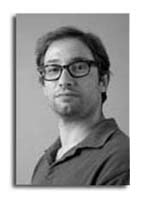
Luke: "Your dust jacket photo and the photo on your professor's page are very different."
Robert: "Two children in between those."
Luke: "What crowd did you hang out with in highschool?"
Robert: "I went to a small private school in Manhattan. Everybody inevitably circulated together. I didn't have many close friends. I was shy. I lived downtown. I was a commuter in a neighborhood school.
"Like many shy people, I've learned to compensate. I teach, which is a branch of performance."
At Harvard, Siegel got a BA in East Asian Studies (Japanese).
Luke: "What makes All the Money in the World literary as opposed to a John Grisham-style law-drama genre?"
Robert: "It was a difficult first publishing experience. It didn't get any support from the publisher, which is part of the reason it disappeared so quickly. In so far as they tried to tried to do anything, they tried to represent it as something it wasn't — as a crime novel. It was the heyday (1997) of the legal thriller.
"People who bought it by mistake were unhappy. When the book got reviewed, it often went to a crime reviewer who was also unhappy because the expectations were so different.
"The book's plot was straightforward. It wasn't a point of interest for me. The focus was on character and the language that carries that experience. That makes it literary."
Luke: "Who's the protagonist of the book?"
Robert: "It's hard to say. The point of view switches between the attorney, Louis Glasser, and his son Jason. Louis is a more interesting character. He's the one who undergoes the drastic life change. It's his book. But Jason stands at the periphery and gives it meaning as an observer.
"That question is unresolved. It might've been a stronger book if it had been resolved."
Luke: "Isn't there a rule against that? It seemed like the protagonist changed 75% of the way through the book."
Robert: "I'm very aware of it as a first book. I'm struggling with so many personal issues and craft issues and my relationship to the material. I was learning as I went."
Luke: "How does Louis change? I know he loses weight and regains the will to live."
Robert: "Losing weight for him is a tremendous thing. If character is destiny, the fault in his character is appetite.
"And yet [the book] doesn't end with a grand pronouncement. That's another thing that marks the book as literary. I was trying to hold within the bounds of normal human experience rather than trying to create a neat dramatic arc. It's true to life. People go through terrible things and sometimes the one reward is having survived.
"Plot was such a struggle for me. It was the last thing I thought about. I was working hard making a plot that runs like a train, from station to station, going somewhere."
Luke: "Have you read John Grisham?"
Robert: "I haven't. I don't want to. For me to read something, there has to be something interesting going on. I don't play videogames either.
"It was pure coincidence that the world of my novel happened to invade their terrain.
"My father was a criminal defense lawyer. I knew that world intimately from childhood on, of small single practitioners with an office near the court buildings in downtown New York. They made good livings but everything was fragile. They worked out of phone booths in the court building and it wasn't clear if they had an office. Some of them worked out of their cars.
"It was my vision of adulthood.
"After college, I worked for my father as a paralegal for a year and a half. That was frustrating. Never work for your father."
Luke: "Did your father bring these crooks home, like Louis Glasser?"
Robert: "In that way, he was like Glasser. He didn't have clear boundaries between work and home, in part because the hours are so strange. When someone gets arrested, you have to go bail them out. It drove my mother wild. I could often hang out at his office. It was a relaxed place. There would be some toys for me. I'd sit there and watch the show (from age six on).
"My dad's clients were always friendly but they were also scary. Kids are learning the difference between what's allowed and what isn't allowed and there's something fascinating and scary about adults who don't follow those rules."
Luke: "How did your father like your book?"
Robert: "He liked it. When he went into criminal defense, that was the least prestigious rung on the legal ladder. He had done extremely well in law school but I think he went in this direction because there was a personal affinity and he lacked a certain comfort with a tonier environment. Like Louis Glasser, he'd grown up poor on the Lower Eastside. He felt he fit in better."
Luke: "How did the publication of your book affect you?"
Robert: "Because nothing happened, it affected me powerfully. These fantasies of literary self-transformation are common among writers. I expected to be changed, whether rich or famous. I thought I'd feel different, that I'd be more confident, that I'd writer better and faster. I would stop having bad days and anxieties. None of that happened. It was a difficult lesson to absorb, but a valuable one."
Luke: "If you would've turned your first novel in to a genre legal-thriller, the primary emphasis would've had to have been on the plot?"
Robert: "Yes. Character must serve plot instead of exploring the ambiguities of what Glasser's guilt is and what it means to him and his family. As one reader put it, Glasser is innocent enough not to deserve his fate but not innocent enough to avoid it. One way to have made it a genre novel would've been to stack the deck, to make him innocent but appear guilty. Then most of the novel would've been about his fight to prove his innocence."
Luke: "Do they give teaching positions to people who write genre novels?"
Robert: "It's a good question. There are literary writers who take a vacation and do genre stuff. Most MFA programs tend to be dominated by literary writers. Literature needs help. Genre work can support itself in the marketplace.
"When I was trying to figure out what plot is, I read some genre books. I really like Elmore Leonard. The plots are fun but mechanical. I picked up on old Elmore Leonard book for a buck on the street. I read it and then realized I had already read it. They tend to be formulaic. There are a bunch of people who transcend genre such as Raymond Chandler."
Luke: "What's your relationship to Judaism?"
Robert: "It's complicated. My father grew up Orthodox but was disillusioned. He said he went to Hebrew school and all the rabbi did was hit all the kids. We had no religious education in the house. I was not bar mitzvahed. But the cultural milieu was Jewish. My grandmother on my father's side was still kosher and yiddish speaking."
Luke: "Do you teach class on Rosh Hashanah and Yom Kippur?"
Robert: "Don't. Those are not holidays here. I have to take off specially. My undergrads are fascinated. For some of them, I'm the first Jew they've ever met. I take that as a pleasure and responsibility. I tell them what it is like to be a Jew."
Luke: "Was there a time in your life when you realized you were going to be a writer?"
Robert: "It's a continuing anxiety. That first book was so hard to write… I wanted to solve the question of whether I was a writer. The reaction was so thunderously silent that there was no strong affirmation. It's not a question you can look to the outside world to solve. If it hadn't gotten published at all, would that have made it less of a book?
"The book sold so poorly that when I finished the second (two years ago, it is tentatively titled All Will Be Revealed, due out in March 2007), I couldn't sell it. I recently sold it to MacAdam/Cage. It was an enormous relief because it coincided with the tenure process. I had to publish a second book to qualify for tenure."
Luke: "Tell me about your second book."
Robert: "It's set in 19th Century New York."
Luke: "Are there a lot of Jews in it?"
Robert: "None, but in a way, the whole western world is Jewish after Freud.
"It's about a crippled pornographer who makes erotic stereographs (which give a three-D immediacy) and spiritualism.
"I give the pornographer in this book the same last name as the pornographer in my first book – Auerbach."
12/26/06
All Will Be Revealed by Robert A. Siegel
According to the publisher:
A [porn] photographer [Augustus Auerbach] is drawn to a beautiful psychic in a turn-of-the-century novel about love, possession, adventure, and greed. At the close of the nineteenth century, wheelchair-bound Augustus Auerbach's only interest is his extraordinarily lucrative business: the manufacture and marketing of "exotic" photographs. His outlook is forever altered, however, when one of his models pressures him to attend a seance.
From page 10: "In the rush to shape the landscape, the interior life of ht enation had been forgotten — had been, in effect, left with Auerbach. Fortunately, he had accepted the task with a sense of high purpose. Whatever bridges were needed to reach our secret desires, whatever canals were necessary for the shipment of our darkest wishes, whatever railroads were required to transport our most powerful cravings — he would build them. He would build the tunnels and corridors, the dungeons and pleasure domes of our yearnings."
All Will Be Revealed was the opposite reading experience for me compared to Siegel's first book, All the Money in the World. I loved Money from the start but was disappointed by the ending. Revealed bored me for the first half of the book and then thrilled me towards the end.
Money started with one main character and proceeded in a linear manner. It sucked me in right away. Then, in the second half, the protagonist changed and I was disappointed by the lack of a thrilling denoument.
Revealed begins with five separate stories and jumps around in time. I wouldn't have put up with that except I liked the author and was going to give him every chance in the world for all to be revealed.
I just watched The Rock for the second time. That's how you tell a story — with lots of cool explosions.
