My Nickname In High School Was ‘The Rapist’

After Torah Talk, I was lying in bed listening to Libera.

I started thinking about Rochelle, a cute brunette I rode the bus with for part of my senior year at Placer High School in Auburn, CA. She was a sophomore and on the gymnastics team. We did a little verbal jousting most mornings.

One Friday night, I told my Seventh-Day Adventist parents that I was going to a Bible study, and instead snuck the video camera out of my school against the explicit instructions of my teacher and joined the girl’s gymnastic’s team for a competition in Sacramento — all because I wanted to be close to Rochelle.

I videotaped the meet for later broadcast on our school’s community access channel on the local cable TV.

The thing went late. I found myself lying on a pillow. In it, I found three quarters. I started to pocket them and then stopped. Holy cow, I was almost a thief. That’s what going to public school had done to my morals.

On the ride home, I got things rowdy on the bus. Cool controlled rowdy so the adults, the coaches, wouldn’t shut things down. When I noticed them laughing, I started tickling people, and keeping an eye on their reactions and making sure I stayed within their good graces, I eventually moved my hands to Rochelle, the object of my affection. I started subtly, just three fingers rubbing her ribs over her uniform, and I watched for her reaction. She squealed, laughed, gasped for air, and pushed me away. I thought this was all good fun so I put both my hands on her and increased my intensity. She yelped and ran away. If I had stopped there, I might’ve remained ahead of the game, but I chased her down the bus and tickled her repeatedly. I put my arms around her, picked her up and jostled her up and down on my lap.

For me, this was foreplay. A promise of great things to come!

The coaches laughed. Our classmates laughed. Rochelle laughed. I laughed.

I loved touching the girl I loved, and I was grateful to do it without having to first ask her out, take her to dinner, make a move, and risk all that rejection and humiliation. I was strong now and I had created an atmosphere where she couldn’t object too strongly without looking like a spoil sport.

“You’re a lot stronger than you look,” said Rochelle midway through our battle and I figured what I was doing was OK. That it would be the beginning of a beautiful relationship.

I’d only had one relationship in my life (in the summers before 11th and 12th grade at Pacific Union College) and it had also started with awkward groping, tickling and tittie twisting a full year before we began kissing.

That Friday night on the bus back from Sacramento, I kept checking with the coaches and noticed they were laughing. They found me charming. I had that Australian accent.

As long as Rochelle wasn’t punching me or appealing for help from the adults, I assumed my behavior was OK.

Yet I knew that I didn’t like to be tickled by somebody stronger than me, I only liked getting flirt tickled by a girl. So, after five minutes, I quit my assault.

Rochelle looked relieved.

I wasn’t sure if she liked me more or less. I wasn’t sure what the future held for us. I felt like I had declared my intentions. It was up to her now.

I was the mighty editor of my school newspaper, the Hillmen Messenger. I did the weekly school news report on the local radio station KAHI AM 950. I was the face of our school’s cable TV channel. I was a good catch.

I got on the bus that Monday morning with trepidation. I looked at Rochelle with hope but she turned. Our friend Rob Stutzman shook his head at me and told me privately, “She doesn’t like you anymore.”

And she didn’t.

Another mutual friend — I guess he liked Rochelle as much as I did — later told me that she was going to the Senior Prom with Markey, the center on the basketball team. I skipped the damn thing and went camping with my buddy Shannon Anderson.

After the prom, my friend reported that Rochelle and Markey had “massive sex.” I believed the news and felt horrible. I couldn’t believe that that Southern California import had despoiled my ideal girl. To deal with my grief, I spread the news around school because I needed to talk about her and my deepest fears.

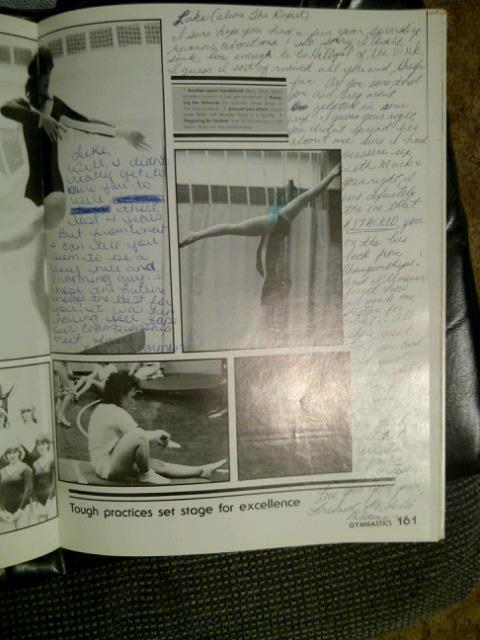
When the Placer High yearbook came out, my friend scribbled in green pen over the crotch area of Rochelle doing the splits on the beam.

She later wrote in my book: “Luke (Alias The Rapist): I sure hope you had a fun year spreading rumors about me! So sorry I didn’t sink low enough to be Hillgal of the Week. I guess I sort of ruined all you and Greg’s fun… I guess your right, you didn’t spread lies about me. Sure I had massive sex with Mark, you’re right, I was definitely the one that ATTACKED you on the bus back from championships! And I’ll never forget how you made me the star on cable TV! All those great tapes you took and most likely edited yourself. I am really glad had a fun time with that collection of yours (of tapes). Love your good, good friend, Rochelle.”

I was relieved that she hadn’t gotten it on with Markey. To an ordinary person, Rochelle’s remarks would’ve stung. For me, they felt good. They were a return to our verbal play. All was forgiven.

A few years later, I got religion, and in the summer of 1992, I sought out Rochelle. I found out she was teaching English in Japan. So I did these vocal exercises and then lay down on the floor so that my voice would get really deep and I talked to her on my dad’s tape recorder:

“Hi Rochelle, it’s Luke, your old bus buddy. I wanted to apologize for my behavior in high school. I was out of control. Yes, I did attack you on the bus back from the gymnastics championships. I thought it was just playful tickling but I realize now I went too far. I’m sorry.

“Also, I’m sorry for spreading rumors about you. There was no excuse for that. I feel bad about my behavior and that’s why I’m making this tape. I hope it finds you well. I got sick about 15 months ago. I’ve had to drop out of UCLA. The doctors call it Chronic Fatigue Syndrome. Nobody knows what it really is. So I’m back in Newcastle and living with my parents and trying to figure things out. And I’m making amends to various people I’ve harmed. I’ve been humbled by life.”

I included in the tape a recording of a KAHI radio interview I’d done about Chronic Fatigue Syndrome.

A couple of weeks later, Rochelle replied on tape. She forgave me. She said she wasn’t any worse than a lot of other guys she knew at Placer High.

“Your voice is extremely deep. It took me a long time to adjust… From the tape of your KAHI interview, I learned much about CFS but even more about how CFS has changed your life. You’ve been given the opportunity to consider the true reasons for man’s existence and to adjust your perception of what is important in life.

“I’m glad that you went on the radio to explain your illness to people. I admit that when I first heard about CFS, I didn’t think that it was legitimate.”

She told me to call her when she got home in a few months. I did. The conversation was brief.

I had all these fantasies that she would rescue me but Rochelle had a life and it did not include me.

I have no idea what she’s doing now. I can’t get Google to tell me a damn thing, except that perhaps she lives in Chico.

I still tickle the girls I like, only I try restrict my tickling these days to strictly verbal play.

My last girlfriend threatened to punch me if I ever tickled her for real. I did not.
Posted in Personal | Comments Off on My Nickname In High School Was ‘The Rapist’

Still the Best Hope: Why the World Needs American Values to Triumph

Here are some reviews on Dennis Prager’s new book: “This is a very wise book by a very wise American. It is probing, lively, comprehensive, and, rarest of all, it is filled with original insights and arguments. Dennis Prager changes intelligent people’s minds.” (Bill Bennett, Former US Secretary of Education, Bestselling Author, and Nationally Syndicated Radio Talk Show Host)

“Dennis Prager’s book is sharp, succinct, and comprehensive. It admirably covers the global ground. I hope it is widely read, and I’m pretty sure it will be.” (Paul Johnson, British Historian and Author of Modern Times)

“Occasionally, a person with rare vision can forsee the future through a deep understanding of the present. Using reason and facts, without rancor, Prager invites his readers to reason. If the world does not embrace American values, as brilliantly explained in this book, we are indeed doomed.” (David Mamet, Winner of the Pulitzer Prize for Glengarry Glen Ross)

“As a member of Congress for more than thirty years, I have met, listened to, and read the greatest living American thinkers. Dennis Prager is one of these. If enough Americans read [this book], America will remain what Abraham Lincoln said it was: the last best hope of earth.” (David Dreier, US Congressman (CA) and Chairman of the House Rules Committee)

Posted in Dennis Prager | Comments Off on Still the Best Hope: Why the World Needs American Values to Triumph

Chess For Politicians

Joe emails: The last week or so has seen a quite enthralling game of chess between the Obama and Romney camps:

The Obama camp’s main thrusts have been in three areas:

1. Class Warfare. The main mover for Obama, one that he hopes can cut across race, gender, and even income, is that Romney is out of touch economically. It is a ridiculous argument. Obama makes far more than the average dipshit American voter. The fact that Romney makes 5 times more than that just from interest and dividends is meaningless. But, it is great politics. That is why all the emphasis on the Buffett argument for higher taxes (will never pass). This is one that Romney will have to handle on his own, and I think he can by saying look, it does not matter how much money I make, it matters how much money Americans are not making because this colonial Marxist is President.

2. Women. The Hilary Rosen assault on Ann Romney was brilliant. It targets educated “stay away from home moms” – women who choose to make money rather than make a home, and spend the money they made on therapists for their kids who they cannot stand to be around. It is not aimed at women who work as a waitresses to make ends meet, most of those view such work as a test, and are not petty enough to begrudge Ann Romney’s ability to stay at home because her husband made some major cake (and he was not always so well off, he worked as a security guard to allow her to go on clandestine visits to see Ann). No, the target was every mother who is a law partner, doctor, professor, etc., i.e., high propensity female voters who view Ann Romney with hatred for being a woman and not being a man. I think this one might be dampened by the old “wives are off limits” but this is about creating a meme, that Romney does not relate to the stay away from home mom, and thus, women in general.

3. Race. The Trayvon Martin showing, which by the way according to the charging papers was at worst manslaughter (not second degree murder) was a gift. IT is going to be mighty difficult to stir the black base. Romney, for all his faults, does not stir the same kind of reaction from a black person that a ron paul or a gingrich might. Obama needs huge black turnout, but it will take identity voting of an extreme manner for Obama to get 95% of the black vote with super high turnout. The guy has simply put more black people into bankruptcy and foreclosure by putting us into socialism. Blacks are discouraged as are other races of americans about the future. But the racially charged stuff can work, just as it did with OJ.

Romney is less of a tactics guy, but he really can’t be, he needs to check mate. His message has to be and is that this piece of crap has to go. He has not transformed anything, other than transformed the American dream into some kind of limbo state where we are just happy to have jobs but no future.

Posted in Politics | Comments Off on Chess For Politicians

Why Aren’t Most Jews Orthodox II?

I ask an Orthodox rabbi: “Why do you think most Jews are not
Orthodox? Is the principal obstacle difficulty or expense or
intellectual or moral? And what did you think of the Newsweek top 50 rabbis list?”

Rabbi Ari Kahn, author of three books on Torah including Echoes of Eden, replies: Most Jews are not Orthodox because their parents are not orthodox. Which pushes the question back at least one possibly 3 or 4 generations.
Judaism has had a hard time confronting modernity. If we limit the discussion to the American Ashkenazik experience – the question could have been posed a hundred years ago, and the answer would be – the community reflects the individuals who chose to live in America. Prior to World War One, most Jews who arrived on your shores did so not because they were seeking religious freedom, they were seeking better lives. In other words the foundation of the American Jewish community was not a God seeking religious community, if anything, quite the opposite.
Those who came between the wars – or those who survived WW2 and then came – had a great deal of difficulty communicating old world sensibilities with a new generation, a generation who saw a new world and new opportunity.
Orthodoxy was not equipped to compete with the allure of the new modern world. In time a new generation of religious institutions and leaders developed who created a new type of orthodoxy, one which may very well survive and thrive. It has taught adherents that they can have the “American dream” and religion. Unfortunately most adherents do not see Modern Orthodoxy or Centrist Orthodoxy as excellence in two spheres, rather they see it as a compromise. While the leaders may preach and sloganize, the average adherent lacks passion. The unaffiliated Jew or for that matter the Reform or Conservative follower do not see this modern Jew as “authentic”, perhaps the random Chabad shaliach or other chasid, but not the modern orthodox.
So as the Jew on the outside peers in, he/she see a compromise that lacks authenticity (and often lacks passion) and they see authenticity which is nostalgic but not really a viable option for most.
Regarding the list of 50 Rabbis – being that I live overseas – I was not expecting to be on the list J – but seriously, it is uneven, and reflects more PR than substance.

Posted in Orthodoxy, R. Ari Kahn | Comments Off on Why Aren’t Most Jews Orthodox II?

Were The Vilna Gaon And The Chatam Sofer Rationalists?

In his fourth lecture on the Chatam Sofer for Torah in Motion, historian Marc B. Shapiro said: “The Rambam did not believe in amulets and the like. The Chatam Sofer would give out amulets. He was not a Lithuanian Torah scholar.”

“Sometimes people talk about the Chatam Sofer the Vilna Gaon as rationalists. Nothing could be further from the truth. Although most of their time was spent on Talmud and halacha (Jewish law), this does not mean they did not spend any time with kabbalah.”

“Until our own time, the prototypical Lithuanian Torah scholar had no involvement with kabbalah.”

“Today mainstream kabbalists say that kabbalah is for elites.”

“This is basic to all religions [and philosophies]. You want to keep the masses worshiping.”

“Chabad is an elite group. They try to teach this [version of kabbalah] to everyone but Chabad prided itself as an intellectual movement, as the most intellectual of the Hasidim.”

Posted in Marc B. Shapiro | Comments Off on Were The Vilna Gaon And The Chatam Sofer Rationalists?

Rabbinic Autobiography

The great rabbis have not been given to writing honestly and openly about themselves. The great exception (though R. Aryeh Leib of Modena also wrote an open autobiography) is 18th Century rabbi Jacob Emden, a subject of the 1988 Harvard PhD thesis of Rabbi J.J. Schachter, who writes there about Emden’s autobiography:

My impression from a careful reading of Megillat Sefer is that although Ernden’s rnemory was sometimes blurred by the passage of time, even when it came to remembering the year of his birth, he did not deliberately distort the truth in order to present himself in a more favorable light. On the contrary, he was very honest, often brutally so, graphically describing his various illnesses, failures ard manifold personal embarrassments. With unusual frankness and candor and with a remarkable lack of self-consciousness he described a rash on his private parts as a child, his frustration at not being allowed by his father to marry the girl he wanted, the impotence of his wedding night, his sexual needs, repeated marital conflicts and mental depressions. Under no circumstances was this an individual who was generally prone to consciously distorting the past in order to leave a more positive impression for the future.

Here are some highlights from the PhD thesis:

* “…Emden’s celebrated statement quoting the testimony of a Gentile woman that a circumcised penis provides her with greater sexual pleasure than an uncircumcised one is found only in some
editions of his Migdal ‘Oz (Altona, 1748), 2b.”

* Jacob’s life was not easy. “…a leprous boil appeared on my penis which blocked the urinary tract for some time in a manner that caused my parents worry, sorrow and great sighing because of me.”

* Jacob’s wedding was not a time of great joy. “For during the cohabitation of religious obligation (following the wedding) I lacked
virility and I agonized over this for several days. Although I was seventeen years old, I had not experienced the sensation of intercourse. I did not experience the feeling of joy for I was filled with grief and sorrow due to the raging60 melancholia. I experienced neither the sensation of a virgin nor that of a non-virgin. I was (thus) deprived of happiness and joy.”

* Even when apart from his wife, Jacob was able to resist temptation. “I was a young man, tender in years, in the full strength of my passion. I had been separated from my wife for a long time and greatly desired a woman. A very pretty unmarried young girl who was my cousin happened to meet me there and was alone with me. She brazenly demonstrated great love to me, came close to me, and almost kissed me. Even when I was lying in my bed, she came to cover me well on the couch, in a close loving manner. Truthfully, had I hearkened to the advice of my instinct she would not have denied my desire at all. Several times it (indeed) almost happened, as a fire (consumes) the chaff.

“Frequently there was no one in the house with me but her. They (i.e. the members of her family) were also not accustomed to come for they stayed in the store on the marketplace, occupied with their livelihood all day. Had God not given me great strength, excellency of dignity and the excellency of power (Gen. 4 9 : 3 ) , to overcome my fiery instinct which once almost forced me to do its bidding, (and) were it not for the grace of God which was great upon me, (I would have
been unable) to withstand this very powerful temptation, greater than all temptations. I was a man at the prime of my strength and passion. There was a very pleasant beautiful woman before me who demonstrated for me all manner of love and closeness many times. She was related to me, unmarried, a tender child and recently widowed. She may have been ritually pure or would have ritually purified herself had I requested it. If I had wanted to fulfill my passionate desire for her, I was absolutely certain that she would not
reveal my secret. I controlled my instinct, conquered my passion and determined to kill it.”

* Jacob’s health problems lasted a lifetime. “However, this time I drank excessively the waters of the cooked tea from which I sought respite from my sorrow and turmoil, to overcome the thoughts of my spirit and to find rest. But it turned into something which broke and shattered me, for all my blood turned to water and the source of my urine opened, flowing like a well. I would not stand for a moment without urinating. This caused me great, bitter and harsh pain at the tip of my penis. Often it was just one step between me, etc. Frequently I fainted, my spirit almost departed, were it not for the great mercies of Heaven.”

* I hazard that Rabbi Jacob Emden wrote more about his penis than any other sage.

Posted in Rabbis | Comments Off on Rabbinic Autobiography

This Week’s Torah Portion – Parashat Shemini (Leviticus 9:1-11:47)

I discuss the weekly Torah portion with Rabbi Rabbs Mondays at 7:00 pm PDT on my cam and on YouTube. Facebook Fan Page.

This week we study Parashat Shemini (Leviticus 9:1-11:47).

* Should a Jew study Torah primarily because God commands it or because he enjoys it? For what reason do you study Torah? Do you see a difference between those who study out of obligation vs. those who study out of desire? Those who do it out of divine command, they tend to have no intellectual curiosity.

* Do you do good deeds and abstain from evil deeds primarily because God commands it or for some other reason?

Rabbi Berel Wein writes: “The events described in this week parsha occur on the eighth day – after the seven day dedication period of the Mishkan and the installation of the kohanim/priests that would serve in that sanctuary. And this eighth day turns into a day of challenge and eventually sad tragedy. By emphasizing that all of this occurred on the eighth day, the Torah teaches us a vital lesson in life.

“The seven days of dedication are days of exhilaration and accomplishment. But such feelings and emotions cannot usually be maintained indefinitely. In life there always is the day after, the eighth day, which is one of challenge, struggle and even of pain. This day, though, can define and determine one’s life and future.”

I had something similar happen to me. After many hours spent at shul one yom tov, I bailed, only to learn afterward that a bunch of attractive young single women had shown up.

I tend to pick and choose in my Judaism and I miss out on a lot because of my tendency to bail and go walking on my own. I have a hard time being in a crowded room for longer than a couple of hours unless I’m strongly connected. I have the personality of an observer rather than that of a participant.

* Rabbi Berel Wein writes: “One of my revered teachers in the yeshiva put it to us starry eyed teenagers quite succinctly, if not somewhat ironically, many decades ago. He said: “Life is like chewing gum – a little flavor and the rest is simply chew, chew, chew.” And so it is.”

It was that kind of instruction in my teens that sent me fleeing from religion, looking for something more exciting like hotties.

Other people get into Hasidic Judaism, which is more exciting than run of the mill Orthodox Judaism. Most people want frequent experiences of ecstasy. Where are you going to get that in Judaism outside of Hasidic Judaism?

I need regular injections of ecstasy. I get them from watching movies, good TV, football, and listening to music.

* Rabbi Wein writes: “And perhaps that is what the rabbis meant when they indicated that the two sons of Aharon who were killed in the Mishkan died because they were inebriated from wine. They were still in the seven days of celebration mode which had ended and not in the eighth day mode which now descended upon them. Such errors in life can be fatal and often disastrous.”

* Rabbi Wein writes: “Judaism is not a “you’re okay, I’m okay” religion of relativism and constantly changing standards of behavior and belief. It not only stands for something – it defines clearly, in minute detail, what it is that it stands for.”

You can’t stand for anything unless you’re willing to be unpopular. On the other hand, if you needlessly choose unpopularity, you’re doing something wrong. If all I know about somebody is that he is popular, I figure he will be a pleasant companion. If I hear somebody is unpopular, he’ll probably be unpleasant company.

* Orthodox Jews frequently have a reputation for not being nice. One reason is that we are so busy with the commandments. We don’t have a lot of time for niceties. We have standards about what is permitted and forbidden and making these distinctions is our pre-eminent concern. It’s more important than being nice or convivial.

* Rabbi Wein writes: “It is obvious from reading and studying this week’s parsha that the Torah intended not only that we eat kosher food but that we become kosher people. Kosher speech, kosher behavior, kosher money, kosher dealings with others are all in the purview of being able to differentiate between what is to be eaten and is not to be eaten. Being careful in using products with proper kosher certification – a field of one-upmanship that has reached spectacular heights in our day and society – is commendable. But it is not the goal itself, it is only meant to be a means towards becoming a kosher person – one who is sensitive towards others and can differentiate between the petty and the solid, between the eternal and the transitory. Shmini cries out to us to sharpen our abilities to differentiate and aim towards becoming a holy people.”

* Why do you think most Jews are not Orthodox?

Posted in Torah | Comments Off on This Week’s Torah Portion – Parashat Shemini (Leviticus 9:1-11:47)

Persian Jews Targeted

The Los Angeles Times reports: “Persian-Jewish community targeted – The Securities and Exchange Commission has accused a Los Angeles man of operating an investment scheme that defrauded investors out of more than $7.5 million. The SEC alleged in a lawsuit that Shervin Neman, 30, targeted members of the Los Angeles Persian-Jewish community, promising to make huge profits by investing in foreclosed real estate and pre-IPO shares of well-known companies. Instead of making such investments, he used new investor contributions to pay returns to early investors and spent about $1.6 million on himself, including on his wedding and honeymoon and on expensive jewelry and tickets to sporting events. “Although Newman promised investors exorbitant returns resulting from his investing acumen and access to pre-IPO shares of well-known companies, what they actually received was simply other investors’ money in hallmark Ponzi scheme fashion,” the SEC said in a news release.”

Posted in Jews, Los Angeles | Comments Off on Persian Jews Targeted

Why Aren’t Most Jews Orthodox?

I ask an Orthodox rabbi: “Why do you think most Jews are not
Orthodox? Is the principal obstacle difficulty or expense or
intellectual or moral? And what did you think of the Newsweek top 50 rabbis list?”

The rabbi replied: “The modern era is all about personal independence and Orthodox Judaism is all about submission to external rules. Not too many people can or want to reject that modern impulse.

“The Newsweek list was about the 50 rabbis mentioned most in the mainstream media. Since the Orthodox community is largely either ignored or misrepresented in that media, its representation in the list is entirely distorted. The description of R. Shmuel Kamenetsky is a case study in cluelessness. The absence of R. Menachem Genack and R. Yaakov Perlow is inexcusable and the inclusion of Sara Hurwitz is inexplicable.”

Historian Marc B. Shapiro responds to my inquiry on why most Jews are not Orthodox: “I haven’t examined it, but I think the reasons are convenience, but also now ideological reasons. Many non-Orthodox Jews see the positions that Orthodoxy takes as immoral. E.g., when it comes to issues like gay marriage. For the non-Orthodox, this is a human rights issue, and Orthodoxy is on the wrong side of history (the women’s issue is also relevant in this regard). So the non-Orthodox are turned off by the difficulty of Orthodoxy, the expense, and what they regard as the moral failings of Orthodoxy. The intellectual issues are minor if at all.”

Posted in Orthodoxy, Rabbis | Comments Off on Why Aren’t Most Jews Orthodox?

Still the Best Hope: Why the World Needs American Values to Triumph

Publisher’s Weekly reviews Dennis Prager’s new book: “The culture wars rage on in this vigorous right-wing polemic. Conservative talk-show host Prager (Nine Questions People Ask About Judaism) fires salvos at “Islamism,” the redoubt of terrorists, anti-Semites, and theocrats, but his focus is the ideological struggle between “Americanism”—defined as low taxes, small government, religion, and militarized patriotism—and “Leftism,” the big tent of everyone from Karl Marx to the Democratic Party. Short on substantive policy analysis, he relies on broad, biting sociocultural caricatures: conservatives value liberty, reason, moral standards, hard work, earned rewards, faith, self-reliance, and manliness; leftists value authority, emotionalism, moral relativism, sexual license, unearned welfare handouts, spurious equality, nihilism, victimhood, and effeminacy. Prager scores entertaining points against left-liberals’ excesses—overblown health crusades, moral hypocrisies, profane celebrities, avant-garde art installations—while tossing off conservative briefs on everything from affirmative action to global-warming denial. Unfortunately, he often succumbs to the same kind of exaggerations and inconsistencies that he attacks. (He condemns leftists for hysterically equating the Guantánamo Bay prison to the Soviet gulag, for example, then offers the banning of incandescent lightbulbs as a latter-day example of leftists’ “Totalitarian DNA.”) There’s juicy red meat here for Prager’s fans, but other readers may find it underdone.”

Max Singer writes in the Washington Times: ““Still the Best Hope” makes an important contribution by encouraging believers in Americanism to stand up for their values and helping them understand the ideological challenge they face. But it is not likely to convert many convinced leftists because, even though it is much less one-sided than most political discussion these days, it obviously is a work of advocacy reflecting the strong values of the author.”

Posted in Dennis Prager | Comments Off on Still the Best Hope: Why the World Needs American Values to Triumph