Refugees In Israel

From the African Refugee Development Center:

Israel is a reluctant host to 46,437 African asylum seekers predominantly from Eritrea (73%) and Sudan (19%) and a small minority (8%) arriving from several other African countries. The state policy toward asylum seekers (particularly Eritreans and Sudanese) is one of temporary non-deportation, officially referred to as “group protection.” Asylum seekers in Israel are denied basic rights and access to social services and the government of Israel has employed various policies to pressure asylum seekers to leave – including indefinite arbitrary detention, refusal to accept and review asylum claims, limitation of access to basic state-sponsored services, incitement and coerced repatriation. The Supreme Court of Israel has, in two distinct decisions, affirmed that the State’s treatment of African asylum seekers is unacceptable and violates fundamental laws concerning human dignity and liberty. The Court insisted on a comprehensive policy that seriously tackles this issue, but the government remains noncompliant.

Prevention of Infiltration Law

The Prevention of Infiltration Law was passed and implemented in the 1950s, to address Palestinian refugees who re-entered Israel after the establishment of the state of Israel. Whether seeking to return to their homes or to commit terrorist attacks, these individuals were identified as “infiltrators,” highlighting the illegal nature of their border-crossing and the perceived danger they posed to national security. Since 2008, the government of Israel began to apply this term to African asylum seekers and actively sought to utilize the Law against them. In the subsequent years, the Israeli Knesset worked diligently to draft a new amendment to the Law that would officially include African asylum seekers. In 2011 the Knesset successfully passed Amendment III (Amendment I and II referred to Palestinian populations) and implemented it in 2012.

Posted in Africa, Immigration, Israel | Comments Off on Refugees In Israel

Newsweek: To Undermine ISIS, We Should Welcome Syrian Refugees

I see no place to comment on this essay.

I am surprised by the number of Republicans who echo these talking points.

The essay does not mention the low average IQ of Syrians (about 83).

By Kim Cragin and Ben Connable of Rand Corporation:

It will take some time to parse all of the events in the Paris attacks, but reporting indicates that at least one of the suicide bombers used a stolen Syrian passport and followed the refugee path to France via Turkey and Greece.

This one attacker now has politicians on both sides of the Atlantic calling for moratoria on Syrian refugee programs.

We argue that the opposite approach—taking in even more Syrian refugees—is not only humane but could bleed the Islamic State militant group (ISIS) dry and deliver the kind of “strategic messaging” victory sought by the U.S.-led coalition.

The United Nations has registered 4.3 million refugees from the conflict in Syria and an additional 370,000 from Iraq. Approximately 123,000 of these refugees have sought asylum in Europe. Together, Canada and the United States have taken in about 5,400.

The international media have documented their journeys. These refugees have risked hypothermia, starvation and death. Families have been separated, and many loved ones have been lost. Yet they keep leaving their homes in search of a safer, better life.

These people deserve compassion for what they have experienced and admiration for their bravery. Of the 123,000, just one has so far been implicated in an attack.

The humanitarian crisis, by any measure, outweighs the risk. But that was known before the attacks in Paris. The challenge is that these attacks have increased pressure on government officials to do more. The calls for action are drowning out the cries for compassion. Instead of blocking Syrian refugees, more should be done. Taking in more Syrians could help defeat ISIS.

After all, what good is an Islamic caliphate if nobody wants to live there?

Posted in Islam, Syria | Comments Off on Newsweek: To Undermine ISIS, We Should Welcome Syrian Refugees

The Neocon Takeover Of The Conservative Movement

Paul Gottfried and Pat Buchanan don’t make the list. Nobody from Chronicles magazine (paleo-conservative). Ann Coulter and Mark Steyn are near the top, but their foreign policy has been largely neocon.

From RightWingNews:

50) Katie Kieffer
49) Thomas Purcell
48) Rachel Alexander
47) Kathy Shaidle
46) Susan Stamper Brown
45) Debra Saunders
44) Ben Domenech
43) Daniel Greenfield
42) Jeff Jacoby
41) John Fund
40) David Harsanyi
39) Cal Thomas
38) Jamie Weinstein
37) Mike Adams
36) Jack Kelly
35) Michael Barone
34) Doug Giles
33) Erick Erickson
32) Ross Douthat
31) James Antle
30) Philip Klein
29) Andrew McCarthy
28) John Ransom
27) Glenn Reynolds
26) Charles Cooke
25) Charles Krauthammer
24) Larry Elder
23) Dennis Prager
22) John Nolte
21) Megan McArdle
20) Matt Lewis
19) David Limbaugh
18) Todd Starnes
17) Rich Lowry
16) Kevin Williamson
15) John Stossel
14) Ashe Schow
13) Walter Williams
12) James Pethokoukis
11) Michelle Malkin
10) Victor Davis Hanson
9) Byron York
8) Milo Yiannopoulos
7) Ben Shapiro
6) Jonah Goldberg
5) Kurt Schlichter
4) Thomas Sowell
3) Ann Coulter
2) Mark Steyn
1) Matt Walsh

Posted in Ann Coulter, Conservatives, Neoconservatives | Comments Off on The Neocon Takeover Of The Conservative Movement

Us Vs Them

Anybody can understand the mentality of “us vs. them.” It’s the most basic divide.

The stronger your group identity, the more likely you are to have negative views of outsiders.

Nationalism is the most powerful political force in the world. It’s like fire. Very dangerous and very powerful.

There’s a tremendous dark side to “us vs. them” thinking but there is a tremendous dark side to avoiding “us vs. them” thinking. The West has been overrun with pathological altruism.

The audio montage in the following report? I love it!

The New York Times says:

The most striking hallmark was Mr. Trump’s constant repetition of divisive phrases, harsh words and violent imagery that American presidents rarely use, based on a quantitative comparison of his remarks and the news conferences of recent presidents, Democratic and Republican. He has a particular habit of saying “you” and “we” as he inveighs against a dangerous “them” or unnamed other — usually outsiders like illegal immigrants (“they’re pouring in”), Syrian migrants (“young, strong men”) and Mexicans, but also leaders of both political parties.

At an event in Raleigh, N.C., on Friday evening, his voice scratchy and hoarse, Mr. Trump was asked by a 12-year-old girl from Virginia, “I’m scared — what are you going to do to protect this country?”

“You know what, darling? You’re not going to be scared anymore. They’re going to be scared. You’re not going to be scared,” Mr. Trump said, before describing the Sept. 11 terrorists as “animals” who sent their families back to the Middle East. “We never went after them. We never did anything. We have to attack much stronger. We have to be more vigilant. We have to be much tougher. We have to be much smarter, or it’s never, ever going to end.”

While many candidates appeal to the passions and patriotism of their crowds, Mr. Trump appears unrivaled in his ability to forge bonds with a sizable segment of Americans over anxieties about a changing nation, economic insecurities, ferocious enemies and emboldened minorities (like the first black president, whose heritage and intelligence he has all but encouraged supporters to malign).

“‘We vs. them’ creates a threatening dynamic, where ‘they’ are evil or crazy or ignorant and ‘we’ need a candidate who sees the threat and can alleviate it,” said Matt Motyl, a political psychologist at the University of Illinois at Chicago who is studying how the 2016 presidential candidates speak. “He appeals to the masses and makes them feel powerful again: ‘We’ need to build a wall on the Mexican border — not ‘I,’ but ‘we.’”

Posted in America, Donald Trump, Nationalism | Comments Off on Us Vs Them

Afghan Migrant Brutally Raped And Burnt To Death Young European Because She Wanted To Break Up

From Breitbart: An Afghan migrant has been sentenced to life imprisonment in Finland for brutally murdering a teenage lover ten years his junior because she didn’t want to continue the relationship.

The 17-year-old Finnish girl had only dated Ramin Azimi for a month before she tried to end their relationship. The court heard how she had wanted to see another man, but Mr. Azimi demanded marriage and children of her. When she wouldn’t cooperate, Mr. Azimi attacked the young woman while she was out jogging.

Equipped with spare clothing, rope and gasoline, the Afghan asylum seeker raped his former lover in revenge for leaving him. Having completed this act, Mr. Azimi then tied the girl to a chair in an abandoned shed, poured petrol over her, and set her alight.

The body of the young woman was later discovered by dogs after her disappearance had been reported to police by her parents.

When arrested Mr. Azimi told police he had tried to commit suicide by burning himself, and his girlfriend had rushed to his aid. In doing so she herself was caught in the burning building but he escaped unharmed. The court rejected this version of events.

The prosecutor said Mr. Azimi killed because he was consumed with jealousy, and even said his struggles with obtaining Finnish citizenship had played a part in driving him to kill.

Judged sane by a court psychiatrist, the perpetrator — a long-time resident of Finland but without Finnish citizenship — has now been sentenced to life imprisonment for the sadistic killing.

Although this is his first criminal offence, he has not been averse to creating trouble. The court heard how he had recently knocked his own mother to the floor, fought with siblings, and punched a friend in the nose so “blood was pouring hard”, reports Iltalehti.fi.

Bizarrely, while Mr. Azimi was ordered to pay €60,000 to the parents of the deceased girl in compensation, he was ordered to pay an even larger amount — €69,000 — to the insurance company responsible for the building he burnt down with his victim inside it.

Posted in Africa, Blacks, Crime, Immigration | Comments Off on Afghan Migrant Brutally Raped And Burnt To Death Young European Because She Wanted To Break Up

Harvard On Jews (1922)

From The Nation Sept. 6, 1922:

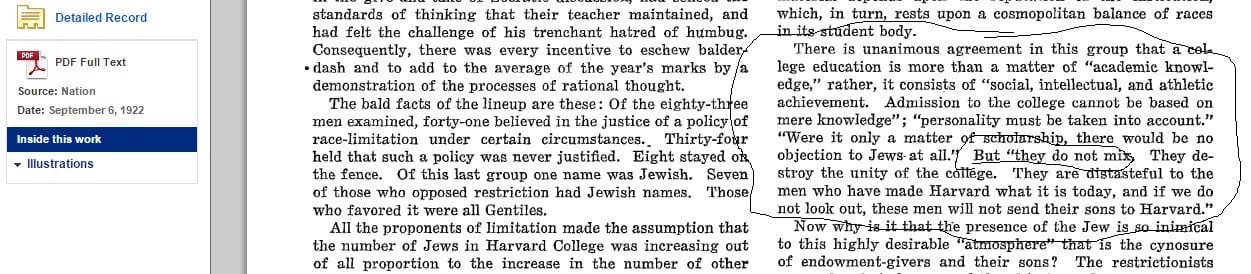
There is unanimous agreement in this group that a college education is more than a matter of “academic knowledge,” rather, it consists of “social, intellectual, and athletic achievement. Admission to the college cannot be based on mere knowledge”; “personality must be taken into account.” “Were it only a matter of scholarship, there would be no objections to Jews at all.” But “they do not mix. They destroy the unity of the college. They are distasteful to the men who have made Harvard what it is today, and if we do not look out, these men will not send their sons to Harvard.”

harvard1

This argument reminds me of the 1940 essay “The Reasoned Case Against Semitism” by Australian nationalist P.R. Stephensen:

Essentially, Jews are a minority, self-differentiated as such, a Race Apart not only from the rest of mankind, speaking generally, but also from any particular community in the midst of which they may reside. This fact makes the usual postulates of political discussion—namely, universal humanitarianism, or, alternately, the welfare of a National Unit, considered as a Whole—inapplicable to the Jewish Question. It is absurd for Jews to preach (as many of them do) that men are all of one Kind, while this preachment is belied by the fact that the Jews themselves, by their own Choice, remain a different Kind from all other kinds of men. Similarly it would be absurd for Jews to preach the welfare and advancement of any one nation as a paramount political consideration, while holding themselves racially apart from the majority in that nation. It can never be true that “all men are brothers,” either within one nation or in the world at large, while Jews continue to practice an extreme form of biological differentiation through rigid selective breeding.

Jews cannot “have it both ways.” They cannot expect to be listened-to with respect when they preach to Gentiles the Universal Oneness of Mankind, while at the same time they, as Jews, remain a Race Apart. It is when this discrepancy between their words and their actions is recognized, that Jews become disliked by non-Jews. Nobody likes to be humbugged, either by financial confidence-tricks, or by metaphysical and political verbal play. In brief, if Jews are going to persist in keeping themselves racially apart from the rest of mankind or from a particular nation, then they should also keep themselves politically apart. The Antisemite brings this point of view to the fore. He starts from the same premise as the Jews themselves—namely that the Jews, by their deliberate practice of Racialism, are differentiated from non-Jews. But, as soon as this differentiation is accepted as an unalterable fact, and is brought to the full consciousness of non-Jews, a prejudice is created against Jews, in the minds of non-Jews, which makes a further dispassionate or detached discussion of the entire topic virtually impossible. The implication of the Jewish practice of Racialism is unmistakably Themselves First—Themselves versus the Rest. Once understood, that constitutes a challenge to the Rest of Us which cannot conscientiously be disregarded.

The discussion, then, comes down to prejudice versus prejudice, the result of a clash of interests which cannot be resolved by any form of words. Carried further, this means propaganda versus propaganda—a process termed, by both sides, “enlightenment.” The most honest thing to do is to avow the prejudice, and stand on it. As a non-Jew, I avow that my prejudices are non-Jewish; and this means that, in any conflict of interests between Jews, on the one hand, and non-Jews on the other, my instincts place me naturally in the non-Jewish camp. When I see an organized minority of Jews, actuated by their self-interest, engaging in operations for their own sectional self-aggrandizement as against the interests of the community-as-a-whole or of the non-Jewish majority in it, then, as a non-Jew, I claim the same right to organize non-Jews as the Jews have claimed and obtained to organize themselves. The political validity of Antisemitism is thus on a plane no higher, or no lower, than that of Antisemitism; for, if there were no Semitism, there would be no need of Antisemitism to counteract it. While organized Semitism operates as a political activity in Australia, there can surely be no logical objection, among “Liberal” political thinkers, to the existence of the counteracting, or counter-balancing, activity of Antisemitism—provided always that the antidote is merely of sufficient strength to neutralize the irritant, and does not in itself become toxic.

Posted in Anti-Semitism, Australia, Harvard | Comments Off on Harvard On Jews (1922)

Hitler On America’s Immigration Policy (1933)

From The New Republic Feb. 15, 1933:

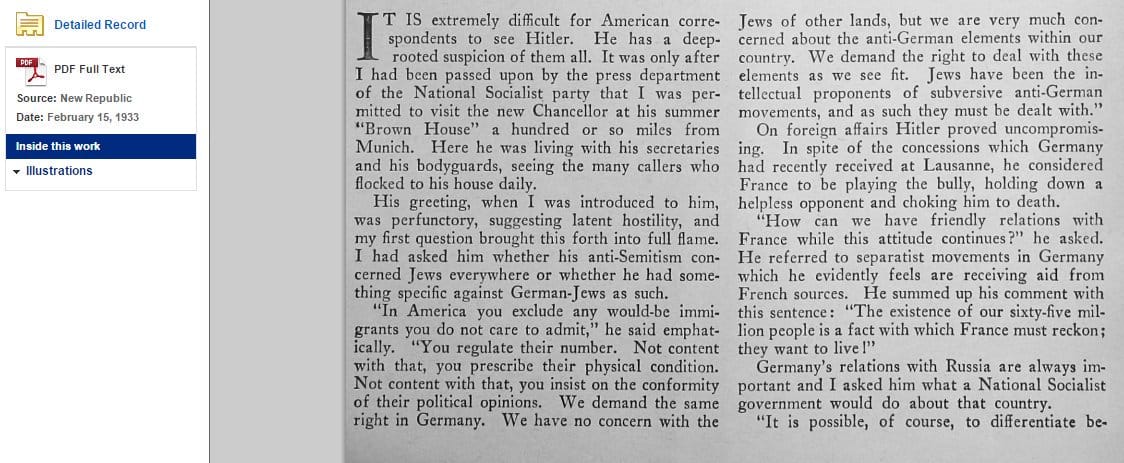
His greeting, when I was introduced to him, was perfunctory, suggesting latent hostility, and my first question brought this forth into full flame. I had asked him whether his anti-Semitism concerned Jews everywhere or whether he had something specific against German-Jews as such.

“In America you exclude any would-be immigrants you do not care to admit,” he said emphatically. “You regulate that number. Not content with that, you prescribe their physical condition. Not content with that, you insist on the conformity of their political opinions. We demand the same right in Germany. We have no concern with the Jews of other lands, but we are very much concerned about the anti-German elements within our country. We demand the right to deal with these elements as we see fit. Jews have been the intellectual proponents of subversive anti-German movements, and as such they must be dealt with.”

hitler

Posted in Adolf Hitler, Anti-Semitism, Germany, Jews | Comments Off on Hitler On America’s Immigration Policy (1933)

Newsweek: Non-Jewish Refugees Get a Cold Shoulder in Israel

I admire how Israel protects itself despite world pressure to diminish its Jewish state.

All nations should protect themselves from the importation of people who are not a good fit.

No country has a moral obligation to destroy itself (aka import the world’s trash).

Newsweek: Usumain Baraka was 9 when Arab Janjaweed militants destroyed his village in Darfur in 2004, killing his father and brother. After four years in a Sudanese refugee camp, Baraka says, he wanted a better future.

At the time, he says, he thought “Israel was the only democracy in the Middle East…. I really related to the Jewish people because of the Holocaust and thought they would identify with me because of the genocide in Darfur.”

At the age of 13, Baraka trekked from Sudan into Egypt, and then over the Egyptian border into Israel. Instead of a safe haven, he found himself in a country that wanted nothing to do with him. “They don’t even check our refugee requests,” says Baraka, who is now 20 and lives and volunteers in a youth village in northern Israel.

He is one of the nearly 65,000 Africans who, according to Israeli government figures, crossed into Israel illegally between 2006 and 2013. Approximately 45,000 remain. More than 33,000 of the asylum seekers in Israel are from Eritrea, while 8,500 are from Sudan—countries the UNHCR says are, respectively, the 10th and fourth largest sources of refugees in the world. Israel has granted refugee status to just four Eritrean refugees and not a single one from Sudan.

As European governments grapple with how to handle hundreds of thousands of refugees and migrants, mostly from Syria but also from Sudan, Eritrea, Afghanistan and other troubled countries, some in Europe are now looking to Israel for lessons in how to keep out asylum seekers.

The irony here is that it was the international failure to assist Jews during the Holocaust that led to the 1951 United Nations Refugee Convention, the first international agreement addressing the rights of refugees and states’ obligations to them. Today, 148 nations are signatories to this legal document, vowing to never again turn their backs on those fleeing persecution and genocide.

That tragic period also led to the establishment of Israel, a safe haven for oppressed Jews around the world. The Jewish state was among the first countries to sign the U.N. Refugee Convention, as its people, perhaps more than anyone, knew what it was like to be unwelcome.

While Israel remains a haven for Jewish refugees, Israeli officials and the media routinely disparage non-Jewish African asylum seekers. In August, Israeli Interior Minister Silvan Shalom declared, “I will not relent until we reach a framework that will allow the removal of the infiltrators from Israel.”

Posted in Israel | Comments Off on Newsweek: Non-Jewish Refugees Get a Cold Shoulder in Israel

Why isn’t Israel accepting more refugees?

Despite considerable pressure from outside and in, Israel’s government stands firm in its commitment to take no Syrian refugees. All nationalists should admire Israel’s dedication to its best interests.

The Jewish state is an ethno-state, perhaps the most successful ethno-state given its difficult circumstances (surrounded by enemies who want to destroy it). By necessity, Israel contains a couple of million Arabs. That diversity weakens it. Israel would be stronger as a 100% Jewish state. No state is strengthened by containing people who hate it.

From an op-ed on Al Jazeera Sept. 22, 2015:

Netanyahu’s hypocritical stance on asylum seekers reflects country’s long struggle over ethnic and national identity.

The European refugee crisis has not gone unnoticed in Israel. The media have been dominated by images of Syrian refugees enveloping Europe, and Israeli opposition Zionist Union chairman Isaac Herzog recently called on the government to allow Syrian refugees into Israel, saying, “Jews cannot be indifferent while hundreds of thousands of refugees are looking for safe haven.”

His remarks, however generous they may seem, expose the hypocrisy of Israel’s center left. He evokes Jewish heritage when convenient and abandons it when necessary. While Syrians qualify as refugees for Herzog, the 45,000 Sudanese and Eritreans in desperate need of asylum in Israel are labeled as infiltrators under Israeli law, detained, and in some cases even deported to third countries.

Israeli Prime Minister Benjamin Netanyahu quickly responded to Herzog’s PR stunt and rejected calls to accept Syrian refugees. In his statement, Netanyahu said that Israel is “a very small country that lacks demographic and geographic depth” and discussed his plans to construct a fence along the eastern border with Jordan.

His response is hardly surprising; when Israel faced an influx of African asylum seekers, the government erected a surveillance fence along the border with Egypt as, he said, “a strategic decision to secure Israel’s Jewish and democratic character.”

The recent refugee crisis in Europe brings to light once again Israel’s struggle to consolidate its values as a Jewish and democratic state. While Israel is party to the 1951 Refugee Convention, it never worked to establish a functional refugee system. As of March 2015, Israel recognized only four Eritreans and not a single Sudanese person as refugees.

While Israel is falling short in its obligations toward asylum seekers, the persecution of European Jews during the World War II remains an important part of Israel’s national narrative. The refugee issue has always been a politically loaded question in the Israeli context. At the same time that Israel acceded to the Refugee Convention in 1954, it adopted the Prevention of Infiltration Law. Under this law, all irregular border crossers are seen as infiltrators, and the Ministry of Defense is authorized to deport infiltrators, even before conviction. While the provisions of the law were directed primarily against the infiltration of armed fighters, the law is also invoked to prevent the entry of Palestinians into Israel or their return. Article 1(3) of the law defines an infiltrator as “a Palestinian citizen or a Palestinian resident without nationality or citizenship or whose nationality or citizenship was doubtful.”

Israel’s reluctance to incorporate the Refugee Convention into its laws may be explained by the context of the time. The vast majority of individuals arriving in the country in the 1950s were displaced European Jews, many of whom were Holocaust survivors, as well as Jewish refugees who fled to Israel from Arab states in the Middle East and North Africa. Since a central aspect of Israel’s identity is the notion that it belongs to Jews, Israel’s immigration laws automatically grant citizenship to the Jewish diaspora. Israel therefore has never dealt with the Jewish refugee population as refugees, because they are already perceived as integral parts of the Jewish nation.

But at the same time, Israel has been dealing with another refugee problem: the Palestinians it expelled in 1948. The Prevention of Infiltration Law provides a legal mechanism for preventing the return of Palestinian refugees. When African asylum seekers began arriving in the country, Israel quickly moved to amend the law to consider all irregular border crossers infiltrators, including asylum seekers.

Israel is constantly seeking to delineate its national narrative through amending its immigration policy; it has worked hard over the years to preserve the status of refugees solely for Holocaust survivors, and it has succeeded in doing so legally. Netanyahu’s recent refusal to accept Syrian refugees was a similarly motivated attempt graft security concerns onto humanitarian ones by labeling Syrian refugees as infiltrators before they even entered the country.

On Sept. 6, Netanyahu wrote on his Facebook page that Israel must control its borders “and prevent migrant workers, infiltrators or generators of terrorism” from entering the country. After stating that “Israel is not indifferent to the human tragedy of the refugees from Syria and Africa,” he quickly moved to call Syrians and Africans “infiltrators” and “terrorists.”

In a Cabinet meeting that took place that day, he further linked the recent refugee crisis to security concerns by discussing the Sept. 3 attacks against five young ultra-Orthodox American yeshiva students in Jabel Johar.

In his short statement on the refugee crisis, Netanyahu managed to link Israel’s security concerns with asylum issues while resealing the Pandora’s box of Palestinian refugees. Applying this line was particularly important for him, especially after Palestinian Authority President Mahmoud Abbas called on Saturday for the absorption of Palestinian refugees now fleeing the war in Syria to the Israeli-occupied West Bank. Even opposition leader Herzog did not dare refer specifically to Palestinian refugees in his calls for Israel to accept Syrians.

Israel’s apparent inability to come to grips with its duality as a Jewish and democratic state is at the core of its response to the refugee crisis. Israel’s refusal to absorb Syrian refugees, allow Palestinians from Syria’s Yarmouk camp into the West Bank or accommodate the 45,000 African asylum seekers in the country should all be viewed as a symptom of the same phenomenon: Israel’s assertion of its ethnic and national identity. In calling asylum seekers and refugees infiltrators, Israel chose to favor, once again, its demographic objectives over its commitment to international law.

Talya Sultana Swissa is a graduate of Columbia University pursuing her master’s degree at Sciences Po at the Paris School of International Affairs.

From the posted comments:

* The writer of this article is an idiot. Who in their right flipping mind would put their people at such high risk as to allow a bunch of Israel hating coo-coo nuts within their borders only for these nuts to attack and stab poor innocent citizens. Just like the current happening of those crazy insane brainwashed so-called ‘palestinians’ stabbing people, including children and toddlers at randoms these past few weeks.

* There is a reason they are not wanted. They are future problems for the country that accepts them. Israel knows this.

* Exactly! It’s not as if these refugees are Hebrews too, and part of the same family. No intelligent common sense leader would invite an army of sworn enemies onto their land, knowing without doubt that they’ll just be stabbed in the back, We all know it. Israel must put their people first and foremost always. These refugees are nothing but problems, cowardly men fleeing their country, then thinking they will deserve to go back once the Assad and real men have fought for it’s survival from the ISIS satanist and their buddies in arms, the criminal Syrian rebels.

* They are not just Syrian refugees, they are sworn enemies of Israel!!! Just as Pakistan is India’s sworn enemies. No good rational thinking leader would invite their KNOWN enemies into their cities and neighborhoods, now would they? Use your common sense.

* The West should investigate other routes. For instance, the Norwegian Foreign Ministry has calculated that because of all the social, health, housing and welfare benefits mandated by the state, supporting a single refugee in Norway costs $125,000 — enough to support some 26 Syrians in Jordan.

* How about the cowardly young and strong healthy Syrian men stay and fight for their country? How about that? This wouldn’t be happening now if it weren’t for those Syrian men being such low-life cowards.

* Israel is a tiny State; only 20 miles wide at the point Tel Aviv is located.

The Jews only have one country for refuge: Israel.

Also Israel does not want to lose it’s Jewish identity.

* Gee… you think maybe its because Syria is technically at war with Israel? Saudi Arabia has a lot more room for their Arab brothers. Let them settle there.

* For 70 years the Arab countries have not accepted even Palestinian refugees, whereas Israel is a country almost entirely populated by refugees.many of whom came from Arab, or other Muslim countries. Can you spell double standard?

* Is this a serious question/article? Not a single Arab country has agreed to accept any refugees from anywhere… Maybe we should be asking why Saudi Arabia, Qatar, Egypt, Yemen etc. aren’t accepting refugees? The world expects the larger European countries to absorb a large proportion of the refugees, so maybe we should also look at the larger Middle Eastern countries for a similar response.

* I keep hearing Israel likened to the Nazis. People who do that are seriously uninformed about the Nazis. They should do some reading. I suggest The Holocaust — a History of the Jews of Europe During the Second World War, by Martin Gilbert.

* Just want to remind you that Qatar, your financial backers, have accepted no refugees from Syria. Please pay attention to your own backyard before you criticize someone else. At least Israel have some legitimate reasons: culture is different and the fact that everyday Muslims aren’t fans of Israel.

* Israel is all is about building fences and borders to keep people out. Israel’s current government has a “bunker and war” mentality, incompatible with the compassion that is required to help other humans of “non-Jewish” origin. Even though the origins of this mind set are understandable, going down this road will not lead to positive outcomes for most Israelis. This is unfortunate.

* Israel has been providing free medical care to the wounded on all sides of the conflict in Syria.

* I just read in the Economist that israel has become a safe haven for rich (jewish) gangsters who want a second home where they will feel secure from prosecution. I guess if you have money you’re welcome anywhere no matter how you gained your wealth.

Posted in Immigration, Israel | Comments Off on Why isn’t Israel accepting more refugees?

Is sociopathy an illness?

I wonder how many people who read this essay will grasp its implications?

There’s no way that people who have evolved in different places are going to have identical abilities.

Anthropologist Peter Frost writes:

Is sociopathy an illness? We often think so … to the point that the word “sick” has taken on a strange secondary meaning. If we call a ruthless, self-seeking person “sick,” we mean he should be shunned at all costs. We don’t mean he should take an aspirin and get some rest.

Sociopathy doesn’t look like a mental illness, being much less incapacitating than schizophrenia and most mental disorders. A sociopath can deal with other people well enough, perhaps too well. As Harpending and Sobus (2015) point out:

It is a psychopathology because of what sociopaths do to us, and it has significant legal, political, and moral consequences for all of us. Most criminals are probably sociopaths according to some definition (the figure of 80% is often quoted).

Sociopaths regularly present the following characteristics:

  • onset before age 15, childhood hyperactivity, truancy, delinquency, disruption in school
  • early and often aggressive sexual activity, marital histories of desertion, non-support, abandonment
  • persistent lying, cheating, irresponsibility without visible shame
  • sudden changes of plan, impulsiveness, unpredictability
  • charm and a façade of sensitivity
  • high mobility, vagrancy, use of aliases

Sociopaths follow a life strategy that is adaptive for themselves but ruinous for society. Harpending and Sobus (2015) argue that they succeed so well because they know how to manipulate social relationships to their advantage.

Sociopathy is at least moderately heritable (Hicks et al., 2004). Interestingly, it seems to cluster with hysteria in first-degree relatives, with sociopathy being expressed in the males and hysteria in the females. Harpending and Sobus (2015) argue that “hysteria is the expression in females of the same genetic material that leads to sociopathy in males.” In short, “sociopathy in females is the result of a greater dose of the genetic material that leads, in smaller doses, to hysteria, namely, hysteria is mild sociopathy.”

If sociopathy is adaptive, why does it affect only a minority of us? It seems that the rest of us have developed counter-strategies of looking for signs of sociopathy and expelling suspects from society … and the gene pool. This is probably why sociopaths tend to be always on the move—if they stay too long with the same people, they risk being detected and dealt with.

Gene-culture coevolution

We adapt to our cultural environment as we do to our natural environment. More so in fact. The last 10,000 years have seen far more genetic change in our ancestors than the previous 100,000, this speeding up of evolution being driven by the entry of humans into an increasingly diverse range of cultural environments.

Sociopathy may thus propagate itself more easily in some cultures than in others, with the result that its incidence may likewise differ from one to another. In a small band of hunter-gatherers, a sociopath will not last long because he is always interacting with the same small group of people:

In a 1976 study anthropologist Jane M. Murphy, then at Harvard University found that an isolated group of Yupik-speaking Inuits near the Bering Strait had a term (kunlangeta) they used to describe “a man who … repeatedly lies and cheats and steals things and … takes sexual advantage of many women—someone who does not pay attention to reprimands and who is always being brought to the elders for punishment.” When Murphy asked an Inuit what the group would typically do with a kunlangeta, he replied, “Somebody would have pushed him off the ice when nobody else was looking.”(Lilienfeld and Arkowitz, 2007)

In a larger community, a sociopath may evade detection long enough to reproduce successfully and pass on his mental traits. Finally, in some cultures he can use his manipulative skills to dominate the community, becoming a “big man” and enjoying very good opportunities for reproduction.

This Pandora’s Box was opened when humans gave up hunting and gathering and became farmers. First, farming supported a much larger population, so it became easier for sociopaths to move about from one group of unsuspecting people to another. Second, farming created a food surplus that powerful individuals could use to support underlings of various sorts: servants, soldiers, scribes, etc. There was thus a growing class of people who did not directly support themselves and whose existence depended on their ability to manipulate others.

Finally, in the tropical zone, farming greatly increased female reproductive autonomy. Through year-round farming, women could provide for themselves and their children with less male assistance. Men accordingly shifted their reproductive strategy from monogamy to polygyny, i.e., from providing for a wife and children to inseminating as many women as possible. This kind of cultural environment selected for male seducers and manipulators rather than male providers. Conversely, it selected for women who feel only an intermittent need for male companionship and who from time to time are able to coax assistance from people who are not so inclined:

Ethnographic descriptions of women who live in social contexts of low male parental investment portray women who are very demanding. Young women demand help from kin on behalf of children. When the help is not forthcoming the mothers often summarily dump or deposit the child or children at the door of a relative who (in their judgment) will not turn the children away. Women demand gifts from boyfriends for themselves.(Harpending and Draper, 1988)

In women, this selection pressure favors a condition known medically as Briquet’s syndrome and more commonly as “hysteria”:

When males are not good risks for parental investment, females will adjust their behavior accordingly. A common clinical characterization of Briquet’s syndrome is a woman who exaggerates need, who demands high levels of attention and investment, who deceives herself and others as to her requirements. The strategy (learned or inherited) makes sense for a woman with high exposure to low investment males. These males, however, are so fickle and so mobile that they can be dunned only in the short run.(Harpending and Draper, 1988)

Sociopathic behavior, be it hysteria or full-blown sociopathy, is not favored in hunter-gatherers, since both sexes invest heavily in their offspring and in each other. The selection is for men and women who can bond strongly with one partner:

[…] abandonment of the pair bond by either partner is likely to be deadly for the offspring. Draper (manuscript) finds that men with more children spend more time hunting than men with fewer dependents; that is to say that more offspring are directly translated into more parental work for the male. Pennington and Harpending (manuscript) found that infant mortality among women who had more than one mate during their reproductive careers was nearly twice as great as infant mortality of women who had only one husband. […] In societies of this type the contexts for the anti-social trait are unfavorable. There will be no pay-offs for anti-social behavior and the bearer of the trait will be readily detected and ostracized. (Harpending and Draper, 1988)

Strategy and counter-strategy

Sociopathy is therefore not an illness but a strategy. It has been least successful in small societies where both sexes invest heavily in care for their partners and offspring. It has been more successful in larger societies, particularly those where men invest less in partners and offspring. Indeed, because sociopathy does so well in such contexts, it may have hindered the development of larger and more complex societies.

In most large societies, people seek out and expel sociopaths from their local kin group and treat everyone else with suspicion. The result is the “amoral familialism” we see throughout much of the world. People prefer to deal with relatives, hire only relatives for their businesses and, as a rule, act morally only towards relatives. Thus, the high-trust environment of the family cannot extend to society in general. Among other things, this is why the market economy has failed to develop spontaneously over most of the world and over most of history. Without strong-armed government intervention (military pacification, police, courts, etc.), markets remain marketplaces—places of exchange that are highly localized in space and time. The market principle cannot spread to most economic transactions.

Some humans have resolved this problem by freeing themselves from the straitjacket of kinship, by adhering to social rules that apply to everyone, and by ruthlessly expelling rule breakers wherever they may be. This is the adaptation that Europeans have developed to the north and west of the Hajnal line. The relative weakness of kinship ties and, correspondingly, the relative strength of individualism favored a complex of psychological traits that may be summarized as follows:

– capacity to internalize punishment for disobedience of social rules (guilt proneness).

– capacity to simulate and then transfer to oneself the emotional states of other people, especially when such people are affected by rule-breaking either by oneself or by others (affective empathy).

– tendency to frame moral rules in universal, absolute terms, i.e., moral universalism and moral absolutism, as opposed to situational morality based on kinship. Rule-breakers are likewise condemned in absolute terms and may be expelled from the entire community, as opposed to being ostracized by close kin.

The above mental package brought Northwest Europeans closer than other humans to the threshold where one could escape the limitations of kinship and organize society along other lines, notably the market economy, the modern State, and political ideology. It thus became possible to meet the challenge of creating larger societies while ensuring compliance with social rules and a high degree of personal autonomy.

COMMENTS:

* Do you think that modern society selects for sociopaths ?

It has never been easier to quickly move through social circles and from city to city.

Modern ethics condemns many mechanisms which punish sociopathic behaviour such as gossip, shunning, feuding between families and extralegal revenge.

The website Chateau Heartistes provides advice that suggests that sociopathy may be a plus in the modern dating game.

Social services provide for the offspring of abandoned children in a way that they did not for most of human history.

* A book of Carlton Coon told the story of a whaling ship’s black cook put ashore in Inuit territory to spend a few weeks making molasses, he impregnated a quarter of the women in the district.

Eysenck found the greatest predictor of psychopathy was ticking the box for “my mother is not a good person”.

* Apart from sociopathy as an adaption where an individual exploits the vulnerabilities of others in his own group, could there also be entire groups who have evolved sociopathic strategies to exploit the vulnerabilities of a larger group whose society they live within as a minority?

* Ordinary Westerners have been indoctrinated for several decades now to believe that there are no such things as out-groups and non-kin.

They think and behave differently when they believe otherwise, as can be seen in history or in contemporary Westerners who were formerly liberal until they became acquainted with HBD or racialist literature.

* Some aspects of modern western society suit the lifestyle of a mobile sociopath, but others present significant obstacles.

More casual social mores and weaker family ties makes it easier to live a “pump and dump” lifestyle but, integrated computer databases mean that travelling from country to country is now difficult for sociopaths, and the tight labour market makes it tougher for sociopaths to find reasonably high paying work. I’d imagine the number of successful middle class sociopaths is relatively low compared with 40 years ago, but the number of sociopaths among the working class is probably increasing. A working class sociopath could probably do quite well out of more informals types of work such as drug dealing, construction work or working in the sex industry.

* Sociopathy is low empathy. The hysteria-spectrum disorders, many of which are today known as conversion disorders, are also characterized by a desire to have other people drop everything they are doing to focus on the “victim”.
Perhaps that explains why the left is composed of sociopaths like JFK and Clinton on the one hand, and hysterical tumblerinas and BLM activists on the other?

* In the coastal PNW, Bundy’s MO was often to approach women of college age, feigning an injury (arm in sling, e.g.) and asking for help with something (appeal to empathy). All his known victims were white women aged 15 to 26, and most were students (in the PNW at least, that is very likely Northern European ancestry).

* My suggestion was that all human beings naturally treat some people in a way we describe as “sociopathic”. Everywhere and always – except for special groups such as the religiously enlightened or highly empathic – some out-groups and their members are systematically treated as almost subhuman. That is, their humanity is ignored as being irrelevant. Even hunter-gatherers, nomads and primitive farmers living in small villages regard all outsiders as enemies.

Today we mostly live in huge nation-states, and the inhabitants of each nation-state tend to treat the inhabitants of other nation-states as different, inferior, suspect and potential enemies. Americans, for instance, see almost all foreigners as inferior, and some – such as Russians, Chinese, and Arabs – as enemies by definition (regardless of their actual behaviour).

But, even within a single nation-state, those of sociopathic disposition treat their fellow-citizens like out-group members – but secretly, without appearing to do so. Game theory showed long ago that, when 19 out of 20 or so of a group behave altruistically and in a trusting way, there are distinct benefits for all group members. But, at about this level, a niche opens up for the remaining one out of 20 to behave cynically and exploitatively, pretending to be altruistic and trustworthy while in fact cheating and lying. This is the criminal class, plus the “secret” criminal class that runs business and government.

Posted in Anthropology, Diversity | Comments Off on Is sociopathy an illness?