
Scott McConnell writes: On Sunday’s “Face the Nation,” host John Dickerson asked his press panel what the Democrats’ reaction would have been to large-scale efforts to block roads and disrupt traffic for those attending a Barack Obama rally during the 2008 campaign. While no one replied directly, Ruth Marcus said, “We know what it would be.” The understood answer was the road-blockers would encounter a nationwide crescendo of denunciation, and would be shamed as despicable racists seeking to disrupt the American democratic process.
By contrast, those seeking to disrupt Trump rallies face nothing of the sort. Instead, Trump and his supporters are denounced over and over again for their verbal, or in two or three instances physical, lashings out against those who have repeatedly sought to wreak havoc on their events.
The possibility of widespread violence, instead of the now-routine disruptions, prompted Trump to cancel a Chicago rally on the evening of March 10. The cancellation, and the TV coverage of altercations outside the arena which followed, sparked debates between liberals and leftists over whether creating mayhem around Trump events is politically prudent, morally justified, and tactically effective. No one who scans these debates is likely to come away greatly reassured about the bedrock solidity of the shared commitment to the democratic rules of the game in American politics; one could easily conclude that America is beginning to veer towards a state where political disruption and civil violence will become a kind of norm, as it is in much of the Third World.
After the cancellation, the news networks played in continuing loops footage of confrontations between outnumbered Trump supporters and anti-Trump demonstrators outside the University of Illinois at Chicago venue. The latter sometimes waved Mexican flags or banners flouting their undocumented status, defiantly expressing the belief, newly ascendant on the left, that the United States has no right to enforce its immigration laws.
The essayist Michael Tomasky tweeted, “It’s surreal, but if you think this hurts Trump and not the protesters, I fear you are mistaken.” This seemingly innocuous tweet was quickly set upon by some of Tomasky’s Twitter followers, one of whom labeled him a “tone-policing white liberal.” In a podcast debate between millennial writer-activists Ali Gharib and Jesse Myerson over whether it was a good idea for the left to shut down Trump rallies, Tomasky was singled out for disdain along with Damon Linker, who had written the left’s proper response to Trump’s events was not to disrupt them. Myerson used the word “cowardice” before adding he didn’t actually know Linker personally. The former Occupy Wall Street activist, who had created a small splash by publishing a kind of communist manifesto for millennials in 2014, argued that almost any action which prevented Trump from speaking was justified, so long as it succeeded. The important thing was to show strength, not weakness. Forcing Trump to cancel a rally showed the demonstrators’ strength. Chicago was thus an unambiguous victory.
Two Bible scholars write: The final step for the creation of the Megillah was connecting the combined story to the (preexisting) Festival of Purim. The name Purim is based on the Akkadian word for “lots” (pūrū). Many scholars believe that the holiday originated as a Persian new- year celebration, which included the casting lots as one of the rituals.[16]
The Megillah, however, uses these festival lots in a different way, imagining the lots as having been cast by Haman to determine the most auspicious time to kill the Jews. It was at this stage that verses like 3:7,[17] which explain how the 13th of Adar was chosen as the fateful day, and much of chs. 8-9 were written.
This recast the story of Mordechai and Esther vs. Haman into a story that undergirds the festival calendar. It justified the Persian Jewish community’s celebration of a new-year festival by turning it into a Jewish festival. Thus the same process that we can see having occurred for Pesach and Sukkot in the Torah,[18] and Shavuot in Second Temple and Rabbinic literature,[19] occurred for Purim as well.
Steve Sailer writes: “How’s NATO working out at defending the borders of Europe, anyway? Are the peoples of the North Atlantic getting their money’s worth? You know, sometimes I almost suspect that the Washington Post favors whatever foreign policy would lead to maximum expenditure of taxpayer dollars within its circulation area. Times being what they are, you gotta keep those ad rates up …”
Comments:
* That’s hilarious. From claiming that Trump has no “policy” that’s quite a climb down for the WaPo clowns to concede he does.
* One possible effect of NATO and the non-necessity of Europeans defending their own borders without Uncle Sam standing behind them is the mistaken impression on the part of Europeans that armies are for intervention, not defense.
I’ve never once seen an article about border skirmishes or even war games on European soil. However, there are constant articles about NATO or French or British military interventions. I assume the media in Europe are basically the same.
I suspect people who don’t think of their military as a defense force don’t think of their nation as requiring defense.
So, maybe one of the best things that could be done to win hearts and minds in Europe on the immigration question would be to completely 100% pull out of Europe and NATO and let them fend for themselves against Russia, ISIS, etc.
* Black Lies Matter hate it every time there is a terrorist attack, because the media focus shifts away from police brutality of Dindus to Muslim extremists. After the Paris attacks happened, Black Lies Matter went on Twitter to tweet who cares about a bunch of dead White people. I am sure they will also tweet the same about the Brussels attacks.
* Back in ’01, were we not all assured by reliable sources that 9-11 was a consequence of GWB’s isolationism? I recall hearing that somehow or other his failure to ratify the Kyoto Treaty had some bearing on the incident. I guess green IS the color of Islam, but I digress.
Is the WaPo running so short of spurious complaints they had to dig up the isolationism schtick? Or am I just supposed to not have a memory? I heard memories are racist, so yeah whatever…
* Has anyone else noticed that headlines and content from the Washington Post and Huffington Post are now impossible to tell apart? Huffington is intended to be a left tabloid and WAPO is meant to be serious.
Even NYT got in on the act for a while but they are dialing back the crazy a little bit.
* Where has Trump said withdrawing from NATO will keep us secure? Trump has suggested we are not getting the bang for the buck. We are providing the lion’s share of manpower and funding of a defense pact in which most of the members are collectively confederated into the European Union which is more populous and has a larger GDP than the USA. Evaluating whether this is the most effective way to spend our defense dollars, or whether the Europeans should contribute more is a different argument that what you wrote.
Now Patrick Buchanan might make the argument that withdrawing from NATO would make us safer. That of course would be based upon his concerns that any one NATO member, such as Turkey, could get us into a shooting war with a nuclear armed Russia over an incident that is not in our national interests. For example, last October’s downing of a Russian jet might have been the tripwire that committed Uncle Sam to an armed conflict with Russia.
Given how close we came to such an event, and given how Turkey’s and possibly other European nations’ interest differ from ours, there is a potential threat to USA security remaining in NATO twenty plus years after its reason to exist went out of business.
* The appearance of this article today simply underscores the fact that the real political battle emerging is between globalism and nationalism, not liberalism and conservatism. The editorial board of one of the most prominent newspapers in the country jumps on the tragic fallout of a great international terror event in order to attack a presidential candidate’s foreign policy platform.
The article is completely incoherent.
“On one side are those who support the internationalist response of President Obama, who said the United States “will do whatever is necessary to support our friend and ally Belgium,” and who asserted that “we must be together, regardless of nationality or race or faith, in fighting against the scourge of terrorism.”
The perfect articulation of internationalism – unqualified devotion to non-Americans. This is assumed to be a good thing; the position is never justified.
“Against them is the radical isolationism of Donald Trump…”
Anything not in the vein of Trotskyite internationalism is automatically branded “isolationism”.
“However much they are reinforced, borders will provide no protection to Americans if the jihadists are not defeated elsewhere.”
Simple non-sequitur. Even if ISIS is not defeated elsewhere, if they can’t get thru the border, or they at least have a decreased chance at getting thru the border, that keeps citizens of Belgium or the US, applicable, safer.”
“Britain, France and Germany, among others, contribute materially to the war against the terrorist entity in Iraq and Syria, not to mention NATO member Turkey.”
Yes, not to mention Turkey, who supports terrorist groups allied with ISIS in their fight against Assad, thus hindering the effort to bring stability to the Syrian situation.
“But she or he must also accept that the alliance won’t function without U.S. leadership — which inevitably means a larger role militarily and financially as well as politically.”
Yes, the world cannot function without US leadership. In the last 15 years, the United States’ international “leadership” has de-stabilized Iraq and Libya, sites that are now, as a result, prominent sources of radical Sunni terrorism.
* For a candidate who is a joke with zero chance of winning, and hopelessly behind either democrat in a general election matchup, the MSM and other candidates sure seem to focus a lot on Trump. I don’t think any major news outlet can go the day without condemning this candidate who has no chance of winning. Even Hillary and Bernie seem to be directing more of their attacks against this potential November walkover than they do against each other. People seem to show a lot of concern and expel a lot of energy over a guy who supposedly has no chance of winning.
* If only we’d had an aggressive foreign policy for the last 15 years, invading and occupying and bombing and droning all over the middle east, I suppose we wouldn’t be facing the threat of ISIS today.
* I know this is a blog that favors deep thought about long-term policy issues, but my first thought regarding that title was clickbait.
“Brussels Shows Trump Wrong”
It’s simple: like sex, Trump sells. And if it bleeds, it leads. Everyone wants an explanation. And we of course can’t say Trump is right. So.
A. Bleeding: Brussels
B. Trump: Wrong
Explanation: A causes B, or B causes A.
It’s a bit much to say that Trump Wrong Caused Brussels (but let’s keep that around, it might come in handy later). So Brussels Caused Trump Wrong.
I’m overthinking it.
“[Insert news here] Shows Trump Wrong”
works for everything. That guy really is a gift to all of us.
* I’m thinking about Steve’s concept of leapfrogging loyalties. As he wrote in 2012, “Modern liberals’ defining trait is making a public spectacle of how their loyalties leapfrog over some unworthy folks relatively close to them in favor of other people they barely know.”
Loyalty, properly understood, has to be reciprocal. You have loyalty to your spouse or to a friend largely because you trust they are loyal to you. To a lesser degree there is some reciprocal loyalty to your neighbors, your coworkers, or members of any group to which you belong. That is how interpersonal bonds are forged. But the liberal, who leapfrogs his loyalty to underclass blacks or Mexican immigrants, gets no loyalty in return. Rather, they see in him someone who has made himself open to manipulation and exploitation. The liberal’s only reward from this arrangement is the pleasure he experiences from the resentment of his fellow citizens, who feel his loyalty would be more properly devoted to them. So his loyalty, the leapfrogging type, doesn’t create the normal bonds that exist between people, or in communities and nations, but fractures them.
Obama frequently displays his leapfrogging loyalties, as when he refused to stop travel from Ebola afflicted nations. As it happened his policy caused few deaths, though that was by no means a given at the outset. However, the message to Americans was, “Your safety and well-being is not my foremost concern.” Similarly, with Syrian refugees, he expresses contempt for the natural concerns of his citizens–”This is not who we are! We’re better than that!”–which means, “If some of you die as a result of my admitting this hostile group, that’s a price I’m willing to pay.”
In a democratic nation, citizens are loyal to their government because the government represents their interests; i.e., makes their safety and well being its primary concern. But in most Western societies that is no longer the case. As this fact sinks in to the citizens of Western nations, they must ask themselves what loyalty they owe their governments. Is their authority even legitimate anymore?
* Trump does poorly in states with high social cohesion. He does better in more diverse states.
* Donald Trump does well with Right Wing people who are not Conservative in the traditional sense, because they use a lot of profanity. That is why The Donald is popular with people like Anthony Cumia, Legion Of Skanks, Gavin McInnes, Nick DiPaolo, Jim Norton, and Adam Carolla, but not Steve Sailer. The Donald is too vulgar for Steve, who has a very PG vocabulary.
* Trump does well with those who feel that society needs what he’s offering and does poorly with those who quite like the society that they inhabit and don’t see the need for Trumpian policies.
* I was looking at county level data for the Trump and anti-Trump voters. The higher the percentage of the county which is black, foreign born, Hispanic the higher the Trump vote and the opposite for the anti-Trump voters. Those were all independent measures. The only measure with higher correlation was poverty in the county. So poverty, followed by black, followed by Hispanic, followed by foreign born, followed by tw0 or more races, etc.
Living in close proximity to diversity sure seems to predict support for Trump.
* If you ever watch a Gavin McInnes or Anthony Cumia podcast, let’s just say its not for the whole family. Sometimes they even have female porn stars on showing their breasts. They also use the N word more freely, get into specific details about sexual acts, and drug use. They are definitely not your parents Conservatives. They are more anti-PC than they are Conservative in the traditional sense. They are like South Park.
* Because it was so classy of Cruz (or his supporters) to use Melania’s 15 year old picture against Trump.
And do you really have a problem with Trump getting angry when his wife is attacked?
* Yeah, I clicked on your link. So Ted (or a front group for him) doing an absolutely unnecessary, and, frankly, vulgar, thing of tweeting a nearly nude pic of Melania (taken 15 years ago when she was a silly girl) is NOT repulsive. Okaaaaayyy.
But, Trump threatening to spill the beans on Ted Cruz’s wife *is.*
Uh. Huh. You do know what the “beans” are, right? That she is an executive of Goldman Sachs and that GS gave undisclosed loans to Ted Cruz’ campaign (no bribes there, right?) and has had active involvement in the, frankly, treasonous effort to abolish the border between Mexico and Canada under the project of North American Union. Telling THAT truth is “repulsive.”
You are nuts.
Twinkie, every time I turn around, you just reconfirm my bias. Asians are *not* good immigrants. Even the ones who are ostensibly well-assimilated Catholics with tall sons.
* Why is it that everything now seems to be PR or Marketing, honed to eventually provide a nozzle via which any collective rage or fear can be redirected at will to hose whatever target is convenient or profitable for those pulling the strings?
We saw this expertly played in the aftermath of 9/11, when public rage was channeled into support for a war long planned, against a nation-state whose rulers and people had nothing to do with the events on that day, while the official story ignored the fingerprints of [a] nation[s] since clearly more involved.
Mass media + mass psychology = herd behavior on a scale not seen before, say, 100 years ago. Video (esp. TV) makes direction and amplification of the mass mind’s emotions all too easy.
Comment: Cruz voters will go to Trump in the general election.
Cruz co-opts and steals Trump’s positions and then accuses Donald of not having them. It’s amazing to watch. He really is a sleazy snake of a man, the kind for whom The Big Lie is a modus operandus.
It was hilarious this morning watching him try to be Trump by talking about some plan to gang-patrol Muslim neighborhoods. This naturally will get him tarred, when it would somehow get Trump more votes.
Looking over a map of states won by Cruz, I can see where the weird states are. I always knew Utah was weird anyway, having lived next door to it.
Steve Sailer writes: Earlier this month, John Rivers tweeted out his hope for the future:
I dream of a world where a midlevel manager in a midlevel company can accurately quote FBI crime statistics on Facebook and not be fired.
We don’t live in that utopia, however, so you should be cautious about mentioning this article at work. But at least accurately quoting government crime statistics is more convenient than ever due to the publication of The Color of Crime, 2016 Revised Edition.
Researched and written in a sober, judicious manner by veteran economic analyst Edwin S. Rubenstein, this is the first update since 2005 of Jared Taylor’s American Renaissance magazine’s venerable report on racial differences in crime rates.
Most of the government data used in the report ends with the year 2013, and therefore generally offers an encouraging contrast to the last report’s use of 2002 as its terminus. From 2002 to 2013, most crime rates fell, and racial differences moderated somewhat.
An epilogue to this 12,000-word study, however, deals with the alarming spike in homicide rates in 2015 during the Black Lives Matter agitation. The Washington Post reported in January:
The number of homicides in the country’s 50 largest cities rose nearly 17 percent last year, the greatest increase in lethal violence in a quarter century. A Wonkblog analysis of preliminary crime data found that about 770 more people were killed in major cities last year than the year before, the worst annual change since 1990.
It’s tragic but hardly unexpected that the antiwhite race-baiting by the Obama Administration, the Soros Foundation, and the national media has led to hundreds more blacks being murdered by other blacks.
After all, that’s also what happened in the 1960s, the last time liberals grabbed control of the criminal justice system. During the Warren Court era, incarceration was driven way down per crime committed, so, amazingly enough, more crimes were committed. Before that historic mistake was finally rectified, much of urban America had been reduced to depopulating slums.
Rubenstein carefully walks readers through the different sources of statistics about crime and race, such as arrests, imprisonment, and interviews with victims.
All three measures come up with similar racial ratios. On average, blacks commit more violent crimes than Hispanics, who commit more than whites, who commit more than Asians.
The more severe the crime, the worse the racial ratios tend to be. For example, California data is instructive because it carefully breaks out Latinos from whites, whereas federal statistics usually lump whites and Hispanics together. In California, blacks are arrested for homicide 8.6 times as often as whites (down from 9.8 times in 2002) compared with 2.5 times for Hispanics (down from 3.6 in 2002). Robbery, a career that favors the athletic and fleet of foot, is even more of a black specialty, with a black-to-white ratio of 13.4 (down from 15.9 in 2002) versus 2.0 for Hispanics (down from 2.7).
In contrast, in California, blacks are arrested for driving offenses only 1.7 times as often as whites, and Hispanics merely 1.3 times as often.
Or, to use national statistics, blacks are incarcerated 13.1 times as often as whites in state prisons for robbery but only 2.6 times as often for “other property crimes.”
Rubenstein makes the important point that this pattern of lower racial ratios for less vicious crimes is inconsistent with the conventional wisdom that racial differences must be the result of blacks and Hispanics being the victims of discrimination by police and juries:
Almost without exception, the black/white and Hispanic/white arrest multiples are lower for the less serious crimes. Whatever else this difference may mean, it is strong evidence that the police are not making biased arrests. Police have broad discretion as to whether they will arrest someone for forcible touching, shoplifting, or setting off a false fire alarm. If racist police wanted to vent prejudices on non-whites, these are the crimes for which they could most easily do so. They can walk away if someone complains he was spat on, and if they are racist they can walk away if the spitter is white but make an arrest if the spitter is black. Police cannot walk away if someone is lying on the sidewalk bleeding from a knife wound.
A body with a hole in it demands attention.
Interracial violence, contrary to the impression you might get these days from the obsessions of respectable media outlets, is overwhelmingly skewed toward victimizing whites (and Asians):
In 2012 and 2013, blacks committed an annual average of 560,600 crimes of violence against whites whereas whites committed only about 99,400 such crimes against blacks. This means blacks were the attackers in 84.9 percent of the violent crimes involving blacks and whites.
The differences in propensity toward interracial violence are noteworthy:
In 2012/2013, the actual likelihood of attack was extremely low in all cases, but statistically, any given black person was 27 times more likely to attack a white and six times more likely to attack a Hispanic than vice versa. A Hispanic was eight times more likely to attack a white than the reverse.
Rubenstein puts “Black Lives Matter” into proper perspective by citing federal murder statistics:
Although most murders are within the same race, [individual] blacks were 13.6 times more likely to kill nonblacks than [individual] nonblacks were to kill blacks.
* What he really means:
I dream of a world where a midlevel manager in a midlevel company can accurately quote FBI crime statistics about black offenders and white victims on Facebook and not be fired.
Of course you can talk about the number of murders recorded by the FBI in 2015 on Facebook without any consequences. However, you can’t talk about black crime against white victims. If John Rivers had real spine he would acknowledge this is actually his vision of utopia.
And do you believe it would be utopia Steve? For whites to be roused up on Facebook and in casual everyday conversation against the black race because there are a large number of black criminals? I would really like to hear your reasoning of why you think this is utopia.
* Try dropping this point on all those Democrats you know who love to brag about how only liberals love “science” while Republicans are in denial about “science.” The trouble is finding a way to do so inciting them to burn you at the stake for daring to question their unquestionable articles of faith.
* The problem can never be fixed if the truth is forbidden.
for example: r/K selection
whatever the starting base line mass unemployment selects for r and full employment selects for K
say group A starts at 70/30 r/K then after generations of mass unemployment it might be 80/20
say group B starts at 30/70 r/K then after generations of mass unemployment it might be 40/60
You can see – if you’ve worked in rustbelt towns – how the white ex-workers get more r-selected over time. Same thing happened to black ppl after 1965.
The starting line might have been different and the end result after n generations will depend on the starting line but the mechanism is the same.
So full employment would improve the problem over generations.
The people who most want to deny the problem are also the biggest cause of the problem because they all support mass unskilled immigration.
* Utopia would be a black crime rate as low as the Asian rate. What we’re discussing on this site is reality. Modern day America largely prevents the open discussion of reality, with disastrous consequences in policy, safety and culture.
“Also, they avoid having anything to do with African-Americans, whom the Mexican smack dealers stereotype as being prone to theft and violence. (When accurately quoting FBI crime statistics is criminal, only criminals will accurately quote FBI crime statistics.)”
* Yesterday, I watched an outstanding report summarizing what’s known about the Brussels terror attack on public TV’s PBS Newshour. What made the segment worthy of a Pulitzer award was that the words “Muslim” and “Islam” didn’t cross the reporter’s lips; nor did he refer to any underlying concepts. A couple of young Belgian men just decided to hold an attack-a-thon. An isis-thingy had something to do with it, and an interview of a professor of sociology revealed that the root cause was the failure of society to provide full employment for young people.
Classic.
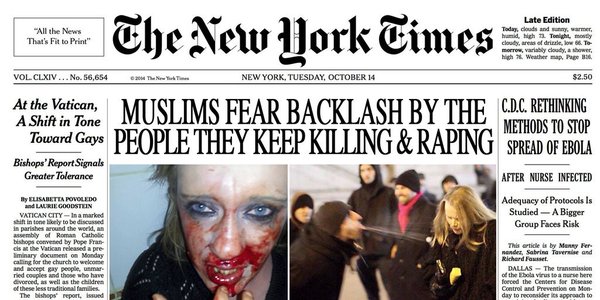
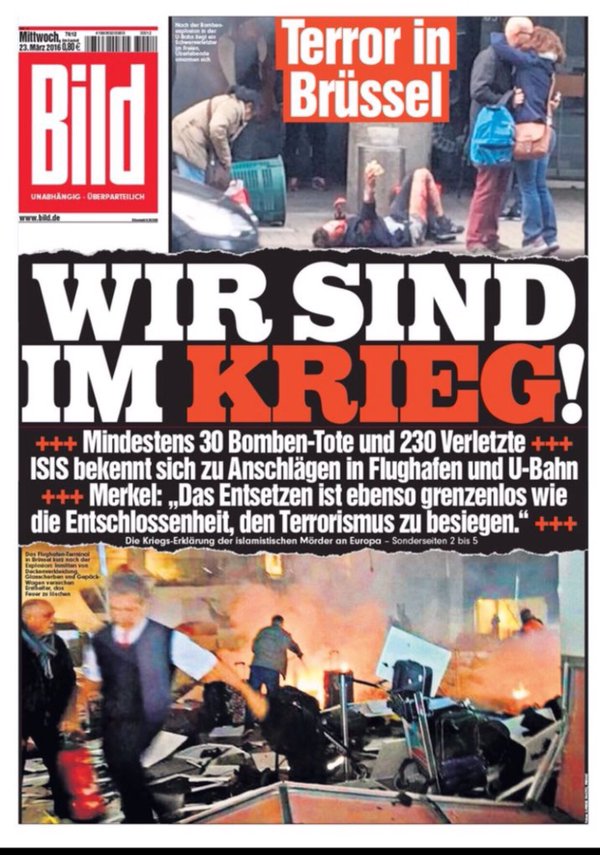
* This is a good time to reflect on our extraordinary good fortune so far–we have a pretty large Muslim population that *hasn’t* become a permanent resentful underclass and a source for terrorist recruiting. This is presumably not because of our clever policies, but rather luck–France, Belgium, and the UK appear to have gotten a much worse grade of Muslim immigrants. There is not an obvious reason why this has to keep working out for us, either.
I wonder how much of this is due to getting more ambitious/smarter/harder working Muslim populations immigrating here, and how much is due to the resentful underclass niche already being mostly filled by blacks in the U.S.
* When I was a kid, I remember my dad always talking about pendulum swings in politics. And now I’m an old guy, and like half the big political issues look like pendulum swings to me. At some point in a fit of good-intentioned penal reform, we let too many bad people out of jail. Crime went up partly as a result of that and partly due to whatever weird social forces move crime rates. So we all got scared of criminals and passed laws to lock a whole bunch of them up again, and we overdid it–you can see that because we have an incredibly high incarceration rate relative to other countries. Pendulum swing.
I expect much of Europe is at a different place in their pendulum swing on this issue. Eventually they’ll expand their prison population to be able to lock up all the folks who badly need locking up, and most likely they’ll overshoot and end up locking up a lot of low-level nobodies who don’t really need long prison terms. And eventually, their pendulum will swing back on this issue, too.
* Blacks are black even though they’ve been in the USA for 400 years. Muslims are “European” if their parents arrived in Europe five seconds before they were born.
I guess whether Muslims are Muslim or “European” all depends on which answer makes (real) Europeans look bad.
* Is this what Europeans look like?
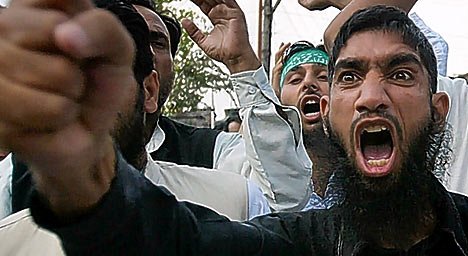
No. These are Europeans.

* This latest meme about the attackers being European, and thus completely unrelated to the immigration issue, is just proof that they have no intent on changing their views. Even some 2nd amendment supporters will agree that there are limits to gun ownership and will support a ban on fully automatic rifles. Or they will support more background checks of private gun sales. Some abortion supporters will agree there needs to be limits on late term abortions. But with immigration it appears there is no room for compromise. No matter what the results it must continue unabated.
Even with a Trump victory and similar positive elections in Europe, I doubt the minds of these open border supporters will change. They will probably use every legal trick in the book, including hearings in front of friendly justices, which will tie up Trump’s actions in courts of law.
I think the only way to change the majority of open border supporters’ views is to shift the paradigm of the issue. Currently the issue is seen as one in which the rich white nations are helping the poor third worlders by bringing them in. Additionally there is the bonus that it annoys the wrong type of whites, i.e. us. Instead if somehow these people could be made to see that immigration is robbing the third world of its talent and that bringing them here is akin to the old colonialists extracting resources from those far off places, it might begin to get the majority of the open borders crowd to reassess exactly why they support it. Additionally instead of playing up the white angst which makes them happy, we could play up the fact that these immigrants are being brought in to support whites in their retirement years. Are you kidding? That is akin to slavery, isn’t it?
Yes I know the real elite like open borders for cheap labor and such. But I am referring to the mass of voters we all know among our friends and relatives who dutifully reject any immigration restrictionist candidate and get squeamish even discussing the issue. These are the people who have been trained to fear the charge of racism and thus will go along with anything that is not racist. Therefore, changing the paradigm of immigration from the perspective that opposition to it equals racism to continued support of it equals racism is what is needed to flip this unfortunately large group.
* “Europe’s terrorist threat, while rising, has come overwhelmingly not from foreigners but from fellow Europeans. And terrorism experts say it’s Europeans who’ve traveled to fight with ISIS and are now coming home, not refugees or migrants, who pose the real threat.”
Terrorist threats from so-called “Europeans” who have names that sound like they came straight out of Aladdin.
It’s funny how these so-called “Europeans” who pledge allegiance to ISIS never have Western sounding names.
* I guess on the other end, if you accelerate immigration and displace the europeans, then your problem is also solved. you’ll have just another dysfunctional african or muslim country, except now it’s located in europe. It worked for Rhodesia and South Africa. During apartheid, South Africa was forever in the news as some kind of never-ending crisis, but once the whites were removed from power, all problems were ostensibly resolved. maybe whites just need to get tf out of the world and all problems will be resolved, right?
* Steve: could you write about the rise of the pro-immigrant meme in correlation with more women coming into western politics? Merkel’s nonsense probs has a nefarious and blackmail background to it, but can also be attributed to her being a woman (embrace the world), much as Thatcher’s hardness was overreaction due to her having to prove her manliness to the male political class. Basically the rise of female politicians means dissolution of western society, or something along those lines. What difference does it make whether a female pol has kids or not?
* My late grandmother was particularly fond of the truism “An ounce of prevention is worth a pound of cure”, which you don’t really hear much anymore, though I admit the metric version doesn’t have quite the same ring to it. My grandfather liked to say that common sense wasn’t all that common, and it seems Taub is trying her best to make it even less so.
A lot of 21st-century liberal writing seems to have the aim of convincing us that common sense/intuition is wrong. There are certainly cases where that’s true, but most of the examples that I can think of off the top of my head involve things that human beings only started thinking about very recently (evolution, quantum/relativistic physics, cardinalities of infinite sets, probability theory). In contrast, primates, being social animals, have been thinking about interactions with other primates for millions of years, so I feel like evolution has given most of us a pretty good cognitive tool set for evaluating our relationships with groups of other humans, particularly ones with a propensity for violence. I don’t know what evolutionary psychologists call this faculty(noticing?), but whatever it is, it’s gotten us this far, so why are progressives so bent on getting rid of it now?
* It’s extraordinarily culturally insensitive of us to police Muslims using principles designed for Europeans. We need to take multiculturalism to its logical conclusion and institute multicultural policing. This would include applying shariah law to Muslim criminals and communal violence for Muslim terror attacks. This wouldn’t be violence for its own sake, but violence specifically to facilitate intercultural understanding.
Torching a block or two of Molenbeek for example would translate to “Cut that shit out!”
* This quote by Aristotle should be stamped on the minds of every politician and journalist,
“Another cause of revolution is difference of races which do not at once acquire a common spirit; for a state is not the growth of a day, any more than it grows out of a multitude brought together by accident. Hence the reception of strangers in colonies, either at the time of their foundation or afterwards, has generally produced revolution…”
The term immigrant is a legal term without much meaning. Donald Trump is married to an immigrant woman but this is rarely brought up in his defense to show that he is pro-immigrant. What matters is what culture, race and civilization do you come from. Immigrants per se are not the problem; Muslims are the problem whether they be immigrants or not.
* Can you name a mainstream leftist propaganda outlet that is more noxious than VOX? I doubt it’s possible. Its staff writers are also overwhelmingly Jewish – surprisingly so even by left-wing NYC standards.
* I have a dream of the day when smack dealers are judged not by the color of their skin, but by the content of their character.

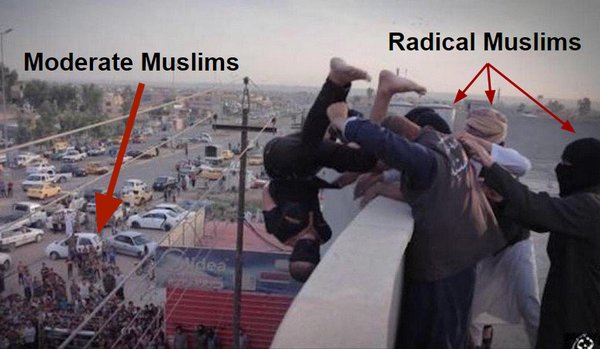
Paul Joseph Watson: “Belgium is one of the most “tolerant,” Islam-friendly countries in Europe, yet it still got hit. What does this say about multiculturalism?”
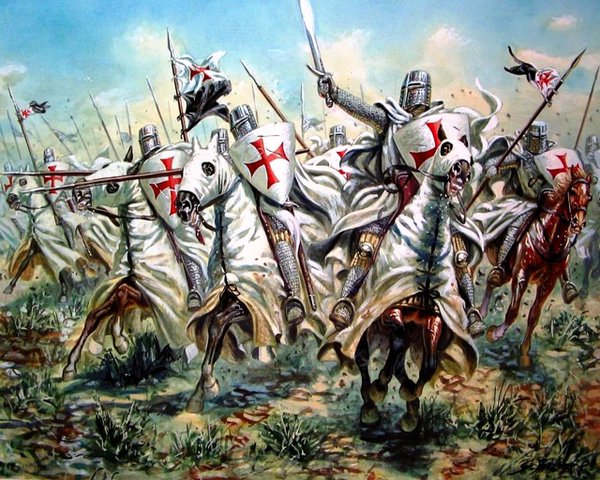
* Just before my grandfather died he started giving away his valuables to just about any stranger he felt was worthy of his charity. He was losing his marbles, we were losing our inheritance.
Our dotty old civilization has been doing the same for a couple of generations. What will be left for our kids?
* Jan. 28, 2016: Asked by the Fox Business Network anchor Maria Bartiromo about the feasibility of his proposal to bar foreign Muslims from entering the United States, Mr. Trump argued that Belgium and France had been blighted by the failure of Muslims in these countries to integrate.
“There is something going on, Maria,” he said. “Go to Brussels. Go to Paris. Go to different places. There is something going on and it’s not good, where they want Shariah law, where they want this, where they want things that — you know, there has to be some assimilation. There is no assimilation. There is something bad going on.”
Warming to his theme, he added that Brussels was in a particularly dire state. “You go to Brussels — I was in Brussels a long time ago, 20 years ago, so beautiful, everything is so beautiful — it’s like living in a hellhole right now,” Mr. Trump continued.
* Yes, obviously the Wahhabist muslims are only attacking us because Donald Trump is saying nasty things about them.
And Adolph Hitler only killed all those people because that horrible racist Mr. Churchill called him some bad names.
And Stalin only massacred the Kulaks because so many western leaders didn’t invite him over for tea.
And Pol Pot only slaughtered like a third of the population of Cambodia because there were a few people in the United States that criticized him.
Really the answer to terrorism is to just never say anything bad about anyone, for any reason.
I mean, look at Japan. They basically don’t let muslims enter their country and there is like zero terrorism and almost no crime. Don’t the Japanese understand how important ‘diversity’ is? Thank goodness our own leaders are so much more enlightened than the Japanese, or we could end up like them…
* The Dutch and the Flemish know all about the joys of Moroccan immigration, so in the wake of the Paris attacks last year, Joost Niemoller, a Dutch journalist and writer, wrote a blogpost about the book Brussel Eurabia, which was written back in 2007 by another Dutch journalist, Arthur van Amerongen.
Van Amerongen decided to spend a year undercover in Brussels’ most enriched, vibrant and Moroccan area: Molenbeek.
His findings, which he describes in the Youtube clips below, can be summarised in three words: “Ze haten ons.” (“They hate us.”)
I’m pretty sure that van Amerongen’s book was never released in the Netherlands, only in Flanders; however, Brussel Eurabia was soon flushed down the memory hole by the Flemish media, who wanted to forget about the book’s uncomfortable, yet entirely obvious findings.
I was unable to find any footage with English subtitles, unfortunately, but if your Dutch/French skills are up to scratch, here are two of the main videos that show how the Belgian/Flemish mainstream media lamely attempted to deal with this politically incorrect truth-teller…
* Your post reminded me of an article that I read around 1980 in Esquire magazine. I think it was entitled, “Letter from an Angry Reader.” He and his wife and moved to a very rough section of L.A. and he had purchased a pistol and acquired a concealed carry permit. He used his pistol to stop an attempted robbery, shooting and wounding the robber (who had a knife). His reaction was, “Well, this is just something we’ll have to get used to, like the ‘seven motors of suburbia or using an ATM.” Would that it were not so!
On a slightly different note, the normal expressions of “sympathy,” cartoons, hashtags, minutes of silence, I hear they’re going to light up the Eifel Tower in the Belgian flag colors, are almost too sickening to read about. Everything but coming to grip with the problem by justice directed against the community from which these fanatics are drawn.
* These attacks will change nothing because our current governing class is incapable of change. Get the Front National, and parties like it, into power and then a course correction at least becomes possible.
* This from a der Spiegel article on what motivates Frau Merkel and her immivasion policy:
“Shortly before the concert began, Merkel saw an old acquaintance: Reverend Rainer Eppelmann……Eppelmann told Merkel how courageous and wonderful he thought her refugee policies were. Given the situation in which Merkel is now in, Eppelmann said, he finds himself thinking often about his favorite quote from the former Czech president and writer Vaclav Havel. “Hope is not the conviction that something will turn out well, but the certainty that something makes sense, regardless of how it turns out.”……She asked: “How did that quote about hope go again?”….
…….
“Dohnanyi knew Merkel’s parents and he believes that her Christian roots are very apparent in her approach to the refugee crisis. “She is the daughter of a socialist pastor. And her mother was an extremely devout woman. Such things are deep within you, they don’t just disappear,” he says. The Kasner family (Merkel is the name of the chancellor’s first husband) adhered to a practical form of theology that involved helping the poor, sick and disadvantaged, Dohnanyi says.
Merkel grew up with the tenet that, if a stranger is standing in the rain before your door, you let him in and help, he continues. “And when you let them in, you don’t grimace,” Dohnanyi says. “Christians don’t do that.” Merkel herself recently said something similar. “We hold speeches on Sundays and we talk about values. I am the chair of a Christian political party. And then people come to us from 2,000 kilometers away and then you’re supposed to say: You can’t show a friendly face here anymore?”
Pastor Eppelmann is likewise convinced that Merkel’s approach to the refugee crisis is deeply rooted in her past. “She stands on a solid foundation that was poured in her childhood and youth.” He also points out that her childhood home was not a normal Protestant parsonage, rather it was a church-run home for people with disabilities. Angela Kasner grew up surrounded by disabled people who needed to be cared for. “She breathed in empathy like air and oxygen,” says Eppelmann.
Later, Eppelmann goes on, Merkel also experienced what it is like to be pushed around by a regime. She initially was not granted a slot at university despite being best in her class. “Such an experience can break a person,” Eppelmann says. As such, Merkel can understand what it must be like for people fleeing Islamic State or the regime of Bashar Assad in Syria.
The Protestant Parsonage
The most important element, though, was the evangelical parsonage, emphasizes Eppelmann, who also worked as a pastor in East Germany. One “becomes aware of a certain ethical standards regarding how life should be led.” That includes that one shouldn’t value oneself more than other people, no matter where they come from, Eppelmann says.
Every day, Jesus and God were discussed in the Kasner household, Eppelmann continues. The daily message was: “Love thy neighbor as yourself. Not just German people. God loves everybody.” You should compare the Protestant Church’s statement on the refugee crisis with Merkel’s words, Eppelmann suggests. “They are virtually identical.”
When Merkel spoke to the CDU party convention in the middle of December, her speech was indeed reminiscent of a sermon. She recalled significant CDU achievements from the past, such as binding Germany to the West and reunification, which former chancellors Konrad Adenauer and Helmut Kohl had pushed through against opposition and doubt. Then she presented her own policies as the heir to these miracles of Christian Democracy.
“The founding of the CDU was in reality an outrageous idea,” she said. “A party that finds its foundation in C, in the God-given dignity of each individual person. That means that today, it isn’t a mass of people that is coming to us. It means they are individuals.” When she stopped speaking after an hour, even the doubters and skeptics applauded her speech. For nine full minutes. Only one member of the audience seemed unimpressed: Wolfgang Schäuble, Merkel’s finance minister.
Schäuble, despite the sweater thrown over his shirt, is a bit chilly. It is the end of November and Schäuble spent four hours that morning in parliament, where it is always a bit drafty. But he hadn’t wanted to leave early. Merkel was delivering her speech on the Chancellery budget and Schäuble didn’t want it to look once again as though he wanted nothing to do with her policies.
Only a few days earlier, Schäuble had compared the chancellor to a clumsy skier who triggers an avalanche on a steep slope. It was an image that provided confirmation to those who blame Merkel for the flood of refugees arriving in Europe.”
* Israel’s Arab citizens (20% of its population; most of whom are Muslim) are much better integrated than French or Belgian Muslims.
* Mondoweiss: Jews and Arabs don’t really mix much in Israel. They attend separate schools from pre-kindergarten age (there are only 5 integrated state schools in the country where Arab and Jewish pupils learn together.) They live in separate cities and towns, with a few exceptions like Haifa and Lod; and even in these mixed municipalities, they tend to live in their ethnically defined neighborhoods. Organizations like Yad L’Achim and Lehava, which receive funding and the tacit approval of the Israeli government, exist in order to combat fraternization between the groups, especially between Jewish women and Arab men. There is no civil marriage option in Israel, which essentially places Jewish-Arab relationships permanently in the realm of the illegitimate.
What can we do to help the Israelis assimilate their Muslims? Insist on a one-state solution that integrates Gaza, Israel and the West Bank?
Yes.Insist that Israel drop the racial and ethnic identification on all ID cards?Yes, that, too.Insist that Israel immediately institute secular/civil marriage and divorce laws?That would also help show goodwill.Withhold all further civil and military assistance until they do?Yes, that is obvious.It is actually a true statement that the problem in Israel is its failure to assimilate its Muslim (and Christian) citizenry.It is also true that the problem in Europe and the United States is Israel’s failure to assimilate its Muslim (and Christian) citizenry.* I am sure that Muslims would be “better integrated” in Europe and America if we returned to the Israeli-style system we used to have a century ago.
In Israel today (as in America a century ago) everybody knows where the lines are drawn and the cost of stepping over them.
Belgians could start by bulldozing houses of collaborators. There must be dozens if not hundreds who looked the other way in Molenbeek.
* Israel hasn’t even tried to integrate West Bank Arabs, Boot wants to continue with that policy, meaning an Apartheid system for settlers and Arabs in the West Bank, which would become ever more evident, as the demographics altered. Boot is mainly interested with his own prestige as an important authority on America’s place in the world, Belgium and Israel effectively ceasing to exist in the foreseeable future is not his primary concern.
* This is actually one of the less stupid things that Boot has said recently. It is true that America has done a better job of assimilating Muslims than Europe has done. And that, in large part, accounts for why there are more attacks there than here. (Other reasons include simple proximity and also closer operational links between Eur0-based radical Muslims and terror groups in the Muslim world).
However, what Boot doesn’t get is that–to quote the Derb quoting Enoch Powell–numbers are of the essence. The larger a Muslim community in a non-Muslim country grows, the more separate it becomes, the more alienated, hostile and prone to radicalism.
America is a sense then just “lucky” that our Muslim population is so much smaller (relatively) and dispersed than Europe’s. But of course if Boot had his way, we’d be taking in a billion more of them.
In my opinion, we don’t need ANY and never did. But if you’re going to have them, fewer is always better than more.
* Forty years ago I saw some fool at the Boston zoo provoke the Baboons, which it seemed was easy to do. Boot is right, the Muslims should not be provoked, but they should also be in a cage or sent back to their natural habitat.
* In the wake of today’s events in Brussels, Hillary and Bernie called for more surveillance. This should be expected as historically the only way to keep the peace in multi ethnic society is to turn it into a police state. I.E. you fear the secret police more then you fear your ethnically different neighbor. But then Max Boot said he’d rather vote for Stalin then Trump so no surprise there either.
To bad Rand Paul couldn’t connect those dot’s, pro liberty, pro rights needs homogeneity to work.
* Muslims are integrating better in America, but the details of why that is makes leftists uncomfortable. They’re integrating here because we enforce minimum wage laws less zealously than the Europeans do. And thus, our Muslims are busy driving taxis 18 hours a day, while in Europe they sit on their butts dreaming of jihad unless they can wangle a corporate-type job.
* How about we send Europe our Latino illegal immigrants? They may not be the sharpest knives in the drawer, but they are not Muslim and they do not blow people up. They work hard and are ready, willing and able to help grow the population there without explosions. Think of it, Mexicans would fit into life in Spain a lot better than Moroccans do.
Send the current, ungrateful migrants back from whence they came. They can transform their Muslim countries into the wonderful nirvanas that we heard they would make Europe. Send Frau Merkel with them.
* Give this crop of immigrants to America a generation or two…
1. Continue to overpromise then to fail to deliver the American Dream to so many… no matter whether immigrant or native born no matter how long or for how many generations they or their families have been in the US
2. Continue to fail to integrate the newcomers by continuing to emphasize divisions and diversity over unity and shared values.
3. Continue to sow discord and hate with identity politics that tell minorities… even if they CHOOSE to come here… that they are victims and suffer the oppression and inequities of racism so they can cultivate their own ressentiment and political loyalty as reliable partisan clientele.
4. Continue to supplicate to the vanguards of these “victim classes” by caving to their every demand and guaranteeing special favored consideration for any and all newcomers to compensate for discrimination
5. To maximize friction and heat, mix well, but not too well
(diversity + proximity = you know what)
We wouldn’t want any of these distinct and incompatible vibrant elements actually blending and losing any of their distinct characteristics as the mainstream Leitkultur rubs off on them.
Then America too can look forward to a bright and bloody future just like Europe already enjoys!
* Imagine a press release in the late 1930′s that read:
The problem in Europe is a failure to assimilate the National Socialist party. Germany has done best job, but the Herschel Grynszpan attack, and French and English resistance alienate Nazis & threaten security.
* There are still right wingers in Israel who want to keep it all. But even beyond that, there’s the fact that the non-Jews in the West Bank are fairly largely integrated into the Israeli controlled power grid, transport infrastructure, water, etc. Yet they have been under a separate set of rules for almost 50 years now. I don’t think that can continue, indefinitely, but the Israeli government doesn’t seem either willing or able to stop the expansion of settlements (although they do uproot some of the smaller ones from time to time.) Not to mention that, for water purposes alone, they will never leave the Jordan River Valley (or Golan) which means that any Palestinian entity will be an enclave in Israel.
It’s a real problem and the only thing that the Israeli government has been doing for the past 30 years (First Intifada) is kick the can down the road.
The conventional wisdom that you’re either going to have one state or two states is belied by the passage of time; if there ever is a separate Palestinian state it will be so closely tied to Israel that one will hardly know the difference. Short of population transfers, which I think are highly doubtful, there will probably be a bi-national state or at least a confederation by the end of the century. And then it will come down to power sharing.
* People always have personal anecdotes about their minority-X friend and how well that friend has assimilated to their cultural norms. So they naively assume that scaling that friend up from him and his family to a few hundred thousand will go just as smoothly.
But they fail to consider that their minority-X friend will acculturate differently when he is relatively unique in a majority culture versus when he and his own are closer to being the majority culture. Scaling up to 5 percent, 15 percent and higher produces much different results than the naive person assumed when his minority-X friend comprised a half a percent of the population.
Whether it is turning a town that was homogeneous into one with a 10 percent foreign population overnight, or doing the same with a school by busing in a diverse bunch of students, those in control rarely take into account what you wrote, “maybe it doesn’t scale. Not everything does.”
* Unlike the West, religious-ethnic communalism has always been the norm in the Levant. That’s still the basic system, though modified somewhat to the needs of the modern nation-state:
Israel’s population registry lists a slew of “nationalities” and ethnicities, among them Jew, Arab, Druse and more. But one word is conspicuously absent from the list: Israeli.
Residents cannot identify themselves as Israelis in the national registry because the move could have far-reaching consequences for the country’s Jewish character, the Israeli Supreme Court wrote in documents obtained Thursday.
The ruling was a response to a demand by 21 Israelis, most of whom are officially registered as Jews, that the court decide whether they can be listed as Israeli in the registry. The group had argued that without a secular Israeli identity, Israeli policies will favor Jews and discriminate against minorities.
* From today’s USAToday editorial:
“It takes Muslims to stand against the tiny minority of savage radicals in the U.S. and other nations, and Muslim forces to stand against ISIL in Syria, Iraq, Libya and everywhere they have gained a foothold. Alienating crucial allies in a shared war against extremists is, quite simply, stupid. Americans should not let it happen.”
What I find mindbogglingly stupid is editorial comment that implies that it is perfectly alright if several score or hundreds of citizens are massacred as long as there is no wish to avoid those who are most likely to kill to them. People like these USAToday editors and the Max Boots of the world are such Magnificent A*sho*es that it his difficult to fathom the world in which they slime-walk.