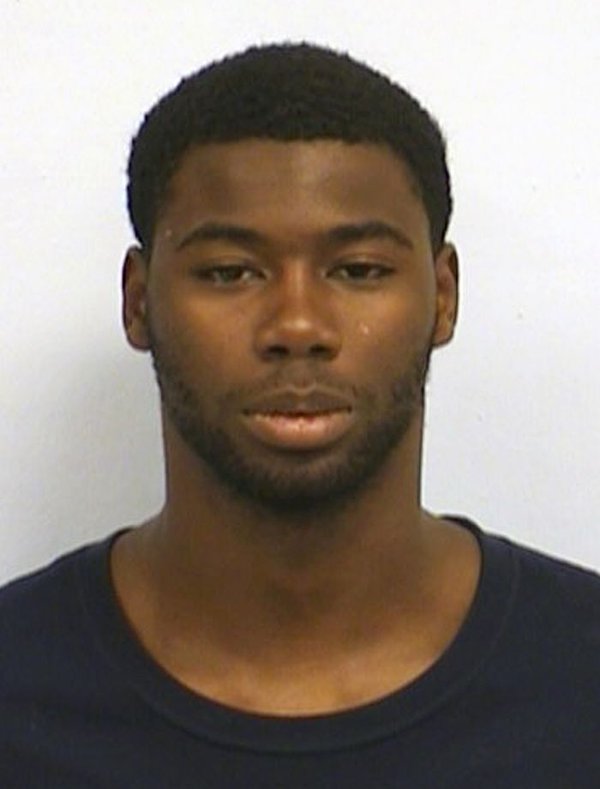
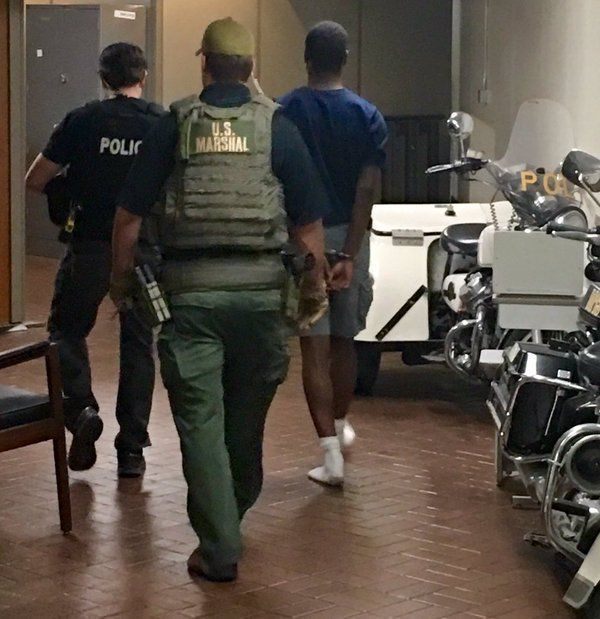
How come the murder of the man in this video stirs no outrage?
AFP: Mexico music video showing woman murder sparks outrage
Mexico City (AFP) – A man finds his lover in bed with another man. He pulls a gun, shoots the rival dead, ties up the woman, drags her to a car, stuffs her in the trunk and smiles as he sets it on fire.
“Fuiste Mia” (“You were mine”), a slick music video by the Mexican-American singer Gerardo Ortiz, has garnered more than 25 million views on YouTube — and provoked a furious backlash in a country that suffers from an ingrained culture of sexual violence and where killings of women have surged.
The 25-year-old Ortiz has a long list of “narcocorridos” — or “narco ballads” — to his credit, a controversial yet hugely popular genre that celebrates the feats of Mexico’s drug lords and is banned from the airwaves in many places.
But none of his videos has attracted as much attention as “Fuiste Mia,” which appeared just as two high-profile sexual harassment cases were making headlines in Mexico — and prompted him to cancel several concerts.
Stuffing a woman in a skimpy nightgown into a trunk is reminiscent of the tactics of Mexico’s drug gangs, who often dump bodies, sometimes hacked to pieces and with notes attached to them, inside cars.
Speaking at a press conference from southern California, where he lives as a US citizen, Ortiz said the “horrible publicity” surrounding the video had the merit of raising awareness of femicide, or the violent killing of women.
But his argument did little to appease critics in Mexico.
Videos like this one “objectify women, glorify violence, and reaffirm stereotypes about women causing problems for men and therefore deserving punishment,” said Lucia Lagunes, head of Women’s Communication and Information, a rights NGO.
The subject is highly sensitive in a country where nearly half of all women over the age of 15 — 47 percent — have suffered some form of sexual violence, according to government statistics.
The Mexican interior ministry condemned the singer by name in a statement expressing “profound rejection of this type of content, and in particular, the video of singer Gerardo Ortiz.”
The video “clearly invites violence against women, in addition to minimizing and normalizing this social scourge,” it said.
Ortiz’s video also caught the attention of officials in the western state of Jalisco, who issued a summons for the singer for questioning. Two years ago police seized six AK-47 assault rifles and a grenade launcher at the upscale home in Jalisco where the video was filmed.
Posted inMexico|Comments Off on Mexico music video showing woman murder sparks outrage
* Wikipedia posts [Dennis] Hastert’s teaching career from 1965-81.
One of the four victims was the equipment manager, Steve Remboldt, who died of AIDS in 1995. He graduated in 1971. His sister believes that “Individual A”, the one who blackmailed Hastert, knew about Rembolt. (I don’t know if sister has solid grounds to know that.)
The others seem to describe a massage that ended with a “sexual act”. There wasn’t as much information about homosexuality in the 1960s–there wasn’t as much information period. So a trusted coach giving a therapeutic massage; which turns into a “happy ending”, it’s not immediately obvious to a teenage boy how to feel. (Obviously having your crank yanked felt good, but other than that). Did he “do anything to you”? Well, he did something for you…
Homosexuality was still classified as a mental disorder. My guess is that Coach didn’t come across as mentally disordered. He wasn’t crossdressing or kissing little boys. He was a big buff tough football/wrestling coach.
So maybe that’s part of the medical treatment? IS it any weirder than drinking raw eggs? (IF you don’t know anything about how sexual predators operate.) But on the whole, no thanks coach, I don’t think I want another massage.
That’s my uninformed guess as to why the kids didn’t fight him off, or say anything.
* Hastert was never on trial for sexual abuse. He was not indicted/convicted of any such crime. It is an absolute disgrace for the prosecutor to release such information to the public. The allegations were never proven in a court of law, civil or criminal.
Hastert’s bank withdrawals of his own dam money were flagged ( probably by his bank to FINCEN) because his was withdrawing numerous amounts under the 10k reporting requirement.
To make matters worse, Hastert made statements to the FBI. You never talk the the FBI or any police person without a lawyer. It is insane if you do.
Just ask Thomas Drake who reported a billion dollars of waste at the NSA and made voluntary statements to the FBI. The FBI with the help of the US Attorney used those same statements and charged Drake with espionage.
Hastert pled guilty to structuring bank withdrawals to evade bank reporting requirements and making false statements to federal investigators.
Hard to wrap your head around a case where the victim of extortion goes to jail and the extortionist is lauded a hero.
A law school professor and former criminal defense attorney tells you why you should never agree to be interviewed by the police.
“Don’t talk to the Police.”
* I worked for a decade in the Middle East. You learn something very quickly in that world: Find yourself in legal problems and there is something wrong with your politics, nothing more. Otherwise, you would have continued to live exempt from the law.
As we relentlessly drive to become a Third World Country, we are finding ourselves and our legal system in similar circumstances. There was something wrong with Dennis Hastert’s politics, nothing more.
* The Hastert prosecution has politics written all over it. My theory, for which I admit I have no proof save for the timing, was that it was a warning to Chief Justice John Roberts to vote for an interpretation of Obamacare that permitted federal insurance exchanges. Roberts’s votes on Obamacare have been very strange and difficult to explain save a potential blackmail threat.
* There was nothing strange about Roberts’ decisions on Obamacare. Did you notice that health stocks were getting killed when people realized that Obamacare might actually get struck down? Have you heard businesspeople complaining about how our complicated employer-funded system of health care makes it harder for them to compete with businesses from countries with functioning national health care?
Roberts was nominated and confirmed in 2005, before Obamacare existed and when Obama was barely a glimmer on the horizon. Roberts was nominated because he was a sure vote for expansive government authority (particularly executive authority in aid of the GWOT), he would take the right side of the culture wars, and he would be hostile to campaign finance regulation. On all of those subjects, he’s been as reliable as a Swiss watch. So far so good, but no one foresaw that Obamacare would be one of the biggest cases of his tenure. It shouldn’t have stunned anyone, however, that a friend of letting the government do what it wants decided to let it have its way this time, too.
Part of the foolishness of these kinds of theories is that they presume striking down Obamacare would have been bad for Democrats. On the contrary, it would have been catastrophic for Republicans and the Supreme Court. Same as the 1992 abortion case where Souter, O’Connor, and Kennedy joined together to save Roe v. Wade.
Posted inRape|Comments Off on WP: Prosecutors offer details on Dennis Hastert’s alleged sexual abuse of teenagers
* Just another example of how the real America is getting gang raped on a pile of broken glass while the story is kept dull, dull, dull…
* It’s not about her, Vinny. It’s about the risibly flimsy grounds upon which the media, academia, and government launched (and continue to perpetrate) the moral panic of a rape epidemic by straight white males. Yes, Jackie was played like a pawn and is–at least partially–a victim as well, but that also needs to be exposed.
* Any lawsuit against the University of Virginia involving this case will subject UVA’s discovery, including all relevant deposition transcripts (which UVA will, of course, demand), to FOIA. So UVA will have to release them.
* Has Jackie publicly acknowledged perpetrating this hoax and apologized to the many people and institutions damaged by it? If not, I don’t see why she is entitled to a break.
* The usual response to a hoax like this that blows up in the face of the SJWs is to say, “Everyone was a victim in this unfortunate matter. Let us put it behind us and speak no more about it.”
Sorry, the people responsible for things like this are ruining other people’s lives. As long as they suffer no repercussions, there’s no reason for them to stop.
* I hope that Eramo gets her millions and that Rolling Stone, if not driven out of business altogether, is more circumspect in future, together with Gawker (in a similar boat) and other such organs following the globalists’ agenda.
* If the public interest required unsealing Jack and Jeri Ryan’s divorce proceedings, then it certainly ought to extend to unsealing Jackie’s deposition.
* Either the judge ordered that the parties were not to release the deposition transcript, or the plaintiff’s attorneys agreed to do so, at least for the time being, so as to not have given Jackie’s attorneys other grounds to object to the deposition being taken. It’s not that unusual for parties in civil litigation to agree to keep discovery materials confidential, and will often over designate.
A third party might have to intervene in the case to have the transcript released if the parties are unwilling to do so. Otherwise, unless the transcript or portions of it are part of a motion or are used at trial, it’s not really a public record, so there’s not a freedom of information act angle.
* Off topic, but point three of your post is also the reason that businesses like to use arbitration to resolve their disputes. Confidential business data is better protected in arbitration than litigation. A very senior British judicial official complained recently tht too much justice was being conducted behind closed doors and blamed arbitration.
* She didn’t give that fraternity at which the claimed the rape took place much of a break. I agree, however, that Jackie is not the principal villain–the author of the piece, Sabrina Rubin Erdely (I think) is either a psychopath or pure, distilled, from the pit of Hell evil, who should never be allowed near a writing instrument of any kind.
* I think that it’s important to expose the personal sickness and distorted cultural values that underlie this case so that other young females and SJWs don’t get so out of control again.
* Anyone at the law firms representing the parties can release the deposition transcript. Carefully, of course. But doubtless any paralegal, secretary, or interested lawyer can likely view the transcript and make a surreptitious copy. Let’s hope they are civic minded.
* You don’t need a separate lawsuit, you’d file a motion to intervene into the case and then object to confidentiality designations as they are made. That’s easier than a lawsuit, and you also would not have to pay the $450 filing fee for a new lawsuit.
A good lawyer would need maybe 6 hours to do the whole thing. If the judge wanted a hearing on the motion, there could be additional time to go to court. So maybe $3,000 on the low side as the cost of hiring someone to do so. It is prestigious to get media clients and fight for open public records, so finding someone to do it at a discount for a journalist might not be too hard. So maybe $1,200, or $200 an hour, taking this into consideration.
The deposition’s confidentiality would fall into three separate levels of protection.
First, any parts of the deposition that were never submitted to the court would not be a public record of any sort. The parties to the case could agree to do whatever they want with the transcript, but would not usually have any reason to release it. Sometimes the whole transcript just gets submitted by one party or another, in which case the whole thing becomes a public record. Sometimes it is just the relevant pages, or none of it.
Second, any parts of the deposition submitted to the court before trial would have a presumption of public access, but it is fairly easy to keep them under seal.
Third, any parts of the deposition used at a trial are very hard, bordering on but not quite impossible, to keep confidential. This is part of the reason why business disputes that last for years in court are often settled right before trial, neither party wants all of their internal financial data and business e-mails put online for all to see. The lawyers for each side have to get together and agree on a trial exhibit list (no “surprise” exhibits are allowed generally, unlike on TV).
Often third party transcripts are not treated carefully because they don’t have lawyers following the case, or don’t have lawyers at all. It seems like both sides probably blame Jackie for their issues, so might not care to keep them secret, and will just do the minimum required.
If I were Jackie, I’d look for an angry spinster SJW attorney to represent me for free, and she’d argue that since Jackie is crazy the deposition is about mental health issues and subject to medical privacy.
To the extent no mainstream journalist doesn’t want to follow the case too aggressively, Ben Shapiro would be a smart anti-SJW attorney who could represent the public interest in open records on the case.
More practically, you can often get a good sense of what is in a deposition filed under seal by reading the briefs that mention it. Again, neither Rolling Stone nor Jackie’s UVA victims have much reason to try to aggressively conceal the contents of her deposition, and may just do the minimum her lawyer required.
* Everyone at the law firms involved signed a confidentiality agreement when they were hired, and would make themselves unemployable if they leaked a confidential document, especially to serve our unpopular “far right” agenda. For this reason this is very unlikely to happen. Probably over 100 people will have access to it, but they probably all prefer continued employment.
If Jackie has no lawyer or a bad one, she may not have conditioned her agreement to a deposition on a protective order. Or a hardass judge might have refused to provide one. In that case, leaking it would still be discouraged, but not violate any confidences, any more than leaking a transcript of a conversation two people had on a bus.
Also, if this is the case, then the transcript can be filed with the court and would go online right away. To get access all you would need to do is pay the $3.00 download fee from the court website.
* Twisted is a word better used to describe “this young woman”. She’s a really sick puppy who inflicted enormous suffering on a group of innocent young men. Only a fanatical, virtue-seeking SJW would even pretend otherwise.
* “You really want this young woman’s scalp. Kind of twisted.”
Yes, only men should have to conform to the established legal & moral norms of our civilization. To expect that of a woman, let alone a young woman, is quite twisted indeed. Girls, after all, are not merely the lowbrow product of snips, snails, and puppy dog tails, and as such, deserve a plethora of rights and privileges not granted to us (male) commoners.
* Are you aware of what this woman, Jackie Last-name-redacted, is doing? She fabricated a story about herself being raped, accused other actual real people (the members of a particular fraternity) of having committed this non-existent crime, and now says that it would be too traumatic for her to dredge up the fake events that never happened which she used to attack the character of other people.
* Reminder that a judge decided to release Cosby’s court depos because they didn’t like Cosby’s comments about black youth.
* In spite of the misogynist feminism of our age (women cast in the image of ersatz males), it is interesting to see movement in the opposite direction; that is, retro-casting females in the traditional role of the “weaker sex” … the perpetual victims of malicious males, the malicious circumstances of life, and, yes, even victims of themselves. Ergo, they need LOTS of protection.
Consistent with this retro-thinking, “Jackie” is evidently calling on the courts to protect her from her own fantasies to save herself from a fit of, we can presume, hysteria, panic, and fainting. How could a sensitive, delicate woman such as “Jackie” otherwise survive such devastating trauma?
Posted inJournalism, Rape|Comments Off on Can Somebody Sue to Get Jackie Coakley’s Deposition Made Public?
Yikes, do those free lunches contain a neurotoxin that attacks the brain?
That picture of the little black boy as a young Copernicus is precious.
* …if Copernicus thought the heavens revolved around an afro.
Note that the white kids are flatfooted whereas the black kid is striving.
* Additionally, the kids to the left and right of the striving negro are both left-handed (i.e. right brained) while the negro child is right-handed (left brained, purportedly with stronger math and logic skills).
* I love the NYT illustration. Not only does genius L’il Jabari grok planetary motion, but he’s also setting up a visually devastating Yo Momma So Fat joke at the expense of scowling Da’Quan in the back row.
* Anyone notice that the child on the highest stack of the books (ie most privileged) is an Asian girl? Has the NY Times ever before even implied anyone is more privileged than a white male?
This may portend a future where SWPL parents complain that over-achieving Asian kids are in some ways more privileged than their own children.
* It’s also horribly racist in its depiction of black youth as maturing faster physically than white and Asian peers. One more growth spurt and he’ll be able to dunk.
* Black genius child draws a more elaborate solar system than the mere white and Asian peers who draw simple stars. Sort of like Morgan Freeman playing one genius after another in the movies. It’s all fantasy. The reality would more likely be that he’d be in Special Ed.
* Is there some kind of journalistic “Making Excuses For Minorities” award? It seems like these people are always gunning for it.
* It seems that the same people debunk the value of IQ testing believe very strongly in learning disabilities. What is the relationship between IQs and learning disabilities? Is a person with a high IQ score just a person without any learning disabilities?
* With lower standards for black and Hispanic kids, the pool of kids sent for testing is expanded. They found high IQ kids who scored above 115. They would also find high IQ white kids who scored below 130 and above 115 but they never looked for those kids. Those kids are discarded, the range is restricted to white kids who scored above 130.
* The picture seems to be an interesting bit of subtle propaganda. The Asian and White kid stand on books, presumably representing the well stocked home libraries and support they have access to as advantaged children. And despite this advantage, they don’t know what outer space really looks like and represent it with cartoonish stars, whereas the Black kid, without the advantage of standing on books, correctly depicts the Copernican model of the solar system.
* Who are the teachers and administrators that conspire to racially discriminate against the 115-130 IQ white kids?
How can any white parent trust any of them in any capacity?
* How much nuffin could a dindu do if a dindu dindu nuffin?
* The NYT comment section has closed. No NYT comment picked up on how the thresholds and eligibility criteria were manipulated to inflate the number of “gifted” students from “underrepresented” groups.
Score: NYT 1, Knowledge -1.
* You highlight a gap that I think we all agree deserves our attention and resources, the one between individual potential and achievement.
Even if it’s worthwhile to invest in human potential in all segments of the bell curve, I still wonder how we decide how much of our resources to dedicate to the development of very modest potential on its far left tail? Is there a formula that we use to possibly compare the diminishing returns to investment for special ed versus using the resources to develop human potential among normal or gifted populations?
* Clearly, the I.Q. cut-offs are set by state law: 130 points for non-disadvantaged students, 116 points for ELL or FRL students.
Since these cut-offs are set by state law, I think we can assume that they were the same before and after the introduction of universal screening.
The universal screening tested all students with a non-I.Q. ability test. The difference in cut-offs was similar to that of the I.Q. test cut-offs: 130 points for non-disadvantage students, 115 (instead of 116) points for ELL or FRL students.
So, since this program did increase the number of ELL and FRL (or otherwise disadvantaged) students, it seems it worked. Universal screening did what it was supposed to, and caught disadvantaged students that were previously overlooked.
Steve’s basic point seems to be that what “identified as gifted” means in article means very different things for different sorts of students. In my opinion it is journalistic malpractice to not inform one’s readers of this.
Mrs. Dynarski did not do so, and for this she is to blame, especially as a professor at Michigan. She also uses a number of weasel words: “many researchers worry”; “psychologists say they believe to be culturally neutral”; “distinguishing between gifted students and everybody else could lock.”
* If you honestly believe that all peoples have identical abilities, then the world must seem an utterly baffling place. No wonder they cook up all sorts of conspiracy theories to explain differing outcomes! You can’t blame them for reaching for Occam’s Butterknife. If you were a racial egalitarian, what would YOU do?
* It’s impossible for a talented minority to go undiscovered. They’re always on the lookout for this fabled being. A minority with two cents worth of brains is a precious find and they get very excited, promoting them beyond their real capability. Resources wasted chasing the Yeti aren’t available to the regular normal to bright students. White adults mostly pay for this nonsense through their taxes and are being robbed along with the white students.
* The eligibility requirements do not appear to be language and SES neutral.
Primary language other than English and low SES each contribute a point to a required 10, and an Underrepresented Gifted Students checklist can contribute an additional 2. These are termed “Environmental Factors” in the matrix.
* It refers to admission to the gifted program. There is no way you get a universal test with a high cutoff and admit 8% of whites and 3% of blacks.
A test that admitted the top 8% of whites would be expected to admit the top 0.79% of blacks using a 1 SD IQ gap and 0.61% using a 1.1 SD gap.
The 8% number should be roughly equal between whites and blacks using the lower 115IQ bar for blacks explicitly. However, some blacks were subjected to the higher “white” standard (middle class blacks), while some whites (poor or immigrant whites) got into the program under the lower “black” standard. So in practice, you don’t get the result that most liberal white institutions want. Instead of getting the 125IQ blacks from middle and upper income families, you exclude them in favor of 115IQ whites and blacks from poor families.
The only reason this program “worked” is that there are few NE Asian immigrants in south florida.
If you did this in California, and admitted whites under a 130 non-verbal IQ threshold but ESL asian kids under a 115 non-verbal IQ threshold, you get gifted classes with 50 ESL asians per black and not all that many whites either.
* The higher the intelligence the more likely the person will be blessed with good physical health, good emotional health, good social skills or the ability to catch up in this area, and ability to rise above adversity, among other advantages. Although it’s not often realized, very bright children are often handicapped in educational settings that are unable to provide them the resources that they are able to take advantage of.
* Every study shows the same. It’s always cherry-picking, self-selection, fraud, or a mistake when you get a result like the NYT headlines.
* And yet higher IQ humans (I’m talking from the 110s onward) are way behind lower IQ humans (I’m talking from the 90s downward) when it comes to violent and/or sex crime. Hence, so many Black and Hispanic violent criminals and/or sex criminals in America when put up with Whites and East Asians.
And let’s not forget disparities in earnings. A signifigant amount of millionaires and billionaires (especially in technology) have IQs from the 120s onward. The movers and shakers in STEM fields (which happen to be both one of the higher earning and more respected fields) are also of the higher IQ persuasion. Being a high fuctioning autistic in today’s economy isn’t really that big of a curse when you look at wage gaps between STEM jobs (favor analytical ability, introversion, and concentration) and jobs in the service sector (tend to focus on ”social skills” but pay much less). Other than exceptions like law (which can be a mixture of both) a significant amount of those who are getting seriously rich or famous these days who aren’t entertainers or someone like Tony Robbins are more in the vein of the SJW’s loathed STEMLords.
* In order to avoid the use of prohibited racial quotas, Chicago Public Schools use a weighted multi-factor system that ranks each census tract within the city. Factors include average income, rate of home ownership, whether or not English was spoke, level of education etc in each census tract. Thus there is no need to muck about trying to deal with the topic of IQ in cognitive testing or even the question of giftedness in this system.
Each census tract is then assigned 1 of 4 tiers. Students applying to schools are classified by the census tract they live in, and are grouped by respective tiers.
The first 30% of students that score the highest in absolute terms on the test and are admitted first to their school of choice. Then each of the four remaining tiers are filled with the highest scoring applicants to the school from each of the four tiers. Students with scores too low for their first choice may be admitted to their second or third choices should their score be above the lowest cutoff in these respective schools.
It is too complex to post all the details but if you care to learn about it, here is a start:
No surprise that with all the tweaking of the socio-economic factors and the respective weights, the overall student body selected for gifted schools (selective enrollment is the term in Chicago) proportionately reflects the racial makeup of Chicago, and the racial breakdown is nearly the same as the prior court ordered selection system that used racial quotas in he first few years. I can’t say for sure what the breakdown is now. This was clearly the intent of its designers.
These are the score cut offs for admission to selective enrollment highschools by various tiers. Be aware that 7th grade grades are also part of highschool enrollment point totals while grades obviously are not used for student entering elementary schools.
You can see not all schools viewed as equal, as the cut offs vary widely by school as well as tier. Some schools have better academic reputations, or are located in less or more desirable neighborhoods in terms of safety or access to public transportation.
Posted inBlacks, IQ|Comments Off on NYT: Why Talented Black and Hispanic Students Can Go Undiscovered
Robert Weissberg writes: Is the Obama administration, or at least some officials in it, hostile toward whites? This is certainly an awkward, publicly unspeakable question–and answering it is exceptionally difficult. Not easy to discern the motives of countless Washington bureaucrats.
Nevertheless, recent events outside of Baltimore, MD suggest that enmity toward whites does afflict some Obama administrators and our proof, though short of the smoking gun standard, is probably as good as it gets.
In a nutshell, thanks to Washington’s money and political pressure, thousands of poor blacks will now be re-located from Baltimore’s slums to upgraded housing in the surrounding, nearly all-white suburbs.
Baltimore County will spend $30 million over the next decade to help private developers build 1000 homes for low-income African American families in affluent suburbs. In addition, the country will create 2000 units of subsidized Section 8 housing where residents will have access to better schools and less crime (housing must be built or rented in racially integrated clusters to avoid creating new ghettoes).
To ensure that these new residences are family friendly, 500 units must contain three or more bedrooms. Housing access will be encouraged by requiring landlords to consider all sources of income–including public welfare–in assessing tenant creditworthiness. Participants will also receive help with moving expenses and security deposits. And to facilitate integration into new (white) neighborhoods, extensive counseling (called “Mobility Counseling Programs”) will teach newcomers about housekeeping and property maintenance, good neighbor skills, financial management and budgeting.
Government sponsored re-location of poor black city residents into affluent white suburbs is hardly new and rests on a theory positing the malleability of human behavior: pathological behaviors are environmentally determined and so just improve environments and “bad” behavior will vanish. Specifically, moving underclass African Americans to pleasant white, affluent towns will see a notable reduction of crime, illegitimacy, drug and alcohol addiction, welfare dependency, domestic violence and other tribulations currently plaguing black inner-city neighborhoods. In addition, the transformation will succeed absent any prior psychological changes of new arrivals. In effect, an industrious law-abiding African American who autonomously flees to the suburbs to live a better life is identical to his Baltimore neighbor motivated solely by the promise of a more spacious, cheap apartment.
It is also assumed that pathologies will be mitigated by inter-racial, inter-class contact. For example, lower class black youngsters will improve academically if they encounter more studious white classmates. And osmosis will flow only one way–white youngster will not gravitate toward crime when socializing with black inner city refugees.
It is hard to think of a more incorrect theory of human behavior. Tellingly, when such enterprises are discussed in official reports, the stress overwhelmingly is on the benefits to the recipients and advice on how to overcome (white) public resistance. The unspeakable harsh truth is that these newly relocated inner-city residents will bring their pathologies with them and after a few years the areas surrounding the freshly built homes and Section 8 apartments will resemble dilapidated crime-ridden Baltimore.
If the transformative power of a better physical setting were correct, how do you explain massive white resistance to such enterprises? Are the millions of whites who over countless decades fled the influx of underclass blacks hallucinating or being fooled by racial demagogues? If such population movement worked as advertised, why must Washington impose it by court decrees, fines for non-compliance and other cram-down measures? How can advocates of this alleged panacea explain why busing thousands of academically troubled poor black students to top-flight “white” schools has failed? Is leafy small town America the magic cure for drug addiction and illegitimacy? Recall Ferguson, MO: put troubled black residents of St. Louis into a nice white suburb, and you create a new St. Louis slum.
Now for the near-smoking gun proofs that this enterprise smells of contempt for whites. First, all this draconian coercion is outside federal law regulating discrimination in housing. Legal penalties for housing discrimination have nothing to do with coerced integration and to obscure the non-legal gun-to-the-head power, the consent of whites is officially deemed “voluntary.” No doubt, the hapless whites of Baltimore Country just realize that resistance is futile; you will be absorbed by the federal colossus.
Second, prudence would suggest a modicum of cost/benefit analysis of this enterprise, and this scrutiny is totally absent (see here for a sampling of research on the alleged advantage of such re-locations). Only the supposed benefits for blacks inform calculations, for example, better schools, and experience suggests that these are likely to be transitory. Nor is there any mention of how the new arrivals will find employment in suburban areas with limited public transportation.
Total silence surrounds the inevitable costs for whites: loss of home equity, increased school violence, more crime, and the shredded social cohesion associated with imposed racial diversity and, in the long run, the costs of moving elsewhere. Indeed, HUD is already anticipating white flight and is trying to impose rules that would forbid real estate agents from openly discussing the negative consequences forthcoming racial shift.
Of the utmost importance for this near smoking gun evidence, these benefits provided to blacks need not come at the expense of whites. The same millions could have been spent in the city of Baltimore building nice homes for blacks adjacent to their old residences and if suburban whites were guilty of racial discrimination, just fine them versus (non-legally) imposing unwanted integration. Moreover, inner-city construction could have utilized nearby unemployed African American Baltimore residents who would, as an extra dividend, gain some job training (the model is Habitat for Humanity). Everything would be win/win politics. But, this sensible win-win solution fails to harm whites and so it is politically off limits.
Beyond these immediate problems inflicted on whites will be, in all likelihood, the political costs of changing these once relatively racially homogeneous suburbs. Ferguson, MO is the future: more communal racial strife, yet more whites will flee, civil rights groups demanding more “inclusionary” policies, and, eventually, Department of Justice intervention to remedy alleged race-related injustices–a “too white” police department, too few black office holders or an excessive expulsion rates of black students, to name but a few possibilities.
One can only wonder why officials cannot foresee this racial-train-wreck-in-the-making. This is punitive policy-making that can only reflect the presence of deeply rooted racial animosities. Helping poor African Americans find decent housing is just the polite cover story. At least some government officials in the Obama administration want to punish suburban whites and given that Uncle Sam will foot the bills, inflicting this damage is irresistible.
Posted inAmerica|Comments Off on Obama Administration Sticks It To Whitey
From Breitbart: Police in Berlin have raided ten apartments because residents may have posted “anti-migrant” views online.
Berlin Police completed a large scale raid on internet users Wednesday. The officers ransacked ten separate apartments in the German capital in the suburbs of Spandau, Tempelhof, Marzahn, Hellersdorf and Pankow.
The force confiscated mobile phones, narcotics and weapons. Nine suspects were arrested, aged 22-58, and are accused of posting messages critical of migrants, migrant helpers and some anti-semitic slogans on social networks like Facebook, WhatsApp, and Twitter, reports Berliner Morgenpost.
The Berlin police have told media that they already knew of the suspects and said that many of them have what they consider a “right-extremist” background. Police spokesman Stefan Redlich said that while many of the men shared anti-migrant views, “the men do not know each other according to previous findings,” and there was no evidence of any planned conspiracy to commit crime among them.
In some of the homes searched police were forced to admit they hadn’t found anything at all, but Redlich justified the raids saying they were maybe, “people who just once expressed their hate-opinion.”
One of the raids in particular was prompted by a Facebook comment to an article regarding an Afghani migrant who was shot dead at the Bulgarian border. The incident took place in October and according to Bulgarian officials it was an accident as a bullet was meant to be a warning shot but ricochet and hit him.
The post responded to the article saying that it was unfortunate too few migrants met with a similar fate, as it might scare the rest of them from coming.
Police announced that the raids show Germans that they are not as safe online as they might think. They say that anyone who says something xenophobic, spreads hate toward migrants, or shares what they consider to be xenophobic music, may be next on the list of apartments to be raided in the future.
58 police were involved in the raids and some illegal items were found in a few of the apartments. Police found one revolver handgun, though it was not mentioned if it had any ammunition or whether or not is was deactivated. They also found an air soft gun, which requires a license to own in Germany and a stun gun that appeared to be camouflaged as a flashlight.
Spokesmen Redlich also mentioned that they had found several unconstitutional symbols but did not divulge specifics. Banned symbols in Germany include Nazi era symbols like the swastika and various Nordic runes used by the Nazis during the era.
Berlin has seen a rapid increase in prosecutions for speech on the internet. In 2014 there were 196 investigations into anti-migrant and xenophobic posts, while 2015 saw 289 cases. In the last six months there have been three raids prior to this one, but so far this has been the largest in scale. Investigators have set up a special task force who work with the organization Network Against Nazis (NAN), headed by ex-stasi agent Anetta Kahani, to monitor internet postings across Germany.
Posted inCensorship, Germany|Comments Off on German Police Raid Apartments Over ‘Right-Wing’ Social Media Posts
This exchange of private letters between Macklin Fleming, Justice of the
Court of Appeal, State of California at Los Angeles, and Louis Pollak, Dean
of the Yale Law School, seems to us to raise important issues affecting the
public interest. We are grateful to Justice Fleming and Dean Pollak for
permission to publish the correspondence–Eds.
Dean Louis H. Pollak
Yale Law School
New Haven, Connecticut 9 June 1969
Dear Lou:
The press of activity on Alumni Day didn’t allow me to comment
on your report to the Executive Committee of the Yale Law School
Association about current admission policy at the Law School. Hence
this letter.
From your remarks and those of Dean Poor, I understand that 43
black students have been admitted to next fall’s class, of whom 5
qualified under the regular standards and 38 did not. You anticipate
that half this group will actually enroll, thus furnishing 22 black
students in the first year class of 165, of whom perhaps 3 will have
qualified under the regular standards and 19 will not. You also said
that the future policyof the Law School will be to admit 10 per cent
of each entering class without regard to qualification under regular
standards. It thus appears that the demand of the Black Law Students
Union that 10 per cent of the entering class be black has been
more than met. It also appears that 38 fully-qualifed applicants for
admission to Yale Law School have been rejected solely because
they are not members of a minority race. Under current policy the
admission ratio for black applicants (50 per cent) is 5 times the
admission ratio for other applicants (10 per cent).
This new policy represents a radical departure from that set out
in the 1968 Yale Law School catalogue: “Admission is based entirely
on a judgment as to the applicant’s promise of professional
distinction.” It is clearly apparent that to this judgment has been
added the criterion of race.
With the adoption of its new admission policy the Law School has
taken a long step toward the practice of apartheid and the maintenance
of two law schools under one roof. Already there has been
established in the Law School building a Black Law Students Union
lounge with furniture and law books provided by the school. And I
learned from Dean Poor that the 12 black students in the present first
year class who were admitted under relaxed standards have not done
well academically. Dean Poor attributed this deficiency to the preoccupation
of these students with racial activities. I think it equally
logical to attribute their preoccupation with racial activities to their
lack of qualification to compete on even terms in the study of law.
Next year the Law School will have in its midst approximately 30
students who were not required to qualify for admission under the
regular standards because of their race. Of the 128 admittees to next
fall’s entering class who had accepted in early April, the highest
ranking of 13 minority admittees stood in an 8-way tie for 98th place
under the regular criteria for admission. Predictably, most of these
students will find themselves unable to compete in law studies on
even terms with the other students, who have been admitted on the
basis of demonstrated academic performance and aptitude for logical
reasoning.
The immediate damage to the standards of Yale Law School needs
no elaboration. But beyond this, it seems to me the admission policy
adopted by the Law School faculty will serve to perpetuate the very
ideas and prejudices it is designed to combat. If in a given class
the great majority of the black students are at the bottom of the
class, this factor is bound to instill, unconsciously at least, some sense
of intellectual superiority among the white students and some sense
of intellectual inferiority among the black students. Such a pairing
in the same school of the brightest white students in the country with
black students of medic, ere academic qualifications is social experiment
with loaded dice and a stacked deck. The faculty can talk
around the clock about disadvantaged background, and it can excuse
inferior performance because of poverty, environment, inadequate
cultural tradition, lack of educational opportunity, etc. The
fact remains that black and white students will be exposed to each
other under circumstances in which demonstrated intellectual superiority
rests with the whites. If to compensate for disadvantaged
background, the faculty discriminates among students in its grading
and marking, its double standard will be quickly perceived by both
groups of students. Because of the Law School’s current admission
policy the difference between the two groups will be centered on the
factor of race.
No one can be expected to accept an inferior status willingly. The
black students, unable to compete on even terms in the study of law,
inevitably will seek other means to achieve recognition and self-expression.
This is likely to take two forms. First, agitation to change
the environment from one in which they are unable to compete to
one in which they can. Demands will be made for elimination of
competition, reduction in standards of performance, adoption of
courses of study which do not require intensive legal analysis, and
recognition for academic credit of sociological activities which have
only an indirect relationship to legal training. Second, it seems probable
that this group will seek personal satisfaction and public recognition
by aggressive conduct, which, although ostensibly directed at
external injustices and problems, will in fact be primarily motivated
by the psychological needs of the members of the group to overcome
feelings of inferiority caused by lack of success in their studies. Since
the common denominator of the group of students with lower qualifications
is one of race this aggressive expression will undoubtedly
take the form of racial demands–the employment of faculty on the
basis of race, a marking system based on race, the establishment of
a black curriculum and a black law journal, an increase in black
financial aid, and a rule against expulsion of black students who fail
to satisfy minimum academic standards.
These unhappy prospects flow from the abandonment of an objective
system of admission based on intellectual aptitude (painstakingly
evolved over a period of decades) and the adoption of a system
of admission which takes racial considerations into account.
From your remarks and those of other members of the faculty I
gather the new system’s justification rests on three theories.
The first is a theory of proportional representation. Only 1 per cent
of the lawyers in the United States are black, and it is desirable that
this percentage be increased to the proportion of the black population
in the country, roughly 10 per cent. Consequently, all law
schools, including Yale, should have a student body which is 10
per cent black.
The weakness of the proportional argument is that quotas, once instituted,
cannot logically be limited to one group when other groups
exist which are equally entitled to quotas. The next step is a series of
quotas. But if minorities obtain quotas, demands from majority
groups for quotas are bound to ensue. In short order a full-blown
quota system would arise which would necessarily impose restrictions
on overrepresented groups in order to assure a student body
representative of the general population. A quota policy particularly
discriminates against minority groups which have achieved disproportionate
representation in a particular field. Such a policy discriminated
severely against Jewish applicants for admission to medical
schools in the 1930’s. That policy was undoubtedly justified by its
supporters as one designed to preserve a proportion of gentile students
in medical schools equivalent to their proportion in the general
population. Currently, the orientals in California, roughly 1 per cent
of the population, comprise in some instances 30 per cent of the enrollment
in certain engineering and technical schools. Were a quota
system to be introduced in those schools in order to favor black and
Mexican-American applicants, the first losers would be applicants
from the presently disproportionately represented oriental group.
A quota system based on race must assume there are two kinds of
racial discrimination and two types of quotas: the benign type designed
to help a disadvantaged group, and the malignant type designed
to prevent over-representation in a particular field by a hardworking
and competent minority. This argument wholly ignores the
fact that discrimination in favor of X is automatic discrimination
against Y. For X and Y substitute any color, religion, or ethnic background;
the process remains discriminatory. The argument of benign
discrimination glosses over the fact that under a quota system a person
is no longer judged on individual merit but is judged in part
according to his membership in a group. It also assumes that race is
a relevant criterion by which to choose law school applicants.
The faculty may have been persuaded to adopt its present quota
system by the argument of inverse, or compensatory, discrimination
mthat past discrimination against a particular group should be remedied
by present discrimination in its favor until the group catches
up. Here again the vice lies in the substitution of a group standard
of merit for an individual standard and in the extension of the criterion
of race to an area in which it should not apply. The American
creed, one that Yale has proudly espoused, holds that an American
should be judged as an individual and not as a member of a group.
To me it seems axiomatic that a system which ignores this creed and
introduces the factor of race in the selection of students for a professional
school is inherently malignant, no matter how high-minded
the purpose nor how benign the motives of those making the selection.
The aspiration to train more lawyers from minority groups is
highly commendable, but I do not believe it will be furthered by putting
unqualified or poorly qualified black students in competition
with students at Yale Law School who average in the 97th percentile
of intellectual achievement (higher than at any other law school).
There are many good regional and local law schools in Philadelphia,
Boston, Los Angeles, and other metropolitan areas, where black law
students can compete with white law students on equal terms and
where they can study law in competition with students of similar
qualifications and aptitudes. Many of these law schools do not follow
YaMs policy of numerically limited enrollment and are geared to
handle within reason all students who can qualify for admission. In
view of the prevalence of these law schools, the relative ease of admission
to many of them, and their flexibility in handling increased
numbers of students, the initiation of a system of proportional representation
for black students at Yale Law School serves no genuine
need or purpose.
The second justification for the current admission policy derives
from the Oxford precedent of training leaders for underdeveloped
countries. Oxford admitted students from distant countriesnBurma,
Nigeria, Kenyamwithout a close look at their academic qualifications
on the theory that whether or not they qualified for serious study,
something of Oxford culture would rub off; that when these students
returned to their people as leaders they would carry the torch of
Oxford with them. It is argued that, comparably, the mission of Yale
Law School is to train national leaders, and therefore its students
should be representatively selected in order to assure quality leadership
for all segments of the population. This theory assumes that the
study of law and the mastery of legal principles are merely incidental
by products of attendance at Yale Law School. It also assumes that
black lawyers compete only with other black lawyers in the practice
of a special kind of black jurisprudence and therefore the academic
performance of black law students at Yale Law School is largely
irrelevant to the development of their future role as national leaders.
No theory could be a greater myth, for the law the black lawyer
must master to achieve success in his profession is the same law
that the white lawyer must learn to handle. In his legal career the
black lawyer must expect to compete on even terms with the white
lawyer, whether he goes into a government oi_ce (executive, legislative,
or judicial), a corporate department, or a law firm. Any
suggestion to the contrary does a great disservice to black law students,
for I think it a safe prediction that national leadership will
conlinue to come, as in the past, from the ranks of those individuals
who have risen to the top of their occupations and professions.
The third justification for a policy of racial discrimination is based
on the suggestion that the traditional measures of qualification for admission
to law school aptitude tests and college grades–are not
accurate, and therefore the Law School is justified in not paying
strict attention to objective standards of admission. Doubtless there
is room for improvement in measuring aptitude in logical reasoning
and ability to handle abstract concepts, the qualities demanded for
intensive study of law, but from everything I have heard the present
tests achieve reasonably accurate results. For many years the Law
School prided itself on its ability to predict student performance in
law school on the basis of the criteria used for admission, and I
have heard nothing to cast doubt on the continued accuracy of
such predictions. If these criteria are ignored, the consequences are
equally predictable. In 1966 Michigan Law School embarked on a
policy of admitting black students under relaxed standards of admission.
The results of this policy were reported last fall to Michigan
Law School’s Committee of Visitors as “disappointing and to a
degree demoralizing . . . the academic performance is not satisfactory
and some new approaches must be explored.” And, I am told,
similar academic ditBculties are being experienced by the underqualified
black students in the first year class at Yale.
In my view none of the above theories justifies the inclusion of
race, or disadvantaged status, among the criteria for admission to
Yale Law School. While racial quotas may serve a purpose in some
contexts, they are entirely irrelevant to the operation of a graduate
professional school with limited enrollment, admission to which requires
four years of college training and specific aptitude for the
profession involved. The present policy of admitting students on
two bases and thereafter purporting to judge their performance on
one basis is a highly explosive sociological experiment almost certain
to achieve undesirable results.
The number of fully qualified minority applicants is growing, and
because of increased college attendance the number of those who
will qualify for admission to Yale Law School under its regular
standards should mushroom within the next few years. Under an
open door policy of competitive admission without regard to race,
religion, or color, and based solely on demonstrated achievement
and aptitude for the study of law, Yale Law School will maintain national
leadership in legal training. Under any other policy I think
this result doubtful. I urge reconsideration of the current admission
policy.
Very truly yours,
MACKLIN FLEMING
Fukuyama Responds to Krauthammer: The Israelization of American Foreign Policy. You may recall that prominent neocon Francis “End of History” Fukuyama jumped ship awhile ago and criticized Charles Krauthammer in The National Interest for his lack of realism about the Iraq War. Krauthammer responded, predictably, by playing the anti-Semitism card. Here is part of Fukuyama’s rebuttal:
“Krauthammer says I have a “novel way of Judaizing neoconservatism“, and that my argument is a more “implicit and subtle” version of things said by Pat Buchanan and Mahathir Mohamad. Since he thinks the latter two are anti-Semites, he is clearly implying that I am one as well. If he really thinks this is so, he should say that openly.”
A little late, perhaps, Francis? “First they came for Pat Buchanan, but I was not Pat Buchanan, so I said nothing. Then they came …”. But better late than never. Fukuyama continues:
“What I said in my critique of [Krauthammer’s] speech was, of course, quite different. I said that there was a very coherent set of strategic ideas that have come out of Israel’s experience dealing with the Arabs and the world community, having to do with threat perception, preemption, the relative balance of carrots and sticks to be used in dealing with the Arabs, the United Nations, and the like. Anyone who has dealt with the Arab-Israeli conflict understands these ideas, and many people (myself included) believe that they were well suited to Israel’s actual situation. You do not have to he Jewish to understand or adopt these ideas as your own, which is why people like Vice President Dick Cheney and Secretary of Defense Donald Rumsfeld share them. And it is not so hard to understand how one’s experience of Arab-Israeli politics can come to color one’s broader view of the world: The 1975 “Zionism is racism” resolution deeply discredited the UN, in the eyes of Jews and non-Jews alike, on issues having nothing to do with the Middle East. This is not about Judaism; it is about ideas. It would be quite disingenuous of Charles Krauthammer to assert that his view of how Israel needs to deal with the Arabs (that is, the testicular route to hearts and minds) has no impact on the way he thinks the United States should deal with them. And it is perfectly legitimate to ask whether this is the best way for the United States to proceed.”
Well said. America’s foreign policy blunders of the last 30 months have less to do with the fact that so many highly influential people in Washington and New York, like Krauthammer, think about Israel and its welfare all the time, as to the fact that it has become extremely dangerous to one’s career to point out that they do. As Gene Expression blogged:
And I’m sorry, but ethnicity will and should legitimately be a topic brought up in the ensuing debate. Consider an analogy. Suppose that Wolfowitz, Perle, Shulsky, Feith, Ledeen, and all the rest were South Asian Americans rather than Jewish Americans and had names like Ramachandran, Patel, and Choudhury. Again they’d be selected from a highly educated group that was less than 2% of society (there are about 2 to 3 million South Asian Americans, about 1/2 to 1/3 the number of American Jews depending on how you count).
Now suppose they were pushing the US to invade Pakistan, and talking about how the Islamic terrorists killing Indian citizens in Kashmir were the same ones bombing the US on 9/11. Assume that they did this whilst having relatives, extended families, and significant contacts in India.
Now, their arguments would not – and should not – be dismissed out of hand. After all, it is probably more accurate to say that Al Qaeda, the Taliban, and the ISI are/were more closely involved in Muslim terrorism in Kashmir than they are with anti-Israeli terrorism in Palestine. (As far as I know, Al Qaeda has never directly attacked Israel.)
But while their arguments would not be dismissed out of hand, clearly their visible ethnicity would figure into the debate. Plenty of people would take their opinions with a grain of salt, knowing that humans tend to be ethnocentric on the population level if not the individual level. It would be scurrilous to dismiss their arguments simply because they were of Indian ancestry, especially if they were born in America. But it would be foolish to think their ethnicity wasn’t impacting any of their arguments, and to rule out mention of their ethnicity as “anti-Subcontinental.”
What we need, now more than ever, is free discussion. Closed discussion helped get us into Iraq.
Police arrest 17-year-old in slaying of first-year University of Texas student
Police have arrested a 17-year-old suspect in the slaying of a University of Texas dance student, law enforcement officials said Friday.
Austin Police Chief Art Acevedo said at a news conference that Meechaiel Criner has been booked into the county jail on a first-degree murder charge in the slaying of Haruka Weiser, a first-year student from Portland, Ore. Weiser, 18, was last seen Sunday night leaving the university’s drama building en route to her dorm, police said. Roommates reported her missing the next morning.
Weiser’s body was found on campus Tuesday in Waller Creek by the university’s alumni center, a short walk from the drama building.
A December 2014 issue of a student publication, the Tiger Times, of Texas High School in Texarkana, Tex., contains an article about Criner headlined “Voice of hope.” The article, on page 12 and accompanied by a photograph of Criner, says the teenager was the victim of schoolyard taunts at an early age because of a “thick, African-like” accent.
“I’ve been bullied almost my whole life,” Criner was quoted as saying. “In elementary school, I would come home crying almost every day. It was because of my accent, you see. People couldn’t understand me.”
Criner told the Tiger Times that he had spent several months in foster care and later lived with a grandmother. The article portrays Criner as a victim of violence and bullying who wants to work to help others.
“I like to stand up for people,” Criner was quoted as saying. “I like to help others. … What I want to leave behind is my name – I want them to know who Meechaiel Criner is.”
Posted inBlacks, Crime|Comments Off on Voice Of Hope Suspected Of Murdering Girl
* The political coalition of the left depends entirely on keeping united various groups that really don’t like each other much, so the progressives do everything they can to keep their anger directed at oppressive law-abiding middle class whites. Noticing social ills that can’t be put on this much-hated demographic is verboten.
* It’s not the prediction that is wrong it’s what flows from it. Bryant Gumble noted this a few years back when Larry Bird caught flack for saying basketball is a black man’s game. Gumble noted it was wrong because if you concluded black men were good at something, then you could conclude they were also bad at stuff.
Well… duh.
So you can’t reliably predict, or profile, these murderers because soon somebody will start to point the finger at the black community’s culture and values that help create these guys. Or maybe even feminism for promoting unwed and single parenthood. We can’t have that now, can we?
As Bryant Gumble so unironically pointed out: they’re not taking any of the blame.
Must be a straight white man’s fault.
* I’ll merely reference the words of the great Joe Sobran:
“Nobody really disagreed with me. That, in fact, was the problem. Nothing creates more awkwardness than saying things people can’t afford to admit they agree with. Disagreement is manageable. It’s agreement that wreaks havoc. If people disagree, they’ll debate you. If they secretly agree with something, but are furious with you for saying it, then they’ll try to shut you up by any means necessary.”
Posted inBlacks|Comments Off on Fired For Noticing
"This guy knows all the gossip, the ins and outs, the lashon hara of the Orthodox world. He’s an [expert] in... all the inner workings of the Orthodox world." (Rabbi Aaron Rakeffet-Rothkoff)