
David Feith at the Hudson Institute writes this Op/Ed in the Washington Post:
To outcompete China, America must believe in itself again
America’s new era of great-power rivalry demands strength and clarity — not exhaustion and doubt.
…President Donald Trump forced a rethinking of China policy as no conventional leader could. Then came the Biden administration, which repudiated many Trump policies but kept his approach to China largely intact. This prompted a thousand headlines about Washington’s new hawkish bipartisan consensus on China and the likely dawn of a New Cold War.
And yet nine months into the second Trump term, Washington is not adopting a Cold War posture toward Beijing. The second Trump administration has taken a soft line on issues from TikTok to semiconductor export controls to Taiwan, with little pushback from Congress or the public.
I wish there was more attention paid to the self-interest of political players like David Feith. We’re self-interested apes. That’s the core of John Mueller’s argument in the 2006 book Overblown: How Politicians and the Terrorism Industry Inflate National Security Threats, and Why We Believe Them—and it’s the same dynamic at work today with the “new Cold War” crowd. He calls it the “terrorism industry”: politicians, bureaucrats, think tanks, and media figures who profit—financially, professionally, and psychologically—from inflating threats.
ChatGPT says: Mueller lays out how after 9/11, the U.S. built an enormous ecosystem of fear that enriched the people selling “security” and punished anyone who said the risk was small. DHS, contractors, experts, and TV pundits all had careers, budgets, and prestige tied to the belief that terrorism was an existential danger—even though statistically, it wasn’t.
It’s the same psychological pattern in play with today’s China panic. Threat inflation keeps elite networks alive—without it, they lose purpose and funding. Mueller even warns that these cycles of overreaction are historically recurrent: Cold War, “war on terror,” “great power competition.” Each one reactivates the same professional self-interest dressed up as patriotic vigilance.
Your “self-interested apes” line hits it perfectly. We rationalize self-interest as virtue. Fear creates moral cover for ambition. And Washington runs on that—what Mueller calls the political economy of fear.
The Washington foreign-policy establishment—“the Blob,” as it’s now called—has rediscovered its reason for being. After the long, anticlimactic “War on Terror,” a rising China gives it a new existential project: another global struggle that justifies the entire national-security bureaucracy, from the Pentagon and intelligence agencies to the think-tank ecosystem and defense-industry supply chain. The push for a “new Cold War” is not just about strategy or ideology. It’s about money, status, and institutional survival—wrapped in the rhetoric of patriotism and freedom.
1. Institutional Self-Preservation
The United States built an enormous Cold War infrastructure: hundreds of bases, dozens of intelligence agencies, a vast weapons complex, and legions of analysts, contractors, and think-tank fellows. When the Soviet Union collapsed, that machinery didn’t vanish—it rebranded. The “War on Terror” kept the budgets flowing for twenty years. As that war wound down and the public soured on foreign interventions, the Blob needed a new organizing principle. China, with its authoritarian system and expanding global footprint, fit the bill perfectly. “Great-power competition” revived the career logic of an entire elite class that had lost its sense of mission.
2. The Profit Motive Disguised as Patriotism
Washington’s most influential think tanks—the Hudson Institute, CSIS, AEI, Heritage, and others—receive heavy funding from defense contractors and, in some cases, foreign governments. Many of their China “experts” rotate between government posts, lobbying firms, and board seats in industries that profit directly from heightened tension: arms, semiconductors, cybersecurity, surveillance tech. Yet disclosure of these financial ties is rare and superficial. A report may list a donor’s name but not specify the dollar amounts or policy access that come with it. What’s presented as sober analysis is often sales copy for the next weapons system or export-control program.
3. The Status Economy of Fear
Inside the Beltway, alarmism is rewarded. Pundits and policymakers gain visibility, funding, and invitations to testify by declaring the threat “existential.” Restraint earns obscurity. The Blob’s moral self-image—guardians of democracy, sentinels of freedom—depends on imagining an ever-present adversary. A cooperative world deprives them of meaning. Rivalry restores it. To admit that China’s rise may be managed through competition and coexistence would deflate the drama and the budgets that sustain their influence.
4. Bureaucratic and Ideological Capture
Every bureaucracy is biased toward mission expansion. The Pentagon’s “pacing threat” language, mirrored by State, Commerce, and the intelligence agencies, ensures China remains central to budget justifications. What began as a strategic assessment has metastasized into a self-perpetuating ideology—China as totalizing menace. Inside this mindset, moderation feels like appeasement. A hard line becomes not just a policy stance but a credential.
5. The Myth of Benevolent Elitism
What the Blob rarely admits is that its incentives can diverge sharply from the public good. A new Cold War would mean higher defense spending, more industrial subsidies, and continued militarization of foreign policy—all costly, all high-risk, all benefiting a small class of insiders. It would also distract from domestic renewal, which the same experts claim to prize. Yet their op-eds seldom include financial disclosures or institutional conflicts of interest. The appearance of impartial expertise conceals a material stake in perpetuating fear.
6. The Alternative They Won’t Discuss
A realistic China policy—competitive but not crusading—would mean smaller budgets, fewer contracts, and less airtime for those who built careers warning of apocalypse. It would mean treating China as a complex rival rather than a civilization-scale enemy. That’s sound strategy but poor business. The Blob’s reflexive Cold War mindset thus endures not because it serves America’s long-term interests, but because it serves its members’ short-term ones.
The new Cold War rhetoric is less about defending American democracy than about defending a class structure that feeds on threat inflation. The Blob doesn’t see itself as corrupt—it sees itself as indispensable. But when the same people who call for confrontation are funded by those who profit from it, their moral authority collapses. The tragedy is that what’s good for the Beltway is rarely what’s good for the country. The next great struggle they seek to ignite may once again be waged for the security of their own relevance, not the security of the American people.
LF: Are there any memoirs or essays by the blob about how their own ambitions blinded them to the havoc they were wreaking?
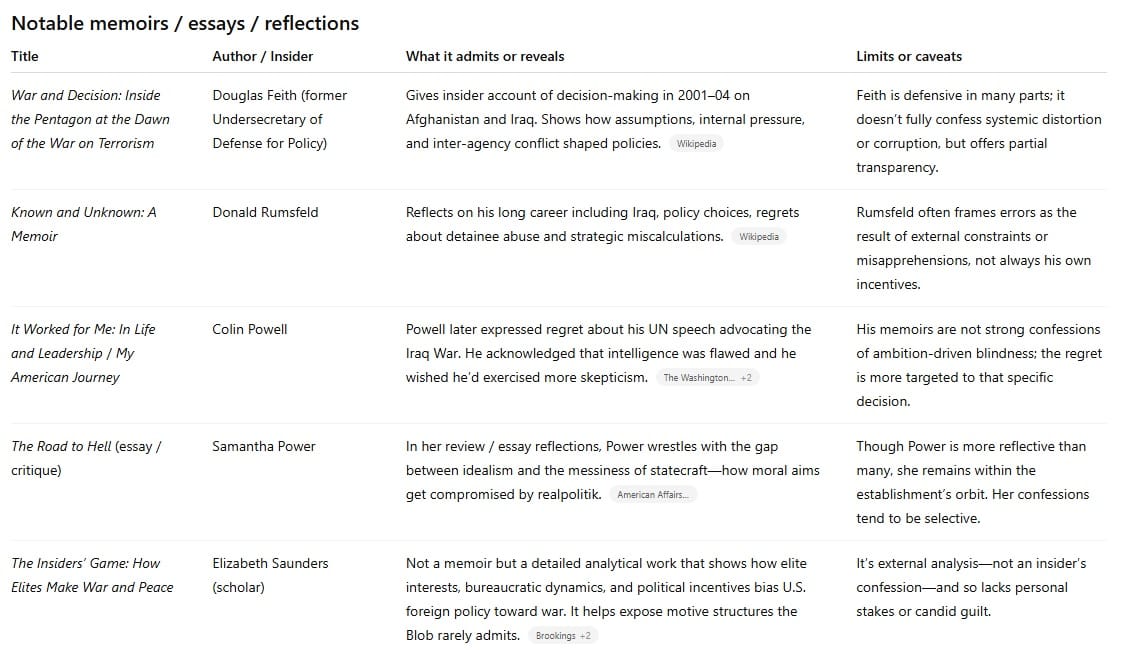
Why there are few “full-blown” confessions
Institutional loyalty & career risk: Writing a memoir that deeply criticizes your own class or role can close doors, tarnish relationships, or provoke retaliation. Many insiders prefer to preserve reputation over full disclosure.
Self-justification and narrative control: Even when admitting mistakes, they tend to frame them as errors in judgment, information gaps, or moral tension—not structural conflicts of interest or willful distortion.
Selective memory & accountability avoidance: Full transparency would force confrontation with complicity, financing, and ethical trade-offs. Few are willing to strip away the professional halo they built.
Audience and genre constraints: Memoirs often aim at legacy, influence, or justification—not cathartic confession. The constraints of narrative and marketing distort the extent of frankness.
What does evolutionary psychology have to say?
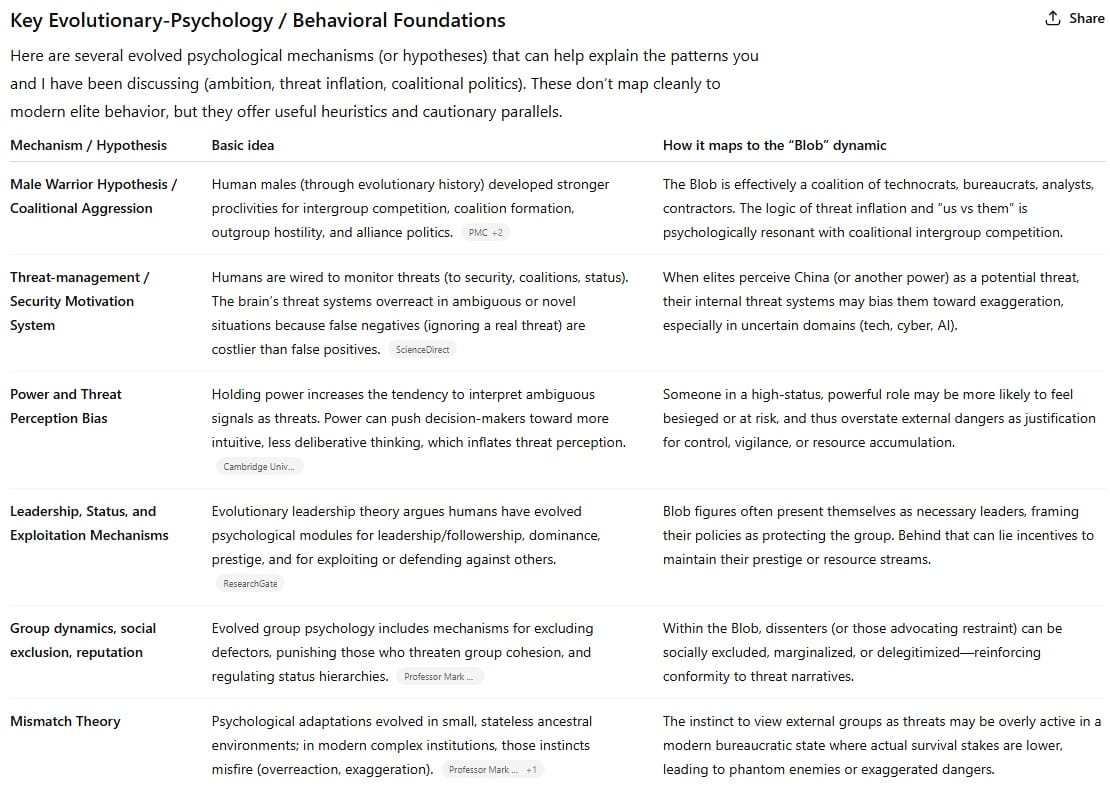
Here are several evolved psychological mechanisms (or hypotheses) that can help explain the patterns we’ve been discussing — ambition, threat inflation, and coalitional politics. These don’t map cleanly to modern elite behavior, but they offer useful heuristics and cautionary parallels.
PMC |
OUP Academic
ScienceDirect
Cambridge University Press
ResearchGate
Professor Mark Van Vugt
Professor Mark Van Vugt
Examples and Scholarly Work
- The Damocles Delusion: The Sense of Power Inflates Threat Perception in World Politics shows empirical evidence that more powerful actors are prone to perceiving higher threat levels—even when objective risks don’t justify that.
- Evolution and the Psychology of Intergroup Conflict discusses how intergroup hostility may stem from deep evolutionary roots in competition over resources, territory, alliances, and status.
- Evolutionary Perspectives on Group Dynamics explores how exclusion, status competition, and coalition logic are shaped by evolved psychology, showing how group actors behave in ways that are adaptive in ancestral settings but misfire in modern institutions.
Caveats & Limitations
- These frameworks are descriptive and heuristic, not deterministic. They suggest propensities, not inevitabilities. Elites are not helpless slaves to evolutionary drives.
- Much of evolutionary psychology is speculative and controversial—especially when going from organism-level traits to large, complex institutions.
- Elite behavior is mediated by ideology, culture, institutional design, incentives, awareness, and rational calculation. Evolution gives a baseline, not total explanation.
- These analyses rarely (if ever) name specific individuals or decision-making contexts in the Blob, so they need to be supplemented with political, sociological, and institutional analysis.
