
New Yorker: ‘Birth of a White Supremacist – Mike Enoch’s transformation from leftist contrarian to nationalist shock jock’

I have many Jewish friends who find gentile nationalisms, particularly white nationalism, terrifying.

Nationalism means that you are devoted to your people. Jews are devoted to their people. Why shouldn’t goyim be devoted to their people?

To me, it’s not scary that there are white supremacists. There’s no inherent connection between that ideology and violence, any more than there is an inherent connection between Christian supremacism, Jewish supremacism, Islamic supremacism, black supremacism, etc, and violence.

It’s not scary when people hate your group. At one time or another, I’ve felt fleeting hatred for almost every group I’ve known and I expect most people have experienced similar emotions.

Genocide happens when there is a dramatic clash of interests. Just because someone hates Jews or blacks or Christians is not a reliable predictor that the person is going to become violent.

Negative feelings about Jews are called anti-Semitism yet the Jewish Bible is filled with negative sentiments about Jews and Jews still regard the book as holy.

Just as I don’t hate any particular group of people, I don’t hate the MSM. They’re probably my primary source of information about the world. I take into account their biases and read them anyway.

The New Yorker, for example, publishes this interesting and valuable profile of Mike Enoch:

This summer, after a loose coalition of white supremacists, neo-Nazis, and Confederate apologists announced that they would hold a rally in Charlottesville, Virginia, promotional flyers began to circulate on the Internet. The flyers included a list of names: the self-proclaimed thought leaders who planned to speak at the rally, arranged, Coachella-like, in order of prominence. At the top of the list was Richard Spencer, who coined the term “alt-right” almost a decade ago, and who has been so successful at making himself the poster boy of the movement that he was once sucker punched while standing on a sidewalk in Washington, D.C. Farther down the list were Jason Kessler, the Charlottesville resident who organized the rally; Matthew Heimbach, who has been called “the affable, youthful face of hate in America”; and Christopher Cantwell, who would later star in a Vice documentary about Charlottesville, unpacking a small arsenal of guns and saying, among other things, “We’re not nonviolent—we’ll fucking kill these people if we have to.”
The second person listed on the flyers, immediately below Spencer, was a white-nationalist shock jock named Mike Enoch. The name might have been unfamiliar to most Americans, but, to an inner cadre of Web-fluent neo-fascists, Enoch is an influential and divisive figure. In May, David Duke, the former grand wizard of the Ku Klux Klan, tweeted, “Hate him or love him—Mike Enoch is someone to pay close attention to.” Just three years ago, Enoch could be heard mocking Spencer (“talks like a fag”) and Cantwell (“a dickhead turtle”), criticizing their ideologies as too extreme. But that was before his radicalization was complete. These days, Enoch routinely refers to African-Americans as “animals” and “savages,” and expresses “skepticism” about how many Jews died in the Holocaust. Apart from interviews with Spencer and Cantwell, who are now his close friends and ideological allies, he largely eschews attention from the media. He prefers to speak—voluminously, articulately, and with an uncanny lack of emotion—on his own podcast, “The Daily Shoah.” (The title, a pun about the Holocaust by way of Comedy Central, reflects the overall tone of the show.) “The Daily Shoah” is the most popular of more than two dozen podcasts on the Right Stuff, a Web site that Enoch founded in 2012. Once an obscure blog about “post-libertarian” politics, the site is now a breeding ground for some of the most florid racism on the Internet. One of its pages is set up to accept donations, in dollars or bitcoins; another is devoted to “fashy memes,” songs and images that extol fascism in an antic, joking-but-not-joking tone. The podcasts—meandering, amateurish talk shows hosted by bilious young men who make Rush Limbaugh sound like Mr. Rogers—are not available on iTunes, Spotify, or any other major platform, and yet collectively they draw tens of thousands of listeners a week.
The Charlottesville rally, on August 12th, immediately erupted in violence, and the police shut it down before any of the speakers could take the stage. A few of them reconvened in a park two miles away. Enoch, surrounded by small concentric circles of reporters, protesters, and counterprotesters, stood on a wooden riser in the shade of a dogwood tree. A tall, stout man with a husky voice and a grim, downturned mouth, he wore aviator sunglasses, a slight beard, and the unofficial uniform of the day: khakis and a white polo shirt. “We’re here to talk about white genocide, the deliberate and intentional displacement of the white race,” he said. “Have we heard this conspiracy theory of white privilege? This is a concept that was brought to us by Jewish intellectuals, to undermine our confidence in ourselves.” He finished his remarks and introduced the next speaker, David Duke. An hour later, James Alex Fields, Jr., wearing khakis and a white polo, drove a car into a crowd of people, killing Heather Heyer, a local counterprotester.
Enoch’s father, who is also named Mike, spent that Saturday at home. He lives in an upper-middle-class New Jersey suburb that is often listed among the most progressive towns in the country. “I made breakfast, and at some point I mowed the lawn,” he said recently. “Then, as I do every day, I sat down to read the New York Times.” He saw a photograph of a torch-wielding mob taken in Charlottesville the previous night. “I looked at the picture for a while, and I couldn’t find Mike anywhere,” he said. He scrutinized other photos online, and still didn’t see his son. “I said, ‘Thank God,’ and I went about my day.”
On Sunday, after he got home from church, he saw that a relative had e-mailed him a YouTube link. He clicked on it: his son and David Duke, standing shoulder to shoulder. “It turned my stomach,” he said. “Until that moment, I had imagined that, whatever had caused him to go down this path, it could somehow be reversed, and he could come home again.”
Most of the bloggers and commenters on the Right Stuff use pseudonyms—Sneering Imperialist, Toilet Law, Ebolamericana, Death. “Mike Enoch” is a pseudonym, too. Over the years, on “The Daily Shoah,” he occasionally dropped hints about his identity, though he was careful not to reveal too much. He said that he lived with his wife in New York City—“which narrows it down to me and eight million other people”—and that he worked at a “normie” day job, which he would surely lose if his employers ever learned about his alter ego. As a child, he had attended church camps and public schools, where he’d been “programmed” to believe in universalism and equality. Most members of his immediate family were still “shitlibs”—committed liberals who had not yet seen the error of their ways.
In January, a group of anti-fascist activists dug up his personal information and released it against his will—an Internet-specific form of retribution known as doxing. Mike Enoch was actually Michael Enoch Isaac Peinovich, a thirty-nine-year-old computer programmer who worked at an e-publishing company and lived on the Upper East Side. As predicted, he lost his job. Someone printed out color photographs of his face and pasted them to telephone poles on the corner of Eighty-second Street and York Avenue: “Say Hi to Your Neo-Nazi Neighbor, Mike Peinovich!” The dox revealed that he had an older sister, a social worker who treated traumatized children, and an adopted younger brother, who was biracial and cognitively impaired. Perhaps most baffling of all, Mike’s wife, who was also identified in the dox, turned out to be Jewish.
At first, Enoch tried to insist that he wasn’t Peinovich, but he soon put up a post on the Right Stuff confirming his identity: “I won’t even bother denying it.” On white-nationalist message boards, including the Right Stuff itself, a few commenters accused Enoch of being “controlled opposition,” or demanded that he divorce his wife. (“I can’t believe all you fags still support this Jew fucker!”) Some held out for more information (“How Jewish? Because if 1/4 or less, I don’t give a shit”); others changed the subject (“I’m more disappointed by how fat he is than anything”).
A few days later, on “The Daily Shoah,” Enoch and his co-hosts read dozens of notes from listeners who were remaining loyal to the podcast, some of whom had donated money to Enoch in his time of need. “My heart goes out to his wife,” one fan, a long-distance trucker, wrote. “If she is married to Mike, she must be a good individual.”
“That is a really nice thing to say,” Enoch said. “I’m sure she’ll appreciate that.” He didn’t mention that his wife had gone to stay with her mother in the Midwest.
Also included in the dox were two e-mail addresses, both purportedly belonging to Enoch. In general, I am opposed to doxing—I worry about vigilante mobs, false positives, slippery slopes—but not opposed enough, apparently, to overcome my curiosity. I e-mailed both addresses.
Enoch responded right away. He said that he didn’t want to talk—“I have a platform to tell my story that is bigger than yours”—and yet, every time I sent another e-mail, he sent one back. I made no secret of the fact that I found his views repugnant, but I added, truthfully, that I wanted to know how he’d ended up in this predicament and what he planned to do next. At one point, I wrote him a long note trying to persuade him to talk to me. His entire response was “You seem kinda mad.” We went back and forth for a while, but I had no real success in drawing him out, and eventually we both lost interest.
He later read our full exchange on “The Daily Shoah.” To his credit, he didn’t edit his responses to make them sound smarter, but he didn’t have to. According to the rules of online debate in the Right Stuff’s “Essential T.R.S. Troll Guide,” which I hadn’t read at the time, Enoch had won our exchange by default, because he had written fewer words and maintained his ironic detachment, whereas I had committed the greatest possible faux pas: letting myself be “triggered” into displaying emotion. After the podcast aired, a few of Enoch’s fans sent me nasty messages on Twitter. I figured that was the end of it.
Then I heard back from the other e-mail address. “I am not the Mike Peinovich to whom you addressed this email, but I am his father,” it read. “Until two days ago, I was totally unaware of his ‘alt-right’ activities. . . . I am struggling to understand how Mike E. (which is what we call him to distinguish him from me and my father who was also Mike Peinovich) could have said, posted or tweeted the things that are attributed to him.”
I called Mike, Sr., and we talked for a long time. It was the week of Donald Trump’s Inauguration, and he spoke in the tone that a lot of liberals were using then—weary and a bit dazed, as if struggling to shake a bad dream. “We tried to give our kids good values,” he said. “Mike E. went to good schools, and he loved being part of his church youth group. We knew that he was an outspoken Trump supporter, and he was very much the only one in the family, so we agreed, at a certain point, not to talk about politics.” He had listened to the podcast for long enough to recognize his son’s voice and profane sense of humor, but lasted only a few minutes before turning it off.
Four days after the rally in Charlottesville, I went to meet Mike, Sr., and his wife, Billie, in New Jersey. They live in an Arts and Crafts house on a tree-lined block near the center of town. Mike, Sr., answered the door. He was taller and thinner than his son, with silver hair and rimless glasses, but I saw the resemblance right away: the square jaw, the downturned mouth.
Billie and Mike are retired, and they spend several months a year travelling. They gave me a tour of the house, pointing out items they’d collected: Persian rugs, Mexican pottery, a floor-mounted globe. Mike was once a professor of Old English at the University of Pennsylvania, and his study contains several dictionaries and translations of “Beowulf,” along with contemporary books such as Ta-Nehisi Coates’s “Between the World and Me.” We sat in armchairs in the living room, and he talked at length about his ancestors. “My grandfather helped drive the K.K.K. out of North Dakota,” he said. “My other grandfather came from Yugoslavia, fleeing religious persecution.”

I find less than 5% of the articled above unfair. Overall, it is an important read. It is a compelling read. It is a great read. My hats off to the author and to the people who participated in the profile. I sense that the author was generally fair and honest.

I feel drawn to write about outlaws. In some ways, members of the Alt Right remind me of pornographers. Outwardly, most pornographers proclaim they have no interest in talking to the MSM and yet most yearn to talk for hours to reporters. They want to be listened to by people in prestigious positions and they want to be acknowledged in mainstream outlets. Most Alt Righters are the same way. Most proclaim they never talk to the press, but as the Mike Enoch example shows, once you get them going, they’ll talk to you for hours.
Posted in Alt Right, Anti-Semitism, Diversity | Comments Off on New Yorker: ‘Birth of a White Supremacist – Mike Enoch’s transformation from leftist contrarian to nationalist shock jock’

The Joys Of Diversity

Most Orthodox Jews I know prefer to spend most of their spare time with other Orthodox Jews. On the other hand, many of the Orthodox Jews I know prefer to have non-Jews as neighbors because they’re not as nosy.

From what I’ve seen, the more Orthodox and non-Orthodox Jews mix, the more they hate each other.

From what I’ve seen, most non-Orthodox Jews have more positive views of non-Jews than they do of Orthodox Jews. Most of them would prefer to have gentile neighbors rather than Orthodox neighbors.

From what I’ve seen, Orthodox Jews make no assumptions about a fellow Jew’s ethics based on his level of observance of Jewish law. From what I’ve seen, increased observance of Jewish law does not make people more honest in business.

From what I’ve seen, non-Jews find it easier to deal with secular Jews than with Orthodox Jews. They prefer secular Jews as neighbors to Orthodox Jews.

Most people, most of the time, prefer their own kind. I notice that even in Orthodox synagogues, Ashkenazi Jews prefer the company of other Ashkenazi Jews, Sephardim generally stick with Sephardim, and Persians stick with Persians.

I notice that the more diversity people have to deal with, the more they keep their head in and their guard up. On the other hand, when people are with people like themselves, they tend to be comfortable.

When Jews move into a neighborhood or business, they sometimes raise tensions (e.g., Postville) by challenging mores. The more observant the Jews, the more challenges they raise.

Posted in Jews | Comments Off on The Joys Of Diversity

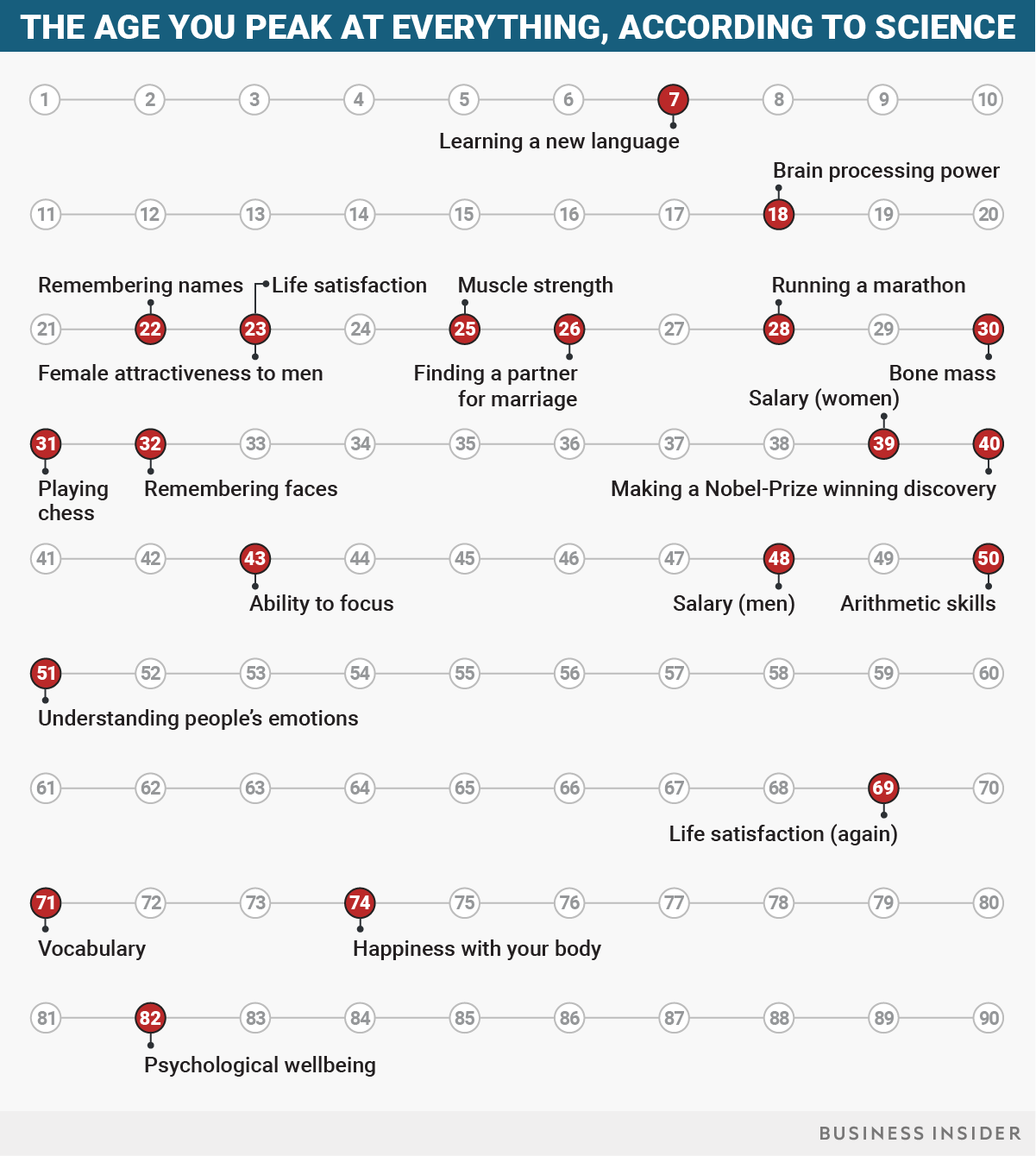
The Age You Peak At Everything

Posted in Health | Comments Off on The Age You Peak At Everything

Judaism, Homosexuality & The Alt Right

We discuss Andrew Joyce’s three essays on the Alt Right & homosexuality. Listen here.

My cohosts are Dennis Dale and Casey the Classicist.

* The Messiah Will Purify Jewish Bloodlines.

* We discuss Count Joseph Arthur de Gobineau (14 July 1816 – 13 October 1882).

* From page 46 of the book Anti-Semitism Before the Holocaust by Albert S Lindemann: The writings of the widely recognized ‘father of modern racism,’ Count Arthur de Gobineau, further suggest some of the overlooked intricacies of racist thinking in regard to the Jews in the nineteenth century…

Gobineau pushed what could be called the essentialist core of racist thinking to its logical conclusion: environment did not explain the rise of civilizations but rather inherent racial genius did; the decline of civilizations was due to the dilution of that genius through race mixing. The phrase in Disraeli’s novel, ‘all is race; there is no other truth,’ was thus consistent with Gobineau’s theories. Revealingly, Gobineau considered the Jews to be one of the superior ‘white’ races and approved of their efforts throughout history to remain racially pure…

Gobineau’s racism was widely criticized, especially in his own country, but in one revealing regard it was widely accepted both in Europe and among people of European descent in the Americas: African Blacks were, he asserted, a distinctly inferior race. For Gobineau, Africans and the European lower orders had common traits — low intelligence, lack of self-control, and proclivity to violence. For all its claims to scientific validity, this view had deep roots in the European and Judeo-Christian past, going back to texts of the Bible as well as commentary on it. Indeed, the terminology of modern racial theory derived from biblical mythology in the account of Noah and his sons (Gen. 9:21-27): Shem, from whom the Semites descended; Ham, from whom the African Hamites descended; and Japheth, from whom the Europeans descended…

Some rabbinical commentary also contained proto-racist elements, enhancing for example the derogation of Blacks more than the bare biblical text in making the sons of Ham ‘ugly and dark-skinned’. The influential Jewish medieval philosopher Moses Maimonides wrote that ‘the Blacks’ nature…is below that of man and above that of a monkey.’ So Disraeli might be said to have drawn from both modern scientific and age-old sources when he concluded that if the white population of the United States were to continue to ‘mingle with [its] negro and coloured population’, an inevitable degeneration of the civilization of the young republic would be the result…

Blacks were often described as lacking in intelligence, Jews as cunning, dangerously intelligent. Blacks allegedly lacked self-control, whereas Jews were seen as disciplined and devious. Insofar as Jews were described as inferior, it usually had to do with moral issues, although their small stature, weak bodies, and odd ‘Oriental’ appearance were also mentioned. In short, negative visions of Blacks tended to describe them as animal-like, at a lower stage of evolution; they could be used in the way beasts of burden were used and were dangerous int eh way that such animals could be dangerous. But there was no concern in nineteenth-century Europe or America that Blacks were taking over the world through clandestine power and financial manipulation.

* The Zakein Mamre is a sage who does not accept the legal rulings of the Sanhedrin. He is executed so that controversies do not disrupt the nation of Israel.

Sanhedrin 88A: “And Rabbi Elazar says: Even if the rebellious elder says his ruling on the basis of the tradition, and the members of the court say: This is the correct understanding in our eyes, he is executed, so that discord will not proliferate among Israel and to ensure that there will be a standard halakhic ruling. And if you say: For what reason was Akavya ben Mahalalel not executed? It is due to the fact that he did not issue his ruling as practical halakha; he merely claimed that his understanding was correct in theory, which is always permitted.”

From Chapter three of the Rambam’s Mishneh Torah:

A person who does not acknowledge validity of the Oral Law is not the rebellious elder mentioned in the Torah. Instead, he is one of the heretics and he should be put to death by any person.

א
מי שאינו מודה בתורה שבעל פה אינו זקן ממרא האמור בתורה אלא הרי זה בכלל האפיקורוסין [ומיתתו בכל אדם]:

2
Since it has become known that such a person denies the Oral Law, he may be pushed into a pit and may not be helped out. He is like all the rest of the heretics who say that the Torah is not Divine in origin, those who inform on their fellow Jews, and the apostates. All of these are not considered as members of the Jewish people. There is no need for witnesses, a warning, or judges for them to be executed. Instead, whoever kills them performs a great mitzvah and removes an obstacle from people at large.

ב
מאחר שנתפרסם שהוא כופר בתורה שבעל פה [מורידין אותו] ולא מעלין והרי הוא כשאר כל האפיקורוסין והאומרין אין תורה מן השמים והמוסרין והמומרין שכל אלו אינם בכלל ישראל ואין צריך לא לעדים ולא התראה ולא דיינים [אלא כל ההורג אחד מהן עשה מצוה גדולה והסיר המכשול]:

3
To whom does the above apply? To a person who denied the Oral Law consciously, according to his perception of things. He follows after his frivolous thoughts and his capricious heart and denies the Oral Law first, as did Tzadok and Beitus and those who erred in following them.

* The Rise & Fall of Civilization by Brian Fitzpatrick

Sex is the sacrament of choice for secular and pagan people — in which they seek their personal, ontological stability. It cannot be found there, but makes a good pretence at it by making one feel good (for five minutes). – E. Fox

Perhaps the definitive work on the rise and fall of civilizations, was published in 1934 by Oxford anthropologist J.D. Unwin.

In Sex and Culture, Unwin studied 86 human civilizations ranging from tiny South Sea island principalities to mighty Rome. He found that a society’s destiny is linked inseparably to the limits it imposes on sexual expression and that those sexual constraints correlate directly to its theological sophistication and religious commitment.

Unwin noted that the most primitive societies had only rudimentary spiritual beliefs and virtually no restrictions on sexual expression, whereas societies with more sophisticated theologies placed greater restrictions on sexual expression and achieved greater social development.

In particular, cultures that adopt what Unwin dubbed “absolute monogamy” proved to be the most vigorous, economically productive, artistically creative, scientifically innovative, and geographically expansive societies on earth. Absolute monogamy is a very strict moral code. Under absolute monogamy, sex can occur only within one-man/ one-woman marriage. Premarital and extramarital sex are not tolerated and divorce is prohibited.

Understandably, the only societies that practice absolute monogamy are the ones that take their religion very seriously.

Whether monotheistic or polytheistic, they believe devoutly in God or gods, and they order their society according to divine moral laws.

Unwin’s contemporary, British historian Arnold Toynbee, was much more explicit about the centrality of religion in history. Toynbee’s masterpiece, his 12-volume Study of History, charted the rise and fall of 26 civilizations. In Toynbee’s view, “The course of human history consists of a series of encounters…in which each man or woman or child…is challenged by God to make the free choice between doing God’s will and refusing to do it.”

Why exactly does absolute monogamy, the Pauline moral code, bring vitality to a society? Absolute monogamy fosters cultural growth by solving what anthropologist Margret Mead called the “central problem of every society”— that is, to “define appropriate roles for the men.” Monogamous civilizations require men to choose either lifelong celibacy or the responsibilities of a husband: fidelity, breadwinning, and fatherhood. Most men choose to marry, to their good fortune, because married men tend to be healthier, happier, and more productive than bachelors.

Those committed husbands create stable marriages, which offer the greatest opportunity for raising healthy, productive children who can keep a society strong and growing. Likewise, the great economist Joseph Schumpeter attributes the success of capitalism not to the entrepreneur’s lust for money or status, but to his love of family. To Schumpeter, the central pillar of any healthy civilization is the self-sacrificing married man who doesn’t spend his income on his pleasures, but prefers “to work and save primarily for his wife and children.”

And in Family and Civilization, Harvard historian Carle Zimmerman concludes that “the creative periods in civilization have been based upon” the strongest form of family, which he terms the “domestic” type: “The domestic family affords a comparatively stable social structure and yet frees the individual sufficiently from family influence to perform the creative work necessary for a great civilization.” If devotion to God, a Pauline moral code, and strong marriages and families are the key to cultural success, then what causes civilizations to decline?

Zimmerman warns of “periods of family decay in which civilization is suffering internally from the lack of basic belief in the forces which make it work.” Unwin’s explanation would be that if people lose their faith in God, they tend to lose their motivation to live by the strict moral code. In This Present Age, sociologist Robert Nisbet writes, “What sociologists are prone to call social disintegration is really nothing more than the spectacle of a rising number of individuals playing fast and loose with other individuals in relationships of trust and responsibility.” Moral standards begin to erode when a society’s members chafe at the discipline imposed by absolute monogamy and begin to gratify their personal impulses without regard for the consequences inflicted on others.

In other words, in an amoral, hedonistic society, you can’t trust the people you need to trust, not even your spouse. Moreover, if people can make and break relationships at will, with no legal repercussions or social stigma, they are much more likely to abandon their marriages—at their children’s expense—when the going gets tough. Husbands with roving eyes are much more likely to trade in their wives for new models.

Thus, the founder of Harvard’s sociology department, Pitirim Sorokin, warned that if individualistic selfishness and self-seeking are not checked, a society will lapse into a state of “sexual anarchy.” In The American Sex Revolution, Sorokin writes that “both man and society are degraded” as a culture becomes “sexually obsessed:”

The members of such a society are habituated to look at the opposite sex as a mere instrument for pleasure…To these individuals, talk of human dignity, religious, and moral commandments, and rules of decency is just bosh…The society degrades the values of womanhood and manhood, of motherhood and fatherhood and venerable age, of marriage and family, and even of love itself.

Posted in Alt Right, Torah | Comments Off on Judaism, Homosexuality & The Alt Right

Forward: ‘Shadowy Blacklist Of Student Activists Wins Endorsement Of Mainstream Pro-Israel Group’

Forward:

For more than two years, a shadowy website called Canary Mission has posted political dossiers on students active in pro-Palestinian groups, saying it hopes to keep them from finding work after college.

Now, a mainstream Jewish pro-Israel organized has endorsed Canary Mission — despite criticism that site uses “McCarthyite” tactics.

In an annual report, the Israel on Campus Coalition cited Canary Mission as an effective model for deterring support for the boycott, divestment and sanctions movement, hailing the website for causing students to drop their support for pro-Palestinian groups out of fear of “repercussions.”

“Through online platforms such as Canary Mission, a database devoted to exposing hatred of Jews and Israel, the pro-Israel community has established a strong deterrent against anti-Semitism and BDS activism,” ICC’s report reads…

Canary Mission’s published dossier on Pritsker runs to 3,000 words, much of it boilerplate text on Students for Justice in Palestine, of which he is a member. It also notes his support for a failed student government resolution to divest from ten companies that SJP says profit off Israel’s occupation of the West Bank and Gaza.

But the dossier also includes information on Pritsker unrelated to his pro-Palestinian activism. It notes that he was arrested earlier this year at a protest against the Trump administration’s Muslim ban, and that he ran for student government in 2015.

Posted in Israel | Comments Off on Forward: ‘Shadowy Blacklist Of Student Activists Wins Endorsement Of Mainstream Pro-Israel Group’

John Travolta: “Hollywood controlled by homosexual Jewish men who expect sexual favors in return for career-related ones”

Rachel Shukert writes for Tabletmag in 2012:

…the press has been all abuzz over the lawsuit recently slapped on John Travolta by a masseur claiming the star attempted to coerce him into unwanted sexual acts during a session at the Beverly Hills Hotel. Two steps forward, one step back. That’s progress, I guess.

Of all the tabloid press coverage on Massage-gate, there are two details that, er, popped up at me. One is the employment of positively J.K. Rowling-esque adjectives regarding the area in question: “solid eight inches … springy” making it sound like Hollywood’s second-most famous Scientologist purchased his, ahem, wand straight from Mr. Ollivander’s. (It chooses the wizard, you know.) The second is the still-unnamed masseur’s assertion of how Travolta explained how he learned to Stop Worrying and Love Transactional Same-Sex Liaisons: By accepting that Hollywood is controlled by “homosexual Jewish men” who expect sexual favors in return for career-related ones.

It may surprise you (although probably not) to hear that I have no quarrel with the airing of the trope that Jews are prominent, even dominant, in the movie industry. The reason for this is that it’s true, and saying it aloud no more makes John Travolta a Jew-hater than asserting that there are a lot of, say, African-American hip-hop artists makes one a racist. It’s not anti-Semitic to make a statement of fact; it’s anti-Semitic to imply that there’s something wrong with it. The real question raised by this statement is the linking of “homosexual,” a descriptor that is relevant to the particulars of the accusation at hand, with “Jewish,” which is not. What, indeed, does one thing have to do with the other? And what does the almost unconscious linking of the two—whether by Travolta or merely by the recollection or fabrication of his anonymous plaintiff—tell us about the nature of prejudice itself?

Posted in Hollywood, Homosexuality, Jews | Comments Off on John Travolta: “Hollywood controlled by homosexual Jewish men who expect sexual favors in return for career-related ones”

Buzzfeed: Here’s How Breitbart And Milo Smuggled Nazi and White Nationalist Ideas Into The Mainstream

From Buzzfeed:

The Breitbart employee closest to the alt-right was Milo Yiannopoulos, the site’s former tech editor known best for his outrageous public provocations, such as last year’s Dangerous Faggot speaking tour and September’s canceled Free Speech Week in Berkeley. For more than a year, Yiannopoulos led the site in a coy dance around the movement’s nastier edges, writing stories that minimized the role of neo-Nazis and white nationalists while giving its politer voices “a fair hearing.” In March, Breitbart editor Alex Marlow insisted “we’re not a hate site.” Breitbart’s media relations staff repeatedly threatened to sue outlets that described Yiannopoulos as racist. And after the violent white supremacist protest in Charlottesville, Virginia, in August, Breitbart published an article explaining that when Bannon said the site welcomed the alt-right, he was merely referring to “computer gamers and blue-collar voters who hated the GOP brand.”

These new emails and documents, however, clearly show that Breitbart does more than tolerate the most hate-filled, racist voices of the alt-right. It thrives on them, fueling and being fueled by some of the most toxic beliefs on the political spectrum — and clearing the way for them to enter the American mainstream.

It’s a relationship illustrated most starkly by a previously unreleased April 2016 video in which Yiannopoulos sings “America the Beautiful” in a Dallas karaoke bar as admirers, including the white nationalist Richard Spencer, raise their arms in Nazi salutes.

These documents chart the Breitbart alt-right universe. They reveal how the website — and, in particular, Yiannopoulos — links the Mercer family, the billionaires who fund Breitbart, to underpaid trolls who fill it with provocative content, and to extremists striving to create a white ethnostate.

They capture what Bannon calls his “killing machine” in action, as it dredges up the resentments of people around the world, sifts through these grievances for ideas and content, and propels them from the unsavory parts of the internet up to TrumpWorld, collecting advertisers’ checks all along the way.

And the cache of emails — some of the most newsworthy of which BuzzFeed News is now making public — expose the extent to which this machine depended on Yiannopoulos, who channeled voices both inside and outside the establishment into a clear narrative about the threat liberal discourse posed to America. The emails tell the story of Steve Bannon’s grand plan for Yiannopoulos, whom the Breitbart executive chairman transformed from a charismatic young editor into a conservative media star capable of magnetizing a new generation of reactionary anger. Often, the documents reveal, this anger came from a legion of secret sympathizers in Silicon Valley, Hollywood, academia, suburbia, and everywhere in between.

Posted in Alt Right, Breitbart | Comments Off on Buzzfeed: Here’s How Breitbart And Milo Smuggled Nazi and White Nationalist Ideas Into The Mainstream

Urban Black Basketball

Here’s an excerpt from an Esquire interview with Steve Oney:

EC: There are a few lines from Brown that suggest a racial insensitivity that today would not be permissible but at the time was a more accepted part of the discourse. Did any of that stand out to you as you re-read the piece today?
SO: You’re referring to a quote in my piece in which Hubie says that “urban blacks” are ruining basketball because they’re selfish and don’t respect the team concept. That was jarring then, and it’s more jarring now. Moreover, if you believe what you read online, it is not the only time Hubie has said something racially insensitive. But I don’t think of him as a racist. (I grew up in Georgia and have known genuine racists.) I see Hubie more as an equal opportunity insult maven — kind of a Don Rickles of basketball. He’s not as funny but just as blunt and politically incorrect. In today’s climate, of course, the line about “urban blacks” would be a firing offense. Hubie doesn’t talk like that on ESPN, but boy, he calls ‘em like he sees ‘em.

Posted in Basketball, Blacks | Comments Off on Urban Black Basketball

NYT: ‘Texas Man’s Death Sentence Thrown Out Over Racist Testimony’

New York Times:

Duane E. Buck barged into his girlfriend’s Texas home after she broke up with him and killed her and a friend. Later that morning in July 1995, he fired a rifle at his stepsister, who survived because the bullet just missed her heart.

His guilt was never in doubt, and Mr. Buck, 54, who is black, was sentenced to death by lethal injection. But concerns about testimony from a psychologist in the sentencing phase — that black people were more dangerous than white people — raised concerns about the role of race in the jury’s decision and led the case to reach the Supreme Court.

Are black people more dangerous than white people? The late political scientist James Q. Wilson noted: “Black men commit murders at a rate about eight times greater than that for white men. This disparity is not new; it has existed for well over a century.”

So telling the truth will get a sentence overturned because the truth is racist.

Posted in Blacks | Comments Off on NYT: ‘Texas Man’s Death Sentence Thrown Out Over Racist Testimony’

Haaretz: ‘White Man’s Burden’

None of these people who pushed for the 2003 Iraq invasion seem to have paid any price for their idiocy.

A smaller percentage of American Jews thought the war was a good idea compared to the general population, but a tiny number of Jewish neocons pushed for this war for years.

Ari Shavit writes for Haaretz April 3, 2003:

The war in Iraq was conceived by 25 neoconservative intellectuals, most of them Jewish, who are pushing President Bush to change the course of history. Two of them, journalists William Kristol and Charles Krauthammer, say it’s possible. But another journalist, Thomas Friedman (not part of the group), is skeptical.

WASHINGTON – At the conclusion of its second week, the war to liberate Iraq wasn’t looking good. Not even in Washington. The assumption of a swift collapse of the Saddam Hussein regime had itself collapsed. The presupposition that the Iraqi dictatorship would crumble as soon as mighty America entered the country proved unfounded. The Shi’ites didn’t rise up, the Sunnis fought fiercely. Iraqi guerrilla warfare found the American generals unprepared and endangered their overextended supply lines. Nevertheless, 70 percent of the American people continued to support the war; 60 percent thought victory was certain; 74 percent expressed confidence in President George W. Bush.
Washington is a small city. It’s a place of human dimensions. A kind of small town that happens to run an empire. A small town of government officials and members of Congress and personnel of research institutes and journalists who pretty well all know one another. Everyone is busy intriguing against everyone else; and everyone gossips about everyone else.
In the course of the past year, a new belief has emerged in the town: the belief in war against Iraq. That ardent faith was disseminated by a small group of 25 or 30 neoconservatives, almost all of them Jewish, almost all of them intellectuals (a partial list: Richard Perle, Paul Wolfowitz, Douglas Feith, William Kristol, Eliot Abrams, Charles Krauthammer), people who are mutual friends and cultivate one another and are convinced that political ideas are a major driving force of history. They believe that the right political idea entails a fusion of morality and force, human rights and grit. The philosophical underpinnings of the Washington neoconservatives are the writings of Machiavelli, Hobbes and Edmund Burke. They also admire Winston Churchill and the policy pursued by Ronald Reagan. They tend to read reality in terms of the failure of the 1930s (Munich) versus the success of the 1980s (the fall of the Berlin Wall).
Are they wrong? Have they committed an act of folly in leading Washington to Baghdad? They don’t think so. They continue to cling to their belief. They are still pretending that everything is more or less fine. That things will work out. Occasionally, though, they seem to break out in a cold sweat. This is no longer an academic exercise, one of them says, we are responsible for what is happening. The ideas we put forward are now affecting the lives of millions of people. So there are moments when you’re scared. You say, Hell, we came to help, but maybe we made a mistake.
2. William Kristol
Has America bitten off more than it can chew? Bill Kristol says no. True, the press is very negative, but when you examine the facts in the field you see that there is no terrorism, no mass destruction, no attacks on Israel. The oil fields in the south have been saved, air control has been achieved, American forces are deployed 50 miles from Baghdad. So, even if mistakes were made here and there, they are not serious. America is big enough to handle that. Kristol hasn’t the slightest doubt that in the end, General Tommy Franks will achieve his goals. The 4th Cavalry Division will soon enter the fray, and another division is on its way from Texas. So it’s possible that instead of an elegant war with 60 killed in two weeks it will be a less elegant affair with a thousand killed in two months, but nevertheless Bill Kristol has no doubt at all that the Iraq Liberation War is a just war, an obligatory war.
Kristol is pleasant-looking, of average height, in his late forties. In the past 18 months he has used his position as editor of the right-wing Weekly Standard and his status as one of the leaders of the neoconservative circle in Washington to induce the White House to do battle against Saddam Hussein. Because Kristol is believed to exercise considerable influence on the president, Vice President Richard Cheney and Defense Secretary Donald Rumsfeld, he is also perceived as having been instrumental in getting Washington to launch this all-out campaign against Baghdad. Sitting behind the stacks of books that cover his desk at the offices of the Weekly Standard in Northwest Washington, he tries to convince me that he is not worried. It is simply inconceivable to him that America will not win. In that event, the consequences would be catastrophic. No one wants to think seriously about that possibility.
What is the war about? I ask. Kristol replies that at one level it is the war that George Bush is talking about: a war against a brutal regime that has in its possession weapons of mass destruction. But at a deeper level it is a greater war, for the shaping of a new Middle East. It is a war that is intended to change the political culture of the entire region. Because what happened on September 11, 2001, Kristol says, is that the Americans looked around and saw that the world is not what they thought it was. The world is a dangerous place. Therefore the Americans looked for a doctrine that would enable them to cope with this dangerous world. And the only doctrine they found was the neoconservative one.
That doctrine maintains that the problem with the Middle East is the absence of democracy and of freedom. It follows that the only way to block people like Saddam Hussein and Osama bin Laden is to disseminate democracy and freedom. To change radically the cultural and political dynamics that creates such people. And the way to fight the chaos is to create a new world order that will be based on freedom and human rights – and to be ready to use force in order to consolidate this new world. So that, really, is what the war is about. It is being fought to consolidate a new world order, to create a new Middle East.
Does that mean that the war in Iraq is effectively a neoconservative war? That’s what people are saying, Kristol replies, laughing. But the truth is that it’s an American war. The neoconservatives succeeded because they touched the bedrock of America. The thing is that America has a profound sense of mission. America has a need to offer something that transcends a life of comfort, that goes beyond material success. Therefore, because of their ideals, the Americans accepted what the neoconservatives proposed. They didn’t want to fight a war over interests, but over values. They wanted a war driven by a moral vision. They wanted to hitch their wagon to something bigger than themselves.
Does this moral vision mean that after Iraq will come the turns of Saudi Arabia and Egypt?
Kristol says that he is at odds with the administration on the question of Saudi Arabia. But his opinion is that it is impossible to let Saudi Arabia just continue what it is doing. It is impossible to accept the anti-Americanism it is disseminating. The fanatic Wahhabism that Saudi Arabia engenders is undermining the stability of the entire region. It’s the same with Egypt, he says: we mustn’t accept the status quo there. For Egypt, too, the horizon has to be liberal democracy.
It has to be understood that in the final analysis, the stability that the corrupt Arab despots are offering is illusory. Just as the stability that Yitzhak Rabin received from Yasser Arafat was illusory. In the end, none of these decadent dictatorships will endure. The choice is between extremist Islam, secular fascism or democracy. And because of September 11, American understands that. America is in a position where it has no choice. It is obliged to be far more aggressive in promoting democracy. Hence this war. It’s based on the new American understanding that if the United States does not shape the world in its image, the world will shape the United States in its own image.
3. Charles Krauthammer
Is this going to turn into a second Vietnam? Charles Krauthammer says no. There is no similarity to Vietnam. Unlike in the 1960s, there is no anti-establishment subculture in the United States now. Unlike in the 1960s, there is now an abiding love of the army in the United States. Unlike in the 1960s, there is a determined president, one with character, in the White House. And unlike in the 1960s, Americans are not deterred from making sacrifices. That is the sea-change that took place here on September 11, 2001. Since that morning, Americans have understood that if they don’t act now and if weapons of mass destruction reach extremist terrorist organizations, millions of Americans will die. Therefore, because they understand that those others want to kill them by the millions, the Americans prefer to take to the field of battle and fight, rather than sit idly by and die at home.
Charles Krauthammer is handsome, swarthy and articulate. In his spacious office on 19th Street in Northwest Washington, he sits upright in a black wheelchair. Although his writing tends to be gloomy, his mood now is elevated. The well-known columnist (Washington Post, Time, Weekly Standard) has no real doubts about the outcome of the war that he promoted for 18 months. No, he does not accept the view that he helped lead America into the new killing fields between the Tigris and the Euphrates. But it is true that he is part of a conceptual stream that had something to offer in the aftermath of September 11. Within a few weeks after the attacks on the Twin Towers and the Pentagon, he had singled out Baghdad in his columns as an essential target. And now, too, he is convinced that America has the strength to pull it off. The thought that America will not win has never even crossed his mind.
What is the war about? It’s about three different issues. First of all, this is a war for disarming Iraq of its weapons of mass destruction. That’s the basis, the self-evident cause, and it is also sufficient cause in itself. But beyond that, the war in Iraq is being fought to replace the demonic deal America cut with the Arab world decades ago. That deal said: you will send us oil and we will not intervene in your internal affairs. Send us oil and we will not demand from you what we are demanding of Chile, the Philippines, Korea and South Africa.
That deal effectively expired on September 11, 2001, Krauthammer says. Since that day, the Americans have understood that if they allow the Arab world to proceed in its evil ways – suppression, economic ruin, sowing despair – it will continue to produce more and more bin Ladens. America thus reached the conclusion that it has no choice: it has to take on itself the project of rebuilding the Arab world. Therefore, the Iraq war is really the beginning of a gigantic historical experiment whose purpose is to do in the Arab world what was done in Germany and Japan after World War II.
It’s an ambitious experiment, Krauthammer admits, maybe even utopian, but not unrealistic. After all, it is inconceivable to accept the racist assumption that the Arabs are different from all other human beings, that the Arabs are incapable of conducting a democratic way of life.
However, according to the Jewish-American columnist, the present war has a further importance. If Iraq does become pro-Western and if it becomes the focus of American influence, that will be of immense geopolitical importance. An American presence in Iraq will project power across the region. It will suffuse the rebels in Iran with courage and strength, and it will deter and restrain Syria. It will accelerate the processes of change that the Middle East must undergo.
Isn’t the idea of preemptive war a dangerous one that rattles the world order?
There is no choice, Krauthammer replies. In the 21st century we face a new and singular challenge: the democratization of mass destruction. There are three possible strategies in the face of that challenge: appeasement, deterrence and preemption. Because appeasement and deterrence will not work, preemption is the only strategy left. The United States must implement an aggressive policy of preemption. Which is exactly what it is now doing in Iraq. That is what Tommy Franks’ soldiers are doing as we speak.
And what if the experiment fails? What if America is defeated?
This war will enhance the place of America in the world for the coming generation, Krauthammer says. Its outcome will shape the world for the next 25 years. There are three possibilities. If the United States wins quickly and without a bloodbath, it will be a colossus that will dictate the world order. If the victory is slow and contaminated, it will be impossible to go on to other Arab states after Iraq. It will stop there. But if America is beaten, the consequences will be catastrophic. Its deterrent capability will be weakened, its friends will abandon it and it will become insular. Extreme instability will be engendered in the Middle East.
You don’t really want to think about what will happen, Krauthammer says looking me straight in the eye. But just because that’s so, I am positive we will not lose. Because the administration understands the implications. The president understands that everything is riding on this. So he will throw everything we’ve got into this. He will do everything that has to be done. George W. Bush will not let America lose.

Posted in America, Iraq, Israel | Comments Off on Haaretz: ‘White Man’s Burden’