Acceptance rates at US medical schools in 2014 reveal ongoing discrimination against Asian-Americans and whites

From AEI: Here are some observations based on the new AAMC data:

For those applicants to US medical schools last year with average GPAs (3.40 to 3.59) and average MCAT scores (27 to 29), black applicants were 4 times more likely to be admitted to medical school than Asians in that applicant pool (81.0% vs. 20.4%), and 2.7 times more likely than white applicants (81.1% vs. 30.6%). Likewise, Hispanic applicants to medical school with average GPAs and MCAT scores were twice as likely as whites in that applicant pool to be admitted to medical school (61.7% vs. 30.6%), and three times more likely than Asians (61.7% vs. 20.4%). Overall, black (81%) and Hispanic (64.1%) applicants with average GPAs and average MCAT scores were accepted to US medical schools in 2014 at rates (81.1% and 64.1% respectively) much higher than the 32.3% average acceptance rate for all students in that applicant pool.
For students applying to medical school with slightly below average GPAs of 3.20 to 3.39 and slightly below average MCAT scores of 24 to 26 (first data column in the table, shaded light blue), black applicants were 9 times more likely to be admitted to medical school than Asians (58.7% vs. 6.5%), and 7.2 times more likely than whites (58.7% vs. 8.2%). Compared to the average acceptance rate of 18.1% for all applicants with that combination of GPA and MCAT score, black and Hispanic applicants were much more likely to be accepted at rates of 58.7% and 30.9%, and white and Asian applicants were much less likely to be accepted to US medical schools at rates of only 8.2% and 6.5%.
We find the same pattern of acceptance rates by ethnic/racial groups for applicants with slightly above average academic credentials. For example, for applicants with MCAT scores of 30 to 32 (slightly above average) and GPAs between 3.40 to 3.59 (average) in the eighth data column (shaded light blue), the acceptance rates for blacks (88.4%) and Hispanics (78.8%) were much higher than the acceptance rate for whites (48.9%) and Asians (41.3%) with those same academic credentials.
For all matriculants to US medical schools in the fall of 2014, the average MCAT score for Asians (32.8) and whites (31.7) were above the average MCAT score of 31.4 for all matriculants, while the average MCAT score for Hispanics (28.1) and blacks (27.3) had average MCAT scores below the overall average (see second to last column in table). Likewise, the average GPAs for Asian (3.73) and white (3.72) matriculants were above the overall 3.69 GPA average, while the average GPAs for Hispanic (3.57) and black (3.46) matriculants were below the overall average (see last column in table).
Bottom Line: Like in my previous posts on this topic, I’m concluding again that 2014-2015 medical school acceptance rates suggest that medical schools must have “affirmative discrimination” and “racial profiling” admission policies that favor black and Hispanic applicants over equally qualified Asian and white students.

Posted in Affirmative Action, Medicine | Comments Off on Acceptance rates at US medical schools in 2014 reveal ongoing discrimination against Asian-Americans and whites

How Do Jews Feel About Christians?

Every closely identifying in-group tends to have some hostility towards outsiders. Jews aren’t unique. The more a guy gets into his Jewish, black, gay, Japanese, or Muslim identity, the more distant he’ll feel from outsiders.

Jewish composers of Christmas songs remove the Christ/God/religion from the occasion, but turnaround is fair play. Jews are fine with Christians writing songs about Yom Kippur that rob the day of its solemnity and religiosity and instead focus on the business deals and slutty fashion show.

Paul Gottfried says: “Most Jews I have known detest Christians and Christianity, with the notable exceptions of Sephardic Jews, who lived under the Muslims, and the younger generation of Israelis, who identify Christians with Dispensationalist allies. What drives Jewish liberalism more than anything else is the overriding passion to neutralize Christian influence as quickly as possible.”

LA (Lawrence Auster) replies:
Then what approach do you propose for Western Christian society to save itself without becoming anti-Semitic?
PG (Paul Gottfried) replies:
Simply ignore Jewish malice. The problem is the WASP majority take the antiquated hostilities of aggrieved minorities too seriously. They either beat their breasts contritely or in a few cases become neo-Nazis. I can’t imagine that a WASP patrician in 1900 would have given a damn what some Jewish leftist maniac thought about him.
LA (Lawrence Auster) replies:
But we’re not speaking here of Jewish leftist maniacs. We’re speaking of Jewish mainstream liberals and conservatives whose ambivalence about Europe and Christianity and the majority gentile culture is such that when push comes to shove between the West and Islam, many of them will not positively take the side of the West, as seemed to be indicated by Daniel Pipes’s detached, neutral prediction of a battle for the possession of Europe between Muslims and Europeans. Given the great influence of Jewish writers and opinion makers, this remains a serious problem. The reason for the problem, says Ezra F. is that Jews fear that any renewed Western patriotism against Muslms will exclude the Jews from membership in the West. So Ezra proposes that if the majority declares that it protects and loves the Jews as Jews, that will overcome the Jews’ rational fears and win their intense loyalty to the West. But you say this will not work, because the Jewish animus against Christianity is too great.
If you’re right, where does that leave us? You say ignore them and just do what has to be done. The bad news I see in what you’re saying is this: an attempt by the majority Christian culture to elicit explicit Jewish loyalty by means of a quid pro quo will only weaken the majority culture. But the good news that I see is this: if the majority culture just goes ahead and begins to defend itself, many members of minorities such as the Jews will go along. In other words, the majority culture will get minorities’ cooperation and even their loyalty, not by seeking it, but by leading. Which relates to my long-time view that minorities’ disenchantment with the majority has not been due to the majority’s being oppressive, but to its giving up its belief in itself and its authority.

Posted in Christianity, Jews | Comments Off on How Do Jews Feel About Christians?

Land Belongs To Those Who Take It

Jack Donovan writes: Land belongs to those who take it and hold it. And this land is no longer your land or my land — officially it’s their land. You may not be able to reclaim it, at least not just right now, but you can become and live as happy Barbarians, as outsiders within, and work to build the kinds of resilient communities and networks of skilled people that can survive the collapse and preserve your identities after the Fall.

Posted in Whites | Comments Off on Land Belongs To Those Who Take It

Steve Sailer: Who Needs Academic Freedom Anymore Now That You Have POWER?

Comments to Steve Sailer:

* The weird thing is that he is wrong, because he’s not “racist” enough.

The professor doesn’t reveal any awareness of HBD, his arguments are all that blacks didn’t work hard, or didn’t want integration, or that they followed the wrong leaders. In other words, that blacks made bad, perverse choices.

And blacks have made some bad choices. But the main reason they do worse than Asians is their average lower IQ, and they didn’t choose to be low IQ.

In that sense, the HBD argument is more sympathetic to blacks, or at least it’s possible to be made more sympathetic, if you’re not a jerk about it.

I know a black girl who recently got her ACT scores. She’s sweet, studies hard, is curious and likes to learn, comes from a good family, goes to a magnet school, and is considered smart among her (all black) peers. And her ACT score was a 23, which puts her in the top 10% of blacks. But she doesn’t compare her scores to blacks, she compares them to national average, by which she is just that – average, or barely above it.

If you’re a smart white person – smart compared to other whites – then you’re smart, period. There might some Asians and Jews who do a bit better than you, but not by a meaningful amount.

But if you’re a smart black person – smart compared to other blacks – you’re just… average. These are the people who are the best of their race, the natural leaders, the ones who are praised by their teachers, win awards in school, and are expected to do great things… but that won’t happen, because compared to the white norm, they’re just average. It struck me as demoralizing and sad.

Obviously there’s nothing wrong with being average, but any group needs a “smart fraction” to be it’s leaders, who will build something better. But for blacks, their “smart fraction” are just… average people.

Whites aren’t responsible for this and it’s unfair to blame them. But blacks didn’t ask for this situation either.

* John Derbyshire once identified “elderly Tourette syndrome:” blurting out things that you know to be true even though they are politically incorrect. It seems that this Duke professor is a good example.

* His protestations that he’s an admirer of MLK are too weak and won’t save him now. He crossed the line by seeming to be critical of America’s holy cows. I’m not sure how Asians might feel about his praise for them. They may not appreciate being used by him as the sharp end of a spear used against another group. Leave us out of it, they may be thinking. Also, blacks coining unusual names for their children is all right by me as it serves as advance warning as to what to expect. Who wants to run into a black who has the same name as they do?

* If there is ever to be a real conversation on race, this will be the shape it has to take. The implication of a normal distribution of Black IQs where even +1SD falls short of 100 are sobering and far-reaching. Expecting black communities to be functional in the way other communities are in Western countries with such a shortage in, say, the 115 cohort, let alone genius-level, is just not realistic. Likewise expecting Blacks to be represented among the elite in numbers that match their percentage of the population is likewise a fools game.

The problem is exacerbated by the overvaluation of abstract-thinking in Western societies, and the concomitant undervaluation of a grounding in concrete reality (Sailer’s “common sense”). If a better balance can be achieved there, the problems with low Black (and to a lesser extent, Mestizo) IQ will be somewhat ameliorated, but only if they are honestly confronted in the first place.

Posted in Blacks | Comments Off on Steve Sailer: Who Needs Academic Freedom Anymore Now That You Have POWER?

Steve Sailer: Matthew Weiner Explains “Mad Men” Is About “White Power”

Steve Sailer writes: With Mad Men finally going away, it’s worth noting again how much the engine behind showrunner Matthew Weiner’s fabulous career has been the racial-ethnic anger and resentment he has carefully nurtured throughout what has been, objectively, a very pleasant and privileged life: he grew up in beautiful Hancock Park in Los Angeles, his father is head of The Leslie P. Weiner Neurological Care and Research Center at USC, he attended and briefly taught at Harvard-Westlake in the Hollywood Hills (the most prestigious prep school in Los Angeles), then went on to Wesleyan U., and then into a successful career in the entertainment industry.

Here’s another interview, this time in Paris Review, in which Weiner explains what his Mad Men was all about:

“These men don’t take no for an answer, they build these big businesses, these empires, but really it’s all based on failure, insecurity, and an identity modeled on some abstract ideal of white power. I’ve always said this is a show about becoming white. That’s the definition of success in America—becoming a WASP. A WASP male. The driving question for the series is, Who are we? When we talk about “we,” who is that? In the pilot, Pete Campbell has this line, “Adding money and education doesn’t take the rude edge out of people.” Sophisticated anti-Semitism. I overheard that line when I was a schoolteacher. The person, of course, didn’t know they were in the presence of a Jew. I was a ghost.”

A newspaper article from when Weiner was a student at Harvard-Westlake in 1981 estimates its student body was 40% Jewish, although in his earlier interview with David Samuels, Weiner insists Jews were much more of a minority at Harvard-Westlake. These implausible memories of his being oppressed for being Jewish in the heart of the second biggest concentration of Jewish wealth and power in the world at the time are incredibly important to Weiner’s sense of himself.

Comments to Steve Sailer:

* We Jewish people don’t all have an aversion to Anglo White Protestants. It’s true that many of us have experienced the feeling of not being quite accepted in group or club settings that are dominated by Anglo Whites, but we don’t all become bitter Weiner types. Unfortunately, Weiner has a media soapbox, and the media rewards ethnic and gender grievance mongering.

* Two things that fascinate me are:

1) Why is the Anglo-Saxon Protestant acronym prefaced with White? Isn’t White assumed? Are there black Anglo-Saxons?

2) After all the obvious hatred and general despising and loathing Jews feel, and generally dish towards ASPs, why do the ASPs remain the Jews biggest non-Jewish fanclub?

No matter how many times a Weiner whines what he says above I can only imagine some gentrified ASP in a country club somewhere applauding the Weiner and resolving to invade another Mid East country to make up for the slight.

* Jewish culture has this useful habit of redirecting memories of internal unpleasantries onto outsiders.

* Well, Weiner saw it out to the bitter end. You’ve got to give him credit for perseverance. My God, to have the stamina and physical well-being to be able to hate so much every morning you wake up, driven by it, day in, day out.

1. He killed off his most hated character in the show–Betty Draper (the ultimate, blue-eyed blonde shiksa, the type of girl every Jewish boy beat off to incessantly from the time he was ten or eleven)–by giving her lung cancer in her late 30s and having her sitting silently and coldly at the kitchen table smoking a cigarette while her daughter washed dishes in the background, the same daughter who’d just left college to watch out for her dying mother. It was absolutely brutal and vulgar, a gleeful killing, had be watched to be believed. I’ve never seen a character treated less sympathetically in a so-called high brow drama.

2. He made the main WASP character the author of all that liberals and progressives think is wrong with this country–cynical corporate consumerism–because, as we know, WASPs have absolutely dominated advertising and media since WW2–it’s not even close. After suffering a near mental and physical breakdown, Don Draper finds himself at a hippie commune type retreat, knows he’s made his life and the lives of his closest and dearest shit, and just when everyone thought he would jump off the cliff and into the Pacific–the commune is CA, of course–he finds humanity in another WASPish (if much less impressive and important) person and is rejuvenated. He greets a brilliant CA morning in a Yoga Session surrounded by other middle-aged hippies and the idea for a new ad campaign hits him–the show ends with Coke’s famous 1971 commercial about Coke being the real thing–the Hilltop commercial.

We’re made to understand, WASPs never change, there’s no spiritual depth there whatever (unlike all those “outsiders”). Draper is just onto his latest manic-depressive cycle of brilliant creation followed by tawdry collapse. More important, WASPs use people and things–the environment, others’ emotions, etc. It’s just the way they are.

Absolutely appalling–again, Weiner demonstrated no sympathy whatever for his main character, he pins all that is awful in America on him, treats him as some demi-demon type figure we should all be afraid of. The Koch brothers all rolled into one in 1970.

* Back when the New York Stock Exchanged was created in 1792, there were 24 signatories. 5 of those signatories were Jewish, at a time when Jews were far less than 0.1 percent of America’s population.

If WASPs historically worked to exclude Jews from the establishment, they obviously weren’t trying very hard – even as far back as the late 1700s.

Of course that’s not the point. Jewish leaders understand that maintaining Jewish solidarity requires setting up a boogeyman to keep the Jewish population in a state of perpetual fear, anger, and loathing. If Jewish intellectuals have to falsify history to make Jews seem like marginalized outsiders, that’s a small price to pay for maintaining Jewish ethnic identity.

* Strangely enough, throughout almost all of American history that particular group was indeed called “Anglo-Saxon” for such totally logical reasons. That’s why Mexicans and other Latin Americans often use the shortened term “Anglo.” Then some time after WWII it was gradually replaced by “WASP.”

When there’s a correctly descriptive term that has been in use for centuries, it’s quite odd for it to suddenly be replaced by much less accurate term, and I’ve always wondered how that came about. Perhaps it was a sociological attempt to distinguish between the “elite WASPS” and the general Anglo-Saxon population, including nearly the entire South and much of rural population.

* The term WASP gained currency with the publication of (the ever dapper) E. Digby Baltzell’s 1964 book The Protestant Establishment: Aristocracy and Caste in America. Before that, Wikipedia tells us, the first published mention of the term was in 1957 by sociologist Andrew Hacker. According to Hacker’s usage, the ‘W’ stood for ‘Wealthy’ rather than ‘White’ (which makes more sense because less redundant).

Alternately ‘Anglo-Saxon’ could be taken to mean ‘English-speaking’. Therefore WASP would mean an an English-speaking white Protestant. Hacker’s usage makes more sense though because the term is usually used to refer to upper-class whites — usually Old Money, New Money, or Ivy League educated.

MORE COMMENTS TO STEVE SAILER:

* There would be no appreciable difference if say, Joss Whedon wrote “Mad Men.” Or any difference in the stuff about racism, sexism, anti semitism, either.

What is important about Matthew Weiner is not that he’s a Jew. He might as well be a different species from Michael Bay, Adam Sandler, and Rob Schneider. No, what is important is that Weiner is a middling upper class guy who resents not being King.

That’s it basically. His whole anti-White guy, anti-Middle Class, anti-American schtick is the same as Joss Whedon’s. Other than sexy vampires, you could mix up Buffy the Vampire Slayer and Mad Men and not tell which scene was which other than better production values in Mad Men. Anti-suburbs? Check! Nuclear family source of all evil? Check! White guys either sexy and bad or nerdy and sexless and icky? Double Check!

Steve both Weiner and Whedon have the same beef. They hate The Man, when in fact they are part of … The Man. A big part. Just not the boss.

* Jews getting mugged/robbed/otherwise attacked by Black criminals in NYC in the late ’60s-early ’70s was one of the reasons for the rise of neo-conservatism.

* For generations, people like Matthew Weiner have been redrawing the pictures we have in our heads of America’s past. So, it’s interesting and useful to speculate on their ethnic motivations and biases, especially when Weiner loves to talk about his ethnic motivations and biases.

I speculated about Weiner having strong opinions on his part-Jewish fellow students at Harvard School not being Real Jews because in his interview in The Tablet with David Samuels he goes on at some length about how only 15 out of 120 students were Jewish and then returns to the topic saying only 10% of the students were Jewish but they were high achievers so everybody overestimates what percent were Jewish. He’s quite worked up over the statistics of 34 years ago.

How do we charitably reconcile his memories with a 1981 newspaper article, which may be an article he even refers to in his interview, saying the student body was 40% Jewish? One possibility is different methodologies for treating part-Jewish kids statistically. If your dad is, say, Tony Curtis and your mom is Janet Leigh, maybe you’d be counted as part of the newspaper article’s 40%, but you wouldn’t count in Weiner’s 10%.

Or maybe Weiner is just delusional.

* Free birthright trips to Israel are set up to get Jewish kids to fall in love with other Jewish kids on the trip or with Israelis.

Elliott Abrams, grand high muckety-muck of Middle Eastern policy in the Bush Administration, wrote a not very controversial book in the 1990s about how to cut down on intermarriage.

I could pull up a lot more examples like this.

Look, Weiner is another example of the kind of powerful guys I want more of on my side: Jews who tend to be natural concentric loyalists. I want them on the side of their fellow American citizens.

Conservatives tried a long experiment in not subjecting them to any kind of reasoned critique. At first, back about 1969, it seemed to be working, but in recent decades, it’s stopped working. If a privileged group is above criticism so they don’t fear being embarrassed over hypocrisy, they will tend to indulge their most self-servingly contradictory stances, like nationalism for Israel and globalism for America.

As an alternative, I offer a fair compromise: patriotism for America and Israel. But of course there’s little pragmatic reason to settle for this when you can have it all because you are above criticism.

Posted in Anti-Semitism, Jews, Whites | Comments Off on Steve Sailer: Matthew Weiner Explains “Mad Men” Is About “White Power”

McFarland USA Greases The Skids For White Displacement

McFarland, California used to be a white town. Like much of America, it is now Mexican (92% Latino according to 2010 census). Why a white American would cheer for his country turning into an extension of Mexico is beyond me.

Mexicans are the heroes of this movie. Whites are portrayed as ignorant and bigoted and scared, wanting to hole up in their precious country clubs and keeping brown people as far away as possible.

I don’t hate Mexicans. I wish Mexicans well. They should live prosperous lives in Mexico. Most of the Mexicans in the movie seem like good people. I just don’t want them illegally entering America and then sucking down welfare. I don’t expect Mexicans enjoy being subjected to tidal waves of illegal immigration from Central America. No country likes to be occupied by foreigners.

How does the movie conform to the truth? Liberties were taken to make whites look bad:

Were their opponents really snobby rich kids who looked down on them?
Likely not. Local photojournalist John Harte, who followed the team at the time, says that he witnessed opposing teams offer genuine handshakes of good luck. This included members of the Bakersfield High Drillers. In the least, such scenes seem to have been exaggerated by the filmmakers.

The movie says implicitly that if only Mexican-Americans were given a chance, they would thrive at college just like white and asians. The reality is very different as Steve Sailer noted in 2013:

The sociologists who authored the major Generations of Exclusion study tracking two generations of Mexican-American families in Los Angeles and San Antonio from 1965 to 2000 (which I reviewed for VDARE) wrote to the New York Times.

Their second paragraph is an important social science finding and should be cited in immigration debates. 

Mexican Immigrants 

To the Editor: 

Re “Hispanics, the New Italians,” by David Leonhardt (Sunday Review, April 21), and “When Assimilation Stalls,” by Ross Douthat (column, April 28): 

In our book “Generations of Exclusion,” we show that the descendants of Mexicans do not experience the steady progress into the third and fourth generations that has been documented for those of European ancestry. [Bold added]

Throughout the 20th century, Mexicans immigrated primarily to fill low-wage jobs and have been held in low regard, a status shared by many of their descendants. Although many Mexican-Americans do well, too many do not pursue education because they attend low-quality schools or receive the brunt of negative expectations by educators. 

Mexicans and other Latinos — especially Salvadorans, Puerto Ricans and Dominicans — also appear to share similar experiences and a nonwhite status that in effect racializes them and channels them into the lowest sectors of our society. 

The solution to poor treatment of immigrants is not to exclude them but to improve educational conditions for all! 

VILMA ORTIZ
EDWARD TELLES
Los Angeles, April 28, 2013

The writers are professors of sociology at the University of California, Los Angeles, and Princeton, respectively.  

In their sizable sample, fourth generation Mexican-Americans (i.e., people who had a grandparent born in American) had only a 6% college graduation rate. My recollection is that their preliminary data on the educational attainments of young fifth generation Mexican-Americans was also unpromising.

STEVE SAILER WROTE IN 2005:

Everyone across the political spectrum admits that the white-black test score gap is a major social problem, but nobody is thinking about the white-Hispanic test score gap, even though we have much more influence through immigration policy over whether Hispanics will be a large or huge proportion of the American population in the future. Fortunately, the facts are available, but they take a lot of digging to uncover.

Here’s the best estimate I’ve yet seen: A 2001 meta-analysis of 39 studies covering a total 5,696,519 individuals in America (aged 14 and above) came up with an overall difference of 0.72 standard deviations in g (the “general factor” in cognitive ability) between “Anglo” whites and Hispanics. The 95% confidence range of the studies ran from .60 to .88 standard deviations, so there’s not a huge amount of disagreement among the studies.

One standard deviation equals 15 IQ points, so that’s a gap of 10.8 IQ points, or an IQ of 89 on the Lynn-Vanhanen scale where white Americans equal 100. That would imply the average Hispanic would fall at the 24th percentile of the white IQ distribution. This inequality gets worse at higher IQs Assuming a normal distribution, 4.8% of whites would fall above 125 IQ versus only 0.9% of Hispanics, which explains why Hispanics are given ethnic preferences in prestige college admissions.

In contrast, 105 studies of 6,246,729 individuals found an overall white-black gap of 1.10 standard deviations, or 16.5 points. (I typically round this down to 1.0 standard deviation and 15 points). So, the white-Hispanic gap appears to be about 65% as large as the notoriously depressing white-black gap. (Warning: this 65% number does not come from a perfect apples to apples comparison because more studies are used in calculating the white-black difference than the white-Hispanic difference.)

Source: Roth, P. L., Bevier, C. A., Bobko, P., Switzer III, F. S. & Tyler, P. (2001) “Ethnic group differences in cognitive ability in employment and educational settings: a meta-analysis.” Personnel Psychology 54, 297–330.

This fits well with lots of other data. For example, Hispanics generally do almost as badly on the National Assessment of Educational Progress school achievement tests as blacks, but that average is dragged down by immigrant kids who have problems adjusting to English. The last time the NAEP asked about where the child was born was 1992, and Dr. Stefan Thernstrom of Harvard kindly provided me with the data from that examination. For foreign-born Hispanics, the typical gap versus non-Hispanic whites was 1.14 times as large as the black-white gap. But for American-born Hispanics, the gap between non-Hispanic whites and American-born Hispanics was 0.67 times as large as the gap between non-Hispanic whites and blacks, very similar to the 0.65 difference seen in the meta-analysis of IQs.

Domino Renee Perez, Director of the Center for Mexican American Studies at The University of Texas at Austin, writes:

Unlike Spare Parts, where the students are undocumented, McFarland’s champions are American boys, whose families came from Mexico. As proof of their American citizenship status, they all know the words to the national anthem, and the camera is careful to linger on their mouths as they sing the words before the big race.

Based on a true story, the film is set in the 80s, providing a comfortable distance between the racial politics of then and now that allows audiences us to believe what separates the well meaning Mr. Whites of the world and Mexicans is not so great or so complicated that it can’t be fixed with a backyard quinceañera.

The young men in Spare Parts live in constant fear of deportation. The state of their lives as undocumented American teenagers speaks directly to current immigration debates, which some may find too political, too Latino.

Maybe Disney is exactly what Latinos need right now need to market our stories to the mainstream, to show that we are not a threat to the fabric of American life, but very much a part of it.

Will Hispanic family values save us? Are Mexicans a threat to the white American way of life? Heather Mac Donald writes some uncomfortable truths in 2006:

Unless the life chances of children raised by single mothers suddenly improve, the explosive growth of the U.S. Hispanic population over the next couple of decades does not bode well for American social stability. Hispanic immigrants bring near–Third World levels of fertility to America, coupled with what were once thought to be First World levels of illegitimacy. (In fact, family breakdown is higher in many Hispanic countries than here.) Nearly half of the children born to Hispanic mothers in the U.S. are born out of wedlock, a proportion that has been increasing rapidly with no signs of slowing down. Given what psychologists and sociologists now know about the much higher likelihood of social pathology among those who grow up in single-mother households, the Hispanic baby boom is certain to produce more juvenile delinquents, more school failure, more welfare use, and more teen pregnancy in the future.

The government social-services sector has already latched onto this new client base; as the Hispanic population expands, so will the demands for a larger welfare state. Since conservative open-borders advocates have yet to acknowledge the facts of Hispanic family breakdown, there is no way to know what their solution to it is. But they had better come up with one quickly, because the problem is here—and growing.

The dimensions of the Hispanic baby boom are startling. The Hispanic birthrate is twice as high as that of the rest of the American population. That high fertility rate—even more than unbounded levels of immigration—will fuel the rapid Hispanic population boom in the coming decades. By 2050, the Latino population will have tripled, the Census Bureau projects. One in four Americans will be Hispanic by mid-century, twice the current ratio. In states such as California and Texas, Hispanics will be in the clear majority. Nationally, whites will drop from near 70 percent of the total population in 2000 to just half by 2050. Hispanics will account for 46 percent of the nation’s added population over the next two decades, the Pew Hispanic Center reports.

But it’s the fertility surge among unwed Hispanics that should worry policymakers. Hispanic women have the highest unmarried birthrate in the country—over three times that of whites and Asians, and nearly one and a half times that of black women, according to the Centers for Disease Control. Every 1,000 unmarried Hispanic women bore 92 children in 2003 (the latest year for which data exist), compared with 28 children for every 1,000 unmarried white women, 22 for every 1,000 unmarried Asian women, and 66 for every 1,000 unmarried black women. Forty-five percent of all Hispanic births occur outside of marriage, compared with 24 percent of white births and 15 percent of Asian births. Only the percentage of black out-of-wedlock births—68 percent—exceeds the Hispanic rate. But the black population is not going to triple over the next few decades.

As if the unmarried Hispanic birthrate weren’t worrisome enough, it is increasing faster than among other groups. It jumped 5 percent from 2002 to 2003, whereas the rate for other unmarried women remained flat. Couple the high and increasing illegitimacy rate of Hispanics with their higher overall fertility rate, and you have a recipe for unstoppable family breakdown.

The LA Weekly review is explicit that the movie’s theme is making whites comfortable with being displaced by Mexicans:

How will Costner’s White go from queso-fearing gringo to a man so in touch with his community that, at the climax, he’ll confess to the sons of fruit pickers that there’s “a kind of privilege that someone like me takes for granted”? (Lay down some tarp at Fox — Bill O’Reilly’s head is gonna kaboom like a Death Star.) He gets there through inspirational sports action, of course, and the cross-cultural celebration of hard work — and a shared disdain for the prep-school have-it-alls of Palo Alto.

Also, a sweet abuelita gives White a live chicken, and everyone in town gets together to throw his daughter a surprise quinceañera, so even the build-a-fence! crowd in Costner’s fan base might go along with this. After all, the trick with most fearful old white folks is that they quite like the minorities they know and work with — it’s the ones they haven’t met who must be massing together to destroy everything that once was great about America…

The film is like a two-hour version of a Brad Paisley hit: It’s well-crafted fluff that’s actually quite serious, an attempt at easing the discomfort of its target audience about the ways our lives are changing. That means it will look hokey — even, perhaps, racist itself — to the people it’s not made for, those of us who groan when White discovers that Mexican food is wonderful, that Mexican-American family life is rich and loving, or that picking cabbages is excruciating work. Of course it is, you yutz! But before chucking fruit at it, remember that McFarland is part of something truly rare in world history: Here is a drama crafted to help a jittery majority accept that life is better once they stop pretending the minority is other.

Posted in California, Latino, Mexicans, Mexico, WASPs, Whites | Comments Off on McFarland USA Greases The Skids For White Displacement

From Principles to Rules and from Musar to Halakhah: The Hafetz Hayim’s Rulings on Libel and Gossip by Benjamin Brown

LINK:

Story from Professor Israel Ta-Shma:

In the year 1873, when the Hafetz Hayim finished writing his book Hafetz Hayim on libel and gossip, he wished to publish it with rabbinical endorsements, as was customary. Since he also wanted to distribute the book among the Hasidim, he wished to get an endorsement from one of the prominent Hasidic masters of the time. He therefore sent an emissary to the Rebbe of Alexander, as well as to a few prominent rabbis, to give them a copy of the new book and ask for their endorsements. The emissary reached the Polish rebbe, and requested his endorsement.

‘‘What is the book about?’’– asked the rebbe.

‘‘About the laws of libel’’– he replied.

‘‘And why do we need a book on the laws of libel?’’ – the rebbe continued.

Embarrassed by the strange question, the emissary answered plainly: ‘‘The book teaches that one may not hurt his neighbor even by speech.’’

To this the rebbe responded:‘‘To hurt one’s neighbor one does not need a tongue or speech; it’s enough just to make an ’eh!’’’– and he made a slight dismissive gesture with his hand.

Seeing that the rebbe refused to give him the desired endorsement, the emissary continued on to the other personalities, all of whom complied willingly. When he came back to the Hafetz Hayim, the emissary reported that all the referees gave him their endorsements, except for the Rebbe of Alexander.

‘‘The Rebbe of Alexander? –’eh!’’– the Hafetz Hayim responded, and made a slight dismissive gesture with his hand…

The emissary told him about his meeting with the rebbe and the content of their conversation. Hearing that, the Hafetz Hayim hurried to add an article to the book, stating that ‘‘there is no difference between one who speaks libel about another person explicitly and one who does it by intimation; in any case it is considered libel.”

Benjamin Brown writes: When the Rebbe of Alexander insinuated that there is no need for a book that articulates the laws of libel, he meant that it would be better to leave this topic in the realm of principles – in this case the principle that‘‘one may not hurt his neighbor even by speech.’’In the example that he gave, he wanted to intimate that one cannot cover all of the possible cases of libel in rules, and that the formulation of the norms in the form of rules would, therefore, needlessly diminish the force of the principle. The Hafetz Hayim’s response represents the opposite tendency: he thought that the norms for libel should definitely be formulated as all-inclusive rules.Therefore, when he was confronted by a case that the existing rules did not cover, he sought to articulate it, too. As I will clarify later on, the traditional rule-centered genre in Jewish tradition is halakhah, while the principle-centered one is known as musar. The Hafetz Hayim’s literary enterprise in this branch should therefore be considered as the halakhization of musar, or, if we allow ourselves a less accurate term, a legalization of ethics.

First I will introduce the theoretical framework for the examination of the relationship between halakhic literature and musar literature. I will then demonstrate that the prohibition against libel had usually been considered a branch of musar, and that it was the Hafetz Hayim who transformed it into a branch of halakhah. After having analyzed the methods used to implement this transformation and its consequences, I will try to evaluate its degree of success…

In classical Jewish literature there is only minimal reference, if at all, to the distinction between musar and halakhah, but in more recent generations we find trends that are similar to those I have suggested here. Thus, for instance, when Rabbi Aharon Lichtenstein formulated the distinction between the two, he convincingly adopted Fuller’s model, and identified the halakhahas a‘‘morality of duty’’and musaras a ‘‘morality of aspiration.’’ Apart from‘‘duties to aspire’’Rabbi Lichtenstein included in the category of musar norms which are not binding at all, such aslifnim mi-shurat ha-din(going beyond the letter ofthe law),19and others may add middat hasidut(pietistic virtue) and similar categories.20 These norms, needless to say, are also closer to principles than to rules. Yeshayahu Tishbi and Joseph Dan wrote similarly regarding the relationship between halakhah and musar:‘‘The halakhah cuts to the minimum that the servant of God is required to doin order to fulfill his obligation to his Creator […] The musar literature seeks not the minimum, but the maximum – the path by which man will reach the zenith of religious life, of approaching and clinging to God.’

…Indeed, even if the Jewish thinkers of all generations gave little attention to the theoretical question of the distinction between halakhah and musar, the living Jewish tradition knew very well how to distinguish between them. Even without being equipped with analytical conceptual tools, every bookseller of religious literature knows that the Mishneh Torah, the Tur and the Shulhan Arukh should be placed in the section of halakhic books, while Hovot ha-Levavot, Sha‘arei Teshuvah, Orhot Tzaddikim, Mesillat Yesharim and the like should be placed in the collection of musar books…

In rabbinic literature, the prohibition against libel developed as an integral part of the area of musar. Indeed, the prohibition‘‘Thou shalt not go as a talebearer among thy people’’(Lev 19:16)45 was clearly considered a binding norm, but apparently it was conceived throughout the generations as a‘‘duty to aspire,’’and not as a duty that can be articulated in concrete actions. In the Mishnah we find the term lashon ha-raonly once46– and that one is in an aggadic context. The term motzi shem ra (sullying a person’s reputation) appears several times, and in halakhic contexts, but only in the sense of ascribing improper sexual behavior to a woman.47 In this,the language of the Sages clearly follows the language of the Torah (Deut 22:14, 19), and this is indeed the limited sense that the term had in their world, in contrast to the broader sense that Maimonides and his followers (including the Hafetz Hayim) attached to it. The latter conceived it as referring to any untrue libel. The term rakhil (gossip, talebearing), too, appears in the Mishnah only once,48 in the sense of revealing a secret, and the context there seems halakhic, yet it is not decisive. The Sages of the Talmud mention these terms more frequently, but generally these references are short and offhanded. The short length is not in itself evidence of the non-halakhic nature of the prohibition, but it is clear that it was not developed using the standard tools of halakhic discourse. The only place where the talmudic sages deal with this topic at length, in bArakhin 15b-16a, we find both halakhic and aggadic sayings integrated, with the latter in clear majority (and it is note-worthy that the two main halakhic sayings are permits!). Here, too the halakhic sayings are not attacked and defended, as is familiar to us in the halakhic texts of the Talmud. This fact strengthens the aggadic character of the text, and gives the impression that even the halakhic sayings are not real rules, but rather coincidental examples of the principle. Apart from these, there are several sayings throughout the Talmud indicating that the Sages allowed one to berate and degrade another person in certain mitigating circumstances, which we will dis-cuss in greater detail in section 4. This demonstrates the fact that theydid not conceive the prohibition against libel as categorical.The Sages give us no reasons as to why they decided to develop a certain prohibition as a branch of the halakhah and another norm as a branch of the aggadah. The verse‘‘Thou shalt not go as a talebearer among thy people’’is phrased in normative language that is not much different than‘‘Observe the Sabbath day to keep it holy,’’but the latter was nevertheless transformed by the Sages into a‘‘meager biblical text with plenty of laws,’’while the former remained a‘‘meager biblical text and meager laws.’’Somehow, the intuition of the talmudic authorities taught them that this area is not appropriate for articulated rules, nor for analytical discourse.

The medieval authorities followed the same path, except for one: Rabbi Isaac al-Fasi, the Rif. This halakhic authority’s major work extracted from the Talmud the gist of the legal discussion while filtering out aggadic sayings. Although his work did not include bArakhin, he cited the sayings of the Sages on libel in his rulings on bShabbat,49 so they are included in his legal summary. The inclusion of these sayings within an outright halakhic work constitutes a clear declaration that theauthor sees them as part and parcel of the halakhah.50 The Rif, however, was probably the last major halakhist who viewed the prohibition against libel in this way. If we rely on the conventional classification of books as halakhic or musar, this subject found its place in the latter. Indeed, although Maimonides included it in his halakhic code, the Mishneh Torah,51 and wrote extensively about its severity,52 it appears only in a musar context: first as a small part – six paragraphs – in the section of Hilkhot De‘ot, which, as demonstrated above, is a musar text, and then again in a small paragraph at the end of the laws of the impurity of leprosy, the placement of which also implies its musar-theological character.53 Both texts rely heavily on biblical tales and aggadic literature. In contrast to halakhic convention, Maimonides does not present in these sections the exceptions to the prohibition, except for one (the permission to speak libel in the presence of three or more people),54 but suffices with the presentation of the prohibition itself, together with words of reproach on its severity.These words of reproach, needless to say, are also in the style of the musar genre. All of these facts corroborate the thesis that Maimonides meant to depict libel as a principle, and not to confine it to specific rules. Although there are some hints in Maimonides’ Commentary on the Mishnah that might indicate that he considers the prohibition of libel to be a‘‘morality of duty,’’there are, in my opinion, stronger hints that he classifies it as a‘‘morality of aspiration.’’

In post-Maimonidean literature, where the boundary between halakhah and musar crystallizes, the classification of libel as a part of musar is further strengthened. The authors of the great codes of that period, the Tur and the Shulhan Arukh, did not allocate any room in their comprehensive halakhic works to the issue of libel.56 In contrast, elaborate and systematic discussions on this subject, often in chapters dedicated solely to it, are found in R. Yonah’s Sha‘arei Teshuvah, in the anonymous Orhot Tzaddikim, in R. Yehiel of Rome’sMa‘alot ha-Middot, in the Maharal’s Netivot Olamand in R. Eliyahu de Vidas’ ReshitHokhmah – all outright musar books…

There is also a linguistic indicator, not terribly significant but interesting nonetheless, that the talmudic Sages and the medieval rabbis did not perceive libel as a halakhic prohibition. There is a halakhic category –mumar le-davar ehad(a‘‘habitual sinner with regard to one matter’’) – that relates to a person who repeatedly violates one particular prohibition. There are clear halakhic sanctions that are imposed on individuals who fall into that category, among them the loss of legal credibility in religious spheres that relate to his transgression.58 This category is utilized only with regard to violations of halakhah, and not with regard to violations of musar, even when defined as a duty of aspiration. Thus, for example, we find‘‘habitual sinners’’with regard to idolatry, desecration of the Sabbath, failure to perform circumcision, and the like, but we never hear of the term‘‘habitual sinner’’with regard to not loving God or failing to achieve holiness. So too, we do not find in rabbinic literature the concept of a‘‘habitual sinner with regard to libel’’(mumar le-lashon ha-ra)…

This was the face of the prohibition against libel until the time of the Hafetz Hayim. Yet, for the sake of precision, we must note that the Hafetz Hayim did not initiate the halakhization of libelex nihilo. He was preceded by a few important halakhists, who noticed the lack of‘‘laws of virtues’’in the Shulhan Arukh, and came to‘‘fill the gap.’’It was in this spirit that R. Abraham Gumbiner, known as the Magen Avraham, added a few musar subjects in his interpretation of Shulhan Arukh, Orah Hayim}161 (entitled‘‘laws of [fairness in] business’’), and his interpreter, R.Shmuel of Cologne, author of Mahatzit ha-Shekel, followed the same path. In both texts, there are only very short references, mostly repeating Maimonides’ words in Hilkhot De‘ot. Following their model, Rabbi Shneur Zalman of Lyadi integrated those instructions in his Shulhan Arukh ha-Rav, where the laws of libel comprise three paragraphs.61 No doubt,these references prepared the ground for the Hafetz Hayim’s project, but were minor in scope and lacked talmudic-style analysis and discussion. Needless to say, they did not have the cultural impact that a book dedicated to a single subject can have. The book that is sometimes mentioned as the precedent to the Hafetz Hayim, R. Raphael of Ham-burg’s Marpe Lashon, is a classical musarstyle book. An approach closer to that of the Hafetz Hayim is demonstrated in a forgotten musar book that was published only 15 years before Hafetz Hayim, entitled Orhot Mesharimby Rabbi Menahem Treivitsch.62 But this book, which was not at all well publicized, was probably not known to the Hafetz Hayim. In any case, it is considered a book of musar rather than a halakhic one.

We may therefore summarize that until the 17th century, the laws of libel were classified clearly as part of musar, not of halakhah. The only possible exception was the Rif, who lived at the end of the Gaonic period, and in this matter his influence was insignificant. From the 17th century and on, a few steps were made toward the halakhization of some musar norms, among them the prohibition against libel, but these were minor and did not considerably change the normative situation.The significant turning point in that direction was made by the Hafetz Hayim, who composed a‘‘Shulhan Arukhof Libel and Talebearing,’’as one of his contemporaries characterized it.65 For this purpose, the Hafetz Hayim needed to develop relatively novel tools, which we will now examine…

Having rejected the path of systematic deduction from the musar principles relating to libel, the Hafetz Hayim adopted two other paths:on the one hand, he turned to halakhic literature and extracted from it short sayings, often sayings that were stated in other contexts, and through exegesis developed them to much larger dimensions than they had in their original sense. On the other hand, he turned tomusarliterature, to theaggadahand even to the Bible, and constructed rulesout of them. He often analyzes these sources legalistically inBe’erMayim Hayimas if they were ordinary halakhic sayings. As I mentioned above, turning to the Bible and the aggada has sources for principles was a common practice of musar literature, but was not at all common in halakhic literature as sources for rules…

More striking than the reliance of the Hafetz Hayim on Sha‘arei Teshuvahis his use of biblical and aggadic texts to derive halakhic rules. The biblical character who is most appropriate for this purpose is Miriam, who, according to the Torah, suffered from leprosy because she spoke libel against her brother, Moses. The Torah commands that the incident be remembered throughout the ages in order to preserve the lesson that it teaches (Num 24:9). On this issue, the Hafetz Hayim establishes a broad exegetical principle:‘‘It is known that we deduce[laws] from everything that was said about Miriam, as it is written:’Remember what the Lord your God did to Miriam’.’’96 He applies this maxim in a list of laws that he derives from the story of Miriam,including the following: that to be guilty of libel, unlike gossip, it is enough to bring others to speak libel, and it need not lead to a quarrel;97 that a person can transgress the prohibition of libel even if he did not intend to hurt the offended party, but only meant to speak the truth, provided that he did not formally rebuke him prior;98that the prohibition of libel applies to relatives, as well;99 that the prohibition of libel applies even if the offended party does not feel offended by it;100 and that the prohibition of libel applies to women as well as to men.101 Yet, the Hafetz Hayim learns not only from the incident of Miriam, but also from countless other biblical stories, as well as from aggadic and midrashic literature…

I again emphasize that the previous are just a few examples among many cases in which the Hafetz Hayimuses biblical and aggadic sources to derive halakhic rules, the second path that I referred to above. Thi spath, which was fruitful in the musar literature as a means of deriving principles, was rarely used to derive laws in the halakhic tradition.Nevertheless, in his work on the issue of libel, the Hafetz Hayim transformed it into the primary method of deriving rules, and applied the classical halakhic analytical techniques to these sources as if they were indeed legal texts. It appears that in certain instances, the Hafetz Hayim takes norms that are explicitly or implicitly considered middat hasidut (pietistic virtue), and transforms them into binding norms…

4. The Tendency of Halakhization: Stringency

There is no question that the halakhization of the area of libel had a significant impact on its content. Essentially, the transition from principles to rules certainly contains the potential for increased stringency, but it also has the potential for increased leniency.Nevertheless, in this instance, there is an added element of the personal approach of the Hafetz Hayim, which significantly strengthened the tendency toward stringency. When discussing criminal (or ethico-religious) norms, the transition from principles to rules is generally a movement toward greater stringency, at least in the particular domain in which it is applied…

Particularly because musar literature urges its readers to aspire to certain principles and goals, it does not have to present the limitations to these principles, nor the competing principles that may need to be balanced with them.

An excellent example of this is Hilkhot De‘otof the Mishneh Torah,in which Maimonides includes only one limitation of the prohibition, even though he certainly was aware of many more.129 The assumption that underlies this phenomenon is that there are so many possible situations in which there will be conflicts between principles, that it would be impossible to clarify all of them. Furthermore, it is impossible to know which principles would take precedence in every possible circumstance. Thus, it is sufficient to inform the reader of the principles, and to encourage him to strive for its fulfillment to the best of his ability. In the codification of rules, on the other hand, the potential conflicts between principles and their resolution in specific circumstances must be expressed, and, in fact, that is one of the very goals of formulating rules. Thus, a halakhic authority who writes about a particular commandment without including its limitations has not been true to his task. In fact, the Hafetz Hayim included at the end of each section of his book a chapter indicating situations in which libel or gossip is permitted.130 Similar elaboration is spread throughout the work. From this standpoint, the halakhization of the prohibition of libel served as a catalyst for the creation of leniencies.

Hayim utilized both options, but the dominant trend in his book is in the direction of stringency.132 This trend finds expression in his effort sto limit the application of a number lenient positions relating to libel in rabbinic literature. The following are several examples of such rabbinic statements that appear to express leniencies regarding the prohibition of libel:A. The Babylonian Talmud explains the statement of Rabbah b. Rav Huna that‘‘anything said in front of three people is not considered libel,’’based on the assumption that it will spread in any case:‘‘Your friend has a friend, and your friend’s friend has afriend.’’133B. Rabbah stated that it is permissible to say libel in front of the offended party:‘‘Anything said in front of the person is not considered libel.’’134 He bases this statement on the opinion of Rabbi Yosi:‘‘I never said anything and turned around.’’Rashi broadens this leniency even further, holding that to remove the statement from the category of libel, it is not necessary for the person to actually say the statement in front of the offended party, but enough that he is prepared to do so.13

C. The Jerusalem Talmud cites the following statement in the name of Rabbi Yonatan:‘‘It is permissible to speak libel about quarrel-mongers.’’136D. bYoma states:‘‘One may publicize the [identity of] hypocrites inorder to prevent desecration of God’s name.’’137E. Rav Ashi stated that‘‘it is permitted to call a person who has acquired a bad reputation a ’gimmel’ora’shin’.’’In other words,one about whom there are negative rumors138 can be degraded and called‘‘son of a whore’’and‘‘son of a rotten one’’(or‘‘son o fa stupid whore,’’or‘‘son of a Gentile,’’or‘‘son of a slave,’’according to other interpretations), which casts aspersions not only on him, but also on his mother.139 Similarly, Rav said:‘‘One may flog a person for negative rumors.’’140 Rashi explains that‘‘a person about whom it is reported that he transgressed is given lashes.’’bM.Q. records a story in which Rabbi Yehudah allowed himself to excommunicate a scholar because‘‘bad rumors had been heard about him’’.141 Also among the rishonim (medieval
rabbis), we find that it was permissible to impose sanctions basedon rumors.F. We often find sages making demeaning comments to their fellow sages. Thus, Rabbi Yehudah ha-Nasi said about his disciple Rabbi Levi that‘‘it appears to me that he has no brain in his skull.’’142 Resh Lakish called two sages‘‘cowherds,’’and they, on their part,saw him as a‘‘a troublesome fellow’’(or‘‘a nuisance’’).143 When Rav Kahana, previously described by Resh Lakish as‘‘a lion,’’did not ask even one critical question in Rabbi Yohanan’s lessons, the latter said:‘‘The lion you mentioned has become a fox.’’144 Rava called Rafram b. Pappa‘‘patya ukhma’’(literally:‘‘black pot,’’but the pun alludes to ’fool’) and castigated Rav Illish as being like‘‘dayanei hatzatzta’’(according to Rashbam – incompetent judges who decide the cases by dividing the sum in dispute in half).145 The term‘‘Bavla’ei tipsha’ei’’(foolish Babylonians) appears often as a derisive label for Babylonian sages.146 Indeed, we may find many more expressions of this type in rabbinic literature.

When viewing all of these statements together, one gets the strong sense that the Rabbis viewed libel as a prohibition to which quite a few limitations are attached, and consequently as a relative one. This point strengthens the assumption that they saw it as a principle that at times had to be balanced with other principles. As such, it was not necessary to formulate as rules how to resolve conflicts between libel and other principles. However, in addition to expressing the normative status of this prohibition, these statements also provide a window into thecultural world of the Rabbis, a world in which rumors were considered a legitimate, and at times necessary, element of communication – i.e., that the degradation of an individual by means of rumors was considered a normal social sanction and not libel. It seems that the Rabbis allowed acertain level of offensive expression against one whose behavior was deemed inappropriate, and that the parameters that they established for themselves were only slightly higher than the standard accepted in society in general. Although the medieval commentators subsequently tended to interpret these norms in a more limited fashion, they still did not establish for themselves an unreasonable standard, as is clear in the parameters that they utilized for expressing themselves in their own internal discourse. It was not uncommon for them to exchange sharp comments in the heat of their controversies. The harsh comments of the Rabad against Maimonides and the severe remarks of Nachmanides against Rabbi Zerahiah ha-Levi are well known. Apparently, they did not view this as a violation of the prohibition of libel.Post-talmudic rabbinic literature could have utilized these statements to derive a host of leniencies regarding the prohibition of libel. In addition, since several of these statements refer to the public interest,they might have been utilized for a modernistic interpretation promoting a doctrine similar to that of freedom of speech in modern law. Nevertheless, the post-talmudic authorities did not try to extend these openings for leniency. On the contrary, they tried to limit them. As previously stated, rabbinic literature in the Middle Ages for the most part attempted to restrict the application of these statements through interpretation. The Hafetz Hayim took this trend to an extreme and tried as much as possible to neutralize or minimize them…

In general, it is enough to take a quick glance at the two chapters in the Hafetz Hayimon permits for speaking libel and for speaking gossip,to discern that the author’s approach is to create a series of stipulations that restrict their application.195 For example, the permit to speak libel in order to help a person who has been harmed is qualified by seven conditions: that the person speaking saw the harm himself, and did not hear it from others; that he clarified that the incident was indeed within the category of damage; that he tried first to rebuke the perpetrator; that the libel will not increase the damage; that his intention is to be helpful, and‘‘not God forbid to benefit from the flaw that he causes to his friend’’; that there is no alternative way to rectify the situation; that the harm caused to the perpetrator not be greater than the harm that he had caused. On this the Hafetz Hayim adds the somewhat strange condition that the person who tells the libel be on a higher ethico-religious level than the person about whom he tells it.196 A similar list can be found in the laws of gossip.197 These conditions are practically impossible to fulfill, but the Hafetz Hayim emphasizes that ‘‘one must be very careful in this permit that none of the above details are lacking.’’

…The Hafetz Hayim does not relate at all to freedom of the press inhis work on libel, nor does he refer to newspapers or other more advanced forms of communication. It is important to point out that the question was clearly relevant at his time, for in the year that his book was published (1873), a number of Jewish periodicals flourished in the Russian Empire in Yiddish, Hebrew, and Russian. He reserved dealing with them to later publications and letters, in which he expressed a sweeping ban on reading newspapers.232 There is no indication that this ban excluded ultra-orthodox newspapers or other‘‘kosher’’journals.This prohibition was so extreme that even the Hafetz Hayim could not maintain it. We know of quite a few instances from his later years in which he wrote to Orthodox newspapers in Poland,233 and of several instances in which he responded to articles that had been published insecular or Haskalah newspapers.234 In general, he negates the value of ‘‘the right of the public to know,’’even in absolutely public issues. For example, the rabbinic prohibition for a judge to reveal to a defendant after the trial that he advocated a minority opinion to exonerate235 is extended by the Hafetz Hayim to other public institutions and to non-judicial processes.236

Neither did the Hafetz Hayim relate at all to academic freedom or art criticism, ideas that were completely foreign to his cultural world.The tension between freedom of expression and libel arises most strongly with regard to the study of history. Given the prohibition expressed by the Hafetz Hayim to speak libel about the deceased237 and his very limited definition of significant outcomes that might justify libel, not only is it clear that he would limit academic freedom in this regard, but he applies these concepts even to biographies of the traditional type. Moreover, even when the rabbinic Sages saw fit to denigrate a contemporary, the Hafetz Hayim was careful to make sure that it not be extrapolated to create a more general permit.

…A study of the halakhization of the prohibition of libel is not complete without a discussion of the issue of sanctions. In most modern legal systems, the publication of libel is considered both a criminal offense and a civil wrong. In the Talmud, by contrast, it is considered a‘‘negative commandment that does not relate to an act.’’As a result, it carries no corporeal punishment or compensation for damages.246 Nevertheless, already in the times of the Geonim, ordinances were enacted that imposed excommunication on one who acted abusively toward another, and in later generations we find the imposition of flagellation, compensation, and public apology.247 Very surprisingly,the Hafetz Hayim does not relate at all, either positively or negatively,to the issue of punishment, and gives no references to sources that deal with the issue. This is a resounding silence.

Marc B. Shapiro writes in Changing the Immutable: “Much of what the Hafets Hayim includes in his halakhic codification of leshon hara was not regarded by earlier sources as having real halakhic standing… Not noted by Brown is R. Jacob Emden’s view that you an speak leshon hara about someone who has ‘sinned’ against you. See his note on Mishnah Avot 1:17 in the Vilna Romm edition of the Talmud, and the complete version of this note (from manuscript) published in Emden, Megilat sefer, 6.” (113)

Posted in Gossip, Hafetz Hayim, Halacah, Orthodoxy, Torah | Comments Off on From Principles to Rules and from Musar to Halakhah: The Hafetz Hayim’s Rulings on Libel and Gossip by Benjamin Brown

Changing the Immutable: How Orthodox Judaism Rewrites Its History by Marc B. Shapiro II

I love this new book. Here are the spicy bits:

* Aaron Wertheimer censored a passage in midrash “that discussed the sexual activity of the righteous in the world to come.” (Changing the Immutable, pg. 80)

* The Conservative prayer book calls God “Master of Life and Death” instead of the literal “Resurrector of the dead.” Instead of calling Israel “the first flowering of redemption”, Siddur Sim Shalom ‘translates’ this line as “its promise of redemption.” (Shapiro, 80)

* Satan tells God in a midrash: “For You created heaven, I created earth.” (Heterodoxy and Censorship, Sawyer, 121)

* Bar Kappara expounded: What short text is there upon which all the essential principles of the Torah depend? ‘In all thy ways acknowledge Him and He will direct thy paths.’ [Prov. 3:6] Rava remarked: Even for a matter of transgression. (Berakhot 63a)

* “R. Hayim of Volozhin records that the Vilna Gaon told him that in matters of halakhah one should not give up one’s independent judgment, even if that means opposing a ruling of the Shulhan Aruch.” (89)

* “All those who deviate from the community by casting off the yoke of precepts, severing their bonds with the people of Israel as regards the observance of the Divine Commands, and are in a class by themselves; also apostates, informers, and heretics — for all these the rules of an onen and of mourners should not be observed. Their brothers and other next of kin should dress in white, eat, drink, and rejoice that the enemies of the Almighty have perished.” (Kitsur Shulchan Aruch)

* According to R. Mordechai Leiner of Izhbitz, the sins of the righteous are predetermined. (90)

* “R. Yair Hayim Bachrach (1639-1702) assumes that a pious person will not drink wine seen by a non-Jew, just as he would not drink wine seen by a menstruant, since both individuals can contaminate through their gaze.” (97)

* One must accept martyrdom rather than drink non-Jewish wine. (R. Leib Pisk) (98)

* Ramban: if a menstruant woman at the beginning of her issue were to concentrate her gaze for some time upon a polished iron mirror, there would appear in the mirror red spots resembling drops of blood, for the bad part therein [i.e., in the issue] that is by its nature harmful, causes a certain odium, and the unhealthy condition of the air attaches to the mirror, just as a viper kills with its gaze. (98)

* “Israeli haredim have a difficult time bringing awareness of breast cancer to their communities, because the word ‘breast’ will never appear in their publications.” (184)

* R. Yisrael Ya’akov Fischer (1928-2003) stated that a poor man is permitted to make believe that he is blind or crippled if this will help him collect more money. R. Shlomo Zalman Auerbach asserted that some great rabbis, whom he did not name, permitted lying to donors about how many students attend a yeshiva in order to receive larger donations. (273)

* Tosafot: “When the oppressors cause the Jews living in their territories to swear that they will not go to a different city, they can swear that they will not go but have in mind ‘today’. Even if they state that they will not leave all their lifetime, they can add some qualifying factor in their mind, and if they void the oath silently with their lips it certainly is a valid nullification.” (BT BK 113a, s.v. noderin)

* The Rogochover permitted his son-in-law R. Israel Citron to swear falsely to the British authorities in Palestine that he was born in the land of Israel in order to speed up receipt of a passport. (279)

* R. Joseph Hayim permitted the forging of a false will to prevent a woman going to a secular court. (280)

* “Witnesses may be intimidated into reporting…” (Rosh Hashanah 20a) (280)

* “While in the popular mind hilul hashem is usually understood to mean that non-Jews see Jews behaving improperly and get a false impression about Judaism, here R. Joseph Hayim understands hilul hashem as meaning that the non-Jews will get a true impression, and this will bring Judaism into disrepute in their eyes.” (280)

* “In a secular court… there are those who say that it is even permitted to lie if it is impossible [to get a Torah-mandated result] without doing so. This is only when there is no chance that they will catch you (hillul hashem).” (R. Yitshak Eizik Silver) (281)

Marc Shapiro: “The implications of this viewpoint are enormous, as anyone who accepts it can no longer be regarded as a trustworthy witness in a secular court. See also Resnicoff, ‘Ends and Means’, 165: ‘A number of authorities also explicitly allow false testimony when a Jewish plaintiff wrongfully sues a Jewish defendant in secular court.’ Resnicoff supports this statement by citing examples where halakhic authorities from earlier centuries permit lying in court in order to achieve a Jewishly just result. For a contemporary halakhist who permits lying in court, see R. Eliezer Melamed, Revivim: kovets ma’amarim, 198 ff., who states that those arrested during protests against Israel’s expulsion of settlers are permitted to falsely deny accusations made against them in order to avoid punishment.”

* “R. Shlomo Zalman Auerbach was asked it if is permitted to tell a story that never happened if it offers the best opportunity to focus on a halakhic matter that is important for the listeners to be aware of. He answers that one can indeed do so.” (281)

* “All lies are bad, but lies about Torah are good.” (Jerusalem Talmud, JT Ber. 9:5)

* R. Elyakim Schlesinger reports that a group of Torah scholars actually admitted to him that they invented stories about the Hazon Ish, since they thought the stories would be inspiring. (283)

* Nietzsche: “Neither Manu nor Plato nor Confucius nor the Jewish and Christian teachers have ever doubted their right to lie.”

* That which leads to the right result is truth. (Rav Dessler) (284)

Posted in Marc B. Shapiro, Orthodoxy, Torah | Comments Off on Changing the Immutable: How Orthodox Judaism Rewrites Its History by Marc B. Shapiro II

Jewish Race Realist – ‘I Defied Nazis, Now I Defy Leftists’

From Wikipedia:

Hans Jürgen Eysenck (/ˈaɪzɛŋk/; 4 March 1916 – 4 September 1997) was a psychologist born in Germany, who spent his professional career in Great Britain. He is best remembered for his work on intelligence and personality, though he worked in a wide range of areas. At the time of his death, Eysenck was the living psychologist most frequently cited in science journals.

Eysenck was born in Berlin, Germany. His mother was Silesian-born film star Helga Molander, and his father, Eduard Anton Eysenck, was a nightclub entertainer who was once voted “handsomest man on the Baltic coast”.[2] (pp. 8–11). Eysenck was brought up by his maternal grandmother (his grandmother was a fervent Lutheran; after her death in a concentration camp, Eysenck found out that she “apparently” was from a Jewish family).[2][3] (p. 80). An initial move to England in the 1930s became permanent because of his opposition to the Nazi party. “My hatred of Hitler and the Nazis, and all they stood for, was so overwhelming that no argument could counter it.” (p. 40)[2] Because of his German citizenship, he was initially unable to gain employment, and was almost interned during the war.[4] He received his PhD in 1940 from University College, London (UCL) working in the Department of Psychology under the supervision of Professor Sir Cyril Burt, with whom he had a tumultuous professional relationship throughout his working life.

By far the most acrimonious of the debates has been that over the role of genetics in IQ differences, which led to Eysenck being punched on the nose by a protestor during a talk at the London School of Economics,[14] as well as bomb threats, and threats to kill his young children.[15] This opposition came when he supported Arthur Jensen’s questioning of whether variation in IQ between racial groups was entirely environmental. (see race and intelligence).[16]

Eysenck thought the media gave the misleading impression that his views were those of a maverick outside the mainstream scientific consensus and cited The IQ Controversy, the Media and Public Policy as showing that there was majority support for every single one of the main contentions he had put forward, further asserting that the idea there was any real debate about the matter among the relevant scientists was incorrect.[17][18]

In the context of this controversy, S.A. Barnett describes Eysenck as a “prolific popularizer” and exemplifies Eysenck’s writings on this topic with two passages from his early 1970s books:[19]

All the evidence to date suggests the . . . overwhelming importance of genetic factors in producing the great variety of intellectual differences which we observe in our culture, and much of the difference observed between certain racial groups.

—HJ Eysenck, Race, Intelligence and Education, 1971, London: Temple Smith, p. 130

the whole course of development of a child’s intellectual capabilities is largely laid down genetically, and even extreme environmental changes . . . have little power to alter this development.

—HJ Eysenck, The Inequality of Man, 1973, London: Temple Smith, pp. 111–12

Barnett quotes additional criticism of Race, Intelligence and Education from Sandra Scarr-Salapatek,[19] who wrote in 1976 that Eysenck’s book was “generally inflammatory”[20] and that there “is something in this book to insult almost everyone except WASPs and Jews.”[21] Scarr was equally critical of Eysenck’s hypotheses; one of which was Eysenck’s supposition that slavery on plantations had selected African Americans as a less intelligent sub-sample of Africans.[22] Scarr also criticised another statement of Eysenck on the alleged significantly lower IQs of Italian, Spanish, Portuguese and Greek immigrants in the US relative to the populations in their country of origin. “Although Eysenck is careful to say that these are not established facts (because no IQ tests were given to the immigrants or nonimmigrants in question?”[22] Scarr writes that the careful reader would conclude that “Eysenck admits that scientific evidence to date does not permit a clear choice of the genetic-differences interpretation of black inferiority on intelligence tests,” whereas a “quick reading of the book, however, is sure to leave the reader believing that scientific evidence today strongly supports the conclusion that US blacks are genetically inferior to whites in IQ.

Posted in Blacks, IQ, Race, Whites | Comments Off on Jewish Race Realist – ‘I Defied Nazis, Now I Defy Leftists’

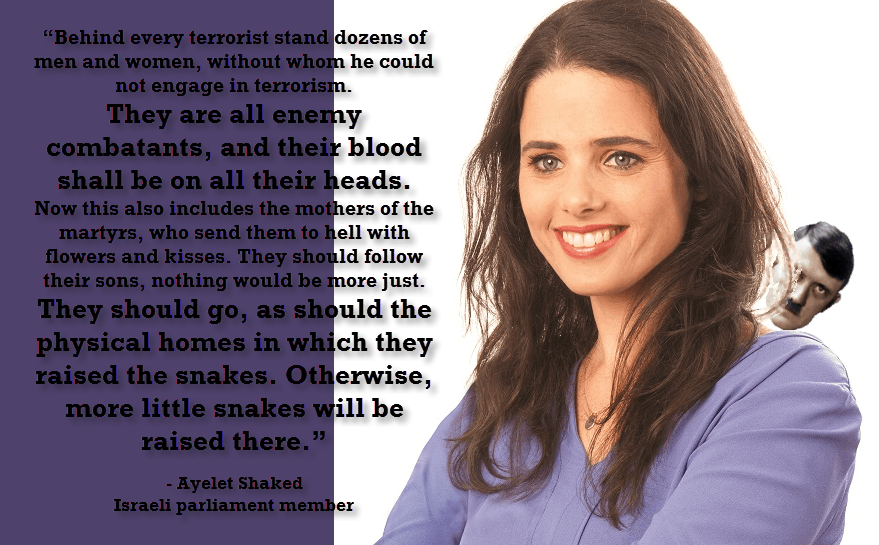
I Love Israel’s New Justice Minister

I’d love to marry a woman like this!

* “Don’t talk. Let’s do action.” (Ayelet Shaked)

* “If you get into emotions, then it disturbs your work. Sometimes you focus on what’s less important and not the main thing.” (Ayelet Shaked)

* “The fact that sometimes you think differently than others, but you still need to insist on your views, although you are being accused.” (Ayalet Shaked)

1002

Posted in Israel | Comments Off on I Love Israel’s New Justice Minister