
Ferguson Effect Detractors Are Wrong

Heather Mac Donald writes:

Violent crime in many American cities began rising in the second half of 2014, after two decades of decline. The Major Cities Chiefs Association convened an emergency session in August 2015 to discuss the double-digit surge in violence besetting its member police departments. Homicides at that point were up 76% in Milwaukee, 60% in St. Louis, and 56% in Baltimore, compared to the same period in 2014; the average homicide increase among 35 cities surveyed by the Association was 19%. “Crime is the worst I’ve ever seen it,” said St. Louis Alderman Joe Vacarro in May. July 2015 was the bloodiest month in Baltimore since 1972, with 45 people killed in 30 days. Arrests, summons, and pedestrian stops had dropped in many cities, where data on such police activity were available.

The violence surge continued into fall. Homicides in Baltimore reached their highest per capita rate in the city’s history. In October, Attorney General Loretta Lynch brought together over one hundred police chiefs, mayors, and federal prosecutors in another emergency meeting to strategize over the rising homicide rates. FBI Director James Comey noted in an October speech that “Most of America’s 50 largest cities have seen an increase in homicides and shootings this year, and many of them have seen a huge increase.”

The media confirmed the experience of law enforcement officials. In September, the data blog FiveThirtyEight found a 16% increase in homicide in the 60 largest cities so far that year. The Washington Post found a nearly 17% increase in homicides in 2015 in the 50 top cities, the largest one-year increase since 1993. (Had homicides dropped 17% in one year, mayors and police chiefs across the country would have been popping champagne corks.) The Brennan Center for Justice estimated a nearly 15% increase in homicides in 25 of the 30 largest cities in 2015. This year, many cities are still struggling with crime increases: the number of homicides in Chicago through March 11, for example, had nearly doubled from the same period in 2015, notwithstanding that homicides had already increased nearly 13% in all of 2015. Homicides in Los Angeles were up nearly 28% through March 9 and violent crime up 13%.

I first noted the rising violence in a Wall Street Journal op-ed in May 2015. And having spoken with police officers across the country, I posited a reason for it: officers were backing off of proactive policing in reaction to the hostility they were encountering in urban areas. Officers had told me about being surrounded by angry, jeering crowds who cursed and threw water bottles and rocks at them when they tried to make an arrest. Suspects and bystanders stuck cell phones in officers’ faces and refused to comply with lawful orders. Officers were continuing to answer 911 calls with alacrity, but in that large area of discretionary policing—getting out of a squad car at 1 a.m., for example, to question someone who appears to have a gun or may be casing a target—many officers were deciding to simply drive on by rather than risk a volatile, potentially career-ending confrontation that they were under no obligation to instigate.

I dubbed this latest outbreak of depolicing and the resulting emboldening of criminals the “Ferguson effect,” picking up on a term first used by St. Louis police chief Sam Dotson. The police shooting of Michael Brown in Ferguson, Mo., in August 2014 had triggered riots, die-ins, and cop assassinations. It gave rise to the angry Black Lives Matter protest movement, which asserts that racist (insert “white” whenever circumstances allow) cops are engaged in a killing spree against unarmed black men. Activists and academics denounced pedestrian stops and public order policing (otherwise known as Broken Windows policing) as racially biased and oppressive. As a result, officers were doing a lot less of such discretionary enforcement. Arrests in St. Louis city and county, for example, dropped a third after the Brown shooting; misdemeanor drug arrests in Baltimore dropped a third through November 2015.

The relationship between depolicing and crime was hardly a novel discovery; a 2005 University of Washington study of depolicing in Cincinnati following the anti-cop riots of 2001 had found a drop in arrests and a surge in crime in the city’s black areas. And I was hardly the only person to hear from police officers about their reluctance to engage in proactive enforcement. FBI director Comey reported that cops in one big city precinct “described being surrounded by young people with mobile phone cameras held high, taunting them the moment they get out of their cars.” The cops told Comey: “’We feel like we’re under siege and we don’t feel much like getting out of our cars.’” In November 2015, the acting head of the Drug Enforcement Administration, Chuck Rosenberg, said his own conversations with police officials had persuaded him that cops were worried about becoming the “next viral video,” because even if they did everything right, they could “still end up on the evening news.”

Despite the ample evidence of officers pulling back from discretionary enforcement, my May op-ed unleashed considerable opposition. The American Society of Criminologists sent out an unprecedented alert to its members in June 2015, asking them to try to disprove the Ferguson effect. The ASC helpfully provided sample rebuttals of my op-ed prepared by The Sentencing Project, an anti-incarceration advocacy group. The ASC worried that my article would somehow impede the push for federal “sentencing reform.”

Criminologists David Pyrooz of the University of Colorado Boulder, Scott Wolfe of the University of South Carolina, and Scott Decker of Arizona State University were among those who responded to the op-ed, publishing a complex econometric analysis of the Ferguson effect. They later defended their analysis on this site against criticism by me and others. Pyrooz and his co-authors modelled monthly rates of change in crime rates in 81 of the 105 largest cities in the country in the twelve months before and after Ferguson. Though the rate of change in violent crime increased ten times after Ferguson, that tenfold increase was not enough to be deemed statistically significant, they say. The authors concluded that “there is no systematic evidence of a Ferguson Effect on aggregate crime rates throughout the large U.S. cities . . . in this study.”

But that 81-city average masked important changes in the nation’s crime picture. Before Ferguson, individual cities’ crime rates were largely moving downwards together; after Ferguson, crime trajectories were all over the map. Crime in some cities was still down; in others, it was way up. Variance in homicide rates increased nearly six times. And the cities with the highest homicide surges were exactly what the Ferguson effect would predict: cities with large black populations, smaller white populations, and already high rates of violent crime.

Recall that the Black Lives Matter movement has sent out a relentless message that cops are the biggest threat facing young black men today. It directs a non-stop flow of racially-tinged animus at the police profession. A typical march that I observed this Fall on Fifth Ave. in New York City featured “Fuck the Police” and “Racism Is the Disease, Revolution Is the Cure” T-shirts, “Stop Police Terror” signs, and “Hey Hey, Ho Ho, Racist Cops Have Got to Go” chants. Such rhetoric has influenced street behavior. During Black Lives Matter demonstrations in Ferguson, Mo., in August 2015, 18-year-old Tyrone Harris opened fire at police officers, and was shot in response. A crowd pelted the cops with frozen water bottles and rocks, wounding three officers, while destroying three police cars and damaging businesses. “We’re ready for what? We’re ready for war,” some protesters chanted. In Cincinnati, a small riot broke out in late July 2015 when the police arrived at a drive-by shooting scene, where a 4-year-old girl had been shot in the head and critically injured. Bystanders loudly cursed at officers who had started arresting suspects at the scene on outstanding warrants.

A recent poll of New York City officers found that active resistance to arrest had increased over the last two years. “There’s a total lack of respect out there for the police,” a female sergeant in New York told me last year, echoing cops across the country. It is in predominantly black neighborhoods where police worry that a videoed use of force will land them on TV in the role of racist cop of the week and where officers tell each other: “‘If you get out of your car, you’re crazy, unless there’s a radio call,’” in the words of a cop in the Los Angeles Police Department’s Newton Division.

In short, it is in high-crime black neighborhoods where the police are backing off the most under the relentless charge that they are racist. And it is in high-crime neighborhoods where a fall-off in proactive policing is going to produce the biggest negative impact. It is in those neighborhoods where informal social controls — above all families — have most broken down and where policing most critically takes up the slack. The per capita rate of shootings, for example, is 81 times higher in predominantly black Brownsville, Brooklyn, than in nearby Bay Ridge. Not surprisingly, the per capita rate of pedestrian stops is also higher in Brownsville than in Bay Ridge—15 times higher—because every shooting will call forth a police response geared to interrupting retaliatory gunfire. There is less public order policing to begin with in low-crime areas, because there is less disorder, but even if police have become equally gun-shy about discretionary enforcement in low-crime areas, the consequences would be less.

The Pyrooz study confirms the relationship between depolicing and an increase in violent crime. Not only have homicides spiked in predominantly black cities, but robberies — the quintessential urban street crime — registered what even the authors deem a statistically significant increase in all 81 cities. Pyrooz and his colleagues struggle mightily against their own findings, however. They attribute the sharp post-Ferguson rise in homicides in predominantly black cities not to depolicing but to the fact that such cities were somehow “primed” for a homicide increase. This is a circular, pseudo-explanation. How do we know that those cities were “primed” for a post-Ferguson crime increase? Because they had such a post-Ferguson crime increase. And why did they have a crime increase? Because they were “primed” for it. They offer a strange analogy to explain their ad hoc “priming” hypothesis: It’s like a “stock portfolio,” they say, “where some holdings increase even in a down market.” But the post-Ferguson crime increases were not random and unpredictable fluctuations among a diversified market basket of data points; they were predictable effects of a racially-driven depolicing phenomenon. If being a high-crime city “primes” that city for further crime increases, the authors need to explain why crime dropped in those same high-crime cities over the previous two decades. (Answer: because of the data-driven proactive policing revolution that started in New York City and spread nationwide.) And if it was obvious that the crime drop in black cities was about to reverse itself—by coincidence at exactly the moment when the Black Lives Matter movement kicked into high gear — the authors might have alerted us to that reversal ahead of time.

The authors claim that their study refutes my Ferguson effect hypothesis because the title of my original Wall Street Journal op-ed was: “The New Nationwide Crime Wave.” Since the post-Ferguson crime increases were not uniform across all 81 of their modelled cities, the title of the op-ed was wrong, they say, and therefore the Ferguson effect hypothesis was also wrong. I did not write the title of my op-ed, consistent with the usual practice, nor did I see it before publication. But in any case, nothing in that first op-ed or in its several follow-ups implied that crime needed to go up uniformly in every American city for there to be a Black Lives Matter-generated pull-back from proactive enforcement and a resulting effect on crime.

Pyrooz, Wolfe, and Decker repeatedly put themselves on the side of “science” against some presumed group of science-deniers. But their analysis of the motivations of people concerned about depolicing is anything but “scientific,” consisting merely of a dizzying set of non sequiturs and ungrounded speculation.

The trio alleges that their critics “want a Ferguson effect to exist” (emphasis in original) and that those critics somehow want a Ferguson effect to exist because they “believe that police are not professional enough, not trained well enough, and too hesitant under pressure to withstand the new reality that their actions can be caught on camera.” Such a belief, they say, is the true “anti-cop” position, compared to the “pro-cop” belief that “a vast majority of officers are well-trained professionals who can withstand pressure from public scrutiny.” The trio then asserts: “If one accepts this premise, we would certainly not expect large groups of officers to de-police and cause higher crime rates in our communities.”

As an initial matter, it is impossible to tell here and elsewhere whether they are arguing that depolicing is not going on, or that it should have no effect on crime rates, or that depolicing would cause higher crime rates but officers are too professional to cut back on discretionary enforcement. In any case, it is an empirical matter whether it is going on or not, regardless of whether acknowledging it is “pro-cop” or “anti-cop.”

Pyrooz, Wolfe, and Decker need to get out there and talk to some officers. “Public scrutiny,” as they call it, is not the problem impeding urban policing today; the problem is hatred, aggression, and sometimes violent resistance to arrest. A police officer in Los Angeles tells me: “Several years ago I could use a reasonable and justified amount of force and not be cursed and jeered at. Now our officers are getting surrounded every time they put handcuffs on someone. The spirit and the rhetoric of this flawed movement is causing more confrontations with police and closing the door on the gains in communication we had made before it began.” Cops are human. It is wholly unrealistic to think that the relentless propaganda campaign against them, accompanied by a volatile, hostile street environment, is not going to lead many to hesitate before initiating encounters that politicians and the press have labelled as racist and that they are under no mandate to undertake.

Moreover, policing is political. The outrage among Black Lives Matter allies at the mere suggestion that the police may be backing off of proactive enforcement is the strangest aspect of this whole episode. A decline in pedestrian stops and Broken Windows policing is exactly what the activists have been demanding. Now they’re getting it. Isn’t that how political pressure is supposed to work?

The authors suggest that “we should spend more time worrying about the legitimacy crisis rather than a Ferguson effect on crime.” But it is the falsehoods about a police reign of terror spread by the Black Lives Matter movement that has brought on that “legitimacy crisis.” Since Wolfe, Decker, and Pyrooz pride themselves on their fealty to “science,” perhaps they could “scientifically” analyse police shootings in the context of crime. They would discover that police shootings of blacks are lower than what black violent crime rates would predict. Police shootings constitute a much lower share of black homicide deaths than of white and Hispanic homicide deaths. And police officers are two and a half times more likely to be fatally shot by a black man than a black man is to be fatally shot by a cop.

The three criminologists’ final argument against the Ferguson effect is the least “scientific” of all. They accuse their critics of “threatening people with the prospect that violent crime will increase if they protest police behaviours,” and of thereby implying that “the police should not be accountable for their behaviour.” No one is “threatening people with the prospect” of a violent crime increase; the violent crime increase was well underway before anyone noticed it and hypothesized a reason. It is a question of fact whether violent crime is rising in urban areas, regardless of any untoward implications the authors think such a fact would have for the Black Lives Matter movement. And no one is saying that “the police should not be accountable for their behaviour.” What analysts such as myself are saying is that the current frenzy of cop hatred is affecting proactive policing. If that effect somehow delegitimates the Black Lives Matter movement in the eyes of Pyrooz and his colleagues, so be it. “Science” is silent on such a matter.


Heather Mac Donald is the Thomas W. Smith fellow at the Manhattan Institute and the author of the forthcoming The War on Cops.
Posted in Crime | Comments Off on Ferguson Effect Detractors Are Wrong

The West, In the Conservatory, With A Shotgun In Its Mouth

The Journal of American Greatness:

How many times since 9/11 has some pundit—some of them very learned and experienced—asserted “Here, finally, is the wakeup call that will change everything”? The calls keep coming and no one ever wakes up.

Why not? The reasons are legion. For the moment, let’s try to understand just one. Decades of self-hating propaganda have been not merely internalized but in a very real sense have replaced religion as a source of unquestionable faith. There are many sources for this self-hatred. Probably the most significant is what Peter Brimelow calls “Hitler’s Revenge.” The West emerged from World War II less with a triumphant sense of its own victory (a sizeable portion of the conflict was after all intra-Western and one of the victors was non-Western, over a Western power) than with a tremendous sense of guilt. One part of the West had perpetrated the Holocaust while another came to feel that it could have stopped it but didn’t.

In his memorable preface to Natural Right and History, Leo Strauss writes of the Allied victory and subsequent German intellectual victory that “It would not be first time that a nation defeated on the battlefield, and as it were, annihilated as a political being, has deprived its conquerors of the most sublime fruit of victory by imposing on them the yoke of its own thought.” (The other times Strauss has in mind, we speculate, would include the Romans and the Greeks, the Romans and the Jews, and the rest of Europe and Revolutionary France.)

No doubt German nihilism is a contributor to our present malaise. We wish to focus here on another, not unrelated, German import.

The left, in the aggregate and within its various subdivisions, has perfected the art of projecting its own internal conflicts outward. This has the double benefit (for them) of avoiding civil war while enhancing in-group cohesion by focusing hostile energy on an external enemy. As Steve Sailer has put it, whatever wounds the left inflicts on itself or on the rest of us are “the fault of the traditional white male power structure and people in Peoria better feel guilty about it, even if they are not exactly sure what they did.”

Something similar resulted from World War II. David Goldman has written than Angela Merkel’s insistence on welcoming millions more “refugees” even after her initial hospitality has proved a disaster to her country, coupled with her fellow Germans’ unwillingness to stop her, amounts to a German death wish. Germany wishes to die because it thinks it deserves to die.

Why do we wish to die? Slavery, of course. Jim Crow. The Indians. Japanese internment. Colonialism. There is no shortage of reasons, and the rest of the West shares in all of them or at least in something like some of them. We are all guilty and so we feel in some subconscious way that we deserve to die. It’s surely odd that nations which liberated Nazi camps feel particular guilt about the Holocaust. But as noted, the hectoring that we could have done more and didn’t has taken its toll and now we feel that we are only a few rungs below the Germans on the guilt ladder. Besides, from the 30,000 foot level, it’s the West itself that’s guilty; intra-Western apportionment of degrees of guilt is a trivial detail.

Posted in America | Comments Off on The West, In the Conservatory, With A Shotgun In Its Mouth

Some people aren’t very spiritual

I was telling a friend about all the wonderful things God was doing in my life and he said, “Can you get sex with desirable women?”

Posted in Personal | Comments Off on Some people aren’t very spiritual

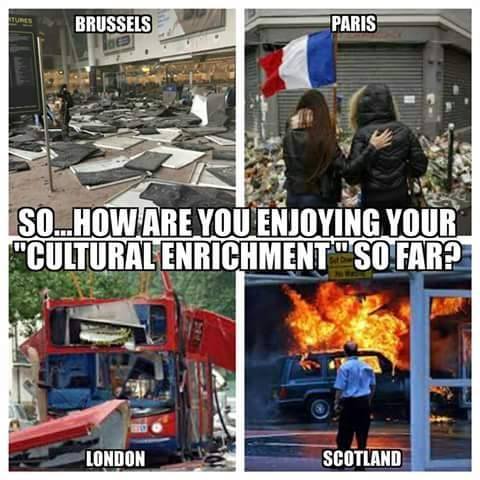
How Are You Enjoying The Vibrancy?

CeahxzNWEAAn1wT

Posted in Diversity | Comments Off on How Are You Enjoying The Vibrancy?

WP: Cruz: National Enquirer story is ‘garbage’ from ‘Donald Trump and his henchmen’

I think the Washington Post is the first MSM outlet to cover this story.

David Weigel writes: OSHKOSH, Wis. – Sen. Ted Cruz (R-Tex.) blamed “Donald Trump and his henchmen” for planting a National Enquirer story that accused him of extramarital affairs. Vehemently denying the story as “garbage” and “complete and utter lies,” the Republican presidential hopeful took his longest step yet toward refusing to back Trump if he won the party’s nomination…

On Friday, after a crowded rally at a parking cone factory here, and after attacking Trump from the stage for his tweets, Cruz himself brought up the Enquirer’s story that accused the senator of having had five mistresses – a subject some of the reporters covering him were loath to even raise. “It became clear as the campaign went on that Donald was a whole lot of sizzle without any substance,” said Cruz. “When he’s scared, when he’s losing, his first and natural resort is to go to sleaze and to go to slime.”

That was how Cruz introduced the subject of the Enquirer story, which alleged that the candidate had carried out affairs with five women – women who bloggers and political activists were starting to “identify” as prominent political pundits. The story had bubbled up on social media, with the hashtag #TedCruzSexScandal appearing in tweets that asked reporters to follow the story.

The Post has not been able to confirm any of the allegations made by the Enquirer…

hen Cruz opened the floor to questions, each was about the allegations. First, addressing the inevitable “pledge” to back Trump if he won, Cruz said that he didn’t “make a habit” of supporting people who smeared his family. Then a local reporter seemed to irritate Cruz by asking if both he and Trump were “childish” and degrading the tone of the campaign.

“Sir, let’s be clear,” said Cruz. “One person has been childish, and that’s been Donald Trump.”

“I’m watching it every day,” said the reporter. “Both of you are going back and forth with this childish stuff.”

“Sir, I understand that the media the game wants to play is when Donald attacks my family to say that everyone is guilty,” said Cruz. “I have never attacked Donald’s family. I do not intend to. Indeed, when Donald sent a second tweet attacking my wife, I responded by saying ‘Donald, real men don’t attack women. Your wife is lovely.’ So not only did I not attack his wife, I praised his wife. Heidi is the love of my life. I’m sorry, sir, if you believe that defending your wife and defending your family is childish. But it is not.”

Cruz tried to wrestle the subject back to Trump’s refusal to debate him, accusing him of “hiding in Trump Tower” instead of campaigning in Wisconsin. (Indeed, on March 29, Trump will make his first public appearance of any kind since his March 21 speech to the American-Israeli Public Affairs Committee.)

“He sits in Trump Tower and sends tweets late at night,” said Cruz. “We need a president who is fighting for the people of America and not battling his personal demons on Twitter.”

Cruz turned and left the news conference, ignoring a shouted question that seemed to say everything about what Trump had done to the campaign’s tone.

“Senator Cruz, have you been faithful to your wife?”

Posted in Donald Trump, Ted Cruz | Comments Off on WP: Cruz: National Enquirer story is ‘garbage’ from ‘Donald Trump and his henchmen’

For Purim, French Jew goes to synagogue dressed as jihadist

AFP: A 40-year-old Jewish man tempted fate by walking into a Paris synagogue dressed as a jihadist, carrying a fake rifle and shouting “Allahu Akbar”, a police source said Friday.

For the soldiers guarding the Habad Loubavitch synagogue in Vincennes in southeastern Paris it came as “a surprise”, was the deadpan verdict of the police source.

The incident happened on Thursday evening when members of the synagogue were celebrating the festival of Purim, during which followers often dress up in costumes and give each other presents.

The source said the man arrived wearing long North African robes, carrying a fake Kalashnikov and crying “Allahu akbar”, Arabic for “God is greatest”.

“It created a certain emotion among the soldiers,” the source said.

The initial shock passed quickly when members of the synagogue realised they knew the man, and that it was only a joke.

He was nonetheless ordered to present himself at his local police station on Friday.

Soldiers have been posted outside many Jewish buildings and other sensitive locations around France in the wake of deadly jihadist attacks last year.

Purim celebrates a story from Hebrew scripture in which the Jews of the Persian empire were rescued from annihilation. Every year, Jews celebrate by giving each other presents and wearing costumes.

Posted in Jews | Comments Off on For Purim, French Jew goes to synagogue dressed as jihadist

Who Runs This Town?

Comment: “You know who runs this town, don’t you?”
“The Jews?”
“The gay Jews!”

Gary Shandling’s interview with Ricky Gervais is something special. I think that after that they cancelled Ricky’s interview show.

* Shandling was a definite contender to succeed Johnny Carson at the Tonight show, having been a popular guest host during the Carson years, so he was hardly an exotic talent.

I don’t think Shandling had the durability of a Leno to do 5 shows per week for decades. So it was probably wise of him to go the weekly sitcom rather than daily talkshow route. As it was, Shandling seemed pretty worn out by his six years doing “Larry Sanders.”

Part of the high regard he was held in by the other pros was related to how it didn’t come easy for him.

* I come from a family full of good-looking people. One kid in our family started modeling at 5 years old. We used to marvel at the fact that we didn’t have any “clunkers.”

Then a couple of my cousins moved out of state, and married some really shitty looking men. They could marry anyone they wanted. They picked inbred-looking losers. Result was some depressingly ugly babies, who are growing into offensive looking children. We were hoping my cousin’s genes would overwhelm the ugly spouse’s genes, but no such luck! One of my cousins looked just like Liv Tyler, I still can’t believe her husbands genes overruled hers. But they did.

They keep posting pictures of their ugly dullard-looking children on Facebook, and it bums me out every time. I guess I’m just spoiled, but I despise looking at people’s ugly kids, and being expected to act as if they don’t repel me. I’m not exaggerating. These kids are fucking ugly. If you woke up in the middle of the night, and saw one of them standing at the foot of your bed, you’d hit the fucking ceiling.

Every time my cousins post yet another fucking Facebook photo of their genetic malapropisms, I want to say, “Nobody forced you to marry that ugly man, and now you have ugly kids, and you want me to pretend they’re NOT so you’re not constantly reminded of your stupid ass mistake!”

Anyway, there’s plenty of ugly kids around, and if you “can’t see it,” you’re neurotic.

Posted in Hollywood | Comments Off on Who Runs This Town?

Trump v Cruz

Comments:

* Trump’s reaction isn’t part of any strategy. It’s an alpha male gut reflex with the intention of smacking Cruz right back down into beta malehood. Trump is saying, ‘I have the supermodel wife and you don’t because I’m the higher quality male.’

* The thing about Cruz’ dear little wife, guys, is, she isn’t a dear little wife. She’s a traitorous architect of the North American Union. I’m stunned that anyone here who’s not an open borders cuck would be doing anything but cheering to see someone tear her a new one.

* As for Trump, he is right that Cruz’s wife is … problematic. As a big time Goldman Sachs VP she was Hillary! right down to the cattle futures to Cruz’s Bill Clinton. In other words, the very model of the modern power couple corruption. See Andrea Mitchell and Alan “Animal Spirits” Greenspan, or Julie Chen and Les Moonves, etc. The problem with power couples is that it makes graft and corruption so easy. No need to buy the Senator. Just buy his wife.

Melania Trump being mere arm candy and a trophy wife is a better deal for the American Aristocracy. Less covert, back-door corruption. It it is done, it will be done out in the open. Not by bribing the wife (see Michelle Obama as University of Chicago’s Medical Center “advisor” at $300K a year while Obama was a Senator — position abolished when he became President and she moved to DC).

As for the measure of each man, well men are judged by men and women alike on the quality of the woman they marry. Melania Trump is real life supermodel, so Trump has achieved Tom Brady levels of Alphadom. Cruz’s wife is … a Goldman Sachs VP and looks it. A junior Hillary. Which does not reflect well on the Alphadom of Cruz.

Plenty of supremely ugly men do very well with women: Rick Ocasek, Steven Tyler, Mick Jagger, and Tom Petty all come to mind. Fame, charisma, charm, and sheer talent that has people worshiping an ugly man on stage can do the trick nicely. Ted Cruz is none of that, and yes that matters. To both men and women who judge a man by the quality of the woman to whom he is married.

Posted in Donald Trump | Comments Off on Trump v Cruz

What Is Pol/Pos/Poz?

Comment: pol refers to 4chan.org/pol and 8ch.net/pol, the latter being more nazi than the former. As you would expect, pol has also come to refer to the people, ideas, and trolling activity common on those boards.

pos = piece of shit

poz = HIV positive, usually with an implication that 1) “I’m alright with that,” 2) “I’m sexually active anyway,” and 3) “I’m alright with *that*” By implication, it refers also to the cultural marxist ideology which caused AIDS and to those people who hold that cultural marxist ideology. It’s quite clever, actually, since cultural marxism is the AIDS of society. The latter, metaphorical, definition is the more common one by far in radical right discourse. This one, I believe, originates at mpcdot.com. Here is a thread where they discuss its meaning.

Posted in Alt Right | Comments Off on What Is Pol/Pos/Poz?

What If Diversity Is Our Weakness?

Rod Dreher writes: A reader left this comment on the “What’s The Matter With Utah?” thread. I think it’s really thought-provoking and challenging, but he posted it under his real name, and I’m worried that if I approve it, it will set him up to be attacked. Reader, if you are sure that you want me to approve it, let me know and I will. But I want to throw the comment out there for discussion, because the issues the reader brings up are real, and difficult:

The patterns displayed by Trump’s performance are ‘confusing’ only because they challenge core beliefs on both sides of the political spectrum about race and diversity. Conservatives are straining to deny the obvious because Trumps’s success confirms a long-denied narrative about the racial roots of the Southern realignment, as has been reiterated in at least a half-dozen op-eds a week. Occam’s Razor would suggest that the story, if a bit simplified, is the cleanest way to explain why an identity-politics candidate is performing well in the Old Confederacy states. Trump is winning in part because these are the same people who are losers in the global wage-arbitration realignment, to places like China, but that’s just one more factor that reinforces their central racialist schema for understanding the world.

But the Left is also reluctant to acknowledge one important element of that narrative: The Putnam hypothesis that racial polarization increases with social contact. This denial is a deeply pernicious epistemological flaw, grounded in an incorrect understanding of human nature. A central dogma of post-religious society is that provincialism and xenophobia are a product of ignorance, and that when people come into contact with one another, they inevitably become more tolerant. But this conviction is a consequence of statistical anomalies, and is not at all representative of broader human nature.

Left-leaning members of the media believe that precisely because it works so well for them. When they encounter minorities in the fields of law, journalism, or politics, those minorities are almost always the handful of successful exceptions to the broader trend of poverty, lack of education, and social malaise. If the only blacks (Hispanics, etc) you encounter are the ones who are disproportionately successful, then it reinforces your conviction in the irrationality of racism, and the necessary existence of deeply perverse moral defects in anyone who doesn’t assent to the “obvious truth” of diversity as a source of social cohesion and institutional success.

Outside those enclaves, it’s easier to see the consequences of building policy around those outliers. Skimming off the handful of successful minorities and concentrating them (whether through affirmative action or by legitimate personal success) into a handful of wealthy multi-ethnic enclaves is itself a reason why many black communities are deprived of the social capital and networking needed to escape poverty. But worse, it tends to create a world where the points of contact between poor whites and poor blacks are entirely negative, and reinforce negative stereotypes in a way that falls far closer to the concept of “rational racism” (in the classic “taxi driver who avoids certain neighborhoods” sense) than the Leftist-orthodox rainbows-and-unicorns celebration of personal experiences as a remedy for bigotry. (This doctrine has only been reinforced by the outcome of the SSM debate, where the communities where homosexuals can comfortably be “out” are the ones where you’d expect to find lots of economically successful and charismatic public figures, in fields like sports and entertainment.)

I live in a poor part of town, about 50% black, 30% Hispanic, and 20% white. All my neighbors are black, and relatively poor. The house next to mine has three junker cars in the back yard, slowly rusting. At night (including last night!), I often hear gunshots and screaming fights between belligerent family members who use all manner of violent-sounding profanity to describe what they’d like to do to one another. God save the fatherless kids in the middle of those fights. Last month a repo-man came to our door asking about the working hours of our neighbor, in an attempt to intercept her; we told him that, so far as we can tell, she is unemployed and lives off benefits. Her children occasionally drop by with grandkids to avail themselves of free babysitting while they smoke pot. The kids seem nice enough, sometimes, but I won’t let my girls go over to play for fear of their parents’ drugs, booze, and guns. It’s hard to sleep, between the gunshots and the foundation-shaking ‘music’ that cars charitably broadcast to the neighborhood. Last fall one of the peach trees I’d been carefully tending was ripped up when a criminal fleeing the police was chased through my yard, eventually being tackled and cuffed on the back of my car after everyone in my house woke up to bullhorn-loud demands to “drop your weapon.”

To me, the existence of a Trump who loses Utah makes perfect sense. It’s hard to sustain anti-racism in the face of a world of social pathology that makes so many parts of the racist narrative feel so deeply rational and appealing. As a lower-elementary kid, I don’t remember ever comprehending the idea of racial prejudice when I attended a private school where there were three black kids, all of them from the families of wealthy politicians. They were so talented, and friendly, and, aside from skin color, so much like us! But when I transferred into the public school system in middle school, and I had to listen to sexually violent “suck my dick, bitch!” rap lyrics on the school bus every day, suddenly I didn’t like black kids nearly as much as I did before. I still said all the right things in public about racial tolerance, but they felt more than a little fake. The black kids were mean. They swore. They fought. They made fun of me. They talked about hurting other people with guns and knives, and it was scary. Despite what my parents said, I felt that the value of being in a “more integrated” public school was all a sham — and having a Trump-esque figure in my circle of friends willing to admit that sham in public would have felt liberating. It was making me vastly less tolerant and open-minded than the unnaturally white private school I had attended before.

Two years later, I started listening to a lot of Rush Limbaugh, and the guy really made sense to me.

I’m aware that tendency cuts both ways. I’m sure there are things that my black neighbors dislike about my house and family — My dog barks too much! I have messy-looking vegetable gardens in the front yard! I’m a dorky-looking nebbish on a bicycle! — and I’m sure they have to work to avoid letting that personal frustration evolve into some broader critique of “white people” in general. All the same socio-economic self-sortings that make working-class white racism feel justified against blacks (or Hispanics) are increasingly likely to cut the other way, as white working-class communities dissolve into meth addiction and out-of-wedlock births and are perceived as dysfunctional by “minorities” that are (in the case of Hispanics particularly) passing them by. Most of the best maintained houses in my neighborhood are owned by Mexicans with a talent for working in construction, and I’m sure they hate living next to poor white trash families in homes with rotting frames without the resources to escape to the exurbs, and who are trapped here pulling down their property values.

But what liberal wants to go up on live TV and admit the obvious truth, that segregation and demographic homogeneity are a powerful force for racial harmony, the best antidote for Trumpian racial resentment, and the easiest way to create the kind of social cohesion that allows us to have a generous Scandinavian welfare state? What conservative wants to tell successful blacks in the position of a Ben Carson or a Clarence Thomas that they should have maintained their identity in poor black neighborhoods, full of selfish (or even well-meaning) friends and relatives who will try to drag them back down into poverty? Which StopTrump secularist organization wants to publicly advocate the sort of strong religiously-motivated homogeneity of Mormon choirs, as an alternative to the “celebrating our diversity” whitewashing of cultural suicide by an African-American artistic community that went from Jazz at Carnegie Hall to the bitches-and-hos hip-hop that blares from every window-rattling car that drives past my front yard?

If Trump is defeated by normal mechanisms, then states like Utah will deserve much of the credit — and that means that the voluntary racial segregation that arose through Mormon migration and discrimination (until recently, by explicit doctrine!) will deserve part of that credit. But no one will dare to say that out loud.

The “Putnam hypothesis” the reader refers to is the research that Harvard political scientist Robert Putnam undertook that … well, read the 2007 Boston Globe piece about it. Excerpt:

It has become increasingly popular to speak of racial and ethnic diversity as a civic strength. From multicultural festivals to pronouncements from political leaders, the message is the same: our differences make us stronger.

But a massive new study, based on detailed interviews of nearly 30,000 people across America, has concluded just the opposite. Harvard political scientist Robert Putnam — famous for “Bowling Alone,” his 2000 book on declining civic engagement — has found that the greater the diversity in a community, the fewer people vote and the less they volunteer, the less they give to charity and work on community projects. In the most diverse communities, neighbors trust one another about half as much as they do in the most homogenous settings. The study, the largest ever on civic engagement in America, found that virtually all measures of civic health are lower in more diverse settings.

“The extent of the effect is shocking,” says Scott Page, a University of Michigan political scientist.

The study comes at a time when the future of the American melting pot is the focus of intense political debate, from immigration to race-based admissions to schools, and it poses challenges to advocates on all sides of the issues. The study is already being cited by some conservatives as proof of the harm large-scale immigration causes to the nation’s social fabric. But with demographic trends already pushing the nation inexorably toward greater diversity, the real question may yet lie ahead: how to handle the unsettling social changes that Putnam’s research predicts.

“We can’t ignore the findings,” says Ali Noorani, executive director of the Massachusetts Immigrant and Refugee Advocacy Coalition. “The big question we have to ask ourselves is, what do we do about it; what are the next steps?”

The study is part of a fascinating new portrait of diversity emerging from recent scholarship. Diversity, it shows, makes us uncomfortable — but discomfort, it turns out, isn’t always a bad thing. Unease with differences helps explain why teams of engineers from different cultures may be ideally suited to solve a vexing problem. Culture clashes can produce a dynamic give-and-take, generating a solution that may have eluded a group of people with more similar backgrounds and approaches. At the same time, though, Putnam’s work adds to a growing body of research indicating that more diverse populations seem to extend themselves less on behalf of collective needs and goals.

His findings on the downsides of diversity have also posed a challenge for Putnam, a liberal academic whose own values put him squarely in the pro-diversity camp. Suddenly finding himself the bearer of bad news, Putnam has struggled with how to present his work. He gathered the initial raw data in 2000 and issued a press release the following year outlining the results. He then spent several years testing other possible explanations.

When he finally published a detailed scholarly analysis in June in the journal Scandinavian Political Studies, he faced criticism for straying from data into advocacy. His paper argues strongly that the negative effects of diversity can be remedied, and says history suggests that ethnic diversity may eventually fade as a sharp line of social demarcation.

“Having aligned himself with the central planners intent on sustaining such social engineering, Putnam concludes the facts with a stern pep talk,” wrote conservative commentator Ilana Mercer, in a recent Orange County Register op-ed titled “Greater diversity equals more misery.”

Whole thing here.

COMMENTS:

* I’m not sure what to make of the writer’s laments. I live in a middle to upper middle class community that is ethnically & cultural diverse; my next door neighbor is Russian/Ukrainian, the family across the street is Latino, down the block there is an African American/Filipino family, a gay couple, a couple of Indian families and so on. There are plenty of churches in town including a couple of mega Evangelical churches that are massive, a large Mormon temple and Sikh temple to name a few. So not a strictly secular, MTD crowd. As of 2012 the political breakdown was roughly 55% GOP & 45% Dem. We also have a Sun City with lots of well to do seniors and other senior communities that aren’t quite as affluent. So we really are quite diverse excepting income. And I think educational attainment & income are the determining factors to a civil and functioning community. Generally people who are well educated/technically skilled and make a comfortable living are more likely to be accepting of diversity. Lack of education and poor/non existent career opportunities are the problem, not race, religion,etc. The writer speaks of ” white trash” with dilapidated homes which reinforces my point – economic insecurity is the root of the issue. That is what needs urgent addressing.

* It is worth noting that the “Nation of Immigrants” was a Nation of segregated neighborhoods and clubs in the height of its “Immigrantiness” in the late 19th century and early 20th century.

There were severe immigration restrictions put in place in the mid-1920’s which ultimately led to significant assimilation with respect to White ethnics anyway. Forty years later, we passed comprehensive civil rights legislation and opened the borders, and we are now in a new era of “immigrantiness”, for better or worse.

As far as segregation, it is very fine to get on the high horse, but America remains as segregated as it ever was in the 1950’s. We just segregate by Zip Code instead of neighborhood like we did in the old days. You can look to the Burger Court if you want to know why. It makes no sense to claim that we are “integrated” today in contrast to some mythic past when we were “segregated”.

Jim Crow in the South, with respect to public accommodations, voting rights, vigilante violence, went well beyond segregation. However, there was plenty of segregation in terms of neighborhoods and private clubs outside of the South, which relatively speaking, may have been more benign. Further, those patterns have mostly continued, with some territorial adjustments.

There is a change in the elite, we have a multi-racial, multi-ethnic elite that is selected primarily on the basis of IQ, and homogenized by a process of common liberal education/indoctrination, and these elites share degrees from fancy colleges. But this is in fact a dream world, take the cream from everyone and homogenize them and they can get along to some extent. It is precisely those elements that are not the “cream” that create the lion share of social and political problems.

* Diversity may provide intellectual cross-pollination when it occurs among the educated and tolerant but it doesn’t work among people who don’t operate at the intellectual level and have little in common socially. The economic and cultural elites have prescribed “diversity” for the common man perhaps thinking that since it works for engineers, doctors and lawyers, it will work just as well for hip-hoppers and their bitch/ho culture, or Hispanic gang-bangers, or poor ignorant whites. But it obviously doesn’t work well; of course, the elites miss this fact because they do not put themselves or their families in a “diverse” environment of ignorant, impoverished, perhaps violent people.

When their cherished objective of diversity fails, the intellectuals and economic elites must find an explanation. It cannot be that enforced diversity is a bad idea. It cannot be that the socially and economically powerless resent being forced to live among those they dislike or fear. It cannot be that, rather than judging people by the color of their skin, people are judging others by the content of their character. No, it can only be that those who resist diversity are “racists” who have not yet been sufficiently exposed to diversity to appreciate its wonders.

But there is another explanation that is simpler, and truer: it is called “human nature”; humans don’t particularly like other humans, and all the kings horses and all the kings men will not make them like or accept people they don’t like or want to accept. People tend to prefer to live among those they consider their own kind. They do not welcome interactions with people who have values or exhibit behaviors of which they disapprove. In every heterogeneous society in the world, people self-segregate—unless prevented from doing so by government fiat. Thus we have the unremarkable phenomenon that successful blacks don’t move back to the “hood” to pull their fellow blacks out of ignorance and poverty; they just don’t want to be around people of that caliber.

* It’s interesting that Chesterton recognized that living in a homogeneous community separated from other races and cultures tends to increase tolerance and goodwill toward them. Consider what he wrote in the introduction to What I Saw in America: “I have never managed to lose my old conviction that travel narrows the mind. At least a man must make a double effort of moral humility and imaginative energy to prevent it from narrowing his mind. Indeed there is something touching and even tragic about the thought of the thoughtless tourist, who might have stayed at home loving Laplanders, embracing Chinamen, and clasping Patagonians to his heart in Hampstead or Surbiton, but for his blind and suicidal impulse to go and see what they looked like.”

When I first read that as a teenager, I found it somewhat shocking, but the more I observe the world, the more I realize that in this, as in much else, Chesterton knew what he was talking about. Putnam didn’t uncover anything people didn’t recognize a century ago; but even having a vast body of pitiless data to demonstrate the fact won’t crack the ideological convictions of the “diversity is our strength!” crowd.

So it is only natural that Utah finds Trump’s anti-immigrant rhetoric unappealing precisely because it is among the least racially and religiously-diverse parts of the country – it is easy to love immigrants when almost none of them live near you. Sweden is a perfect example of this. They were one of the most harmonious and ethnically-homogeneous nations in the world, and so had no hesitation to share their success by throwing open their doors to vast numbers of refugees and economic migrants from the Balkans, Africa and Asia. And now, after a few years of this, the Sweden Democrats, a hard Right ethno-nationalist party is leading the polls there. The introduction of large numbers of foreigners of different races and religions has turned a large portion of what was famously the most open and tolerant society in the world into anti-immigrant nationalists in an astonishingly short amount of time. Those who have eyes, ought to see.

The social engineers must be stopped before they wreck the very foundations of functional, pluralistic democracy pursuing their flawed ideals. They must come to understand, whatever they would like to be true, that in many cases diversity narrows the mind.

* It is hard to imagine how anybody can seriously believe that Balkanization (which is what “Diversity” should properly be called) is anything other than an invitation to disaster.

Only highly educated ivory-tower intellectuals can be dumb enough to believe that in the first place.

Human beings are naturally tribal, and most people do best and are happiest & most productive when they are in the company of others who are similar (but not necessarily identical) to themselves.

When you try to force dissimilar peoples into close contact, the best you can hope for is simmering resentment. And, sooner or later, (per Enoch Powell) you are likely to have “rivers of blood in the streets.”

And those who call themselves “Libertarians” should keep firmly in mind that it is absolutely impossible for a country to be both a “diverse, multicultural utopia” and a limited-government constitutional republic. (Obviously, the advocates & beneficiaries of Big Government regard that as a feature rather than a bug.)

Once you get Balkanized, the only thing that can keep the lid on is an iron-fisted central government. And if you don’t believe that, just look at what happened between the Turks & the Armenians when the Ottoman Empire collapsed; look at what happened in India & Pakistan when the British Empire collapsed; or look at what happened in Yugoslavia when the Soviet Empire collapsed.

“Diversity” is a curse. (And it really has nothing to do with whether some of the peoples are “good” and others are “bad.” Just the fact that they are different is enough.)

* The uncomfortable truth is that the Greek polis was a very ethnically homogeneous creation, and was able to govern itself, even with direct democracy, because of a broadly shared agreement on the good.

In contrast, the Imperial Nation, be it Byzantium or Macedonian or Russia (for example), is generally autocratic and there is some form of universalist religion (like Christianity or Islam) that is imposed on the majority, and religious minorities are at best entitled to second class status, if not persecutions. The Imperial Nation comes to exist by both pushing out certain other ethnic groups, as well as assimilating other ethnics.

For example, America pushed out the Native populations, but brought in European immigrants from beyond the British Islands to people the “virgin” continent. The Romans ethnically cleansed the Gauls to the North, but mixed with other tribes in the South of Italy. People love the “universalist” side of ethnogenesis, but it always comes with a dark side for those who are deemed incapable of assimilation (like the Cherokee People in the American Southeast or the Pied Noir in Algeria).

The problem is from the national standpoint, Nation States always want to expand their hegemony, meaning empire. At the same time, if you look domestically, people are much too humane to have a stomach for empire, and the birth rates are too low to have a surplus population that people are willing to send off in search of foreign conquest. America’s elites wants an Empire, but the American population is incapable of it.

Second, we are doing this global thing, and there are these global transfers of populations, but there isn’t anything like real ethnogenesis going on in America or Europe, and if it was, it would be viewed as a problem, not a solution. [I am trying to use non-judgmental language here.] So you have this weak, decaying sense of traditional identity being replaced by shopping and internet porn, and you are bringing in these people with totally different world views, customs and values, and you expect them to abandon their way of life and become shallow airheads. Good luck, empire on the cheap is pretty dicey.

There could be a populist push for a more Republican government, but it would be informed by anti-globalism and anti-immigration, an attempt to revive some portion of America’s historic traditions and an attempt to homogenize the existing population here in terms of a shared national culture. But good luck, the elites want war, the military industrial complex wants weapons, the multinationals want “access to markets” (e.g. gunboat diplomacy), Hollywood wants to market consumer identities and lifestyles to your children, and at the end of the day, who calls the shots in this country? Not Pat Buchanan.

* Diversity simply makes us care less for those around us, and focus more on the micro-level of ourselves and our immediate family and friends. It does this across racial lines, really. There are racists out there, for certain, but for most people the impact of diversity is a very watered down sense of community and communal interest, and a reinvigorated sense of self/personal-family over all else. This really is quintessential to our current culture. When you add in the exceptional emphasis on autonomous individualism, it just amplifies the effect, as both aspects increase the overall impact to create a breathtakingly anonymous, autonomous culture.

* Traits of human nature are inherently amoral, and can be employed in moral or immoral ends (depending on the given moral framework).

Take sex. We want to do it as part of our human nature. Without it, we wouldn’t be here. Sex can manifest itself positively — loving relations between faithful spouses who share in the joys and burdens of child-rearing — or negatively — rape and so forth.

Tribalism — which is basically a broader version of affinity for one’s close kinfolk; race, as Steve Sailer says, is just a partially inbred large extended family — is itself morally neutral, and evolutionarily adaptive. You hear tribalism and basically your mind Godwins, and that is certainly a possibility with tribalism, but tribalism is also why people have community, civilization, in the first place.

* The liberal policy of forced busing destroyed basically every city in the Northern US from the 1960’s to the 1980’s. It put white kids in situations where the family would have to move to get out of the schools where they would be beaten up all the time. I was there to see the end of it. But, this massive devastation has never been acknowledged, except to occasionally blame it on that racist Emmanual Goldstein.

Lenders lowered standards for mortgages before 2008 and this was justified on anti-racism grounds: since racism prevented lending in the past, morally we have to get rid of all standards, which are potentially racist. Every other aspect of the 2008 collapse can be looked at except the use of anti-racism to justify lowering lending standards.

Diversity/anti-racism is the foundation of our new unacknowledged official state religion. As such it can not be questioned no matter what the consequences.

Posted in Diversity | Comments Off on What If Diversity Is Our Weakness?