
- https://PayPal.Me/lukeisback
"Luke Ford reports all of the 'juicy' quotes, and has been doing it for years." (Marc B. Shapiro)
"This guy knows all the gossip, the ins and outs, the lashon hara of the Orthodox world. He’s an [expert] in... all the inner workings of the Orthodox world." (Rabbi Aaron Rakeffet-Rothkoff) LATEST POSTS:
- What is a ‘Received Idea’?
- Jordan Bardella: The Manufacture of Normality
- Everyone Became Television: Bourdieu’s Warning and the 2026 Iran War
- Marine Le Pen
- The Coalition-Proximity Rule
- Nigel Farage
- Bernard Haykel: A Life Between the Text and the Gun
- Walker Connor (1926-2017)
- Benedict Anderson and the Nation as Imagination
- Anthony D. Smith: The Student Who Kept the Question and Rejected the Answer
- Ernest Gellner
- Eric Kaufmann: The Man Who Made the Majority Visible
- Dominic Cummings: A Biography
- Steve Lopez: The Last City Columnist
- California Historian Kevin Starr
- Stephen Kotkin: A Life in Power
- William T. Vollmann: An American Life in Excess
- Rod Dreher: A Life in Exile
- The Cross at Sinjar: Tom Holland’s Dominion
- Rick Warren: A Biography
BEST POSTS:
- * The Enlightenment Wasn’t Enlightened (6-23-26)
* Mr. Burge Draws The Line (6-23-26)
* 'Improving on Democracy' (6-17-26)
* People Leak To People Who Are Fun (6-11-26)
* Why Does Australia Produce So Many Great Journalists? (6-11-26)
* Steve Wynn and the Press: Power, Litigation, and the Contest Over Las Vegas (6-3-26)
* Sheldon Adelson and the Journalists (6-3-26)
* The Vigilant Animal: Thinkers Who Reject the Myth of Human Gullibility (6-2-26)
* The Cost of Refusing the Misunderstanding Myth (6-2-26)
* Show Me How It Travels (6-2-26)
* The Norm Explainers (6-2-26)
* Centering Marginalized Voices (6-1-26)
* What would it look like if the Washington Post put its reader first? (6-1-26)
* What would it look like if the Financial Times put its reader first? (6-1-26)
* What It Would Mean for the Los Angeles Times to Put the Reader First? (6-1-26)
* What It Would Mean for The New York Times to Put the Reader First? (6-1-26)
* Why Wembanyama Lives on the Perimeter (5-31-26)
* The Emotional Palettes Of San Diego, Los Angeles, San Francisco & Sacramento (5-27-26)
* The Administrative Capital: Sacramento Legal Culture (5-27-26)
* San Diego - The Quiet Republic (5-27-26)
* The Quiet Bar: San Diego Legal Culture (5-27-26)
* SF v LA Legal Culture (5-27-26)
* Why Talent Travels Poorly Between San Francisco and Los Angeles (5-27-26)
* San Francisco and Los Angeles as Rival Models of Urban Access (5-27-26)
* Social Cliques in New York, 2026 (5-25-26)
* Social Cliques in San Francisco, 2026 (5-25-26)
* The Rival Courts of Washington (5-25-26)
* The City of Private Rooms (5-25-26)
The Rise And Rise Of Kerry Packer: Uncut
Here are some highlights from this 2007 book by Paul Barry:
* Clyde was an intellectual who liked to talk about books. People in Santa Barbara, where he lived, did not talk about books, said one close friend; they did not even have them in their houses.
* [Kerry] seemed, for all his wealth and power, to be a desperately lonely and unhappy man. He liked people around him all the time, and was always ready to sit up and talk till the small hours if he could find someone prepared to listen. In one such late-night conversation with Philip Adams, they got round to the subject of astronomy and black holes. Adams explained what they were and Packer said, ‘That’s what I have: a black hole inside me.’
To keep boredom and loneliness at bay, he needed constant excitement.
* Nowadays the TV networks will tell you that international cricket is ideal for commercial television. It has bright colours, gladiatorial action, Australian nationalism, thumping the Poms and sixty seconds of advertisements at the end of every four-minute over. Best of all it is extremely profitable, because it is tremendously cheap to broadcast and rates better than almost anything on the dial.
The Growth, Scope, and Spatial Distribution of People With Felony Records in the United States, 1948–2010
* Western and Pettit have shown that incarceration has become a routine life event for low-skilled black men—more common than serving in the military or earning a college degree (Pettit and Western 2004; Western 2006). The cumulative risk of imprisonment for black men ages 20–34 without a high school diploma stands at 68 % compared with
21 % of black men with a high school diploma and 28 % for white men without a high school diploma.
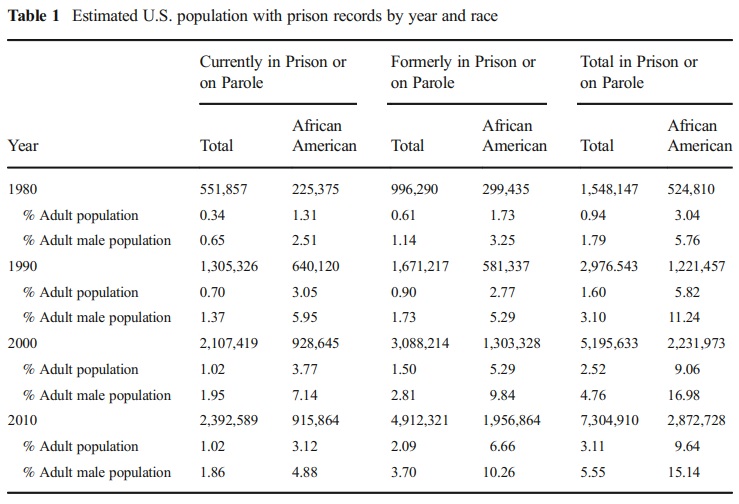
* In 1980, nearly 6 % of the adult male African American population had been to prison at some point (total prison/parole) compared with just less than 2 % of all adult men. By 2010, 15 % of African American adult males had spent time in prison versus 5.6 % of all adult males.
* These estimates are generally comparable with those obtained by other researchers applying different demographic techniques. Bonczar (2003) estimated that in 2001, 3 % of adults, 5 % of adult males, and 17 % of African American adult males had been to prison. Pettit and Western (2004) found that black men born between 1945 and 1949 had an 11 % chance of imprisonment, relative to a 21 % for the cohort of black men born between 1965 and 1969. These figures are generally congruent with our overall estimate that 15 % of black men had experienced imprisonment by 2010.
* California leads the nation with about 12 % of African American adults having a prison record.
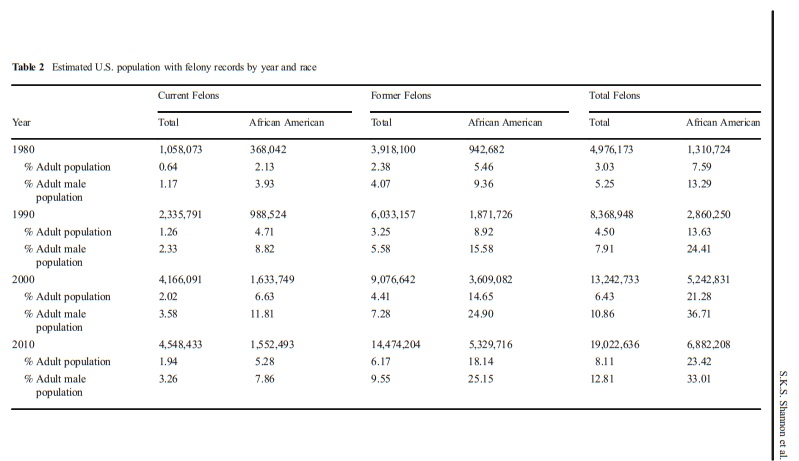
* In California and Indiana, we estimate that at least one in four of all adult African Americans had a felony conviction history. Although it may seem implausible that more than 20 % of the African American adult population has a felony conviction history in such states, recall that at least 5 % of the African American population was currently under felony supervision in these states in 2010.
* Nationwide, approximately 8 % of all adults had a felony conviction as of 2010, but approximately 23 % of African American adults shared the same distinction. A staggering 33 % of African American adult males had a felony conviction by 2010.
Posted in Crime
Comments Off on The Growth, Scope, and Spatial Distribution of People With Felony Records in the United States, 1948–2010
Islam and Religious Studies Post-9/11
Aaron W. Hughes writes in his book Theorizing Islam:
“When one permits those whom one studies to define the terms in which they will be understood, suspends one’s interest in the temporal and the contingent, or fails to distinguish between “truths,” “truth-claims,” and “regimes of truth,” one has ceased to function as a historian or scholar. In that moment, a variety of roles are available: some perfectly respectable (amanuensis, collector, friend and advocate), and some less appealing (cheerleader, voyeur, retailer of import goods). None, however, should be confused with scholarship.” (Lincoln 1996: 227)
For much of the past forty years, scholars of religion have largely tended to look upon their departmental colleagues who specialize in Islamic data with some degree of bewilderment and bemusement. Their sparse numbers (often one scholar of Islam per department) and their highly technical philological training in other fields (e.g., Near Eastern, Middle Eastern, or Islamic studies) have often generated a set of methodological and theoretical interests perceived to be far removed from the academic study of religion. This has, at least historically, resulted in a rather tenuous and complicated relationship between the study of Islam and religious studies.1
All of this, however, radically changed in the aftermath of September 11, 2001. Islam’s involvement in the attacks of that day (whether this was real or perceived is certainly not the issue here) suddenly thrust this religion into the spotlight. Revealing that our larger field is truly at the mercy of global events and directly proportionate to where our troops are, scholars of Islam—or Islamicists, as they are often called—suddenly became a highly sought-after commodity. Hundreds of jobs opened up, students flocked to courses, programs were created, and Islamicists have increasingly become important players within the American Academy of Religion (AAR),2 North America’s largest organization devoted to the academic study of religion.3
…the academic study of Islam has become more, not less, insular and apologetic. It is within this latter context that scholars of Islam have presented themselves to their colleagues, to the media, and to the general public as the de facto interpreters
of Islam. They have largely invoked their authority to elevate their particular and idiosyncratic interpretation of Islam (e.g., liberal and egalitarian) over others and, in the process, deemed their version to be somehow more authentic and normative. On one level, given the anger and hostility directed toward Islam and Muslims this is certainly understandable. In this respect, many Islamicists have tried to correct the blatant and often hostile misrepresentations that frequently circulate in both the media and public opinion. However, on another level, problems inevitably arise when, to correct such misrepresentations, the only Islam that is presented as normative is the one that they have largely constructed in their own image.
The declaration of any Islamic social or identity formation as the authentic one risks overlooking or marginalizing the complex processes whereby competing Islams—or interpretations of Islam— interact with and confront one another. Unfortunately, in much of the work that I examine in the following pages this interaction and confrontation is forsaken. Instead, we encounter a liberal Islam, one whose message is largely defined by tolerance, “gender justice,” and a universal respect for human rights. While I certainly do not doubt that there are Muslims and versions of Islam to which these virtues can properly be ascribed, it is highly problematic to use these as the sole criteria whereby an authentic Islam is constructed.
The essays in this volume seek to redress such oversights and apologetics. Taken as a whole, they examine how scholars of Islam working in departments of religious studies manufacture such an Islam, the rhetorical devices they employ, and the often hidden ideological assumptions behind such devices. Within this context, this book’s thesis is simple enough: The academic study of Islam as carried out in departments of religious studies has become so apologetic that it has largely ceased to function as an academic discipline, preferring instead to propagate a theological and apologetical representation of the religion. This discourse, which I call “Islamic Religious Studies,” is largely theological in orientation, manipulative in its use of sources, and distortive in its conclusions. My goal is to study the study of Islam, with an eye to improving or reforming it. In so doing, I take my cue from Jonathan Z. Smith, who contends that it is part of our job as scholars to “expose the set of tacit understandings which inform, but are rarely the objects of, our corporate discourse about religion” (1990: 5).
* Employing the term “Islamic Religious Studies” has a number of advantages. First, as mentioned, it is a convenient term that permits me to refer to a particular set of discourses that are largely uninterested in (or, even better, hostile toward) critical scholarship. Second, and again as mentioned, it enables a neat differentiation between those who engage in such apologetic discourses and those who do not (e.g., Islamic Religious Studies vis-à-vis Islamic Studies).
* The scholars of Islam to whom I refer are largely associated with the Study of Islam section of the AAR. These individuals have created a collective response to the events of 9/11—a response that is described on their website (http://groups.colgate.
edu/aarislam/response.htm) as the product of “the cooperation of over 50 professors of Islamic Studies and Middle Eastern Studies from the US and Canada. These scholars are members of the Study of Islam section at the American Academy of Religion, the largest
international organization responsible for the academic study of religion.” They write that as
“scholars of religious traditions, we observe that religious symbols are used for political motives all over the world in Hindu, Christian, Jewish, and Muslim traditions. However, we must critically distinguish between politically motivated deployment of religious symbols and the highest ideals that these traditions embody. Just as most would regard bombers of abortion clinics to be outside the pale of Christianity, so the actions of these terrorists should not be accepted as representing Islam in any way.”
(http://groups.colgate.edu/aarislam/response.htm)
This statement says much about what these scholars imagine “real” Islam to be: peaceful, non-political, internal. For them, Muslims who commit terror in the name of Islam misunderstand their own tradition and are motivated by political, as opposed to spiritual, gain. It is these “over 50 scholars” (and those like them)—and the graduate students they have trained in the meantime and whom they continue to train—who are responsible for producing this response and are whom I have in mind when I talk about the largely “apologetical” discourses that pass for academic scholarship. It is these scholars, I maintain, who have created a set of discourses associated with what we can now conveniently delimit with the rubric “Islamic Religious Studies.”
* “At present, the study of Muhammad, the founder of the Muslim community, is obviously caught in a dilemma. On the one hand, it is not possible to write a historical biography of the Prophet without being accused of using the sources uncritically, while on the other hand, when using the sources critically, it is simply not possible to write such a biography. (Motzki 2000: xiv)”
* The social and political upheavals associated with the rapid spread of Islam fatally compromise the earliest sources, according to many scholars who work in this period. These sources were written so long after the fact and with such distinct ideological or political agendas that they provide us with very little that is reliable or with which to reconstruct the period that they purport to describe.
* “In reading Muslim literature—both contemporary and classical—one can see that the evidence for the primacy of spiritual jihad is negligible. Today it is certain that no Muslim, writing in a non-Western language (such as Arabic, Persian, Urdu), would ever make claims that jihad is primarily nonviolent or has been superseded by the spiritual jihad. Such claims are made solely by Western scholars, primarily those who study Sufism and/or work in interfaith dialogue, and by Muslim apologists who are trying to present Islam in the most innocuous manner possible. (2005: 165–6)”
* In the Introduction to his In the Footsteps of the Prophet: Lessons from the Life of Muhammad (2007), [Tariq] Ramadan writes that:
“Our aim is more to get to know the Prophet himself than to learn about his personality or the events in his life. What is sought is immersion, sympathy, and essentially love … This is indeed the primary ambition of this work: making of the Messenger’s life a mirror through which readers facing the challenges of our time can explore their hearts and minds and achieve an understanding of questions of being and meaning as well as broader ethical and social concerns.” (xi)
For Ramadan, the main hermeneutic with which to understand Muhammad and his life is love. Let me put this in perspective. I know of no other discipline that would allow a “scholar” from the University of Oxford, publishing an “academic” monograph with Oxford University Press, to make such claims. Could a serious scholar of Christian origins in the year 2011 get away with saying in an academic monograph published by, say, Cambridge University Press that the main way to understand Jesus and the early Jesus movement was through love?
* In the concluding chapter of In the Footsteps of the Prophet, Ramadan summarizes Muhammad for his readers:
“He was beloved by God and an example among humans. He prayed, he contemplated. He loved, he gave. He served, he transformed. The Prophet was the light that leads to Light, and in learning from his life, believers return to the Source of Life and find His light, His warmth, and His love. The messenger may have left the human world, but he has taught us never to forget Him, the Supreme Refuge, the Witness, the Most Near. Bearing witness that there is no god but God is, in effect, stepping toward deep and authentic freedom; recognizing Muhammad as the Messenger is essentially learning to love him in his absence and to love Him in His presence. Loving and learning to love: God, the Prophet, the creation, and humankind.” (216)
As touching and moving as such a passage may be, it does not reflect the historical record.
* The goal of academic works is not to proselytize. Moreover, from an academic perspective we cannot assume that all Muslims think and believe the same thing about Muhammad. How do we understand different constructions of Muhammad? What historical, political, ideological, and cultural forces contribute to such constructions? Unfortunately, none of these authors are interested in entertaining such mundane concerns. Their interest, on the contrary, is to create a rarefied and spiritualist reading of Muhammad that fits with their own understanding of Islam.
Some Muslims create peace in the name of Muhammad and others kill in his name. Is one the right understanding of Muhammad, the most “authentic”?
* The books under discussion here maintain the guise of scholarship. Professors of religious studies at reputable universities (e.g., University of North Carolina-Chapel Hill, Oxford) write them; excellent university presses (e.g., Oxford University Press) publish them; their authors’ academic bona fides are printed prominently on the book jackets and within (e.g., “When I was a student at Harvard …”); and they “blurb” each others’ work on their back covers. These self-styled experts speak from positions of authority derived from their institutional frameworks…
* Despite the fact that the books described in the previous chapter claim, like Omid Safi, to present a Muhammad who “is authentic, real, and recognizable” (2009: 32), they reveal more about the authors themselves than they do about a seventh-century prophet. The end result is that we read about what Muhammad means to the lives of Muslim university professors of Islamic Religious Studies who teach in secular western universities. This is a Muhammad who, like them, is liberal, tolerant, egalitarian and, as such, the perfect symbol of the Muslim in the modern world. In presenting later accounts as if they were contemporaneous, these books gloss over the textual and chronological difficulties that face the scholar of early Islam. Invocations of ambiguous terms such as “memory” or “footsteps” mean that these authors largely eschew any of the problems that face scholars who actually work in this period, whose work they would prefer to remain, as Ernst claims, “safely buried in obscure academic journals” (2003: 97). Those interested in such problems can be written off as Islamophobic (“How dare they engage in source criticism that threatens to undermine Islam’s mythic origins”) at worse or as arcane at best.
* many Muslims and scholars of Islamic Religious Studies regard a skeptical and historical account of Muhammad as invasive, whereas skeptics believe that an account of Muhammad’s life that simply portrays him as the later sources do is biased and subjective. The goal of this chapter is to try to strike a balance between these two perspectives. That is, it seeks to show how Muhammad functions as a trope in Muslim belief and practice, while at the same time speaking to the biographical and textual problems of reconstructing the historical Muhammad. The Muhammad of history and the Muhammad of faith, at least from a
non-theological perspective, are certainly not easily reconciled.
* We possess very little textual or other evidence that dates to the period in question. Since Muhammad is generally considered to be the most important person in Islam, we possess ream upon ream of material about his life and times. However, virtually all of this material comes from a later period that retroactively seeks to project onto the character of Muhammad later virtues and messages.
* After a brief and critical discussion of the various sources that claim to provide us with evidence of Muhammad’s life… The goal is not to take these sources at face value, but to explore some of the potential reasons behind their construction. For whom were they produced? Why? What functions did they serve?
* Although the Qur’an certainly provides us with a glimpse at the changing historical circumstances that Muhammad faced as an individual, it presents us with very few specifics. Moreover, there is considerable debate as to the dating of its final recension. As for the biographies of Muhammad, they present other problems: they were written roughly 150 to 200 hundred years after his death. They are often highly stylized and, unlike historical biographers of the modern period, their authors were not interested in writing accounts firmly embedded in the historical record.
* the biographical literature about Muhammad is the work not of historians or even biographical historians, but of creative storytellers or myth-makers…
* medieval and even some modern European critics of Islam would claim that Muhammad had epilepsy and that the Qur’an is actually a product of this illness.
* It seems that the pool of available converts to Muhammad’s movement in the early period was largely composed of Arab-Christians and Arab-Jews.
* Much like the emergence of the cosmic Christ from the historical Jesus, the historical and supra-historical aspects of Muhammad’s personality eventually become fused and indistinguishable. This Muhammad now became the perfect prophet and lawgiver, the bravest general, the best military tactician, the most liberal thinker, and so on.
* Because his personality is intimately connected to the Qur’an, the creation of a cosmic Muhammad makes perfect sense. This
Muhammad had to be described as living a life of sinlessness (`isma), lest his message somehow be contaminated. Yet, although this cosmic Muhammad may make perfect sense from a religious point of view, the end result of its formation is that it is probably impossible to uncover the historical Muhammad.
* What both critics and apologists share, of course, is the desire to create a Muhammad who functions as a placeholder for their ideas of what Islam is or should be.
* hadiths may well tell us about later Muslims and what was important to them, but become problematic when it comes to telling us about a historical Muhammad.
* [John Esposito’s] assessment is so distortive and apologetic that it borders on the ridiculous. His distinction between Islam (= timeless and preaching a message of gender equality) and culture (= responsible for putting a temporal patriarchal veneer on the religion) is problematic, as is his selective use of quotations from Muslim “feminists,” who reify his distinction with claims that, for example, “both sexes are equal when it comes to performing their religious duties and in terms of rewards and punishments”…
By focusing solely on the “religious” teachings of the tradition, Esposito overlooks the reality “on the ground.” Certain texts have good things to say about gender egalitarianism, so he gravitates toward them, labeling them as “authentic” and making them the essence of the tradition. Meanwhile all those texts that do not support his claims are either completely ignored or written off as marginal or as “inauthentic.” That Muslim women are mistreated—for example, when they are attacked in the street for not veiling in Algeria or when schools for girls are destroyed in Afghanistan—is of no consequence to him and his whitewashed version of Islam because such actions have nothing to do with what he constructs as the “real” Islam…
It seems to me that Esposito can make such claims because, as he sees it, the main goal of the academic study of religion is neither nuance nor engagement in philological study, but to present often highly essentialized data (“Muslims believe …”; “Islam is …”) to policy-makers and fellow citizens… Like many humanists, Esposito makes claims to relevance in an academic climate that is increasingly defined by its shrinking financial and administrative support. In religious studies this often means invoking the mantra that, because many of the conflicts of the contemporary world have a “religious” patina, professional religionists are uniquely poised to interpret the world.1 While there can be no doubt that certain actors invoke religion to legitimate certain actions and behaviors, our goal should not be to adjudicate between “authentic” and “inauthentic” invocations, which is often done, but to reveal the manifold political, cultural and ideological contexts of such invocations.
For example, I do not doubt that Muhammad Atta, the ringleader of the 9/11 attacks, thought that he was a pious Muslim. And, again, I have no doubt that both his will and the final set of instructions found in his luggage at Logan airport in Boston were saturated with Qur’anic and other legal categories and terms derived from the later Islamic tradition. This is the obvious point. What is of interest is the overlapping contexts that led him to fly a plane into the World Trade Center. How did he come to understand Islam in the manner that he did? How were the various discourses created (I do not want to say “distorted” because this would imply that they have only one, pure, and noble meaning) by him and the larger Islamist movement of which he was but a part. What social forces led to this understanding of Islam? What are the historical sources of such interpretation? How do these social and historical forces combine with political, ideological, and economic ones? Esposito, however, is not interested in any of these features because his intent is to show that Atta is not a “real” Muslim.
* whenever we make our work accessible to a general public, including policymakers, it comes at a real cost. The general public wants sound bites that are predicated on a set of essentialisms (e.g., Muslims do …; Muslims believe …; Muslims act …) that should make scholars uncomfortable.
* Islamic studies scholars who want to take their role as scholars seriously are caught between numerous subcultures. These include, but are not necessarily limited to: a) orthodox Muslim students who reject the scholarly approach and who want only positive things said about Islam; b) public discourse leaders who favor an essentialized version of Islam as under siege from within by perversions of its pure, progressive and peaceful nature, and who want the academy to back them up; c) bona fide Islamophobes who cannot think of anything “fair and balanced” or positive to say about Islam and who feel any positive claims must be anti-Semitic, anti-western, illiberal or all of these; d) students and colleagues who think all religions are basically good, and the same at heart; e) policy-makers who want to use a particular portrait of Islam, or Arabs, to justify one political decision or another.
* I certainly do not want to claim that John Esposito is undeserving of becoming President of the AAR. In fact, given the emphases of the AAR—e.g., on ecumenicism, on crypto-theologizing, on essentialism, and on the application of liberal Protestant categories to the world’s religions—he is a perfect choice to represent the Academy’s diverse constituency.
* I would contend that (1) the highly critical and ideologically motivated attacks against Islam in the media and other outlets cannot be answered by an “expert” account that is equally ideological, but from the opposite end of the spectrum. Where theirs is critical, his is apologetical. The result is further distortion because Esposito sweeps under the hermeneutical carpet all of the real issues that a general reading public wants to know about. The treatment of women, for example, becomes in his hands not a “religious” phenomenon, but a “cultural” one (e.g., 2003: 87). As for (2), Esposito creates a double standard of his own because he treats Islam—for example, his bold claim that he can tell us what Muslims really believe—in the way that no self-respecting
scholar (not theologian) of Christianity or Judaism would treat their datasets.
* In The Future of Islam, which he refers to as “the culmination of my work on Islam and Muslim politics” (2010: 4), Esposito is at his apologetical best. In the Introduction, for example, he recycles numerous clichés, such as Islam is a religion of peace:
“Why do Muslims emphasize that Islam is a religion of peace? The very word “Islam” means “peace and submission to God.” Just as Jews use the greeting Shalom (peace), and Christians greet each other with the sign of peace, Muslims say Assalam wa alaykum (peace be upon you) whenever they meet someone or say good-bye.”(38)
There are numerous problems with this. First, and quite simply, those who want to equate Islam with a “religion of peace” are apologists. No religion is a religion of peace for the very simple reason that religions pack under their large canopies numerous voices, from the peaceful to the militant. To reiterate, no self-respecting scholar of Judaism or Christianity would make the claim that either of these two religions are “religions of peace.” Second, Islam means “submission” (i.e., to the will of God); it most decidedly does not mean peace. Third, how does this square with the suggestion that Jews or Christians use the
term “shalom” as a greeting? I know very many Jews (from secular to ultra-Orthodox) and none of them uses the phrase; I also know Christians and, as far as I am aware, have never been greeted with the “sign of peace.”
* Esposito goes to great lengths, including the performance of ingenious hermeneutical backflips, to defend Muslims. Of the infamous Danish cartoons, for example, he writes that For Muslims, “opposition to the cartoons was a matter of respect for their Prophet and their religion. They see the cartoons as Islamophobic and racist, intended to humiliate rather than extend the same respect that Christians and Jews enjoy.” (2010: 27)
Christianity and Judaism can be and are “humiliated” on a daily basis in the media, on the internet, and in art galleries in “western” society (whatever this term may mean). However, and this is a key point, most Christians and Jews can get over it and they do not go on rampages throughout the “Christian” or “Jewish” worlds. Instead of apologizing for Muslims, as Esposito does, it might be more productive to claim that in the future of Islam (which is, after all, the title of his book), Muslims have to get used to the fact that Islam might also be criticized and that, in a liberal democracy with freedom of speech and freedom of the press, this is the way it is and must be.
* After one finishes reading Esposito’s work, one sees a peaceful and peace-loving Islam that has no room for those who hate or kill in its name. The reason one sees this is because Esposito has effectively sugar-coated the tradition and ingeniously removed all such individuals or groups from the pale of the tradition.
* “Women’s status in Islam is unmatched by any other system,” [preacher Amir Khaled] says, “but we Muslims have ignored these rights for too long.”
* Catholicism does not condone pedophilia, yet the Church’s authoritative and administrative structures create the space in which such crimes can occur. Does this mean that Catholicism is a religion of pedophilia? Certainly not. However, to try and completely separate the pedophilia of some priests from the Church is to ignore the latter’s authority that can create certain conditions that make it possible.
What bothers me in all of this, and the impetus behind this chapter, is that John Esposito is generally considered to be one of the major interpreters of Islam in the West. He advises government officials, is part of think tanks and NGOs, and lectures throughout the world. His neatly packaged essentialisms seem to be precisely what everyone wants to hear. “Religion” as a category is never queried or nuanced; religion, as real and quantifiable, is something whose main role is to do good in the world; is something internal or spiritual; and, as such, can never be co-opted by the forces of evil.
* We know virtually nothing about the earliest centuries of Islam because all of the materials that claim to provide knowledge of this period come from much later sources.
* How can we honestly teach our students or the general public about Islam if we peddle half-truths or simply repeat a set of slogans until we have convinced ourselves that they are true? We largely fail, both as scholars and as educators, if we create an object of study solely in our own image or in the image of what we desire that object to be. This is a form of wish fulfillment, not scholarship, and it paradoxically both results in and flows from shoddy methodological frameworks and unchecked assumptions..
Because Islam, like any religion, does not exist naturally in the world, our understanding of this tradition, in all its manifoldness and synchronic and diachronic complexity, is contingent upon the lenses we cut and through which we look. These prisms are not value neutral, but coincide with the formation of a set of terms, categories,
and rhetorical tropes. All prisms distort and it is up to us to employ those with the least amount of refraction. And the only way this can happen is to be constantly vigilant as to what we are doing and why we are doing it.
* Words are certainly not disinterested or innocent, and it is often the case that larger concepts ride, unchecked, on their backs. Many of the words employed in Islamic Religious Studies, from the most obvious ones such as “Islam” or “shari`a” are not value-neutral (as they are often presented), but sites of contestation around which various regimes of truth skirmish for control. Frequently we encounter, for example, terms such as “Islam” in the singular as opposed to the plural. Or, “Islam” is presented as existing as early as the time of Muhammad, but never the product of later generations who created the legal, exegetical, and ritual components that actively brought Islam (or, better, “Islams”) into existence.
* Terms that are fast becoming the hallmarks of Islamic Religious Studies—such as “gender justice,” “progressive Islam,” “democracy,” “transnationalism”—need, I urge, to be submitted to scrutiny. Where do such terms come from? When were they first employed and, concomitantly, what are their ideological genealogies? What sorts of intellectual work do such terms perform for those who employ them?
* “Although critical inquiry has become commonplace in other disciplines, it still offends many students of religion, who denounce it as ‘reductionism.’ This charge is meant to silence critique.”
* Thesis Number One. We must cease treating Islam, Muslims and Islamic data as if they were somehow special or privileged objects of study. “Reverence,” to quote from Lincoln’s fifth thesis, “is a religious, and not a scholarly virtue” (1996, 225–6).
* Thesis Number Two. It is time to identify all those approaches that masquerade as critical scholarship for what they are.
* Thesis Number Three. We cannot make claims about the tradition that are false or distorted because we believe that this is what others want to hear about the tradition.
* Thesis Number Four. Scholars of Islam must not bring the interfaith work they do in their private lives into the classroom.
* Thesis Number Five. We can be critical of Islam and Islamic identity formations without somehow undermining Islam, or being accused of having an “ax to grind,” or being a neo-conservative.
Thesis Number Six. Islams and the Muslim sources that produce them are our data, not our faith commitments.
Thesis Number Seven. We must ask of Islamic data what we would of any data.
Thesis Number Eight. As a social formation, Islam—like any such formation—is not a stable entity defined by readily ascertainable or accessible boundaries that effortlessly moves throughout history.
Thesis Number Nine. Islamic studies must appeal to the theoretical frameworks of other disciplines.
Thesis Number Ten. Finally, Islamic studies must integrate itself with those critical discourses within the academic study of religion that are non-phenomenological.
Posted in Aaron W. Hughes, Islam
Comments Off on Islam and Religious Studies Post-9/11
When Bad Scholarship Is Just Bad Scholarship: A Response to Omid Safi
I’ve never been called a racist before. Yet, if Omid Safi’s undocumented musings about the current state of Islamic Studies is to be believed, I am one of several non-Muslims who have the nerve to attack and critique “the prominence of Muslim scholars in the Study of Islam Section” of the AAR. It’s funny, but I never thought of myself as critiquing Muslims, only bad scholarship.
I could respond in so many ways. Who says I’m not a Muslim? Who cares? That he can classify me with Richard “Martin” and David “Freidenreich,” two scholars for whom I have a lot of respect, I guess implies, by innuendo, that “Hughes” is not a Muslim name. If I told him that my grandfather’s name was “Nejdi,” that he was a Lebanese Shi`i, that he was responsible for the construction of the first mosque in Canada (the masjid al-Rashid in Edmonton, Alberta)—would this make any difference to him? Apparently not. Safi has already lumped me into the category “Islamophobe” because my work is “grossly polemical.” According to his reading, I am an enemy of Islamic Studies because I insist on issues that transcend particularistic and apologetical concerns.
I have criticized Safi in print. His soft and historically inaccurate portrayal of Muhammad in Memories of Muhammad is woeful. But, and here I differ from him, I believe in giving evidence as to why bad scholarship is bad scholarship. I list, seriatim, why his argument is weak. It is based on a misreading of the sources, of wanting to find solid ground when all we possess is quicksand, of engaging in hermeneutical legerdemain. I counter his utopic vision with a dystopian universe. And I do so, moreover, with fact and with argumentation, not with insinuation. I don’t care whether he is a Muslim, a Christian, a Jew, a Buddhist, or a member of the Seneca First Nation. I care about scholarship. I do so because, as a scholar, my first commitment is to uncovering truth. Not to apologetics; not to wishful thinking. Perhaps this is what he is upset about.
If scholarship is to be scholarship, as opposed to identity politics, it must take ideas seriously, and not engage in a “with us or against us” mentality. I am glad, pace Safi, that there are more Muslims (men and women) in the field of Islamic Studies. I also wish that there were more Muslims in Buddhist Studies, in Jewish Studies, and in Christian Studies.
Perhaps Safi is upset because I occupy a Chair in Jewish Studies? We all know that Jews are the arch-enemy of Islam. Perhaps this is also why he is so critical of David Freidenreich, who also occupies such a position. Freidenreich’s award winning scholarship is bizarrely referred to as “outdated” by Safi. I won’t speak for Freidenreich, but, I can probably guarantee Safi that my thinking of Jewish-Palestinian issues far transcends his wildest “liberal” (read: illiberal) dreams. But this is not the point, unless, of course, people like Safi want to make it the point. Please tell us, Omid, what is your point? Are you upset that Muslim scholars must face questions? Are we simply to accept what those with names such as “Safi,” “Rahman,” and “Moosa” say because, well, they have those names?
So, Mr. Safi, if you want to engage my critique of the field, may I suggest you do what the Western tradition of scholarly discourse demands and respond to my ideas in print as opposed to engaging in innuendo and identity politics. If you do so, I will, to be certain, learn from your critique and format my previous positions accordingly. I will respond to you, and perhaps a conversation will ensue. What I will not do is pejoratively call you a “Muslim.” I presume that this is what you want me to do. But I am not Fox News. I am not a Neo-Con who thinks Islam is a danger to national or any other kind of security. Detailed and documented scholarship is the way scholarship works. You should know better than to introduce identity politics where none previously existed. If this is all you can rely on then you have no sense of the field, only opinion and pseudo-science.
To write someone off, paternalistically, as engaging in “friendly concern” (as you do Richard Martin), or, critically, as “inaccurately outdated” (as you do David Freidenreich) or as “grossly polemical and simplistic” (as you do me) without a shred of argument is, simply stated, irresponsible. You have created a line. On this side are insiders; on that side, outsiders. I fell vindicated because I have been writing from some years now that this would be one possible future of Islamic Studies. I see that I was correct, but trust me I don’t gloat about it.
Mr. Safi, you have introduced race, religion, and ethnicity into this debate when none has previously been mentioned. I guess this is the way you argue. You end citing the work of, among others, “scholars like Sherman Jackson, Amina Wadud, Jonathan Brown, Kecia Ali, Ingrid Mattson.” Many, though certainly not all, of these individuals engage in special pleading. Is this the future of Islamic Studies for you?
Are we simply to agree with you because of your last name?
Sometimes, Mr. Safi, bad scholarship is just bad scholarship.
Your musings, as impressionistic as they are based on identity politics, are all that is wrong with Islamic Studies (at least in Religious Studies) at the present moment. It also shows how far Islamic Studies must travel to engage with non-apologetical Humanities scholarship.
Posted in Aaron W. Hughes, Islam
Comments Off on When Bad Scholarship Is Just Bad Scholarship: A Response to Omid Safi
Channeling Jewish History Interview with Dr. Marc Shapiro
Posted in Marc B. Shapiro
Comments Off on Channeling Jewish History Interview with Dr. Marc Shapiro
NYT: ‘tempers are rankled by sweltering temperatures’
Comment: “This is the Spike Lee theory of criminality, I believe. First mentioned in “Do the Right Thing,” then “Summer of Sam.” The heat made me do it, yes sah. I’m surprised the Times hasn’t gone full-bore with this and produced headlines like “heatwave results in 7 gun deaths across city.” The skreets have been shown to cause violence, why not ambient temperature?”
Posted in Crime
Comments Off on NYT: ‘tempers are rankled by sweltering temperatures’
JP: Brooklyn’s Anti-Gentrication Groups are Pushing Antisemitic Narratives and Activism
Today’s situation of riots, anarchy, and anti-Jewish violence, has a lot of parallels to the Crown Heights riots of ‘91, and one of them is this: Jews in middle and southern Brooklyn are under siege again. The government, the police, and to a large extent, the organized Jewish community supposedly here to defend us, are AWOL. And while some of these problems are national, the violence against the haredi community began before the riots.
As anti-Jewish and especially anti-Orthodox violence began rising in Crown Heights and elsewhere in Brooklyn, groups like the ADL declined to point a finger, and seemed to think teaching elementary kids slogans of tolerance was a sufficient answer to assuage the increased violence from adults. But our institutions appear to have never asked the question: Who has been agitating against us locally?
This was unfortunate, even irresponsible, as the violence does appear to be coming at least in part from a perceived turf battle over territory, with the Jews as the “colonizers” in that battle. And we can identify at least two organizations promoting that narrative that have enjoyed nothing but fawning media approval, from the NY Times to Buzzfeed, and zero resistance from the ADL or any other Jewish organization.
Two radical activist organizations that are particularly noteworthy in their aggressive stands against the Jewish community for the sake of “anti-gentrification” are Decolonize This Place and Equality for Flatbush.
Decolonize This Place, run by Amin Husain, describes itself as an, “Action-oriented movement: Indigenous struggle, Black liberation, free Palestine, workers, degentrification, dismantle patriarchy.”
Decolonize This Place posted an instagram of George Floyd wearing a Palestinian kefiah even though he was not Muslim, never mind Palestinian.
A strong ally of Decolonize This Place in degrentification efforts, Equality for Flatbush (E4F), has consistently taken credit for coordinating harassment of a “Karen” who organized to call the police on the endless industrial-grade fireworks, as denying working people sleep for months on end is seen as a legitimate and effective weapon against gentrification. Like Decolonize This Place, E4F believes a critical element to NYC real estate wars is based in…Palestine. As E4F says, “People Power Movement say from Kingsbridge, Bronx to #Palestine #gentrification is a crime”
Both are part of the “Brooklyn anti-gentrification network.”
What are these groups really doing by associating gentrification with the Arabs in the Israel-Arab conflict? They are identifying the enemy in their struggle. And it isn’t the IDF. What does Palestine have to do with gentrification?
Posted in Brooklyn
Comments Off on JP: Brooklyn’s Anti-Gentrication Groups are Pushing Antisemitic Narratives and Activism
Singo: The John Singleton Story
Here are some highlights from this 2010 book about the legendary Australian ad man:
* work is for working and grog is for getting pissed.
* Singleton enforcing a booze ban might seem like Dracula handing out bandaids but he has proved himself deadly serious through the years about maintaining a Spartan office routine.
* The tyranny of conformity that existed up to that point [late 1960s Australia] is almost impossible to convey to those who now reside in one of the world’s most permissive societies, where legalised brothels flourish and a Gay Mardi Gras beckons as an international tourist attraction. Back in the sixties, however, Aussies were still weighed down by regulations restricting every aspect of human conduct from sex to shopping. The nation’s censorship laws were the most prudish outside Roman Catholic Ireland. The long-ruling Federal Coalition—‘mooed’ into action by the dairy lobby—introduced legislation to prevent housewives switching from butter to margarine. In NSW the Labor Government, at the command of the trade unions, jailed corner-store owners for daring to serve customers on a Saturday afternoon.
* The Returned & Services League, for example, was forced to issue a statement hosing down an inflammatory declaration from its NSW president, Sir William Yeo. No, he did not necessarily speak for members in general when he referred to the British Commonwealth as ‘a polyglot lot of wogs, bogs, logs and dogs’.
* There was also, in that week, a key court ruling upholding a ban against the importation of Chance magazine, Justice Helsham agreeing with censors that ‘a general tone of dirtiness pervaded the whole publication’. In particular, he ruled that a photograph of a semi-naked woman posed lying on her back was ‘simply lustful’. Nor did he take kindly to a smutty subheading: ‘Perving is looking up down under’.
* Australians soon found themselves in the throes of a major identity crisis. Their own sacred institutions—Parliament, the courts, the RSL, and the churches—were trying to make them behave in ways they could no longer accept. The impact of television, backed up by the flood of US troops pouring into Sydney on rest and recreation leave from Vietnam, helped swing the cultural balance from traditional British values values to more free-wheeling American attitudes. It would be misleading, however, to label the end results as ‘Americanisation’, since what really emerged was a lifestyle not quite like any other. In Sydney, at least, the younger generations would actually prove themselves far more uninhibited than their Yank counterparts. Many of the visiting soldiers and sailors were from devout ‘God-fearing’ families, the pinched-face kind with pitch forks at the ready. They were left agog at the sight of scantily clad Aussie women sunbaking on public beaches.
Australians, then, were beginning to recognise themselves as a people apart—maybe not the most sophisticated or stimulating human beings in the world, but happy enough to get on with life and glad to be different. No longer did they talk nostalgically about England as ‘home’, as earlier generations had. Neither were they tempted to see the United States as a star-spangled paradise, paradise, after witnessing the assassinations of the Kennedy brothers and the big-city race riots. A new decade would bring growing awareness of a distinctively Australian personality—a sense of self that infused its way through almost every facet of life.
* It was the industry’s continuing reluctance to use everyday Australian accents that proved how out of touch it really was. Upper-crust English remained much in favour, personified by celebrity presenters like Stuart Wagstaff, speaking with the precise enunciation presumably meant to denote an old boy from one of the better private schools who spent holidays with chums in London. There were also pseudo-American voices which heralded the product as the ‘in’ choice of the jet set. Of course, some ads did feature characters whom people in the better suburbs might recognise as tradesmen, secretaries and housewives from inferior suburbs. But there was nobody spruiking in a cockatoo rasp, mashing vowels into a unrecognisable pulp, using the language as it was heard in pubs, or at racetracks and footy matches. That would become John Singleton’s most widely recognised contribution to the social transformation underway when he launched his new agency. He created ads specifically designed for Australian ears and eyes, using the blunt, irreverent language people were used to and evoking images familiar in everyday working life. A typical Singo commercial encouraged Aussies to feel more comfortable about being themselves, even to the point of being able to laugh at some of their more extreme eccentricities. In doing so they gained the confidence to be themselves.
* Singleton was determined to keep his agency free from the inefficient work practices he had seen elsewhere. His pet hate was the so-called business lunch. Account executives naturally tried to justify it as an attempt to build good relations with a client or brainstorm ideas in a more relaxed atmosphere with a few sips of a good red ‘to get the old brain ticking over’. To Singleton, those were merely poor excuses for slackening off on the job.
* ‘Advertising is neither moral or immoral,’ he argued. ‘If the product has been developed to satisfy an economic or emotional want then the consumer will buy it. If it achieves neither of these objects then the consumer will reject it.’
* “A good ocker commercial can sell the bejesus out of anything.” Bryce Courtenay
* ‘If you look at the people that are really close to him, you’ll find most of them fit into the category of “knockabouts”. That’s a euphemism for people who tend to go a bit outside the boundaries, like a good time, swear, drink, womanise. Singo gets on with all types, from Kerry Packer, Malcolm Fraser and Bob Hawke to those that may have a few skeletons in their closet, done a bit of time. Some of my best friends now are people I met through Singo.’
* “I know the Aborigines are drunk most of the time when they’re in town but as close as I can make out it’s just like if you or me win the lottery. We take the day off work and go off and get plastered don’t we? Well, it’s the same with the Aborigines except they win the welfare lottery every day, so they celebrate every day. And take the day off work every day. It is logical. And unlike you or me, they don’t want or need a flash house or car or colour TV. They just want to sit down in the sun, have the one and enjoy themselves. But the do-gooders insist the Aborigines live exactly like us whites. It is obviously ludicrous. And those do-gooders who believe that the best thing they can do for the Aborigines is to have them emulate our own white European lives are guilty of gross arrogance. In fact, every time I look at one of those bearded university-trained southern do-gooders, I wonder if they ever realise that they can never solve the Aboriginal problem because they are the problem.”
* Australian pub humour dictates that if someone has a particular area of sensitivity, that’s what you immediately go for, like a fly on an open sore. However, even the most aggressive of Singleton’s mates recognised the subject of drugs was off limits. The agony caused by the fallout over Hayward left no room for a laugh, or even a sardonic smile. ‘He was down at a pub in Woollahra and ran into this very well-known reporter, whose name I won’t mention,’ recalls John Tesoriero. ‘We started talking and he asked Singo, “How’s the drug trade?” Singo just decked the bloke. He had to have brain scans and everything else but he never complained because he realised it was such a stupid thing for him to have said.’
* ‘I was pregnant with Sal and I got pneumonia during the pregnancy. We were building a house and renovating the farm and all that. I was pushing too hard and John doesn’t have a lot of time in his life for people who are sick. You are either on the fun wagon or you’re not. I guess I didn’t have a lot of time to be on the fun wagon—and he just got bored.’
* Bob Hawke rode to power on a television beam, bypassing Parliament to appeal directly to the people in the style more of a president than a prime minister. No Australian politician before or after has shown such mastery of the electronic medium, an instinctive ability to make millions of viewers feel he was speaking to each and every one of them. ‘Hawkie’, as his supporters affectionately called him, was at his stirring best on the night of 23 June 1987 when he formally launched his campaign to win an unprecedented third successive successive term for his Labor Government.
* Most people tend to think of advertising as an attempt to plant a thought in someone’s head. To a professional like Singleton, however, a truly effective ad is more like the plucking of a banjo string—it activates a feeling that’s already there somewhere in the back of our mind. That’s why a sound often moves us in a way that words never can. It triggers a rush of emotions that can be traced to when we first heard it or to when it began to mean something in our lives. If the edge of annoyance or anger in a mother’s voice was a powerful motivator to a small child, it was no less potent in making a grown voter sit up and take notice, alerting him or her to the fact that something seems very wrong.
* By the time John Singleton took his fourth bride, his modus operandi as a serial heart-breaker should have been known to every female newspaper reader in the land. He was a man prepared to go to extraordinary lengths to win a woman’s love but having won it, was capable of whatever it took to drive her away.
* During his SPASM years he even invented his own parable about the world’s first ad agency, Matthew, Mark, Luke & John or MML&J as it would be referred to these days. It’s first client was Jesus and to help sell his message the agency hit upon the brilliant slogan ‘Eternal Life’—perfect because no one could ever prove it didn’t work.
* “You don’t live in the real world. You don’t drink, you don’t smoke, you don’t go to the football, you don’t go to the races. You’re not a real, fair-dinkum Aussie.” John Singleton to Phillip Adams
* Through the 1990s he would find himself increasingly embroiled in such clashes as Australia’s self-image transformed itself almost month by month under pressure from succeeding waves of migration and growing demands for social reform.
* When he was coming of age in Enfield, mates not only stuck together but managed to settle their differences without recourse to courts or tribunals. A fist fight was a lively discussion carried on by other means and ‘victim’ was a word so foreign to the Aussie ear it almost required translation.
* Compared to Singleton, Packer admits to being more pessimistic about the changes occurring in the Australian way of life. He believes people are less and less inclined to look after one another; and again he credits Singleton with having a sense of moral responsibility that is becoming all too rare.
* One of the best examples of his cutting wit I had heard of previously was when he appeared as guest of honour at a sedate luncheon gathering of civic leaders in Cairns. The host for the occasion, a local radio presenter, cheerfully asked him how he got his start. ‘Jack and Mavis had a fuck,’ he replied without blinking.
* No society could afford to have too many Singos; but there’s a lot to learn by looking closely at the life of one.
Posted in Australia
Comments Off on Singo: The John Singleton Story
The New Perry Mason
Comment: The new Perry Mason is very well done as far as sets, costumes, period details, etc. – they spent a fortune and it shows. But the plot is pure 2020. Mason has a Latina lover who is a wealthy pilot and she, not Mason, controls the terms of their relationship – she calls Mason over to service her whenever she is in the mood. Della Street is a lipstick lesbian with feminist ideas. The black cop is a good guy. All the white dudes are evil – evil cops, evil DA, evil church officials. The straight female characters (especially the Christian believers) are manipulative at best and insane at worst. The one non-evil white guy (the Lithgow character) was once a respected attorney but now he is old and his mind is fading (I think Lithgow modeled his character after Joe Biden). He might as well kill himself. Perhaps other old white men will take the hint (even Biden after the election). This has a lot more to do with 2020 than it does with 1932. I can’t think of any character who is identifiably Jewish.
Posted in Los Angeles
Comments Off on The New Perry Mason