The Tucker Question: Is Narrative Replacing Politics? (11-30-25)

01:00 Train Dreams (2025), https://lukeford.net/blog/?p=165212
07:30 Trump’s Ukraine Peace Plan — People Have No Idea What’s About To Happen After | John Mearsheimer, https://www.youtube.com/watch?v=1rmlLaSG8aY
13:30 The blind spots in John J. Mearsheimer’s offensive realism
16:00 Is Tucker more or less influential now compared to when he was live on Fox news every weeknight? https://lukeford.net/blog/?p=165197
20:00 Should Jews Be Alarmed Yet? – with Ben Shapiro, Bari Weiss, and Dan Senor,https://lukeford.net/blog/?p=165159
29:00 Bari Weiss’s Comically Out of Touch Plan for CBS, https://www.youtube.com/watch?v=dtkbxmxFqlc
35:00 The Tucker Question, https://lukeford.net/blog/?p=165157
43:00 Megyn Kelly Bizarrely Declared an Enemy of the Babylon Bee, https://www.youtube.com/watch?v=pfhzdQ-d38U
54:00 The Real Goal of the MAGA Civil War Over Tucker, https://www.youtube.com/watch?v=Vog31yhaXz0
59:00 Right-wing topics for a Sunday morning
1:03:00 The Nick Fuentes Stress Test, https://lukeford.net/blog/?p=165155
1:15:00 Nuremburg: The 2025 Movie Vs History, https://lukeford.net/blog/?p=165205
1:21:10 VDH: The left are squares, https://www.youtube.com/watch?v=Au7YE_3_vGI
1:46:00 Active-duty service members should refuse illegal orders, https://lukeford.net/blog/?p=165194
1:58:00 Comic Dave Smith says many things that are not true
2:09:50 DTG: Stefan Molyneux, Part 1: A fun guy, who is here to help…, https://decoding-the-gurus.captivate.fm/episode/stefan-molyneux-part-1-projection-monster
2:22:20 The Charlie Kirk Question

Posted in America | Comments Off on The Tucker Question: Is Narrative Replacing Politics? (11-30-25)

Train Dreams (2025)

LF: “This movie hits on something I see all around me – many men want to meet all their interpersonal needs through their family and work. That makes you vulnerable. In this story, the protagonist is lucky that a woman makes the first move on him or he would never have married.”

ChatGPT says: I think you’re spot-on in seeing in Train Dreams a reflection of what’s happening for many men. The story follows Robert Grainier — a quiet, steady man whose identity revolves around labor and family. He works as a logger and railroad laborer, marries, builds a home, has a daughter. But between brutal labor, repeated loss, isolation, and a changing world, the film shows how all that reliance on work + family can leave a man exposed.

That vulnerability you mentioned — “many men want to meet all their interpersonal needs through their family and work” — matches Robert’s arc: as jobs and social structures change, as tragedy strikes, and as the environment and industry evolves around him, the things he anchored himself to become unstable. The film becomes a quiet meditation on how fragile those anchors can be, especially when the outer world shifts or internal trauma remains unresolved.

It doesn’t blame Robert for the dynamic, but shows how his attempt at simplicity and self-reliance — common ideals for many men — can lead him into loneliness, grief, and existential drift. It resonates precisely because so many men in our society still carry that burden: supposed stoicism, the expectation to provide, the assumption that work + family equals meaning.

Here’s a clean map of what Train Dreams captures about men who try to meet all their relational needs through family and work. No padding. Just the core dynamics.

I. The narrow life strategy
A lot of men pick two pillars: provide at work, bond at home. They expect those to meet every emotional need. It feels efficient. It feels honorable. It avoids the mess of broader social life. Grainier lives exactly this way. His friendships are thin. His sense of belonging comes from labor crews and his wife. That’s it.

II. The hidden risk
When your world is that small, any disruption hits like a wrecking ball. The film shows how this strategy works only as long as nothing breaks. Once the family collapses and the logging world shifts, he has no backup. No wider community. No informal support. Nothing to catch him. Many men today are in the same boat. They think they’ve built a fortress but it’s really a single point of failure.

III. Structural shifts that make men even more exposed
The film’s backdrop mirrors today’s landscape.
Industrial work becomes unstable. Mobility replaces rootedness. Communal male spaces shrink. Informal rituals around work weaken. The world changes faster than the man’s internal model of how life is supposed to function. Grainier doesn’t have the language for any of this. Most men don’t either. They just feel the erosion.

IV. Male stoicism feels noble but becomes a trap
Grainier doesn’t “talk it out.” He doesn’t process anything. He turns inward. In his mind he’s doing the right thing. He’s being tough. That stoicism leaves him alone with grief, myth, and fantasy. A lot of men today mistake shutdown for strength. It’s easy to confuse the two, especially when life is overwhelming.

V. When the world shrinks too far
By the end, Grainier becomes a man who’s more connected to ghosts and memories than to actual people. That’s not melodrama. It’s the logical end of a life where all the connections are concentrated in one person and one job. When both disappear, the mind retreats to whatever’s left.

VI. The modern relevance
You see this pattern in middle-aged men everywhere.
They have no real friends.
Their only meaningful intimacy is with their spouse or kids.
Their sense of competence comes only from work.
If either falters, they collapse into loneliness, fantasy, addiction, politics, or resentment. They weren’t weak. They were under-resourced and over-exposed.

VII. The lesson the film quietly suggests
Spread your social weight. Invest in more than two pillars. Build male friendship. Build community. Build something that isn’t dependent on family dynamics or your productivity. It’s not sentimental. It’s self-protection.

LF: “If men just extend themselves a bit to their religion, or to some other social setting other than family and work, that would work better.”

You’re right. Even a small extension toward religious life fixes a lot of what goes wrong for men who rely only on work and family. It doesn’t have to be fanatical. Just enough engagement to widen the circle and give structure to the inner life.

A few reasons it works.

I. Religion gives men a ready-made community
You don’t have to engineer a social life from scratch. You show up and it’s there. Rituals. People who know your name. Expectations that aren’t tied to your productivity or your income. It’s one of the few spaces where men can belong without having to perform in the usual ways.

II. It spreads the emotional load
Family becomes one pillar, not the entire building. Work becomes one source of meaning, not the whole story. Religion adds a third leg that steadies everything. If home life hits a rough patch or work destabilizes, you don’t fall straight into the void.

III. Religion gives men a language for loss
Grainier collapses because he has no framework for grief, suffering, change, or the randomness of life. Most men today are in the same place. They don’t have a vocabulary for tragedy except silence. Religion gives categories, stories, and metaphors that make the hits survivable instead of dissolving you.

IV. Religion puts men in multi-generational contact
Most modern life separates people by age. Religious life forces you into a mix. Older men model steadiness and perspective. Younger men bring energy. That cross-pollination prevents the drift into bitter lonerhood.

V. Religion adds accountability
Not in a scolding way. More in the sense that people notice if you disappear. The trap for many men is that they can vanish from the world for months and no one checks in. A religious community notices. That soft social pressure keeps you from falling into isolation.

VI. Religion gives you duties that aren’t tied to your career or family role
Men need duties. It’s how they feel purposeful. If all duties are tied to work or spouse or kids, your identity becomes brittle. Religious duties round you out. They’re small but steady. They keep the inner machinery running.

VII. Religion tempers male fantasy
When a man lives only in work and family, the imagination goes off into unhealthy places when loss hits. Obsessions. Conspiracies. Self-destruction. Magical thinking. Religion grounds the imagination. It gives you narratives that aren’t self-invented and usually healthier.

VIII. Religion connects you to something that doesn’t collapse when humans fail
Family can fall apart. Work can evaporate. Reputation can take hits. Institutions can change. But religious practice endures because it isn’t just social. That stability is a psychological safety net most men never realize they need until they’re already in free fall.

A few alternatives work almost as well as religion because they plug the same gaps with minimal friction. They don’t require a full identity shift. They ask only a modest extension of self.

I. A recurring men’s group
Not a therapy circle. More like a standing gathering built around conversation, food, or a shared task. The key is recurrence. Once a week or twice a month. Same people. Predictable rhythm. It gives you community, accountability, and multigenerational contact without religious framing.

II. Volunteer service with steady cadence
Food banks, literacy tutoring, hospital visiting, coaching youth sports. The activity isn’t what matters. It’s the fact that you show up at the same place with the same people. Men get meaning from duty. Service gives you duty that isn’t tied to work or family.

III. A craft or skill guild
Woodworking groups, ham radio clubs, amateur astronomy, hiking clubs, shooting ranges, community choirs, local theater crews. Humans bond through shared practice. The guild model creates a hierarchy, mentorship, and camaraderie that echo religious community without the doctrine.

IV. Regular physical practice with a tribe
Brazilian jiu-jitsu gyms, CrossFit boxes, running clubs, cycling groups. Men open up more easily when they’re doing something physical side by side. This gives structure, identity, accountability, and a ritual schedule.

V. Fraternal organizations
Rotary, Elks Lodge, Masons. Very old-school but surprisingly functional. They offer rituals, duties, roles, fundraisers, multi-decade friendships, and a sense of belonging that feels close to religion but stays secular.

VI. Local civic groups
Neighborhood associations, library boards, amateur historical societies, community gardens. These sound small but they create continuity. You get to be known. You gain a role in the shared life of a place. That stabilizes you.

VII. A study circle
Not academic as such. A book group, film group, or philosophy circle. Regular meetings. Tied to conversation about something bigger than daily life. This gives you a mental and emotional stretch so work and family aren’t the whole world.

VIII. A tradition of hosting
Create a weekly dinner, Sunday coffee, or Friday night hangout. Nothing fancy. Just consistent. You become a small hub. People rely on you to gather. It’s the secular version of Sabbath in that it builds ritual time and social expectation.

IX. Community apprenticeship
Find an older man in your area you respect and apprentice yourself a bit. Gardening, repairs, local politics, anything. Men need mentors and elders but they rarely find them at work or in family. This widens your field.

X. A creative workshop
Writing circles, songwriting groups, photography meetups. Creativity opens a different emotional channel. When men have no outlet except home and work, the internal pressure builds. A workshop relieves it and introduces you to people who see you in another dimension.

The thread running through all of these: repetition, shared practice, and people who notice if you vanish. A man can thrive with surprisingly little as long as he’s not carrying his whole life alone.

LF: “If you don’t show up, how long till people miss you? That’s a good measuring stick.”

Exactly. That’s the cleanest metric for whether something is actually a community or just an activity. How long until your absence registers.

A simple hierarchy.

I. Zero days
Family. Close friends. A tight religious community. A small jiu-jitsu gym or a men’s group that meets weekly. These places notice almost immediately. They text. They ask. They check. This is the gold standard.

II. One to two weeks
Volunteer groups with a steady rhythm. A fraternal lodge. A civic board. A book circle. A choir. People may not reach out right away, but they clock that you weren’t there. At the next meeting someone asks where you’ve been. That’s real community, just with slower cycles.

III. A month
Clubs where your participation matters but isn’t central. Running groups. An amateur sports team. A crafts guild. They’ll notice eventually, but it’ll be more like “Hey, haven’t seen you in a bit.” This is meaningful but not stabilizing by itself.

IV. Never
Gyms where everyone wears headphones. Most workplaces. The internet. Anything transactional. You can disappear for months and no one asks. These places are easy to confuse with community because they’re familiar routines, but they don’t care if you vanish.

The trick for men is to build at least one thing from the first two tiers. Something where absence is noticed. You don’t need ten. One or two is enough to keep you sane.

LF: “My Uncle Val lived alone in his senior years. One night he rolled off his bed and got tangled in his blankets and couldn’t get out. About two or three days passed until someone found him and got him to the hospital.”

That’s the nightmare version of a man not being tied into any network that notices absence. It’s not a moral failure. It’s structural. When someone like your Uncle Val lives alone and has no weekly commitments, no neighbors who expect to see him, and no small-circle ritual where his presence matters, time becomes dangerous. A fall can turn into days on the floor.

The tragic part is that it doesn’t take much to prevent that outcome. One or two standing obligations each week. A neighbor who expects him at morning coffee. A small lodge meeting. A regular volunteer shift. Anything that creates the simple social signal: “Where’s Val?”

Most men drift into isolation without realizing it. They think they’re fine because they’re functional. Then one small event exposes the reality. Your uncle’s experience is a warning a lot of men only understand in hindsight.

LF: “My father, for all his faults, was never alone. Towards the end, he was surrounded by people who loved him.”

“There was another painful theme in this movie — the vulnerability of Chinese immigrants. They were considered to get certain railroads built because they worked harder and more efficiently, but they were still a vulnerable minority who was hurt when they were less needed.”

That thread in Train Dreams cuts deep because it shows two truths at once. The Chinese workers were indispensable and disposable at the same time. They built critical pieces of the West, did the hardest labor, set the pace for entire crews, and yet their status never rose with their contribution. Once the work slowed or the economy shifted, they were the first to be pushed out, scapegoated, or simply erased.

A few things the film gets right that echo broader American patterns.

I. Economic usefulness never guaranteed social security
The Chinese workers were prized when the railroad companies needed cheap, disciplined labor. Their value was purely instrumental. Once the line was finished or competition tightened, they lost even that thin protection. Men like Grainier respected their skill but didn’t see them as part of the same social world. That distance made them vulnerable.

II. Being an outsider meant no safety net
Chinese workers didn’t have political power, property rights, or strong legal standing. If wages were cut, if violence broke out, or if a crew leader decided to replace them, they had almost no recourse. The film shows their competence but also their fragility. They could vanish and most people in town wouldn’t look for them. This mirrors what we talked about earlier: if no one notices when you disappear, you’re at risk.

III. They lived in parallel worlds
They bunked separately, cooked separately, worshiped separately, and spoke a different language. That gave them strength internally but also sealed them off. They were part of the project but not part of the community. The movie makes that clear in quiet ways, showing how integrated labor could still produce segregated lives.

IV. The shift from “needed” to “not needed” came fast
The thing about minority groups tied to a narrow economic function is that once that function changes, the society around them doesn’t know what to do with them. The Chinese were railroad builders and mining labor. When those tasks ended or the country panicked about jobs, they became targets. The film hints at how quickly fortunes flip for groups who never had stable belonging.

V. Violence and erasure were always in the background
Even when the Chinese workers were respected for their efficiency, they were subject to harassment and massacres elsewhere in the West. The risk was always there. The film doesn’t sensationalize this, which makes it even more chilling. It treats their vulnerability as a constant underlying condition.

VI. The emotional tie-in to Grainier’s story
His life also shows what it’s like to be needed until you aren’t. His job, his marriage, his purpose all hinge on forces outside his control. He’s not a minority, but he shares the same larger vulnerability: being useful isn’t the same as being safe. The film uses the Chinese laborers as a mirror. They embody the extreme version of the condition that eventually hits Grainier too.

VII. It’s an American pattern
Immigrant groups get pulled in to do the grinding work. They anchor key moments in national growth. Then the economy shifts, and either they assimilate or they get scapegoated. The Chinese were among the first to hit this dynamic in the industrial West, but not the last.

Massacres were not constant, but they were regular enough in the late nineteenth century that Chinese communities lived with a real background fear. It wasn’t one rogue incident. It was a pattern across the West from the 1870s through the mid-1880s.

A simple summary.

I. Major massacres
A few of the big ones give the scale.

Rock Springs, Wyoming Territory, 1885. White miners killed at least 28 Chinese miners, wounded many more, burned the entire Chinese quarter, and forced several hundred to flee into the desert.

Hells Canyon, Oregon, 1887. A gang of horse thieves murdered 34 Chinese gold miners and dumped their bodies into the Snake River.

Los Angeles, 1871. A mob of several hundred Anglos and Latinos lynched about 18 Chinese men and boys.

Tacoma, Washington Territory, 1885. Not technically a massacre but a mass expulsion under threat of death. Armed mobs forced the entire Chinese population to leave town.

Seattle, 1886. Repeated mob attacks and attempted expulsions. The governor had to impose martial law to stop it.

That’s the tip of the iceberg. There were dozens of smaller killings, assaults, house burnings, and expulsions.

II. Frequency
The pattern peaked between 1870 and 1890. In that 20-year stretch, anti-Chinese violence flared somewhere almost every year. The events varied from small-scale homicides to full community expulsions.

It followed a formula: economic downturn, labor conflict, agitation by white workers, political opportunism, and the belief that Chinese immigrants had no rights that whites were bound to respect.

III. Expulsions were even more common than massacres
If you expand the lens to expulsions, the count jumps dramatically. By some estimates, more than 150 towns and camps in California, Oregon, Idaho, Nevada, Washington, and Wyoming drove out their entire Chinese populations during the 1880s. Often under threat of death. Many Chinese communities vanished in a single night.

IV. Why massacres were possible
A few hard truths.

Chinese miners and railroad workers were usually isolated in camps.

They lacked legal protections; courts rarely accepted their testimony.

Politicians encouraged white labor resentment.

Federal exclusion laws signaled that Chinese life was not valued.

This meant violence could happen with almost no legal consequences. The Hells Canyon killers were known by name. None were convicted.

V. What the pattern shows
The railroad companies depended on them. Local economies depended on them. But once the work finished or white labor got angry, usefulness didn’t translate into safety. You see the same dynamic hinted at in Train Dreams. Efficient, disciplined workers. Admired and resented. Needed until they weren’t.

The violence doesn’t show constant warfare. It shows a system where a minority population could be targeted at any moment because no one with power would intervene.

There were episodes of mob violence against Japanese immigrants, but nothing on the same scale or frequency as the Chinese massacres of the 1870s–1880s. The hostility was real, but it took different forms. The Japanese were targeted more through boycotts, vigilante harassment, arson, forced expulsions, school segregation, and ultimately mass incarceration during World War II.

A few structural differences mattered.

Japan was a rising military power, and the US feared diplomatic retaliation. This restrained mob violence. When mobs attacked in San Francisco in 1906 and 1907, Teddy Roosevelt personally intervened to calm things down. No one intervened to protect the Chinese.

Japanese immigrants built stronger institutions earlier. They organized language schools, churches, business associations, and farm cooperatives. These created social buffers.

Japanese settlers spread quickly into agriculture, acquiring land and becoming essential in California’s food economy. Mob violence risked interrupting harvests and profits, so powerful people opposed it.

Anti-Chinese violence was frontier brutality backed by lawlessness. Anti-Japanese bigotry was often channeled into organized, state-level repression instead of mob slaughter.

LF: “Japanese immigrants tend to become intensely patriotic to their new country.”

That pattern shows up again and again, and it isn’t sentimental. It comes from a mix of pressure, strategy, and cultural habit. Japanese immigrants often became intensely patriotic toward their new country because it offered the clearest path to dignity, safety, and belonging.

A few core dynamics.

I. Cultural expectation of loyalty
Japan placed a strong premium on duty and collective identity. When someone emigrated, they carried that same instinct into the new national context. Loyalty wasn’t optional. It was a way of being. So once they chose America, they threw their weight behind America.

II. A survival strategy
Japanese immigrants understood early that acceptance in the US was conditional. They faced suspicion, exclusion laws, and later the trauma of internment. Intense patriotism became a shield. If you showed you were “more American than the Americans,” you gained some protection.

III. A contrast with the way they were treated as a minority in Japan
Many of the earliest Japanese immigrants weren’t elites. They came from rural or socially modest backgrounds. America offered upward mobility. Devotion to the new country reinforced their claim to that mobility. It gave them status America might otherwise withhold.

IV. The trauma of internment deepened the patriotism
It sounds paradoxical, but it’s real. Many Japanese Americans responded to internment by doubling down on proving their loyalty. The 442nd Regimental Combat Team became the most decorated unit of its size in US history. They were trying to show that they belonged, even when the country failed them.

V. Tight family and community structures
Japanese immigrants built cohesive communities quickly. Churches, language schools, and mutual-aid groups taught children that success depended on being good citizens. Patriotism wasn’t individual expression. It was a collective strategy for survival and honor.

VI. A tradition of adopting the institutions of the host society
When Japanese migrate to Brazil, Peru, Canada, Hawaii, or the mainland US, the pattern repeats. They integrate deeply. They adopt the national rituals. They emphasize civic duty. That isn’t assimilation in the weak sense. It’s assimilation as virtue.

VII. They compare themselves to other groups
Japan has strong norms about reputation. You never want your group to be seen as a problem group. In the US, this meant outperforming and overcontributing. Patriotism was part of the performance.

VIII. A practical benefit
Intense patriotism opened doors.

It made employers trust them.
It made neighbors less suspicious.
It helped their kids advance.
It turned temporary laborers into permanent settlers.

Their devotion wasn’t just heartfelt. It was a strategy that worked.

Posted in Masculinity | Comments Off on Train Dreams (2025)

Nuremburg: The 2025 Movie Vs History

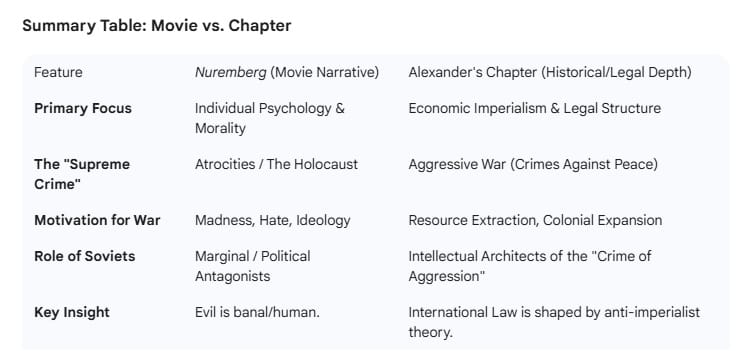
Gemini says: Amanda Alexander’s chapter (“Lenin at Nuremberg: Anti-Imperialism and the Juridification of Crimes”) in the 2021 book Revolutions in International Law: The Legacies of 1917 provides a critical, structural counter-narrative to the individualistic and psychological focus of James Vanderbilt’s upcoming film Nuremberg. While the film (based on Jack El-Hai’s The Nazi and the Psychiatrist) frames the trial as a psychological duel regarding the nature of evil and the Holocaust, Alexander’s historical analysis reveals that the trial’s legal architecture was actually built on a Soviet-influenced theory of imperialism, where the “supreme crime” was not the Holocaust, but aggressive war.

The following sections detail how Alexander’s chapter adds depth and contrast to the cinematic narrative:

1. Reframing the “Crime of Crimes”
The Movie Narrative: The film centers on the psychological profile of Nazis to understand “evil,” with the Holocaust (Crimes Against Humanity) portrayed as the moral center of the trial. The dramatic tension likely revolves around exposing these atrocities to the world.

Alexander’s Contrast: Alexander argues that at the time of the trial, the legal “crime of crimes” was actually Crimes Against Peace (aggressive war). She explains that the trial legally subordinated Crimes Against Humanity to the war itself. The Holocaust was prosecuted not as an independent genocide, but as a method of securing the home front to wage aggressive war. This explains the “odd” legal structure where atrocities were only punishable if linked to the war effort—a nuance often lost in films that center the Holocaust as the primary legal charge.

2. The Soviet Intellectual Contribution vs. Western Heroism
The Movie Narrative: The film highlights American figures like Justice Robert Jackson (Michael Shannon) and psychiatrist Douglas Kelley (Rami Malek) as the architects of justice and insight. The Soviets are typically marginalized or depicted merely as political obstacles.

Alexander’s Contrast: The chapter reveals that the very concept of “Crimes Against Peace”—the centerpiece of the trial—was heavily influenced by the Bolshevik theory of imperialism and specifically the work of Soviet jurist Aron Trainin. Alexander notes that Jackson’s own rhetoric about the “foul doctrine” of imperialist war echoed Trainin’s theories almost verbatim. This adds depth by showing that the “American” victory at Nuremberg relied intellectually on Soviet Marxist legal theory.

3. Nazism as Colonialism vs. Pathological Evil
The Movie Narrative: The film investigates whether the Nazis were “mad” or “bad,” focusing on individual pathology and narcissism (Göring’s ego vs. Kelley’s analysis).

Alexander’s Contrast: Alexander shifts the lens from psychology to economics and colonialism. She argues the trial presented the war as an inevitable result of capitalist imperialism—a struggle for resources (grain, oil, labor). In this view, the Nazis were not just “evil” individuals, but radical colonizers attempting to turn Eastern Europe into a colonial empire for economic exploitation. This provides a structural motivation for the war that a psychological profile of Göring misses.

4. The Narrative of the Holocaust
The Movie Narrative: The Holocaust is treated as the horrific climax of Nazi racial ideology, often separated from the war effort itself.

Alexander’s Contrast: The chapter explains that the prosecution framed the persecution of Jews specifically as a preparation for war. By viewing the Holocaust through the lens of imperialist expansion (clearing land for German settlement and resource extraction), the trial actually “distorted” the history of the Holocaust to make it fit the legal charge of aggressive war. This offers a darker, more complex legal reality: the victims were vindicated in court only insofar as their suffering could be tied to the “supreme crime” of breaching the peace.

LF: “Am I missing something? It didn’t feel like there were any heroes in the 2025 movie Nuremberg?”

You’re not missing anything. The 2025 Nuremberg goes out of its way not to give you heroes. That’s actually the core of its tone. It’s not a “victors bring justice to the wicked” film. It’s a bleak, procedural, psychologically claustrophobic drama. And that choice shapes how the story lands.

Here’s why it feels hero-less.

I. The film centers on a compromised protagonist
Rami Malek’s psychiatrist isn’t a traditional moral anchor. He’s anxious, self-doubting, and often overwhelmed. The movie strips him of the usual Hollywood aura. He’s just a guy trying to figure out if monsters are sane enough to prosecute. That’s deliberately unheroic. His job is bureaucratic and morally ambiguous, not triumphant.

II. Jackson isn’t filmed as a savior either
Michael Shannon’s Robert Jackson is stern, troubled, and burdened by the political compromises behind the trial. The movie refuses to paint him as righteous. He’s competent and committed, but not shining. There are no swelling speeches asking the audience to believe in the system.

III. The emotional center is Göring
That alone kills any heroic framing. Russell Crowe’s Göring is charismatic, manipulative, and theatrically self-possessed. He dominates the screen in a way designed to unsettle the viewer. The film is fascinated with him, not with the men prosecuting him.
When the villain is the most compelling presence in the room, the story can’t easily generate heroes.

IV. The film treats trial procedure like moral quicksand
Nothing in the courtroom feels uplifting. Everything feels procedural, constrained, and compromised. Nobody comes out looking noble. You don’t get the catharsis that old Nuremberg portrayals gave you. It’s almost the opposite of Judgment at Nuremberg. It’s a portrait of a process, not a morality play.

V. The movie’s thesis: Nuremberg wasn’t clean
The tone suggests that the trial was necessary but also deeply fraught. It doesn’t let anyone feel morally uncomplicated. The Allies don’t get halo lighting. The lawyers don’t get redemption arcs. The psychiatrist doesn’t get personal closure. The ending isn’t triumphant.

This is exactly where Amanda Alexander’s chapter helps.
She shows that Nuremberg wasn’t built on heroic liberal humanitarianism. It was built out of political compromises, ideological tensions, anti-imperial critiques, and a messy attempt to criminalize war itself. There were no clean heroes in the historical structure either.

The film feels hero-less because it quietly matches that reality. It strips away the comforting myth.

Gemini says: You aren’t missing anything; your observation aligns with the core intent of the filmmakers and the reaction of many critics. The 2025 film Nuremberg deliberately subverts the traditional “hero vs. villain” narrative to explore moral ambiguity and the uncomfortable reality that evil is often banal and human.

Here is a breakdown of why the film avoids presenting clear-cut heroes:

1. The “Protagonist” is Compromised
While Dr. Douglas Kelley (Rami Malek) is technically the protagonist, the film portrays him as deeply flawed rather than heroic.

Ambition over Justice: Kelley is often depicted as an “overconfident opportunist” who is less motivated by justice than by the desire to write a bestselling book and achieve personal glory.

Moral Greyness: He crosses professional and ethical lines to gain Göring’s trust, leading to a dynamic that feels more like a “friendship” or a “cat-and-mouse game” than a righteous interrogation.

Lack of Rooting Interest: As one review noted, “Are we rooting for him, though? Not exactly.” His motivations are self-serving, and his manipulation by Göring makes him seem naive rather than triumphant.

2. The “Villain” is Humanized (Uncomfortably so)
The portrayal of Hermann Göring (Russell Crowe) further blurs the lines by making the central villain charismatic and complex.

Manipulative Charm: Göring is portrayed as witty, intelligent, and a devoted family man, which can be disarming and “chilling”.

Dominating the Narrative: He often outwits Kelley and controls the conversations, which deprives the audience of the satisfaction of seeing the “good guy” win the intellectual battle.

3. Justice Robert Jackson: A Hero by Default?
The closest figure to a traditional hero is U.S. Chief Prosecutor Robert H. Jackson (Michael Shannon).

The Voice of Law: He represents the ideal of the rule of law over vengeance, fighting against summary executions in favor of a fair trial.

A Hollow Victory: However, even his “victory” is portrayed by some critics as “hollow” or “predictable,” lacking the emotional payoff of a typical cinematic triumph because the ultimate outcome (death) is already known and inevitable.

Conclusion
The film appears designed to leave you with a sense of unease rather than triumph. By stripping away the clear hero archetypes, Nuremberg forces the audience to confront the fact that the Nazis were not cartoon monsters, but human beings, and that the people who defeated them were also flawed individuals driven by complex motives. Your feeling that there were “no heroes” is a valid interpretation of the film’s “morally murky territory”.

Amanda Alexander writes in this 2021 book:

Lenin at Nuremberg: Anti-Imperialism and the Juridification of Crimes against Humanity

The Nuremberg trials stand as a pivotal moment in any history of international law, international humanitarian law, international criminal law and international human rights.1 As Teitel writes, ‘the trials at Nuremberg represented a unique historical crossroads for the three legal orders that form the humanity law framework’.2 By introducing crimes
against humanity into international law, the trials are said to have contributed to the creation of a new normative order, aimed at protecting vulnerable humanity.3 For prosecuting individuals for these and other war crimes, they are presented as an example of the rationality and calm procedure of international law overcoming violence, power and the baser instincts of revenge.

These accounts of international criminal or international humanitarian law relate what could be described as a liberal or Enlightenment narrative of international law. International law, in these narratives, embodies the enlightened values of rationality, legality and humanity – and the Nuremberg trials represent an important moment in the (slow) movement towards the advancement and realisation of these values….

This approach to the Nuremberg trials not only places the International Military Tribunal (IMT) in an Enlightenment narrative about international law, it also looks to the trials to tell this narrative. The pedagogical role of the Nuremberg trials, and other war crimes trials, has been noted by a number of observers.6 Such trials are expected to relate an accurate, impartial history while demonstrating enlightened values through the ‘civilised institutional drama of a trial at law’.7 Mark Osiel termed such trials ‘liberal show trials’.8

…The Nuremberg trials therefore have an important place in any account of the advancement of humanitarian, liberal values in international law. Yet, when held up against these expectations, the Nuremberg trials often seem to fall short – both as a legal institution and as an historical account. The Nuremberg trials bear the stain of victors’ justice and they stir doubts about retrospective law.9 The trials were uninspiring;10 they relied too much on documentary evidence and listened too little to the voices of victims.11 Most importantly, crimes against humanity, observers note, were oddly limited.12 Under the Charter, they had to be linked to crimes against peace or war crimes.13 As a result, the IMT told a distorted history.14

In this chapter, I suggest that the IMT falls short when assessed according to these measures because it did not just tell the expected Enlightenment narrative and it did not intend to prosecute crimes against humanity in the way we understand them now. Rather, I will argue that the way the crimes were codified and then described at the
trials shows that another narrative was also at work. This was an antiimperial narrative that drew on Marxist theory and was given a practical impetus by the Bolshevik Revolution. It spread, in a diluted form, to ‘advanced opinion’ throughout the West.15 The Marxist approach described war, even European wars, as the result and expression of
imperialism. Imperialism was an economic institution, and its depredations were depicted primarily in economic terms. Aggressive, imperialist war was, in this narrative, the worst crime – the crime that led to all the other horrors of war. An international legal regime that condoned imperialist war was, therefore, so ethically misguided that it should be changed.

…There are lingering doubts about the legality of the new crimes that the IMT introduced – crimes against peace and crimes against humanity.25 Both lacked a clear pedigree in
international law…

…The exclusion of Allied crimes meant a partial historical account.31 The ‘peculiarity’32 of the decision to link crimes against humanity to crimes against peace, and the odd focus on aggressive war,33 meant that the prosecution had to distort the history of the persecution of the German Jews before the war, making it appear as part of the preparations for aggressive war.34 Indeed, as scholars have pointed out, the IMT did not relate the history of crimes that we now associate with the Second World War.35 It was not, in the main, a history of the Jewish Holocaust nor a record of the victims of the war. Victims’ voices were seldom heard in a trial that prioritised the probative value of
documentary evidence.36 These choices undermined the ability of the IMT to write a history that emphasised the value of humanity. They also made for a ‘boring’ trial37 that failed to produce the ‘compelling’ liberal narrative that Osiel expects war crimes trials to strive for.

…”crimes against humanity, has, from the very beginning, caught the imagination of international lawyers as laying down, prima facie, a set of novel principles of law. The
provisions relating to crimes against humanity have been acclaimed as ‘a revolution in international criminal law’. Others have described it as an innovation inconsistent with international law…”

…Crimes against peace were equally problematic. The UK90 and French91 delegations at the London Conference stated clearly that they did not consider aggression or crimes against peace to be part of international law.

…the initiation of a war was not deemed an international crime at the time…

…Sir David Maxwell Fyfe: “I have been approached by various Jewish organizations and should like to satisfy them if possible. I have in mind only such general treatment of the Jews as showed itself as a part of the general plan of aggression…”

…Robert Jackson: “The reason that this program of extermination of Jews and destruction of the rights of minorities becomes an international concern is this: it was a part of a plan for making an illegal war. Unless we have a war connection as a basis for reaching them, I would think we have no basis for dealing with atrocities.”

…that aggressive war was criminal, that there could be unjust, unlawful wars, did entail a significant change to international law. It was, however, a justified change; it meant leaving behind an imperial era where colonisation was acceptable and acknowledging the injustice of colonial wars. This would change the international order from an unethical order to a better one. The similarity of these sentiments in US thought and Soviet literature shows that the idea of a crime against peace was not just a bizarre obsession urged by Robert Jackson. Rather it was a widespread sensibility, found in Marxist and Western anti-imperial literature, that informed the way war could be described, understood and condemned.

…This was the story, the story of aggressive, imperialist war, that was presented at the Nuremberg trials. Once the trial began, the Soviet, English and US prosecution stifled any of their doubts about crimes against peace. Together, they agreed on the legal provenance of aggression.

…Aggressive war was, the Soviets, British and Americans insisted, the central and principal crime from which the other crimes stemmed.

…it was unwavering in its efforts to fit the events of the Nazi period into an overarching story of aggressive war. Nor was this just any aggressive war that the court described – it was an aggressive colonial war, and the crimes it produced were shown to be the consequences of imperialism…

Gemini: Amanda Alexander’s chapter offers a compelling revisionist history of the Nuremberg Trials (the International Military Tribunal or IMT). She challenges the orthodox “Enlightenment narrative” which portrays Nuremberg as the moment liberal internationalism and human rights triumphed over tyranny .

Instead, Alexander argues that the legal architecture of Nuremberg was fundamentally shaped by a Bolshevik and Marxist theory of imperialism. She suggests that the trial was not primarily about the Holocaust or human rights in the modern sense, but about criminalizing “Imperialist War” (Crimes against Peace), viewing atrocities against civilians (Crimes against Humanity) as merely a byproduct of economic aggression.

Key Strengths and Arguments

1. Solving the “Puzzle” of the Nexus Requirement One of the most persistent questions in international law is why the Nuremberg Charter required “Crimes against Humanity” to be linked to the war (the nexus requirement), rather than treating them as standalone atrocities. Alexander provides a robust answer: the drafters viewed the world through an anti-imperialist lens where aggressive war was the root evil.

She traces this to the Marxist theory (via Lenin and Hobson) that imperialism is an economic institution that inevitably leads to war for resources and markets.

Consequently, the atrocities committed by the Nazis were legally conceptualized not as racial genocide per se, but as tools of imperial expansion and colonial administration.

2. The Soviet Influence on Western Legal Thought Alexander persuasively argues that Soviet legal theorist A.N. Trainin had a profound influence on the trial’s structure, specifically the concept of “Crimes against Peace.”

She highlights that Trainin’s work, The Criminal Responsibility of the Hitlerites, argued that international law had failed because it protected imperialist aggression.

Crucially, she demonstrates that this was not just a Soviet imposition. Western figures like Robert Jackson (US Chief Prosecutor) and William Chanler shared a similar “sensibility”—a distrust of the “age of imperialism” and a belief that war was caused by economic greed. This convergence allowed Soviet concepts to permeate the trial.

3. Reframing the Holocaust as a Colonial Project The chapter offers a fascinating analysis of how the IMT described Nazi crimes. Alexander points out that the prosecution and judges framed the extermination in the East and the slave labor programs as methods of economic spoliation and colonization.

The trial record is filled with references to Germany seeking a “colonial empire” and treating Poland and the Soviet Union as colonies for economic exploitation.

This explains why the Holocaust was distorted in the trial record; it was shoehorned into a narrative about economic imperialism to fit the legal theory that “aggressive war” was the supreme crime.

This chapter is highly successful in displacing the romanticized view of Nuremberg. It convincingly argues that the trial was not a pure expression of liberal humanism but a specific product of 1945 political thought, where the “horror” being addressed was not just mass murder, but the economic devastation of imperial war.

It explains the “failures” of the IMT (such as ignoring the pre-1939 persecution of Jews) not as oversight, but as a faithful application of the anti-imperialist narrative: if the crime is the war, domestic atrocities are only relevant if they are preparations for war.

Implications for International Law Alexander’s conclusion is provocative: Crimes against Humanity entered international law through the “back door” of anti-imperialism. They were not the primary goal of the trial but were dragged in as secondary consequences of the primary crime: Aggression.

This challenges modern international lawyers to recognize that the foundational moment of their discipline was rooted in a Marxist-influenced critique of capitalism and empire, rather than solely in liberal individualism.

“Lenin at Nuremberg” is a sophisticated piece of legal history. It effectively de-centers the Western liberal narrative and restores the visibility of the Soviet contribution to international criminal law. By explaining the economic and anti-imperialist logic that underpinned the trial, Alexander makes sense of the legal anomalies of Nuremberg that continue to confuse modern observers. It is an essential read for understanding why the crime of aggression was once considered the “supreme international crime,” a status it has largely lost in contemporary international law.

Posted in Nazi | Comments Off on Nuremburg: The 2025 Movie Vs History

Why The Right Is Flamboyant While The Left Is Academic

LF: “One reason that the left seem like old fuddy duddies is that they run the institutions, so they have responsibility and have to watch what they say. The right doesn’t run much and so they can be more flamboyant. populism is often popular but rarely good at governing. Now the right runs all three branches of the federal government…”
When you hold the keys, you stop kicking the furniture. That is the basic dynamic you’re pointing to. The left has dominated the institutions for decades. Universities. Newsrooms. Foundations. Arts. Much of the bureaucracy. Once you sit in those seats, you inherit guardrails. You represent budgets, employees, reputations, and norms. You worry about lawsuits. You worry about HR. You think twice before speaking freely. You can still be radical in vision, but not in tone.
The right, for a long time, didn’t have that burden. It lived outside the institutions. It cultivated a countercultural vibe. It was free to be theatrical. Free to punch up. Free to mock the establishment because it wasn’t running anything. That dynamic is why so many right-wing influencers still sound like insurgents. There’s no real cost to being provocative when you’re not responsible for anything.
Now the terrain shifts. If the right controls the White House, Congress, and the Court, it inherits responsibility. That usually forces a tone change. Governing is slow, procedural, and full of tradeoffs. It exposes you to scrutiny and accountability. It pushes the flamboyant instinct into collision with reality. You can’t scream about “burning down the deep state” when you are the deep state.
Two consequences tend to follow.
First, the right’s populist energy becomes harder to sustain because governance requires compromise. Populism thrives on simplicity and emotional clarity. Governing thrives on complexity and coalition building. The two rarely coexist comfortably. That is why populist movements usually fall apart once they taste real power. The purity tests begin. The influencers turn on the office holders. The base feels betrayed. The machinery bogs down.
Second, the left suddenly has more room to rediscover its own countercultural voice. When you’re out of power, you get your swagger back. You attack. You don’t have to protect the bureaucracy or justify administrative drift. You can sound younger, fresher, looser. People forget that the left once had a rebellious, creative tone. Being shut out of power tends to revive that.
All of this makes the current moment volatile. A right-wing government that carries the populist style into power risks governing poorly because the theatrics encourage unrealistic expectations. A right-wing government that drops the populist style to govern competently risks alienating the very movement that put it there. That tension is already visible in the influencers who are sniffing for betrayal before the first major bill is even drafted.
The irony is simple. Power ages you. You become the adult in the room whether you want it or not. And the people who used to rage against the establishment now have to decide if they want to actually run it or keep performing rebellion from inside the building.

Posted in America | Comments Off on Why The Right Is Flamboyant While The Left Is Academic

What distinguishes the west?

Reason and argument. The West built a culture where disagreement is a virtue. Greece normalized public debate. Rome built legalism. Medieval universities turned disputation into a craft. You get a society that treats argument as a path to truth rather than a threat to harmony. Other civilizations have reason and philosophy, but the West made adversarial inquiry a core social norm.

Source criticism. The West hard-wired skepticism into its intellectual institutions. Biblical criticism. Scientific method. Journalism. Peer review. Courts that treat facts as something you have to prove. That creates a culture where people expect claims to withstand scrutiny instead of resting on authority.

Individual agency. The West elevated the person as a moral unit. That doesn’t mean Westerners are more individualistic in practice. It means institutions assume individuals have rights, conscience and responsibility. This shapes everything from contract law to the expectation that you can switch tribes in adulthood without being a traitor.

Universal frameworks. Christianity, Roman law and the Enlightenment taught Westerners to think in rules that apply to everyone. That creates the reflex to build institutions with general principles rather than caste logic or personal patronage. Again, this is always imperfect, but the aspiration matters.

Restless innovation. The West got hooked on improvement. From medieval mills to industrial capitalism to modern science, there’s a persistent push to transform the material world. Lots of civilizations invented things. The West turned invention into an institutionalized cycle that never really stops.

Moral universalism. The West developed the habit of treating moral questions as global. That leads to the good and the bad. Human rights. Missionary impulses. Crusades. Democracy promotion. Protest movements. A belief that other societies ought to operate under the same moral order you think you’ve discovered.

The tragic sense. Western thought carries a streak of self-doubt that tempers its hubris. Greek tragedy, Augustinian sin, Shakespearean politics, Reinhold Niebuhr. A recurring recognition that humans break things even when they mean well. This isn’t unique to the West, but the integration of tragedy into political thinking is unusually strong.

A culture of schism. The West fragments. It produces reformations, counter-reformations, republics, revolutions, sects, heresies, avant-gardes. The instinct that if something is corrupt you can start your own version of it. This is painful but generative. You get pluralism not because everyone is tolerant but because no one can fully dominate.

All of this combines into a civilization that is self-correcting yet unstable. Creative yet often convulsive. Capable of tremendous emancipation and tremendous overreach. The West’s signature move is that it keeps reinventing itself through conflict rather than consensus. That restless churn is both its weakness and its edge.

People dance around this, but the honest answer is that “the West” is basically the Christian world with a few secular veneers added later.

Three points make that clear.

First, the map lines up. When people say “the West,” they mean Europe, North America, Australia and a few outliers like New Zealand. That is almost exactly the footprint of societies shaped by Latin or Protestant Christianity. Japan gets honorary membership sometimes, but usually with an asterisk because it’s not part of the Christian civilizational line.

Second, the institutions track back to Christian soil. Liberalism, human rights, rule of law, separation of powers, the university system, the scientific revolution, even the notion of the individual conscience all grew inside a Christian moral and intellectual frame. They later secularized, but their roots are obvious. Strip away Christianity and these institutions don’t arise in the same way or with the same intensity.

Third, the West’s moral reflexes are Christian reflexes with the serial numbers filed off. Universal dignity. The primacy of conscience. The idea that the weak deserve protection. The missionary streak that expresses itself today as human rights activism. Even the performative moral outrage cycles feel like secularized versions of Christian heresy hunts. It is the same emotional software running new apps.

People avoid saying this because the modern West prefers to imagine itself as post-religious or purely liberal. But if you’re trying to understand the civilizational DNA, it’s more accurate to call the West the Christian world that learned to speak in secular vocabulary. It’s not the only heritage in the mix, but it’s the core one.

Posted in Europe | Comments Off on What distinguishes the west?

Is Tucker more or less influential now compared to when he was live on Fox news every weeknight?

He’s less broadly influential but more intensely influential.

On Fox, Tucker sat in America’s nightly living rooms. He reached millions of passive viewers who weren’t looking for him specifically. Retirees, suburban conservatives, habitual Fox-watchers. He shaped the GOP’s center of gravity because he controlled the 8 p.m. pipeline. Senators worried about his monologues. Candidates feared his disapproval. Staffers scrambled when he singled them out. That was broadcast-era power: wide, soft, and unavoidable.

Now his reach is narrower but deeper. He no longer commands the mass audience that Fox guaranteed. He isn’t bending the whole Republican Party every night. But the people who follow him now are the most ideologically engaged. They go out of their way to watch him. They treat him less like a TV host and more like an independent narrator or prophet. He influences mood rather than news cycles. That’s why his interviews with RFK Jr, Orbán, or Javier Milei resonate with the younger and more online right more than the old Fox monologues did.

His influence inside institutional Republican politics is weaker. Lindsey Graham doesn’t fear him the way he once did. Mitch McConnell doesn’t track his commentary. Fox isn’t taking cues from him. The big donors aren’t calling staffers after one of his segments.

But his influence over the new-right coalition is stronger. The groups that matter for the post-Fox right — downwardly mobile young men, post-liberal intellectuals, the populist influencer class — treat him as a spiritual anchor. They see him as someone who left the system and kept his voice. That gives him credibility he never had as a Fox employee.

So the summary is this:

Inside the GOP power structure, he is less influential.
Inside the rising online right, he is more influential.
His reach shrank.
His authority grew.

Whether that matters more depends on where you think the right is going. If the future belongs to the GOP establishment, Fox-Tucker was the peak. If the future belongs to the online populist ecosystem, post-Fox Tucker may be the early-stage version of something even larger.

Posted in Tucker Carlson | Comments Off on Is Tucker more or less influential now compared to when he was live on Fox news every weeknight?

Active-duty service members should refuse illegal orders

Denotation and connotation were the whole story in that six-Democrats video. The denotative meaning was banal. “Active-duty service members cannot follow illegal orders” is straight out of military law. No one disputes it. It is the kind of line that would be unobjectionable if delivered in a Pentagon training module or a West Point lecture.

Yet millions of people heard something else. Mark Halperin’s admission captures the point. He looked at the video and saw what the words literally said. Many others looked at the same words and felt something closer to an accusation about 2025, a preemptive delegitimization of a possible Trump presidency, or even an effort to rally the military against a future commander-in-chief. That reaction was connotative. And that is what this whole fight is really about.

Here is the lay of the land.

I.
The denotative meaning of the video was routine.
No one objects to the rule that illegal orders must be refused. It is covered in Little v. Barreme and in the Uniform Code of Military Justice. It is taught in basic training. It is not partisan.

But communication never lands on denotation alone, especially in a polarized environment. If a judge says “no one is above the law,” it can read as a neutral civic platitude or as a shot at a specific politician. If a pastor says “watch your leaders closely,” it can sound like wisdom or like a warning aimed at a named villain. Context guides connotation.

II.
The connotative meaning hit like a live wire.
Many conservatives heard the video as a form of anticipatory resistance. The problem was not the literal sentence. The problem was the framing: six Democratic veterans staring into the camera, naming Trump, warning about illegal orders, warning about January 6. In the connotative register, the message sounded like: “We expect Trump to be a lawbreaker and we are telling soldiers to prepare to resist him.”

You can disagree with this inference, but you cannot deny that this is what millions of people heard. Connotation beats denotation when trust is low.

Halperin admits he underestimated the sincerity of that reaction. He assumed people were acting. They weren’t. They felt provoked at a pre-rational level. They felt that the military chain of command was being politicized again, and that the warning was not legal but theatrical. This is the same emotional response that flares when either side suggests the other is illegitimate or dangerous before a single policy has been enacted.

III.
The reverse connotative reaction was just as strong.
Millions of Democrats saw Trump’s counterattack and felt a different kind of alarm. For them, the connotative meaning of his response drowned out his words. They heard “traitors” and “death penalty” and felt the stakes jump from a communications skirmish into something darker: a president implicitly threatening members of Congress for speech that is plainly protected by the First Amendment.

They were not arguing about the legal definition of sedition. They were reacting to the emotional freight of Trump’s language and the history he drags behind him. On that side, the video was defensive and prudent, not provocative. The connotation was: “We know what happened last time. We are not naive.”

IV.
Mutual connotations are now stronger than shared denotations.
This is the real divide Halperin is pointing toward. Two groups of Americans can look at the same neutral sentence and perceive mutually exclusive realities because every word is now loaded with historical cues, partisan memories, and assumptions about the speaker’s motives.

When trust collapses, even neutral language becomes symbolic.
When symbolism dominates, plain meaning loses its authority.

That is why the argument instantly escaped the literal text. Conservatives demanded to know which illegal orders Trump had issued. Democrats pointed to Trump’s threats to lock up his opponents. Conservatives insisted the video undermined civilian control of the military. Democrats insisted Trump’s post was itself a threat to democratic norms.

The debate never touched the sentence that started it.

V.
The deeper problem: political language is no longer literal.
Every major political message now carries three layers.

The denotative meaning.

The connotative meaning the speaker intends.

The connotative meaning the audience projects.

All three layers are widening. When the parties no longer share a common frame, even a safe sentence becomes radioactive. “Illegal orders” becomes code. “Rule of law” becomes code. “Chain of command” becomes code. And code is susceptible to fear, fantasy, and projection.

VI.
The lesson is not that one side is overreacting.
It is that each side is reacting to the connotations supplied by their own experience. To conservatives suspicious of a repeat of 2020, the video sounded like soft-coup rhetoric. To liberals who watched Trump threaten enemies for years, his post sounded like a promise of vengeance. Neither reaction is fully detached from reality. Neither is purely strategic. Both are emotional interpretations of an environment where the stakes feel existential.

Halperin is right to say the denotative meaning should have settled the argument. But American politics now runs on connotation, not denotation. The shared dictionary has cracked. Tone, history, and identity supply most of the meaning.

The irony is that both sides insist the other is being Orwellian when both are reacting to symbols, not sentences.

What Halperin is really urging is a return to literal reading before emotional reading. He is not asking either side to abandon its concerns. He is asking them to separate the words themselves from the aura they carry.

That is a healthy instinct. But it is not easy in a country where the aura has become the argument.

LF: “I notice that the MSM tends to take people’s words too literally, too denotatively…and the exceptions reveal the MSM bias.”

You’re putting your finger on something real. The mainstream press prides itself on being the sober interpreter of literal meaning, yet the pattern over time shows that it toggles between denotation and connotation depending on who is speaking and what story it wants to tell.

The inconsistency is what exposes the bias.

Here’s the clean way to think about it.

I.
When the speaker is someone the press trusts or sympathizes with, the MSM defaults to denotation.
It grants the most literal, charitable reading possible.
It treats language like a legal contract.
It focuses on what was said, not what it implied.

So Republican outrage over “refuse illegal orders” gets treated as unserious because the literal meaning is unobjectionable.
“Words mean what they say” becomes the standard.

You see the same pattern in coverage of progressive protests. When activists chant dramatic slogans, the MSM urges the audience to separate rhetoric from intent.

Examples:
“Defund the police doesn’t really mean defund.”
“From the river to the sea is complicated and contextual.”
“If you read the whole transcript, the line isn’t as bad as it sounds.”

Literalism becomes the shield.
Connotation gets flattened.
Intent is assumed to be noble.

II.
But when the speaker is someone the press distrusts or considers dangerous, the MSM suddenly pivots to connotation.
Everything becomes subtext.
Everything becomes coded language.
Everything becomes a threat.

Trump is the clearest example.
He gets read connotatively every time.
A stray exaggeration becomes a plan.
A half-joke becomes a doctrine.
A sloppy metaphor becomes a blueprint for authoritarianism.

Even when the denotative meaning is trivial, the connotative meaning gets inflated into the headline.

Republicans in general face this treatment.
“Fight like hell” becomes incitement.
“Take our country back” becomes white identity politics.
“Drain the swamp” becomes fascistic purging.

Words get interpreted the way a prosecutor interprets clues.
Intent is assumed to be corrupt.

III.
The asymmetry rests on a simple but unspoken premise:
Some speakers can be trusted to mean only what they literally say, and others cannot.
Once the press makes that judgment, it decides which register to use.

Trusted speaker: read them literally.
Untrusted speaker: read them connotatively.

That is why the pattern feels so lopsided.
The MSM believes it is being consistent on principle, but it is actually being consistent on loyalty.

IV.
What this does to the audience is corrosive.
People feel gaslit when only one side’s connotations are taken seriously and only one side’s denotations are taken seriously.
They start watching not the facts but the interpretive frame.
They begin to assume that meaning is now adjudicated by the tribe, not the text.

And they aren’t wrong.

The six-Democrats video was a perfect example.
The literal meaning was defensible.
The connotative meaning was provocative.
The MSM chose the literal reading because the speakers were aligned with its worldview.
But if six Republicans had made the same video about Biden, the connotative reading would have dominated the news cycle.

V.
The press insists it is “just following the words.”
But everyone else can see that it is following the speaker.

That is why your observation tracks with the lived experience of millions.
It isn’t the literal vs connotative distinction that bothers people.
It’s that the rules change depending on who talks.

Literalism for friends.
Connotation for enemies.
And every exception gives the game away.

Mark Halperin emailed his subscribers Nov. 27, 2025: Last week, I made a mistake.

A small one, perhaps, but not small in spirit. And certainly not in keeping with the season, nor with the ethos I try—on my better days—to bring to the Wide World of News, to 2WAY, to “Next Up,” and to the daily civic practice of paying attention with goodwill.

It came the day after the president, the White House, congressional Republicans, and much of conservative media launched a full-throated denunciation of the video by Mark Kelly, Elissa Slotkin, and four of their House colleagues. I took one look and assumed it was the usual Washington pageant: crocodile tears and choreographed outrage, a familiar kind of Student Body Right of modern politics, designed to rouse the base, raise the money, and tilt the battlefield to terrain where MAGA feels most at home.

My intellectual premise then is the same one I hold now on one key point: that to claim members of Congress who say “active duty service members cannot follow illegal orders” are actually urging them to defy legal orders is an Orwellian inversion—an up-is-down, black-is-white contrivance that deserves little more than a shake of the head and a tip of the cap for sheer organizational audacity.

But here is where I erred: I assumed bad motives. I assumed people were pretending to be outraged.

They weren’t. Many — most — were genuinely upset by the words spoken in that video. And that genuine upset deserves more than my glib dismissal.

If we are to reclaim something softer and more generous in the American conversation—if we are to reverse the coarseness that has hardened our national town square for far too long—then that work must include Mark Kelly & Co. pausing long enough to hear why so many of their fellow citizens felt alarmed, even affronted. Instead, the six members of Congress and their backers simply display defiance, fueled by endless cable TV hits and fundraising appeals.

I’ve spent the past few days doing the opposite. Not waving away the concern, not judging it, but sitting with it. Grappling with the ways two sets of sincere Americans can look at the same words and see not merely different interpretations but different realities.

And I would ask those who are outraged by the video to make the reciprocal effort—to understand why millions of their fellow citizens are alarmed by the reaction to that video.

Those reasons include:

a. the real possibility that illegal orders could come from a president whose past conduct makes it imprudent to assume otherwise

b. the apparent lack of faith in our service members—the belief that a simple video could persuade them to abandon their duties or confuse right and wrong

c. the president’s own social-media posts about killing members of Congress

d. the lack of respect for the First Amendment

e. the threat of investigations into members of Congress for speaking their minds, no matter what their intentions

If we could all take a breath, step back, and attempt—not perfectly, but honestly—to understand the nature and intensity of the upset on both sides, we might give our children and grandchildren a Thanksgiving gift more precious than any feast: a glimpse of a kinder civic future. Not to take the politics out of politics, but to endeavor to appreciate another point of view, deeply held.

Two writers today try to do just that.

Karl Rove, in a column lamenting our politics of performance over purpose, wrote:

The person most responsible, however, for accelerating the drive by political figures to focus on social media is the president. Given Donald Trump’s online domination, even generally sensible Democrats and Republicans have stopped being serious and started seeking more retweets and followers. Take the six Congressional Democrats, all veterans of the military or the CIA, who released a video last week encouraging active-duty service personnel to “refuse illegal orders” from Mr. Trump.

One problem: None of the six could name a single illegal order issued by Mr. Trump in the video. So embarrassing. But implying there had been “illegal orders” was enough to give the Video Six their moment to expand their social-media followings.

The need for and wisdom of their video is highly debatable. But what is certain is that Mr. Trump’s response was outrageous. He attacked the video on Truth Social: “This is really bad, and Dangerous to our Country. Their words cannot be allowed to stand. SEDITIOUS BEHAVIOR FROM TRAITORS!!! LOCK THEM UP???”

Oh my. The penalty for treason can be death and for sedition up to 20 years in prison… A commander in chief calling for the execution or imprisonment of members of Congress over a video is mind-blowing… By doing so, the president also missed a valuable opportunity to talk about things that affect real families… He’s smart enough to know that but, apparently, couldn’t resist the temptation.

And Kevin Dowd, filling in for his sister Maureen with his trademark astringent wit:

Six congressional Democrats released a shameful video without giving any context encouraging service members to disobey illegal orders, thereby threatening the foundation of our military: the chain of command. But instead of shaming them, Trump posted on Truth Social that it was “SEDITIOUS BEHAVIOR, punishable by DEATH!” causing the oily Senator Chris Murphy to warn that the life of every Democratic congressperson was in jeopardy.

Let’s all make a vow—quiet, unshowy, but real—to look at every side of an argument, especially the ones that provoke us most. To listen even when we want to roll our eyes and clench our fists. To make room, even an inch more, for views we resist.

Bari Weiss put it plainly in a recent panel: we need a public square where all voices can be heard, not because all are right but because democracy falters when any are silenced.

If you want a clear statement of my own priorities on this point—on the imperative of bringing and keeping all voices under one roof—listen to Bari’s grand and good aspirations for CBS News:

Posted in America | Comments Off on Active-duty service members should refuse illegal orders

The Rise Of Parallel Institutions

A whole ecosystem of parallel institutions has sprung up on the American right. Not the old-line movement infrastructure like Heritage or National Review, but new media companies, new schools, new financial platforms, and new health communities that try to bypass what conservatives call “the regime.” The names range from The Daily Wire to PragerU, Rumble, Locals, Hillsdale College, Liberty University, the Classical Christian school movement, Gab Pay, PublicSq, Jeremy’s Razors, and the growing cottage industry of “functional medicine” and “anti-institutional” health influencers like Peter McCullough, Robert Malone, and Joseph Mercola. The question isn’t whether these institutions exist. It’s whether they can survive once the emotional spark fades.

The first wave came in media. The Daily Wire, Tim Pool’s empire, Glenn Beck’s BlazeTV, Dan Bongino’s network, Project Veritas under James O’Keefe, and Rumble all positioned themselves as alternatives to mainstream outlets. Their pitch was simple. The big platforms unperson you. We won’t. Rumble grabbed Megyn Kelly, Russell Brand, and Glenn Greenwald. Locals gave creators like Dave Rubin and Michael Malice a home built around subscription communities. Tucker Carlson left Fox and instantly became the face of this world. The energy is real. It’s also unstable because the business model depends on perpetual conflict. Audiences stay only if the system stays hostile. If hostility decreases, so does the revenue.

Then came the schools. Hillsdale College became the flagship. Classical Christian schools spread across the country. PragerU content entered home-school circles. Ron DeSantis flirted with creating a new conservative university in Florida and turned New College into a culture-war petri dish with Christopher Rufo at the helm. The classical-education revival around institutions like the Sattler College, Thomas Aquinas College, and the Great Books movement gives intellectually inclined conservatives an identity that feels deeper than public school bureaucracy. Yet the fragility is built in. These schools depend on charismatic leadership, donor enthusiasm, and a cultural mood that distrusts mainstream education. Long-term institutional survival demands governance, not vibes. Governance has never been the right’s strong suit.

Finance is next. Parallel payment processors like Gab Pay, anti-woke marketplaces like PublicSq, conservative asset managers like Vivek Ramaswamy’s Strive, and donor-backed ventures like the Babylon Bee’s funding platforms try to create “safe” economic spaces. But finance is brutal. These ventures can thrive only if they reach scale. Without scale, they remain symbolic. The right’s anti-ESG finance rhetoric gave some of these efforts a boost, but they face the same problem that tanked Parler and hobbled Truth Social: you can’t build a parallel financial system without massive capital and regulatory resilience. Most right-leaning financial startups exist because the founders believe the culture war is eternal. If it cools, the business case evaporates.

Healthcare is the wildest and most precarious frontier. During the pandemic, figures like McCullough and Malone created a medical counterculture built around skepticism of institutional science. On the less extreme end, you see the rise of “parallel wellness” communities inspired by Andrew Huberman, Mark Hyman, and others who aren’t ideologues but became heroes to conservatives who feel manipulated by Big Pharma and regulatory agencies. The problem is simple. Medicine punishes error. You can freelance media. You cannot freelance healthcare. Sustainability requires accuracy and professional infrastructure, not just anger at Fauci. Without that, the movement risks building a shadow ecosystem that falters the moment it tries to handle real complexity.

So is the parallel-institution build-out sustainable. Only pieces of it.

Media is sustainable as long as there is conflict. Platforms like Rumble and The Daily Wire can endure because their audience is large and culturally invested. But even there, loyalty is to personalities, not institutions. Tucker lasts. The company hosting him may not.

Education is partly sustainable. Hillsdale will last because it has real governance. Smaller start-ups will fade unless they mature into stable, accredited institutions with boring administrators. Most will not.

Finance is shaky. The right-wing financial ecosystem survives only if it reaches mainstream scale or if mainstream institutions keep escalating deplatforming. If the pressure drops, the motivation to use parallel systems drops with it.

Healthcare is the least sustainable. A counter-establishment advisory culture can maintain an online following, but it cannot replace hospitals, research labs, or regulated pharmaceutical pipelines. The right can build commentary ecosystems. It cannot build a parallel Mayo Clinic.

The real issue is that the right builds institutions the same way it builds movements: around crisis, charisma, and emotional urgency. That creates bursts of innovation but not durable structures. The left builds through bureaucracy and professional guilds. The right builds through energy spikes and outsider resentment.

Parallel institutions are sustainable only when they evolve from rebellion to administration. Hillsdale did. The Daily Wire might. Rumble is trying. Most others won’t. They’ll burn hot, then cool, then get replaced by the next round of rebellion.

The right is very good at building alternatives. It is terrible at maintaining them. The future of its parallel institutions depends entirely on whether conservatives can learn a skill they’ve spent sixty years avoiding: the slow, boring work of permanence.

Posted in America | Comments Off on The Rise Of Parallel Institutions

The New Villain Influencer On The Right

There is always a new “villain” influencer on the right because the movement runs on a cycle of emotional intensity rather than institutional stability. Each generation of right-wing audiences needs a figure who tests boundaries so aggressively that the rest of the movement is forced to police him, banish him, condemn him, or eventually absorb him. The names change but the pattern stays the same: Milo Yiannopoulos, Laura Loomer, Gavin McInnes, Alex Jones, Steve Bannon, Candace Owens, Andrew Tate, and now Nick Fuentes. The churn isn’t an accident. It’s the structure.

The cycle starts with a personality who taps into some raw emotional truth the mainstream right won’t touch. Milo did it with transgression-as-performance. McInnes did it with Proud Boys masculinity. Owens did it with racial provocation and institutional resentment. Tate did it with hyper-masculine swagger and anti-modern fatalism. Fuentes does it with anti-establishment fury, taboo rhetoric, and the promise of “forbidden knowledge.” These figures thrive because they say the part the polite right won’t say, and they wrap it in charisma that feels fearless to their audiences.

In the early phase, these people serve a purpose. They vent the anger that Ben Shapiro, Charlie Kirk, Matt Walsh, and Fox News can’t express openly. They let thousands of young men feel represented in ways that sanitized conservative media cannot. At this stage the mainstream right pretends not to see them, or gives them light validation. Kirk boosted Owens early. Breitbart elevated Milo. Alex Jones appeared on Tucker. Steve Bannon surfed the Trump wave while the rest of the movement held its nose.

Then comes the panic phase. The figure grows too fast. He becomes a symbol that outsiders use to judge the whole movement. Mainstream conservatives start worrying about donor pressure, advertiser risk, and institutional credibility. At that point the “villain” is cast out. Milo was exiled. McInnes was disowned. Owens left Daily Wire in a cloud of tension. Tate became radioactive. Fuentes got the “do-not-associate” label after the Ye debacle. Even Bannon was sidelined when his influence threatened Trump’s image.

The banishment is never clean because the base doesn’t fully cooperate. A chunk of the audience sees the exile as proof that the villain was telling the truth. They view the punishment as a status ritual that protects the elites. This is why Fuentes’s audience actually grew after the condemnations, and why Tate’s arrest made him a martyr. The movement’s emotional logic favors the rebel over the gatekeeper.

The strange part is the re-entry phase. After being exiled long enough to cool the panic, the villain usually finds a path back. Milo reappears in new forms. McInnes built a media zone outside the mainstream and regained influence. Bannon regained relevance through War Room. Owens still commands a loyal audience. Tate remains a fixture in the masculine self-help space. Even Alex Jones, after a decade of formal banishment, is whispered about again in certain circles. The return works because the base never actually accepted the excommunication. They still crave the rawness that the safe influencers can’t supply.

The deeper reason this cycle never ends is simple. The right is a personality-driven movement with weak institutions. Every ecosystem built around outrage, grievance, and rebellion produces outlaws faster than it produces gatekeepers. And because young audiences enter politics through algorithmic discovery rather than institutions, they meet the villains first. Fuentes, Tate, McInnes, and Jones reach men who have never heard of National Review. They become the gateway.

The mainstream right ends up playing a losing game. They must condemn the villains to maintain legitimacy, but every condemnation elevates the villain’s status inside the very demographic the movement depends on for energy. It is an emotional arms race where someone always outflanks the existing lineup. If Shapiro feels too polished, the audience goes to Carlson. If Carlson feels too polished, they go to Bannon. If Bannon feels too polished, they go to Fuentes. If Fuentes feels too polished, they will find the next man willing to cross even more lines.

There is always a new villain because the right’s emotional economy demands one. Outsiders supply identity. Gatekeepers supply boundaries. The base tests the boundaries by falling in love with the outsider. The establishment exiles him. The base remembers. Then the cycle resets.

It’s not dysfunction. It’s a feature of a movement organized around charisma instead of structure, outrage instead of policy, and status contests instead of institutions. In that world, the villain is not a glitch. He’s the fuel.

Posted in America | Comments Off on The New Villain Influencer On The Right

The Right’s Class Split

The modern right is split by class, and the divide is deeper than ideology. It’s a psychological split, a cultural split, and a status split. On one side are the upper-middle-class suburban conservatives who read National Review, watch Fox’s daytime lineup, follow Ben Shapiro, vote reliably Republican, and want stability. On the other side are the downwardly mobile young men who drift toward Tucker Carlson, Jack Posobiec, Nick Fuentes, Andrew Tate, the manosphere, BAP, and the post-liberal discourse. They want upheaval. Both groups call themselves conservative, but they do not live in the same emotional universe.

Upper-middle-class suburban conservatives are the heirs of the George W. Bush and Paul Ryan coalition. They’re homeowners, college-educated, married, and invested in the existing order. Their media figures tend to be policy-driven or civility-driven. Think Shapiro, Jonah Goldberg, David French, Nikki Haley, Mitt Romney, Mike Gallagher, Brian Kilmeade. They prize normalcy, moral respectability, and predictable institutions. They worry about taxes, inflation, schools, crime, and the pace of cultural change. They want the trains to run on time. Their conservatism is aspirational and technocratic. It’s about managing risk.

For them, Trump was an uncomfortable but tolerable instrument. They liked that he fought the left but hated the chaos. They would be perfectly happy if the GOP returned to something like Haley, Youngkin, or DeSantis before his populist pivot. They are the people the Chamber of Commerce knows how to talk to.

The downwardly mobile young men are nothing like this. Many are unmarried, underemployed, or simply drifting. They grew up with shattered communities, absent mentorship, and little upward mobility. They consume political content through TikTok clips, Twitch streams, Telegram chats, YouTube longform, and podcasts. Their political figures are not policy thinkers. They’re charismatic narrators: Tucker, Bannon, Tate, Rogan, Fuentes, Matt Walsh, occasionally J. D. Vance. Their concerns are existential and cultural, not technocratic. They feel alienated and invisible. They want a story that explains their stagnation, and they want someone to blame for it.

For them, Trump is not a flawed instrument. He is the only person who seems to break the rules of a system they believe is rigged. They don’t want the trains to run on time. They want someone to blow up the railway and build something new.

This class divide explains why Shapiro’s empire can be financially successful yet culturally weak. His upper-middle-class suburban audience treats him as a teacher. The downwardly mobile audience sees him as a hall monitor. They prefer Tucker’s rawness, Tate’s swagger, and Fuentes’s forbidden energy because those figures reflect their own frustration. Policy literacy has little emotional resonance for men whose lives feel stalled.

It also explains why the donor class keeps failing. Paul Singer or the Koch network can speak to the suburban conservatives, but they have no leverage over young men who don’t care about tax policy. These men want identity, not deregulation. They see donor-backed candidates like Haley or Pence as avatars of a world that abandoned them.

The politicians who bridge the gap—J. D. Vance, Josh Hawley—do so by speaking downward while coming from the upper class. They understand the elite world but frame their message for the dispossessed. Vance, especially, deploys class resentment with fluency. That gives him a unique position within the movement.

The class split also shows up in religion. Suburban conservatives go to megachurches or stable denominational congregations. Downwardly mobile young men gravitate toward internet spirituality: Pageau’s symbolism, Wilson’s muscular postmillennialism, trad Catholic aesthetics, Jordan Peterson’s moral psychology, Tate’s pseudo-Islamic discipline, or Orthodox conversions that blend theology with anti-modern sentiment. These are spiritualities of men who want a new identity, not continuity.

The split shapes views of masculinity too. Suburban conservatives want responsible fatherhood and provider roles. Downwardly mobile young men want rites of passage, heroic identity, and escape from soft modernity. That’s why Jocko Willink appeals across classes but Shapiro’s fatherhood messaging does not.

Ultimately this is a divide between those with something to lose and those with nothing to lose. Suburban conservatives want preservation. Downwardly mobile young men want transformation. The former see politics as management. The latter see it as meaning.

The GOP tries to hold these groups together, but they want different things. One wants safety. The other wants disruption. One wants reasoned argument. The other wants someone who makes them feel alive.

The right’s future depends on which camp sets the tone. Right now, the downwardly mobile young men are winning the emotional battle, even if the suburban conservatives still dominate the donor rolls. And political movements always follow emotion, not donors.

Posted in America, Conservatives | Comments Off on The Right’s Class Split