
- https://PayPal.Me/lukeisback
"Luke Ford reports all of the 'juicy' quotes, and has been doing it for years." (Marc B. Shapiro)
"This guy knows all the gossip, the ins and outs, the lashon hara of the Orthodox world. He’s an [expert] in... all the inner workings of the Orthodox world." (Rabbi Aaron Rakeffet-Rothkoff) LATEST POSTS:
- Tanner Greer
- Economist Tyler Cowen
- Richard Reeves: A Life in Institutions
- Jake Adelstein: The Reporter Who Became His Story
- Jim Goad (1961-2026)
- Moira Greyland
- Robert Oscar Lopez: The Inconvenient Witness
- Two Ledgers: Decoding the Gurus and the Price of Talk
- The Pervert’s Progress: Costin Vlad Alamariu and the Making of Bronze Age Pervert
- Curtis Yarvin: A Life Against Democracy
- Mark Helprin: Against the Current
- Mark Brandt: The Man Who Asked Who Else Is Prejudiced
- John T. Jost: The Psychologist of Acquiescence
- Strange Bedfellows in the Academy: Alliance Theory and the Straussian Schism
- Tournier on Desmond Ford
- The Fence and the Blessing: How Jews Have Thought About Gentiles
- Tournier on Luke Ford
- Tournier on The Nostradamus Kid
- An Alliance Theory of Antisemitism
- Tournier on Cinema Paradiso and Desmond Ford
BEST POSTS:
- * The Enlightenment Wasn’t Enlightened (6-23-26)
* Mr. Burge Draws The Line (6-23-26)
* 'Improving on Democracy' (6-17-26)
* People Leak To People Who Are Fun (6-11-26)
* Why Does Australia Produce So Many Great Journalists? (6-11-26)
* Steve Wynn and the Press: Power, Litigation, and the Contest Over Las Vegas (6-3-26)
* Sheldon Adelson and the Journalists (6-3-26)
* The Vigilant Animal: Thinkers Who Reject the Myth of Human Gullibility (6-2-26)
* The Cost of Refusing the Misunderstanding Myth (6-2-26)
* Show Me How It Travels (6-2-26)
* The Norm Explainers (6-2-26)
* Centering Marginalized Voices (6-1-26)
* What would it look like if the Washington Post put its reader first? (6-1-26)
* What would it look like if the Financial Times put its reader first? (6-1-26)
* What It Would Mean for the Los Angeles Times to Put the Reader First? (6-1-26)
* What It Would Mean for The New York Times to Put the Reader First? (6-1-26)
* Why Wembanyama Lives on the Perimeter (5-31-26)
* The Emotional Palettes Of San Diego, Los Angeles, San Francisco & Sacramento (5-27-26)
* The Administrative Capital: Sacramento Legal Culture (5-27-26)
* San Diego - The Quiet Republic (5-27-26)
* The Quiet Bar: San Diego Legal Culture (5-27-26)
* SF v LA Legal Culture (5-27-26)
* Why Talent Travels Poorly Between San Francisco and Los Angeles (5-27-26)
* San Francisco and Los Angeles as Rival Models of Urban Access (5-27-26)
* Social Cliques in New York, 2026 (5-25-26)
* Social Cliques in San Francisco, 2026 (5-25-26)
* The Rival Courts of Washington (5-25-26)
* The City of Private Rooms (5-25-26)
I Was Livestreaming When The Earthquake Rolled Through
Posted in Steve Bannon
Comments Off on I Was Livestreaming When The Earthquake Rolled Through
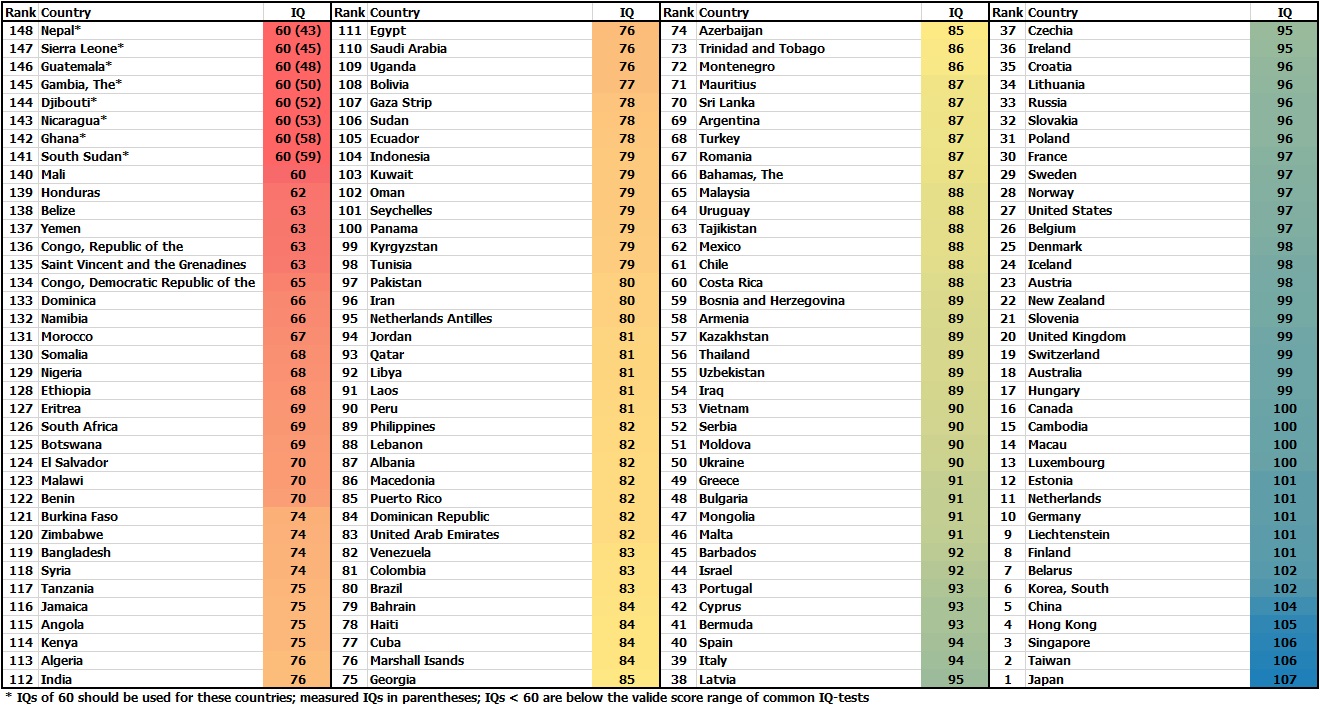
The Average World IQ Is 82
Posted in IQ
Comments Off on The Average World IQ Is 82
Wife of fugitive Rancho Mirage doctor returned to U.S. from Israel, faces new charges
David and Linda Morrow were a prominent part of the Orthodox Jewish community of Beverly Hills.
The wife of a Rancho Mirage plastic surgeon was returned to the United States and entered not guilty pleas on Monday in federal court in Los Angeles to new charges involving flight while on probation and contempt of court, records show.
Linda Morrow, 67, with her husband and their business, Morrow Institute Medical Group Inc., were charged in 2016 with dozens of counts of fraudulently billing insurance companies for surgeries that were not covered.
David M. Morrow, 74, worked out a plea deal in 2017 with federal prosecutors in which he admitted guilt to one count of conspiracy to commit mail fraud. But both fled the country to Israel before he could be sentenced and she could be charged.
“Linda Morrow arrived today in Southern California after being deported from Israel,” Thom Mrozek, spokesman for the U.S. Attorney’s Office in Los Angeles said in an emailed response to questions on Monday. “She is pending charges in the health care fraud case.”
He said David Morrow is pending extradition from Israel.
Both were taken into custody in Israel on June 16.
In his plea deal, Morrow admitted he participated in a scheme to obtain money from insurance companies by “false or fraudulent pretenses.”
Morrow operated two plastic surgery centers in Rancho Mirage and authorities said that for four years his medical practice billed insurance companies for cosmetic surgeries falsely described as “medically necessary.” The loss to insurance companies was estimated at $3.5 million.
He faced up to 20 years in prison — and charges against Linda Morrow had not yet proceeded to trial — when they disappeared in 2017 and later turned up in Israel.
Investigators say the Morrows sold their Beverly Hills home for about $9.5 million and also sold several of their vehicles shortly before disappearing.
“Before slinking away, they had wire-transferred millions of dollars, most likely to fund their flight and disappearance,” officials wrote in 2017 in a summary of the case.
Posted in Beverly Hills
Comments Off on Wife of fugitive Rancho Mirage doctor returned to U.S. from Israel, faces new charges
Ethnonationalism: The Quest for Understanding by Walker Connor
Political Science professor Rupert Emerson defined nation: “the largest community, which when the chips are down, effectively commands men’s loyalty, overriding the claims both of lesser communities within it and those which cut across it or potentially enfold it within a still greater society.”
PDF of Ethnonationalism: The Quest for Understanding by Walker Connor
…Connor is best known for his work on nationalism, and is considered one of the founders of the interdisciplinary field of nationalism studies.[1]
Before the collapse of European communism that began in the late 1980s, nationalism was not a subject of significant academic study and was generally neglected,[citation needed] with the exception of some major contributions by authors such as Ernest Gellner, Benedict Anderson, and Anthony D. Smith.[2][3][4] Connor’s work is another exception to this rule, and today he is regarded as “one of the scholars of nationalism and ethnic conflict who has contributed most towards establishing a conceptual grounding” for the study of nationalism.[5]
Widely cited for his insistence on the inherently ethnic character of nationalism, which he calls ethnonationalism to emphasize the point, Connor has long held that the most significant obstacle to advancing the study of nationalism is terminological imprecision. Particularly problematic, he contends, is the tendency to conflate the distinct concepts of state and nation, as well as the respective concepts of patriotism and nationalism which derive from them.[6]
Another significant theme in Connor’s work is the passionate, nonrational character of nationalism. When trying to understand national sentiment, he argues, the key is not chronological or factual history, but sentient or felt history. National identity is based on the emotional psychology of perceived kinship ties – a sense of the nation as the fully extended family – and accordingly belongs to the realm of the subconscious and nonrational.
Mons writes:
The notion of ethnic group or nation as arbitrary social construct can be likened to the construction of a cathedral or pyramid. True, the artifice is distinctly human and can be said to be commanded by elites. But the act of building the cathedral cannot be a hollow order but must involve labor brought forth from the masses. Without the buy-in of the people, no progress can be made. Secondly, it is an act of great effort. Cathedrals can be built, but doing so takes many, many years and much treasure. It cannot be done on a whim.
All such criticisms of social constructs are founded on the notion that the social construct is arbitrary and also that it can be destroyed and remade at a whim. But houses are social constructs. There can be significant variation in the form of a house, but certain key characteristics remain cross-culturally. This is because the house must always satisfy the needs of a house. A house that is a shitty house ceases to be built. You can have brutalist houses, Modernist houses, rococo houses, but all houses fundamentally must shelter the inhabitants in a reasonably pleasant way.
Nations are ultimately the greatest social constructs. They are constructed, yes, but through the efforts of generations and the treasure of whole states. To do so lightly is folly. To ignore the existing construction to start anew is almost always an act of madness.
Such things cannot be boiled down to mere feelz. Law is a social construct, but law is one of the most real things a person has to deal with. The unreality of social constructs is one of the key push points of the Left, and we must clarify that socially constructed is not the same as arbitrary.
Posted in Nationalism
Comments Off on Ethnonationalism: The Quest for Understanding by Walker Connor
Schindler’s Fate: Genocide, Ethnic Cleansing, and Population Transfers
Academic Robert M. Hayden writes in 1996:
In 1934, as the guarantees of the minority treaties of the Versailles settlement proved utterly illusory and as Hitler consolidated power in Germany, C. A. Macartney, the secretary to the Minorities Committee of the League of Nations published a detailed analysis of the minority problem in Europe and came to the conclusion that “the real root of the problem lies in the philosophy of the national state as it is practiced today in central and eastern Europe. . . . It is true that the [minorities] Treaties provide in general terms for the equality of all nationals of the contracting state before the law, and as regards enjoyment of civil and political rights, and for the same treatment and security in law and fact. . . . [However], since the whole conception of the national state implies a violation of the principle of equality to the detriment of the minorities, the guarantee of equality might be construed as involving the renunciation by the state of its national character. . . . A national state and national minorities are incompatibles.'”
The “philosophy of the national state” referred to by Macartney was that the state, a territory with a government, is an expression of the sovereignty of a “nation,” a group that is in American terms defined ethnically (even religion being considered more a matter of heritage than necessarily of faith). He also noted that the new states after Versailles defined themselves constitutionally in national terms, each as the state of the single nation that forms the majority of its population. Macartney noted that when a minority exists in such a state, only three solutions are possible: the revision of frontiers to match the distribution of populations, the elimination of the minorities by emigration “perhaps through exchange of populations,” or the altering of the basis of the state, so that it is no longer a national state. He also noted that a fourth possibility could be seen in “physical slaughter,” but that “although this most effective of remedies is still in vogue in certain countries it shall not be discussed in this…analysis…
Posted in Genocide, Nationalism
Comments Off on Schindler’s Fate: Genocide, Ethnic Cleansing, and Population Transfers
Operation Typhoon: Hitler’s March on Moscow, October 1941 by David Stahel
Here are excerpts from this book:
* …Germany found it extremely difficult to operate new agents in the Soviet Union. The training programme for agents had in fact been rapidly expanded in 1941, and attempts were made to use agents from Romania, China and Japan. Soviet counterintelligence, however, proved extremely effective in eliminating such men. This was due in part to the NKVD’s rigorous security procedures, but was also the result of faulty German documentation, which often contained minor errors on identification papers…
* Foreign Armies East also failed to accurately assess how the climate and topography of the Soviet Union would affect the operation of aircraft, motor vehicles and tanks.
* In spite of the large gaps in German intelligence, the army’s confidence in the success of Operation Barbarossa remained unshaken because all that was not known about the Soviet Union was offset by Nazi precepts about Slavs and the general staff’s traditional, and largely disparaging, view of Russia. Such unfavourable views were used to gloss over more positive and even worrying depictions of the Red Army, which were by no means absent from the planning process. The Walther memorandum from the German embassy in Moscow (October 1940) foresaw no chance of an internal Soviet collapse and argued that Ukraine, Belarus and the Baltic states would probably be more of a burden than a benefit to Germany’s economic situation.
* In spite of such well-reasoned objections the German general staff operated in reverse order, planning its operations first and then using intelligence to assess the enemy’s most damaging reaction instead of having intelligence shape the operational concept from the beginning.
* While the Germans struggled to conduct and repel intelligence operations into and out of the Soviet Union, their failings extended well beyond the eastern front because British cryptologists working on the Ultra project at Bletchley Park had decrypted the German Enigma codes. Acting on such intelligence without betraying their knowledge of it was a dilemma that would occupy the British for the rest of the war, yet this did not stop them from passing highly sensitive information to the Soviets.
* Given the gulf in the effectiveness of intelligence gathering between the Allied powers and Nazi Germany it is small wonder that in October 1941 Hitler and his high command did not appear to know just how imperilled their war effort really was.
Posted in Germany, Soviet Union
Comments Off on Operation Typhoon: Hitler’s March on Moscow, October 1941 by David Stahel
The Hijacking of American Nationalism
Now, a conference on “conservative nationalism,” which will take place in Washington in July, may be pushing a “nationalism” that is at least as adaptable as Judis’s. One featured speaker, Claire Lehmann, the founder of Quillette, will be talking about how nationalism “is the antidote to racism.” Presumably the more inclusive the operative term, the less likely will be the Left’s attack on those wielding it.
The presence of Daniel Pipes and other neoconservatives at this gathering also suggests that at least some of the panelists will be offering two approved concepts of nationalism: propositional nationhood for the United States and solidarity with Israeli nationalism. In both cases, however, the nationalism being advocated ends up tied to an aggressive foreign policy.
Nationalism, in any case, means different things for different peoples. It doesn’t hold the same meaning for Estonians or Hungarians, who belong to ethnic, historic communities, as it does for a pluralistic country with hundreds of millions of people and a constantly expanding immigrant population.
In the latest issue of the Rassemblement National monthly L’Incorrect, Steve Bannon speaks of the natural fit between European nationalism and the nationalist movement that he has been promoting in the United States. Both these ideologies, Bannon says, derive from the same national principle. In an interview with me in the same publication, I treated Bannon’s contention as wishful thinking. The United States has become too diverse and too culturally disunited to fit a traditional national model. Our use of nationalism will likely lead to something less quaint and less organic but more explosive than what comes from the Baltic nationalists or Viktor Orbán.
The nationalist label has now fallen into the hands of the neocon establishment, which has managed to identify it with international meddling and a creedal nation. In other words, it’s been appropriated by those who already wielded power.
Posted in Nationalism
Comments Off on The Hijacking of American Nationalism
Clarity About Nationalism
In order to make arguments for nationalism, we have to define it.
The first definition in Merriam-Webster is “loyalty and devotion to a nation.” But in a second paragraph, it adds, “especially: a sense of national consciousness exalting one nation above all others and placing primary emphasis on promotion of its culture and interests as opposed to those of other nations or supranational groups.”
Let’s be clear: If the second paragraph is the only definition of nationalism, nationalism is always a bad thing. Furthermore, I acknowledge that this definition is what some people have in mind when they call themselves nationalists.
At the same time, even anti-nationalists would have to acknowledge that if the first paragraph is the definition of “nationalism,” nationalism can often be a beautiful thing.
So, if we are to be honest, the answer to the question of whether nationalism is good or bad is “How do you define it?”
The normal Orthodox Jew has “a sense of national consciousness exalting one nation above all others and placing primary emphasis on promotion of its culture and interests as opposed to those of other nations or supranational groups.” There are other forms of Jewish identity aside from Orthodox Judaism but none of them have been able to sustain themselves, so therefore they don’t matter. The only form of Jewish identity that can sustain itself is one that has “a sense of national consciousness exalting one nation above all others and placing primary emphasis on promotion of its culture and interests as opposed to those of other nations or supranational groups.”
Jews are not separate from the rest of the human race. The only form of nationalism that works in the real world is one that has “a sense of national consciousness exalting one nation above all others and placing primary emphasis on promotion of its culture and interests as opposed to those of other nations or supranational groups.”
How does a marriage work? Do spouses tend to place a primary emphasis on promotion of their interests? I think they do. A spouse that does not give primary loyalty to their own family is not in a happy marriage. If members of a family don’t give their primary familial loyalty to their own family, I suspect they are not in a happy family.
Families do not have to be based on genetic relatedness, but it helps. Parents tend to treat their kids better if their kids are their biological offspring. The more genetically related people are, the better they tend to get along.
Nationalism is, by logic, linguistics, and definition, a subset of racism because nation is a subset of race. The only “nationalism” that is not intrinsically related to race is civic nationalism, which is not nationalism at all, but an ersatz paperwork substitute for it.
UPDATE: Phelps points out that (((Prager))) also lies about “e pluribus unum”.
This is an ABSOLUTE lie. It never meant, “out of many races”, it explicitly meant “out of many states, one confederation.” That is why it is the United STATES, not United Races.
Comments at Vox Day:
* “when it celebrates a nation as inherently superior to all others and when it denigrates all other national commitments.”
Any nation which does not consider itself superior to all others is not long for this world.
The only necessary commitment by a nation is to the nation itself. All other commitments are tactics and strategy to advance and improve the nation.
* All the words related to nation that are explicitly related to birth, family, blood, etc.
The Spanish word for being born is nacir. The past tense, “was born”, is nació. Natal means birth, “née” denotes a woman’s maiden name, etc.
It’s very clear where the word nation comes from. Just drop the n from the English word and you get the Latin root, to be born.
Total lies from Dennis Prager. Now I just have to get my mom to stop listening to him.
* No comment section available.
Figures.
Professional liars NEVER allow responses to be posted to their lies.
* I should like a world where England celebrated the English race, Japan celebrates the Japanese race, Egypt celebrates the Egyptian race, America celebrates the American race, etc.
It would be far better than the bizzaro-world where foreigners are praised and preferred over citizens. (e.g. H1Bs)
* “American nationalism, based as it is on the motto “e pluribus unum” (“out of many, one”), by definition includes Americans of all races and ethnicities. That is how conservatives define American nationalism.”
Well, then the way conservatives (i.e., Civic Nationalist cucks) define American Nationalism has nothing to do with what the term actually signified when it was originally used.
As Phelps correctly pointed out, it is a reference to the original 13 colonies uniting, and had nothing whatsoever to do with different races or ethnicities “coming together.”
The fact that the Naturalization Act of 1790, the first statute in the United States to codify naturalization law, restricted citizenship to “any alien, being a free white person” who had been in the U.S. for two years is bad news to those who would believe Prager’s expected distortions.
* That physical separation of groups of peoples, over time, producing differing sets of heritable physical traits from elsewhere, is understood and currently generally accepted. That such separation and differing environmental stressors would have similar tendencies in heritable behavioral traits is not even a leap, it is part in parcel. Denying that latter part is the glue of civic nationalism.
Nations arising out of these differing traits would create differing patterns of stability and conflict/conflict resolution, among other heritable behaviorally influenced cognitive patterns. Providing differing levels of stability for groups sharing social, economic, and governmental systems of organization.
* Civic nationalists are no different from the rest of the Leftists because they are all egalitarian, which disqualifies them from being conservative, by any definition, and anyone who is not also egalitarian (to them) is awful, and cruel, and mean, and wrong….and the worst thing they can think of, which must be Nazi Germany. Only in this way could anybody equate the Confederacy with Nazi Germany or to elevate the KKK to being a nation.
So Dennis wants the rest of the Leftists to know that the civic nationalists are egalitarians too, so it is OK to negotiate with them, and they can paint anyone who is not egalitarian as the enemy. The only thing the civic nationalists have to compromise with the Leftists is personal income tax rates for the wealthy and corporate private property.
* The civic nationalist have swallowed whole Breitbart axiom “politics is down stream of culture.” I believe this can be used against them by adding to it in the following way, “politics is down stream of culture, and culture is down stream of demographics.”
* I think the problem is not that people lie as much as that the ideas of “nation,” “race,” and even “culture” are so fungible. I suspect that Mr. Day and Mr. Prager define nation differently, not that either is “lying” when they use the term.
When I ask someone who starts opining about the “white” race who, exactly, is included and excluded, I get a different list almost every time. And each of these people is absolutely convinced that *his* list is the correct one, and everyone else is wrong. Who knew, for instance, that the Celts were (and are) not “white” to many folk? Those Irish,eh. Or the Slavs. Or Semitic folk. Or Gypsies. Or Visigoths/Latinos. Spanish people are white, but Argentinians are not. Blue-eyed Mexicans are white, but brown-eyed Mexicans are not.
Similarly, only their definition of nation is right. When did did the Roman empire stop becoming a “nation?” When it started making Syrians and Arabs emperors? When the Visigoths started running the show?
And only their classifications of cultures is right. And only their classification of religions is right. Catholics are Christian, but Baptists are not. Anglicans are Christian, but Catholics are not. Seventh Day Adventists are Christian, but Latter Day Saints are not. Charismatic Lutherans are Christian, but Pentacostals are not.
When, as all right thinking people know, it’s *my* definitions that are correct.
* Empires are not, definitionally, nations. And even a cursory study of history will show that empire is the ruin of every nation that tries it. Either the other nations around them destroy them, or they succeed and become a cosmopolitan empire, and eventually replace themselves in their own home.
Greece, Rome, England, France, Germany, Russia, America. Some nations recover, to some extent, after sufficient time.* England itself is composed of several nations. Wiki lists the following that preceded unification.
Wessex
Sussex
Essex
Kent
Dumnonia
Mercia
East Anglia
Northumbria
Welsh Marches
Principality of Wales* Nations don’t last forever, when they mix and match. Those identities have been lost. Strangely though, they do not list Yorkshire, which is a still separate national identity within England.
I read Hazony’s book. Unlike many on the nationalist Right, I saw through him immediately and pointed out that his “National Conservative” conference was an obvious attempt to set up yet another neoclown gatekeeping organization, this one focused on nationalists. Hazony’s further attempts to “defend his ideas” readily reveal him to be not only a gatekeeper, but a shameless liar of the Ben Shapiro variety for two very obvious reasons.
First, to the extent there is any distinction between two terms that have historically been used in a synonymous manner, nation is a subset of race. Necessarily. So to base an argument on the idea that nation is actually a broader category than race is worse than dishonest, it is deeply stupid. It’s a total nonstarter.
Second, the etymology of nation makes it obvious that racialism is, and always will be, an element of nationalism.
1250–1300; Middle English < Latin nātiōn- (stem of nātiō) birth, tribe, equivalent to nāt(us) (past participle of nāscī to be born) + -iōn- -ionOne's nationality derives from one's birth, not one's geographical location or paperwork. It is an identification based on DNA, blood, and family, not ideology, confession, documents, or current location in the space-time continuum. By appealing to the fact of adoption, Hazony is stupidly attempting to derive a rule from its occasional exception.
Comments on this Vox Day blog post:
* The civnat nonsense usually has an appeal in Christian countries because of the supra-national, confessional nature of Christianity to which the civnats draw false comparisons with nationality. Churchians are particularly susceptible. You don’t generally see this in non-Christian nations. Where you Don it is because of a secular religion that holds to some sort of confessional membership (international socialism), but it tends to be fairly weak due to the inherently false nature of secular religions. There is an element of it in Muslim nations, but it is weak due to strong tribal bonds (see, e.g. pan-arabism, Persian international influence through Shia islam, etc.).
* And the examples that he pulls from the Bible (Naomi and Ruth, I believe) in his book to demonstrate that nation does not equal race, though somewhat valid, are not even remotely relevant to the modern world and mass migration. A handful of migrants and refugees can, of course, be assimilated both genetically and culturally into a larger nation. Millions of them, however, cannot be.
Furthermore, I thought his examples were cherry picking data. He could have given a more balanced biblical view had he mentioned all of the evil religious and cultural practices that were brought in by Solomon’s (and other king’s) foreign wives.
* Should we expect ideological purity from Hazony? Let’s not be naive.
One the one hand, he and his spouse are working overtime to ensure his tribe’s posterity, what with their nine kids. He’s taking personal responsibility for “an identification based on DNA, blood, and family.”
One the other hand he’s got nine kids and, hey, a guy’s gotta grab the punditry dough while he can with all those mouths to feed and send, presumably, to Princeton, the loving couple’s alma mater.
Oh well. If he makes the term “nationalism” respectable that’s progress of a sort.
* Historically, there were a few ways to claim legitimate membership in the tribe:
1. Be born into the tribe to one or two parents who were full members of the tribe.
2. Be accepted by tribal authorities as an adopted member who had earned their place through legitimate, proven loyalty.
3. Marry a member of the tribe.
4. Be adopted by members of the tribe as a child.Nothing about Jus Soli gives you legitimate membership in the tribe. Being born in proximity is simply not sufficient.
That said, one area where the “racialists” are generally wrong is that the tribe has no right to disinherit someone from membership in the tribe because they are of mixed blood or were adopted in accordance with custom and law. That sets a dangerous precedent wherein the ancient rights of inheritance and familial authority are altered or abolished based on modern theories.
Posted in Dennis Prager, Nationalism
Comments Off on Clarity About Nationalism
WP: The case for diet soda: It gets a bad rap, but the research tells a different story
Many people I know are hysterically opposed to diet soda. I did the research and realized there wasn’t much to their claims.
The nutrition community doesn’t like diet soda. Of all the groups that make dietary recommendations, I can’t find one that lends full-throated support. “Limit low-calorie sodas,” says the American Heart Association, and “stick to water.” The Center for Science in the Public Interest says it’s “best to avoid” artificial sweeteners. The Canadian dietary guidelines discourage them. The U.S. dietary guidelines are decidedly meh. Although added sugar is a top public health concern, diet soda is consistently met with something between distrust and hostility.
Dig into the research, though, and you don’t find a lot of substance. The hostility-to-evidence ratio is way out of whack. What gives?
I’ll try to answer that, but we have to begin with what is arguably the most important thing to know about low-calorie sweeteners: You consume them in teeny tiny quantities. Take sucralose, the ingredient in Splenda. The FDA has determined that the Acceptable Daily Intake (which it derives by determining the safe level and dividing by 100) is 5 milligrams per kilogram of body weight. If you weigh 150 pounds, that means you can eat 340 milligrams, the amount in 28 packets of Splenda, every day.
The important number there is 340 milligrams — about a third of a gram. If it were sugar, that would be one-third of a quarter-teaspoon.
Posted in Health
Comments Off on WP: The case for diet soda: It gets a bad rap, but the research tells a different story