In the presence of [ethnic] diversity, we hunker down. We act like turtles. The effect of diversity is worse than had been imagined. And it’s not just that we don’t trust people who are not like us. In diverse communities, we don’t trust people who do look like us.
—Harvard professor Robert D. Putnam
It was one of the more irony-laden incidents in the history of celebrity social scientists. While in Sweden to receive a $50,000 academic prize as political science professor of the year, Harvard’s Robert D. Putnam, a former Carter administration official who made his reputation writing about the decline of social trust in America in his bestseller Bowling Alone, confessed to Financial Times columnist John Lloyd that his latest research discovery—that ethnic diversity decreases trust and co-operation in communities—was so explosive that for the last half decade he hadn’t dared announce it “until he could develop proposals to compensate for the negative effects of diversity, saying it ‘would have been irresponsible to publish without that.’”
In a column headlined “Harvard study paints bleak picture of ethnic diversity,” Lloyd summarized the results of the largest study ever of “civic engagement,” a survey of 26,200 people in 40 American communities:
When the data were adjusted for class, income and other factors, they showed that the more people of different races lived in the same community, the greater the loss of trust. ‘They don’t trust the local mayor, they don’t trust the local paper, they don’t trust other people and they don’t trust institutions,’ said Prof Putnam. ‘The only thing there’s more of is protest marches and TV watching.’
Lloyd noted, “Prof Putnam found trust was lowest in Los Angeles, ‘the most diverse human habitation in human history.’”
As if to prove his own point that diversity creates minefields of mistrust, Putnam later protested to the Harvard Crimson that the Financial Times essay left him feeling betrayed, calling it “by two degrees of magnitude, the worst experience I have ever had with the media.” To Putnam’s horror, hundreds of “racists and anti-immigrant activists” sent him e-mails congratulating him for finally coming clean about his findings.
Lloyd stoutly stood by his reporting, and Putnam couldn’t cite any mistakes of fact, just a failure to accentuate the positive. It was “almost criminal,” Putnam grumbled, that Lloyd had not sufficiently emphasized the spin that he had spent five years concocting. Yet considering the quality of Putnam’s talking points that Lloyd did pass on, perhaps the journalist was being merciful in not giving the professor more rope with which to hang himself. For example, Putnam’s line—“What we shouldn’t do is to say that they [immigrants] should be more like us. We should construct a new us”—sounds like a weak parody of Bertolt Brecht’s parody of Communist propaganda after the failed 1953 uprising against the East German puppet regime: “Would it not be easier for the government to dissolve the people and elect another?”
Before Putnam hid his study away, his research had appeared on March 1, 2001 in a Los Angeles Times article entitled “Love Thy Neighbor? Not in L.A.” Reporter Peter Y. Hong recounted, “Those who live in more homogeneous places, such as New Hampshire, Montana or Lewiston, Maine, do more with friends and are more involved in community affairs or politics than residents of more cosmopolitan areas, the study said.”
Putnam’s discovery is hardly shocking to anyone who has tried to organize a civic betterment project in a multi-ethnic neighborhood. My wife and I lived for 12 years in Chicago’s Uptown district, which claims to be the most diverse two square miles in America, with about 100 different languages being spoken. She helped launch a neighborhood drive to repair the dilapidated playlot across the street. To get Mayor Daley’s administration to chip in, we needed to raise matching funds and sign up volunteer laborers.
This kind of Robert D. Putnam-endorsed good citizenship proved difficult in Uptown, however, precisely because of its remarkable diversity. The most obvious stumbling block was that it’s hard to talk neighbors into donating money or time if they don’t speak the same language as you. Then there’s the fundamental difficulty of making multiculturalism work—namely, multiple cultures. Getting Koreans, Russians, Mexicans, Nigerians, and Assyrians (Christian Iraqis) to agree on how to landscape a park is harder than fostering consensus among people who all grew up with the same mental picture of what a park should look like. For example, Russian women like to sunbathe. But most of the immigrant ladies from more southerly countries stick to the shade, since their cultures discriminate in favor of fairer-skinned women. So do you plant a lot of shade trees or not?
The high crime rate didn’t help either. The affluent South Vietnamese merchants from the nearby Little Saigon district showed scant enthusiasm for sending their small children to play in a park that would also be used by large black kids from the local public-housing project.
Exotic inter-immigrant hatreds also got in the way. The Eritreans and Ethiopians are both slender, elegant-looking brown people with thin Arab noses, who appear identical to undiscerning American eyes. But their compatriots in the Horn of Africa were fighting a vicious war.
Finally, most of the immigrants, with the possible exception of the Eritreans, came from countries where only a chump would trust neighbors he wasn’t related to, much less count on the government for an even break. If the South Vietnamese, for example, had been less clannish and more ready to sacrifice for the national good in 1964-75, they wouldn’t be so proficient at running family-owned restaurants on Argyle Street today. But they might still have their own country.
In the end, boring old middle-class, English-speaking, native-born Americans (mostly white, but with some black-white couples) did the bulk of the work. When the ordeal of organizing was over, everybody seemed to give up on trying to bring Uptown together for civic improvement for the rest of the decade.
The importance of co-operativeness has fallen in and out of intellectual fashion over the centuries. An early advocate of the role of cohesion in history’s cycles was the 14th-century Arab statesman and scholar Ibn Khaldun, who documented that North African dynasties typically began as desert tribes poor in everything but what he termed asabiya or social solidarity. Their willingness to sacrifice for each other made them formidable in battle. But once they conquered a civilized state along the coast, the inevitable growth in inequality began to sap their asabiya, until after several generations their growing fractiousness allowed another cohesive clan to emerge from the desert and overthrow them.
Recently, Princeton biologist Peter Turchin has extended Ibn Khaldun’s analysis in a disquieting direction, pointing out that nothing generates asabiya like having a common enemy. Turchin notes that powerful states arise mostly on ethnic frontiers, where conflicts with very different peoples persuade co-ethnics to overcome their minor differences and all hang together, or assuredly they would all hang separately. Thus the German heartland remained divided up among numerous squabbling principalities until 1870. Meanwhile, powerful German kingdoms emerged on Prussia’s border with the Balts and Slavs and Austria’s border with the Slavs and Magyars.
Similarly, the 13 American colonies came together by fighting first the French and Indians, then the British. In this century, two world wars helped forge from the heavy immigration of 1890 to 1924 what Putnam calls the “long civic generation” that reached its peak in the 1940s and ’50s.
Half a millennium after Ibn Khaldun, Alexis de Tocqueville famously attributed much of America’s success to its “forever forming associations. There are not only commercial and industrial associations in which all take part, but others of a thousand different types—religious, moral, serious, futile, very general and very limited, immensely large and very minute. Nothing, in my view, deserves more attention than the intellectual and moral associations in America.”
The transformation of economics into a technical rather than empirical field discouraged hard thinking about co-operation. It was much simpler to create mathematical models based on the assumption that rational individual self-interest drove human behavior, even though that perspective could hardly explain such vast events as the First World War, that abattoir of asabiya.
In the 1990s, the importance of civil society was widely talked up as crucial in transitioning post-Soviet states away from totalitarianism, but the free-market economists’ prescription of “shock therapy” prevailed disastrously in Russia, as gangsters looted the nations’ assets.
An important contribution to the scholarly revival came in Francis Fukuyama’s 1995 book Trust: The Social Virtues & the Creation of Prosperity. Fukuyama raised the hot-potato issue that Americans, Northwestern Europeans, and Japanese tend to work together well to create huge corporations, while the companies of other advanced countries, such as Italy and Taiwan, can seldom grow beyond family firms. (As Luigi Barzini remarked in The Italians, only a fool would be a minority shareholder in Sicily, so nobody is one.) Fukuyama prudently ignored, though, the large swaths of the world that are low both in trust and technology, such as Africa, Latin America, and the Middle East.
As an economics major and libertarian fellow-traveler in the late 1970s, I assumed that individualism made America great. But a couple of trips south of the border raised questions. Venturing onto a Buenos Aires freeway in 1978, I discovered a carnival of rugged individualists. Back home in Los Angeles, everybody drove between the lane-markers painted on the pavement, but only about one in three Argentineans followed that custom. Another third straddled the stripes, apparently convinced that the idiots driving between the lines were unleashing vehicular chaos. And the final third ignored the maricón lanes altogether and drove wherever they wanted.
The next year, I was sitting on an Acapulco beach with some college friends, trying to shoo away peddlers. When we tried to brush off one especially persistent drug dealer by claiming we had no cash, he whipped out his credit-card machine, which was impressively enterprising for the 1970s. That set me thinking about why we Americans were luxuriating on the Mexicans’ beach instead of vice-versa. Clearly, the individual entrepreneurs pestering us were at least as hardworking and ambitious as we were. Mexico’s economic shortcoming had to be its corrupt and feckless large organizations. Mexicans didn’t seem to team up well beyond family-scale. Read on.
Posted inDiversity|Comments Off on Steve Sailer: ‘Multiculturalism doesn’t make vibrant communities but defensive ones’
Earnest Minnesota boomer Tom Gjelten is flummoxed by his discovery of emerging tensions between two natural allies within the Coalition of the Virtuous: Black civil-rights crusaders and well-to-do liberal Jews.
The report begins,
The Jews who immigrated to America in the early 20th century brought with them their history as a persecuted people. Many were fleeing pogroms and anti-Semitic attacks in Europe, and those experiences bonded them to other groups that also faced discrimination.
Fair-use excerpt to give a sense of Gjelten’s anxiety:
[In the years subsequent to 1964, the Anti-Defamation] League was focused primarily on fighting anti-Semitism, but the League’s new president, Jonathan Greenblatt, wants the ADL to renew its old civil rights activism and move the work forward.
“There’s questions like mass incarceration, the school-to-prison pipeline, economic opportunity,” Greenblatt told NPR in a recent interview. “We need to integrate what’s happening with the Latino community [and] the LGBT community, because when we fight for the rights of others, it strengthens America. It makes America a better place.”
There is just one complication. For many current civil rights activists, solidarity with Palestinians is taking precedence over the old solidarity with American Jews.
Uh-oh!
“Many of our experiences of police repression and brutality seem to mirror that of many international peoples, including [people in] Palestine,” says the Rev. Mike McBride, a prominent African-American pastor from Berkeley, Calif., who became involved with the Black Lives Matter movement after the shooting of Michael Brown in Ferguson, Mo.
“When we were in Ferguson, and we were being terrorized by the law enforcement and military apparatus,” McBride says, “it was Palestinian young people who started to tweet us on how to survive and deal with the terror we were experiencing.”
Fortunately, Gjelten wraps with an inspiring call for meeting the increased pig-iron production quotas of the new Five Year Plan:
… But given the disagreements on issues such as the Israeli-Palestinian conflict, even greater efforts may be necessary to make the Anti-Defamation League a consistently valued civil rights partner in a time of divided loyalties.
This being NPR, merriment ensues in the Readers’ Comments section. Progressives have no need to recognize “virtue signalling” when they can employ it with such elegance and expertise.
As icing, Mr. Gjelten’s “new book, A Nation of Nations: A Great American Immigration Story (Simon & Schuster), recounts the impact on America of the 1965 Immigration Act, which officially opened the country’s doors to immigrants of color.”
Posted inADL|Comments Off on Anti-Defamation League Chief Faces Challenge Trying To Renew Civil Rights Activism
Steve Sailer writes: “The Democrats have been boasting since the 1990s that they are going to impose one party rule on America by importing countless foreign ringers to vote for them … Why wouldn’t Americans resent this?”
* I follow immigration polls, and about 5 in 6 are badly biased in their wording. This is intentional, it is always a bias designed to elicit an open-borders view and exaggerate support for immigration.
Probably the worst polls are when amnesty is being actively considered, and the polls wording completely distorts the content of the actual amnesty bills. The most important part of the Rubio amnesty bill was that it immediately legalized nearly all illegal immigrants. At least 10 million, overnight, would go from “currently subject to deportation” to “can work on the books and complete with Americans for these jobs.” Instead the polls were like “Should some immigrants who learn English, pay back taxes, and pass a background check be eligible for a path to citizenship?”
The more honest polls show that only 20% or so Americans have the elites’ view of immigration, amnesty for illegals and ramp up legal immigration, and about 60-65% think current levels of immigration are too high. And I have never seen a poll that lets the respondent agree or disagree with my view and many others, including probably Trump: “no Muslim immigration or uneducated economic migrants, but scientists and the small number of Europeans and Japanese who want to come are OK”
Posted inAmerica|Comments Off on Do Americans Want More Immigration?
* #UCLA students should immediately go to their gun-free safe-spaces to be completely protected from all harm.
Last night:
Breitbart: LOS ANGELES — The latest stop on Milo Yiannopoulous’s “Dangerous Faggot Tour” at the University of California Los Angeles (UCLA) was blocked by protests at the beginning, and evacuated by a bomb threat at the end.
Before the event started, groups of protesters gathered outside of the Broad Art Building, where Milo was to speak. A large banner was hung from the third story of a neighboring building, which read: “Bruins Against Hate.” Groups of women and men stood outside holding pro-feminism signs — with black duct tape over their mouths (above).
The protesters blocked the entrance of the building, forcing the hundreds of Milo fans to wait outside until organizers and campus police could offer a different way to enter the auditorium.
Fights began to break out when the back doors, which organizers had been using to usher people into the event, were also blocked by protesters who refused to let people in.
After all of the drama outside, Milo and his special guest David Rubin were interrupted by two feminist protesters during their remarks. The protesters’ chants were met by a loud roar from the crowd: “Build the Wall!”
Finally, after the feminists were removed from the auditorium, Milo and David were able to resume their talk. After the show was over, however, and most of all the people in the auditorium had left, a large group of UCLA police came in and told those left in the room that they had to leave immediately because of a bomb threat.
Soon thereafter, the Los Angeles Police Department (LAPD) arrived on campus with bomb-sniffing dogs. After a sweep of the auditorium, the all-clear was given.
Posted inUCLA|Comments Off on Murder-Suicide At UCLA
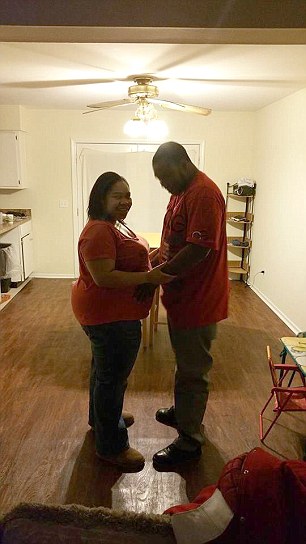
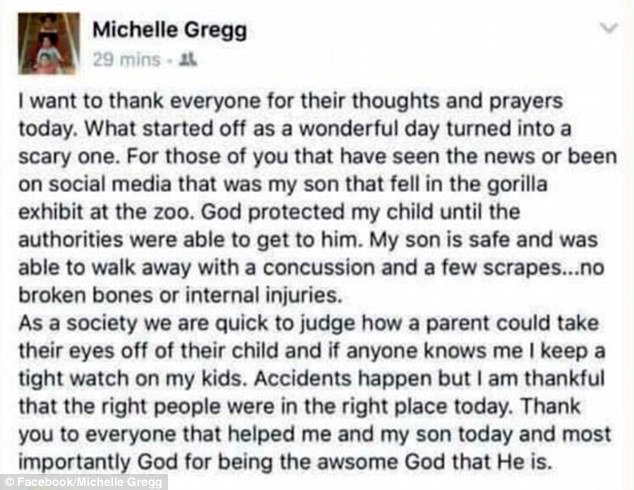
Daily Mail: Deonne Dickerson and Michelle Gregg have been heavily criticized
Harambe was fatally shot after their four-year-old boy crawled past a railing and fell 15ft into the gorilla exhibit moat
Harambe was shot dead after dragging the boy violently around
Many have blamed the boy’s parents for 17-year-old Harambe’s death
They released a statement on Sunday saying their boy is doing ‘just fine’
Zoo director said Harambe was ‘disoriented’ and tranquilizer would have taken too long with the possibility of agitating the animal even more
Director said: ‘Looking back we would make the same decision’
He insisted barriers were secure, asking: ‘Do you know any four-year-olds? They can climb over anything’
These are the parents of the four-year-old boy whose 15-feet fall into the gorilla exhibit moat in Cincinnati Zoo resulted in the death of 17-year-old silverback gorilla, Harambe.
Seen here for the first time is mother Michelle Gregg, 32, who has four children by father Deonne Dickerson, 36, a man who, Daily Mail Online can disclose, has a lengthy criminal history.
Criminal filings against Dickerson stretch over a decade and include burglary, firearms offences, drug trafficking, criminal trespass, disorderly conduct and kidnap.
In 2006 he was sentenced to one year behind bars for a drug trafficking conviction.
But in numerous pictures posted on Dickerson’s Facebook site in recent years he appears to have turned his life around to become the proud father of four.
Indeed, the majority of his postings to the social media site are updates of his children and his working life.
In others pictures he has uploaded his friends congratulate him and Michelle on the birth of their fourth child last January.
Posted inBlacks|Comments Off on Parents-of-four whose son fell into zoo enclosure sparking killing of Harambe the gorilla as it emerges father has a lengthy criminal history – including kidnap and drug trafficking
Steve Sailer writes: Donald Trump has come to be seen by both his enemies and his supporters as the living embodiment of a potential revival of the American tradition of free speech after the Obama ice age of political correctness. Trump’s backers tend to believe they have more to gain from frank, outspoken debate (whether in pragmatic advantages or simply in entertainment value), while his opponents assume that they, personally, have more to lose from a return to a freer market for ideas.
This is one of those rare cases in politics where both sides may be right.
For example, back in March, Senator Marco Rubio warned, shortly before losing the Florida primary and dropping out of the race, that this new craze for honesty had America careening toward chaos and anarchy (not to mention poorer career prospects for establishment Republicans):
“This is what a culture and a society looks like when everybody says whatever the heck they want, when everyone just goes around saying ‘I’m just going to speak my mind,’” Rubio said at a morning press conference in Largo, Fla. “Well, there are other people that are angry, too. And if they speak out and say whatever they want, it all breaks down. It’s called chaos. It’s called anarchy. And that’s what we’re careening towards.”
Rubio had prospered under the old rules of the game that had limited the topics for Republican rhetoric to questions of who liked the corporate income tax least and loved Israel most. But in the unexpected new Trump Era when Republican voters were suddenly allowed to offer their opinions on more fundamental topics such as who should be allowed into America, Rubio withered.
Of course, Rubio didn’t stumble quite as humiliatingly as onetime front-runner Jeb Bush, whose central theme—that he loved Mexicans more than he liked Americans—had been considered electoral genius by the GOP brain trust in 2012–15. Before Trump reminded voters that your candidate really ought to at least claim to be on your side, it was thought clever for Republican candidates to offer American voters an attitude of disdain and a platform of dispossession.
“The fact that Trump is offering a less filtered version of how a typical New York City voter views the universe is probably a good thing.”
One odd thing about all this is that Trump, who prides himself on his salesmanship, had never seemed during his long celebrity career to be a likely candidate for the role of leader of the awkward squad of tellers of inconvenient truths. Even more than most salesmen, Trump has been famous over the last three decades for using generous helpings of what he calls “truthful hyperbole” to promote his offerings as the greatest things ever. (On the other hand, in contrast to the rather abstract business life of Mitt Romney, Trump’s career of building giant buildings that rappers and pro athletes want to live in is the kind of tangible accomplishment that citizens can identify with.)
Trump’s evident love of making money meant that he wasn’t seen as a threat to the established order, because our system is practiced at controlling dissent through economic squeezing.
The key month in the emergence of the Legend of Trump, however, came immediately following his June 16, 2015, announcement of his candidacy, when business behemoths like NBC, Macy’s, Univision, Carlos Slim, and the golf tours of America and Britain all threatened to break their corporate relationships with Trump for pointing out that Mexican elites are dumping their unwanted population on America.
Normally Americans meekly back down with apologies when confronted with that kind of corporate firepower. But Trump responded that he had 10 billion dollars so he could afford to tell the truth. Granted, Trump probably doesn’t have close to 10 billion dollars, but that only made his political audacity seem even more heroic. Read on.
* People like Anglin and other men with extravagant haircuts (what?) don’t really believe Trum is a fascist.
They have learned from 100 years of liberalism. They realized that the only thing required a of a political movement in the age of mass media is to be known. As long as you manage to grab attention with an air of having fun and I-don’t-give-a-fuck, you’ll do well. Being serious and thoughtful is for later. Remind you of anything?
They also photoshopped Hitler quotes onto Taylor Swift pictures until the terse letters from her lawyers.
* I’ve finally gotten around to watching The Sopranos, and Trump strikes me as likeable for many of the same reasons the TV audience finds the Tony Soprano character likable.
Gets things done.
A natural leader–assumes dominance.
Says what he thinks without fear or favor.
Treats his opponents harshly, as they (usually) deserve.
Deals with the world as it is rather than with wishful thinking.
Has an intuitive understanding of the strengths and weaknesses of others.
Anti-intellectual, cuts through intellectual bullshit and gets at the essential truth.
* Hillary? Jokes? She can only be found on the pointy end of that spear.
Let’s pull one of her previous exertions at humor out of the memory hole — the barking incident.
The thing that got me about Hillary’s canine performance is that it just couldn’t have been spontaneous — it was obviously designed as part of a joke. Her communication team must have thought it was a fine idea to have her do this thing.
Can you imagine the brainstorming that must have gone into this?
Communication Guru 1: The problem we keep running into in the focus groups is that your delivery seems too canned, Hillary.
Hillary: Canned? Canned? They just don’t know me! Everybody who knows me knows how warm and spontaneous I am! They love me to pieces for my warmth and spontaneity! Sometimes they get so overwhelmed with it they have to leave the room!
Comm Guru 2: We just have to figure out a way to let the public see what all your friends already know.
Hillary: Everybody loves my dog imitation! They can’t believe it when I do my dog imitation! You’ve all seen my dog imitation, haven’t you?
Comm Guru 1: Oh Yes of course.
Comm Guru 2: Many times. Can’t count how many. Not enough fingers and toes.
Hillary: So let’s figure out how to work it in.
Comms Gurus 1 and 2, in unison: Great idea, Hillary!
Comm Guru 1: How about making fun of the Republicans? They’re like silly demented dogs, right?
Hillary: That’s fabulous!
Comm Guru 2: Yes, Hillary, what you could do to set it up is to talk about how everytime a Republican lies, a dog barks. And then you do your silly demented dog bark.
Hillary: And that is fabulous! Perfect! This thing is on!
Comm Guru 1: It’s so inspirational to be working with you, Hillary!
Comm Guru 2:Yeah, I think I speak for both of us when I say it almost feels wrong to charge for our services!
Hillary: Almost, but not totally, am I right?
Comm Gurus 1 and 2: Oh, you’re right again, Hillary!
All: Ha,ha,ha!
Hillary: People aren’t going to stop talking about this one, I can feel it!
Comm Guru 1: It’ll never go away, I guarantee it.
Comm Guru 2: Youtube is forever.
Hillary: What I wouldn’t give to see the look on Trump’s face when he first hears it! [Hillary starts barking, doesn’t stop].
* And my belief that Trump is going to steamroll Hillary is due not to specific attacks. It is due to the Sailer strategy being valid, and Trump being far better at winning, executing and strategizing than Hillary has proven to be. Hillary is plenty smart, but so is Trump and likely more so. And what Trump has is killer instinct, competitiveness, and ability in that area. This is something common to all elite businessmen – their idea of the perfect business situation is one where they have no competition, and if that is not the lay of the land, they do their best to make it that way.
Someone like Trump is very well practiced at sizing up strengths and weaknesses of opponents, he will know his own, and he will have analyzed it before even entering the race. He will pit his strengths against her weaknesses, and do his best to make her play his game. His feeling for what people will buy, what they believe, what they think – it’s far more valuable than her knowledge of arbitrary laws and how to get your way in a courtroom. Her Secretary of Statesmanship was her opportunity to show what a diplomatic deep state genius she was. And… nothing. She’s no Bill, she doesn’t have the feel, the instinct; her hamfisted campaign attempts have been exactly that. Nothing grabs. She’s struggling to beat a geriatric communist.
One thing I’ve been pretty good at, is kind of the opposite to Steve. Things I like become popular. I early adopt some things years before they go mainstream. In the case of HBD, more than anything else I’ve been a fan of, however the full weight of the media, education system and a lot of the government has been against us. We’re going mainstream, and Trump is our avatar. The riot in the ballot booth is about to begin, and not before time.
* The Times article is well worth reading in entirety. Steve focuses on immigration, but there’s more to the “psychological reactance” (a theory that apparently has been around since 1966) driving Trump’s appeal:
Jonathan Haidt, a professor at N.Y.U., suggested to me that one way to better understand the intensity of Trump’s appeal is by looking at something called “psychological reactance.” Haidt describes reactance as
“the feeling you get when people try to stop you from doing something you’ve been doing, and you perceive that they have no right or justification for stopping you. So you redouble your efforts and do it even more, just to show that you don’t accept their domination. Men in particular are concerned to show that they do not accept domination.”
Haidt applies this to the 2016 election:
“Translated to the Trump phenomenon, I would say that decades of political correctness, with its focus on “straight white men” as the villains and oppressors — now extended to “straight white cis-gendered men” — has caused some degree of reactance in many and perhaps most white men.”
In both the workplace and academia, Haidt argues,
“the accusatory and vindictive approach of many social justice activists and diversity trainers may actually have increased the desire and willingness of some white men to say and do un-PC things.”
There you go. That’s it, in a nutshell. The parts in bold – my emphasis – sum up what I hear from a lot of men I know who are surprise Trump supporters. As Paddy Chayefsky put it, they’re mad as hell, and they’re not going to take this anymore. It’s not just immigration, not just BLM or silly arguments over transgender bathroom rights. It’s the demonization of them, of us, which recently has become openly celebrated in mainstream media. Just as important, it’s the sense that one can’t fight back or even argue gently, mildly and reasonably against any of the PC dogma without risking ostracization and professional and sometimes personal ruin.
The level of fury with this hatred for whites, males and heterosexuals and this enforced orthodoxy of thought has been steadily building for years. It has found a voice in Trump, for all his many faults.
That’s why he’s Teflon Trump – it almost literally doesn’t matter what he says. He’s fighting back. And it just feels so damn good to have someone on the public stage sticking a thumb in the eye of the forces of PC that he gets tremendous support regardless of what he actually stands for.
The fact that things have come to this, that so many white men feel almost compelled to support this otherwise awful man for President, is another reason to be furious. We’ve not only been demonized and silenced, now we’re pushed to support someone for President who is poorly suited to the office but who at least speaks up for us.
* They’ve spent decades trying to make Crooked Hillary look human/warm/empathetic, only to have it fall flat and fake each time. Any comedian will tell you it’s the delivery, not the material, that sells the joke. It’s also why Chris Rock’s material wouldn’t work for Jerry Seinfeld and vice-versa; their deliveries work for their stuff, not for anyone else’s (it’s also why comedians will sometimes tell stories about “giving” a joke to another comedian because it doesn’t “work” for them).
That isn’t to say that material isn’t important – it is- but if you can’t deliver a joke the material doesn’t matter.
Hillary always tries the fake humorous routine or the fake warmth routine, and it falls flatter and flatter each time. She should really just play up her dour, humorless, but serious nature – similar to Margaret Thatcher (whom Hillary is too proud and ignorant to emulate). That way, a dry riposte from Hillary would carry far more humor, because you wouldn’t see it coming. But she’s dumb, so she’ll do the fake-cackling nonsense and the fake-loving-grandma routine and no one will buy it.
That said, the comedians have been out in force attacking Trump since last summer, and it just makes him stronger. Why? Simple: every joke in the world that could be made to denigrate Trump has already been made. They aren’t fresh. So anything Hillary delivers will seem stale from the get go. That’s dangerous.
Trump also took full-frontal comedy blows already at a professional roast by Comedy Central. Way back in 2011: http://www.imdb.com/title/tt1865333/. Nothing Hillary can throw at him will in anyway be as cutting or memorable as when he sat there and let professional comedy writers and comedians have a field day on him on cable TV.* Hillary will come off as a summer repeat with her jokes.
Trump, meanwhile, has the gift of freshness and great delivery. “Crooked” Hillary was fresh – as Scott Adams called it, a linguistic killshot – but Trump has the gift of great comedic delivery. That’s killer. If Ted Cruz or Rubio had called her “Crooked Hilary” or Goofy Elizabeth or Crazy Bernie, it would have sounded stilted, forced, and fake. Trump comes off humorous, and the jokes fit his delivery. He has a great stage presence.
If I were Hillary, I would avoid making jokes about Trump, because it plays into Trump’s strengths and not hers. It’d be Dukakis in the tank all over again, or Kerry on the windboard – don’t play up an image that isn’t you. That said, she seems a bad enough campaigner to fall for some Hollywood consultant’s argument that they just need to make fun of Trump more this summer, and she can use the same comedy writers that Jimmy Kimmel have – after all, he’s funny, so it must be all his material, right? **
*again, the fact that Trump did this roast in 2011 me he was thinking about seriously running for a long time and planned it out. He opened himself up for the roast specifically to gauge where the likely attacks would come from and what they would say, and to get it all out of the way. Remember: he registered “Make America Great Again” as a trademark way back in 2012. He’s playing 4th-level chess while everyone else thinks he’s too dumb to know how to open the box.
**p.s. Jimmy Kimmel isn’t funny, just putting this in context.
Posted inAmerica|Comments Off on Steve Sailer: ‘The core of the Trump Phenomenon is the question of freedom of expression.’
I guess tribalism is peachy for Jews and other non-whites but it is a bad thing for goyim. Got it.
Ben Shapiro writes: “So, what about those of us who despise both the KKK and the Black Lives Matter movement? What about those of us who think that white nationalism is despicable, and that the censorious brutality of the “diversity” clique is gross? We’ve got a long road ahead of us. We’ll have to teach a new generation, from scratch, that freedom and liberty still matter, regardless of race. We’ll have to attempt to restore the notion of a social fabric, rather than the tribalism that now dominates the conversation. We’ll have to stand tall against authoritarianism from both sides.”
Fox News tweets: @benshapiro: “For Trump there’s some sort of bizarre connection between the ethnicity of the person & the ideology the person must hold.”
Posted inBen Shapiro|Comments Off on Orthodox Jew Ben Shapiro Condemns Tribalism
Know any white guys who want to restrict freedom of speech? I don’t.
The Torah has no such category as hate speech or racism or bigotry or anti-Semitism. These are all gentile terms contrary to Torah. Torah Jews don’t spend time “fighting anti-Semitism” or “fighting racism” or “fighting homophobia.”
Jewish groups welcome FB, Twitter pledge to crack down on hate speech
YouTube, Microsoft also sign code of conduct with European Commission, requiring removal of reported content within 24 hours
Jewish groups welcomed a pledge by four internet giants to crack down on online hate speech, though some questioned the firms’ commitment to act.
Facebook, Twitter, YouTube and Microsoft on Tuesday signed a code of conduct with the European Commission that requires them to delete the majority of reported illegal hate speech within 24 hours, The Telegraph reported.
The European Jewish Congress offered an “enthusiastic welcome” to the code of conduct in a statement Tuesday, but the World Jewish Congress reacted more coolly in a statement the same day, voicing “skepticism about the commitment of these firms to effectively police their respective platforms.”
YouTube, Twitter, Facebook and others “already have clear guidelines in place aimed at preventing the spread of offensive content, yet they have so far utterly failed to properly implement their own rules,” the CEO of the World Jewish Congress, Robert Singer, said in the statement.
“Tens of thousands of despicable video clips continue to be made available although their existence has been reported to YouTube and despite the fact that they are in clear violation of the platform’s own guidelines prohibiting racist hate speech. … Nonetheless, YouTube gives the impression that it has been cracking down on such content. Alas, the reality is that so far it hasn’t.”
Last week, France’s Union of Jewish Students, or UEJF, and the anti-racist organization SOS Racisme sued Twitter, YouTube and Facebook for failing to remove anti-Semitic, racist and homophobic content, Le Parisien reported.
The two groups, together with SOS Homophobie, said that on March 31 and May 10, they found 586 examples of such content. Only 4 percent of the content was deleted by Twitter, 7 percent by YouTube and 34 percent by Facebook, the groups said.
In 2013, the Paris Court of Appeals issued a landmark ruling forcing Twitter to block the hashtag #UnBonJuif — French for “a good Jew” — and to remove the thousands of associated anti-Semitic tweets that violated France’s law against hate speech.
The ruling was a turning point in the fight against online hate speech in France and beyond because it caused Twitter to abandon its policy of applying as little censorship as is permissible in the United States, where Twitter’s head office is based and where there are fewer limitations on free speech than in many countries in Europe.
YouTube has since permanently banned videos posted by Dieudonne, a French comedian with 10 convictions for inciting racial hatred against Jews.
In 2014, Facebook removed the page of the Holocaust denier Soral for “repeatedly posting things that don’t comply with the Facebook terms,” according to the company. Soral’s page had drawn many complaints in previous years.
Despite complaints of partial compliance on hate speech removal by the internet giants, European Jewish Congress President Moshe Kantor celebrated the accord Tuesday as “a historic agreement that could not arrive at a better time.” It is “very important” that governments and online companies “work in tandem to make the internet a safer space for all,” he said.
The president of the Conference of European Rabbis, Rabbi Pinchas Goldschmidt, was also optimistic, saying in a statement that “internet hate leads to a culture of fear. We hope that today’s announcement will be the first step in combating that culture.”
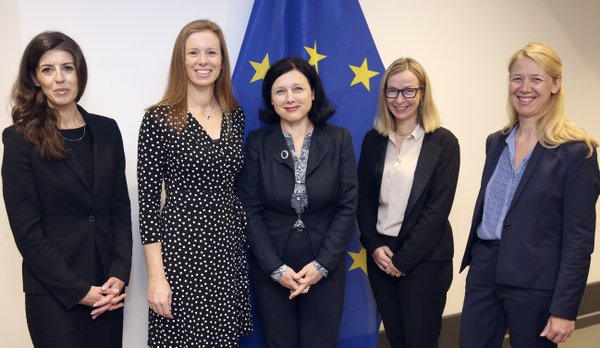
REPORT: “The recent terror attacks have reminded us of the urgent need to address illegal online hate speech. Social media is unfortunately one of the tools that terrorist groups use to radicalize young people,” said Vera Jourova, European Commissioner in charge of Justice,Consumers and Gender Equality, at a daily press briefing of the Commission.”The Internet is a place for free speech, not hate speech. The Code of Conduct against illegal online hate speech, agreed with IT companies today, will ensure that public incitement to violence to hatred has no place online,’’ she added.
The definition of illegal online content is based on the Framework Decision on Combatting Racism and Xenophobia which criminalises the public incitement to violence or hatred directed against a group of persons or a member of such a group defined by reference to race, colour, religion, descent or national or ethnic origin.
Jewish groups welcome the agreement. Daniel Schwammenthal, Director of the AJC Transatlantic Institute, declared : “For too long, social media companies claimed their ‘community standards’ are sufficient to deal with the haters on their platforms. For too long, users flagging posts such as ‘Kill all Jews’ were frequently told though such calls to murder didn’t violate these same ‘community standards.’ We hope this agreement will help ensure social media platforms are no longer abused by those who threaten people’s lives and the very values our free societies are built on.’’“We trust the European Commission and EU Member States will monitor closely whether this agreement is properly implemented and take the appropriate measures should the code of conduct prove to be ineffective,” he added.“This is a historic agreement that could not arrive at a better time,” said European Jewish Congress President Moshe Kantor. “We have seen a massive growth of online hate speech and incitement in recent years and it is very important that governments, law enforcement agencies and online companies work in tandem to make the internet a safer space for all.”“It has been demonstrated that many of those who have shed blood on the streets of Europe in recent years have been indoctrinated online, so hopefully this agreement can cut off a means of recruitment into extremist organizations.”
Posted inCensorship|Comments Off on Jewish Groups Welcome Censorship
VIENNA (Reuters) – Far-right parties in some European countries are winning over Jewish voters by exploiting fears about militant Islamists and mainstream parties must do much more to address Europeans’ security concerns, a Jewish leader said on Tuesday.
Boosted by Europe’s migrant crisis, Norbert Hofer of Austria’s anti-immigration Freedom Party only narrowly lost the country’s presidential election on May 22. He would have been the first far-right head of state in the European Union.
“I understand that, most probably, a not insignificant part of the (Jewish) community here voted for Hofer for the presidency,” the head of the Conference of European Rabbis (CER), Pinchas Goldschmidt, told Reuters in an interview.
Goldschmidt, who is also the chief rabbi of Moscow, said he had received reports of a similar shift among French Jews towards supporting the anti-immigration National Front ahead of presidential and parliamentary elections next year in France.
“When God gave out intelligence, not everybody stood in line. And so when those parties come with a populist message to the Jews and say ‘We’re going to save you from the Muslims’ … propaganda is effective,” he added.
Freedom Party leader Heinz-Christian Strache visited the Yad Vashem Holocaust memorial in Jerusalem in April – a gesture rich in symbolism, given the Nazis’ role in Austrian history and the flight or murder of most Austrian Jews following the country’s annexation by Adolf Hitler in 1938.
“Not only from the Freedom Party in Austria but also from the side of, for example, the National Front in France … and also (Geert) Wilders in Holland, they all seem to want us Jews to say they are acceptable,” Goldschmidt said.
Today Austria is home to an estimated 15,000 Jews and more than 500,000 Muslims.
“DANGEROUS” POPULISM
The security threat posed by Islamist militants has become much clearer after last year’s Paris attacks and must be tackled, Goldschmidt said, adding that Europe’s Schengen area of passport-free travel made that more difficult.
“I think that since the populist right-wing parties raised real concerns of people, unless the mainstream parties of Europe are going to address those issues, they’re going to lose.”
Goldschmidt, who was in Vienna for a gathering of the CER, suggested measures including the creation of a European anti-terrorism task force, improvements in border security and more effective integration of refugees.
He also condemned what he said was the tendency of far-right parties to conflate ordinary Muslims with Islamist militants.
“(The) moderate Muslim is our natural ally. They are as much the victims of radical Islamism as we Jews. It is the populism, the generalization, which is dangerous and destructive.”
Posted inAlt Right, Europe, Jews|Comments Off on Far-right parties winning over some Jewish voters, top rabbi warns
"This guy knows all the gossip, the ins and outs, the lashon hara of the Orthodox world. He’s an [expert] in... all the inner workings of the Orthodox world." (Rabbi Aaron Rakeffet-Rothkoff)