
The Jewish Question

Jews have been in Europe for more than a millenia but they remain a distinct people. So why should anyone expect Muslims to integrate into the West? That’s naive. There’s no reason to expect that Arabs will become normal citizens in the Jewish state.

Japanese-Americans and Chinese-Americans are also distinct groups. Races don’t assimilate except in the most superficial of ways. Instead, they act out their genetic imperatives.

Wikipedia:

The Jewish question is the name given to a wide-ranging debate in European society pertaining to the appropriate status and treatment of Jews in society. The debate was similar to other so-called “national questions” and dealt with the civil, legal, national and political status of Jews as a minority within society, particularly in Europe in the 18th and 19th centuries.

The debate started within societies, politicians and writers in western and central Europe influenced by the Age of Enlightenment and the ideals of the French Revolution. The issues included the legal and economic Jewish disabilities (e.g. Jewish quotas and segregation), Jewish assimilation, Jewish emancipation and Jewish Enlightenment.

The expression has been used by antisemitic movements from the 1880s onwards, culminating in the Nazi phrase “the Final Solution to the Jewish Question”. Similarly, the expression was used by proponents for and opponents of the establishment of an autonomous Jewish homeland or a sovereign Jewish state.

The term “Jewish Question” was first used in Great Britain in around 1750. According to Holocaust scholar Lucy Dawidowicz, the term “Jewish Question”, as introduced in western Europe, was a neutral expression for the negative attitude toward the apparent and persistent singularity of the Jews as a people against the background of the rising political nationalisms and new nation-states. Dawidowicz writes that “the histories of Jewish emancipation and of European antisemitism are replete with proffered ‘solutions to the Jewish question.'”[1] The question was next discussed in France (“la question juive”) after the French Revolution in 1789, before arriving in Germany via Bruno Bauer’s treatise “Die Judenfrage” – The Jewish Question.

From that point hundreds of other tractates, pamphlets, newspaper articles and books were written on the subject, with many offering solutions including resettlement, deportation and assimilation of the Jewish population. Similarly, hundreds of pieces of literature were written opposing these solutions and have offered solutions such as re-integration and education. This debate however, could not decide whether the problem of the Jewish Question had more to do with the problems posed by the German Jews’ opponents or vice versa: the problem posed by the existence of the German Jews to their opponents.

From around 1860 the notion took on an increasingly antisemitic tendency: Jews were described under this title as a stumbling block to the identity and cohesion of the German nation and as enemies within the Germans’ own country. Antisemites such as Wilhelm Marr, Karl Eugen Dühring, Theodor Fritsch, Houston Stewart Chamberlain, Paul de Lagarde and others declared it a racial problem unsolvable through integration, in order to make their demands for the “de-jewifying” of the press, education, culture, state and economy, plausible, along with their demands for the condemnation of inter-marriage between Jews and non-Jews. They also used this definition to oust the Jews out of their supposedly socially dominant positions.

By far the most infamous use of this expression was by the Nazis in the early- and mid- twentieth century, culminating in the implementation of their “Final Solution to the Jewish question” during World War II.
Posted in Jews | Comments Off on The Jewish Question

Trump & The Jewish Question

I thought “The Jewish Question” was whether Jews could be full citizens of gentile countries while retaining their membership in the worldwide nation of Jewry.

Rabbi Avi Shafran writes:

One needn’t be a supporter of Mr. Trump, though, to recognize that the anti-Semitism charges against him are seriously, forgive me, trumped up. In fact, they’re nonsense.

That he has an Orthodox-converted Jewish daughter and a Jewish son-in-law (and three grandchildren, whom he often refers to as his Jewish progeny), with all of whom he is close, should itself be enough to put the charge to rest.

If more is needed though, well, the Trump Organization’s longtime chief financial officer, Steve Mnuchin, and general counsel, Jason Greenblatt, are both observant Jews. The latter, who has worked for Trump since the mid-1990s, is one of the candidate’s top advisers on Israel and Jewish affairs. And another top Trump adviser has said that Trump backs an Israeli annexation of all or parts of the West Bank. The candidate once received an award from the Jewish National Fund and served as grand marshal of the New York Israel Day parade.

Posted in Anti-Semitism | Comments Off on Trump & The Jewish Question

Satmar: Do They Take Us For Fools?

Rabbi Yitzchok Adlerstein writes:

I was puzzled by the anguished responses of some of my friends to the videos of children at two Satmar camps being indoctrinated in the fine art of hatred of Zionists. Publicized on Yeshiva World News, the leaked videos showed children chanting slogans like “A Jew is not a Zionist,” and at one of the camps, all of them pelting a vehicle they were led to believe contained PM Netanyahu with eggs.

Sure, I was disgusted by this on many levels. How many enemies of our people would argue that Jews are no better than Hamas, whose summer camps teach thousands of children in Gaza to murder Israelis? (To be fair, in the Hamas camps, the kids are throwing grenades, known to be unsafe to humans and other life forms. Satmar’s eggs could probably, at worst, elevate cholesterol levels for a short period of time.) How many more Satmar kids will be taught not that they are proud bearers of their communities banner, but that they are the only authentic Jews! How unthinking of the organizers of these activities not to take into account how they embolden those whose intentions are nothing less than genocidal!

But was this really the worst that we’ve seen from Satmar? What about public demonstrations at the Israeli Consulate in NY – at a time that Israel was under intense pressure in the world community – in front of the watchful eyes of the world?

…Was there no worry that such a statement would intensify all the pushback against Satmar’s refusal to provide minimal education to their children? No concern that the camp activity would convince people that living in enforced isolation from the rest of us was the incubator of attitudes that they saw in the videos? That somehow Jews who lived with some degree of connection with the external world developed more tolerance?

Did the author of those lines take us all – the State, and the rest of us non-Jewish Jews – for utter fools? Or, perhaps he knows that Satmar, as one of the last groups with guaranteed bloc voting, has enough influence with politicians that it can say or do anything it wants? In which case our confidence in the American political system – complete or limited – actually does make us fools?

Posted in Satmar | Comments Off on Satmar: Do They Take Us For Fools?

Illusions of Objectivity

Rabbi Avi Shafran writes:

Some American journalists assigned to the political beat are having a hard time. Their dilemma is named Donald Trump, a man they don’t feel they can cover objectively.

Those troubled are reporters with a liberal bent, and that, of course, means most of the profession. The vast majority of mainstream print and electronic media personnel are well entrenched on the left end of the political spectrum. To be sure, one needn’t be a social or political liberal to regard the Republican presidential candidate with concern – many in Mr. T.’s own party are distancing themselves from him – but “progressive” citizens have a particular revulsion for the controversial candidate.

And so, while the intrepid reporters soldier on in the quest for fairness, impartiality and objectivity, they are finding it hard to maintain their professional standards, or even the façade of neutrality.

Jim Rutenberg, the New York Times’ “media columnist,” lamented his and his colleagues’ predicament.

“If you’re a working journalist,” he wrote, “and you believe that Donald J. Trump is a demagogue playing to the nation’s worst racist and nationalistic tendencies, that he cozies up to anti-American dictators and that he would be dangerous with control of the United States nuclear codes… you have to throw out the textbook American journalism has been using for the better part of the past half-century, if not longer, and approach it in a way you’ve never approached anything in your career.”

“You would move closer,” he continued, “than you’ve ever been to being oppositional. That’s uncomfortable and uncharted territory for every mainstream, nonopinion journalist I’ve ever known, and by normal standards, untenable.”

Mr. Rutenberg’s honest confession of discomfort is commendable. But it’s also somewhat amusing, because, while Mr. Trump may be an outsize (one might even say yuuuge!) challenge to the media’s objectivity, the notion itself of journalistic impartiality is more veneer than substance. There are other fairness challenges that reporters routinely face and fail.

Posted in Journalism | Comments Off on Illusions of Objectivity

The Ellul Challenge

Rabbi Yitzchok Adlerstein writes:

“If they understood the effect the chiming of the church bells had on the Jewish soul, they would never stop them.” So observed a Torah sage of a different generation, when the grandeur and power of the Church further demoralized an impoverished and persecuted European Jewry. If the Pew Research Center is correct, today’s worry should be the growing silence of those bells. In this we find a challenge as Elul is upon us, and as we look towards the yemei ha-din…

Not so long ago, Jews would pithily observe, “Vi es christelt zich, azoy yidelt zich.” The translation loses all of the flavor, but the meaning is something like “whatever is happening in the Christian world, is going to happen in the Jewish world.” We would not be amiss if we modernized that to “Vi es un-christelt zich, azoy yidelt zich” – whichever way Christianity is unraveling, Jews will follow suit. And follow suit we certainly will, unless we act less like the Fiddler on the Roof shouting one word slogans at questions, and more like the am chacham v’navon we are supposed to be.

Posted in Jews | Comments Off on The Ellul Challenge

The Trump Tallis and Outsider Journalism

Rabbi Yitzhok Adlerstein writes: When a black pastor in Detroit draped a tallis around the shoulders of The Donald, Jewish tongues started clucking with disapproval. “Cultural appropriation!” “He’s an anti-Semite!” Notably, the vehemence, as best as I could tell, all came from Jews on the left – politically and religiously. Perhaps their real discomfort was in the realization that Donald Trump wears a tallis more often than they do. The rest of us were mildly amused (if anything about this strange campaign can be said to be amusing), and wanted to know more about the pastor and his church. (Hint: It is a Pentecostal church. There are lots of black Pentacostal churches, full of people who are pro-Israel, certainly more so than the elites in Haaretz who were quick to condemn the incident.)

The real cultural appropriation came from Jewish circles, which had to scramble to figure out what a tallis was, why the benighted religious Christians believed that Jesus wore one, and why they had to be wrong. Savor this, from an article in The Forward, authored by a “soferet” and designer of the famous Tefillin Barbie:

“In the religion known as rabbinic Judaism, rectangular garments are required to have knotted tassels on the corners, following the Torah. According to the scholar Dafna Shlezinger-Katsman, in Jesus’s era, people in the eastern parts of the Roman Empire routinely wore a rectangular thing called a pallium, and therefore people who wanted to observe rabbinic Judaism probably put tassels on their pallia. …A tassel-equipped pallium is what the early rabbis were probably referring to when they said “tallit.” …The tassels on the religious Jews’ pallia probably stood out to those in the know, but those who weren’t savvy to the significance wouldn’t have cared especially…Jesus may or may not have worn a tallit, depending on whether he was the type who wore pallium and whether he was inspired to mark himself as part of the rabbinic in-group by attaching tassels to it. …Quite possibly Jesus, too, thought there were more important issues to focus on. …Having a special rectangular garment with tassels that you wear during prayer seems to have been a late medieval development, according to scholars like Elisheva Baumgarten.”

Except that it wasn’t. Unless we assume that the Babylonian Talmud is of late medieval development. I can’t tell you how much a tassled Roman pallium would set you back on Ebay in fourth or fifth century Iraq, but they seemed to know about it and its role in davening:

“R. Yochanan said, “Were a verse not written, it would be impossible to say it. This teaches that the Holy One, Blessed is He, wrapped Himself in a tallis like a prayer leader and demonstrated to Moses the order of prayer.” (Rosh Hashanah, 17B)”

Posted in Journalism, Judaism | Comments Off on The Trump Tallis and Outsider Journalism

Conservatism In Crisis

Rabbi Avi Shafran writes: The alt-right’s “intellectual godfather,” in many eyes, is Jared Taylor. Although he characterizes himself as a “white advocate,” he strongly rejects being labeled racist, contending that his “racialism” is “moderate and commonsensical,” a benign form of belief in the “natural” separation of races and nationalities. He contends that white people promoting their own racial interests is no different than other ethnic groups promoting theirs. He has said, “I want my grandchildren to look like my grandparents. I don’t want them to look like Anwar Sadat or Fu Manchu.”

Pointing to the homogeneity of places of worship, schools and neighborhoods, he insists that people “if left to themselves, will generally sort themselves out by race.”

Certain of Mr. Taylor’s beliefs may resonate with some Orthodox Jews. We may rightly eschew racism (seeing black Jews, for instance, no different from white ones), but we tend to be less than enamored of some elements of various minority cultures; we deeply value ethnic cohesion, preferring to live in neighborhoods among “our own kind”; and we have serious problems with certain elements of “progressive” western civilization and multiculturalism.

Mr. Taylor, in fact, welcomes Jews. He has said that we “look white to him.”

That sentiment though, is not typical among others under the alt-right umbrella.

Even a nuanced rejection of non-western cultures inevitably attracts genuine racists and haters, and devolves into rejection of the eternal “other”: Jews. The American far right has always embraced, inter alia, one or another form of Jew-hatred. More balanced members of the alt-right refer to their “1488ers” – a reference to two well-known neo-Nazi slogans, the “14 Words” in the sentence “We Must Secure The Existence Of Our People And A Future For White Children”; and the number 88, referring to “H,” the eighth letter of the alphabet, doubled and coding for “Heil Hitler.”

And even Mr. Taylor has permitted people like Don Black, a former Klan leader who runs the neo-Nazi Stormfront.org web forum, to attend his conferences. He may or may not endorse Black’s every attitude, but neither has he rejected his support.

Back in the 1960s, the John Birch Society, then dedicated to the theory that the U.S. government was controlled by communists, was condemned by the ADL for contributing to anti-Semitism and selling anti-Semitic literature. The brilliant and erudite William F. Buckley Jr., the unarguable conscience of conservatism at the time, recognized the group’s nature, and the threat its extremism posed to responsible social conservatives. In the magazine he founded, National Review, he denounced and distanced himself from the Birchers in no uncertain terms, contending that “love of truth and country call[s] for the firm rejection” of the group.

It is ironic that it has fallen to the Democratic presidential contender to make a distinction between responsible Republicanism and the current loose confederacy that includes haters.

Posted in Alt Right | Comments Off on Conservatism In Crisis

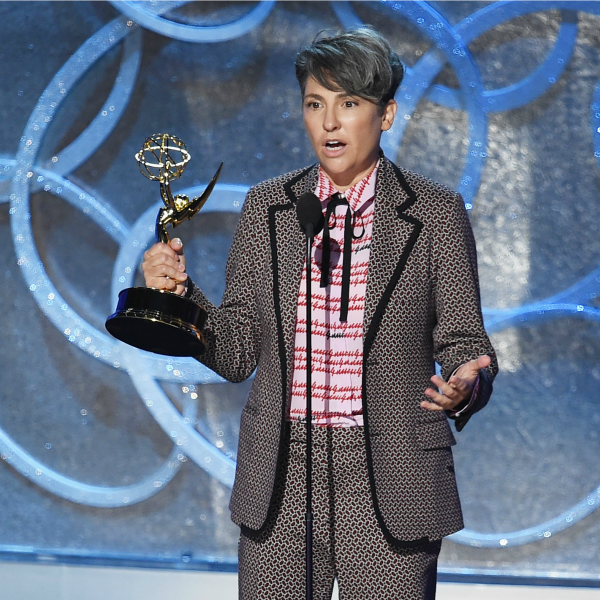
Jill Soloway: ‘Any Moment That I Have to Call Trump Out for Being an Inheritor to Hitler, I Will’

solowaysq

Posted in Jews | Comments Off on Jill Soloway: ‘Any Moment That I Have to Call Trump Out for Being an Inheritor to Hitler, I Will’

Celebrity Rabbi, Asked to Pray for GOP, Picks Mourner’s Prayer

Should not the Jennifer Rubins of the pundit world be replaced by right-wing pundits of the variety that the voters actually support? Or should WAPO continue to pretend to have right-wing commentators when they only have jesters? What will that do over time to their and others reputation as a supposed media source?

Chaim Amalek writes: “She has the right to earn a parnassa (living), no? And how else could she, when she’s that old? When Trump becomes President (BH), I hope to make my living by explaining him to the Jews of the Upper West Side. I will be the anti-Rubin.”

Forward: “When Rabbi Meir Soloveichik was called to offer his roast, he chose to provide a broader perspective on the current situation of the Republican Party. Telling the audience he was looking for the right Jewish prayer for the moment, the young rabbi began reciting the mourner’s kaddish.”

Posted in R. Meir Soloveichik | Comments Off on Celebrity Rabbi, Asked to Pray for GOP, Picks Mourner’s Prayer

From A Time When Women Knew The Score (Or Men Were Less Beta)

From the Chateau:

Reader Mister Bicks digs up a very old tune (originally written in 1917!) with a message that’s more honest than you’ll hear from any singer today.

Thinking about your assertion that looks aren’t as important as charisma (for lack of a better word at the moment), I think of a great song The Andrews Sisters called “Oh Johnny” (written in 1917). Please read the lyrics, noting especially that in the song, even though Johnny is NOT handsome, the girl wonders why she is so infatuated with him. Well, it’s because he’s “very very bad” and he knows about love.

People back then knew well what we try to avoid today.

***

Oh, Johnny! Oh, Johnny!
How you can love
Oh, Johnny! Oh, Johnny!
Heavens above
You make my sad heart jump with joy
And when you’re near I just can’t sit still a minute
I’m so, Oh, Johnny! Oh, Johnny!
Please tell me dear
What makes me love you so?
You’re not handsome, it’s true
But when I look at you
I just, Oh, Johnny!
Oh, Johnny! Oh!
Da-da-da

All the girls are crazy for a certain little lad
Although he’s very very bad
He could be oh so good if he wanted to
Bad or good he understood about love & other things
For every girl in town followed him around
Just to hold his hand & sing

Americans, and women in particular, from a century ago were a lot more aware of, or at least a lot less antagonistic towards, ugly truths about the sexes and romance. It seems as if there was this pre-post-America age when Realtalk™ wasn’t a rebellious act of defiance but a normal, gentle undercurrent governing the flow of human society.

The explanation for this is multivariate, but I’ll stick to one that I believe is a major contributing factor that doesn’t involve an endless stream of propaganda by the gynocratic hivemind: American women were more “red pill” a long time ago because their contemporaneous American men were less beta. When men are alpha and in control of their nation’s public spaces and curators of their nation’s heritage, they’re giving women more of what women want (whether they’re consciously aware of it or not). Women in that kind of sexual market have daily reminders of how admirable and yes even sexy men can be, as opposed to Thee Current Year when American women are getting daily reminders of how contemptible, effeminate and anhedonic their men have become.

Women (and men) have forgotten about sex differences partly because the sexes have shed their dimorphic sexuality to conform to a unisex amorphous androgynous blob of mood-killing homoplasm. Women are now the aggressors and men the deferential lapdogs. Our cultural messages reflect this sorry sexual devolution and, not coincidentally, our native stock birthrate plummets as we import less progressive barbarians to fill the womb void.

Posted in America | Comments Off on From A Time When Women Knew The Score (Or Men Were Less Beta)