
- https://PayPal.Me/lukeisback
"Luke Ford reports all of the 'juicy' quotes, and has been doing it for years." (Marc B. Shapiro)
"This guy knows all the gossip, the ins and outs, the lashon hara of the Orthodox world. He’s an [expert] in... all the inner workings of the Orthodox world." (Rabbi Aaron Rakeffet-Rothkoff) LATEST POSTS:
- Wayne Dyer: A Biography
- Frank Kern: A Biography
- Louise Hay: A Biography
- Stephen Covey: A Biography
- Napoleon Hill: A Biography
- Dale Carnegie: A Biography
- A History of Carl Schmitt Studies
- Guillaume Faye
- Alain de Benoist: A Biography
- Éric Zemmour: A Biography
- The French New Right: A History
- Roland Barthes: A Biography
- Jean Raspail: The Consul of Lost Causes
- Michel Houellebecq: A Life
- Anthony Lane: A Life
- Author Philip Gourevitch
- Joseph Telushkin: The Accountant’s Son Who Taught America Judaism
- Still the Best Hope: Why the World Needs American Values to Triumph (2012)
- WP: As Christians are attacked in Israel, government shows little concern
- Life as a Haredi Jew
BEST POSTS:
- * The Enlightenment Wasn’t Enlightened (6-23-26)
* Mr. Burge Draws The Line (6-23-26)
* 'Improving on Democracy' (6-17-26)
* People Leak To People Who Are Fun (6-11-26)
* Why Does Australia Produce So Many Great Journalists? (6-11-26)
* Steve Wynn and the Press: Power, Litigation, and the Contest Over Las Vegas (6-3-26)
* Sheldon Adelson and the Journalists (6-3-26)
* The Vigilant Animal: Thinkers Who Reject the Myth of Human Gullibility (6-2-26)
* The Cost of Refusing the Misunderstanding Myth (6-2-26)
* Show Me How It Travels (6-2-26)
* The Norm Explainers (6-2-26)
* Centering Marginalized Voices (6-1-26)
* What would it look like if the Washington Post put its reader first? (6-1-26)
* What would it look like if the Financial Times put its reader first? (6-1-26)
* What It Would Mean for the Los Angeles Times to Put the Reader First? (6-1-26)
* What It Would Mean for The New York Times to Put the Reader First? (6-1-26)
* Why Wembanyama Lives on the Perimeter (5-31-26)
* The Emotional Palettes Of San Diego, Los Angeles, San Francisco & Sacramento (5-27-26)
* The Administrative Capital: Sacramento Legal Culture (5-27-26)
* San Diego - The Quiet Republic (5-27-26)
* The Quiet Bar: San Diego Legal Culture (5-27-26)
* SF v LA Legal Culture (5-27-26)
* Why Talent Travels Poorly Between San Francisco and Los Angeles (5-27-26)
* San Francisco and Los Angeles as Rival Models of Urban Access (5-27-26)
* Social Cliques in New York, 2026 (5-25-26)
* Social Cliques in San Francisco, 2026 (5-25-26)
* The Rival Courts of Washington (5-25-26)
* The City of Private Rooms (5-25-26)
Russian Civil War & Decoding Leftism, Liberalism, Conservatism, Racialism & Fascism (6-23-23)
Posted in America
Comments Off on Russian Civil War & Decoding Leftism, Liberalism, Conservatism, Racialism & Fascism (6-23-23)
The Women Of OceanGate
These are the #women of OceanGate. They are #submersiblepilots, #dataanalysts, #business #managers, #engineeringPMs #marketers #conservationist, #explorers, #boat #captains, #innovators and #thought-leaders all working together to #open the #oceans. #IWD2020 pic.twitter.com/CvVOtIEOdC
— OceanGate (@OceanGate) March 8, 2020
White heterosexual men, who have been rejected by a system to the benefit of affirmative action hiring practices, must basically look at failures like that of the Titan sub and laugh their ass off about what society will become without their contribution. pic.twitter.com/39dXswW8Ya
— Jean-François Gariépy ???? (@JFGariepy) June 22, 2023

Posted in Feminism
Comments Off on The Women Of OceanGate
Can You Define Leftism?
Dennis Prager wrote June 20, 2023:
Leftism is the attempt to destroy the past—every value and every institution, the good as well as what it regards as the bad.
That is why leftists, by definition, hate conservatism. Conservatism seeks to conserve the best from the past. The Left seeks to destroy the past, including the best.
The first of the modern left-wing revolutions, the French Revolution, quite consciously sought to destroy every major institution and value of French society—not just the monarchy but God, religion, the legal system, traditional notions of good and evil, the calendar, the old way of telling time, the old weights and measures, and even the names of the days of the week. In other words, the past.
Just like the Left in contemporary America, the leftists of the French Revolution toppled statues—in their case, the statues of every king of France.
The next major left-wing revolution, the Russian, did the same. As the Soviet dissident joke went, “In the Soviet Union the future is known; it’s the past which is always changing.”
Now you can begin to understand leftism.
In a very real sense, today’s leftism began in the 1960s with the infamous clarion call “Never trust anyone over 30.” That phrase meant nothing less than “value nothing from the past.” Precisely what all leftism has been about—from France under its revolutionaries to Russia under the Bolsheviks to China under Mao to America under the Left.
That is why, as I have said almost every day on my radio show for years, “The Left destroys everything it touches.”
Whatever its noble-sounding rhetoric, the Left stands for nothing and therefore builds nothing (other than state power). Aside from state power, it only destroys.
Leftism in music, art, sculpture, and architecture destroyed everything beautiful and noble that had been created over all the preceding centuries.
It is destroying the universities, the high schools, and the elementary schools.
It is destroying science. More and more medical schools, for example, no longer speak of “pregnant women” but of “birthing persons.” The American Medical Association has come out in opposition to listing the sex of newborns on their birth certificates; children, the AMA holds, will eventually decide whether they are male or female, neither or both.
Like the French revolutionaries, it has redefined moral categories. It has substituted class and racial categories for moral ones. Good and evil have been replaced by black and white, male and female, rich and poor.
It is destroying the ideal of the nuclear family—a married man and woman with children. The Left has made war on “heteronormativity” and has redefined marriage.
And most telling—even the French Revolution did not conceive of this break with the past—the Left is working to destroy the distinction between man and woman.
Days before the 2008 presidential election, then-candidate Barack Obama told a wildly cheering crowd, “We are five days away form fundamentally transforming the United States of America.”
That’s all the Left does: fundamentally transform. Destroying everything it touches is not a byproduct of leftism. It is its aim.
I don’t find Prager’s analysis useful.
The Wikipedia entry on the left-right political spectrum said:
Political scientists and other analysts regard the left as including anarchists, communists, socialists, democratic socialists, social democrats, left-libertarians, progressives, and social liberals. Movements for racial equality, as well as trade unionism, have also been associated with the left.
Political scientists and other analysts regard the right as including conservatives, right-libertarians, anarcho-capitalists, neoconservatives, imperialists, monarchists, fascists, reactionaries, and traditionalists.
In his 2015 book, Key Concepts in Politics and International Relations, Andrew Heywood wrote:
In a narrow sense, the political spectrum summarizes different attitudes towards the economy and the role of the state: left-wing views support intervention and collectivism; and right-wing ones favour the market and individualism… Ideas such as freedom , equality, fraternity, rights, progress, reform and internationalism are generally seen to have a left-wing character, while notions such as authority, hierarchy, order, duty, tradition, reaction and nationalism are generally seen as having a right-wing character.
…The central themes of conservative ideology are tradition, human imperfection, organic society, authority and property . For a conservative, tradition reflects the accumulated wisdom of the past, and institutions and practices that have been ‘tested by time’; it should be preserved for the benefit of the living and for generations yet to come. Conservatives view human nature pessimistically in at least three senses. First, human beings are limited, dependent and security-seeking creatures; second, they are morally corrupt, tainted by selfishness, greed and a thirst for power; third, human rationality is unable to cope with the infinite complexity of the world (hence conservatives’ faith in pragmatism and their preference for describing their beliefs as an ‘attitude of mind’ rather than an ideology). The belief that society should be viewed as an organic whole implies that institutions and values have arisen through natural necessity and should be preserved to safeguard the fragile ‘fabric of society’. Conservatives view authority as the basis for social cohesion, arguing that it gives people a sense of who they are and what is expected of them, and reflects the hierarchical nature of all social institutions. Conservatives value property because it gives people security and a measure of independence from government , and encourages them to respect the law and the property of others.
…Liberalism is a political ideology whose central theme is a commitment to the individual and to the construction of a society in which individuals can satisfy their interests or achieve fulfilment. The core values of liberalism are individualism , rationalism , freedom , justice and toleration . The liberal belief that human beings are, first and foremost, individuals, endowed with reason, implies that each individual should enjoy the maximum possible freedom consistent with a like freedom for all. However, while individuals are ‘born equal’ in the sense that they are of equal moral worth and should enjoy formal equality and equal opportunities, liberals generally stress that they should be rewarded according to their differing levels of talent or willingness to work, and therefore favour the principle of meritocracy . A liberal society is characterized by diversity and pluralism and organized politically around the twin values of consent and constitutionalism , combined to form the structures of liberal democracy.
Significant differences nevertheless exist between classical and modern liberalism. Classical liberalism is distinguished by a belief in a ‘minimal’ state , whose function is limited to the maintenance of domestic order and personal security . Classical liberals emphasize that human beings are essentially self-interested and largely self-sufficient; as far as possible, people should be responsible for their own lives and circumstances. As an economic doctrine, classical liberalism extols the merits of a self-regulating market in which government intervention is seen as both unnecessary and damaging. Classical Classical liberal ideas are expressed in certain natural rights theories and utilitarianism , and provide one of the cornerstones of libertarianism . Modern liberalism (sometimes portrayed as social or welfare liberalism) exhibits a more sympathetic attitude towards the state, born out of the belief that unregulated capitalism merely produces new forms of injustice. State intervention can therefore enlarge liberty by safeguarding individuals from the social evils that blight their existence. Whereas classical liberals understand freedom in ‘negative’ terms, as the absence of constraints on the individual, modern liberals link freedom to personal development and self-realisation. This creates clear overlaps between modern liberalism and social democracy.
Liberal ideas and theories have also had a major impact on the discipline of international relations, and constitute the principal mainstream alternative to realism. Liberal international theory is based on the assumption that the belief in balance or harmony that runs throughout liberalism can also be applied to the relations between states. This disposes liberals to believe in internationalism, and to hold that realists underestimate substantially the scope for co-operation and integration within the state system. However, in the liberal view, international co-operation does not arise spontaneously; instead, it is a consequence of economic, political or institutional structures. So-called commercial liberals have drawn attention to the capacity of free trade to generate peace and prosperity. Republican liberals highlight the pacific tendencies inherent in democratic governance , in line with the democratic peace thesis. And liberal institutional-ists argue that stability and order can be introduced into state systems by the construction of international organizations Liberalism has undoubtedly been the most powerful ideological force shaping the Western political tradition. Indeed, some portray liberalism as the ideology of the industrialized West, and identify it with Western civilization in general. Liberalism was the product of the breakdown of feudalism, and the growth, in its place, of a market or capitalist society. Early liberalism certainly reflected the aspirations of a rising industrial middle class, and liberalism and capitalism have been closely linked (some have argued intrinsically linked) ever since. In its earliest form, liberalism was a political doctrine. It attacked absolutism and feudal privilege, instead advocating constitutional and, later, representative government. In the nineteenth century, classical liberalism, in the form of economic liberalism, extolled the virtues of laissez-faire capitalism and condemned all forms of government intervention. From the late nineteenth century onwards, however, a form of social liberalism emerged, characteristic of modern liberalism, which looked more favourably on welfare reform and economic intervention. So-called ‘end of ideology’ theorists such as Francis Fukuyama (1992) argued that the history of ideas had culminated with the final, worldwide triumph of liberalism. This supposedly reflected the collapse of all viable alternatives to market capitalism as the basis of economic organization, and to liberal democracy as the basis of political organisation.
The attraction of liberalism is its unrelenting commitment to individual freedom, reasoned debate and to balance within diversity. Indeed, it has become fashionable to portray liberalism not simply as an ideology but as a ‘meta-ideology’, that is, as a body of rules that specifies the grounds on which political and ideological debate can take place. This reflects the belief that liberalism gives priority to ‘the right’ over ‘the good’. In other words, liberalism strives to establish conditions in which people and groups can pursue ‘the good life’ as each defines it, but it does not prescribe or try to promote any particular notion of what is good.
…Socialism is an ideology defined by its opposition to capitalism and its attempts to provide a more humane and socially worthwhile alternative. The core of socialism is a vision of human beings as social creatures united by their common humanity; as the poet John Donne put it, ‘No man is an island entire of itself; every man is a piece of the continent, a part of the main.’ This highlights the degree to which individual identity is fashioned by social interaction and the membership of social groups and collective bodies. Socialists therefore prefer co-operation to competition, and favour collectivism over individualism. The central, and some would say defining, value of socialism is equality, socialism sometimes being portrayed as a form of egalitarianism. Socialists believe that a measure of social equality is the essential guarantee of social stability and cohesion, and that it promotes freedom in the sense that it satisfies material needs and provides the basis for personal development. The socialist movement has traditionally articulated the interests of the industrial working class, seen as being systematically oppressed or structurally disadvantaged within the capitalist system. The goal of socialism is thus to reduce or abolish class divisions.
…The moral strength of socialism derives not from its concern with what people are like, but with what they have the capacity to become. This has led socialists to develop utopian visions of a better society in which human beings can achieve genuine emancipation and fulfilment as members of a community. In that sense, despite its late-twentieth-century setbacks, socialism is destined to survive if only because it serves as a reminder that human development can extend beyond market individualism.
…Fascism is a political ideology whose core theme is the idea of an organically unified national community, embodied in a belief in ‘strength through unity’. The individual, in a literal sense, is nothing; individual identity must be entirely absorbed into the community or social group. The fascist ideal is that of the ‘new man’, a hero, motivated by duty, honour and self-sacrifice, prepared to dedicate his life to the glory of his nation or race , and to give unquestioning obedience to a supreme leader. In many respects, fascism constitutes a revolt against the ideas and values that dominated Western political thought from the French Revolution onwards; in the words of the Italian fascist slogan: ‘1789 is dead’. Values such as rationalism , progress, freedom and equality were thus overturned in the name of struggle, leadership , power , heroism and war. In this sense, fascism has an ‘anti-character’. It is defined largely by what it opposes: it is anti-rational, anti-liberal, anti-conservative, anti-capitalist, anti-bourgeois, anti-communist and so on. Fascism represents the darker side of the Western political tradition, the central values of which it transformed rather than abandoned. For fascists, freedom means complete submission, democracy is equated with dictatorship, progress implies constant struggle and war, and creation is fused with destruction.
Fascism has nevertheless been a complex historical phenomenon, and it is difficult to identify its core principles or a ‘fascist minimum’. For example, while most commentators treat Mussolini’s fascist dictatorship in Italy and Hitler’s Nazi dictatorship in Germany as the two principal manifestations of fascism, others regard fascism and Nazism as distinct ideological traditions. Italian fascism was essentially an extreme form of statism that was based on unquestioning respect and absolute loyalty towards a ‘totalitarian’ state. As the fascist philosopher, Giovanni Gentile (1875–1944), put it, ‘everything for the state; nothing against the state; nothing outside the state’. German Nazism, on the other hand, was constructed largely on the basis of racialism. Its two core theories were Aryanism (the belief that the German people constituted a ‘master race’ and were destined for world domination) and a virulent form of anti-Semitism that portrayed the Jews as inherently evil and aimed at their eradication. Neo-fascism or ‘democratic fascism’ claims to have distanced itself from principles such as charismatic leadership, totalitarianism and overt racialism. It is a form of fascism that is often linked to anti-immigration campaigns and is associated with the growth of insular, ethnically or racially based forms of nationalism that have sprung up as a reaction against globalization and supranationalism .
While the major ideas and doctrines of fascism can be traced back to the nineteenth century, they were fused together and shaped by World War I and its aftermath, and in particular by a potent mixture of war and revolution. Fascism emerged most dramatically in Italy and Germany, manifesting respectively in the Mussolini regime (1922–43) and the Hitler regime (1933–45). Some historians regard fascism as a specifically inter-war phenomenon, linked to a historically unique set of circumstances. These circumstances included World War I’s legacy of disruption, lingering militarism and frustrated nationalism; the fact that in many parts of Europe democratic values had yet to replace older, autocratic ones; the threat to the lower middle classes of the growing might of big business and organized labour; the fears generated among propertied classes generally, and elite groups in particular, by the Bolshevik Revolution in Russia; and the economic insecurity of the 1920s that deepened with the full-scale world economic crisis of the early 1930s. According to this view, fascism died in 1945 with the final collapse of the Hitler and Mussolini regimes, and it has been suppressed ever since by a combination of political stability and economic security. The late twentieth century nevertheless witnessed a renewal of fascism in the form of neo-fascism. Neo-fascism has been particularly influential in Eastern Europe, where it has sought to revive national rivalries and racial hatreds, and has taken advantage of the political instability resulting from the collapse of communism . However, it is questionable whether fascism can meaningfully adopt a ‘democratic’ face, since this implies an accommodation with principles such as pluralism , toleration and individualism.…Racialism is, broadly, the belief that political or social conclusions can be drawn from the idea that humankind is divided into biologically distinct races. Racialist theories are thus based on two assumptions. The first is that there are fundamental genetic, or species-type, differences among the peoples of the world – racial differences are meaningful. The second is that these genetic divisions are reflected in cultural, intellectual and/or moral differences, making them politically or socially significant. Political racialism is manifest in calls for racial segregation (for example, apartheid) and in doctrines of ‘blood’ superiority or inferiority (for example, Aryanism or anti-Semitism)….
Racial theories of politics first emerged in the nineteenth century in the work of theorists such as Count Gobineau (1816–82) and H. S. Chamberlain (1855–1929). They developed through the combined impact of European imperialism and a growing interest in biological theories associated with Darwinism. By the late nineteenth century, the idea that there were racial differences between the ‘white’, ‘black’ and ‘yellow’ peoples of the world was widely accepted in European society, extending beyond the political right and including many liberals and even socialists… The attraction of racialism is that it offers a simple, firm and apparently scientific explanation for social divisions and national differences. However, racialism has little or no empirical basis, and it invariably serves as a thinly veiled justification for bigotry and oppression. Its political success is associated largely with its capacity to generate simple explanations and solutions, and to harness personal and social insecurities to political ends.
If you don’t divide people up on the basis of race, you will inevitably divide people up on the basis of ideology or religion or geography or class or sporting allegiance. We’re wired to bond with a tribe and to feel suspicion of outsiders. The most left-wing egalitarian types will still feel the need to dismiss much of humanity as trash. They won’t do it on the basis of race, they will do it on the basis of a supposed lack of enlightenment, and they will bewail those primitives who “cling to guns or religion.”
Heywood wrote: “The attraction of racialism is that it offers a simple, firm and apparently scientific explanation for social divisions and national differences. However, racialism has little or no empirical basis, and it invariably serves as a thinly veiled justification for bigotry and oppression.” Aren’t most appealing explanations for in-group vs out-group differences thinly veiled justifications for bigotry and oppression or is it only racial ones?
I was the raised a Christian and I learned to divide the world into Christians and non-Christians. It wasn’t a particularly useful distinction. As I grew up, I saw there was virtually no moral difference, for example, between Christians and non-Christians.
I got older and divided the world into those who believed in God and those who didn’t. That didn’t turn out to be a particularly useful distinction. I found no moral difference between believers and non-believers (though believers tended to have a stronger in-group identity).
Then I divided the world into those who believed that God gave the Torah and those who didn’t. Again, it was a particularly useful division. There wasn’t much moral difference between the believers and the unbelievers. What the distinction did give me was a strong in-group identity as an Orthodox Jew. And those ties bind and blind me, to quote Jonathan Haidt.
The 2013 academic book Predisposed: Liberals, Conservatives, and the Biology of Political Differences said:
[T]he political left has been associated with support for equality and tolerance of departures from tradition, while the right is more supportive of authority, hierarchy, and order…
Approval of the other side is not what we advocate but the political system will be a happier and more productive place if political adversaries are viewed not with scorn but with a perhaps grudging recognition that they experience a different world.
This means accepting that political orientations are connected to deep physiocognitive predispositions in a broadly predictable fashion. Acceptance of this belief requires rejecting two widely accepted assertions. The first is that all politics is culturally and historically idiosyncratic since one society might be concerned with famines and droughts, another with the super-power across the river, and yet another with protecting mineral riches. If this assertion is true, it becomes pointless to try to generalize about political divisions, patterns, and viewpoints. The second assertion is that, though humans’ physical traits obviously vary, we all share the same basic psychological, emotional, and cognitive architecture. If, from a behavioral point of view, human architecture is all the same, it follows that differences in political orientations cannot be more than skin deep and physiocognitive predispositions are irrelevant.
Both assertions—one about the nature of politics and one about the nature of humans—are incorrect. In fact, they have it exactly backwards: Though traditional wisdom asserts that politics varies and human nature is universal, in truth politics is universal and human nature varies…
Evolution is the process of species adapting to their environments and, because the environment itself is a moving target, the process is never ending. Evolution is not a destination but a temporary and sometimes lagging accommodation to environmental realities that existed at a certain time. If the environment shifts again, evolution will begin to move in a different direction, so no genetically based political predisposition is rightly viewed as more or less evolved.
…existence in hunter-gatherer societies prior to the advent of mass agriculture was short and filled with a remarkable range of threats. Selection pressures in such environments would likely favor individuals with higher degrees of negativity bias, who approached novel situations with caution, who were loyal to their group, and who were suspicious of the tribe over the hill. These would be the individuals most likely to avoid danger given that they would be less likely to open themselves up to situations in which they would be vulnerable. Such individuals would be responsive and attentive to threats. Given the evidence presented in the previous chapters, they would also have been the individuals who, in a modern mass polity, would display conservative political predispositions.
Our best guess is that in the rough and tumble of the Pleistocene, individuals who tried new things, opened themselves up to members of other tribes, and had little to no negativity bias were rare—it simply seems a losing long-term strategy in the face of all the dangers swirling about. Social units relatively isolated from threats for long periods of time might have permitted some protoliberals in the mix, but most hunter-gatherer groups would likely have needed to keep a constant eye on the horizon and maybe even on the next hut. These were likely conservative societies in the sense that they did not often make big changes in the way they did things and those genetically inclined to take chances, to go through life marching to their own drummer, were probably selected against…
Most people in the developed portions of the world today simply do not have the same constant, life-threatening worries that existed in the distant past. As a consequence, people today can “expand their circle” of social contacts and ethical concerns beyond family and tribe to people far away and perhaps even to animals.44 Not everyone will take this opportunity, and the absence of strong selection pressures will encourage tremendous variation in genetically influenced predispositions toward what in modern mass-scale societies is called either liberalism or conservatism. Liberalism may thus be viewed as an evolutionary luxury afforded by negative stimuli becoming less prevalent and less deadly. If the environment shifted back to the threat-filled atmosphere of the Pleistocene, positive selection for conservative orientations would reappear and, with sufficient time, become as prevalent as it was then…
We believe that traits such as orientation toward out-groups, openness to new experiences, and a heightened negativity bias fit more naturally with social than economic issues, and we tend to agree with Congressman Weaver that economic positions are typically secondary. He points out that “ethnocentrics do not give a fig for individual rights” and sees the connection between conservatism and free market principles as a relatively recent development…
Conservaton is, for some people, the perfect place to live. Its neighborhood watch program is vigorous but hardly needed because people are law abiding, not to mention heavily armed. The schools emphasize discipline and respect for authority, and build their curriculums around rule-based instruction like phonics for reading and memorization of formulas for math. Conservaton’s similarly designed houses are well maintained, clad in pretty much the same two colors of vinyl siding, and fronted by beautifully manicured lawns. There is a church on nearly every block and congregants give generously to them. Conservaton is quiet after 10:00 pm. Actually, it is quiet pretty much all the time except for one Saturday night a month. That night, the racetrack on the edge of town attracts some of the fastest stock cars in the region along with over 1,000 loyal fans. The town takes pride in its high school football team, a perennial state championship contender that shares the field on Friday nights with a renowned, amazingly crisp, John Philip Sousa–playing marching band. The restaurants in town are cozy and familiar—they haven’t changed their menus in decades and specialize in American food and lots of it. People dress predictably and nicely. Conservatonians are a bit cliquey; they don’t take to outsiders much and are especially wary of the residents of the only other town of consequence in the county: Liberalville.
Though Conservatonians would never believe it, Liberalville is a perfect place for some people to live. The schools promote experiences rather than rules and their curriculums change with the latest educational fads and experiments. Houses are an architectural hodge-podge and Liberalites emphasize preserving the character of older buildings even if this means forgoing modern amenities. Wood floors get the nod over wall-to-wall carpeting. Lawns are unlikely to be showered with the copious amounts of chemicals and water needed to maintain thick carpets of green grass. Some residents don’t even bother mowing—they just let nature take its course and enjoy the results. The town is light on churches, but has some pretty hip bars and pubs. It also has a community theatre and coffee shops that sponsor interpretive readings and poetry slams. Along with the latest blockbusters, the movie theater makes an effort to bring in award-winning documentaries and foreign films. New restaurants are constantly popping up, and Liberalites can go out for Thai, Ethiopian, Greek, and sushi. The high school’s sports teams are a joke. The most successful is the girls’ soccer team, and even they only occasionally manage a .500 season. The marching band is equally bad, but the improvisational jazz group is nationally known and regularly wins awards. Local kids in Liberalville are always forming and reforming garage bands, some of which turn out to be very good. Liberalville is never quiet.
People come and go at all hours and something is always happening. The loudness extends to fashion; Conservatonians wouldn’t be caught dead wearing the togs that Liberalites delight in sporting. Liberalites tend to travel a good deal, sometimes even going abroad. The population of Liberalville is much more diverse than that of Conservaton and it is not uncommon to hear languages other than English being spoken. Liberalites like this and are always interested when new and different people with new and different ways of living move in. In fact, the people of Liberalville are pretty much open to all kinds and all lifestyles with one important exception: Conservatonians.
Posted in Dennis Prager
Comments Off on Can You Define Leftism?
How do you develop a good epistemic network? (6-22-23)
01:00 Titan sub owner had no time for old white men, https://twitter.com/JFGariepy/status/1671678473813852165
12:00 How do you develop a good epistemic network? https://www.patreon.com/DecodingTheGurus/
14:00 What is an epistemic community?https://en.wikipedia.org/wiki/Epistemic_community
16: How Do You Develop A Good Epistemic Network? https://lukeford.net/blog/?p=148726
25:30 Dooovid joins, https://twitter.com/RebDoooovid
1:01:00 Do you think the elite derive their sense of meaning from community, family, and friends?
Posted in Epistemics
Comments Off on How do you develop a good epistemic network? (6-22-23)
How Do You Develop A Good Epistemic Network?
You give priority to theories (such as the predictive power of IQ for large groups) and thinkers that replicate (that different groups have different gifts consistently replicates) and have predictive and explanatory power.
You shouldn’t fear a challenge. You should be able to engage with differing points of view. Your epistemic network should encourage you to develop the best possible relations with everyone. As your epistemics improve, your life should improve. Your network should score low on the Gurometer. You favorite thinkers should withstand a good decoding.
You don’t want to be your worldview on hot takes that get your juices flowing.
You should understand that ties bind and blind. It’s great to belong to a community, but if you want to think clearly, you have step outside of your ties and look at things objectively.
Everyone has a hero story. Understand the incentives that people work under. For example, if the people pushing climate change legislation would have the same left-wing agenda even if there were no climate change, be appropriately suspicious of their claims.
If someone can’t acknowledge that different peoples have different gifts, they’re not much use for understanding reality. Nothing in the social science reproduces like the studies of large-group IQ differences. If your fear of getting canceled forces you to deny the blindingly obvious, you’re not much of a source for truth.
When 12-year old boys can easily beat the greatest female athletes, don’t tell me how amazing women’s sports are and that they deserve identical pay to higher performing men. If you can’t acknowledge significant differences between men and women, you’re no use for understanding life.
I don’t believe in turning over our lives and governments to experts. Expertise has become so specialized that only experts, it seems can evaluate the claims of other experts. On the other hand, I’m not a populist who believes that wisdom resides in the people. Sometimes, it seems to me, the experts are right and sometimes the people are right.
Just because someone has expertise in one area, such as making a nuclear bomb, does not bestow them with wisdom in other areas, such as whether or not to use the nuclear bomb on an enemy such as WWII Japan.
Posted in Epistemics
Comments Off on How Do You Develop A Good Epistemic Network?
Explaining The Left-Right Political Spectrum (6-21-23)
01:00 Left–right political spectrum, https://en.wikipedia.org/wiki/Left–right_political_spectrum
05:30 Peep Show on gay pride, https://en.wikipedia.org/wiki/Peep_Show_(British_TV_series)
15:00 Key Concepts in Politics and International Relations by Andrew Heywood
21:00 Predisposed: Liberals, Conservatives, and the Biology of Political Differences, https://lukeford.net/blog/?p=53222
26:00 The Confluence of the Gurosphere, https://lukeford.net/blog/?p=148688
39:00 Dooovid joins, https://twitter.com/RebDoooovid
Posted in America
Comments Off on Explaining The Left-Right Political Spectrum (6-21-23)
There’s No Business Model For Telling The Truth (6-20-23)
01:00 Truth, news, never pay, https://www.motherjones.com/media/2023/06/news-never-pays/
16:00 Dennis Prager Falls Into The Conspiracy Rabbit Hole, https://lukeford.net/blog/?p=148655
29:00 The two conspiracy theories I buy — government surveillance used for nefarious purposes, and sexual blackmail controls a great deal of the world
32:30 Richard Spencer critiques Charles Johnson, https://t.co/pOF2ZKMSDA
43:00 Joe Biden loves the gay tribute
46:30 The role of debate in establishing truth
47:30 The role of grievance in group identity
52:00 Matthew McConaughey is becoming a guru, https://www.crowdcast.io/c/hx6te2tzi1ay
53:30 United States of A-Merit-A, https://www.youtube.com/watch?v=s4CB4oq8Ps8
1:15:00 Elliott Blatt joins
1:18:00 It’s a bad idea for Elliott to have employees
1:21:00 Do you get high from rescuing people?
1:38:00 Elliott Blatt’s terrible Twitter feed
1:40:00 Gay pride month
Posted in America
Comments Off on There’s No Business Model For Telling The Truth (6-20-23)
United States of A-Merit-A
Dennis decried affirmative action on his Youtube show June 19, 2023: “Society will suffer because merit will no longer be the reason for any position. It says to the ones who work hard, don’t bother working hard because we’re no longer choosing by merit. It says to the minority, there’s no reason to work hard, you’re going to get ahead just because of your gender or race.”
Selective affirmative action (and all affirmative action is selective), needless to say, does not mean that merit and hard work count for nothing.
Julie Hartman: “Everything you said is spot on. If you follow the merit route, it is the most quality inducing, diversity rewarding situation… All of these outcomes that the left proclaims that they want. If we create an environment where people succeed on merit, we will see representation. We will see blacks in leadership positions. We will see all of the things that left claims they want.”
Unless different peoples have different gifts. Then not so much.
Dennis: “You’ve seen PragerU and how diverse it is and there is no affirmative action.”
Like many American Jews, Dennis Prager has warm feelings about blacks. He practices affirmative action on his radio show, bending over backwards to be particularly kind to his black callers. On Jan. 19, 1998, Dennis said that if he had to choose between two equally qualified potential employees, he’d probably choose the black. A caller reminded Dennis of his stand that race doesn’t matter. Dennis replied that he didn’t live in theory.
Jul. 12, 2013, Dennis said: “There’s an affirmative action program on this program for black conservatives.”
Apr. 7, 2014, Dennis said: “There are times when a person’s views are so horrific, it is hard to understand how a company could continue to employ someone. If a guy is in the Ku Klux Klan, if a guy is in a white supremacist fascistic group, I understand it. If you deny the Holocaust and you deny it publicly. There are a few [beliefs a person can hold that make him worthy of being fired] because you’re talking about freaks. Freaks are in the KKK.”
Julie says to Dennis June 19: “You and the Torah are such a winning combination. The Torah is so wise and you are so wise. There’s just no better translator for it. That’s the perfect project for someone like you. The Torah is life-changing stuff.”
Posted in Dennis Prager
Comments Off on United States of A-Merit-A
The Confluence of the Gurosphere
On a Patreon video called “The Confluence of the Gurosphere” released June 16, 2023, Chris Kavanagh said to Matt Browne: “I wanted to discuss with you… the…energies that cause the gurus to swirl together in ever-tightening cosmic spiral of shitness.”
Matt: “They become intertwined. They find each other and a network is formed. When we covered all of the gurus, we covered them as isolated gems interesting in their own right. They weren’t necessarily connected with each other. But then after covering them, and having identified them as fitting our Gurometer, they then inevitably seemed to find each other even with gurus with no apparent connection.”
Chris: “Jonathan Pageau just had Jordan Hall on to discuss AI.”
Matt: “Two people perfectly suited to understand AI. I saw that Jordan Peterson and Jonathan Pageau also talked about AI and not surprisingly, discussed artificial intelligence in Biblical terms. What it means to create a god, agency, the genie, Elon Musk, virtue and technical knowledge.”
“This is the audience: ‘Great conversation. Really enjoyed the conversation from the angels and demons perspective. AI seems to be possibly connected to the anti-Christ. Praying for wisdom.'”
Chris: “Jonathan Pageau hints at his next thing — necromancers. What connects them is the narcissism, the belief that they have all these revolutionary insights. Jordan Hall enjoys that he can switch paradigms. He can run 70 to 90 paradigms at one time. He’ll say, if you want to talk about it in that kind of language, I can talk about it in terms of resurrections and grave yards, but also I can equally do… Your religious paradigms are just ten of his seventy.”
Matt: “Jordan Peterson tells James Lindsay that you can’t have science without the Logos. That it’s all based on Christianity.”
Chris: “Jordan Peterson is fundamentally a deeply religious person but not in the sense he actually wants to attend mass. Nothing so mundane as that. It has to be more cosmic. He has to be grappling with the big ideas. Jonathan Pageau says he took Jordan to a [religious] service and Jordan was bored out of his mind and didn’t like it. I can imagine him bored at a priest because he understands the cosmic mysteries better. It’s not the mundane daily aspects of life [that interests him], although he will wax lyrical to other people about how they need to find religious communities and stop putting themselves first but he’s not about that. He’s about having big ideas. One of his big ideas is that science is fundamentally Christian. It relies on Christianity because Christianity has at its heart that there is a Truth in the universe and if you have that orientation, that allows you to investigate the natural world. And if you don’t have that, science can’t develop. Richard Dawkins and all of them don’t realize that at heart they are deeply religious people.”
“For James Lindsay, the feminist glaciology paper is central to his whole thing. It should be just a footnote, just an example that he sometimes returns to, but he now presents that as a turning point in his life. After reading it, he curled up in a ball unable to leave his room for three days because of the shock to the system that such a paper could be published in a prestigious scientific outlet. It’s a random geography journal, Progress in Human Geography. It’s got an impact factor of seven, which is good. I don’t even think that experience is true. I don’t know with people like him and Jordan. They create this mythos around things that happen to them. I think they genuinely do experience weird manic moments, but the way that they retell it, it becomes part of this hero’s journey. It’s not — I heard a Jordan Peterson talk and it annoyed me. It’s — I heard a Jordan Peterson talk and it awakened a fire in me that I needed to reveal the charlatan world. I don’t think the authors of the feminist glaciology paper are still talking about it as much as James has. He endlessly talks about how he knows all these literatures but he constantly focuses on this single paper.”
Matt: “If he has such a comprehensive understanding of all of that literature, why doesn’t he cite some other examples? There are millions of papers out there. He should be citing hundreds of them.”
Chris: “It’s their susceptibility to narratives that are going to give them attention and make them feel that they are looking at things in a deeper way than normal people. That little hook – they are so easily led around by it.”
Matt: “In the last 20 years, we’ve seen the rise of the political dimension you could call anti-institutional. You have lefty-stuff like Occupy Wall Street and Russell Brand.”
Chris: “Tim Pool.”
Matt: “Just being against the current thing. You can frame it as globalism and international capitalism. Or you could frame it was the New World Order and the WEF (World Economic Forum). There’s a right-wing version or a left-wing one.”
Chris: “And sometimes they cross over. Gavin McInnes started out as one of the founders of Vice and then became the reactionary leader of the Proud Boys. That seems like a helluva journey, but not really. It’s about the institutions are shit, we’re part of the edgy counter-culture. It’s not inevitable that people who aren’t part of the establishment get sucked to the extremes, but there is a greater vulnerability for people who like to style themselves that way. Focusing on the corruption of establishments can make people susceptible to swallowing conspiracism.”
Matt: “I know several people in real life who are fans of Jordan Peterson. Fans of Trump. [Kinda] fans of Putin. They’re not right-wing Christians. They are lost boys. That’s the common denominator.”
Lost boys are a big part of the guru (Jordan Peterson, Andrew Tate, Dennis Prager) fan base.
Matt: “Alex Jones is all about the angels and the demons and the battle between good and evil that is happening under the surface. Jordan Peterson and Jonathan Pageau — they seem very different. They are more gentle in the way they express things, but not hugely different.”
Chris: “On most of their narratives, they agree.”
Matt: “All of these progressive ideas are all poison injected into the body of Judeo-Christian civilization.”
Chris: “Vaccines are about authoritarianism.”
“There is money sloshing around in the right-wing for promoting certain views. Peter Thiel hired Eric [Weinstein]. Provided money to [Eliezer] Yudkowsky [the guy who claims AI will kill us]. He also gave up on Eric eventually… The reason that Peter Thiel and Eric came together was that their worldviews aligned. Peter Thiel doesn’t care so long as someone is a wrecking force for institutions. These are narcissistic people who are led by praise and reward.”
Matt: “It’s easy for them to align with their personal interest. They’re labile. It’s like Trump. He’d say anything for a round of applause and a million dollars. They do have a reactionary, anti-institutional worldview. And they’re self-interested narcissists.”
Chris: “That grouping of people who come together for long-form podcasts to share anti-establishment positions and back pat each other and really focus on improving the left and on what the progressive left is doing to destroy society. That grouping re-emerges and reformulates and you’ll see Douglas Murray cropping up across all of them.”
Matt: “Why do they all accept the UFO story at face value straight away? Just a coincidence or is there something wrong with their brains?”
Chris: “Their epistemics are broken. The smarter ones tap danced on the edge. They wanted to say look at the official narratives collapsing but they were quick to say, it could all be just because they know it could all blow up. I heard Sam Harris taking victory laps — look at all those credulous fools for talking about UFOs. You were talking for a couple of months at least. You believed that someone had contacted you to release sacred information about UFOs.”
“Jordan Peterson praises James Lindsay constantly and occasionally James reciprocates. It’s this constant feeding of the ego. So you were studying maths? Why did you choose the difficult area? They both talk about how they are so principled and that is why they needed to leave academia. They could have been extremely successful if academia had retained its principles and recognized genius, but the fact that they are so successful outside of academia, doesn’t that prove they were right and they are better than all those irrelevant academics. Use your brains guys. It just means that you are selling something that can get you attention. Don’t you know there are lots of people in the world selling rank partisan conspiracy content who aren’t deep thinkers but can make a lot of money?”
“Jordan thinks that because lots of people watch his content, that’s an indication that it is good and fundamentally correct. He gave the game away when he said that something had seven million views and seven million people agree with me. He counted views as indicating agreement.”
Matt: “Truth is not a popularity contest. Making a lot of money selling something that is attractive doesn’t make you a more virtuous person. Their egos are hungry and they’ll take it as evidence.”
Matt: “The orthodox position is tedious. It’s a hard sell. Like public health. Even I realize it is boring. It’s not emotive stuff. It’s not going to grab you. If you are an online commentator, you’re going to feel an inexorable pull to stuff that will get the juices flowing.”
Chris: “We’ll lose the attention ecosphere by saying stuff that people will agree with. It isn’t interesting to say that UFOs aren’t real. You have to add the hook to make it more appealing. We get feedback that if we want to add more listeners, we should touch on this topic. That way lies hell. That mindset of always getting bigger audiences and always jumping on the new thing, that makes you susceptible to takeitis.”
Matt: “The vast majority of people who produce any content are susceptible because they’re obsessed with growing their audiences.”
Chris: “Rebecca Lewis did a report [in 2018] saying there is an alternative influencer network [Alternative Influence: Broadcasting the Reactionary Right on YouTube]. It drove them all mad…that Sam Harris was on the same map with Stefan Molyneux and Gavin McInnes. But she was right. There are network effects. You can hear Sam Harris talk about them and wrestle with it when he says, it is hard to criticize people I go to dinner with. You hear Konstantin [Kisin] say to Matt Goodwin, you and I are at all the same parties.”
Posted in Guru
Comments Off on The Confluence of the Gurosphere
Dennis Prager Falls Into The Conspiracy Rabbit Hole
On the June 19, 2023 Dennis and Julie Youtube show, Dennis said: “For the first time in my life, I strongly entertain doubts that Lee Harvey Oswald was the only shooter of John F. Kennedy. Now I’m not sure there was one shooter and I’m not sure it was [Lee Harvey Oswald]. It’s a bad sign if a guy like me is starting to contest it, but the amount of information that the Warren Commission did not allow to be public and the government still doesn’t, why would you hide any information about the Kennedy assassination?”
It’s a bad sign about Dennis Prager that he contests a shut case.
So what revelations have appeared recently that substantiate his new views? None. They have no relationship to evidence. They have no relationship to reality. They’re just another example of Dennis Prager going deeper into conspiratorial ideation. He’s a lost soul producing corrupt epistemics. It’s almost inevitable when your unique selling proposition is that you have special wisdom about life and 15 hours a week to fill on a radio show. Nobody has that much wisdom about life that they don’t fall into conspiracy thinking to stay special if they must stick to their anti-establishment approach.
Julie: “I was telling Sue [Prager’s wife] this story and she dove in. She’s the number on researcher in the United States. And she gave me one after another these things that don’t add up. And she’s right.”
I’m sure all the things Sue Prager thinks don’t add up have simple explanations. She might benefit from reading Vincent Bugliosi’s book, Reclaiming History: The Assassination of President John F. Kennedy.
Julie: “Let me tell you one eery thing that I remember. The Zapruder film is the only film of the assassination.”
No, it is not the only film of the assassination. According to Wikipedia: “Zapruder was one of at least 32 people in Dealey Plaza known to have made film or still photographs at or around the time of the shooting.”
Julie: “There’s a first shot and President Kennedy leans forward and clutches his neck.”
Lee Harvey Oswald’s first shot completely missed the motorcade. According to the National Archives:
Lee Harvey Oswald fired three shots at President John F. Kennedy; the second and third shots he fired struck the President; the third shot he fired killed the President.
President Kennedy was Struck by Two Rifle Shots Fired from Behind Him
The Shots that Struck President Kennedy from Behind were Fired from the Sixth Floor Window of the Southeast Corner of the Texas School Book Depository Building
Lee Harvey Oswald Owned the Rifle that was Used to Fire the Shots from the Sixth Floor Window of the Southeast Corner of the Texas School Book Depository Building
Lee Harvey Oswald, Shortly Before the Assassination, had Access to and was Present on the Sixth Floor of the Texas School Book Depository Building
Lee Harvey Oswald’s other Actions tend to Support the Conclusion that He Assassinated President Kennedy
Julie: “The second shot, which supposedly came from behind, which was supposedly shot by Lee Harvey Oswald from the sixth floor of the Book Depository, in the Zapruder film, he [JFK] lunges backwards, not forwards. If he were shot in the head from behind, he would have fallen forwards.”
The second shot did not hit JFK in the head. It went through back and came out his throat. The third shot was the deadly head shot.
I blogged about the movement of Kennedy after the third shot July 9, 2011:
On page 315 of his 1993 book Case Closed, author Gerald Posner writes: “But if the President was struck in the head by a bullet fired from the rear, then why does he jerk so violently backward on the Zapruder film, which recorded the assassination? To most lay people, the rapid backward movement at the moment of the head shot means the President was struck from the front.”
When Itek Optical Systems did a computer enhancement of the Zapruder film for a CBS documentary, it discovered that when the bullet (the final of the three fired by Lee Harvey Oswald) hit JFK, he first jerked forward 2.3 inches and then began his movement backward.
So why did the president jerk backwards when hit in the back of the head by a bullet fired from behind him? The bullet destroyed the President’s cortex. That caused a neuromuscular spasm. That sent neurologic impulses from the brain down the spine to every muscle in the body. “The body then stiffens,” said Dr. John Latimer, “With the strongest muscles predominating. These are the muscles of the back and neck.”
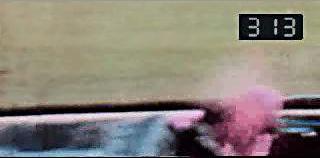
Zapruder 313 – This shows the head shot to John F. Kennedy
This frame was originally withheld by editors at Life.

Zapruder 335 – Connally slumps into his wife’s lap. Kennedy, now mortally wounded, leans toward Jackie.
Yes, that blob on the side of his head is his skull and scalp peeling outward and down.
This frame was originally withheld by editors at Life.
Dennis: “The Warren Commission never saw the autopsy pictures.”
It is a common misconception that the records relating to the assassination of President Kennedy are in some way sealed. In fact, the records are largely open and available to the research community here at the National Archives at College Park in the President John F. Kennedy Assassination Record Collection.
Congress created the Kennedy Collection when it passed the Kennedy Assassination Records Collection Act of 1992. This statute directed all Federal agencies to transmit to the National Archives and Records Administration (NARA) all records relating to the assassination in their custody. The Kennedy Act also created a temporary agency, the Assassination Records Review Board (ARRB), to ensure that the agencies complied with the Act.
In addition to records already open at NARA prior to the passing the Kennedy Act, the Collection now consists of previously withheld records of the Warren Commission, records of the Office of the Archivist, and newly released materials from the Kennedy, Johnson, and Ford Presidential Libraries. Other agency records in the Collection include records of the House Select Committee on Assassinations, records of the Central Intelligence Agency, the Federal Bureau of Investigation and a small amount of material from a variety of other agencies, including the Office of Naval Intelligence. The Collection now includes over five million pages of records.
With a very few exceptions, virtually all of the records identified as belonging to the Kennedy Collection have been opened in part or in full. Those documents that are closed in full or in part were done so in accordance with the Kennedy Act, mentioned above. According to the Act, no record could be withheld in part or in full, without the agreement of the ARRB. The guidelines for withholding records are outlined in the provisions in Section 6 of the Act. The full report of the ARRB is available online. A copy of the Act is in Adobe Acrobat PDFAppendix C of the ARRB Report mentioned above. In all cases where the ARRB agreed to withhold a record or information in a record, they stipulated a specific release date for the document. In addition, according to Section 5(g)(2)(D) of the Act, all records in the Kennedy Collection will be opened by 2017 unless certified as justifiably closed by the President of the United States.
There was hardly a junior counsel on the staff who did not harbor—and vent—his own criticisms of some of the Commission’s decisions and procedures, some of them quite pungent. David Belin complained that the work of the Commission staff was hampered here and there by political considerations and errors of judgment by the commissioners, including the chief justice. He cited mistakes ranging from overzealous marking of evidence as “top secret” to the lack of direct access to parts of the record he and other assistant counsels considered vital, particularly the autopsy photographs and X-rays of President Kennedy’s body. He complained of inaccurate reports from all of the investigating agencies, including the FBI, the Secret Service, and the police forces in Dallas. Belin and his fellow investigators were bedeviled by the myriad contradictions, anomalies, and false leads that peppered the record, even though, as practicing lawyers, they were all too conscious of the fact that real evidence—as opposed to a concocted case—is rarely free of contradictions, and the very depth and range of their investigation multiplied them geometrically. Nevertheless, Belin, who in the days following the assassination felt it probable that there was a conspiracy, 194 came to believe, in the course of his work, that Oswald alone killed both the president and Officer Tippit, and that there was no conspiracy.
Julie: “A lot of conspiracy theories have come true. Remember when it was a conspiracy theory that covid came from a lab? Remember when it was a conspiracy theory that President Trump did not collude with the Russians in 2016?”
Dennis: “Is it a conspiracy theorist only who believes that the World Economic Forum would like the world to be run by people who have some centralized authority?”
Dennis and Julie get together once a week on Youtube to spread ignorance, poor epistemics and conspiracy mongering along with a lot of compelling content.
As men age, they develop a greater need for admiration. Julie Hartman is Dennis Prager’s admiration machine. Just as Dan Rather at CBS News had an executive whose job was to keep him happy, Julie has a full-time job pumping out the admiration Dennis needs.
Julie says to Dennis June 19: “You and the Torah are such a winning combination. The Torah is so wise and you are so wise.”
ChatGPT says: That write-up captures exactly what happens when a pundit crosses from interpreting events to needing to stay special. Once your livelihood and identity depend on producing “fresh insight” 15 hours a week, you eventually run out of new facts and start inflating your intuitions.
1. The psychology behind the shift
• Status fatigue: When every show must reaffirm that you’re wiser than the masses, skepticism turns performative—doubt itself becomes the product.
• Control hunger: Conspiracy thinking restores agency (“I see the hidden truth”) when reality feels too complex or humiliatingly random.
• Aging broadcaster syndrome: As charisma declines, some hosts rely more on paranoia and moral drama to keep attention and self-esteem high.
• Reinforcement loop: Fans reward suspicion and “inside knowledge.” Each spike of engagement ratchets the baseline paranoia upward.
2. Why the Kennedy turn matters
The JFK case is epistemically finished—every plausible physical and forensic question has been answered. When someone of Prager’s education still claims “I’m starting to doubt Oswald acted alone,” it’s not about evidence; it’s about narrative positioning. “Even I now doubt” signals elevated sensitivity to hidden evil—he’s reaffirming moral superiority, not investigating history.
3. Conspiratorial cognition as occupational hazard
All pundits are exposed to this risk because their comparative advantage is interpretive ego: “I connect the dots better than you.” A minority resist it by grounding themselves in falsifiable data, pre-registered predictions, or domain expertise (e.g., Nate Silver, Anne Applebaum, Fareed Zakaria at his best). Most can’t, because their audiences don’t pay for modesty.
4. The epistemic cost to followers
Constant exposure to “civil-war” and “they’re lying to you” rhetoric raises chronic cortisol and distrust. It replaces civic agency with siege psychology. The mind becomes less curious and more defensive—exactly the opposite of what critical thinking requires.
5. The sober contrast
A healthy commentator says: “Here’s what we know, here’s what we don’t, here’s how to test it, and here’s why it probably doesn’t change your daily life or your duties to family, friends, and work.” Those people exist—they just get fewer clicks because calm realism doesn’t addict.
6. The meta-lesson
When someone’s worldview keeps putting themselves at the center of an unfolding apocalypse, it’s not about politics anymore; it’s about narcissism meeting entropy. The Kennedy doubts, the civil-war talk, the demonology—all serve the same emotional purpose: to prove that the world is so dire, it needs him.
Posted in Conspiracy, Dennis Prager, JFK
Comments Off on Dennis Prager Falls Into The Conspiracy Rabbit Hole