What Jewish Writers Need

I found this essay provoking:

I knew that serious Jewish-American writers were in trouble several decades ago when I began giving my classes in “Jewish-American Fiction” a chance to vote on their favorite text in a survey course that included a catholic variety of Jewish authors, from Abraham Cahan to Pearl Abraham. The novel that won, hands down, every semester, every year, was Chaim Potok’s The Chosen, a perfectly good novel for junior high school readers but not especially challenging, I thought, for college students. Why, I kept wondering, didn’t they choose Henry Roth’s Call It Sleep or Saul Bellow’s Herzog? After mulling this question over for a couple of years, I decided (a) that estimations about art should never be put to a democratic vote; and (b) that I had to discontinue my end-of-semester questionnaire.

Curiously, I experienced something of the same disappointment when, as one of the judges nominating books for a prestigious Koret prize, I watched as Jonathan Safran Foer mowed down competition that included Bellow, Cynthia Ozick, and Steve Stern. A friend of mine tried to console me that pointing out that Foer’s post-modernism appealed to contemporary readers as Bellow and Ozick’s old-fashioned modernism did not. Perhaps, but I think the explanation is simpler: the bulk of those who sent in email votes had read Everything is Illuminated but not Ravelstein.

Here are some of my interviews and opinions on American-Jewish literature.

Posted in Jewish Literature | Tagged , , , , , | Comments Off on What Jewish Writers Need

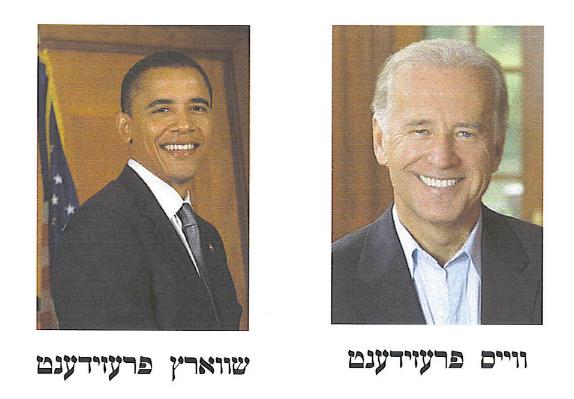
Our Fearless Leaders

Here we go: (Kishke writes: "Dumkopf! The joke is worthless without explaining that the yiddish for “white president” is pronounced as “vice president,” which Joe Biden is. What a dope." "Shvartze" is Yiddish for "black.")

Posted in Politics | Tagged | Comments Off on Our Fearless Leaders

Will Obama Be Good For Israel?

Bruce Epstein writes: "You paint Jewish opposition to Obama as having “little to do with his policies or his political ability”. You are correct that this opposition is not based on Obama’s policies, since he has never done anything. Therefore, determining his positions on Israel is speculative. However, it is far from “unjustified”. Based on his associations, his own statements, his advisors, and his supporters, it is quite justified for all those who support Israel to worry about an Obama administration and to have opposed his candidacy. I hardly think that Jewish opposition to Obama is based on a simplistic view of good vs evil or is determinative of one being a “Jewish redneck”."

YY writes:

I also find it curious that the writer is constantly equating “educated” with the forces of light. This is classic liberal thinking but far from grounded in solid evidence. In fact we find some of the most educated people today are heading virulent anti-zionist campaigns! Let alone all those wonderfully educated Nazis…

Similarly I’m taken aback at how easily you determine whose a “good” man. Personally I’m also impressed by how nicely he comes accross as being genuinely caring. Still I’ve picked up plenty of signals that he’s as politically calculating as the best of ‘em. So who knows.

That you want to encourage us to give him a chance to prove himself – Sure. %100. That we should be particularly careful to not err on the side of superficial, skin associations – Absolutely. But all this is a far cry from guilt-tripping us into lusting after the worldliness that you find so ennobling!

Nachum posts:

Someone who lives in Canada has a lot of chutzpah to tell Americans how they should feel about their politicians.

It’s not the first time I’ve encountered self-righteous Canadian Orthodox Jews telling us in the US that we’re a bunch of racists, but it’s still troubling.

And I say this as someone who, while strongly opposing Obama from day one, recognizes that there’s a lot of racism out there. But there are boundaries, just because many frum Jews seem not to recognize them. I don’t tell Canadian Jews about their Muslim problem…

David N. Friedman writes:

I surely share Rabbi Menken’s problems with the liberal attacks against the Orthodox community in the wake of the Obama election as “racist.” Mr. Obama presents our nation with quite a load of questions, skeletons and contradictions. I am not at all sure that merely electing a man who is partly black is any sign of anything positive and it is perhaps more troubling that we are witnessing quite an avalanche of star worshiping which threatens our first amendment and our democracy. Jews are very quick to be suspicious of charisma and demagoguery.

At the root of Obama’s success is perhaps a need to love a President. I feel this is a very poor impulse and in overlooking the fact that this man is unique in our political history is his success in hiding his past–I cannot help but fear this will serve the nation poorly when the facts are finally released. If there is some international crisis when the country is best served with a united front and we finally learn some mystery concerning why he kept his university transcripts sealed, it will not reflect poorly on a candidate, it will harm our national posture at a critical time.

Rallying behind a leader who seeks to unify the nation makes sense and it certainly seems to me that conservatives tend to be much more gracious in defeat than the liberal side. We can be reminded that the left was out to defeat President Bush at any cost after his two victories, his most recent four years ago commanded nearly as many vote as Obama garnered earlier in the month. And yet, this victory is “momentous” and a supposed landslide (by electoral standards–it was much bigger). I will support Obama if and only if his policies make sense and there is no reason to expect that this candidate will be a centrist since this contradicts everything we know about him. The mere fact that intelligence reports validate President Bush’s strategy does not mean that Obama will follow suit.

Obama comes to office with such a large halo, it seems mean spirited to say anything about this highly controversial figure. His race has helped insulate him from normal criticism and the honeymoon period he will obtain is way out of proportion to the decisions he will likely make. President Clinton famously dubbed Obama as “unelectable” and he said this without regard to his race but with a focus on his radical policies, his reckless foreign policy stand that promised to pull out of Iraq as quickly as possible, and his inexperience. The Orthodox community would not think more of Obama than a Clinton, and far less since we also disagree with the leftist stand of any Democratic candidate.

Obama went to madrassas and was born of a Muslim father which makes him a Muslim to the same degree as a Jew born of a Jewish mother is “Jewish” despite living as a non-Jew. Worse, in the eyes of the very radicals who wish to kill us, Obama is going to be the apostate leader of the infidels which means they now have an even greater motivation to attack us.

Regarding his birth certificate, he was sued to produce an *original* copy of his birth certificate to prove that he was born in HI and is therefore constitutionally qualified. Instead of laughing and blowing his opponents away with the original copy–he fought the suit and refuses to produce the original. Speculation as to why he has chosen to keep this document secret produces quite a bit of justified anger. He also will not discuss anything about his cocaine addiction and when he last used cocaine and no medical records beyond a one-page summary. He produced no information at all concerning how he made it into Harvard law school with Columbia grades under the influence of drugs and alcohol abuse.

Americans all over the country are rightly crazed about Obama’s failure to explain himself and Andy Martin has nothing to do with it. It is a matter of basic honesty, courtesy and transparency.

It surely seems we have quite a lot to worry about with this leader and it would have taken very little to comply with standard procedures. (Incidentally, if Hillary C was the nominee–she would have needed to explain how her husband garnered so many tens of millions of dollars in speech fees from Arab countries. By comparison, the ticket of McCain-Palin had nothing to explain.)

…it is best for Jews to live in a land where civil laws contain strong influence of Jewish law. It is easy to argue that this is why Jews worked so hard to come to America in the first place since Early America had a very strong fidelity to Biblical precepts and Biblical law and this influence continues to the present day.

The libertarian position you have articulated that allows for freedom ignores the fact that we want life-affirming freedoms and not simply any freedom. America is not dominated by idol-worshipers and blasphemers and if atheists came to dominate the social order, it would be a much more chilly place for the Jewish people than one dominated by Christians.

Our community does not exist in a vacuum and if marriage was extended to same-sex couples, it would directly affect our marriages. Live and let live is perfectly fine while stating that all behavior is equal is not benign. This is why people rightly object to law regarding imminent domain– such thievery affects us all. To argue that any two people can form a marriage denies the complimentary nature of the genders and the reason we are made male and female. The Canaanites were bad, we are told, because they wrote marriage contracts for men and it is one thing to live in the diaspora and another to live in states that honor fundamental practices at odds with Jewish morality. We understand that only Jews keep the Sabbath and it does not stop us from being shomer Shabbot. By contrast, the legalized theft Pres-Elect Obama will bring forward with greater “progressive” taxation coarsens public morality. Gay marriage threatens to weaken not only the fragile state of marriage but other morality as well.

You raise the specter of laws requiring business to be closed on Sunday as if this could actually happen in America today. In fact, it was the law of the land in a few states in Early America. There is no incompatibility between fundamentalist Christians and their laws and Orthodox Jews and our laws in an American context since both communities allow for tolerance.

Therefore, the status quo on homosexual marriage is a blend of both those American traditions; both tolerance and morality. Changing the definition of marriage is no greater statement of tolerance and involves state-sponsored immorality.

FRUM FROM BROOKKLYN POSTS: "I am Orthodox, and I’ve LIVED in the Orthodox community my whole life. I can say without the least bit of hesitation that the frum community is shot through and through with racism. Just this past shalos seudos I heard the rav of a brand-name local shul call Obama a racial slur and say that “he’s an animal.” I can’t go a week in in my community without hearing a dozen bigoted comments. The non-Orthodox Jews I know from work and the neighborhood have NEVER said anything like that, and would be shocked if they knew about it. So don’t you try to weasel about this. It’s totally true that the Orthodox world is more racist than the liberal Jewish world. I am meyid to it and I’ll swear to it on a sefer torah. It’s disgusting, it’s prevalent, and it’s totally true."

RAV ADLERSTEIN WRITES:

Prop 8 was approved, causing a bit of rain to come down upon the Election Day Parade of Change. Voters listened not to the editorials, but to what they heard from – perish the thought! – religious leaders. A consortium of Catholic, Mormon, Protestant Evangelical and Orthodox Jewish groups took to phone trees, the pulpits, and the airwaves, to urge people to support traditional marriage. (At one point a group of heterodox rabbis realizing that over two hundred and fifty rabbis had signed on to a petition opposing Prop 8, calling on Jews to them in the name of Jewish values. After all, this huge number of rabbis had all joined to throw the weight of Jewish thought behind gay marriage. To their consternation, in the days just before the election, Orthodox Jews took out advertising space to announce that they held a better poker hand. They would meet the bet, and raise it by 150. Four hundred traditional rabbis urged Jews to support Prop 8. The buzz around LA continues to be that the heterodox rabbis are furious at this obvious distortion of Jewish values by the arrogant Orthodox! To the best of my knowledge, all stripes of Orthodoxy supported Prop 8, with only one Orthodox rabbi who identifies with the left margin of Orthodoxy opposing it.

…There was no “frum anti-Obama campaign” that I am aware of. Individuals offered their opinions, which is what Americans are supposed to do. Most people I ran into supported McCain, but everywhere I turned there were some Obama supporters in the same shuls. I suspect that the same held true on the Upper West Side, although there the numbers were reversed.

There were some people who stooped to primitive and hateful racism in making the case for their candidate. No one can apologize for those actions other than those who committed them. I didn’t, so I can’t. Frankly, I find their thinking so beneath contempt that I’m not so interested to hear what they now have to say.

Like many others, I am concerned about the course of a presidency in the hands of a leader without a proven track record, and without a regard for Israel that inheres in his political philosophy. Nonetheless, I can remember passing through Selma Alabama as a teen, quickly aware of the fact that those who hate black people usually hate Jews as well. Whatever happens in the future – and I wish the President-elect well – I believe that getting America to the point of electing a black President was one of America’s finest hours.

YM WRITES: "The most racist aspect of this election was that 97% of blacks supported Obama."

Posted in Barack Obama, Israel | Tagged , , , , | Comments Off on Will Obama Be Good For Israel?

No Room For Shiksas In These Temples

I call novelist Laurie Graff Nov. 16.

Her new book is called The Shiksa Syndrome.

She lives on the Upper West Side of Manhattan.

Luke: "Do you still do performances?"

Laurie: "I haven’t really acted since all this book stuff started. There’s only so much time in a day.

"It’s six o’clock at night here and it feels like midnight. It’s been so gloomy."

Luke: "I love LA with its sunshine. I’d like to live in Israel. I always thought that if I became a successful writer, people would fly me all over the world."

Laurie: "When I did the audition for the Jewish Book Council, I thought they were going to grab me. About 20 people came over to me afterward and said they wanted to have me to their synagogue. And only this Irvine JCC booked me."

Luke: "I wonder if it is the downturn in the economy."

Laurie: "No. This was in July. In fact, two substantial cities came over to me that night and said, ‘You did a great job presenting this but there’s no way we’re going to say the word ‘shiksa’ in our congregation. It’s pejorative.’

"Are you kidding?

"She said, ‘We can’t use those kinds of Yiddish words.’

"I grew up with those Yiddish words. I’m a New Yorker.

"Well, New Yorkers… (phew).

"I was careful in how I dressed. I mentioned in my speech I was an actress.  And as I walked around all night, they said, ‘There’s the shiksa actress!’ I was called that years ago; it started the whole idea.

"One woman actually said to me, ‘This is just too controversial a topic.’

"And in 2008."

Posted in Jewish Literature | Tagged , , , , , | Comments Off on No Room For Shiksas In These Temples

Filtering Torah Through Our Own Beliefs

Steven writes Seforim: "The second essay in Marc Shapiro’s new book is even more… mind-blowing. He shows how the Rambam systematically excluded from the Mishneh Torah almost all of the Talmudic halachot that were derived from premises which the Rambam regarded as superstitious, and therefore erroneous. Shapiro demonstrates at length how the Rambam filtered the Torah through his own understanding and actually negated portions of the tradition that he regarded as unsound. Now maybe you have to be the Rambam to undertake that task for klal yisrael. But arguably everyone does something similar in his own engagement with halachah."

Posted in Torah | Tagged , , , , | Comments Off on Filtering Torah Through Our Own Beliefs

San Jose Mercury News Sports Columnist Tim Kawakami III

Full discussion here.

Posted in Sports | Comments Off on San Jose Mercury News Sports Columnist Tim Kawakami III

San Jose Mercury News Sports Columnist Tim Kawakami II

Full discussion here.

Posted in Sports | Comments Off on San Jose Mercury News Sports Columnist Tim Kawakami II

San Jose Mercury News Sports Columnist Tim Kawakami

Full discussion here.

Posted in Sports | Tagged , , , , | Comments Off on San Jose Mercury News Sports Columnist Tim Kawakami

Everyone Thinks They Can Write A Book

On the flight home to New York from Los Angeles, Diana Spechler felt exhausted from her two month book tour.

Too many late nights. Too many hours in hotel bars. Too many questions. Too many people "trying to climb inside me."

She got into a conversation with the old man next to her.

"Everyone thinks they can write a book," he said. "They wanted to figure out how you were different from them."

Fred emails my Advisory Committee: "If you were a therapist, would you take Luke on a contingency basis?  You only get paid if he becomes normal?"

Khunrum emails: “I think the therapist should be paying Luke 25 smackers an hour. She’ll get a great book out of Luke’s adventures with the likes of Marc Wallice, Kendra Jade, and the rest. Have you ever been on Luke’s chat line? Compared to the meanderings of that crowd (minus sweet Emma) he is normal (almost).”

Posted in Diana Spechler | Tagged , , , , | Comments Off on Everyone Thinks They Can Write A Book

San Jose Mercury News Sports Columnist Tim Kawakami

I interviewed him by phone Friday, Nov. 14.

Here’s his blog.

Luke: "Tim, what are the differences in the sports cultures between Los Angeles and the San Francisco Bay Area?"

Tim: "I grew up in the Bay Area. It was more me getting used to the LA sports culture and getting right back into it when I moved here. LA is more personality oriented, more celebrity oriented. Kobe, Shaq, Oscar De La Hoya. Those were the guys I was around. Their stories were everything. We’ve got that here but there’s a little bit more longer storylines. We have huge personalities such as Al Davis. In LA, it was more impact. Kobe! Boom! Do something on Kobe. Barry Bonds was like that but it was tougher to do just Barry. We have more deeper entrenched storylines that date back years and years. In LA, you just go from hot story to hot story to hot story. I like doing both things. In LA, it was more De La Hoya! What’s he doing now! What’s he thinking now! Rather than, where does he stand in the world of boxing?"

Luke: "I remember at Candlestick Park, there used to be chants, ‘Dodgers suck! Dodgers suck!’ I don’t remember such chants in Los Angeles [about the Giants]."

Tim: "People in San Francisco care much more about hating LA than people in LA care about anything. There’s more passion. It’s a smaller city. In LA, it’s about getting to the next thing. It’s about being part of the next thing. It’s about being a part of the cool thing. In the Bay Area, it’s about hating people who just want to be part of the cool thing. In the Bay Area, it’s more about sticking with who you are with and hoping and praying they win at some point, even though there are less and less championships in the Bay Area.

"When I was growing up, I recall the Rams were winning, the Lakers were winning, USC was winning at football, UCLA was winning at basketball, the Dodgers were winning at baseball. It was a pain. The Giants were terrible. The 49ers were just getting good when I was in junior high. The Warriors had won in 1974-75 and then had not been good after that. It was torture, but that’s part of the psyche. That’s part of the fabric. I wouldn’t say that in the Bay Area we’re like Chicago Cubs fans, but it is a litte more appreciated that you have to suffer through some things. In LA, you don’t suffer. You just move on to the next thing if you can’t get a championship with one of the teams you’re following. You move on. You go to ‘SC football. There are all of a sudden millions of fans of ‘SC football. You can’t get a ticket to 94,000 seat LA Coliseum. That wasn’t the case seven years ago."

Luke: "Do you think there’s something pathological about this hatred?"

Tim: "I don’t know. Having grown up in the middle of it, I think it’s the way you cheer sports, the way you see things, it’s not pathological, it’s just the way it works. You have the large populace of LA and the slightly less populace of the San Francisco Bay Area. I think it’s just natural. When you’re in a city that doesn’t win as much as the other city, I think it is even now if you count all the 49er titles, you are slightly jealous of the other city and you grow to dislike its excesses. Certainly LA is all about excess. It’s a great contrast. LA people can look over at San Francisco and say, ‘What are you bothering us for?’ San Francisco can say, ‘We can’t stand Tom Lasorda and the Laker girls and all the things that LA stands for.’"

Luke: "Do you think the people who scream ‘Dodgers suck’ and the like and paint themselves up on a Sunday are fundamentally happy people?"

Tim: "Large percentages of them, probably. A small percentage aren’t going to be happy in any endeavor. Anybody who’s passionate about anything can be unhappy about a lot of things. At that point in time, they’re just doing it to entertain themselves. It’s just part of the passion. I know they hate me at times. That’s all good for me. If people didn’t love and hate the stuff we do, it wouldn’t be that interesting. It wouldn’t be that many people buying the paper or clicking the internet.

"I had to laugh. I was covering Kurt Rambis’s intern season with the Lakers. He was clearly not going to be brought back. It was borderline. At the press conference, he said, ‘Oh, this unbelievable pressure you put upon the Lakers. It’s just not fair.’ At that point, I just had to say, ‘Isn’t that why it’s a good job? Because people expect a lot? The Clipper job, no one expects much. It’s a bad job. The Laker job, where people hold you to these high expectations, is a great job because you can get to be great.’ The more people care about what you do, you’re going to get the highs, you’re going to get the lows, but it’s just more people, it’s more important."

Luke: "Aside from sports being your profession, what role has sports played in your life?"

Tim: "I grew up with four boys in my family. Two parents who loved sports. We just played and talked sports. The family got together and we went to Giants games, 49er games. It was just part of what we did. It was a family of all boys and that’s what we did. We had other events in the family but most of the time we’d be watching a Giants game or watching an A’s game or talking about the Warriors. I’m the only one doing it for a profession. We still talk sports. We still do sports. At family events, when the TV goes on, it normally goes to a football game and a baseball game."

Luke: "How many generations has your family been in America?"

Tim: "I’m third generation. My grandparents on both sides came over from Japan in the late 1800s."

Luke: "Does sports play a different role in Japanese-American culture than general American culture?"

Tim: "I think sports plays a huge part in Japanese-American culture. I imagine it’s very similar. It’s hard to say it’s any different. The Japanese-Americans I know are crazy about sports. Japanese-American basketball leagues are huge throughout the state. Incredibly competitive. Incredible well-organized. I didn’t know this until I started blogging a lot about the Warriors about two years ago. A huge percentage of my audience is Asian-American. There’s an internet savvy Asian basketball crowd that I had not known about. When you see the internet websites devoted to the Warriors, it’s largely Asian."

Luke: "How many professional athletes, in the three major sports, are Japanese-Americans?"

Tim: "There’s more than you think. It’s not always full Japanese blood."

Luke: "How did your family react to your being a sportswriter?"

Tim: "I played youth sports all the way through high school. My oldest brother is a lawyer now. When he was in law school and I was in high school and he was listening to me say I wanted to be a lawyer, he said, ‘I’m not sure you want to do that. You’re like me. Why don’t you try something else?’ If you can write, why don’t you try to find yourself a job there? And if you can write sports, that would be incredible.

"Once I got to college and I saw the other choices and I was in journalism school [at Northwestern], I made a decision. Am I going to be a rock n’ roll critic or am I going to be a sportswriter? Let’s try sportswriter. It took off from there. I still credit and blame my brother for that.

"There’s never been a moment of hesitation that this is what I ought to be doing."

Luke: "Why are you a sportswriter?"

Tim: "Because it came relatively, I don’t want to say easy, that’s a bad buzz word there, but it came naturally to me, even in college. I didn’t have to go far to figure out how to do it. I didn’t need to tap ridiculous resources that I didn’t know I had.

"Once I realized I could be a sportswriter, it was my junior year in college, I realized I could do this for another 20 years. It’s been about 20 years.

"I went to Philly right out of college. I didn’t even think about anything else. The jobs seem to come to me. I didn’t have to scramble. It was hellaciously hard work but it was fun work. It was entertaining to me. It hasn’t ceased to be entertaining. It has only become more entertaining."

"When I figured out I didn’t need to pay another $20,000 for graduate school was one of the greatest days of my life. No longer would I worry about getting C+s on the science project.

"I finished Northwestern in four years. You better finish Northwestern in four years or you’ll be paying more money."

Tim graduated in the summer of 1987. He went to the Philadelphia Daily News, "the punchy tabloid. It had a history of hiring young writers. They sent me the sections. Incredible stuff. Gary Smith had left by then. John Schulian had been there and gone. Mark Wicker was there. There was some incredible writing. Page after page of stories about the Flyers and the Sixers and the Eagles. It was the full-throat of East Coast passionate sports. It was a tremendous place to start. A scary place to start."

"That was the beginning of sports talk. WIP. Getting on WIP. Having to go on WIP. Having to talk about the Eagles. I took Rich Hoffman’s place on the Eagles when he bumped up to columnist. I was 23. That was heady stuff."

"The Philly thing was a complete sprint. I don’t remember a day off. It was the Eagles at their Buddy Ryan most raging. They’ve been better since then. I don’t think they’ve ever been more chaotic. It was pedal to the medal. Back page. Screaming headlines. Rambunctious. Get on the radio. People would yell. It was really intense.

"I got to the LA Times in 1990. The LA Times then covered the Rams out of the Orange County edition.

"It couldn’t have been a greater step off the cliff [going to Philly]. Ultra-intense. Ultra-interested. You couldn’t write a word about the back-up quarterback that 50,000 people wouldn’t be talking about.

"The Rams had just been beaten by the 49ers in the NFC championship game. They looked like they were going to be on the rise and they just dropped like a stone when I started covering them.

"It just was a quieter, dude, certainly not intense. The Rams in Orange County were a settled situation. Six or seven years later, they moved. It was not nearly passionate enough. I covered them for three years. It was almost by apathy that it felt apart. There was no rhthym to it.

"I was in LA for seven more years, covering a bunch of different things. The Lakers at the end, which was more intense, but not quite like Philly. Up here, I’ve been a columnist. Because of the internet and because of ESPN, everything is more the same across America.

"If Philly was the most intense, LA was the most laid back. The Lakers were not laid back. San Francisco is in between. There’s more perspective than Philly."

Luke: "When did you first realize that the newspaper business model was in big trouble?"

Tim: "It might have been at some point in my LA Times experience, maybe mid-nineties and I looked around and not that many people on my block in Long Beach were getting the newspaper. They talked about the paper. They knew what was in it. I didn’t see it being delivered to that many people. Now it’s getting to the point where I’m the only one in my sub-division, about 150 homes, getting the Mercury News. That scares you. This is the delivery system. This is what funds the newspaper. You can talk all about numbers and ad revenue and classifieds, but when people aren’t buying the newspaper, that’s the reason it’s going away.

"It’s still on the internet. It’s still important. I write a story. People seem to know about it. I don’t see it get delivered. I want to go out at 5 a.m. with one of these delivery drivers. How many do they actually deliver? There aren’t that many in my area. There are more Wall Street Journals and New York Timeses than their are Mercury Newses. That hits you in the face. I began to see that at the LA Times.

"When my nephews and nieces were growing up, 14 and 15 year olds, they weren’t reading the paper. They are smart kids going to college and they are not reading the newspaper. They seem to know about the paper. They seem to talk about the stories we’re all talking about, but they’re not thumbing through the paper like I was.

"When I was at Northwestern, we got the Chicago Tribune in our suite and we went through it section by section. I think I might’ve been the last generation. One time I met with the publisher of the LA Times, Mark Willes, when he first took over, about 1996, and he met with a group of reporters one at a time, about eight of us, David Shaw was one of them, and he asked us around the table what our concern was, and my concern was that I am afraid I am part of the last generation that takes newspapers seriously.

"I didn’t think it was going to happen this fast. It became pretty clear that I didn’t know what the end game was if people who were five years younger than me, eight years younger than me, did not buy the newspaper, well, they’re never going to buy the newspaper. If they’re not buying it at 30, they’re not going to buy it at 35 and 40. Our audience is dying."

Luke: "Do you have any theory why the newspaper lost its hold on the younger generation?"

Tim: "I think it’s the delivery system. The information is just as in demand. You go to the presidential election, people couldn’t get enough information and analysis…

"I get up in the morning and click on my laptop. I get the paper, but it’s at 10:30 a.m. after I’ve wandered around a little bit."

Luke: "What do you love and hate about your job?"

Tim: "I love that if keeps me busy. I’m an active mind. I go from thing to thing. The more I can write, the more I will write. The internet has just got it out of me. What I dislike is that the thing I’m doing which is going well for me will never go away. It’s not like I could invent something, make two billion dollars and retire. I will do this for the rest of my life, which is a little scary. I don’t know that I want to do it for the rest of my life.

"It’s not just the three columns a week, which seems a little antiquated now, but if something happens in the sports world in the Bay Area, I want people to know there’s going to be something up on my blog. If they are to know there’s something on my blog, there has to be something on my blog. It can’t get there by magic. I’m on vacation now and I’ve probably blogged three times. That was not the case when we were pre-internet. If something happens and I can give a unique spin, I want that up. If it’s not up, it’s a loss for me. I’ve lost the audience for that day.

Posted in Journalism, Sports | Tagged , , , , , | Comments Off on San Jose Mercury News Sports Columnist Tim Kawakami