
LAT: What FDR said about Jews in private His personal sentiments about Jews may help explain America’s tepid response to the Holocaust.

Rafael Medoff wrote in the Los Angeles Times in 2013:

In May 1943, President Franklin Roosevelt met with British Prime Minister Winston Churchill at the White House. It was 17 months after Pearl Harbor and a little more than a year before D-Day. The two Allied leaders reviewed the war effort to date and exchanged thoughts on their plans for the postwar era. At one point in the discussion, FDR offered what he called “the best way to settle the Jewish question.”

Vice President Henry Wallace, who noted the conversation in his diary, said Roosevelt spoke approvingly of a plan (recommended by geographer and Johns Hopkins University President Isaiah Bowman) “to spread the Jews thin all over the world.” The diary entry adds: “The president said he had tried this out in [Meriwether] County, Georgia [where Roosevelt lived in the 1920s] and at Hyde Park on the basis of adding four or five Jewish families at each place. He claimed that the local population would have no objection if there were no more than that.”

Roosevelt’s “best way” remark is condescending and distasteful, and coming from anyone else it would probably be regarded as anti-Semitism. But more than that, FDR’s support for “spreading the Jews thin” may hold the key to understanding a subject that has been at the center of controversy for decades: the American government’s tepid response to the Holocaust.

Here’s the paradox. The U.S. immigration system severely limited the number of German Jews admitted during the Nazi years to about 26,000 annually — but even that quota was less than 25% filled during most of the Hitler era, because the Roosevelt administration piled on so many extra requirements for would-be immigrants. For example, starting in 1941, merely leaving behind a close relative in Europe would be enough to disqualify an applicant — on the absurd assumption that the Nazis could threaten the relative and thereby force the immigrant into spying for Hitler.

Why did the administration actively seek to discourage and disqualify Jewish refugees from coming to the United States? Why didn’t the president quietly tell his State Department (which administered the immigration system) to fill the quotas for Germany and Axis-occupied countries to the legal limit? That alone could have saved 190,000 lives. It would not have required a fight with Congress or the anti-immigration forces; it would have involved minimal political risk to the president.

Every president’s policy decisions are shaped by a variety of factors, some political, some personal. In Roosevelt’s case, a pattern of private remarks about Jews, some of which I recently discovered at the Central Zionist Archives in Jerusalem and from other sources, may be significant.

In 1923, as a member of the Harvard board of directors, Roosevelt decided there were too many Jewish students at the college and helped institute a quota to limit the number admitted. In 1938, he privately suggested that Jews in Poland were dominating the economy and were therefore to blame for provoking anti-Semitism there. In 1941, he remarked at a Cabinet meeting that there were too many Jews among federal employees in Oregon. In 1943, he told government officials in Allied-liberated North Africa that the number of local Jews in various professions “should be definitely limited” so as to “eliminate the specific and understandable complaints which the Germans bore towards the Jews in Germany.”

There is evidence of other troubling private remarks by FDR too, including dismissing pleas for Jewish refugees as “Jewish wailing” and “sob stuff”; expressing (to a senator ) his pride that “there is no Jewish blood in our veins”; and characterizing a tax maneuver by a Jewish newspaper publisher as “a dirty Jewish trick.” But the most common theme in Roosevelt’s private statements about Jews has to do with his perception that they were “overcrowding” many professions and exercising undue influence.

This attitude dovetails with what is known about FDR’s views regarding immigrants in general and Asian immigrants in particular. In one 1920 interview, he complained about immigrants “crowding” into the cities and said “the remedy for this should be the distribution of aliens in various parts of the country.” In a series of articles for the Macon (Ga.) Daily Telegraph and for Asia magazine in the 1920s, he warned against granting citizenship to “non-assimilable immigrants” and opposed Japanese immigration on the grounds that “mingling Asiatic blood with European or American blood produces, in nine cases out of ten, the most unfortunate results.” He recommended that future immigration should be limited to those who had “blood of the right sort.”

FDR’s decision to imprison thousands of Japanese Americans in internment camps during World War II was consistent with his perception of Asians as having innate racial characteristics that made them untrustworthy. Likewise, he apparently viewed with disdain what he seemed to regard as the innate characteristics of Jews. Admitting significant numbers of Jewish or Asian immigrants did not fit comfortably in FDR’s vision of America.

Other U.S. presidents have made their share of unfriendly remarks about Jews. A diary kept by Harry Truman included statements such as “The Jews, I find, are very, very selfish.” Richard Nixon’s denunciations of Jews as “very aggressive and obnoxious” were belatedly revealed in tapes of Oval Office conversations.

But the revelation of Franklin Roosevelt’s sentiments will probably shock many people. After all, he led America in the war against Hitler. Moreover, Roosevelt’s public persona is anchored in his image as a liberal humanitarian, his claim to care about “the forgotten man,” the downtrodden, the mistreated. But none of that can change the record of his response to the Holocaust.

The observance of Holocaust Memorial Day begins Sunday night. It is the annual occasion to reflect on the Nazi genocide and the world’s response to it. In the case of the United States, it is sobering to consider that partly because of Roosevelt’s private prejudices, innocent people who could have been saved were instead abandoned.

Rafael Medoff is the founding director of the David S. Wyman Institute for Holocaust Studies in Washington. His latest book is “FDR and the Holocaust: A Breach of Faith.”Medoff will speak Sunday at the Holocaust Memorial Day service at the Alpert Jewish Community Center in Long Beach.

Regarding paragraphs one and two, it sounds like the black-a-block strategy adopted by many neighborhoods to stem white flight. The strategy worked when it was allowed. FDR’s proposal to spread Jews out would also likely reduce anti-Jewish attitudes and reduce the chances of Jews dominating certain sectors of gentile countries, a domination that usually causes an anti-Jewish backlash.

There’s never been a country in modernity with more than a 5% Jewish population that has not been wracked by anti-Semitism.

Jews comprise a nation, and so when you have members of this nation having citizenship in gentile nations, it creates challenges. The same is true with Muslims. Whenever Muslims constitute more than 3% of a non-Muslim country, they start creating considerable challenges for their host and thereby cause an anti-Muslim backlash.

There would be considerably less anti-black sentiment in America if no more than one black family per block was allowed to move into non-black neighborhoods.

I am not arguing for or against FDR’s plan. Jews have had a pretty easy time of it in Protestant countries. They do less well in corporate countries (Catholic, Muslim, etc). How well Jews do in a gentile country and how positively or negatively they affect it depends upon many different factors (such as the particular country, its particular needs at a particular time, and the make-up of the particular Jews residing there).

Roosevelt’s “best way” remark is condescending and distasteful, and coming from anyone else it would probably be regarded as anti-Semitism.

This is just point and sputter. Rafael Medoff can mount no argument. All he can do is throw slurs.

But more than that, FDR’s support for “spreading the Jews thin” may hold the key to understanding a subject that has been at the center of controversy for decades: the American government’s tepid response to the Holocaust.

There’s nothing to understand. There’s nothing America could have done to have significantly reduced the Holocaust (or other genocides that took place during the 1930s and 1940s). How come there’s no discussion about what America could have done to reduce the Holodomor (the 1930s Ukrainian genocide)?

The U.S. immigration system severely limited the number of German Jews admitted during the Nazi years to about 26,000 annually — but even that quota was less than 25% filled during most of the Hitler era, because the Roosevelt administration piled on so many extra requirements for would-be immigrants. For example, starting in 1941, merely leaving behind a close relative in Europe would be enough to disqualify an applicant — on the absurd assumption that the Nazis could threaten the relative and thereby force the immigrant into spying for Hitler.

Why did the administration actively seek to discourage and disqualify Jewish refugees from coming to the United States? Why didn’t the president quietly tell his State Department (which administered the immigration system) to fill the quotas for Germany and Axis-occupied countries to the legal limit? That alone could have saved 190,000 lives. It would not have required a fight with Congress or the anti-immigration forces; it would have involved minimal political risk to the president.

Notice how Medoff doesn’t bother to argue that the United States would have benefitted from taking in more Jews and immigrants during this time. Medoff has no concern with America’s welfare. His only concern is making the country user-friendly for Jews.

The United States had double digit unemployment during the 1930s. Why would it want to take in more immigrants? It is not America’s duty to rescue non-citizens.

In 1923, as a member of the Harvard board of directors, Roosevelt decided there were too many Jewish students at the college and helped institute a quota to limit the number admitted. In 1938, he privately suggested that Jews in Poland were dominating the economy and were therefore to blame for provoking anti-Semitism there. In 1941, he remarked at a Cabinet meeting that there were too many Jews among federal employees in Oregon. In 1943, he told government officials in Allied-liberated North Africa that the number of local Jews in various professions “should be definitely limited” so as to “eliminate the specific and understandable complaints which the Germans bore towards the Jews in Germany.”

It seems like FDR saw that different groups have different interests, that if Jews dominate parts of a gentile nation they are likely to cause an anti-Jewish backlash. Big deal. The Jewish state of Israel positively discriminates in favor of its majority.

As one Paul Gottfried reader noted: “Anti-Semitism is as natural to Western civilization as anti-Christianity is to Jewish civilization, Islamic civilization and Japanese civilization.”

There is evidence of other troubling private remarks by FDR too, including dismissing pleas for Jewish refugees as “Jewish wailing” and “sob stuff”; expressing (to a senator ) his pride that “there is no Jewish blood in our veins”; and characterizing a tax maneuver by a Jewish newspaper publisher as “a dirty Jewish trick.” But the most common theme in Roosevelt’s private statements about Jews has to do with his perception that they were “overcrowding” many professions and exercising undue influence.

What’s troubling about this? Has Rafael Medoff ever been to shul? Ever heard anti-goy remarks by Jews? Different groups have different interests and see the world differently and tend to hate those who are hurting them. Judaism is all about preserving a distinct genetic heritage. Why should not gentiles have the same pride about their heritage?

As far as Jewish wailing and “sob stuff,” Jews tend to be more expressive of their emotions than WASPs.

In some ways, Jews are like women. Both groups evolved over the millennia to use their wiles to deal with an adversary usually bigger and stronger than them. It is not unheard of for women and Jews (and other minority groups in the West) to exaggerate their suffering to try to get an advantage.

In a series of articles for the Macon (Ga.) Daily Telegraph and for Asia magazine in the 1920s, he warned against granting citizenship to “non-assimilable immigrants” and opposed Japanese immigration on the grounds that “mingling Asiatic blood with European or American blood produces, in nine cases out of ten, the most unfortunate results.” He recommended that future immigration should be limited to those who had “blood of the right sort.”

And this is bad why? It is particularly obnoxious for an Orthodox Jew such as Rafael Medoff to caste aspersions on those who want to preserve their bloodline. Such preservation is the essence of Judaism. Has Medoff ever read the Hebrew Bible? It’s all about keeping the Chosen People separate from the nations and preserving their unique genes.

FDR’s decision to imprison thousands of Japanese Americans in internment camps during World War II was consistent with his perception of Asians as having innate racial characteristics that made them untrustworthy.

Different groups have different interests. You can’t expect non-WASPs to have the same relationship to the nation-state. How trusting are the Japanese in Japan of non-Japanese?

As Samuel Francis said: “The civilization that we as whites created in Europe and America could not have developed apart from the genetic endowments of the creating people, nor is there any reason to believe that the civilization can be successfully transmitted to a different people.”

Is Israel strengthened by the presence of non-Jews? Of course not. So why would anyone think that America is strengthened by the presence of people who hate it?

Haaretz: Sephardi Chief Rabbi Says non-Jews Forbidden From Living in the Land of Israel

Haaretz: Jewish Extremists’ Leader: Christians Are ‘Blood Sucking Vampires’ Who Should Be Expelled From Israel

What is good for the goose is good for the gander.

All groups benefit from cohesion.
Posted in Anti-Semitism, Holocaust | Comments Off on LAT: What FDR said about Jews in private His personal sentiments about Jews may help explain America’s tepid response to the Holocaust.

Underearners Anonymous

* The word “can’t” is to the underearner what alcohol is to the alcoholic.

* Vision is something that you are not doing that you want to do.

* Shadow vision is coming close to what we want to do but based on fear, we don’t do it.

* Sometimes I can’t connect with God without reaching out to people.

* Do you judge your insides by other people’s outsides?

* You can’t recover alone.

* Life is a team sport.

* Making amends creates energy and lightness.

* Getting rid of needless possessions, frees up energy and creates more room for prosperity.

* When you chew gum, it leaves no room for your higher power.

* What is the subtle thinking that precedes my underearning thinking?

* The quality of my life depends upon the quality of the questions I ask.

Posted in Addiction | Comments Off on Underearners Anonymous

What’s Wrong With Germany?

Comments to Steve Sailer:

* The ‘flaw in the German character’ is being surrounded on all sides by powerful and dangerous states.

* Here’s an interesting question to contemplate: Why is it that Germany so completely failed to create a great civilization? France and Britain, despite much smaller populations, created great civilizations that spread their cultures and their beautiful yet efficient languages around the globe.

Today hardly anybody is studying German at America’s colleges and universities, and yet French, despite the ascendancy of Spanish, is continuing to hold its own. There must be some deep flaw in the German character that prevented Germany from creating a great civilization. True, Germany is located some distance away from Paris and London, the two great centers of European culture. As a result, the Industrial Revolution was delayed in Germany by 50 years. Berlin, ruled by dour and rigid Prussian Lutherans, was a backwater for most of its history while Catholic Vienna was full of life and a great center of culture ever since it was saved on Sept.11, 1683 from the Ottoman Turks by the Polish king Jan Sobieski and his winged hussars.

All this was brought home to me when several years ago I was on
the train to Frankfurt, and shared a compartment with a young
German fellow of about 28 who was, in fact, permanently moving
to China because, as he said, he saw no future for himself in Germany.

When I mentioned I was actually going to Paris, he reacted as if to say, “So Germany isn’t good enough for you?” except he was more polite about it. How many women dream of visiting Berlin? And how many dream of visiting Paris?

In June several years ago I was on the plane from NYC to Paris. About 40% of the passengers were young white women, and not just any women – they looked well-bred, the sort of women you might run
into at a cocktail party on the Upper East Side. And they all seemed in a state of hushed exhilaration, even euphoria – in a few hours we’ll be in Paris! This is what Germany lacks – too much of its energy has gone into military expansionism and the kind of science and technology that are too easily weaponized, and not into the finer things in life. Even today Germany is one of the largest arms exporters in the world.

So much effort going into aggression that underneath the thin veneer of civilization one cannot help but sense remnants of barbarism that perhaps makes the Turks in Germany feel right at home.

* What?

The same Germany that had the Holy Roman Empire, you mean?

The same Germany that, in the 19th Century, made more scientific accomplishments than any other nation on earth—and huge ones at that?

The same one that had the greatest national film industry of the 1920s ?

The same one that produced Wagner and Beethoven?

The same one that became a watchword for higher education for 200 years—to be educated in Germany meant you attended the very best universities?

Perhaps your problem is that you’ve actually not studied the history of Germany and are only looking at the current situation and Western world view. That’s understandable. But do a bit of historical research first—you sound utterly foolish.

And let’s be clear that “Germany” really was a lot of separate nations for a good long period, thanks to geographical divides. It was only technological advances in transportation that created the nation as united as we see today. But even despite that, Germany’s accomplishments are truly great.

* The commies turned out to be better for the native population than the cultural Marxists.

* “Imperial Germany” is an English-language coinage of convenience.

The state formed in 1871 as the “German Reich” was not dissolved in 1919. It lost all its sovereign princes and got first a provisional republic and then a new republican constitution, but the state was continued without interruption in law [it is an Americanism to assume that the constitution creates the state and the change of the constitution means a new state- no old world country thinks that; indeed- if there were a constitutional convention tomorrow and the 1787 constitution were replaced in toto by a new one, and the country remained the “United States of America”, would Americans really regard themselves as living in Year 0 of a new nation?].

The Weimar Republic, a popular neologism still in wide use in the west and used in Germany at the time both by friends [for convenience] and foes [as an insult] was not the name of the state. Neither was “German Republic”. The state was called the German Reich. Laws in force that did not conflict with the new constitution were continued until such time as the Reichstag saw fit to amend them, if it ever did.

The German Reich of 1871 was also not technically dissolved in 1945. The unconditional surrender placed all sovereignty in the hands of the allies, who proclaimed their assumption of such. The allies, for various reasons, allowed the construction of German states on [un-annexed] portions of the Reich but neither one was ever the legal successor of the Reich during the period of the occupation. The West German basic law was explicitly provisional for its whole pre-1990 history, pending reunification and a new permanent constitution for the German Reich.

When the two states became sovereign for practical purposes [FRG in I think 1951], international treaties reserved a few matters for the allies and put other issues of state succession on hold pending a formal peace treaty [which had not been signed- the states of war among the various powers with Germany were ended by other legal instruments]. During the period 1951-90, West Germany in particular operated as a sort of provisional successor of the German Reich on the soil it governed, pending the final settlement of all statuses by a peace treaty.

As such, and as is normal in almost any case of state collapse/reconstitution/succession, everyday laws remained in place until and unless amended by the competent sovereign. So, for example, plenty of laws were abolished by the occupation administrations and replaced with others, but only where denazification or allied interests were engaged. The FRG would have amended or replaced other laws by statute at times, but only where necessary. Most of the 1871 civil code is probably still in force, and even where it has been changed, those are amendments to the civil code, not replacements of it.

In 1990, the London Accords that saw all the 4 occupying powers renounce all remaining occupying power rights, recognized the unification of Germany under the existing Federal Republic, served as a peace treaty, settled all borders, and determined that the Federal Republic of Germany is the state successor of the German Reich.

It’s a matter of semantics whether you wish to interpret that as meaning:

a) the German Reich lasted 1871-1990 in law and the already existing de facto FRG formed 1949-51 on the Reich’s soil assumed all its powers in 1990, a new state acting as heir.

b) The German Reich lasted 1871-1990 in law and the already existing de facto FRG formed 1949-51 on the Reich’s soil was recognized in 1990 as being that state under a new constitution and name.

To give an analogy, no Frenchman regards the Kingdom of France to 1792, French Republic to 1808 [for 3 years it was a republic “governed by an hereditary emperor”…], French Empire 1808-14, Kingdom of France 1814, French Empire 1815, Kingdom of France 1815-30, Kingdom of the French 1830-48, French Republic 1848-51, French Empire 1851-71, French Republic 1871 [prov]-1940, French Republic 1945-58, and French Republic 1958-present as having been different states.

Even where the overthrow is more wholesale, it is actually common for everyday laws in place to be continued by all sorts of successor regimes. Even the US and its original states continued all sorts of laws in place under colonial government, admittedly sometimes by specific adoption but also by passing blanket bills acknowledging that these laws remained in force as normal even though the state had reconstituted its government by convention.

* The Germans, like the English/British [taken as a whole], French, and Italians, and maybe Dutch, were tier one contributors to western civilization, and like them contributed elements to most major fields of cultural endeavour, albeit with a degree of emphasis on some over others.

The Germans were the music masters of Europe for 200 years, outshining the Italians and French, the other big leaders, and far ahead of the 2nd tier Spanish, Russians or others.

The Germans were contributors in the visual arts, albeit behind the French, Italians, and Dutch.

The Germans also made major contributions to literature, albeit behind the French, Italians, and English [even if you exclude Irish writing in English]. Maybe the Russians should also be on tier one in this category.

Philosophy too, though I admit German philosophy’s constant attempts to systematize both itself and the world has left me cold.

The Germans mainly stunk up the joint at law [brilliant legal thinkers but too much assumption of servile premises] and politics, but then so did every other European culture except the English, so that’s not too much of a black mark.

They DID fail to spread a specifically German civilization, speaking German and governed by Germans according to German principles, around the world. That does speak to the political position of the German world in the 18th and 19th c, which in turn does suggest some of the weaknesses of the German political traditions. But they also faced tough geographic and political legacies dating back to the Middle Ages.

And of course German models of doing science and education were spread everywhere, having a profound impact on the west and world, and even changing the direction of the Anglo world in key respects. So there’s that.

Posted in Germany | Comments Off on What’s Wrong With Germany?

Exposure to Pre- and Perinatal Risk Factors Partially Explains Mean Differences in Self-Regulation between Races

Objectives

To examine whether differential exposure to pre- and perinatal risk factors explained differences in levels of self-regulation between children of different races (White, Black, Hispanic, Asian, and Other).

Methods

Multiple regression models based on data from the Early Childhood Longitudinal Study, Birth Cohort (n ≈ 9,850) were used to analyze the impact of pre- and perinatal risk factors on the development of self-regulation at age 2 years.

Results

Racial differences in levels of self-regulation were observed. Racial differences were also observed for 9 of the 12 pre-/perinatal risk factors. Multiple regression analyses revealed that a portion of the racial differences in self-regulation was explained by differential exposure to several of the pre-/perinatal risk factors. Specifically, maternal age at childbirth, gestational timing, and the family’s socioeconomic status were significantly related to the child’s level of self-regulation. These factors accounted for a statistically significant portion of the racial differences observed in self-regulation.

Conclusions

The findings indicate racial differences in self-regulation may be, at least partially, explained by racial differences in exposure to pre- and perinatal risk factors.

Self-regulation—which can been defined as the regulation of the self by the self [1]—is a human phenotype that has a pronounced influence on a wide range of outcomes across the entire life course. The inability to regulate one’s attention in early childhood is a harbinger of maladaptive and problematic outcomes later in life [2–6]. Children who have problems with self-regulation are, for example, more likely to develop and manifest behavioral problems, to display signs of conduct disorder, and to have difficulties in forging social relationships [3, 7–8]. Children and adolescents who lack self-control—a phenotype that is closely related to self-regulation—are at risk for engaging in delinquent acts, for using and abusing drugs and alcohol, and for performing poorly in school [9–10]. Moreover, problems with self-control also affect economic success, overall health, and the probability of coming into contact with the criminal justice system in adulthood [4, 11]. Taken together, the available literature suggests self-regulation is an important trait that has consistent and wide-sweeping effects on a number of human complex traits.

Research has revealed that individual differences in self-regulation emerge within the first few years of life [12–15] and remain relatively stable throughout adolescence and adulthood [16]. As a result, there has been a significant amount of research devoted to uncovering the etiological origins of self-regulation. This rapidly expanding literature has revealed that a range of factors, including genetic/biological influences [17–19], cultural/social forces [18, 20], and school-based elements [21] influence the development of self-regulation during the first two decades of the life course. Although a number of disciplinary perspectives have been employed to explain the development of self-regulation, one perspective in particular that has generated some empirical support is the public health approach. This approach has centered on examining an array of factors, especially pre- and perinatal risk factors, and how they affect the development of self-regulation and related phenotypes [22–25].

Importantly, scholars have noted that mean levels of self-regulation differ across racial categories with Black respondents tending to score higher on measures of impulsivity compared to Asians and Whites [6, 26–27]. Additionally, there is evidence of differences in a range of temperament scores cutting across samples of Asian and American respondents [28–29]. In studies examining related traits—such as general intelligence (which is associated with long term planning, problem solving ability, increased prosocial behavior, and increased self-regulation)—similar race-graded patterns have emerged such that Blacks and Hispanics tend to evince lower scores than Whites and Asians [26–27, 30–31].

Given these findings, an intriguing question that has yet to be fully addressed concerns the degree to which exposure to pre- and perinatal risk factors explains racial disparities in measures of self-regulation (see, generally [32–34]). While few studies have addressed this question, the literature base offers two general explanations of any observed racial differences in self-regulation [35–36]. First, racial differences in mean levels of self-regulation may be due, in part, to differential exposure to risk factors (i.e., an exposure-level hypothesis). If one group is more likely to experience trait-relevant risk factors than another group, then the former should exhibit lower levels of self-regulation on average. We refer to this explanation as Hypothesis 1.

A second explanation also highlights the importance of risk factors, but suggests that groups differ in their susceptibility to risk. Thus, racial groups may exhibit mean differences in self-regulation because one group is differentially more or less vulnerable to the effects of the risk factors. This moderating explanation posits a statistical interaction between risk factors and race in the prediction of self-regulation. We refer to this explanation as Hypothesis 2. It is also important to note that Hypothesis 2—the moderation explanation—is consistent with the argument that certain experiences (e.g., education) qualitatively differ across racial lines. If this were the case, we might expect some factors to matter more for one group compared to another [37]. (An anonymous reviewer deserves credit for raising the possibility that Hypothesis 2 may be supported if interpretations of the experiences differ across racial groups.)

While relatively little research has considered Hypothesis 2, there is some evidence to support Hypothesis 1; that is, that racial groups differ in their level of exposure to risk factors [32–33, 36]. Indeed, Lynch [38] reported a wide range of racial disparities in early child health and development using data from the Early Childhood Longitudinal Study, Birth Cohort (the same data that will be analyzed here). Moreover, national statistics show that of the four million births in 2001, approximately 83 percent received prenatal care during the first trimester, meaning that roughly 17 percent did not receive such medical attention. Breaking down this statistic by racial categories revealed that approximately 89 percent of White mothers received prenatal care during the first trimester while approximately 75 percent of Black mothers, 69 percent of American Indian mothers, 84 percent of Asian or Pacific Islander mothers, and 76 percent of Hispanic mothers received such care [39]. (The analysis presented below utilizes data drawn from the year 2001, so we present national statistics from that same year.) This finding leaves open the possibility that minority mothers are more likely to experience pregnancy and/or birth complications than White mothers due to their lesser access to, or utilization of, prenatal care. Racial differences were also observed for other indicators such as maternal age at childbirth, a purported risk factor for the child’s development [40], and length of the gestation period (e.g., Black children tended to be born earlier than other children [39]; see also [36]).

Posted in Blacks, Race | Comments Off on Exposure to Pre- and Perinatal Risk Factors Partially Explains Mean Differences in Self-Regulation between Races

Politico: Could Trump Be Impeached Shortly After He Takes Office?

At some point, Trump’s supporters may well tire of a system rigged against them and they’ll attack their enemies.

From Politico: Donald Trump isn’t even the Republican nominee yet. But his incendiary rhetoric, most notably about killing the families of terrorists and bringing back torture, has critics on the right and the left discussing the most extreme of countermeasures at an unusually early point in the race.
“Impeachment” is already on the lips of pundits, newspaper editorials, constitutional scholars, and even a few members of Congress. From the right, Washington attorney Bruce Fein puts the odds at 50/50 that a President Trump commits impeachable offenses as president. Liberal Florida Rep. Alan Grayson says Trump’s insistence on building a wall at the U.S.-Mexico border, if concrete was poured despite Congress’s opposition, could lead down a path toward impeachment. Even the mainstream Republican head of the U.S. Chamber of Commerce recently tossed out the I-word when discussing the civilian backlash if Trump’s trade war with China led to higher prices on everyday items sold at WalMart and Target. On his radio show last month, Rush Limbaugh even put a very brisk timeline on it: “They’ll be talking impeachment on day two, after the first Trump executive order,” he said.
Story Continued Below
It’s not unusual for controversial presidents to be shadowed by talk of impeachment, once they’ve been in office long enough to make people mad. But before he’s elected? Before he’s a nominee?
Constitutional experts of all political stripes say it’s surprising for impeachment talk to bubble up this early—but then Trump has been throwing around some surprising ideas for a leading candidate, calling the Geneva Conventions a “problem” and pitching policies that many see as violating international law. “What he’s stated in my judgment would be clearly impeachable offenses,” said Fein, a former Reagan-era Justice Department official who worked on the Bill Clinton impeachment effort. Likewise, Yale Law School lecturer and military justice expert Eugene Fidell offered a similar prediction for Trump from the left. “He’s certainly said things, which if followed through on, would constitute high crimes and misdemeanors,” Fidell said. And doubtless many of Trump’s foes would like to see him impeached just on principle—the quickest way to broom out a leader who horrifies the inclusive sensibilities of Democrats, and has blown apart the Republican Party he’s nominally part of.
So could it really happen? And how about Limbaugh’s two-day timeline? Given the attention a Trump impeachment has already received—the New York Daily News tabloid opined that “it’s not too early to start” an “Impeach Trump” campaign—it’s worth asking the questions. We interviewed more than a dozen members of Congress, former Capitol Hill administration and presidential campaign aides and legal experts to cobble together a totally hypothetical situation in which Trump were to become the first American chief executive to ever get the ultimate, “You’re fired!” from lawmakers.

Posted in Donald Trump | Comments Off on Politico: Could Trump Be Impeached Shortly After He Takes Office?

Is That Even A Thing?

Comments to Steve Sailer:

* The phrase “Is that even a thing?” has a specific usage. I first encountered the phrase when listening to my then college-age daughter, and was quite struck by it. The intended meaning of “thing” in this phrase is something like

“An activity that a substantial number of people do.”

For example, take “whale-watching”. This does not mean “I happened to see a whale.” “Whale-watching” means that I bought stuff to do it with, I paid for tickets to do it, I rode with a number of other people on a specially-designed boat on a voyage the specific purpose of which was finding, getting close to and yes, watching whales.

The phrase “Is that even a thing?” expresses something more, namely, incredulity or at least doubt, that something is an activity that a number of people do. If you asked “Is whale-watching even a thing?” you are expressing at least doubt that people really engage in whale-watching as an organized activity. (Well, I’ve done this myself, and I can assure you that whale-watching is, indeed, a thing.)

However, when a native speaker (I’d say a millennial) uses this phrase, they are sometimes doing more than simply expressing doubt that the named activity is actually recognized as an activity, and is done by a substantial number of people.

They are trying to control what is a thing, in the sense of the last sentence of your post. They are seeking to have deep power over the thoughts and activities of their social group.

Posted in America | Comments Off on Is That Even A Thing?

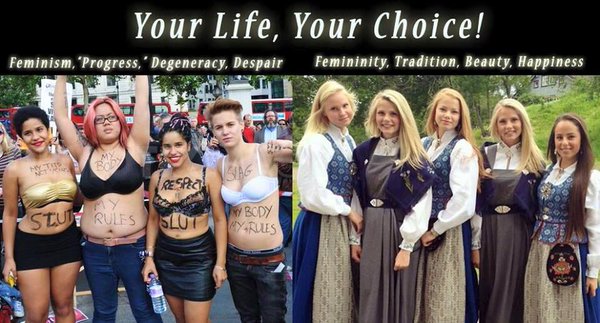
Choices

Cf4oNKQW4AAtgd2

Posted in Feminism | Comments Off on Choices

Facebook Vs Trump

I’ve long noticed that Facebook tilts left in the stories it promotes.

Gizmodo: Facebook Employees Asked Mark Zuckerberg If They Should Try to Stop a Donald Trump Presidency

This week, Facebook CEO Mark Zuckerberg appeared to publicly denounce the political positions of Donald Trump’s presidential campaign during the keynote speech of the company’s annual F8 developer conference.

“I hear fearful voices calling for building walls and distancing people they label as ‘others,’” Zuckerberg said, never referring to Trump by name. “I hear them calling for blocking free expression, for slowing immigration, for reducing trade, and in some cases, even for cutting access to the internet.”

For a developer’s conference, the comments were unprecedented—a signal that the 31-year-old billionaire is quite willing to publicly mix politics and business. Zuckerberg has donated to campaigns in the past, but has been vague about which candidates he and his company’s political action committee support.

Inside Facebook, the political discussion has been more explicit. Last month, some Facebook employees used a company poll to ask Zuckerberg whether the company should try “to help prevent President Trump in 2017.”

…More than 1.04 billion people use Facebook. It’s where we get our news, share our political views, and interact with politicians. It’s also where those politicians are spending a greater share of their budgets.

And Facebook has no legal responsibility to give an unfiltered view of what’s happening on their network.

“Facebook can promote or block any material that it wants,” UCLA law professor Eugene Volokh told Gizmodo. “Facebook has the same First Amendment right as the New York Times. They can completely block Trump if they want. They block him or promote him.” But the New York Times isn’t hosting pages like Donald Trump for President or Donald Trump for President 2016, the way Facebook is.

Most people don’t see Facebook as a media company—an outlet designed to inform us. It doesn’t look like a newspaper, magazine, or news website. But if Facebook decides to tamper with its algorithm—altering what we see—it’s akin to an editor deciding what to run big with on the front page, or what to take a stand on. The difference is that readers of traditional media (including the web) can educate themselves about a media company’s political leanings. Media outlets often publish op-eds and editorials, and have a history of how they treat particular stories. Not to mention that Facebook has the potential to reach vastly, vastly more readers than any given publication.

With Facebook, we don’t know what we’re not seeing. We don’t know what the bias is or how that might be affecting how we see the world.

Facebook has toyed with skewing news in the past. During the 2012 presidential election, Facebook secretly tampered with 1.9 million user’s news feeds. The company also tampered with news feeds in 2010 during a 61-million-person experiment to see how Facebook could impact the real-world voting behavior of millions of people. An academic paper was published about the secret experiment, claiming that Facebook increased voter turnout by more than 340,000 people. In 2012, Facebook also deliberately experimented on its users’ emotions. The company, again, secretly tampered with the news feeds of 700,000 people and concluded that Facebook can basically make you feel whatever it wants you to.

If Facebook decided to, it could gradually remove any pro-Trump stories or media off its site—devastating for a campaign that runs on memes and publicity. Facebook wouldn’t have to disclose it was doing this, and would be protected by the First Amendment.

Posted in Facebook | Comments Off on Facebook Vs Trump

Why Do Blacks Vote For Hillary?

Comments to Steve Sailer:

* I think the best explanation is that blacks vote what they know. Low information voters take a very long time to absorb something, and if you haven’t been talking about yourself all over the national stage for years, blacks don’t have a clue about who you are. Bernie hasn’t been boasting about his civil rights record since the 1960s like Jesse Jackson. He’s concentrated too much on local Vermont politics, and he’s seen as a Vermont politician, not an American politician. By contrast, Hillary has been all over the US media since the 1990s.

* The useful description is “Coalition of the Fringes.” Democrats tend to run even or win from everyone outside the American core of married white people.

The different constituency groups don’t actually like each other.

Because of political correctness and civil rights nostalgia, it’s impossible for a candidate like Bernie Sanders to say “I’m not going to bribe black pastors to get votes, like the Democratic establishment does.” So instead we’re getting code words like “Deep South.”

* Lawrence Auster’s First Law of Majority-Minority Relations:

Here’s the First Law expressed well in its three main variations:

1. The worse a designated minority or non-Western group behave, the more they are praised and their sins covered up.

2. The worse a designated minority or non-Western group behave, the more racist it becomes to speak the truth about their behavior.

3. The worse a designated minority or non-Western group behave, the more their behavior must be blamed on white racism.

* I attended a talk given by Paul Gottfried who said that the alt-right is the only real opposition to neo-conservatism and that paleo-conservatism no longer has much relevance. He also said that Trump has forced the neo-cons to confront the illegitimacy of their dominance of the conservative movement. However, he feels it’s going to be very difficult to unseat them.

* Separate white and black countries in North America will be the equivalent of putting Ghana next to Switzerland. There’s a reason that there’s very little black nationalist sentiment: at some subliminal level blacks know that they’re dependent on whitey to keep things running. Whites “going their own way” is the ultimate black nightmare: there’ll be no one here but us!

* Blacks are overwhelmingly hostile to the idea of white separatism. The idea that whites should be kept away from non-whites (or allowed to keep themselves away from non-whites) so they can’t racissly oppress them any more doesn’t fool blacks for a second. You’d think there’d be the occasional moment of cognitive dissonance if this stuff was really subconscious, but no.

* Blacks are conservative only in the sense that they don’t pretend one man shoving his phallus into another man’s lower digestive system is anything to celebrate.

* Jews are similar in many respects, but candidates don’t seem eager to push them around. Why? Their financial clout and their solidarity. If white males had the same solidarity, all these SJWs, diversitycrats, feminists, and cuckservatives would shut their mouths.

Heck, as recently as the late 80s (when white racial solidarity was moderately strong), you really didn’t see much anti-white male agitation, except for fringe elements. In that era, even liberal Democrats, like Mondale and Dukakis, weren’t into white male bashing. Of course, in that era, there were lots of Frank Rizzo Democrats in the party. Not so much these days.

Posted in Blacks | Comments Off on Why Do Blacks Vote For Hillary?

Jews & The West

Comments to Steve Sailer:

* The problem is that Jews are 33% of the 500 richest men in the world, but white goyim are not supposed to notice that fact, let alone talk about it, let alone wonder if something can and/or should be done about it.

Is it “good” or “bad” that Jews have disproportionately more wealth and power than any other ethnic group? “Good” or “bad” for whom? Are white goyim better off in a world where Jews are 33% of the 500 richest men? Would we better off if Jews made up only 3% of that list, or 66% of it, or 0% or 100%? How so?

Would white goyim be better off if George Soros were a white goy who spent his money on white-goy causes? (What is a white-goy cause, anyway?)

Would white goyim in America be better off if our government didn’t give so much money to Israel? Would we be better off if our country had a border fence like Israel’s?

These are all interesting questions. Unfortunately, white goyim can’t ask them, openly, in public, because a white goy who asks even one of them is branded an anti-Semite. Remember: We’re not even supposed to notice that Jews have a disproportionate amount of wealth and power.

Some Jews pursue Jewish interests, even at the expense of white goyim, and that’s fine. So don’t tell me that I’m wrong to want to pursue white-goy interests, even at the expense of Jews.

Ultimately, no group “should” be in charge. White goyim don’t “deserve” to rule over Jews any more than Jews “deserve” to rule over white goyim. It’s a game – winner takes all.

Jews are good at winning. One way to win is to change the rules of the game so that your opponent doesn’t even know what he can do, let alone what he should do.

White goyim can either bend over and accept losing, or they can steel themselves for a long, hard slog and try to make a few new rules of their own.

I don’t believe that Jews can (or necessarily should) be displaced from their firmly-entrenched position in the ranks of the economic, social, and political elite. But I’ll be damned if someone’s going to tell me that I can’t even acknowledge the fact that they make up a large part of that elite.

* [Cathy] Young’s article would’ve been interesting if it contained an argument, rather than ad hominem. She writes as another SJW, defining the limits of polite company and respectable debate. She apparently hails from the same community that believes that dissent can only be offered by Democrats during Republican administrations.

It’s a funny (strange) article in contrast to the USA Today article critiqued by Sailer. Either race matters–or it doesn’t. If it matters, then all aspects are discussable. If it doesn’t, then stop obsessing over it.

You’d have thought someone born and raised in the Soviet Union would respect debate–especially debate outside the constraints deemed by those ‘in the mainstream’ –but you’d be wrong.

* With Philip Giraldi, literally 100 percent of his blogs are about the Jews. To him it’s like 98 percent of the rest of the nation do not even exist. Philip Giraldi’s obsession with the Jews matches Ta-Nehisi Coates obsession with his Black body.

Philip Giraldi could be living in Wyoming where there is like 3 Jews in the whole state and 100 percent of his blogs would still be about the Jews.

* I think the idea that Jews are trying to subvert the West is nonsense. I mean, I’ve known a lot of Jews (a lot of blacks, too, for that matter). Maybe a couple have had the cliche’d “is it good for the Jews” mentality but most of them are just trying to live their lives, to the extent that their families will allow them. (Jewish mothers were Tiger moms avant la lettre).

There is a lot of nepotism in fields that Jews dominate. It’s not as bad as it sounds. It’s really no different than the way ethnic catholics tend to dominate fire and police departments in the northeast.

Jewish kids are expected to be “smart”, even when they aren’t. So they tend to be very good verbally because that’s the easiest way to appear smart, even if you aren’t. Verbal facility equals fluent writing, fluent writing means good grades and praise, good grades and praise leads to fields where you write for a living, presto, Jews are seriously over-represented in the verbal professions.

Being Jewish, Jewish writers tend to write about things that come easily to their life experience. The whole thing we are getting now where myriad Indian and Chinese youngsters are writing “sensitive first novels” about “what it means to be Indian/Chinese/etc.” was done 50-60 years ago except the authors were all Jewish boys and girls talking about what it meant to be Jewish, etc.

Also, being Jewish, Jewish writers are going to be hung up on Israel, the Holocaust, things like that. So they write about that a lot. And everyone who isn’t Jewish is exposed to it a lot. If, in fact, Jewish writers were not frequently writing about those things, and particularly Israel, non-Jews wouldn’t be complaining about Israel.

I don’t think any of this is very complicated. At the same time, Jewish perceptions are not the only possible human perceptions. Non-Jews are not necessarily going to have the same attitudes towards Israel or Jewish history that Jews do. Jews have to understand this and not reflexively accuse people of anti-semitism like that uncle on Seinfeld every time some non- Jew has a different take on these things. By the same token, to upbraid any Jew who is critical of Israel (e.g., Finkelstein) by calling him an “anti-semitic crackpot” or, worse, a “self-hating Jew” is, in my opinion, just plain wrong.

* There are a lot of Jewish people in the newspapers, movie industries, and on Wall Street (newspapers and movie studios were founded by Jews without other outlets in many cases, and Jews were in banking in Europe since the Middle Ages). People tend to be affected by their background. This tends to skew media coverage in certain ways. Why are there so many more movies about the Holocaust than the Holodomor?

Of course, there are also lots of Harvard grads, liberals, big-city dwellers, people from the Northeast, and so on. (These groups overlap.) That means that non-college grads, conservatives, small-town people, Southerners, and so on tend not to get a fair shake in the news.

Of course, ethnonationalists tend to think ethnically. So ethnic explanations tend to get foregrounded. I think that’s part of the real picture, but there’s also a complex overlapping web of interests that determines who gets their way–money is a lot of it, for example. I don’t agree that America’s elite is entirely composed of sinister Jews trying to destroy the white race, and the hatred of the white race is way overblown as an explanation (they hate whites so much 60% of them marry them?), but if Jews are 33% of the 500 richest men in the world, they’re going to hit way above their weight class. To reduce it to a simpler situation–if a committee made of George Soros and the Koch brothers makes all the big decisions, Soros is going to get a lot more of what he wants than a chicken farmer in Kansas will, even though he’ll be flustered frequently.

* If a soft drink contained only 10% feces, or even 1%, would you buy it? The usual level of tolerance in the rest of American society for public anti-Semitism is zero, so even a little bit of anti-Semitism is shocking to see. It’s unfortunate because it de-legitimizes the rest of Steve’s work that doesn’t deserve to be de-legitimized in the mainstream. It’s a tough problem, because you want to be for free speech and you don’t want to adopt the McCarthyite tactics of the left where no deviation from the Party line in any matter larger or small is permitted on pain of losing your job (and Steve is not responsible for the view of his commenters) but if your biggest fans are raving anti-Semites then you may have a problem.

* Why is the emotion of hate, and its expression, considered beyond the pale–that is, at least for so-called Conservatives?

* “The problem is that Jews are 33% of the 500 richest men in the world, but white goyim”

I don’t even say White Goyim, I just say Goyim because the term Goyim alone automatically means White people who are not Jewish. Nobody is including Tongans and Haitians in the definition of Goyim. Adding White to Goyim is just redundant.

If a Black person murders a Non Jewish White person, nobody says it is Goyim on Goyim violence.

* Life is a team sport. The amazing thing is that Whites can be convinced that otherwise.

Posted in Alt Right, Jews | Comments Off on Jews & The West