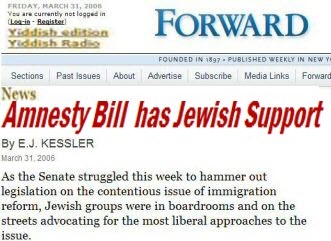
Jewish Groups Lead Push To Crack Open Doors to Syria Refugees

If Jews deserve to preserve their people and heritage, which I believe they do, then surely non-Jews such as the Germans, Swedes, Australians, English etc also deserve to preserve their heritage and keep enemy aliens (Muslims, Africans, etc) out. Every group deserves the chance to develop themselves free of outside interference and invasion.

JewishGroupsLeadPush

Nathan Guttman writes: Of the four million Syrians who have fled their war-torn country in recent years, at least 135,000 of them require immediate resettlement.
But America has absorbed fewer than 1,000.
For Jewish activists pushing the government to shift gears, that feeble number and the accompanying bottleneck in resettlement of Syrian refugees are troubling reminders of their community’s own experience during World War II.
“Waiting two years for resettlement isn’t really rescue,” said Melanie Nezer, vice president for policy and advocacy at HIAS, the leading communal group dealing with the admission of refugees. “As a Jewish community, we understand what it means to be refugees without getting any help. We would have been in a different place if the world had stepped up then.”
The challenge facing Jewish groups assisting Syrian refugees is more complex than their past missions, which involved helping refugees from the former Soviet Union or from South East Asia gain entry to the United States. Security checks have been ramped up significantly in the past decade, slowing the admissions process to a grind. For many refugees, the road to a new life in America is a years-long journey. A less-inviting climate now prevails, regarding all forms of immigration. And there is an extra sense of suspicion in some political circles toward those coming from Muslim and Arab countries. This has made advocacy on their behalf even harder.
“There is a politicization of the refugee issue, which is concerning,” Nezer said.
Human rights organizations often refer to the Syrian civil war, now in its fourth year, as the biggest humanitarian crisis of our generation. Brutal attacks by the Assad regime against opposition forces have been followed by equally vicious responses by forces from the group known as the Islamic State, which has taken over parts of the country. The result so far is more than a quarter of a million casualties and a country in ruins. The 4 million Syrians who have fled their homeland have found temporary shelter in Turkey, Jordan, Lebanon and Iraq. Many more are described as internally displaced, a term used for those who were forced to flee their homes and towns because of fighting and are now living a refugee life in their own country.
The United Nations High Commissioner for Refugees, the aid agency tasked with determining refugee status and identifying those in need of immediate relief, has been sifting through requests for resettlement in the refugee camps on Syria’s borders. The 135,000 already deemed by UNCHR to be at high risk in their current situations include single women or those with children but no father present, refugees suffering from illnesses, and those facing persecution, including journalists and political and human rights activists.
“I’ve seen families that are really desperate,” said Shadi Martini, a Syrian expatriate working from the United States to help refugees. “They want to survive, but they can’t work, and have to go through this very long process. They don’t have any idea when they’ll be resettled.”
Martini serves as a senior Syria adviser at the Multifaith Alliance for Syrian Refugees, an ecumenical group working to assist refugees in the camps, including those wishing to resettle.
The Multifaith Alliance, noted Rabbi Eric J. Greenberg, the organization’s director of communications, programs and interfaith relations, started off as a Jewish response to the Syrian crisis. A year and half ago the group reached out to other faith-based groups and to humanitarian organizations, inviting them to join the effort. The alliance is made up of 40 groups of all faiths, but Jewish organizations still play a prominent role in the coalition.
The alliance has deployed its funds to help Syrian refugees in camps and to raise awareness of the crisis they face among Americans. The group delivered part of its assistance through Israeli relief organizations working at the Syrian refugee camps. In an official publication, the alliance said it is “nurturing this development through transformative Syrian-Israeli civil society engagement to complement future governmental diplomatic work.”
It is uncertain how recent revelations of Israeli military assistance to Jihadist groups fighting in Syria may now impact the humanitarian assistance provided by these Israeli relief groups.
Meanwhile, back in America, the Jewish community’s efforts to resolve the Syrian refugee crisis include high-level advocacy aimed at helping more Syrians resettle here.
Traditionally, the United States has taken it upon itself to admit half the refugees worldwide who are identified by UNHCR as being in need of immediate resettlement. In the Syrian case, this translates into about 65,000 out of the 135,000 total. But so far, UNHCR, slowed by its own vetting process, has referred only 12,000 requests to the United States.
Experts anticipate that by the time the refugee evaluation process is completed, some 400,000 will be recognized as needing resettlement. This will present America with a request to absorb 200,000 Syrian refugees.

COMMENTS TO THE FORWARD:

* These Jewish Groups are willing for the U.S. to absorb 200,00 Syrians. How many is Israel going to Absorb if any. And if they are not: Why not?

* I guess that Nezer and Greenberg have taken it upon themselves to blow that stereotype about Jews being smart completely out of the water.

* Thanks to these naronim, our fate will be the same as that of the European Jewry – dilution of our vote and increase in antisemitism thanks to HIAS and friends.

* What on the surface appears to be compassion is under the surface arrogance. After 6 decades of “saving the world,” I tend to believe we need to allow the world to save itself.

forward-immigration-jewshighlight-343x300

Simon_Wiesenthal_Center-300x225

JewishAmnesty

bikini2n-5-web

Posted in Europe, Immigration, Israel, Jews, Syria | Comments Off on Jewish Groups Lead Push To Crack Open Doors to Syria Refugees

Blog: Haredi Rabbi says Muslim invasion of Europe is ‘excellent news’ because “Edom” (Christianity) must be destroyed before “Messiah” can “return”

Blog: An extract from a talk by apparently Chabad-associated Rav David Touitou. Full video here.

The rabbi says: “The Messiah of Israel will only come when Christ, Europe, Christianity are totally defeated. Therefore I ask you, is this good news that Islam is invading Europe? Yes, this is great news!”

I don’t think the goyim appreciate it when Jews say they need to be destroyed to bring the Jewish Messiah.

I wonder how many Jews are going to get killed because of what this rabbi said?

Here are a selection of the comments on this Liveleak video:

* rare glimpse into the modern jew and how they see goyim. i tell ppl all the time they are no better than muslims, and they just stare at me like wtf

* death of Israel would be even nicer. This cancer together with their GCC puppets get more and more annoying by the hour. 😀 I believe what will follow as a response will make Auschwitz look like a walk in the park. Anmd they will have only themselves to blame, the jihad Air force aka Israel.

* I don’t think nazi describes what lies ahead even remotely. What we are witnessing is a demographic time-bomb, and in 20 years from now, when muslim popullation starts counting in elections and starts placing their own people in rellevant positions, people will start realising that a suicide on slow motion has been in the making and, unless swift and brutal reaction is taken, that will mean the end of Europe. There will be nowhere to deport or expel the muslims (their countries sent them for a reason, no way they’re taking them back) and when full understanding of the problem is achieved, the solution will be crystal clear. History repeating itself…over and over again, despite all the political correctness bullshit and pandering we are suffering these days.

* Don’t come crying for refuge when the Muslims try to cut your head off and rape your goats.

A French pop group uses the rabbi’s words to start an angry video:

Daniel Sayani: “What a complete and utter fool. I suppose he wants Jews to be slaughtered and oppressed as dhimmis.”

Posted in Christianity, Europe, France, Islam, Jews, Messiah | Comments Off on Blog: Haredi Rabbi says Muslim invasion of Europe is ‘excellent news’ because “Edom” (Christianity) must be destroyed before “Messiah” can “return”

Europe’s Immigration Disaster

Michael Sheuer writes: The leaders and bureaucrats of the European Union (EU) are fortunate that they have largely disarmed the citizens of EU member states. If the citizens of Europe had personal weapons, all officials at all levels of the increasingly authoritarian EU organization might well be under fire — and rightly so – for causing the horde of unwanted, unneeded, and non-assimilable migrants that is now inundating Europe.

The migrants will produce further lawlessness, a debilitating level of societal tensions, enormous increases in the expense of social services and public housing, and contribute nothing worth having to the nations of the EU. The migrants also will wreck the status quo in EU security as the many hundreds of thousands of incomers are mixed with a goodly number ISIS and al-Qaeda organizers, recruiters, fighters, and suicide attackers who will make the job of EU security and intelligence services even more undoable. Indeed, the only upside of the migrant flood is that elected and appointed EU officials will feel proud of themselves for spending the money of the EU’s wildly overtaxed citizens for a “humanitarian purpose” that, to anyone with commonsense, clearly carries the seeds of terrorism, the end of the EU, fascism, and civil war.

EU leaders also should be deliriously happy that most of the region’s media are urging that Europe take in as many of the migrants as possible and are keeping their readers from asking why the migrants are flowing into Europe. Many European politicians and pundits are blaming Bashir al-Assad and the Syrian regime. The British finance minister George Osborne, for example, said last weekend that the world needs to focus on dealing with the migrant “problem at source, which is this evil Assad regime and the ISIL (Islamic State) terrorists, and you need a comprehensive plan for a more stable, peaceful Syria.” Mr. Osborne must be crazed.

And then there is the Pope Francis who wants to get all the migrants possible into Europe and wants Catholics to defy the law and put them up. The mindless, do-gooding interventionism of this Pope will not be sated until he helps to turn the EU into a gigantic Greece, and ensures the impoverishment of the rest of the Western world, while the Vatican’s art collection and property holdings remain intact.

The major and nearly only cause of the EU’s overwhelming influx of unwanted migrants is the relentless interventionism of the EU, NATO, and the United States in the Islamic world, and their refusal to win the wars they start there. Although such Western interventionism has been a constant since 1945, it has become the tool of first resort since the attacks of 9/11 and it is the direct and primary cause of the migrant tide now destabilizing the EU. From 1996 until this day, the four following realities lead in a direct, unambiguous, and causal line to the current migrant onslaught.

–The Islamist began to wage their religious war against the United States and its Western allies in 1996 because of what they saw as a half-century of reliable Western intervention — especially by the United States — on the side of Israel’s ambitions and the preservation of Arab world’s tyrants. Nearly 20 years later, the United States, NATO, and the EU continue their unnecessary and largely unwanted intervention in the Islamic world on behalf of both, fighting on the side of the Gulf tyrants in Iraq, Yemen, and Syria and supporting an increasingly authoritarian Egyptian government that seized power by military coup. In addition, Washington is publicly bragging about the higher-than-ever flow of U.S.-made arms to Israel, apparently to compensate it for an Iran deal that will not stop Tehran completing its nuclear weapon, but will greatly expand Sunni Muslim hatred toward the United States and the West.

–The U.S.-NATO invasion and 15-year occupation of Afghanistan that not only was militarily defeated by the Islamists, but which allowed al-Qaeda to proliferate around the world, facilitated the accelerating Arabization of Afghan and Pakistani Islam in the direction of Salifism and Wahhabism, nurtured a new generation of Sunni mujahedin, and strengthened the Muslim world’s confidence that Islamist fighters are more than a match for any opponent, given their defeat of first the Russian and then the U.S.-NATO militaries in Afghanistan.

–The unprovoked, unnecessary, and ultimately defeated U.S.-led military intervention and occupation of Iraq. This act of Western insanity destroyed the only reliably durable obstacle — Saddam Hussein and his regime — that blocked the westward expansion of the Islamist army that had been incubating in Afghanistan and Pakistan since the Soviet’s Afghan invasion in 1979. Saddam’s demise (a) opened an easily traveled, westward-heading highway for the Islamist to move from Pakistan’s tribal region to Morocco’s Atlantic coast; (b) removed a mujahedin-hating Sunni tyranny in Iraq, replaced it with an incompetent, Sunni-persecuting Shia tyranny, and along the way created the environment that allowed birth, development, and expansion of the Islamic State (IS); (c) yielded the Islamists’ second defeat of the U.S. superpower; and (d) ultimately created the Islamist forces that attacked Assad’s regime and caused the Syrian-Islamist war which has provided the first batch of migrants is now pouring into Europe.

–The final direct cause of the EU’s migrant disaster is the destruction of the Qaddafi regime in Libya, and that action is the sole responsibility of David Cameron, Nicholas Sarkozy, Hillary Clinton, and Barack Obama. The U.S.-NATO military annihilation of the Libyan regime gave the mujahedin more ordnance than ever before; a large reinforcement of veteran and skilled jihadis; laid open all of North Africa, Egypt, and the Sahel region to the Islamists’ exploitation; gave IS a place to territorially expand and so add to the credibility of its caliphate; and provided nearly 5,100 miles of coastline from which people-smugglers, IS, and al-Qaeda can dispatch a mass of migrants salted with Islamist fighters to the EU.

Posted in Europe, Immigration, Islam | Comments Off on Europe’s Immigration Disaster

Invasion By Immigration

William Lind writes: Were Russian tank divisions now pouring into Germany, it is safe to say Germany would be fighting back. As it happens, Germany and Europe are now suffering an invasion more dangerous than that would be. Yet all Frau Merkel can do is stand by the side of the road handing posies to the invaders.

As I have pointed out for many years, in a world of Fourth Generation war, invasion by immigration is more dangerous–not less dangerous–than invasion by a foreign army. Why? Because unless the invaders are a Roman army, the enemy army usually goes home. He may permanently occupy a province–Silesia, Elsass-Lothringen–but an enemy state seldom swallows the whole thing and changes it into a place unrecognizable in both its people and its culture to those who lived there before. At least until Stalin did it to eastern Poland and Germany east of the Oder-Neisse line.

But vast numbers of immigrants do exactly that. The reason Gaul, Spain, Britain, and Italy in the year 800 bore no resemblance to those places in the year 300 was mass immigration. The current invasion of Europe by Moslems from the south is actually worse, because while most of the barbarians moving in wanted to become Romans–their numbers were too great for that–Islamics have no desire to assimilate. They plan to Islamicize Europe.

The September 18 New York Times quoted Marine le Pen of France’s National Front as saying, “Unless the French people take action, the invasion of the migrants will be every bit the same as that of the fourth century, and could have the same consequences.” Regrettably, the invasion of France has already succeeded, leaving that country occupied by millions of Islamic Arabs bitterly hostile to French culture.

But the suicide of Germany and the rest of Europe that is welcoming the invaders must continue so long as Globalists remain in power. The notion that all peoples, religions, and cultures are wonderful and peaceful (except Western culture, the White race, and the Christian religion, which are evil and oppressive) is central to Brave New World’s ideology. That ideology is, of course, the cultural Marxism of the Frankfurt School. Its goal, from its initial conception in 1919 (independently) by Gramsci in Italy and Lukacs in Hungary, has been the destruction of the Christian West.

In all the West, as of now only one country, little Hungary, is acting to halt the invasion. This role is not new to Hungarians, who fought the Turks for centuries. Not only has Hungary forcefully closed its southern border, it has rightly called for a joint European force to defend the borders of Greece. The best place to stop the invaders is on the beaches. If the Greek islands are easy for the migrants to reach, they are also easy places from which to send them back.

Posted in Europe, Immigration | Comments Off on Invasion By Immigration

Real Life Hunger Games

Sarah A. Hoyt writes: Social capital, what’s that? The built-up support networks of families and individuals that help maintain and order their lives. Family ties, community ties — with organizations like churches, schools, and voluntary associations that once were more common parts of everyone’s lives. The mutual assistance of friends and neighbors. Reputation, status, and the regard of others which motivated good behavior, honesty in dealing, and charitable assistance, which maintained and strengthened those ties, and helped those in need with both assistance and the strings of obligation to repay that assistance by being useful members of the community.

In a small town, the impulse to assist the poor and disorganized was direct, and the people being helped were known to everyone. Big cities with their concentrated slums of poor immigrants led to social service agencies, funded at first by churches and cities, and then by state and federal governments. As the source of the assistance became impersonal, so did the aid — and the direct contact between those assisting and those assisted declined. Instead of the local church matrons with their bourgeois ideas of proper behavior and work, harassed social workers with enormous caseloads processed cases quickly, and the ideology of government assistance changed so that any behavioral expectation of the client population was viewed as an affront to their dignity.

In time, the government assistance ethos spread to every corner of the country and crowded out the local community services. Meanwhile, locally-controlled schools were gradually taken over by higher levels of government and distant union bureaucracies so that the influence of local parents was minimized. This was viewed as “progressive,” since distant elites thought local school boards and parents were too parochial and backward to be entrusted with decisions, and would get in the way of teaching the correct materials.

The incorrect application of emotions of sympathy and support to faceless categories of people like “the poor” and “the undocumented” removes any possibility of understanding the real situations of each of the category’s members. A hazy idealized poor family is envisioned, then a response that would be appropriate if that family lived next door (help them!) leads to voting for politicians that offer new programs to help “people like that.” By misapplying family and community feelings to higher levels of government, voters put into place a bureaucracy that misses most of the social signalling features of local groups and takes tax money to grow itself, crowding out local groups (and the valuable social signals that maintained bourgeois standards.)

Progressives generally are sentimentally supportive of direct local politics — they especially favor the ideals of the New England town meeting, where everyone who showed up had a say. The reason why this form of local government was generally abandoned is that it is simply too time-consuming for larger communities, and allows the motivated minority to capture control. Election of representatives was an advance which allowed voters to go about their own lives most of the time while exerting control through their representative, who had time to understand the issues thoroughly and vote in council in the best interests of the voters. Being in the 1% of local voters who cares deeply enough about an item to show up at a public meeting about it does not mean your feelings about it are more important than the views of those who didn’t show up; the once-every-few-years election is more likely to reflect what most voters want.

What have been the effects of progressive, centralized control of education, healthcare, and social services? It is true that the backwards practices of a few local school boards have been reformed, but the loss of a rich layer of church and private charity social services has impoverished local social capital. While today’s mass communication and the Internet removed one of the impulses to community (“I’m bored. Let’s go into town and hang out!”), a lot of the loss is due to the crowding out by a monopoly government, which had deep pockets and would use them to continue failed policies, as Microsoft in the 80s used the profits from its near-monopoly OS business to keep creating mediocre applications software until the innovators in applications were destroyed.

Very wealthy people have always been freer than others from the stifling social controls and judgments of bourgeois community standards. The elite of Paris and London in the 1800s often kept mistresses and dabbled in drug use without having their lives destroyed. The lower classes did not have the wealth to recover from errors, and those who did not hew to bourgeois social norms were isolated and damaged.

As the upper middle classes in the US grew as wealthy as the elite had been in the previous century after WWII, the sexual revolution and War on Poverty bestowed more social freedom on everyone — the middle and upper classes got birth control, sexual freedom, and women in the workplace, while the poor got programs to “uplift” them from poverty (a term which exposes the condescension involved). Social workers in vast numbers were hired to distribute assistance, free of any obligation — except for unmarried mothers, who were told their assistance would be cut if they married a working man.

Over the course of several generations, the well-off used their freedoms and came out relatively unscathed — families were still largely intact, children were still trained in the arts of civilization and followed the path of university and marriage into professional careers. But the artificial assistance to the poor, with its lack of community obligations and support and its immediate withdrawal in the event of marriage and better work, removed the social incentives that keep healthy communities healthy. Intact families grew less common. Crime and social pathologies became the norm in poor inner-city communities. As conditions worsened, the motivated and organized left for more civilized neighborhoods with better schools. The segregation of cities and even whole regions by income increased. Whole generations of children were poorly raised, poorly schooled, and left to drift without purpose or guidance from now-absent fathers, who were in prison or adrift themselves.

Posted in Diversity | Comments Off on Real Life Hunger Games

The West Needs More Ethnocentrism, Less Pathological Altruism

Richard Rorty writes: If we Westerners could get rid of the notion of universal moral obligation created by
membership in the species, and substitute the idea of building a community of trust between ourselves and others, we might be in a better position to persuade non-Westerners of the advantages of joining such a community. We might be better able to construct the kind of global moral community which Rawls describes in ‘The Law
of Peoples’.

In making this suggestion, I am urging, as I have in other writings, that we should peel apart Enlightenment liberalism from Enlightenment
rationalism. I think that discarding the residual rationalism which we inherited from the Enlightenment is advisable for many reasons, some of which are theoretical and of interest only to philosophy professors, for example the apparent incompatibility of the correspondence theory of truth with the naturalistic, Darwinian account of the origin of the human mind.22 But others are more practical. One more practical reason is that getting rid of rationalistic rhetoric would permit the West to approach the non-West in the role of someone with an instructive story to tell, rather
than in the role of someone purporting to make better use of a universal human capacity.

Posted in Nationalism | Comments Off on The West Needs More Ethnocentrism, Less Pathological Altruism

Europe’s Migrant Crisis

From Chronicles Magazine: RS: What is your take on the migrant crisis inside Europe, and what’s happening between Serbia and Croatia?

ST: “Migrant crisis” is the right term. I wouldn’t use the term “refugees” because, strictly speaking, most of these people had already been safe and sound in Turkey and other countries of first refuge. Their decision to move on is mostly prompted by economic reasons, by the desire to reach countries such as Germany, or the Benelux and Scandinavia, where they can look forward to free apartments and welfare payments. A refugee is someone who escapes from Syria to Turkey. Someone who moves on from Turkey to Europe is no longer a “refugee.” [ . . . ]

The Hungarian fence along the border with Serbia is obviously working. The “refugees” do not want to stay in Serbia – it is a relatively poor country by European standards, and there are no jobs and no welfare handouts – so the pressure will go wherever there is least resistance. Croatia was able to stem the flow only temporarily, because in the long term the build-up in Serbia is also insustainable. The country simply lacks the infrastructure to take care of the additional thousands of people who are arriving from Greece and across the former Yugoslav republic of Macedonia every day.

In the long term, the decision by the European Commission to impose mandatory quotas [on EU member countries to accept allocated numbers of refugees] is a mistake. It will only prompt more ?uroskepticism among the former Soviet Bloc countries, and also in Britain. It will also act as an invitation to further hundreds of thousands of migrants to make the trip from Turkey and other countries. In the long term I wouldn’t be surprised if Europe were to impose more stringent controls. In order to do that, they will need to exert pressure on Turkey’s President Rejep Tayyip Erdogan. Not many people realize that he is really the villain of the piece, because he has used the refugees in Turkey as a means of exerting pressure on the Europeans, and the Turkish infrastructure has been mobilized to move hundreds of thousands of people from its eastern borders with Syria and Iraq to the Aegean, Mediterranean ports in the southwest of the country.

In the long term, resistance to this migratory influx will increase even in the “old” European countries which have been welcoming them for the time being, notably in Germany, France and the Benelux. After all, even though they are better off than the Czech Republic, Hungary, Slovakia and Rumania, it is only a question of time when the unassimilable multitudes start acting in the way in which the Islamic diaspora in those countries has been acting for a long time – unwilling to assimilate and unwilling to adapt to the European cultural norms. [ . . . ]

RS: They left one place, they left the conflict zone and they are moving on for purely economic reasons. Why isn’t the Western press portraying it like this? Why is the press saying that it’s not even the Syrians, that we need to help everybody – it could be Libyans, it could be Africans. Why don’t we have the true media definition of what’s happening?

ST: It is a mix of political correctness and what has been called “the pornography of compassion.” When what remains of the religious impulse is compassion devoid of the moral infrastructure based on the Christian religion, then you get these knee-jerk reactions. For instance, the photograph of a drowned Syrian boy on a Turkish beach trumps any rational debate.

I would say that fewer than one-half of the people on the move at the moment even come from the countries that can be legitimately regarded as refugee-producing. Most of the people crossing from Libya into Lampedusa and Sicily in Italy are sub-Saharan Africans. Admittedly they come from some rather unpleasant countries, such as Mali, Tchad, or Nigeria, but by that token at least two and a half, maybe three billion people around the world, live in poor and unpleasant countries with no economic prospects. If they are put in the same category as genuine refugees, it will only be a matter of time before Europe is literally deluged.

In the long term this will produce a huge security problem for the host countries. As the Charlie Hebdo attack in Paris last January, and the attack on the train from Brussels to Paris only a few weeks ago remind us, the French security services had had the culprits in those attacks under supervision – and then they lost the ability to track them because they were overwhelmed. Nobody knows how many would-be jihadists and sympathizers of the Islamic State are coming with this latest flood, and I greatly fear that the European security services simply do not have the resources to investigate each and every applicant. Even if only a few percent of these people are jihadist-minded, it will create a new hotbed of extremism in the heart of Europe.

RS: You’ve mentioned that Turkey’s Erdogan is playing the disguised villain in this case. Are you suggesting that he is using the migrants as some sort of migration weapon?

ST: Turkey has been very actively projecting its influence in southeast Europe, particularly among the Muslim communities in Bosnia-Herzegovina, Albania, Kosovo, in Macedonia, in Serbia’s Sanjak region, and in southern Bulgaria. Not only is he [Erdogan] delighted to increase the Muslim diaspora in Europe, at the same time I think he is also exerting indirect pressure on the Europeans to subscribe to his way of resolving the Syrian crisis. He continues to treat Bashar al-Assad as the key culprit. He also seeks the creation of a buffer zone in northwestern Syria, along the border with Turkey, which would be but another way for Turkey to battle the Kurds in Syria, whom he regards as more dangerous to the stability of the Turkish state than the Islamic State itself.

Posted in Europe, Immigration | Comments Off on Europe’s Migrant Crisis

Trump, Carson have Republican Jewish establishment worried

From JTA: WASHINGTON – The Republican Jewish establishment is watching the surge of political outsiders — like Donald Trump and Ben Carson — in the presidential primaries with dismay.

“It’s like we have a conference call every morning, and we ask, ‘What can we do to screw ourselves up today?’” said Fred Zeidman, a longtime fundraiser for Republican presidential candidates.

Zeidman’s exasperation pervades the Jewish Republican world: A party that has, in recent years, established a cozy relationship with Jewish conservatives seems to be careening — at least since the presidential race began.

Donald Trump, the billionaire reality show star, has lobbed rhetorical bombs at Hispanics, women and GOP rivals, and promised to deport 11 million illegal immigrants. Ben Carson, the retired world-famous neurosurgeon, said this weekend that a Muslim can’t be president.

The two men are jostling for the lead in polls, with former Hewlett-Packard CEO Carly Fiorina in third. All three have never held elected office — and former Florida Gov. Jeb Bush, along with other establishment candidates, lag behind the outsiders.

“This election is proving that nobody really knows anything, including me,” said Seth Mandel, the Op-Ed editor of the New York Post.

It’s a disorienting experience for longtime Republican Jewish donors and activists, who have made inroads into the party’s establishment over the last two decades, and who have been at the forefront of advocacy for tolerance and pluralism within the party.

“The tone of what they’re saying, we get painted as a party of intolerance,” said Zeidman, who practices law in the Houston area and backs Bush’s candidacy.

The anti-immigrant rhetoric especially infuriates Zeidman, a past chairman of the US Holocaust Memorial Council, who was driving near his home during his phone interview with JTA.

“I think half the people I’m looking at doing roadwork in 100-degree heat are not legal — and they are working their tuchus off,” he said.

Posted in Donald Trump, Jews | Comments Off on Trump, Carson have Republican Jewish establishment worried

The Future of Palestine: Righteous Jews vs. the New Afrikaners

John J. Mearsheimer is widely regarded as the most important political scientist in America today. I respect his work. Yet his prediction and prescription for Israel in this 2010 talk bewilders me.

Regrettably, the two-state solution is now a fantasy. Instead, those territories will be incorporated into a “Greater Israel,” which will be an apartheid state bearing a marked resemblance to white-ruled South Africa.

With Stephen Walt and John J. Mearsheimer, I don’t think Israel is a worse nation than others. On the other hand, along with Walt and Mearsheimer, I don’t think it is a significantly more kind occupier than others.

If Israel were kinder to the Palestinians, it would cease to exist. If Israel were harsher, it would lose Jewish and Gentile support. From my perspective, Israel, like most nations, is just doing the best it can with very difficult circumstances.

John Mearsheimer is a foreign policy realist. He knows that a country’s human rights record has nothing to do with how effectively it can govern and project power and retain its independence. So why is he getting all moral about Israel’s treatment of the Palestinians?

I am not a political scientist, but what other countries are called “apartheid”? I just did a Google search for “apartheid” and all of the results refer to South Africa except for a handful for Israel. Is the way Israel rules so distinctively and uniquely evil in the world that only it deserves the term “apartheid”?

For most people in the western world, “apartheid” is about the worst term you can fling at a country.

So John J. Mearsheimer’s choice of it for Israel and for nobody else (aside from the former South African regime) disturbs me. A Google search for “John Mearsheimer apartheid” reveals he does not use the term for any other country but Israel (and the former South Africa).

It seems like John J. Mearsheimer, following up on his important book The Israel Lobby (co-written with Stephen Walt) has become unhinged about the Jewish state. I wonder if all the slurs hurled at him have somewhat disengaged him from his rational faculties with regard to Israel?

Mearsheimer writes “young Israeli Jews, many of whom hold clearly racist views toward the Palestinians in their midst.” Is noticing differences and conflicting group interests racist? I thought the “realist school” of foreign policy analysis meant that the moral quality of a regime has nothing to do with how powerful and effective it can be. Why is Mearsheimer suddenly getting all moral with Israeli attitudes?

A Google search for “racist John Mearsheimer” reveals in the first 50 results that Mearsheimer only uses the term for Israeli attitudes. That’s weird. Why is Israel’s racism so much worse than everyone else’s?

Mearsheimer writes that if Israel expels its Arabs, it would be a “crime against humanity.” Would expulsion be a greater crime than all the genocides that happen routinely in the Arab world and Africa? Compared to those genocides, why would expulsion be such a crime?

Here is an example of why I respect Walt and Mearsheimer.

From Walt’s blog:

Ever since John Mearsheimer and I began writing about the Israel lobby, some of our critics have leveled various personal charges against us. These attacks rarely addressed the substance of what we wrote — a tacit concession that both facts and logic were on our side — but instead accused us of being anti-Semites and conspiracy theorists. They used these false charges to try to discredit and/or marginalize us, and to distract people from the important issues of U.S. Middle East policy that we had raised.

The latest example of this tactic is a recent blog post from Jeffrey Goldberg, where he accused my co-author of endorsing a book by an alleged Holocaust denier and Nazi sympathizer. Goldberg has well-established record of making things up about us, and this latest episode is consistent with his usual approach. I asked Professor Mearsheimer if he wanted to respond to Goldberg’s sally, and he sent the following reply.

John Mearsheimer writes:

In a certain sense, it is hard not to be impressed by the energy and imagination that Jeffrey Goldberg devotes to smearing Steve Walt and me. Although he clearly disagrees with our views about U.S.-Israel relations and the role of the Israel lobby, he does not bother to engage what we actually wrote in any meaningful way. Indeed, given what he writes about us, I am not even sure he has read our book or related articles. Instead of challenging the arguments and evidence that we presented, his modus operandi is to misrepresent and distort our views, in a transparent attempt to portray us as rabid anti-Semites.

His latest effort along these lines comes in a recent blog post, where he seizes on a dust jacket blurb I wrote for a new book by Gilad Atzmon titled The Wandering Who? A Study of Jewish Identity Politics. Here is what I said in my blurb:

Gilad Atzmon has written a fascinating and provocative book on Jewish identity in the modern world. He shows how assimilation and liberalism are making it increasingly difficult for Jews in the Diaspora to maintain a powerful sense of their ‘Jewishness.’ Panicked Jewish leaders, he argues, have turned to Zionism (blind loyalty to Israel) and scaremongering (the threat of another Holocaust) to keep the tribe united and distinct from the surrounding goyim. As Atzmon’s own case demonstrates, this strategy is not working and is causing many Jews great anguish. The Wandering Who? should be widely read by Jews and non-Jews alike.

The book, as my blurb makes clear, is an extended meditation on Jewish identity in the Diaspora and how it relates to the Holocaust, Israel, and Zionism. There is no question that the book is provocative, both in terms of its central argument and the overly hot language that Atzmon sometimes uses. But it is also filled with interesting insights that make the reader think long and hard about an important subject. Of course, I do not agree with everything that he says in the book — what blurber does? — but I found it thought provoking and likely to be of considerable interest to Jews and non-Jews, which is what I said in my brief comment.

Goldberg maintains that Atzmon is a categorically reprehensible person, and accuses him of being a Holocaust denier and an apologist for Hitler. These are two of the most devastating charges that can be leveled against anyone. According to Goldberg, the mere fact that I blurbed Atzmon’s book is decisive evidence that I share Atzmon’s supposedly odious views. This indictment of me is captured in the title of Goldberg’s piece: “John Mearsheimer Endorses a Hitler Apologist and Holocaust Revisionist.”

This charge is so ludicrous that it is hard to know where to start my response. But let me begin by noting that I have taught countless University of Chicago students over the years about the Holocaust and about Hitler’s role in it. Nobody who has been in my classes would ever accuse me of being sympathetic to Holocaust deniers or making excuses for what Hitler did to European Jews. Not surprisingly, those loathsome charges have never been leveled against me until Goldberg did so last week.

Equally important, Gilad Atzmon is neither a Holocaust denier nor an apologist for Hitler. Consider the following excerpt from The Wandering Who?

As much as I was a sceptic youngster, I was also horrified by the Holocaust. In the 1970s Holocaust survivors were part of our social landscape. They were our neighbours, we met them in our family gatherings, in the classroom, in politics, in the corner shop. The dark numbers tattooed on their white arms never faded away. It always had a chilling effect. . . . It was actually the internalization of the meaning of the Holocaust that transformed me into a strong opponent of Israel and Jewish-ness. It is the Holocaust that eventually made me a devoted supporter of Palestinian rights, resistance and the Palestinian right of return” (pp. 185-186).

It seems unequivocally clear to me from those sentences that Atzmon firmly believes that the Holocaust occurred and was a horrific tragedy. I cannot find evidence in his book or in his other writings that indicate he “traffics in Holocaust denial.”

The real issue for Atzmon — and this is reflected in the excerpt from his blog post that Goldberg quotes from — is how the Holocaust is interpreted and used by the Jewish establishment. Atzmon has three complaints. He believes that it is used to justify Israel’s brutal treatment of the Palestinians and to fend off criticism of Israel. This is an argument made by many other writers, including former Knesset speaker Avraham Burg, historian Peter Novick, and political scientist Norman Finkelstein. Atzmon also rejects the claim that the Holocaust is exceptional, which is a position that other respected scholars have held. There have been other genocides in world history, after all, and this whole issue was actively debated in the negotiations that led to the building of the Holocaust Museum in Washington, DC. Whatever one thinks of Atzmon’s position on this subject, it is hardly beyond the pale.

Finally, Atzmon is angry about the fact that it is difficult to raise certain questions about the causes and the conduct of the Holocaust without being personally attacked. These are all defensible if controversial positions to hold, which is not to say one has to agree with any of them. But in no way is he questioning that the Holocaust happened or denying its importance. In fact, his view is clear from one of Atzmon’s sentences that Goldberg quotes: “We should strip the holocaust of its Judeo-centric exceptional status and treat it as an historical chapter that belongs to a certain time and place.” Note that Atzmon is talking about “the holocaust” in a way that makes it clear he has no doubts about its occurrence, and the passage from The Wandering Who? cited above makes it clear that he has no doubts about its importance or its tragic dimensions; he merely believes it should be seen in a different way. Again, one need not agree with Atzmon to recognize that Goldberg has badly misrepresented his position.

There is also no evidence that I could find in The Wandering Who? to support Goldberg’s claim that Atzmon is an apologist for Hitler or that he believes “Jews persecuted Hitler” and in so doing helped trigger the Holocaust. There is actually little discussion of Hitler in Atzmon’s book, and the only discussion of interactions between Hitler and the Jews concerns the efforts of German Zionists to work out a modus vivendi with the Nazis. (pp. 162-165) This is why Goldberg is forced to go to one of Atzmon’s blog posts to make the case that he is an apologist for Hitler.

Before I examine the substance of that charge, there is an important issue that needs to be addressed directly. Goldberg’s indictment of Atzmon does not rely on anything that he wrote in The Wandering Who? Indeed, Goldberg’s blog post is silent on whether he has actually read the book. If he did read it, he apparently could not find any evidence to support his indictment of Atzmon. Instead, he relied exclusively on evidence culled from Atzmon’s own blog postings. That is why Goldberg’s assault on me steers clear of criticizing Atzmon’s book, which is what I blurbed. In short, he falsely accuses me of lending support to a Holocaust denier and defender of Hitler on the basis of writings that I did not read and did not comment upon.

This tactic puts me in a difficult position. I was asked to review Atzmon’s book and see whether I would be willing to blurb it. This is something I do frequently, and in every case I focus on the book at hand and not on the personality of the author or their other writings. In other words, I did not read any of Atzmon’s blog postings before I wrote my blurb. And just for the record, I have not met him and did not communicate with him before I was asked to review The Wandering Who? I read only the book and wrote a blurb that deals with it alone.

Goldberg, however, has shifted the focus onto what Atzmon has written on his blog. I discuss a couple of examples below, but I will not defend his blog output in detail for two reasons. First, I do not know what Atzmon may have said in all of his past blog posts and other writings or in the various talks that he has given over the years. Second, what he says in those places is not relevant to what I did, which was simply to read and react to his book.

Let me now turn to the specific claim that Atzmon is an “apologist for Hitler.” Again, I am somewhat reluctant to do this, because this charge forces me to defend what Atzmon said in one of his blog posts. But given the prominence of the charge in Goldberg’s indictment of Atzmon (and me), I cannot let it pass.

Plus, I see that Walter Russell Mead, who is also fond of smearing Steve Walt and me, has put this charge up in bright lights on his own blog. Picking up on Goldberg’s original post, Mead describes Atzmon’s argument this way: “poor Adolf Hitler’s actions against German Jews only came after US Jews called a boycott on German goods following Hitler’s appointment as German Chancellor. Gosh — if it weren’t for those pushy, aggressive Jews and their annoying boycotts, the Holocaust might not have happened!”

It is hard to imagine any sane person making such an argument, and Atzmon never does. Goldberg refers to a blog post that Atzmon wrote on March 25, 2010, written in response to news at the time that AIPAC had “decided to mount pressure” on President Obama. After describing what was happening with Obama, Atzmon notes that this kind of behavior is hardly unprecedented. In his words, “Jewish lobbies certainly do not hold back when it comes to pressuring states, world leaders and even superpowers.” There is no question that this statement is accurate and not even all that controversial; Tom Friedman said as much in the New York Times a couple of weeks ago.

In the second half of this post, Atzmon says that AIPAC’s behavior reminds him of the March 1933 Jewish boycott of German goods, which preceded Hitler’s decision on March 28, 1933 to boycott Jewish stores and goods. His basic point is that the Jewish boycott had negative consequences, which it did. In Atzmon’s narrative — and this is a very important theme in his book — Jews are not simply passive victims of other people’s actions. On the contrary, he believes Jews have considerable agency and their actions are not always wise. One can agree or disagree with his views about the wisdom of the Jewish boycott — and I happen to think he’s wrong about it — but he is not arguing that the Jews were “persecuting Hitler” and that this alleged “persecution” led to the Holocaust. In fact, he says nothing about the Holocaust in his post and he certainly does not justify in any way the murder of six million Jews.

Let me make one additional point about Goldberg’s mining of Atzmon’s blog posts. Goldberg ends his attack on me with the following quotation from a Feb. 19 blog post by Atzmon: “I believe that from [a] certain ideological perspective, Israel is actually far worse than Nazi Germany.” That quotation certainly makes Atzmon look like he has lost his mind and that nothing he has written could be trusted. But Goldberg has misrepresented what Atzmon really said, which is one of his standard tactics. Specifically, he quotes only part of a sentence from Atzmon’s blog post; but when you look at the entire sentence, you see that Atzmon is making a different, and far more nuanced point. The entire sentence reads: “Indeed, I believe that from [a] certain ideological perspective, Israel is actually far worse than Nazi Germany, for unlike Nazi Germany, Israel is a democracy and that implies that Israeli citizens are complicit in Israeli atrocities.” This is not an argument I would make, but what Atzmon is saying is quite different from the way Goldberg portrays it.

Finally, let me address the charge that Atzmon himself is an anti-Semite and a self-hating Jew. The implication of this accusation, of course, is that I must be an anti-Semite too (I can’t be a self-hating Jew) because I agreed to blurb Atzmon’s book. I do not believe that Atzmon is an anti-Semite, although that charge is thrown around so carelessly these days that it has regrettably lost much of its meaning. If one believes that anyone who criticizes Israel is an anti-Semite, then Atzmon clearly fits in that category. But that definition is foolish — no country is perfect or above criticism-and not worth taking seriously.

The more important and interesting issue is whether Atzmon is a self-hating Jew. Here the answer is unequivocally yes. He openly describes himself in this way and he sees himself as part of a long dissident tradition that includes famous figures such as Marx and Spinoza. What is going on here?

The key to understanding Atzmon is that he rejects the claim that Jews are the “Chosen People.” His main target, as he makes clear at the start of the book, is not with Judaism per se or with people who “happen to be of Jewish origin.” Rather, his problem is with “those who put their Jewish-ness over and above all of their other traits.” Or to use other words of his: “I will present a harsh criticism of Jewish politics and identity … This book doesn’t deal with Jews as a people or ethnicity.” (pp. 15-16)

In other words, Atzmon is a universalist who does not like the particularism that characterizes Zionism and which has a rich tradition among Jews and any number of other groups. He is the kind of person who intensely dislikes nationalism of any sort. Princeton professor Richard Falk captures this point nicely in his own blurb for the book, where he writes: “Atzmon has written an absorbing and moving account of his journey from hard-core Israeli nationalist to a de-Zionized patriot of humanity.”

Atzmon’s basic point is that Jews often talk in universalistic terms, but many of them think and act in particularistic terms. One might say they talk like liberals but act like nationalists. Atzmon will have none of this, which is why he labels himself a self-hating Jew. He fervently believes that Jews are not the “Chosen People” and that they should not privilege their “Jewish-ness” over their other human traits. Moreover, he believes that one must choose between Athens and Jerusalem, as they “can never be blended together into a lucid and coherent worldview.” (p. 86) One can argue that his perspective is dead wrong, or maintain that it is a lovely idea in principle but just not the way the real world works. But it is hardly an illegitimate or ignoble way of thinking about humanity.

To take this matter a step further, Atzmon’s book is really all about Jewish identity. He notes that “the disappearance of the ghetto and its maternal qualities” in the wake of the French Revolution caused “an identity crisis within the largely assimilated Jewish society.” (p. 104) He believes that this crisis, about which there is an extensive literature, is still at the center of Jewish life today. In effect, Atzmon is telling the story of how he wrestled with his own identity over time and what he thinks is wrong with how most Jews self-identify today. It is in this context that he discusses what he calls the “Holocaust religion,” Zionism, and Israel’s treatment of the Palestinians. Again, to be perfectly clear, he has no animus toward Judaism as a religion or with individuals who are Jewish by birth. Rather, his target is the tribalism that he believes is common to most Jews, and I might add, to most other peoples as well. Atzmon focuses on Jews for the obvious reason that he is Jewish and is trying to make sense of his own identity.

In sum, Goldberg’s charge that Atzman is a Holocaust denier or an apologist for Hitler is baseless. Nor is Atzmon an anti-Semite. He has controversial views for sure and he sometimes employs overly provocative language. But there is no question in my mind that he has written a fascinating book that, as I said in my blurb, “should be widely read by Jews and non-Jews alike.” Regarding Goldberg’s insinuation that I have any sympathy for Holocaust denial and am an anti-Semite, it is just another attempt in his longstanding effort to smear Steve Walt and me.

Who could read that and the linked smears against him and not side with John Mearsheimer in this case against the slur merchants?

In early 2009, John Mearsheimer castigated Israel for its war in Gaza:

Israel and its supporters claim that the IDF is going to great lengths to avoid civilian casualties, in some cases taking risks that put Israeli soldiers in jeopardy. Hardly. One reason to doubt these claims is that Israel refuses to allow reporters into the war zone: it does not want the world to see what its soldiers and bombs are doing inside Gaza. At the same time, Israel has launched a massive propaganda campaign to put a positive spin on the horror stories that do emerge.

The best evidence, however, that Israel is deliberately seeking to punish the broader population in Gaza is the death and destruction the IDF has wrought on that small piece of real estate. Israel has killed over 1,000 Palestinians and wounded more than 4,000. Over half of the casualties are civilians, and many are children. The IDF’s opening salvo on Dec. 27 took place as children were leaving school, and one of its primary targets that day was a large group of graduating police cadets, who hardly qualified as terrorists. In what Ehud Barak called “an all-out war against Hamas,” Israel has targeted a university, schools, mosques, homes, apartment buildings, government offices, and even ambulances. A senior Israeli military official, speaking on the condition of anonymity, explained the logic behind Israel’s expansive target set: “There are many aspects of Hamas, and we are trying to hit the whole spectrum, because everything is connected and everything supports terrorism against Israel.” In other words, everyone is a terrorist and everything is a legitimate target.

Israelis tend to be blunt, and they occasionally say what they are really doing. After the IDF killed 40 Palestinian civilians in a UN school on Jan. 6, Ha’aretz reported that “senior officers admit that the IDF has been using enormous firepower.” One officer explained, “For us, being cautious means being aggressive. From the minute we entered, we’ve acted like we’re at war. That creates enormous damage on the ground … I just hope those who have fled the area of Gaza City in which we are operating will describe the shock.”

One might accept that Israel is waging “a cruel, all-out war against 1.5 million Palestinian civilians,” asHa’aretz put it in an editorial, but argue that it will eventually achieve its war aims and the rest of the world will quickly forget the horrors inflicted on the people of Gaza.

This is wishful thinking. For starters, Israel is unlikely to stop the rocket fire for any appreciable period of time unless it agrees to open Gaza’s borders and stop arresting and killing Palestinians. Israelis talk about cutting off the supply of rockets and mortars into Gaza, but weapons will continue to come in via secret tunnels and ships that sneak through Israel’s naval blockade. It will also be impossible to police all of the goods sent into Gaza through legitimate channels.

Israel could try to conquer all of Gaza and lock the place down. That would probably stop the rocket attacks if Israel deployed a large enough force. But then the IDF would be bogged down in a costly occupation against a deeply hostile population. They would eventually have to leave, and the rocket fire would resume. And if Israel fails to stop the rocket fire and keep it stopped, as seems likely, its deterrent will be diminished, not strengthened.

More importantly, there is little reason to think that the Israelis can beat Hamas into submission and get the Palestinians to live quietly in a handful of Bantustans inside Greater Israel. Israel has been humiliating, torturing, and killing Palestinians in the Occupied Territories since 1967 and has not come close to cowing them. Indeed, Hamas’s reaction to Israel’s brutality seems to lend credence to Nietzsche’s remark that what does not kill you makes you stronger.

But even if the unexpected happens and the Palestinians cave, Israel would still lose because it will become an apartheid state. As Prime Minister Ehud Olmert recently said, Israel will “face a South African-style struggle” if the Palestinians do not get a viable state of their own. “As soon as that happens,” he argued, “the state of Israel is finished.” Yet Olmert has done nothing to stop settlement expansion and create a viable Palestinian state, relying instead on the Iron Wall strategy to deal with the Palestinians.

There is also little chance that people around the world who follow the Israeli-Palestinian conflict will soon forget the appalling punishment that Israel is meting out in Gaza. The destruction is just too obvious to miss, and too many people—especially in the Arab and Islamic world—care about the Palestinians’ fate. Moreover, discourse about this longstanding conflict has undergone a sea change in the West in recent years, and many of us who were once wholly sympathetic to Israel now see that the Israelis are the victimizers and the Palestinians are the victims. What is happening in Gaza will accelerate that changing picture of the conflict and long be seen as a dark stain on Israel’s reputation.

The bottom line is that no matter what happens on the battlefield, Israel cannot win its war in Gaza. In fact, it is pursuing a strategy—with lots of help from its so-called friends in the Diaspora—that is placing its long-term future at risk.

I think Mearsheimer is over-doing the case against Israel. I don’t know of any other nation that has been hit by a constant barrage of rockets and reacted with more restraint than Israel did? Which people in Israel’s position would be more compassionate to Palestinians while staying alive as their own independent state?


Posted in Israel, John J. Mearsheimer | Comments Off on The Future of Palestine: Righteous Jews vs. the New Afrikaners

Fallout (2013)

Helen Caldicott says in this documentary: “America was testing atmospheric bombs in Nevada and they only did it when the wind blew east over the Mormon population because they knew the Mormons were so patriotic, they would never complain.”

You would think all smart countries would prefer patriotic citizens.

From imdb.com:

Any fears that Lawrence Johnston’s documentary on the making of Stanley Kramer’s 1959 film On the Beach would be something of a parochial, introspective effort were instantly dis-spelled with footage of President John F. Kennedy giving a speech likening the threat of nuclear annihilation as being a Sword of Damocles hanging over the whole world’s population.

On the Beach, the apocalyptic story of the world coming to an end following a northern hemisphere war in which the use of cobalt bombs brought about inevitable mutual self- destruction was penned by Nevil Shute in 1957. As the radioactive fallout heads south on the Trade Winds killing all life in its path, the Australian city of Melbourne is the last major centre on earth to be left standing, its population going about its daily business with stoic phlegm, law and order prevailing. The documentary explained that Shute based this on the reaction he witnessed of Londoners during the blitz of 1940.

Shute sold the film rights to Hollywood for 80,000 pounds and the then very dull and isolated Anglo-Celtic enclave of Melbourne went agog with excitement as screen royalty – Gregory Peck, Ava Gardner, Fred Astaire and the up and coming Anthony Perkins – arrived to shoot the adaptation of the international best-seller.

This meticulously researched, superbly produced and always fascinating documentary swept along with seamless segues as it detailed Nevil Shute’s life and career, his fractious relationship with Stanley Kramer and the politics behind the film – both internal and external. All this was set in the context of the time when people the world over were coming to terms with the realisation that Man had invented a weapon that could see everyone wiped out at a near instant.

Nevil Shute was extremely wealthy through his ‘hobby’ writing. However, he considered himself first and foremost an aeronautical engineer and, as his daughter advised in the film, considered writing a ‘nancy’ occupation. The documentary also detailed how Shute left Britain for Australia soon after the Second World War due to punitive taxation from the Labour Government. But this I think only told half the story. Shute was an extremely conservative man – both with a big and small C – something which so often comes through in his work. He only left Britain in 1950 after Attlee’s Socialist administration had been re-elected and despondently he believed that the country was now well and truly finished. In his 1953 novel, In the Wet, Shute gives a prophetic vision of 30 years hence. Britain is governed by ill-educated Welsh miners and in terminal decline. Australia and Canada are paragons of private enterprise, prosperous and free of state regulation. HM The Queen decamps for Canberra leaving the United Kingdom under the control of a Governor-General.

But when it came to the threat of nuclear war, Shute identified strongly with those, mainly on the left, who thought the whole concept total madness. As Fallout clearly detailed, it was Conservative forces which were uncomfortable with the film’s premise and put barriers up to frustrate its production.

Fallout is choc a bloc with interesting facts and vignettes. There are interviews with Donna Anderson, the only star from the film still alive; Shute’s daughter; Kramer’s widow Karen together with contributions from historians, journalists and an incredibly lucid photographer who was at Hiroshima immediately after its bombing and who was subsequently chosen to produce the stills for On the Beach.

All this was interspersed with clips from the film, a fleeting history of the development of nuclear bombs and a social history of Melbourne with relevant archive footage to accompany. It should be of interest to anyone who wants to get a feel of what the world was like in the Cold War days of the 1950s.

One of the last words went to author and journalist Gideon Haigh who wondered why the threat of nuclear destruction is no longer the social issue it once was when it is probably more likely now then ever before. He suggested the world was now an ammunition dump which one stray spark could set off. With nuclear proliferation now so prevalent and suicide bombers seemingly happy to achieve immortality, he opined that it was highly feasible two volatile states could go to war , or some fanatic detonate a nuclear device in a major world city.

This was thought provoking. Why so many are expending energy on the rather abstract idea of climate change that may cause major problems in 50, or 100, years time when a far more devastating event could happen at any time is strange indeed.

Posted in America, Australia, Nuclear | Comments Off on Fallout (2013)