Some thoughts upon discovering that the latest SJW drama stars histrionic Breitbart (!) employee and Fox News neocon narcissist Michelle Fields… the words of Macbeth come immediately to mind: “it is a tale told by an idiot, full of sound and fury, signifying nothing.”
Or—just made this up—”scratch a female neocon and, presto, therein the soul of the Social Justice Warrior emerges, Tweeting her bruise hysterically.”
So, the latest tale of narcissism, Cultural Marxism and female hysteria (but I repeat myself) comes in the form of—little surprise here—an individual within my personal demographic of females under age 30. One Michelle Fields (whose history as a serial fraudster was unearthed by Charles C. Johnson at Gotnews) claims to have been physically assaulted by Trump’s manager Corey Lewandowski while pursuing her vocation as neocon reporter questioning future president Trump on ‘affirmative action’ (LOL). She apparently lost her balance while attempting to pursue him and was physically rebuffed by an individual that may or may not have been Lewandowski. She then proceeded—in full SJW narcissistic, histrionic glory—to photograph the minuscule bruising on her arm that may or may not have been caused by the other individual and posted it on Twitter.
(Keep in mind that this person has also claimed to have been assaulted by the cops while participating in an Occupy Wall Street mob riot and thus felt the need to commiserate with the leftist rabble).
Michelle getting pushed down by police during the Occupy Wall Street protests. Trump campaign serial liars pic.twitter.com/oNptBzNkC9
She posts the picture of her bruise—then out springs brittle neocon boyfriend (Jamie Weinstein from the Daily Caller) to rev the engines of valiant outrage, Conservatism Inc. gleefully joins in, and thus unwarranted Internet neocon venom is unleashed at poor Mr. Lewandowski. And it seems she’s now pressed charges! Is Corey Lewandowski in need of a Movement to Free Him (kind of like Mumia, except actually innocent)? Shall we make photo T-shirts too, like the ones that always get made immediately in the ‘black community’ after another individual commits suicide by cop? Free Corey!
Unforgivably, the formerly somewhat-okay Ben Shapiro has led this hysterical SJW mob, which proves beyond all reasonable doubt that those ‘conservatives’ within my age group being paid money to proffer shallow and cliched opinions need to be removed from social media until they read and digest the entire works of the Old Right.
This combination of neocon vapidity and SJW malicious garbage is totally unbearable. It is NEVER GOING TO END!!! And now even Breitbart? How I wish Murray Rothbard, Sam Francis and Joe Sobran were alive to skewer these people. Can you imagine the Rothbard-Rockwell Report in the age of Twitter? One can only dream…
Trump supporters are not authoritarians, but populists and then the article (by social scientists) explains the difference. Cruz’s supporters are authoritarians. Sanders supporters are more populists, but they are not patriotic. The authors conclude they are cosmopolitan socialists.
It is a revealing article because the media has whipped up such hostility to Trump. The L.A. Times declared him unfit to be president. Robert Reich and many others label him a fascist or a nazi. The Republican establishment has many times claimed that Trump’s views are antithetical to the views of Americans. It seems that all of Trump’s opponents want nothing more than for there to be violence at Trump rallies so that they can blame it on Trump. Even though a large group of yesterday’s protesters were shouting Bernie, both inside and outside the hall, Sanders has not stood up for Trump’s right to speak and Trump’s supporters to hear him, and that has not been condemned even though the same media and candidates would try to hold Trump responsible for the acts of his supporters.
It is incredibly disturbing to me that the actions of the anti Trump demonstrators have not been universally criticized by the media, by the other candidates (both Republican and Democrats) and by other politicians.
But in our research, we find no evidence that Trump supporters are any more “authoritarian” (at least by common measures) than those who like Sen. Ted Cruz (R-Tex.) or even Sen. Marco Rubio (R-Fla.).
Authoritarianism and populism are easy to conflate, but they actually refer to very distinct tendencies.
Authoritarianism, as understood by political psychologists, refers to a set of personality traits that seek order, clarity and stability. Authoritarians have little tolerance for deviance. They’re highly obedient to strong leaders. They scapegoat outsiders and demand conformity to traditional norms.
Populism, on the other hand, is a type of political rhetoric that casts a virtuous “people” against nefarious elites and strident outsiders. Scholars measure populism in a variety of ways, but we focus on three central elements:
Belief that a few elites have absconded with the rightful sovereignty of the people;
Deep mistrust of any group that claims expertise;
Strong nationalist identity
Posted inDonald Trump|Comments Off on Trump Supporters Are Populists, Not Authoritarians
Of course, Safe Spaces has nothing to do with safety and everything to do with the territorial imperative. Young people naturally feel the urge to fight turf wars, to stake out territory and drive out enemies. Normally in America we have laws to regulate the competition for property so territorial urges don’t turn into mob rule. But over the last year minority college students have increasingly asserted that they must be above the law because racism. It’s the only way they can be safe.
What we’re seeing at UIC is the balkanized future of America in which The Diverse can only come together over fear and loathing of whites. Hating whites is the KKKrazy Glue of the coalition of the fringes.
When black, Muslim and Latino student activists at the University of Illinois at Chicago heard last week that Donald Trump was planning a rally on campus, they did what any good organizers do in 2016: They went online.
Within days, thousands of people had liked a Facebook page called “Stop Trump – Chicago.” Tens of thousands added their names to a MoveOn.org petition calling on the school to cancel the rally.
They all had one thing in common, said Casandra Robledo, a second-year student who helped organize the protest: “We felt so strongly that Donald Trump and his bigotry and racism wasn’t welcome here.”
Comments:
* I saw bits and pieces from three of Trump’s speeches today, and from the one in St Louis yesterday. In each speech he was interrupted several times. The protests were staged to burn one protester every five minutes or so. So instead of one big protest, you got all these little protests.
Yet Trump surprisingly stayed focused and calm. Even when he was giving some anecdote and was interrupted for 5 minutes, he seemed to be able to recover and continue. That’s impressive for a 69 year old without notes.
The bottom line is that I am impressed with his ability to maintain his self control and not lose his temper or just storm out. He waited out the disturbances, tried to remain upbeat and soldiered on. Looking at all the traveling he has done in the past 24 hours, I am amazed.
* “This is where BLM and the Romneyites converge.
I think there needs to be a better explanation than merely the coalition of the fringes, because when the most establishmenty guys of all provide some of the cues for the protesters maybe we ought to entertain the notion that there isn’t any core to speak of anymore.”
Both are part of the established order. Both see each other as enemies and they both know how to fight each other and both have deep territory from which they draw their strength.
It’s much better to fight an enemy you know by following comfortable routines than getting engaged in a battle to the death with an unknown enemy who fights in ways you can’t counter.
Trump is an existential threat to the Romneyites because he would dislodge them from power and he’s s threat to the BLM types because he doesn’t respond in predictable ways. BLM knows that they can shake-down the Romneyites but Trump is more likely to tell them to FO and go ballistic on them and smash them to dust.
* ““As an undocumented UIC graduate student, I feel unsafe knowing that Trump along with his followers will be at my university,” organizer Jorge Mena wrote in an open letter to the school’s administration.”
He feels so unsafe that he publicly talks about how he’s undocumented to a major U.S. newspaper and in an open letter to the school’s administration.
* After watching the videos of Ragin’ Rupert Pupkinado attempting to attack Trump I give the security team a C+ grade.
Doesn’t look like his security detail would do well with two or three rushing the stage at once. Or even a diversionary action coordinated with a stage rush. The security guys looked OK but not great.
We need to realize that the videos are being studied intently by the scum who is organizing this stuff.
Posted inDonald Trump|Comments Off on Steve Sailer: The Violence Against the Trump Rally Was Part of the Safe Spaces Movement
* Steve, it’s prudent for the media if a Trump assassination is what they want to have happen. If they get their wish… I am having to self censor pretty strongly here.
* I’d add that some of the most unhinged people seem to be at the Glen Beck end of the spectrum. Beck, Erik Erikson, Matt Walsh and several others are tweeting furiously against Trump, sometimes in literally apocalyptic terms. I hadn’t heard of most of these Blaze.com people until a few days ago but they have tens of thousands of followers. I get the impression these people have no sense that Trump and his supporters are well within the normal bounds of democratic, constitutional politics and instead they’re certain the American Republic is in immediate danger.
* Steve, you have NO IDEA of how deep Tommy-rabbit’s cuckhole goes.
1) Hilarious black male cuckold fetish. Yes, seriously. It sounds too good to be true, but this time it ain’t.
cumcloud.tumblr.com
2) Has tweets out planning this for weeks. The video walks you through it.
3) Has co-conspirators.
4) So much weird video on this guy. Flag-stomping activism, drooling gaze at black male bodies, recurring music video theme of bare-chested black men shooting white police in some kind of Marxist revolution, etc etc.
It’s like this man was designed by 4chan.
* In a poetically just world, someone like Mr DiMassimego would be flayed.
That would take care of his most immediate white privilege problem. And he would no longer have skin in the game.
* In the 24 hours leading up to the rally, DiMassimo tweeted about hating white people, becoming a martyr, and physically attacking Trump at the rally.
And he was released on $3,000 bail after a few hours?? Should be in jail!
* I’ve just been reading the list of assassination attempts on US presidents. I’d say Trump is relatively safe. The most likely people to try it would be Muslim terrorists because of his promise to cut off Muslim immigration. It’s unlikely any would-be assassin will come from the SJW ranks. In the past, it was mostly right-wingers or psychotics/fanatics without any clear ideology who tried it.
* Trump needs to use the kind of Blackwater mercs who protected Paul Bremer outside The Green Zone. I wasn’t impressed how a solitary fat unathletic guy could make it within feet of Trump before being wrestled to the ground. Secret Service might be good as far as executive bodyguards go, but the anti-Trump rhetoric and threats are way beyond a lone political assassin. Drugs cartels and oligarchs want him dead. Show hosts like Bill Maher are openly wishing for it. Even establishment conservatives are wishing for it.
* A couple of months before Fortuyn was killed, he got a “pie” containing animal feces thrown in his face by protesters who were shouting “don’t give racism a voice”.
It is very likely that this event encouraged Fortuyn’s killer (who BTW is presently a free man again, having completed two thirds of his ridiculously light sentence, and having subsequently somehow convinced a judge to remove the conditions pertaining to his early release – yet another travesty of justice) to put his plans into action.
* Perpetual students are the sort of dodo birds who’d do something like this. They can’t mature properly. This moron doesn’t realize he’s made a serious career change once he’s tussled with the Secret Service. Once you fight with them, you’ve just committed a felony and a Federal crime. I hope he likes prison.
* I think Trump needs more secret service men or they should profile and kick out potential troublemakers beforehand.
Posted inDonald Trump|Comments Off on Attempted attack on Donald Trump at Dayton Ohio March 12, 2016
“This is what a culture and a society looks like when everybody says whatever the heck they want, when everyone just goes around saying ‘I’m just going to speak my mind,’” Rubio said at a morning press conference in Largo, Fla. “Well, there are other people that are angry, too. And if they speak out and say whatever they want, it all breaks down. It’s called chaos. It’s called anarchy. And that’s what we’re careening towards.”
Comments to Steve Sailer:
* The thing about being a homogeneous society is that everybody will instinctively understand where the line is. The more people around me differ from me the less I can safely say because the window of what will probably offend nobody will be tiny.
* Republican voters, not Donald Trump, got attacked in Chicago.
Why would Republican voters vote for somebody who excuses violence against Republican voters?
* How long before the submissive right joins the left in chanting “free speech does not include hate speech”?
That and a few graduates from colleges accustomed to routinely “no platforming” uncomfortable opinions, and Bob’s your uncle – the First Amendment reinterpreted to class “hate speech” with “fighting talk”.
Five years? Ten?
* The Homosexual British Greek Jew Milo Yiannopoulos is a bigger defender of the 1st Amendment than the Christian Cuban Republican Little Marco.
* What I find utterly dispiriting is how deeply so many on the right have internalized the Left’s values. As Conservatives, what are they conserving? Conservatism seems to be a grab-bag of policies which bind these people together and they’ve just slapped a tag, conservatism, on the grab bag.
Free Speech, no, can’t have that if it disrupts the road to capital gains tax reductions. Reducing capital gains tax, now that screams conservatism, but free speech, why is that conservative? What thread ties Rubio back to ancient traditions in America? You’d think conserving Free Speech would be a no-brainer, but this isn’t immediately obvious to him, instead he’s driven by something else.
For all the talk about Trump having no core of convictions, when I see guys like Rubio who robotically spout Republican policy positions, I wonder about the root of his convictions. Trump is easier to understand, love of America past. Rubio seems to have gone hook, line and sinker, into love of America future, full of glorious multiculturalism and glorious government managing us all and glorious military launching revolutions for democracy all over the world. What’s conservative about that?
* Rubio’s statement was presaged in the last debate when he said he understands that people might like Trump because he says what they would like to say but can’t. I wondered why no one explored why people can’t say certain things and whether Rubio thinks they should be able to.
* How many times have we heard movement conservatives say something like this, “I disapprove of what you say, but I will defend to the death your right to say it?” So much for that bluster from those who claim to worship the Constitution. For now it appears Rubio, Kasich, Cruz and the rest of the GOP establishment are not only not going to defend us to the death, but are going to assign the blame to us instead. For anyone still supporting Rubio, Kasich or Cruz this should be eye opening.
If they collapse like a house of cards on a clear-cut 1st amendment issue like this, how sanguine are you that they will protect your interests when it comes to immigration, trade and a host of other issues? In this case they don’t even have to approve of Trump or his supporters because the 1st amendment is pretty clear. Yet they still found a way to back down. Just wait until they go to bat for you on an issue that is more nuanced and even less clear-cut.
* A political party that favors the American people over the will of the wealthy elites, special interest groups, and citizens of other countries, doesn’t need to hold secret meetings at Sea island to try to silence the will of the people in support of wealthy elites. Core American voters are not the ‘useful idiots’ that make up the masses of the Democrat Party. They can put 2+2 together, and they remember. If they do come up with a way to remove Trump, the GOP is basically eviscerating itself with its base.
* From today’s LA Times: “Trump has yet to back down from any of the incendiary, race-based comments he has made during this campaign; only the night before he had insisted in a Republican debate that he was correct in asserting Muslims “hate” Americans.”
Paul Ciotti: “This is not as wild a statement as it first seems. It was addressed in Samuel P. Huntington’s 1996 book, “The Clash of Civilizations” and in historian Bernard Lewis’s 1990 article for the Atlantic entitled: “Why so many Muslims deeply resent the West, and why their bitterness will not easily be mollified.”
* The recent events at the Trump rallies, although probably an overreaction to a bit of heckling are a reminder that Democracy is a pretty fragile thing, and the US, although the most heavily policed nation in the world other than ISIS territory, is not immune to breakdowns of public order at elections in a country where millions have guns.
Perhaps we should have curated elections on TV only, with commercial breaks for candidate advertising, and only allow those candidates approved by the Supreme Court to participate. It would also reduce divisiveness if we only allow one party, since there is not much to choose between the two we have anyway and it is impossible to found a new party because only the existing parties are allowed to make the rules for elections, a single party nation makes more sense.
The new party could be called the Partido Unido.
* As a Traditional Catholic, an Aristotelian-Thomist, a monarchist, and a perennialist, I know pretty well what I am trying to conserve. I admit, however, that my side has had a rough few centuries.
As you mentioned, the “conservatism” of Marxo Rubio is really just a label without meaning or significance. What he actually stands for is the complete liberation of crony-capital to loot and ransack the world. This differs from transnational socialism only in inessentials.
Back in the heady days of the mid 2000′s when the Iraq War as in full swing and George Bush and the Neocons were much hated, it became fashionable among dissenters to criticize Leo Strauss, whose philosophy was believed to animate their whole nation-building mission. The salient point of Strauss’ program was that the End of History would see the coming of a universal liberal democracy in which everybody could find expression for their grievances and would hence be “satisfied.”
“Conservatives” like Little Marco only care about America insofar as they see it as a seed crystal of the universal liberal democracy, thus their desire to conflate the historic American nation with other crystalization points like the EU, the UN, and global capitalism. They don’t care how many traditions, nations, and peoples have to be destroyed for the advancement of their vision. They truly are apocalyptic, millenarian, chiliastic, and eschatological. If a proper taxonomy of heresy were still in usage, they would be known as a Gnostic cult on par with the Albigensians.
There is a vast fog of confusion which beclouds the vision of Establishment Cuckservatism. What many fail to realize, however, is that the source of this confusion predates, and finds expression in, the US Constitution itself; therefore adverting to “constitutionalism” a la Ted Cruz is not going to help anything. The Constitution is a Gnostic document.
The wonderful thing about Donald Trump is that he is pioneering a new era of extra-constitutional rule, but that he is doing so within the established political traditions of the country. This is “conservatism” in a much deeper and more ancient sense than any GOP ideologue can appreciate. It is the conservatism of Julius Caesar, who in his own way harkened back to the heroes of the Mycenaean Age.
* Perennialism (as distinguished from Perennial philosophy, which is actually a syncretist heresy) is really just a way of saying that you’re a natural-law realist. Perennialism is the metaphysical substrate of all traditionalist thought. It condenses cultural continuity, patriarchy, race-realism, and a whole raft of other concepts into single handy term.
* Of course Rubio is against freedom of speech.
You don’t have it in Latin America so you don’t need it in Latinizing America.
Posted inAmerica|Comments Off on Steve Sailer: Marco Rubio Denounces Freedom of Speech
On Thursday, TruthRevolt Editor-in-Chief Ben Shapiro appeared on The Kelly File with Megyn Kelly to share his personal concerns about the possible slippery slope of the NBA slapping a lifetime ban on Clipper’s owner Donald Sterling for racist views he expressed on an illegally obtained recording, rather than any racist actions he had taken.
“What we are seeing here is that thoughts matter significantly more than actions,” said Shapiro, before highlighting prior lawsuits against Sterling alleging racial discrimination toward minorities. “Now he says the wrong thing and the NBA wants to oust him. So we live in an era, unfortunately, when public views and apparently private views that are taped by your girlfriend in the privacy of your own home are more important to the general public than the actions you take.”
By contrast, when you watch from 7:38 onwards taken in the past two weeks, Ben Shapiro says about racists: “We need to go after them and ruin their careers.”
Posted inBen Shapiro, Censorship|Comments Off on Ben Shapiro Used To Support Free Speech
The MSM is whipping up the hysteria that Trump is Hitler and so of course people are going to try to kill Trump.
New York Times: In foreboding conversations across the political world this past year, a bipartisan chorus warned that the 2016 presidential campaign was teetering on the edge of violence.
The anger from both sides was so raw, they concluded — from supporters of Donald J. Trump who are terrified they are losing their country and from protesters who fear he is leading the nation down a dark road of hate — that a dreaded moment was starting to look inevitable. “I don’t see where that anger goes,” the historian Heather Cox Richardson predicted a few weeks ago, “except into violence.”
This weekend it finally arrived.
The ugly and chaotic clashes that unfolded on Friday inside a tense Chicago arena between Trump supporters and a coalition of protesters were the culmination of an extraordinarily indignant year in public life in which those on both sides of a widening divide have begun to see their fellow Americans as a fundamental threat to their economic future and basic dignity.
By Saturday, it was clear that the past 48 hours were something of a turning point in the presidential race. Demonstrations at Trump rallies persisted, leading to a panicked moment near Dayton, Ohio, when Secret Service agents briefly encircled the candidate after a man leapt over a security barrier and rushed toward the stage.
And Mr. Trump’s rivals in both parties denounced his candidacy as the match that lit the fire, even as they try to harness the same electoral forces that have turned him into the Republican front-runner. “Donald Trump has created a toxic environment,” Gov. John Kasich of Ohio declared. “There is no place for a national leader to prey on the fears of people.”
Senator Marco Rubio, fighting for his political life in Florida’s primary on Tuesday, likened Mr. Trump to a third-world strongman. Hillary Clinton accused Mr. Trump of committing “political arson,” saying that “the ugly, divisive rhetoric we are hearing from Donald Trump and the encouragement of violence and aggression is wrong, and it’s dangerous.”
Inside a campus pavilion at the University of Illinois at Chicago on Friday, a bitter night of pushing, shoving, sign-ripping and yelling left three people injured, the authorities said, and at least four were arrested. Mr. Trump canceled the rally for safety reasons, and on Saturday, sounding annoyed, he called the demonstrators “a disgrace if you want to know the truth,” suggesting it was an organized protest with “professionally” made signs. (Activist groups did try to disrupt the event, but many protesters said that they learned of the demonstrations on social media and went of their own accord.)
Posted inDonald Trump|Comments Off on The push for eventual assassination moves forward with an understanding nod from the NYT
* I was there and suffered the full force of the beginnings of the feminist PMS movement. My first wife dove in head-first, literally, when the pill became available in the mid-sixties. She informed me she was her ‘own’ woman and could do with her body what ‘I want to.’ And she did. She told me straight away that she had done ‘everything she could for me and it was time to move on.’ And she did. Less than two years later, she was back at my door admitting that she had made a fool of herself – Would I consider reconciling? Nope. I had moved on. It was a bad time for me and has been since that year – 1963 – so much so that I’m surprised when people place the ‘ovary revolution’ during much later times.
* On hard times, I had a job once, I won’t say exactly what it was, but it required, shall we say, getting people to fulfil their legal obligations. These people, being somewhat disinclined to shoulder these obligations, would seek any means to shift or delay the burden. Taking offence, or rather, pretending to, was popular, as it brought, or so they believed, the relieving levity of righteousness to their side, and could even delay proceedings against them. One case sticks in my mind for its ridiculousness. I had to write a letter to a woman whose marital status I knew not, and so I decided, not unreasonably, to address her as “Ms”, confident that here at least, in this tiny detail, in this honorific address fit regardless of marital status, there could be no opportunity for the offending party to pretend to be the offended party. I received a reply in which, sure enough, the woman brazenly seized the opportunity to be the offended party on account of my addressing her as “Ms”. Her exclamation-marks came in triplicate: “How dare you address me as a ‘Ms’!!! I am a ‘Miss’!!!” Etc. Etc. Naturally in the office it had to be noted, drolly but rather obviously, that she was very amiss.
Posted inFeminism|Comments Off on Feminism & The Pill
* [Andrew] Jackson is bad because he was mean to the Native americans and Trump is also bad because he is nice to the native Americans.
* To expand on my comments in the earlier thread about Democrats’ enthusiasm for more immigration, all Republican candidates today have to sound more concerned about the security of Israel than they are about the security of the US. Otherwise they would be not allowed on the platform.
The Democrats used to do the Israel pandering. I am old enough to remember a Demorcatic debate, in 1984 during the Mondale-Hart contest, where Mondale and Hart competed to be more enthusiastic about moving the US embassy the 55 miles between Tel Aviv and Jerusalem. They took up a good part of the debate on this silly issue, which everyone forgot about after the primary. The Israelis themselves don’t care. If they wanted to make a big deal about this, they could make the point by locating their own embassy to this country in Baltimore, but they don’t bother.
At least the Democrats were pandering to actual voters, the debate took place before a crucial primary in New York and they were pandering to Jewish voters. The Republicans do it because the party depends on a handful of Israeli billionaires to fund it.
* Ted Cruz just said that politicians go to Washington and get in bed with lobbyists. Was that a dig at Marco? He is reported to have had two affairs with lobbyists (female ones) since arriving in DC.
* Jeez, Trump killed it in tonight’s debate. He really does very well when he keeps his temper under control. All he has to do is slow down and explain himself instead of popping off whenever somebody gets under his skin, and he nails it.
It’s like I’m watching a completely different candidate. He actually looks like a plausible commander-in-chief tonight. Carson’s supposedly endorsing him — I wonder if the good doctor prescribed him whatever chill pill he takes himself.
* If Trump does win the nomination, could he please do the Vice Presidential selection as a reality TV show? Maybe a special edition of “The Apprentice”?
* Turkey joining the EU was based on our State Dept.’s addled belief that Islam and a liberal democracy are compatible and that would prove it and our military’s senile nostalgia – wasn’t Turkey our ally in a fight against Soviet expansionism, so let’s help them so they will stay on our side with our new enemy. Except the Turks made a point of proving Islam and liberality are mutually exclusive and our Pentagon no longer has even a vague idea who it is they are supposed to be defending us from, and that is with the largest defense budget in the world. And all of the sudden, the idea of Turkey joining the EU did not seem so important.
* In a more modest United States of America, mailman was one of the most prestigious jobs in the black urban communities. Lets say back in the 1930s, 40s, 50s when blacks were segregated and were actually discriminated against. You had to get a good grade in a civil service exam, you needed to be literate. It was a stable job with a pension. This made you a highly desirable marriage partner. I read this years ago in the Autobiography of Malcolm X.
* Trump speaks about Israel the way many American Jews do. Cruz and Rubio are talking Christian Zionist lingo.
Posted inAmerica|Comments Off on Republican Debate Open Thread
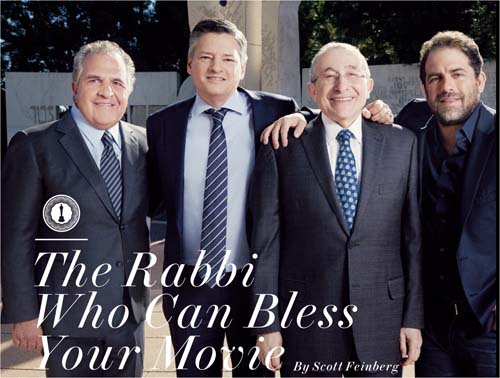
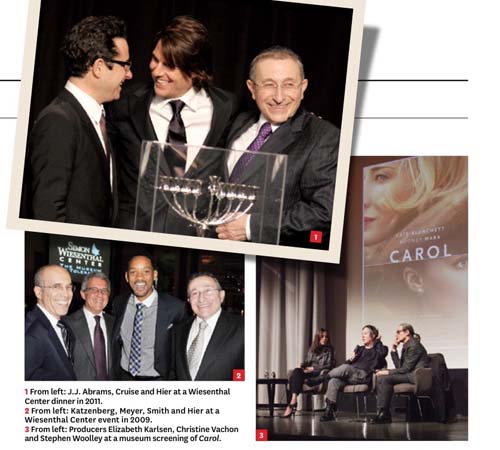
The Hollywood Reporter: [Rabbi Hier is] the founder and dean of the Simon Wiesenthal Center, America’s first Holocaust museum, and overseer of its offshoot organization, the Museum of Tolerance…But he’s also Hollywood’s go-to guy when A-listers are in need of advice, spiritual or otherwise…
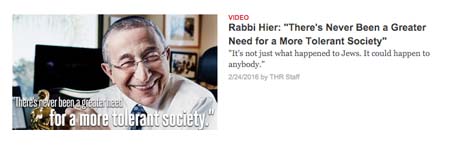
“To build a great constituency for tolerance that will be able to stand up to the bigots, the haters and the terrorists,” is how he describes his life’s mission — or his ability to marshal Hollywood talent to aid his causes. He may well be the most powerful religious figure in L.A. He’s certainly the best connected…
As he recounts in his just-published memoir, Meant to Be, he developed a fascination with Jewish history, particularly the Holocaust, while growing up on New York’s Lower East Side…
Moriah’s [the Center’s film division] 14 films, several of which can be viewed on Netflix, have been narrated by the likes of Michael Douglas, Sandra Bullock, Christoph Waltz and Nicole Kidman — free of charge. The company…is now at work on its 15th release, a doc about Ben-Gurion.
Indeed, Hier’s next project could be his biggest blockbuster yet: a $200 million, 180,000 square-foot Museum of Tolerance in the center of Jerusalem, which is scheduled to open its doors in late 2017.
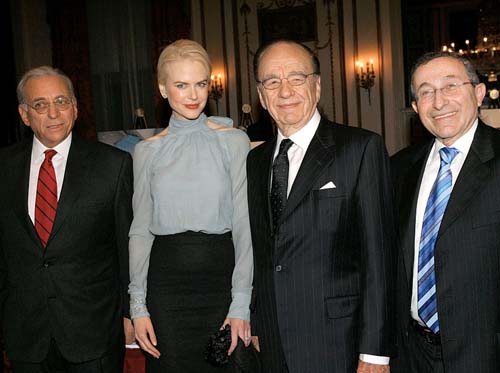
NEW YORK – JANUARY 11: (L-R) Nelson Peltz, actress Nicole Kidman, honoree Rupert Murdoch and the Simon Wiesenthal founder Rabbi Marvin Hier attend the Simon Weisenthal Center honors Rupert Murdoch ceremony at The Waldorf Astoria on January 11, 2006 in New York City. (Photo by Evan Agostini/Getty Images)
Posted inHollywood, R. Marvin Hier|Comments Off on Meet the Oscar-Winning (Twice!) Rabbi Whose Blessing Hollywood Seeks Each Awards Season
"This guy knows all the gossip, the ins and outs, the lashon hara of the Orthodox world. He’s an [expert] in... all the inner workings of the Orthodox world." (Rabbi Aaron Rakeffet-Rothkoff)