Why don’t the French bomb Belgium?

Rod Liddle writes: I am always open to spiritual guidance from any quarter, all the more so if that guidance is of practical import. So I was especially grateful to hear reports of a fatwa from the prominent Saudi Arabian cleric, Abdul Aziz bin Abdullah. This fatwa apparently made it clear that it was perfectly permissible for me, if suffering from ‘severe hunger’, to eat my wife. Either eat all of her — or merely, as it helpfully elucidated, some of her ‘body parts’. It did not say which body parts. In lieu of further enlightenment, I assumed that all of them were up for grabs.

Anyway, many has been the time that I have rooted through the fridge for something to stave off a ravenous hunger and found nothing but those tiny yoghurts that women eat to assuage constipation. I have stamped around and cursed, not understanding that the answer to my problem was sitting a few yards away in the living room, watching a re-run of Wolf Hall. Some, perhaps including the renowned Quranic scholar David Cameron, will no doubt say that such a fatwa (which Abdul insisted was a fabrication) would exemplify a ‘perverted’ view of Islam. Perhaps. But might it actually be rather moderate in stipulating that this recourse is available only to men suffering ‘severe hunger’? There may be other Muslim clerics who would argue that we should eat our wives even if we feel only a little peckish, or have got the ‘munchies’. The disputed fatwa, by the way, was said to reinforce the thesis that wives should be obedient to their husbands and that eating them was merely another way that ‘2 become 1’, as the Spice Girls once had it.

It may well be that when you first heard of the barbarous Islamist atrocities in Paris you thought: ‘My God. My God. How could they do that? At least now maybe the scales will fall from some eyes and we will tackle the problem head on.’ And then, like me, having thought this, you will have watched a BBC news programme and very quickly realised — nope, not a chance, business as usual. The same delusional rubbish, the same gerrymandering of public opinion, the same absurdities. My anti-epiphany began with Kirsty Wark on Newsnight interviewing two women, one of whom said that the problem was France’s racist society and the other, a French-Algerian, who opined that it first looked like the attacks could have been caused by rival drug gangs. I stared at the screen, mouth agape, unable for a while to believe what I was hearing. A whole programme about the Paris attacks in which three words — Muslim, Islam, jihadi — were not used at any point. The desperation to exculpate the ideology was present long before the bodies had been carried away. Then, when it was revealed that some attackers had entered the country as refugees, the Today programme had a fair, balanced and unpartisan debate between three people who agreed that we should take more refugees, because getting tough is ‘what they (the nasty terrorists) want us to do’. Even before the attacks the majority of British people wanted fewer migrants to be allowed in and a bit more rigour at the checkpoints — but that view was not remotely reflected. With the exception of a rather fine piece by John Sweeney on Panorama, the BBC’s coverage throughout was appalling in its cringeing, politically correct, liberal bias.

Meanwhile, the Home Secretary was telling us that the terrorists represent a ‘perverted’ form of Islam. Hmm. The same perverted form of the religion as practised by Abdul’s home country, Saudi Arabia? Or in Iran, or Libya, or Palestine, or Somalia, or . . . the list of countries which kill apostates, persecute Christians, Jews, homosexuals and women is longish, you have to say. We must grasp that the proportion of Muslims worldwide who hold this ‘perverted’ view is far, far, higher than Mrs May or the BBC would like you to think. Some 27 per cent of British Muslims, for example, expressed sympathy with the Charlie Hebdo murderers. This week it was reported that one in five British Muslims sympathises with Islamic State fighters. That is a number which is, as John Major might put it, not inconsiderable.

And the weird canards and the non-sequiturs. I have lost count of the number of times I have heard politicians express worry about British Muslims going to Syria and coming home ‘radicalised’. No. They were radicalised before they went. That is why they went there. In any case, we always let them back in when they arrive home after a spot of decapitating, instead of confiscating their passports and telling them to clear off.

Posted in Belgium, France, Islam | Comments Off on Why don’t the French bomb Belgium?

French comic convicted in Belgium for anti-Semitic jokes

I am so glad to see Jewish groups in Europe leading the way to restrict speech and to send people to prison for jokes.

REPORT:

A Belgian court sentenced controversial French comedian Dieudonne M’bala M’bala on Wednesday to two months in prison and a 9,000 euro ($9,534) fine for making anti-Semitic jokes during a comedy show in 2012.

Dieudonne, known for his use of jokes based on ethnic stereotypes, has repeatedly been convicted of racism in France and fined for hate speech. He insists he is not anti-Semitic.

The court in Liege found the comedian, known by the stage name Dieudonne, had spread racist ideas by making discriminatory, anti-Semitic and holocaust-denying remarks in the 2012 gig in nearby Herstal, a court spokeswoman said.

He was not in court on Wednesday.

Judges said that the remarks, made in front of an audience of 1,100 people in the town of Herstal, were clearly calls to hatred and violence. By calling on Christians and Muslims to unite to kill Jews, he had incited genocide.

He was also ordered to pay for the entire text of the judgment against him to be printed in two leading French-language Belgian newspapers.

In March, he was given a two-month suspended sentence for condoning terrorism in a Facebook post shortly after Islamist attacks that killed 17 people in Paris in January.

He was later fined 22,500 euros for a jibe against a radio journalist in 2013, suggesting that hearing the broadcaster speak made him think of Nazi gas chambers.

The comedian, who began his career with a Jewish sidekick in the early 1990s, is credited with inventing the “quenelle”, a downward Nazi-like salute.

Originally active with anti-racist, left-wing groups, the Paris-born son of a Cameroonian father and French mother began openly criticizing Jews and Israel in 2002, and ran in the European elections two years later for a French pro-Palestinian party.

From Feb. 25, 2015:

France prepares for war against online hate speech

France’s government is looking to adopt a tough new stance on online racism, anti-Semitism and other hate speech that would allow authorities to shut down offending websites amid a recent rise in hate crimes in the country.

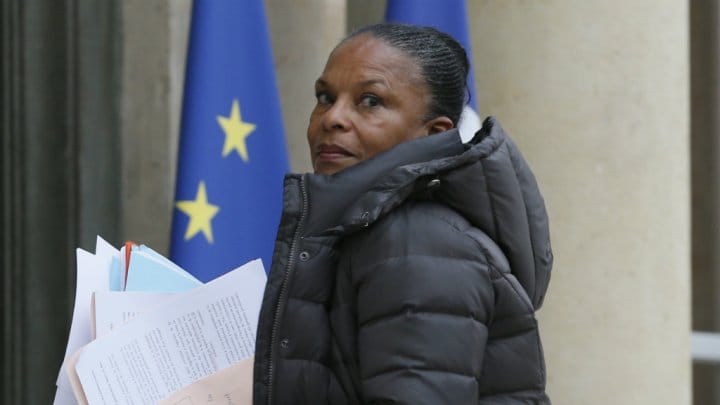
Justice Minister Christiane Taubira has said she will push for legal reforms that would help French authorities crack down on racism and anti-Semitism online in much the same way they do with paedophilia. The proposals include empowering French authorities to shut down websites hosting content that is deemed illicit without prior court approval.

“Crimes recognised in public spaces must also be recognised as such on the Internet,” Taubira told a French Jewish student group on Sunday, echoing other recent statements on combating terrorism. “Our challenge is to find the most appropriate responses, but we are determined to wage an unmerciful battle against racism and anti-Semitism on the Internet.”

The declaration of war against online hate speech has raised questions about possible violations of civil liberties and the curtailing of due process as France struggles to find a way forward after a wave of deadly violence and anti-Semitic hate crimes in the country…

Last week more than 250 tombs were vandalised by a group of teens at a Jewish cemetery in eastern France, sparking what appeared to be copycat acts in other non-Jewish cemeteries in Normandy and the Pyrenees in the following days.

Amid the compounding tensions, and real fears over the radicalisation of young people via the Internet, Taubira and other authorities want the legal means to counter racism, anti-Semitism and Islamist extremism on the web. But blocking ubiquitous online hate speech could be a thorny task for officials.

Some people are applauding France’s aggressive approach. The Simon Wiesenthal Center, an international rights group researching the Holocaust and hate crimes, says it has observed a steady rise in racist and anti-Semitic speech online since it began studying the phenomenon 20 years ago. The increase has been exponential since the advent of social media platforms like Facebook and Twitter.

“France’s efforts must be congratulated,” Shimon Samuels, who heads the center’s Europe office, told FRANCE 24. “If child pornography and paedophilia have no place on the Internet, if advertising for things like alcohol and tobacco are controlled because they are considered noxious to children, then what about hate?”

Samuels downplayed the dangers of curtailing free speech or privacy as a result of Taubira’s proposed reforms. He pointed out that nowhere are free speech laws an unlimited privilege, and that we constantly forfeit our right to privacy to online advertisers without batting an eye.

“I see this as a way of ultimately protecting civil liberties,” Samuels said. “Of course the measures need to work within the framework of the law, of course there has to be oversight so that they are not abused. A healthy debate is arising about freedoms, but that is part of democracy.”

It is unclear whether France will get what it wants from other countries and the Internet giants, with whom it has clashed in the past. In the meantime, it has launched an Internet site where citizens can report worrying content to police, and launched a multimedia campaign to expose the recruiting methods and myths used by jihadists.

Samuels and O’Loughlin agree that more also needs to be done on the education front.

Parents in both Jewish and Muslim communities need to be better informed about the kind of content children are encountering on the Internet, and be encouraged to have frank – even uncomfortable – discussions with them about what they see, said Samuels.

O’Laughlin said people who have become blasé about the vitriol they encounter regularly on the web need to be woken from that stupor and given the tools to identify and report online hate speech.

Taubira_0

Justice Minister Christiane Taubira

Posted in Anti-Semitism, Censorship, France, Simon Wiesenthal | Comments Off on French comic convicted in Belgium for anti-Semitic jokes

JTA: For Jewish groups, Syrian refugees are a reminder — not a threat

I don’t know a single Jew in my real life who wants more Muslims in America. I suspect most Jews in America and in the West don’t want more Muslims around. Yet Jewish elites through the major Jewish organizations keep pushing for more Muslim immigration.

These Jewish elites are rich and they don’t have to worry so much about Muslim aggression. Regular Jews and regular goys pay the price for Muslim immigration.

WASHINGTON (JTA) – American Jewish organizations don’t see the Syrian refugees as a threat; they see them as a reminder.

With rare unanimity on an issue that has stirred partisan passion, a cross-section of the community has defended the Obama administration’s refugee policy in terms recalling the plight of Jews fleeing Nazi Europe who were refused entry into the United States.

“The Jewish community has an important perspective on this debate,” the Orthodox Union said in its statement. “Just a few decades ago, refugees from the terror and violence in Hitler’s Europe sought refuge in the United States and were turned away due to suspicions about their nationality.”

Echoed the Conservative movement’s Rabbinical Assembly: “We can sadly remember all too well the Jews who were turned away when they sought refuge in the United States on the eve of, and during, World War II.”

Eleven Jewish organizations joined another 70 groups in pleading with Congress to keep open the Obama administration’s program, which would allow in 10,000 refugees over the next year from among the 200,000 to 300,000 in Europe. Neither the Orthodox Union nor the Rabbinical Assembly signed the letter.

Among the signatories were mainstream bodies like the the Reform movement, the Anti-Defamation League, the American Jewish Committee and the National Council of Jewish Women, as well as HIAS, the lead Jewish body dealing with immigration issues, and the Jewish Council for Public Affairs, the umbrella body for Jewish public policy groups.

Officials from the organizations that support allowing in the refugees said they were not likening the magnitudes of the two catastrophes, but could not help noting the reluctance in the 1930s, as now, to accept refugees and the accusations that the refugees posed a danger.

“It’s obviously a sensitive comparison, but it’s the right point to make,” said Nathan Diament, executive director of the Orthodox Union Advocacy Center. Both the Orthodox Union and the Rabbinical Assembly added in their statements that the administration and Congress should also take into account legitimate security concerns, while pressing forward with resettlement.

The consensus among the three major streams of U.S. Jewry – Reform, Conservative and Orthodox – is derived from a shared understanding of Jewish scripture, said Rabbi Jonah Pesner, who directs the Reform movement’s Religious Action Center.

“Our role is to be the pure rabbinic voice that lifts people up beyond their narrow partisan views,” he said of rabbis.

Rabbi Steve Gutow, a Reconstructionist who is the outgoing president of the Jewish Council for Public Affairs, said sympathy for the refugee was written into the Jewish cultural genetic code.

“We’ve been facing the need to have refuge since we left Egypt,” he said. “To think about not speaking out flies in the face of who we are.”

Being on the losing side of a political debate is nothing new for organizational American Jewry, said the ADL’s CEO, Jonathan Greenblatt, noting that the ADL in 1958 solicited a book from a “young senator from Massachusetts” — John F. Kennedy — to counter rising anti-immigrant sentiment. The future president wrote and published “A Nation of Immigrants.”

“‘We were once strangers’ is core to our identity,” Greenblatt said.

There are signs that support for the refugees may not always be a partisan one.

The U.S. Holocaust Memorial Museum, which has a rigorously bipartisan board, has weighed in backing the program. And Michael Chertoff, President George W. Bush’s secretary of Homeland Security, who is Jewish and otherwise has been sharply critical of the Obama administration, joined his Democratic successor, Janet Napolitano, in urging Obama to safeguard the resettlement program, describing the current screening program as “robust.”

Jen Smyers, the director of advocacy for Church World Service, one of several groups involved in refugee advocacy and resettlement, said she expected more Republican backing for the refugees once grassroots activists contact their representatives during the Thanksgiving break.

“This is a powerful week to be in touch,” she said, referring to the holiday commemorating refuge.

COMMENTS:

* Clergy and religious organizations are pressuring politicians to allow the resettlement of Syrian refugees in their states. This reminds me of the 1600 Rabbis for Obama who I fought years ago when I was chairman of Rabbis for Romney. I am a lonely voice who is attacked by organized groups and politicians primarily democratic. I will not back down . I hope you will voice your concerns to your clergy and politicians. They are backing Obama. I believe these Muslim refugees have not been vetted enough and our country and families are in jeopardy.

* So, Mr. Kampeas, it becomes clearer that you are a lib. These Jewish organizations are shameful. There is no comparison with the Jews on the St. Louis or any other Jews being turned away. Those Jews were really, really seeking refuge from those that would kill them. THese so called refugees are only about 10% families seeking true refugees. The rest are young men between 19 and 45 who are coming here and to other countries to take us all over. I am very thankful to G-d for making me Jewish, but I am shamed of all the stupid Jews who are cowards, afraid to fight, afraid to let people know they are Jewish, afraid to stand up for what is right and godlike in this world.

* You are not alone Rabbi Rosenberg. Many Jews stand with you! We know a hostile invasion when we see one. The major organizations are run by Democrat party lackeys and guilt-ridden Libs, who will rue the day they invited these Jew-haters, when they will, no doubt, give America a taste of what’s happened to France.

Posted in ADL, Immigration, Islam, Orthodox Union | Comments Off on JTA: For Jewish groups, Syrian refugees are a reminder — not a threat

A Nation Of Immigrants

Who can forget this stirring book, solicited by the ADL in 1958 and written in the president’s name.

According to Wikipedia:

The book was originally written by Kennedy in 1958, while he was still a senator.[1] It was written as part of the Anti-Defamation League’s series entitled the One Nation Library.[2] Subsequently, after gaining the presidency, he called on Congress to undertake a full reevaluation of immigration law; and he began to revise the book for further publication. In August 1963, excerpts of the 1958 pamphlet were published in the New York Times Magazine.[3] He was assassinated before completing the revision, but the book was nevertheless posthumously published in 1964 with an introduction by his brother, then Attorney General Robert F. Kennedy.[4] In 2008, the book was re-issued by the Anti-Defamation League.

The book contains a short history of immigration in the United States beginning in colonial America, an analysis of the importance immigration has played in American history, and John F. Kennedy’s proposals for the liberalization of immigration law.

In his book, A Nation of Nations: A Great American Immigration Story, Tom Gjelten writes:

John F. Kennedy had been talking immigration off and on for a dozen years… With the 1960 presidential election on the horizon, Kennedy set out to burnish his reputation as an immigration reformer. First came the 1958 publication of his book A Nation of Immigrants, written at the suggestion of the Anti-Defamation League, with an outline prepared by a Harvard historian. (One of Kennedy’s aides, Myer Feldman, was later quoted as saying he, not Kennedy, did the actual writing.) A year after the book’s publication, Kennedy introduced still another bill to do away with national quotas.

It’s so easy to go along with the treason lobby (aka the ADL, SPLC and all the other organizations pushing for the immigrations of groups that America struggles to assimilate). They do the work for you and you get to slap your name on it and rake in the money and applause. Betraying white people is massively incentivized. It’s cool to be anti-white and to work for white replacement. A Harvard historian will do an outline for you, an aide will write the book, and the ADL will publish it.

Posted in Immigration | Comments Off on A Nation Of Immigrants

Little Rock Police: Black Guy Kills White GF During Argument

KATV:

derrick-mason

The Little Rock Police Department has released the names of the victim and suspect involved in a homicide in the 2500 block of Bishop Street Tuesday morning.

According to Officer Ernest Hilgeman with Little Rock PD, the suspect, identified as Derrick Mason, called police just after 11 a.m. on Tuesday asking to speak with police. Mason said he had killed his girlfriend, according to a Little Rock PD release.

When detectives arrived on the scene, a woman, identified Jessica Berliew, was found dead in a home. Berliew’s body has been transported to the crime lab for an autopsy.

Mason was taken into custody and interviewed by detectives. According to police, after waiving his rights, Mason told police he killed Berliew when they got in an argument after she got home from work.

Mason has been charged with 1st degree murder.

Posted in Blacks, Crime | Comments Off on Little Rock Police: Black Guy Kills White GF During Argument

Boca Raton victim says hate crime was ‘nerve-wracking’

It’s rarely a good idea to start a fight just because somebody insulted you. It’s even more rarely a good idea to start a fight over an insult when you are a rabbinical student.

I’ve had people flip Heil Hitler salutes at me and yell similar insults and I always ignore them. There’s no way I’d start a fight over it.

REPORT: BOCA RATON, Fla. – The Jewish community in Boca is on edge as police say they are investigating a possible hate crime.

Investigators say the 19-year-old victim was walking in the area of 350 NE 2nd St.

The victim says on Saturday a male on a bicycle passed him and shouted, “Jews should go back to Auschwitz.. Hitler was right.” The victim responded with, “Why don’t you come back here and say that!”

The suspect rode over to the victim, repeated his statement and shoved the victim. As the victim fell, he twisted around so he landed face down and his forehead hit the ground.

The victim got up and exchanged punches with the suspect, before the suspect rode off on his bicycle.

“I’m doing better. It was just a little bit nerve-wracking having someone scream at me these things,” the victim told NewsChannel 5.

The victim is studying to be a Rabbi at the Chabad Center near Mizner Park.

Posted in Anti-Semitism, Chabad | Comments Off on Boca Raton victim says hate crime was ‘nerve-wracking’

Steve Sailer: When Society Encourages Mean Girls to Bully Boys

Steve Sailer writes:

Social psychologist Jonathan Haidt, whose 2012 book The Righteous Mind I reviewed in Taki’s, writes:

The Yale Problem Begins in High School

by Jonathan Haidt | Nov 24, 2015 | campus turmoil, free speech | 182 comments

A month before the Yale Halloween meltdown, I had a bizarre and illuminating experience at an elite private high school on the West Coast. I’ll call it Centerville High.

One possibility for the school Haidt is talking about is Lakeside School in Seattle, which Bill Gates and Paul Allen attended. Haidt gave a talk there on October 21.

I gave a version of a talk that you can see here, on Coddle U. vs. Strengthen U. …

But then the discussion began, and it was the most unremittingly hostile questioning I’ve ever had. I don’t mind when people ask hard or critical questions, but I was surprised that I had misread the audience so thoroughly. My talk had little to do with gender, but the second question was “So you think rape is OK?” Like most of the questions, it was backed up by a sea of finger snaps — the sort you can hear in the infamous Yale video, where a student screams at Prof. Christakis to “be quiet” and tells him that he is “disgusting.” I had never heard the snapping before. When it happens in a large auditorium it is disconcerting. It makes you feel that you are facing an angry and unified mob — a feeling I have never had in 25 years of teaching and public speaking.

After the first dozen questions I noticed that not a single questioner was male. I began to search the sea of hands asking to be called on and I did find one boy, who asked a question that indicated that he too was critical of my talk. But other than him, the 200 or so boys in the audience sat silently.

After the Q&A, I got a half-standing ovation: almost all of the boys in the room stood up to cheer. And after the crowd broke up, a line of boys came up to me to thank me and shake my hand. Not a single girl came up to me afterward.

After my main lecture, the next session involved 60 students who had signed up for further discussion with me. We moved to a large classroom. The last thing I wanted to do was to continue the same fruitless arguing for another 75 minutes, so I decided to take control of the session and reframe the discussion. Here is what happened next:

One of Haidt’s most illuminating techniques is simply to ask his audience to answer his questions by raising their hands.

Me: What kind of intellectual climate do you want here at Centerville? Would you rather have option A: a school where people with views you find offensive keep their mouths shut, or B: a school where everyone feels that they can speak up in class discussions?

Audience: All hands go up for B.

Me: OK, let’s see if you have that. When there is a class discussion about gender issues, do you feel free to speak up and say what you are thinking? Or do you feel that you are walking on eggshells and you must heavily censor yourself? Just the girls in the class, raise your hand if you feel you can speak up? [about 70% said they feel free, vs about 10% who said eggshells ]. Now just the boys? [about 80% said eggshells, nobody said they feel free].

Me: Now let’s try it for race. When a topic related to race comes up in class, do you feel free to speak up and say what you are thinking, or do you feel that you are walking on eggshells and you must heavily censor yourself? Just the non-white students? [the group was around 30% non-white, mostly South and East Asians, and some African Americans. A majority said they felt free to speak, although a large minority said eggshells] Now just the white students? [A large majority said eggshells]

Me: Now lets try it for politics. How many of you would say you are on the right politically, or that you are conservative or Republican? [6 hands went up, out of 60 students]. Just you folks, when politically charged topics come up, can you speak freely? [Only one hand went up, but that student clarified that everyone gets mad at him when he speaks up, but he does it anyway. The other 5 said eggshells.] How many of you are on the left, liberal, or democrat? [Most hands go up] Can you speak freely, or is it eggshells? [Almost all said they can speak freely.]

Me: So let me get this straight. You were unanimous in saying that you want your school to be a place where people feel free to speak up, even if you strongly dislike their views. But you don’t have such a school. In fact, you have exactly the sort of “tolerance” that Herbert Marcuse advocated [which I had discussed in my lecture, and which you can read about here]. You have a school in which only people in the preferred groups get to speak, and everyone else is afraid.

What are you going to do about this? Let’s talk.

After that, the conversation was extremely civil and constructive. The boys took part just as much as the girls. We talked about what Centerville could do to improve its climate, and I said that the most important single step would be to make viewpoint diversity a priority.

On the entire faculty, there was not a single teacher that was known to be conservative or Republican. So if these teenagers are coming into political consciousness inside of a “moral matrix” that is uniformly leftist, there will always be anger directed at those who disrupt that consensus.

That night, after I gave a different talk to an adult audience, there was a reception at which I spoke with some of the parents. Several came up to me to tell me that their sons had told them about the day’s events. The boys finally had a way to express and explain their feelings of discouragement. Their parents were angry to learn about how their sons were being treated and… there’s no other word for it, bullied into submission by the girls.*

Tina Fey’s movie Mean Girls with Lindsey Lohan makes the point that girls have always been extremely adept on average at nonviolent bullying: girls tend to be quick and sharp at interpersonal thinking with a talent for knowing precisely where to slip in the psychological stiletto.

Of course, most of that talent has been deployed over the millennia against their rivals in the sexual marketplace, other females (although little brothers and henpecked husbands have been victims too). But now our society encourages girls, at the point where their social skills are most advanced relative to boys of the same age, to use their Mean Girls techniques to bully and silence boys in the name of Fighting Patriarchy.

It would be interesting to study how big a price females pay down the road in lack of romantic satisfaction due to being encouraged to psychologically emasculate the boys around them. Like I’ve been saying for a long time, there’ll be no final victor in the War Between the Sexes.

Posted in Feminism | Comments Off on Steve Sailer: When Society Encourages Mean Girls to Bully Boys

Study: Democrats Want To Be Led By Effeminate Milksops

From the Chateau:

Sometimes I don’t need to wield the shiv. The shiv wields itself.

“A deep tone of voice appeals to conservative voters. More generally, conservative voters seem to have a preference for politicians who look physically strong and masculine, while liberal voters prefer those who have less dominant features and seem more accommodating, perhaps even slightly feminine,” said Laustsen.

Since universal suffrage was passed into law, women voters have pushed America toward the extreme far Left. Now we have a biological underpinning that helps explain why. The liberal, social safety net, open borders preferences of women align with the political preferences of effeminate men (like John Scalzi, Alex Pareene, and Ezra Klein). The effeminate men never had much of a political voice until they were able to hitch the behemoth female voting bloc to their cause. And now we have gay marriage, mudsharking on prime time TV, and slut walks featuring half-naked fat chicks.

Laustsen and Petersen’s research proceeds from the observations that in order to understand the behavior of modern humans, you need to look into the evolutionary history that has shaped the psychology producing this behavior. In prehistoric times when the ancestors of modern humans were roaming the East-African savannah in small groups, it made sense to support the strongest members of the tribe when confronted with danger. Psychological mechanisms which 30,000 years ago saved our ancestors from being devoured by saber-toothed tigers and other fierce animals continue to be at work today, explaining, among other things, why people vote as they do along the left-right continuum.

“There are evolutionarily important reasons for the structure of our psychology. Our ancestors had to make a decision about which leader to follow, and it was crucial for their survival and reproduction that they picked the right one. As a species we are pre-programmed to think in a certain way about who we would like to be in charge. This affects choices that we make even today,” said Petersen.

Antibiotics and two oceans have enabled the rise of the American Leftoid.

Is this knowledge useful for the politicians? For example, would it be helpful for conservative politicians to tone down their dominant, masculine personality traits in hopes of snatching voters further to the left who tend to find less dominant features more attractive?

“Democrats are often seen as empathic, compassionate types. Republicans, by contrast, are often considered as strong leaders with a moral compass. This kind of subjective views may have real importance in cases where a Republican candidate is seen as more empathic than his Democratic opponent and trespasses into his territory. Perhaps he can gain some votes there,” he said.

If Trump can successfully merge themes of closed borders, White dispossession, and oligarch wage gutting, while connecting with the White working class Democrats and Independents, he will walk into the White (again) House.

In related news, effete, rich liberal Democrats are the only group that wants hordes of Muslims streaming across the nation’s borders, and eventually across their rectal borders.

Posted in Politics | Comments Off on Study: Democrats Want To Be Led By Effeminate Milksops

Israel Studies Professor Hounded by Anti-Israel Texas U Activists, Forced to Wear Disguise on Campus

News: Chanting “Long live the Intifada,” University of Texas at Austin activists recently stormed a class to protest and disrupt a talk by a guest lecturer.

Waving Palestinian flags and shouting anti-Israel epithets, twelve members of the Palestine Solidarity Committee (PSC) entered the public event, sponsored by Institute for Israeli Studies Professor Ami Pedahzur and hosting Stanford University military historian Dr. Gil-Li Vardi.

Throughout the incident — during which Pedahzur insisted that the invasive students either “sit down and learn something” or leave — the PSC activists filmed everything on their cellphone cameras.

Since that episode, which took place on Friday, November 13, mere hours before Paris was brutally attacked by ISIS terrorists, Pedahzur, professor of government and founding director of the Institute for Israel Studies, has become the focus of a PSC intimidation campaign. This includes a petition circulated by the PSC and claims that Pedahzur was violent.

“We were met with physical force and intimidation,” the PSC said in a statement.

A UT Austin professor as well as an attendee escalated what was supposed to be a reading of a prepared two-minute statement, culminating in professor Ami Pedahzur physically pressing his body against a PSC member, nose-to-nose in a move to physically intimidate the student. Pedahzur had to be restrained by 3 people.

Watching the video of the episode, which was uploaded to YouTube by PSC members immediately after they crashed the event, one gets a sense of the menacing nature of the demonstration — on the part of the students, not those trying to subdue them.

In an exclusive interview with The Algemeiner on Tuesday, Pedahzur described the incident, the first of its kind he says he has experienced in his career — as professor of government, the Arnold S. Chaplik Professor in Israel and Diaspora Studies and founding director of the Institute for Israel Studies — and the ongoing nightmare he is now living as a result of it. Wearing a disguise on campus and fearing for the safety of his family and students says it in a nutshell.

“Along with the PSC petition smearing my name and accusing me of inappropriate behavior, I’ve received death threats,” Pedhazur said. “But no one at the university has offered to protect me or my students. That is why I went to the police last Monday to request protection for my class — titled ‘Suicide Terror’ — which is in a basement, so in an emergency situation, it would be very hard to evacuate 95 students. I couldn’t take the chance that because of my name, someone would try to do away with a ‘Zionist professor.’”

The first course of action Pedhazur took was to vacate the offices at the Israeli Studies Institute, and, he said, “Police gave us recommendations on how to secure the facility, so as not to put anybody at risk.”

What the university did in the immediate aftermath of the incident was to instruct Pedahzur to defer all requests from journalists to its public affairs department. Pedahzur’s silence “gave the groups the opportunity to smear me. The whole field was open to them.”

Posted in Anti-Semitism, Israel | Comments Off on Israel Studies Professor Hounded by Anti-Israel Texas U Activists, Forced to Wear Disguise on Campus

France: A Society Ripe for Submission

Quadrant: His imagining of an Islamic France is no simple provocation. Rather, this deep, gripping and haunting novel is a recent high-point for European fiction. No current writer gets anywhere near Houellebecq’s achievement in finding a fictional way into the darkest and most necessary corners of our time.

Douglas Murray writes:

Michel Houellebecq (left) is a genius. He is also a nihilist. And not the fashionable type of American nihilist (“nihilism with a happy ending”, as Allan Bloom once called it), but a connoisseur and practitioner of the fullest-blown fin de millénaire French nihilism. For Houellebecq and his main characters life is a solitary and pointless labour, devoid of interest, joy or comfort aside from the occasional—generally paid-for—blow-job.

The fact that the poet of such an existence can have been celebrated by his peers (Houellebecq has been awarded the Prix Goncourt, among other prizes) is perhaps less surprising than the fact that such a writer has proved so popular. For almost two decades his books have been best-sellers in their original French and in translation. When books sell this well—especially when they are also quality, rather than pap, literature—it is because they must speak to something of our times. It may be an extreme version of our present existence, but even the unarguably bracing nature of the nihilism would not be sufficient as an attraction without at least a disgusted flicker of self-recognition from his readers.

Houellebecq’s first important novel, Atomised (1999), laid out what became a signature scene. He depicts a society and a set of lives with no purpose whatsoever. Familial relations are poisonous where they are not absent. Death, and the fear of it, fills the space which was once absorbed by the business of God. At one point in Atomised the lead character Michel takes to his bed for two weeks, and repeatedly asks himself as he stares at a radiator, “How long could Western civilisation continue without religion?” No revelation comes from this, only more looking at the radiator.

Michel’s half-brother Bruno is told by a girl that he has a very pessimistic view of the world. “Nietzschean,” he corrects her, before feeling inclined to add, “Pretty second-rate Nietzsche at that.” In the middle of what is described as “depressive lucidity” there are—apart from sex—no moments of pleasure. Christine, with whom Bruno has been having a halting, meaningless conversation, interrupts a silence by suggesting they go to an orgy on a nudist beach. The philosophical state of their culture has washed across them and submerged them under in its own pointlessness. At one point we read, “In the midst of the suicide of the West, it was clear that they had no chance.” The joys of consumerism are certainly not enough, but they can prove diverting. As Bruno is meant to be arranging for the burial or cremation of his mother’s body he plays Tetris on his Gameboy. “Game over,” it says, and plays “a cheerful little tune”. (Mother-son relationships in Houellebecq are especially non-existent, a fact which the interviews with and writings by the novelist’s now late mother confirm as certainly autobiographical.)

Although Atomised works as a meditation on the state of the culture, it works less well as a novel and even less well as narrative. Although the rarity of events is part of the point, in the absence of any plot-drive Atomised always risks contaminating its readers with the fatal ennui of its characters. But if the themes and characters of Atomised are repeated in Platform (first published in English in 2002) they also find there something to centre on. Again graphic sex, repetitions and variations of the same are the only light in the gloom. Valerie, a woman who is willing to do absolutely everything sexually with the main character, Michel, is a good find and a source for hope. But even so, the genitals, it is made clear, are “meagre compensation” for the misfortune, shortness and pointlessness of life. And horror followed by acceptance and then indifference towards human suffering lead to no enlightenment or interest. “On the whole, I am not good,” the narrator tells us, “it is not one of my characteristics. Humanitarians disgust me, the fate of others is generally a matter of indifference to me, nor have I any memory of ever having felt any sense of solidarity with other human beings.” However, in Platform another worldview imposes itself on Houellebecq’s characters.

Having given up his job as a civil servant, Michel takes Valerie on holiday to Thailand. He loathes the decadence of the tourism and the people who take part in it at the same time as taking part in it himself. One day Islamist terrorists—who also loathe the decadence on show but have a view of their own on what to do about it—storm the beach and massacre many tourists, including Valerie. After the 2002 Bali terrorist attacks this particular scenario was seen to have been prescient. But whatever respect Houellebecq might have enjoyed from this was mitigated by the trouble the book helped get him into in France. Even before the description of the beach-massacre the character Michel calls Islam an “absurd” religion. After the massacre his contempt for the religion builds to a paragraph in which he reflects:

It is certainly possible to remain alive animated simply by a desire for vengeance; many people have lived that way. Islam had wrecked my life, and Islam was certainly something which I could hate; in the days that followed, I devoted myself to trying to feel hatred for Muslims. I was quite good at it, and I started to follow the international news again. Every time I heard that a Palestinian terrorist, or a Palestinian child or a pregnant Palestinian woman had been gunned down in the Gaza Strip, I felt a quiver of enthusiasm at the thought that it meant one less Muslim. Yes, it was possible to live like this.

For this passage and others deemed offensive both from interviews and from Atomised (where a character describes Islam as “the most stupid, false, and obscure of all religions”) submission found himself the target of legal proceedings in France. Whether for this reason, or his often-cited desire to minimise his taxes, Houellebecq left France to live in Ireland.

Perhaps it was the stupidity which chased him away. After all, anybody who actually read Houellebecq—as opposed to (in the current fashion) excerpts they hoped to be offended by—could see that the characters in his novels are infinitely harsher in their criticism and contempt of the modern West than they are of the precepts and claims of Islam or Muslims. Houellebecq’s contempt always fires off in all directions. In Atomised Bruno at one point expounds his theory that there are no such things as homosexuals, only pederasts. But he also claims that heterosexuals like himself are never attracted to people their own age, only much younger versions—a problem at the root of most of his male characters’ discontents. Or you might turn to the description of the behaviour of Chinese people in Platform which climaxes with the narrator describing the Chinese as “an awful lot of pigs”. Dragging Houellebecq to court for being rude about Muslims was a demonstration of the grossest sensitivity top-trumps of our time, but it also showed a wild literary ignorance. Not only in hauling an author to court for his expressions, but in the fact that Houellebecq’s derision or contempt so clearly goes beyond the whines and pleadings of special-interest groups: his is a rage and contempt aimed against our age and our species as a whole.

Yet however great the acrobatics and pyrotechnics in a literature of this type, it is always the case that it must at some point either mature or fizzle out. The evidence that Houellebecq wasn’t going to fizzle out came with his 2010 Prix Goncourt-winning The Map and the Territory—the story of an artist called Jed Martin who makes himself fabulously wealthy through his deeply occasional work. This wealth allows him to seclude himself from a France doomed to become in the near future little more than a cultural theme-park for the new Russian and Chinese super-rich. The work is not only an exploration of the traditional Houellebecq themes (dysfunctional family life, empty sex, solitude) but a profound satire on modern culture. It includes a hilarious and devastating self-portrait—a reminder of the truth that the most savage critics always also turn their gaze on themselves. Jed visits the drunken writer Michel Houellebecq in his remote and unattractive Irish retreat. There are boxes everywhere and no furniture. “Have you just moved in?” his guest asks. “Yes. I mean, three years ago.”

Houellebecq’s self-portrait is, if the interviews and accounts of those who know him are anything to go by, remarkably accurate. Dissolute, alcoholic, depressive and meandering, the portrait of Houellebecq in The Map and the Territory shows an almost affrontingly desiccated life. It is also a life which produces enemies. A curious detail is that at one point in the novel, “Houellebecq” is found dead—decapitated, flayed and mutilated. This year that scene assumed less amusing overtones.

Houellebecq’s most recent novel, Submission, was due for publication on January 7 this year. Even before publication it had caused critical and political controversy. The plot takes French politics forward to the 2020s. The current French President, Francois Hollande, is coming to the end of a disastrous second term. The National Front party of Marine Le Pen is ahead in the polls. The moderate right of the UMP collapses, as do the Socialists. But another party has come together over recent years—a Muslim party led by a moderate Islamist who enjoys the support of France’s growing Muslim population. As the run-offs get closer it is clear to the other mainstream parties that the only way to keep the National Front from power is to unite behind the Islamist party. This they do, and the Islamist party wins. Using some old pliant French lefties for cover the Islamists set about transforming France, not least by taking control of education and making (with the help of substantial Gulf funding) all public universities, including the Sorbonne, into Islamic institutions. Gradually even the novel’s main figure—a dissolute scholar of J.K. Huysmans—sees the sense of converting to Islam.

In the few public comments he made about the book, Houellebecq was at pains to stress his admiration for Islam—a demonstration perhaps that the brow-beating and threats of the thought-police do work. It was to be expected that such pleas would be drowned out, if not for the reasons which transpired.

Among those to attack and ridicule Houellebecq for a plot many claimed was wilfully provocative was a satirical weekly magazine then little known outside France called Charlie Hebdo. The magazine—which has a long tradition of left-wing, secular, anti-clerical iconoclasm—had come to limited international attention in recent years after repeatedly showing itself willing to depict Islam’s prophet (a willingness it was almost alone in demonstrating after the 2005 Danish cartoons affair). There were assaults, including a firebomb attack, on their Paris offices but the publication held firm, as it had over their earlier critiques of the Pope and far-Right leaders including the National Front.

In expectation of the launch of the new novel, a typically ugly caricature of a hideous, gnome-like Houellebecq was on the cover of the magazine on that January morning when two Islamist gunmen forced their way into Charlie Hebdo’s Paris offices and shot ten of the magazine’s staff and two policemen. As the Yemen-trained French Muslim gunmen left the offices they were heard shouting, “We have avenged the Prophet Muhammad” and “Allahu Akbar” (“Allah is greatest”). Among the victims of their assault on the magazine’s morning editorial meeting was the economist Bernard Maris, a close friend of Houellebecq’s.

Paris and France went into several days of lockdown, and another assault (by another Islamist gunman on a Jewish food store) was still to come. Houellebecq’s publishers announced that his publicity tour was cancelled and the author himself went into hiding. Ever since he has been accompanied by bodyguards. And although the French state is helping to protect him it has by no means thrown itself behind him. In the immediate aftermath of the Charlie Hebdo attacks the country’s Socialist Prime Minister, Manuel Valls, chose to make an address in which he said, “France is not Michel Houellebecq … it is not intolerance, hatred and fear.” Obviously—unless he had got hold of an early proof—the Prime Minister had not read the novel.

Of course it is worth stating from the outset—since in these times we seem to have to do such things—that even if Submission were the most anti-Islamic, “blasphemous” and offensive novel ever written Houellebecq would have the right to publish it and do so without being judged by politicians or gunmen who in their different ways fire off over books they don’t read. As it happens, Submission is not a simple provocation. It is a deep, gripping and haunting novel which proves a culmination point of Houellebecq’s work so far and, in my view, a recent high-point for European fiction. I can think of no writer currently working who can get anywhere near Houellebecq’s achievement in finding a fictional way into the darkest and most necessary corners of our time. Nor can I think of another writer currently working who would be able to write a novel of this depth, scope and relevance while also making it witty and page-turning.

The most intelligent criticism to date has come from reviewers who have objected to one layer of the novel which relates to the academic specialism of the main character. Francois is a typical Houellebecq leading man: a middle-aged academic whose parents’ deaths have no effect on him, who has short relationships with his younger female students and who since separating from an attractive young Jewish student, with whom he still intermittently has sex, switches to prostitutes though finds his libido insufficiently diverted. When Francois flees the looming chaos in Paris by going to the significantly chosen town of Martel in the south of France he tries to interest himself in Cro-Magnon man. At one point he reflects, “Cro-Magnon man hunted mammoth and reindeer; the man of today can choose between an Auchan and a Leclerc, both supermarkets located in Souillac.”

But Francois’s internal life is not only dry—it is also painfully in need of relief. As French culture and society decay all around him, two revelations in particular stand out. The first comes as a result of his Jewish girlfriend’s choice to leave France (another slightly prophetic idea) and join her family in heading to Israel. After their sexually athletic final meeting she asks him what he will do, especially now that the university looks as if it will close when the Muslim party comes to power. “We were standing at the door. I realised that I hadn’t the slightest idea, and also that I didn’t give a fuck. I kissed her softly on the lips, and said, ‘There is no Israel for me.’ Not a deep thought; but that’s how it was.” As anyone who has followed Europe’s recent tergiversations will know, that is a very deep thought, and a demonstration of the profligacy of Houellebecq’s genius that he can throw it away with such apparent ease.

But the deeper spiritual point in the novel lies precisely in Francois’s meditations on his scholarly interest. Houellebecq (like a lot of his literary critics) assumes that his readers will be unfamiliar with the work of Huysmans, but I would have thought that a significant portion will have read or at least heard of A Rebours (“Against Nature”), one of the central texts of late-nineteenth-century French decadence. By the point at which the novel starts Francois is tiring of his enthusiasm for Huysmans, in the way that many academics are after their first love is overlaid by years of the same lectures and questions. But the choice of Huysmans as a constant presence in the novel is more important and pertinent than some critics seem to realise. As the novel develops, Francois not only rediscovers part of his passion for Huysmans but also confronts one of the central challenges of Huysmans’s life. Like many of his contemporary decadents across Europe, Huysmans ended up being received into the Roman Catholic Church. It is a journey which, as everything falls apart around him and intimations and then sporadic and shocking outbursts of violence become commonplace across France, Francois tries to emulate.

Francois even heads back to the monastery in which Huysmans found his faith and in which the young Francois spent some time in search of his literary idol while a younger man. He sits in front of the Madonna and his meditations strain towards a goal. But he cannot do it: he may have returned to the source, and he may even be open to the moment but he cannot perform the necessary leap of faith. And so he returns to Paris, and there the university authorities—now Islamic—explain to Francois (as one they have generously pensioned off) the logic of Islam. And not just the logic that he will get his career back at the Sorbonne if he converts, but the logic it will make in other corners of his life. He will have wives (up to four, and younger—if he wishes—even than his usual tastes). And of course he will be part of a community of meaning for the first time. He will be able to continue enjoying most of the few pleasures he has had and will gain much more than he had thought possible in the way of comforts. Unlike the leap required to become a Catholic, the practical logic of Islam in a society ripe for submission as a whole becomes irrefutable. Houellebecq’s plea that the novel is by no means anti-Islam is not without foundation.

Is the novel’s vision plausible? I would say so—often deeply uncomfortably so. Endless small details rhyme. For instance in the run-up to the crucial election the French media and mainstream politicians deliberately obscure stories of real interest. One is reminded of the events last December in France when Muslim extremists kept driving into crowds of people while shouting “Allahu Akbar”, only for the politicians and media to dismiss these events as meaningless traffic incidents. Then there is the portrait of the Jewish community leaders who remain around to flatter their enemies and negotiate for themselves (as many did with the Nazis) even as everything signals their community’s destruction. And of course the novel’s truest conceit is the depiction of a class of politicians across the political divide so keen to be seen above all as “anti-racist” that they end up flattering and ultimately handing over their country to the worst racists of our time.

Houellebecq’s career has included several fateful coincidences of timing. But perhaps the most propitious is that his work has come to artistic maturity at just the moment to capture a society tipping from over-ripeness into something else. What precisely? More decadence, barbarism, or salvation? And if salvation, then what kind, and whose?

Douglas Murray is the author of Neoconservatism: Why We Need It, and is the Associate Director of the Henry Jackson Society, a British think-tank.

Posted in France, Islam | Comments Off on France: A Society Ripe for Submission