Tucker Carlson seems the most woke of all conservative journalists.
Daily Caller: This of course brings up accusations of white supremacy. However, all three men object to this description. When asked about this label, Brimelow pointed to race and IQ studies which show “whites are not the superior race” and it is instead East Asians. He then joked that he must then be a “yellow supremacist.”
The alt right leaders also received many questions related to whether they are anti-semites. Taylor and Spencer disagreed here, but both said that Jews could be part of the Alt Right. Taylor said he considers European Jews to be European and Spencer said that Jews are a distinct people.
The movement has been described frequently as relating to conservatism but those present at the meetings objected to this characterization. Spencer said the “origin of the alt right is really a revolt against conservatism as we know it.” He spoke about “cuckservatives,” and defined them as “defending institutions for other people.”
Clinton spoke about the alt right in connection with Donald Trump. However, Spencer doesn’t think Trump is alt right — just that he is “high energy” and what they want in a leader. He agrees mostly with Trump’s immigration policy, but would want tighter legal immigration that prefers Europeans.
The movement has no strict leadership or orthodoxy and Spencer said that he is opposed to specific policy proposals. He instead prefers “meta-politics.” He has a vision for a white ethno-state, but this is a utopia he sees occurring far into the future. Spencer said having a utopia-like vision is positive and better than the “negativity” of mainstream conservatives that just seeks to oppose liberal policies.
Taylor’s goal for the alt right is possibly more realistic. He envisioned a PTA meeting where people are discussing the lack of black students in AP classes, and a mother stands up and mentions race’s influence on intellect.
Before either of these goals are achieved, Spencer wants the alt right to professionalize like other political movements. When asked about where they will get money for this, Spencer joked and said, “Vlad,” in reference to Vladimir Putin.
Posted inAlt Right|Comments Off on The Alt Right Has Its Coming Out Party
Mother Jones: Spencer explained that he likes Trump’s immigration policy, which not only calls for mass deportation of undocumented immigrants but also reduces legal immigration into the country. (Spencer’s ideal policy would also favor immigrants from Europe.) But as Spencer put it, it’s Trump’s more intangible qualities that make him a hero of the alt-right. To Spencer, Trump’s brash style suggests a white savoir, unwilling to be bullied by the politically correct crowd.
“I don’t think our support of Trump is really about policy at the end of the day,” Spencer said. “I think it’s really about Trump’s style, the fact that he doesn’t back down, the fact that he’s willing to confront his enemies…You look at that and you think, this is what a leader looks like.”
Spencer continued, “It really is about him and it’s about, in a way, projecting onto him our hopes and dreams. There’s something called ‘me magic,’ and that is a self-fulfilling prophecy…We want to make Trump; we want to imagine him in our image. And that is maybe—you can see that in a meme of Trump as a Napoleon or Trump as some figure out of the Dune novels in an arcade of the future in a robotic suit of armor fighting enemies. All of that stuff is silly, all of that stuff is ridiculous, but it actually gets at something real and that is that we want something more, we want something heroic, we want something that is not defined by liberalism or individual rights or bourgeois norms. We want something that is truly European and truly heroic.”
For this description, Spencer was greeted with much applause by his fans in the room. He elaborated that rather than a multicultural America, his ideal is a white empire. He described his “dream…ethno-state” as “a homeland for all Europeans,” which would take an “imperial form.”
“It’s very similar to the idea of Zionism for Jews in the 19th century,” he said. “It’s actually very similar to the ideal of communism for the left in the 19th century. It’s not here, it’s in the future, we should dream about it.”
What would this utopia look like? Spencer said it’s too far off to get into specifics. But he and Taylor, whose role at Friday’s event was to give academic assurances that the races of the world are not equal, disagreed on whether Jews would be welcomed into the white utopia homeland. Spencer took the position that they were not “European” and therefore would take their place in their own ethno-state. Taylor countered, “I don’t think that if a Jewish person identifies with the West and with Europe than that’s something that we should deny.” As Spencer acknowledged, the alt-right has yet to sort out these mere details.
But Spencer did offer up a vision of an alt-right society. “If the alt-right were in power, we would all have arrived here via magnetic levitation trains,” he said. “We would have passed by great forests and beautiful images of blond women in a wheat field with their hands, running them through the wheat.” The audience tittered. “It would be a wonderful sight.”
Posted inAlt Right|Comments Off on Alt-Right Movement Presents Its Vision for an All-White Society With Trump Paving the Way
From TPM: In a cramped, carpeted ballroom at the Willard Hotel in downtown Washington, the rebranded “alt right” movement took a victory lap Friday and looked optimistically toward their future as a growing movement in the United States.
The press conference included all the same alt right notes that have become the centerpiece of the movement. There were discussions about an “ethnostate” and how to build one and debates about whether Jewish people could rightly identify themselves as European. One participant waxed poetic on why he is tired of being called a white supremacist in the media, and another predicted that the United States “will break up” over its divisions.
After years in relative obscurity in chatrooms and anonymous forums online, the disjointed alt right movement, closely aligned with the white nationalist movement, is experiencing a bit of a renaissance at the moment. In Europe, a backlash against a refugee crisis has resulted in Brexit. And in the United States, at the top of a major party ticket, the alt right finally has a Republican candidate in Donald Trump it can rally around.
“It is in a way projecting on to him our hopes and dreams,” said prominent movement leader Richard Spencer, a man who has said before he dreams of a white ethnostate. “We have not been made by Trump, but we want to make Trump and we want to imagine him in our image.”
The alt right claims to have no leader, no spokesman, no formal organization. But in front of dozens of sympathizers and reporters, leading figures Spencer, Peter Brimelow and Jared Taylor outlined their own vision for the future of their movement and their most high-profile political spokesman yet, Trump…
Trump, Spencer argued, “seems to be willing to go there. He seems to be willing to confront people” even if the alt right readily admits Trump is far from the optimal candidate.
“Donald Trump is not alt right in the sense of his ideas. He is not really alt right in terms of his policies,” Spencer said, nothing that his movement grew increasingly worried earlier this summer that Trump was backing way from his hard-right policies toward immigrants.
“We cannot be a Trump cheerleading squad,” Spencer said about the movement’s future, ruminating on the possibilities that the movement may even have to serve as a chief critic of Trump if he is elected and proves to be disappointing.
Posted inAlt Right|Comments Off on The Alt Right Eyes Its Future And Preps To Professionalize Post-Trump
The left-wing point of view is also instinctive and biological and rooted in imprinting.
Genes and imprinting and geography and culture create our decisions (and free will if you believe in that).
I think people on the right have a stronger fight and flight reflex, have a stronger disgust reflex while people on the left are more at ease with diversity and shocking images.
When I feel a group is a threat to my group, I have a strong reaction to that threat. I know how much I hate those who threaten the existence and tranquility of people I love, so I am not dismayed when members of other groups have a strong reaction against those who threaten them.
The Alt-Right seems to me to be another instinctive biological reaction. I think all of the major political views are primarily rooted in biology and imprinting. Exposition of these reactions can be eloquent, but these expositions are always rationalizations of primal feelings.
The pre-frontal cortex can temper one’s instinctive reactions to make them more socially acceptable. I suspect that most people are a lot more racist and bigoted and intolerant than they will allow themselves to seem in public in America.
I believe most Israelis wish that Palestinians would disappear. I am sure most Arabs and Muslims wish that the Jewish state would disappear and probably all of its Jewish residents as well. It is normal for people to wish that their enemies would disappear, but most of are more diplomatic than to say so in public. So when Alt-Righters may say Jews are “oven-worthy,” I don’t think they are expressing any sentiment that is unique to Nazis. I think it is a universal human sentiment to wish to be rid of your enemies. Members of the Alt Right tend to be self-destructive and anti-social so they say the quiet part out loud.
In Judaism, I see how violent are the feelings between different types of Jews. The more Orthodox Jews and non-Orthodox Jews interact, I suspect, the more they dislike each other. Jewish history is filled with examples of Jewish civil wars. Wanting to destroy your enemies is not unique to Nazis or to Arabs or to Muslims but the relish one says such shocking things out loud usually reveals something about your socialization and your standing.
Marginalized politics attract marginalized people, meaning people with little to lose, meaning people who haven’t built anything or connected to anyone. These are dangerous people, usually most dangerous to themselves.
Someone who joins the Alt Right likely feels like he has nothing to lose, which is not the sign of a thriving life.
Posted inAlt Right|Comments Off on The Alt-Right Is An Instinctive Reaction
For centuries, the politics of Western nations have been characterized by a struggle between two antithetical visions of world order: an order of free and independent nations, each pursuing the political good in accordance with its own traditions and understanding; and an order of peoples united under a single regime of law, promulgated and maintained by a single supra-national authority. The first vision is today most clearly represented by nations like India, Israel, Japan, Norway, South Korea, and Switzerland—and now by Britain, perhaps to be followed by others. The second vision is held by much of the leadership of the European Union, which affirmed its commitment to the concept of an “ever closer union” of peoples in the Stuttgart Declaration of 1981 and has proceeded since then to introduce EU laws and currency into most member nations, as well as requiring the free movement of populations among most member states.
The conflict between these two visions is as old as the West itself. The idea that the political order should be based on independent nations was an important feature of ancient Israelite thought as reflected in the Hebrew Bible (or “Old Testament”). And although Western civilization, for most of its history, has been dominated by dreams of universal empire, the presence of the Bible at the heart of this civilization has ensured that the idea of the self-determining, independent nation would be revived time and again.
Why is the Hebrew Bible so concerned with the independence of nations? The world of Israel’s prophets was dominated by a succession of imperial powers: Egypt, Babylonia, Assyria, and Persia, each giving way to the next. Despite their differences, each of these empires sought to impose a universal political order on mankind as a whole, the gods having sent them to suppress needless disputes among peoples and to create a unified international realm in which men could live together in peace and prosperity. “None hungered in my years or thirsted in them,” the Pharaoh Amenemhet I wrote a few centuries before Abraham. “Men dwelled in peace through that which I wrought.” And this was no idle boast. By ending warfare in vast regions and harnessing their populations to productive agricultural work, imperial powers were in fact able to bring to millions a relatively reliable peace and an end to the threat of starvation.
No wonder then that the imperial rulers of the ancient world saw it as their task, in the words of the Babylonian king Hamurabi, to “bring the four quarters of the world to obedience.” That obedience, after all, was what ensured salvation from war, disease, and starvation.
And yet, despite the obvious economic advantages of an Egyptian or Babylonian peace that would unify humanity, the Bible was born out of a deep-seated opposition to that very aim. To Israel’s prophets, Egypt was “the house of bondage,” and they spared no words in deploring the bloodshed and cruelty involved in imperial conquest and the imperial manner of governing, its recourse to slavery and murder and its expropriation of women and property. All of this, the Israelite prophets argued, stemmed from Egypt’s idolatry—from its submission to gods who would justify any sacrifice so long as it advanced the extension of the imperial realm of peace and kept the production of grain running at maximum capacity.
Was there a viable alternative to universal empire? The ancient Near East had much experience with localized political power in the form of city-states. But these were helpless before imperial armies and the ideology of universal empire that motivated them. It is in the Hebrew Bible that we find the first sustained presentation of a different possibility: a political order based on the independence of a nation living within limited borders alongside other independent nations.
By “nation,” I mean a people or group of peoples that are united—or that are capable of being united—around a shared history, language, or religion, permitting them to act effectively as a body for the common defense and other large-scale enterprises. The Bible systematically promotes the idea that members of a nation (Hebrew, goy) should regard one another as “brothers,” and the Mosaic law directs all Israelites to join in establishing what would today be called a national state. The king of such a state would be drawn “from among your brothers.” Its prophets, too, would be “from among you, from among your brothers.” And so would its priests, appointed to guard the traditional laws of the nation and teach them to the king “so that his thoughts not be lifted above his brothers.” Moreover, Moses sets boundaries for Israel, instructing his people to keep their hands off of the lands of neighboring kingdoms like Moav, Edom, and Ammon, which deserve their own independence. As he tells them in God’s name:
Take good heed of yourselves therefore. Meddle not with [the children of Esau], for I will not give you of their land. No, not so much as a foot’s breadth. Because I have given Mt. Seir to Esau for a possession. . . . Do not harass Moav, nor contend with them in battle, for I will not give you of their land for a possession, because I have given Ar to the children of Lot for a possession. . . . And when you come near, opposite the children of Ammon, harass them not, nor contend with them, for I will not give you of the land of the children of Ammon any possession, for I have given it to the children of Lot for a possession.
Nor are these passages unique. Throughout the Hebrew Bible, we find that the political aspiration of the prophets of Israel is not empire but a free nation living in justice and peace amid other free nations.
The Bible thus puts a new political conception on the table: a state of a single people that is united, self-governing, and uninterested in bringing its neighbors under its own rule. This state is governed not by foreigners responsible to a ruler in a distant land but by kings and governors, priests and prophets, drawn from the ranks of the nation itself: elites that are, for just this reason, thought to be better able to stay in touch with the needs of their own people, their “brothers,” especially the less fortunate among them.
In addition, because the Israelite king is merely one of the people, and not the representative of some abstract universal ambition, his powers can be circumscribed to prevent abuse. Unlike the kings of Egypt or Babylonia, the Israelite king under the Mosaic constitution is not empowered to make the laws, which are the heritage of his nation and not subject to his whim. Nor does he have the power to appoint the priesthood, thereby making law and religion subservient to him. In the same way, the Mosaic law limits the king’s right to tax and enslave the people, just as the limitations on Israel’s borders prevent the king from embracing the dream of universal conquest.
It is important to notice that the Israelites’ conception of the nation has nothing to do with biology, or what we call race. For biblical nations, everything depends on a shared understanding of history, language, and religion that is passed from parents to children, but which outsiders can join as well. Thus the book of Exodus teaches that there were many Egyptians who attached themselves to the Hebrew slaves in fleeing Egypt, and that they received the Ten Commandments (more accurately translated as the “Ten Precepts”) at Sinai with the rest of Israel. Similarly, Moses invites the Midianite sheikh Jethro to join the Jewish people. And Ruth the Moabite becomes part of Israel by declaring “your people will be my people and your God will be my God”—her son being the forefather of King David himself.
But the ability of Israel to bring foreign-born individuals into its ranks always depends on these individuals’ willingness to accept Israel’s God, its view of history, and its laws. Without embracing these elements of the national identity, foreigners will not be able to contribute to Israel’s cohesion and strength in times of hardship. They will not be part of the Israelite nation.
Posted inEurope, Jews, Nationalism|Comments Off on Nationalism and the Future of Western Freedom
Different people have different gifts. Businesses should treat different types of customers differently. Many traditional Orthodox Jewish communities in America currently abuse return policies. From anecdotal reports, it seems to me that Orthodox Jewish kids tend to cheat more in school than your average kid. That does not make Orthodox Jews inferior to other groups. Like all groups, Orthodox Jews have strengths and weaknesses. For example, Orthodox Jews do a great job of taking care of their own, not having children out of wedlock, and not committing violent crime.
Pegida reports: “Austria imposes night-time curfew for migrants after soaring sex-attacks on women.”
Different groups of people tend to behave differently and should be treated differently.
Even if the shop’s prices may be criminally expensive — take for example this $1,085 cape dress — its two-tiered return policy is not illegal in either NJ or NY, which stipulate that businesses must post a clear return policy on their websites, but does not put any limitations on these policies.
Perhaps surprisingly, the owner of Shan and Toad, Shana Laub, is herself an Orthodox Jew and a mother of five girls.
Orthodox Jews tend to have a more clear-eyed perspective on the ethics of other Orthodox Jews than do many non-Jews.
As a convert to Orthodox Judaism who has lived among Orthodox Jews for more than two decades, I have seen that abusing return policies is common (though Modern Orthodox Jews in this respect tend to be more ethical than traditional Orthodox Jews).
On Wednesday, JTA reported that Shan and Toad, a high-end children’s clothing retailer, had a very specific return policy: Customers could return non-sale items for a full refund — except for residents of five communities in New York and New Jersey, all of which have a significant Orthodox population.
Those living in those zip codes, which include Brooklyn and Passaic, New Jersey, could exchange unworn items or return them for store credit only — a policy that some decried as discrimination against Orthodox Jews.
But in an e-mail to JTA sent Thursday, Shana Laub, the owner of the online shop, denied allegations that her company’s return policy was in any way discriminatory against Orthodox Jews.
“Thank you for the opportunity to explain my return policy and its genesis and hopefully repair both any damage done and my reputation,” the message read.
Laub emphasized that her store accepted returns from all areas, and that residents of these five areas could still return unworn clothes for store credit. She said she implemented the more restrictive return policies because “the survival of the business had been threatened by abuse of its return policy among customers in a few concentrated areas,” she wrote.
She continued: “Those customers would place large orders and return all, or nearly all of the items they had purchased, often in poor condition, and only after a substantial delay.”
According to Laub, a mother of five girls whose LinkedIn page lists her as living in the “Greater Los Angeles” area — and whose blog says the company was originally launched in Jerusalem — these mass orders would deplete her stock and affect her ability to process other orders, which proved destructive for her small business. “If I continued to offer returns to these neighborhoods,” Laub wrote, “my business and my income would be destroyed.”
She added that she knew of other businesses that also implemented similar return policies out of concern for their fiscal well-being. She did not reply to a JTA request seeking follow-up comments.
Laub also claimed that, since the release of the story about her company’s return policies, she has “experienced a firestorm of legal accusations, public humiliation, and a host of the most vile and vituperative e-mail and phone messages.”
“If I unwittingly insulted or hurt anybody, I sincerely ask forgiveness now,” Laub added, “I had never intended to. I was merely trying to survive.”
Posted inEthics, Orthodoxy|Comments Off on Kids’ clothing retailer defends return policy singling out Orthodox neighborhoods
* I’m always amazed at the notion that the demographic with the lowest measured average intelligence, educational, financial and career attainment at the same time has a deep and abiding grasp of history and politics that dictates their 95%+ univocal voting pattern. People who are so easily suckered into payday loans, rent-to-own consumer product agreements, “predatory mortgages” and all other manner of obvious swindles are somehow born with an innate sixth sense for which politicians have their best interests in mind.
Occam’s razor dictates that these people are easily (mis)led and vote for tribal reasons and direct supplies of gibs payments.
* As I made clear in my future-Nobel prize winning piece earlier this month, the basic unit of value in any economy is the lifetime wage required to sustain the worker in a useful, productive, comfortable lifestyle. Anything less results in externalities that must eventually, somewhere down the line, be paid. Nothing’s free.
For example, once you factor in the degradation of China’s ecological landscape, the social poverty created by their soulless housing for their workers, the psychological anguish created by their ruthless labor practices and the reality that the Chinese worker can’t afford to buy what he makes, then it becomes obvious that there is no escape from my formulation of the Iron Law of worker lifetime/lifestyle value.
Henry Ford had it right. If the workers can’t afford to consume what they manufacture, then the economy will limp along at less than optimal capacity. This puts a nation on a downward spiral of searching for ever cheaper labor which will tolerate ever worsening lifestyles–exactly the trajectory the USA is on today. The only way such an economy “grows” is to enlist ever more desperate suckers.
My formulation results in a steady state economy that expands in an orderly progression in which demand balances supply. It is autonomous and doesn’t parasitize its neighbors.
I have provided the essential Idea. I leave it to the technicians, the economists, to work out the details. Contact the NSA for my real email and identity and the address to which you may send my Nobel.
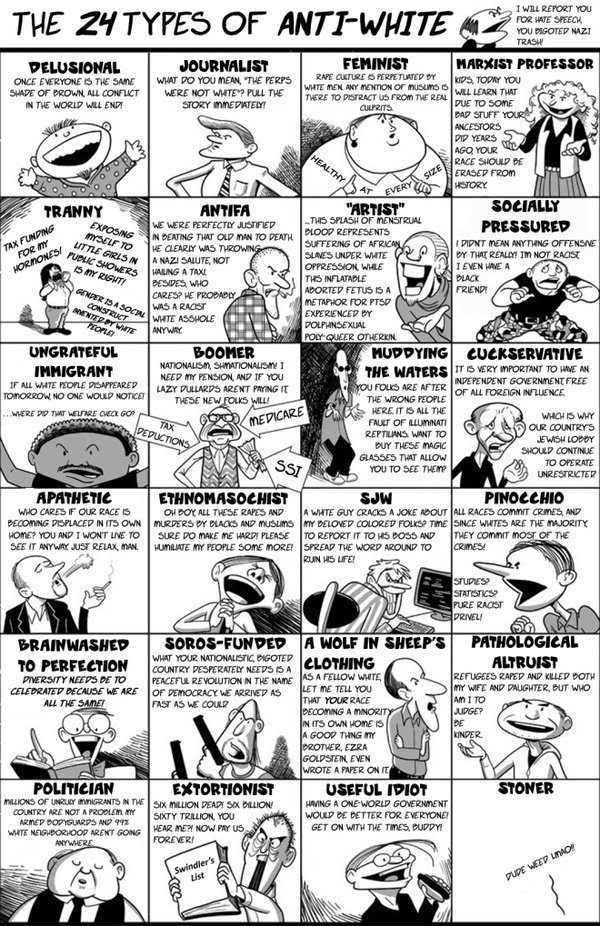
Posted inAlt Right, America|Comments Off on 24 Types Of Anti-White
“We are writing to inform you that the lecture by Professor James Watson, scheduled for September 12, 2016 has been cancelled. We received the attached letter that had been written by medical and graduate students at NYU School of Medicine to express their feelings regarding the invitation of Dr. Watson for this distinguished lecture. In the letter, the students raised the point that Dr. Watson had made public claims to diminish respect for black, female and obese individuals. We agree with the students that this runs counter to our mission of diversity and inclusion at NYU Langone Medical Center and have thus elected to cancel the lecture.”
Scientist James D. Watson, co-discoverer of the structure of DNA and a Nobel Prize winner, says anti-Semitism is justified, in a recent magazine interview.
The ADL called Dr. Watson’s remarks about Jews “disturbing” and is asking Watson to clarify them.
Watson, 78, who lives in Cold Harbor, N.Y., tells Esquire magazine in its January edition that anti-Semitism, in some circumstances, is justified.
In an interview profile for the magazine Watson asks rhetorically, “Should you be allowed to make an anti-Semitic remark?” He answered: “Yes, because some anti-Semitism is justified. Just like some anti-Irish feeling is justified. If you can’t be criticized, that’s very dangerous. You lose the concept of a free society.”
Apparently a firm believer in eugenics, Watson also feels “Ashkenazi Jews” – Jews descended from the medieval Jewish communities in the area of Germany – have higher intelligence than other people.
“I’ve wondered why people aren’t more intelligent,” Watson says. “Why isn’t everyone as intelligent as Ashkenazi Jews? And it may be that societies work best when there’s a mixture of ability – the bright people would never be an army.”
Watson says his own politics have evolved from the left to libertarianism. He said he “turned against the left wing” because “they don’t like genetics, because genetics implies that sometimes in life we fail because we have had bad genes.”
Watson complains that the poorer classes are having more children than the richer, more intelligent classes.
“I think now we’re in a terrible sitution where we should pay the rich people to have children.” He says if we don’t encourage procreation of wealthier citizens, IQ levels will most definitely fall.
* In an MA Applied Linguistics program at a well-regarded university I once tried to base a thesis proposal on an analysis of how language is used to promote the elite’s narrative on race/HBD at the expense of scholars like Watson as well as democratic citizenries’ generally by denying them access to information they need to make informed decisions. This approach to linguistic analysis is called critical discourse analysis (CDA). It’s very much like what Sailer has been doing with lefty news articles over the past 20 years. My proposal was flatly rejected without my being given a chance to answer any questions first. I was told in no uncertain terms that CDA could only be used from a leftwing perspective and that Watson was ignorant. CDA has only ever been used from a leftwing perspective, it’s true, and I think the particular professor who expressed this view (and who was from Asia not the West) could not get her head around the idea that right-wing perspectives can also encompass discriminatory perspectives. Ah well.
* Ah, yes. An auto-da-fe of the 21st century Leftist Inquisition. Watson, discoverer of DNA, thrown out of a medical school for comments nearly a decade old that contradict the official dogma of the Diversity Cult.
The Age of Enlightenment is dead, people. The scientific method has been subordinated to the neo-communist religion of the Left.
Next time you hear some lefty criticizing the Medieval Church for the Inquisition or the treatment of Galileo, laugh in his face. Next time you hear some lefty like Obama piously claim the authority of “science,” or denounce the Republicans as “anti-scientific,” you should be rolling on the floor with spasms of uncontrollable, hysterical laughter.
* Even if he engages in crimethought, he also repents earnestly.
Towards the end of Social Conquest of Earth, Wilson concludes that religion is a mechanism of tribal cohesion. Then he goes on to hope that we can all just forget about religions and our tribal past — without jettisoning all their great literature! — to embrace a one-big-happy-race world.
But he put that Noble Hope at the end of a book that argues that our very nature is to compete as groups and within groups, that the moral angst of the duel loyalty is the physiological struggle manifested in millennia of great art.
But we can change!
* Why allow any old white-privileged racist male (with his structurally racist thoughts and structurally racist mind) to sully the consciousness of those young geniuses comprising today’s affirmative-action mobs?
What would a Nobel Prize-winning scientist who discovered DNA’s double helix even bring to the discussion? Come on. It’s the Current Year!
James Watson should just quit the hard sciences (so racist!) and just voluntary submit himself now to be brainwashed with the august scholarship and anti-racist Marxism of Prof. Kimberlé Crenshaw, Critical Race Theory co-founder and promoter of ‘intersectionality’. It’s all he really needs to know, anyway.
* “Jacobson added, “Obviously, the impact of anti-Semitism through the century has been devastating to Jews”
I don’t mean to be indifferent to the suffering of Jews who were murdered in WW2 or their descendants who live with the nightmares of those events, but this argument is, if not debatable, then as least subject to qualification.
An aspergerian or autistic could argue that because of severe selective pressure, the Jewish genome has benefitted from the most ruthless culling of any in the world today. Where else did that high IQ come from if not from the fact that most of the Jews who could afford to emigrate before WW2 came from the most talented, wealthiest class and they brought their smarts with them.
But Jacobson doesn’t believe in the possibility for any genetic basis for intelligence to begin with, so this argument wouldn’t offer any consoling, redeeming or explanatory value for him.
* James Watson is still honored in Russia. Last summer he went to Russia, where he was given back his Nobel medal by the tycoon who had bought it, and was received with lots of public acclaim.
Posted inAmerica, HBD, Jews|Comments Off on NYU Disinvites James D. Watson
"Here Are EIGHT Campus Rape Hoaxes Eerily Like The UVA Rape Story"
===
It is is false alarm from Google side
We’ve gone ahead and submitted the website to Google Webmaster Tools for blacklist review. They usually revoke the warning after a couple of days although sometimes they can take up to 72 hours.
You also may try just to omit the name of the article or rephrase this paragraph so Google will exclude the article from its blacklist faster (because it will stop triggering false alarms).
Here Are 10 More Examples of Google Search Results Favorable to Hillary
“Crime” and “indictment” are not the only terms Google is keeping hidden from searches of Hillary Clinton, a Washington Free Beacon analysis finds.
Common search terms associated with Clinton appear to have been scrubbed from Google as the tech giant has been accused of manipulating its autocomplete results to favor the Democratic presidential candidate.
Matt Lieberman of SourceFed released a video showing examples of Google skewing its autocomplete results for Clinton, while other search engines simply display the most searched terms.
“While researching for a wrap-up on the June 7 Presidential Primaries, we discovered evidence that Google may be manipulating autocomplete recommendations in favor of Hillary Clinton,” SourceFed wrote. “If true, this would mean that Google Searches aren’t objectively reflecting what the majority of Internet searches are actually looking for, possibly violating Google’s algorithm.”
For example, when searching Hillary Clinton “cri,” Google finishes the phrase as “crime reform.” On Yahoo, the result is “criminal charges.” On Google’s own trend website, there were not enough searches for Hillary Clinton and “crime reform” to build a graph of the results.
Typing Hillary Clinton and “ind” gives Google users results on Hillary Clinton and Indiana. On Microsoft’s Bing search engine, a user gets Hillary Clinton and “indictment,” yielding results for the FBI investigation into Clinton’s private email server.
Just putting the name “Hillary Clinton” into Google, you are directed towards searches for her “twitter,” “email,” “age,” and “speech.”
The campaign for the neologism “santorum” started with a contest held in May 2003 by Dan Savage, a sex columnist and LGBT rights activist. Savage asked his readers to create a definition for the word “santorum”[1][2] in response to then-U.S. Senator Rick Santorum’s views on homosexuality, and comments about same sex marriage. In his comments, Santorum had stated that “[i]n every society, the definition of marriage has not ever to my knowledge included homosexuality. That’s not to pick on homosexuality. It’s not, you know, man on child, man on dog, or whatever the case may be.”[3] Savage announced the winning entry, which defined “santorum” as “the frothy mixture of lube and fecal matter that is sometimes the byproduct of anal sex”. He created a web site, spreadingsantorum.com (and santorum.com), to promote the definition, which became a top internet search result displacing the Senator’s official website on many search engines, including Google, Yahoo! Search, and Bing.[4]
In 2010 Savage said he would take the site down if Santorum donated US$5 million plus interest to Freedom to Marry, a group advocating legal recognition of same-sex marriages.[5] In September 2011 Santorum asked Google to remove the definition from its search engine index. Google refused, responding that the company does not remove content from search results except in very limited circumstances…
When asked in June 2011 whether Google should step in to prevent the definition appearing so prominently under searches for his name, Santorum said they should intervene only if they would normally do so in this kind of circumstance.[20] In September 2011 Santorum asked Google to intervene by altering the indexing of the content, saying, “If you’re a responsible business, you don’t let things like that happen in your business that have an impact on the country…To have a business allow that type of filth to be purveyed through their website or through their system is something that they say they can’t handle but I suspect that’s not true.”[6] In response to Santorum’s request, a Google spokesperson asserted that Google does not “remove content from our search results, except in very limited cases such as illegal content and violations of our webmaster guidelines.”[6]
According to Talking Points Memo (TPM), “Google did crack down” on google-bombing in the past.[44] In an interview with TPM, search engine expert Danny Sullivan stated that Santorum mischaracterized the campaign as a “Google bomb”, when it was actually a relevant use of the search query santorum to create “a new definition for the word”.[44] Sullivan argued that, in a Google bomb, pranksters persuade Google’s algorithm to send the wrong results for a certain term (e.g., when pranksters caused the search term “miserable failure” to point to the White House website’s presidential biography page). In Santorum’s case, on the other hand, the term “santorum” still points to a web page about a “santorum”—which happens to be Savage’s neologism instead of the Senator from Pennsylvania. Sullivan concluded that, “for [Senator Santorum] to say Google could get rid of it would be like him saying, ‘I don’t like the word ‘unicorn’ and I think that that definition should go away.'”[44]
Some sources describe the neologism campaign as a prank.[45][46] However, despite three times as many inbound links,[5] observers have noted that search engines Bing and Yahoo had been presenting the offending links second behind Santorum’s web site.
Tech Companies Apple, Twitter, Google and Instagram Collude to Defeat Trump
There is no such thing as Pro-Trump free speech as Clinton corporate allies serve up a carefully curated view of the campaign
Wikileaks founder Julian Assange said Clinton made a deal with Google and that the tech giant is “directly engaged” in her campaign. It’s been widely reported Clinton hired Eric Schmidt—chairman of Alphabet, the parent company of Google—to set up a tech company called The Groundwork. Assange claims this was to ensure Clinton had the “engineering talent to win the election.” He also pointed out that many members of Clinton’s staff have worked for Google, and some of her former employees now work at Google.
So it should come as no surprise that there have been multiple reports accusing Google of manipulating searches to bury negative stories about Clinton. SourceFed details how Google alters its auto-complete functions to paint Clinton in a positive light.
For example, when you type “Hillary Clinton cri” into other engines like Yahoo! or Bing, the most popular autofills are “Hillary Clinton criminal charges” but in Google it’s “Hillary Clinton crime reform.” Google denies they changed their algorithm to help Clinton, and insists the company does not favor any candidate. They also claim their algorithms don’t show predicted queries that are offensive or disparaging.
But Google has gotten into hot water on multiple occasions for connecting Trump to Adolf Hitler. In June, when users searched “when Hitler was born” it generated the expected information on Hitler but also an image of Trump. In July, searches for Trump’s book, Crippled America, returned images of Adolf Hitler’s manifesto Mein Kampf. Google has since fixed both—but again, why do these issues always conveniently disparage Trump and help Clinton?
Twitter is another culprit. The company has gotten a lot of slack for banning conservatives and Trump supporters such as Breitbart’s Milo Yiannopoulos and, most recently, rapper Azealia Banks after she came out in support of Trump. Twitter has provided vague answers as to why conservative voices have been banned while they’ve allowed other users to call for the killing of cops.
Just yesterday, Buzzfeed revealed that the social media giant’s top executive personally protected the President from seeing critical messages last year. “In 2015, then-Twitter CEO Dick Costolo secretly ordered employees to filter out abusive and hateful replies to President Barack Obama.”
This year, Twitter isn’t just banning conservatives—the platform also changed its algorithms to promote Clinton while giving negative exposure to Trump.
The founders of some of the most popular pro-Trump Twitter handles—including @USAforTrump2016 and @WeNeedTrump—insist Twitter is censoring their content. They’ve pointed out that Twitter changes trending hashtags associated with negative tweets about Clinton (which has been reported before). On August 4, shortly after the hashtag “HillaryAccomplishment” began trending, it was taken over by anti-Clinton users, who used it to mention Benghazi or Emailgate. Eric Spracklen, @USAforTrump2016 founder, noticed the hashtag was quickly changed—pluralized to #HillarysAccomplishments.
“They take away the hashtag that has negative tweets for Clinton and replace it with something that doesn’t so the average person doesn’t see what was really trending,” Spracklen said. “This happens every day.”
Jack Murphy, founder of @WeNeedTrump, says followers complain they often aren’t able to retweet his pro-Trump tweets.
Instagram has also banned accounts that depict Clinton in a negative light. In June, a conservative comedy group called Toughen Up America was banned with no warning or explanation. Last week, the popular Australian-based graffiti artist, Lushsux, was banned from Instagram after he posted photos of a bikini-clad Clinton mural he painted.
“I don’t want to sound like a conspiracy theorist with a tin foil hat, but the timing of the Hillary Clinton mural posting and the deletion that ensued can’t just be a coincidence,” he told the Daily Mail Australia. Lushsux has posted photos of way more graphic murals, including a topless Melania Trump and a naked Donald with his package in full sight. These images did not trigger any censorship from Instagram.
Facebook has a long history of shutting down pages and blocking conservative users while promoting progressive voices like Black Lives Matter activists. The problem became so transparent that Sen. John Thune sent a letter to Facebook CEO Mark Zuckerberg asking him to explain their practices.
Facebook denies it discriminates against “any sources of ideological origin” and Zuckerberg did meet with conservatives in an attempt to resolve this issue. While some walked away from the meeting encouraged that Zuckerberg wants to repair their relationship, other prominent conservatives rejected the invitation as a publicity stunt. It should be noted that Facebook employees have donated more to Clinton than to any other candidate.
Many conservatives have come to expect this kind of thing from the mainstream media. CNN, which paints itself as the centrist antidote to right-leaning Fox News and left-leaning MSNBC, has actually been among the most disingenuous offenders during this cycle, fully earning its derisive nickname “Clinton News Network.” For example, as NewsBusters pointed out for just one day, “CNN set aside nearly half of its air time on Wednesday’s New Day to various recent controversies involving the Trump campaign — 1 hour, 24 minutes, and 18 seconds over three hours. By contrast, the program clearly didn’t think much of the Wall Street Journal‘s revelation that the Obama administration secretly airlifted $400 million in cash to Iran. John Berman gave a 27-second news brief to the report, but didn’t mention that the payment was sent on “an unmarked cargo plane.” New Day, therefore, devoted over 187 times more coverage to Trump than to the millions to Iran.”
Another favored CNN trick is to present a “balanced” panel comprised of two Republicans, two Democrats and a host, as they did on the afternoon of July 29, just to name one instance of a hundred. However, the Republican side always features one Trump supporter and one “Never Trump” Republican, with the host grilling the Trump Supporter—often a beleaguered Jeffrey Lord—in what amounts to a 4-on-1. So much for balance.
Right now, CNN has a story on its site called “Which Republicans oppose Trump and why?” There’s no corresponding story about Democrats who oppose Clinton, even though her underdog challenger in the primary lasted far longer and received far more votes than any of Trump’s Republican challengers.
Google to cut ties with rightwing lobby group over climate change ‘lies’
The internet giant Google has announced it is to sever its ties with an influential rightwing lobbying network, the American Legislative Exchange Council, accusing it of “lying” about climate change.
The move, ahead of a United Nations summit on climate change, delivered a victory to campaigners and the UN’s newly minted initiative to persuade companies to shun climate-denying business lobbies.
Google’s chairman, Eric Schmidt, told National Public Radio that the company had joined Alec, a lobby group that shares model legislation, for a campaign on an unrelated issue. But he said: “I think the consensus within the company was that that was some sort of mistake, and so we’re trying to not do that in the future.”
Alec’s views on climate change were not in line with Google’s, he said.
“The facts of climate change are not in question anymore. Everyone understands climate change is occurring, and the people who oppose it are really hurting our children and our grandchildren and making the world a much worse place. And so we should not be aligned with such people — they’re just, they’re just literally lying.”
The main Google searchbox on Google.com has a feature where if you start typing a phrase it tries to anticipate what you have in mind and offer the complete phrase in a drop down pick list based on what other users have asked. For example if you type into Google’s searchbox
How do I
Google offers ten suggestions for completing this entry, beginning with these three useful questions:
How do I find my IP address How do I know if im pregnant How do I get a passport
Commenter Victoria points out that if you type in, however, Pat Bu, Google offers you the following ten prompts:
Pat Burrell Pat bus schedule Pat Buttram Pat Burrell stats Pat Burns Pat Burrell wife Pat Burke Pat Buckley Moss Pat Buckley Pat Burns cancer
Who are these people?
Using the power of Google, it’s easy to discover that Pat Burrell is a leftfielder, Pat Buttram was Gene Autry’s sidekick in 1930s singing cowboy movies and later Mr. Haney on Green Acres. Pat Burns is a former hockey coach. Pat Buckley Moss is a painter. Pat Buckley was the wife of William F. Buckley.
Somehow, I don’t think those are the most famous Pat Bu…s on the Internet today.
If you type in Pat Buc, then Google just gives up giving you prompts, which it doesn’t with other letters. For example, Pat But prompts you with a whole bunch of new names even more obscure than the immortal Pat Buttram.
Maybe it’s just a misunderstanding. So, let’s type into Google Patrick Bu. And we get another list of prompts, but none of them include He Who Must Not Be Named.
Finally if you type in Patrick J. you’ll get a list of prompts of people named Patrick J. Something, none of them as famous as Patrick J. Buchanan, winner of the 1996 New Hampshire GOP Presidential primary.
Of course, Google can’t (yet?) delete Pat Buchanan from their main search engine, just from the prompts. If you type Pat Buchanan into Google’s searchbox, you get back:
Results 1 – 20 of about 1,630,000 for pat buchanan. (0.22 seconds)
In contrast, if you type in Pat Buttram:
Results 1 – 20 of about 49,300 for pat buttram. (0.32 seconds)
It’s the sheer pettiness of Google going to the trouble of banning Pat Buchanan from its little prompting feature, one of its least important, that is so amusing and eye-opening.
P.S.: Richard Hoste points out in comments that Yahoo.com’s search bar has the same prompting engine, with Pat Buchanan being the first of the Pat Bu and second, behind Pat Benatar, for Pat B. Another commenter points out the Microsoft’s Bing search bar delivers the same prompts as Yahoo: Buchanan is the #1 Pat Bu and #2 Pat B.
So, somebody at Google is doing this intentionally. To repeat, this one example isn’t at all important — what’s striking is the mindless animus of somebody at Google that would lead to going to all the trouble of doing such a trivial thing.
And because Google is so close to being a monopoly, it’s crucial that the public monitor abuses by Google stemming from Google’s not exactly subtle political biases, such as this silly little thing or the more serious annihilation of Mangan’s blog in November (which was rectified after many complaints).
Ridicule is the best medicine.
Comments on the post:
* 1. This action is not “mindless” animus. It’s radical ideology at work.
2. This action is not a “trivial” thing. It’s a calculated attack in the Culture War.
And what about the obvious question: “Who will be next to start circling the Google memory hole?”
* I found this at the Google site:
“We try to filter out suggestions that include pornographic terms, dirty words, and hate and violence terms. If you encounter a term that should not be suggested, please let us know by posting in the Google Web Search Help Forum.”
I wonder if “Pat Buchanan” was overzealously put in the “hate” terms.
* Google search removed all listings to my PrestoPundit after I broke the story about Obama’s socialist father, the man Obama says gave him his political ideals.
All pleas to relist my blog were ignored.
* Do not read without a hanky: Google Maps imagery, currently available in the public area, displays at about about 1/100 of the satellite magnification imagery that is available in the restricted area of Google (not open to the public).
Do not read without a hanky: Google Chrome browser has taken user tracking to a whole new level.
Do not read without a hanky: Google has provided search engine query user files going back years to a wide variety of intel and security departments as a matter of routine – in cases with no warrant, arrest or even “person of interest” declaration.
* It’s not just Google’s drop-down menu that implies a leftwing bias.
Its logo also indicates that Google no like some patriotic America holidays. A few years ago, conservative groups complained that Google had not acknowledged either Memorial Day or Veterans Day with a “doodle” but had marked the launch of Sputnik by America’s Cold War adversary.
Google ‘censors its website so anti-Islam searches fail to appear’
Search engine Google has been accused of censoring its results after users discovered it never suggests search terms when it comes to Islam.
In a time-saving feature the internet phenomenon, whose motto is ‘don’t be evil’, helpfully suggests common searches as people type in what they are looking for.
For example, if you type in ‘Christianity is’ in the search bar a whole range of options flash up including controversial suggestions such as ‘Christianity is fake’ and ‘Christianity is a cult’.
But anyone typing in a similar phrase which replaces Christianity with Islam gets no suggestions at all.
The anomaly has led some to conclude the firm, famed for its democratic approach to the world of information it controls, is censoring the search results.
Google’s normal search suggestions originate from searches made around the world, adverts and known web pages.
The company also says on its website: ‘We try to filter out suggestions that include pornographic terms, dirty words, and hate and violence terms. If you encounter a term that should not be suggested, please let us know by posting in the Google Web Search Help Forum.’
A Google spokesman claimed the strange absence of results was a software problem.
He said: “This is in fact a bug and we’re working to fix it as quickly as we can.’
Google also makes suggestions which are in the future tense. Search for ‘Islam will’ and the results are very balanced, including suggestions such as ‘Islam will be destroyed’ and ‘Islam will take over the world’.
How did Google become the internet’s censor and master manipulator, blocking access to millions of websites?
The company maintains at least nine different blacklists that impact our lives, generally without input or authority from any outside advisory group, industry association or government agency. Google is not the only company suppressing content on the internet. Reddit has frequently been accused of banning postings on specific topics, and a recent report suggests that Facebook has been deleting conservative news stories from its newsfeed, a practice that might have a significant effect on public opinion – even on voting. Google, though, is currently the biggest bully on the block.
When Google’s employees or algorithms decide to block our access to information about a news item, political candidate or business, opinions and votes can shift, reputations can be ruined and businesses can crash and burn. Because online censorship is entirely unregulated at the moment, victims have little or no recourse when they have been harmed. Eventually, authorities will almost certainly have to step in, just as they did when credit bureaus were regulated in 1970. The alternative would be to allow a large corporation to wield an especially destructive kind of power that should be exercised with great restraint and should belong only to the public: the power to shame or exclude.
If Google were just another mom-and-pop shop with a sign saying “we reserve the right to refuse service to anyone,” that would be one thing. But as the golden gateway to all knowledge, Google has rapidly become an essential in people’s lives – nearly as essential as air or water. We don’t let public utilities make arbitrary and secretive decisions about denying people services; we shouldn’t let Google do so either.
Let’s start with the most trivial blacklist and work our way up. I’ll save the biggest and baddest – one the public knows virtually nothing about but that gives Google an almost obscene amount of power over our economic well-being – until last.
1. The autocomplete blacklist. This is a list of words and phrases that are excluded from the autocomplete feature in Google’s search bar. The search bar instantly suggests multiple search options when you type words such as “democracy” or “watermelon,” but it freezes when you type profanities, and, at times, it has frozen when people typed words like “torrent,” “bisexual” and “penis.” At this writing, it’s freezing when I type “clitoris.” The autocomplete blacklist can also be used to protect or discredit political candidates. As recently reported, at the moment autocomplete shows you “Ted” (for former GOP presidential candidate Ted Cruz) when you type “lying,” but it will not show you “Hillary” when you type “crooked” – not even, on my computer, anyway, when you type “crooked hill.” (The nicknames for Clinton and Cruz coined by Donald Trump, of course.) If you add the “a,” so you’ve got “crooked hilla,” you get the very odd suggestion “crooked Hillary Bernie.” When you type “crooked” on Bing, “crooked Hillary” pops up instantly. Google’s list of forbidden terms varies by region and individual, so “clitoris” might work for you. (Can you resist checking?)…
3. The YouTube blacklist.YouTube, which is owned by Google, allows users to flag inappropriate videos, at which point Google censors weigh in and sometimes remove them, but not, according to a recent report by Gizmodo, with any great consistency – except perhaps when it comes to politics. Consistent with the company’s strong and open support for liberal political candidates, Google employees seem far more apt to ban politically conservative videos than liberal ones. In December 2015, singer Joyce Bartholomew sued YouTube for removing her openly pro-life music video, but I can find no instances of pro-choice music being removed. YouTube also sometimes acquiesces to the censorship demands of foreign governments. Most recently, in return for overturning a three-year ban on YouTube in Pakistan, it agreed to allow Pakistan’s government to determine which videos it can and cannot post.
4. The Google account blacklist.A couple of years ago, Google consolidated a number of its products – Gmail, Google Docs, Google+, YouTube, Google Wallet and others – so you can access all of them through your one Google account. If you somehow violate Google’s vague and intimidating terms of service agreement, you will join the ever-growing list of people who are shut out of their accounts, which means you’ll lose access to all of these interconnected products. Because virtually no one has ever read this lengthy, legalistic agreement, however, people are shocked when they’re shut out, in part because Google reserves the right to “stop providing Services to you … at any time.” And because Google, one of the largest and richest companies in the world, has no customer service department, getting reinstated can be difficult. (Given, however, that all of these services gather personal information about you to sell to advertisers, losing one’s Google account has been judged by some to be a blessing in disguise.)
…The answer has to do with the dark and murky world of website blacklists – ever-changing lists of websites that contain malicious software that might infect or damage people’s computers. There are many such lists – even tools, such as blacklistalert.org, that scan multiple blacklists to see if your IP address is on any of them. Some lists are kind of mickey-mouse – repositories where people submit the names or IP addresses of suspect sites. Others, usually maintained by security companies that help protect other companies, are more high-tech, relying on “crawlers” – computer programs that continuously comb the internet.
But the best and longest list of suspect websites is Google’s, launched in May 2007. Because Google is crawling the web more extensively than anyone else, it is also in the best position to find malicious websites. In 2012, Google acknowledged that each and every day it adds about 9,500 new websites to its quarantine list and displays malware warnings on the answers it gives to between 12 and 14 million search queries. It won’t reveal the exact number of websites on the list, but it is certainly in the millions on any given day.
In 2011, Google blocked an entire subdomain, co.cc, which alone contained 11 million websites, justifying its action by claiming that most of the websites in that domain appeared to be “spammy.” According to Matt Cutts, still the leader of Google’s web spam team, the company “reserves the right” to take such action when it deems it necessary. (The right? Who gave Google that right?)
And that’s nothing: According to The Guardian, on Saturday, Jan. 31, 2009, at 2:40 pm GMT, Google blocked the entire internet for those impressive 40 minutes, supposedly, said the company, because of “human error” by its employees. It would have been 6:40 am in Mountain View, California, where Google is headquartered. Was this time chosen because it is one of the few hours of the week when all of the world’s stock markets are closed? Could this have been another of the many pranks for which Google employees are so famous? In 2008, Google invited the public to submit applications to join the “first permanent human colony on Mars.” Sorry, Marsophiles; it was just a prank.
When Google’s search engine shows you a search result for a site it has quarantined, you see warnings such as, “The site ahead contains malware” or “This site may harm your computer” on the search result. That’s useful information if that website actually contains malware, either because the website was set up by bad guys or because a legitimate site was infected with malware by hackers. But Google’s crawlers often make mistakes, blacklisting websites that have merely been “hijacked,” which means the website itself isn’t dangerous but merely that accessing it through the search engine will forward you to a malicious site. My own website, http://drrobertepstein.com, was hijacked in this way in early 2012. Accessing the website directly wasn’t dangerous, but trying to access it through the Google search engine forwarded users to a malicious website in Nigeria. When this happens, Google not only warns you about the infected website on its search engine (which makes sense), it also blocks you from accessing the website directly through multiple browsers – even non-Google browsers. (Hmm. Now that’s odd. I’ll get back to that point shortly.)
The mistakes are just one problem. The bigger problem is that even though it takes only a fraction of a second for a crawler to list you, after your site has been cleaned up Google’s crawlers sometimes take days or even weeks to delist you – long enough to threaten the existence of some businesses. This is quite bizarre considering how rapidly automated online systems operate these days. Within seconds after you pay for a plane ticket online, your seat is booked, your credit card is charged, your receipt is displayed and a confirmation email shows up in your inbox – a complex series of events involving multiple computers controlled by at least three or four separate companies. But when you inform Google’s automated blacklist system that your website is now clean, you are simply advised to check back occasionally to see if any action has been taken. To get delisted after your website has been repaired, you either have to struggle with the company’s online Webmaster tools, which are far from friendly, or you have to hire a security expert to do so – typically for a fee ranging between $1,000 and $10,000. No expert, however, can speed up the mysterious delisting process; the best he or she can do is set it in motion.
So far, all I’ve told you is that Google’s crawlers scan the internet, sometimes find what appear to be suspect websites and put those websites on a quarantine list. That information is then conveyed to users through the search engine. So far so good, except of course for the mistakes and the delisting problem; one might even say that Google is performing a public service, which is how some people who are familiar with the quarantine list defend it. But I also mentioned that Google somehow blocks people from accessing websites directly through multiple browsers. How on earth could it do that? How could Google block you when you are trying to access a website using Safari, an Apple product, or Firefox, a browser maintained by Mozilla, the self-proclaimed “nonprofit defender of the free and open internet”?
The key here is browsers. No browser maker wants to send you to a malicious website, and because Google has the best blacklist, major browsers such as Safari and Firefox – and Chrome, of course, Google’s own browser, as well as browsers that load through Android, Google’s mobile operating system – check Google’s quarantine list before they send you to a website. (In November 2014, Mozilla announced it will no longer list Google as its default search engine, but it also disclosed that it will continue to rely on Google’s quarantine list to screen users’ search requests.)
If the site has been quarantined by Google, you see one of those big, scary images that say things like “Get me out of here!” or “Reported attack site!” At this point, given the default security settings on most browsers, most people will find it impossible to visit the site – but who would want to? If the site is not on Google’s quarantine list, you are sent on your way.
OK, that explains how Google blocks you even when you’re using a non-Google browser, but why do they block you? In other words, how does blocking you feed the ravenous advertising machine – the sine qua non of Google’s existence?
Have you figured it out yet? The scam is as simple as it is brilliant: When a browser queries Google’s quarantine list, it has just shared information with Google. With Chrome and Android, you are always giving up information to Google, but you are also doing so even if you are using non-Google browsers. That is where the money is – more information about search activity kindly provided by competing browser companies. How much information is shared will depend on the particular deal the browser company has with Google. In a maximum information deal, Google will learn the identity of the user; in a minimum information deal, Google will still learn which websites people want to visit – valuable data when one is in the business of ranking websites. Google can also charge fees for access to its quarantine list, of course, but that’s not where the real gold is.
Chrome, Android, Firefox and Safari currently carry about 92 percent of all browser traffic in the U.S. – 74 percent worldwide – and these numbers are increasing. As of this writing, that means Google is regularly collecting information through its quarantine list from more than 2.5 billion people. Given the recent pact between Microsoft and Google, in coming months we might learn that Microsoft – both to save money and to improve its services – has also started using Google’s quarantine list in place of its own much smaller list; this would further increase the volume of information Google is receiving.
To put this another way, Google has grown, and is still growing, on the backs of some of its competitors, with end users oblivious to Google’s antics – as usual. It is yet another example of what I have called “Google’s Dance” – the remarkable way in which Google puts a false and friendly public face on activities that serve only one purpose for the company: increasing profit. On the surface, Google’s quarantine list is yet another way Google helps us, free of charge, breeze through our day safe and well-informed. Beneath the surface, that list is yet another way Google accumulates more information about us to sell to advertisers.
You may disagree, but in my view Google’s blacklisting practices put the company into the role of thuggish internet cop – a role that was never authorized by any government, nonprofit organization or industry association. It is as if the biggest bully in town suddenly put on a badge and started patrolling, shuttering businesses as it pleased, while also secretly peeping into windows, taking photos and selling them to the highest bidder.
Consider: Heading into the holiday season in late 2013, an online handbag business suffered a 50 percent drop in business because of blacklisting. In 2009, it took an eco-friendly pest control company 60 days to leap the hurdles required to remove Google’s warnings, long enough to nearly go broke. And sometimes the blacklisting process appears to be personal: In May 2013, the highly opinionated PC Magazine columnist John Dvorak wondered “When Did Google Become the Internet Police?” after both his website and podcast site were blacklisted. He also ran into the delisting problem: “It’s funny,” he wrote, “how the site can be blacklisted in a millisecond by an analysis but I have to wait forever to get cleared by the same analysis doing the same scan. Why is that?”
Could Google really be arrogant enough to mess with a prominent journalist? According to CNN, in 2005 Google “blacklisted all CNET reporters for a year after the popular technology news website published personal information about one of Google’s founders” – Eric Schmidt – “in a story about growing privacy concerns.” The company declined to comment on CNN’s story.
Google’s mysterious and self-serving practice of blacklisting is one of many reasons Google should be regulated, just as phone companies and credit bureaus are. The E.U.’s recent antitrust actions against Google, the recently leaked FTC staff report about Google’s biased search rankings, President Obama’s call for regulating internet service providers – all have merit, but they overlook another danger. No one company, which is accountable to its shareholders but not to the general public, should have the power to instantly put another company out of business or block accessto any website in the world. How frequently Google acts irresponsibly is beside the point; it has the ability to do so, which means that in a matter of seconds any of Google’s 37,000 employees with the right passwords or skills could laser a business or political candidate into oblivion or even freeze much of the world’s economy.
Posted inCensorship, Google|Comments Off on Google Has Blackballed This Website From Its Search Results Since August 18
"This guy knows all the gossip, the ins and outs, the lashon hara of the Orthodox world. He’s an [expert] in... all the inner workings of the Orthodox world." (Rabbi Aaron Rakeffet-Rothkoff)