Where Is Ross Douthat On The Buffered Vs Porous Scale?

Douthat sits in a hybrid spot. He isn’t fully buffered in the Charles Taylor sense and he isn’t romantic about porousness either. He’s a modern Catholic intellectual who feels the costs of buffering but distrusts the naïve return to enchantment. His whole project is about trying to live with a managed porousness inside a buffered age.

He accepts the buffered frame as the default habitat. He writes as someone who knows he is formed by technocracy, analytic habits, elite-college secular culture, medicalization, and a meritocratic worldview. He treats the buffered self as the water he swims in.

He feels the insufficiency of that mindset. Much of his work reads like a lament for a world where transcendence is harder to experience and harder to take seriously without feeling self-conscious. He sees the boredom, drift, and sterility of purely buffered life.

He selectively valorizes porousness. Bad Religion and The Deep Places both circle the idea that spiritual experience, suffering, and the supernatural can break through modern insulation. But he never glamorizes full porousness. He sees it as dangerous if unmoored. He prefers porousness disciplined by tradition rather than porousness as free-floating mysticism.

He tries to carve out a narrow middle lane that is emotionally porous but epistemically cautious. In The Deep Places his own chronic illness pushes him toward a more open posture to non-material explanations while his journalistic training keeps him wary of credulity. You can feel him negotiating between the buffered reflex to doubt and the porous reflex to receive.

In political commentary he treats the decline of shared thick moral horizons as a buffered-world problem rather than a purely institutional one. He sees the loss of enchantment, ritual, and hierarchy as a key source of malaise. That’s a porous diagnosis of a buffered society.

He is deeply Taylorian even when he doesn’t cite Taylor. He agrees we live in an “immanent frame” that narrows spiritual possibility. But he thinks meaning leaks in anyway. So his entire vibe is: the frame is real, you are formed by it, but openings remain. Follow them carefully.

Douthat is a buffered man who wishes he weren’t quite so buffered and spends his writing life working out how to let a controlled amount of porousness back in without losing sanity, reason, or social footing. This is why he resonates with readers who feel the same tension. It’s also why he annoys both hard secularists and hard mystics.

The elite-journalist mindset is built inside institutions that reward detachment, verification norms, procedural rationality, and self-presentation as an autonomous chooser. All of that pushes them toward the buffered identity as the obvious, sane way to exist. They don’t experience it as a theory. They experience it as adulthood.

The buffered frame lets them do their job. It supports skepticism, emotional distance, and the sense that you can stand outside belief systems and evaluate them. It keeps them from being captured by movements and it protects their professional neutrality.

But the costs show up too.

They underestimate how much people are shaped by ritual, myth, sacred ideals, group enchantment, status ecologies, and spiritual hunger. They often misread charismatic movements because they assume a buffered psychology where people make discrete, rational choices instead of being swept into collective emotion. They miss the heat and stickiness of identity. They flatten everything into ideology when much of politics is really liturgy.

They also don’t see their own porousness. Their profession has its own sacreds and taboos but they treat them as neutrality. They have their own rituals and collective effervescence, only it happens in newsrooms, conferences, Slack channels, and social media echo chambers. Because they name it “reason” they don’t recognize it as enchantment.

So yes, most elite journalists assume the buffered identity is just the water everyone should swim in. It gives them a sense of competence and control. It also blinds them to the deep forces moving the people they cover. This is why figures like Benz, Fuentes, Trump, or any other charismatic actor often disorient them. They don’t have the conceptual tools to see how porous identity works in practice.

The buffered identity shapes news in ways most reporters don’t even notice.

It narrows what counts as a real cause. Buffered identity assumes people are governed by incentives, interests, and rational calculations. So coverage leans heavily toward material explanations and treats emotion, ritual, myth, and spiritual longing as fringe or decorative. Reporters cover policy, not liturgy. They miss the fact that many conflicts are really battles over sacred meaning rather than cost-benefit logic.

It sanitizes the texture of lived experience. Porous moments feel uncanny or charged. People describe being moved, seized, pulled, swept up. Buffered reporters translate all that into “motivated reasoning,” “identity,” or “disinformation.” They flatten intensity into categories that feel safe inside the immanent frame. The mystical or the collective gets written out of the story.

It builds a blind spot around charisma. Charismatic authority looks irrational from inside buffering. Journalists interpret it as manipulation or demagoguery because they can’t feel its appeal from the inside. They handle it like a pathology. This creates constant misreads of movements that run on enchanted energy. They don’t get how status, ritual, and shared ecstasy function.

It produces tone policing. Buffered identity values emotional restraint. So anyone who speaks from visceral conviction gets labeled extreme or unserious. Passion reads as danger. Newsrooms reward the type of writer who watches life rather than participates in it. That shapes who gets hired and who shapes the narrative.

It makes “balance” and “objectivity” feel like moral goods instead of professional techniques. Buffered identity treats distance as virtue. You become suspicious of anything that smells like commitment. This influences what stories get framed as “important,” which voices get credibility, and which experiences are dismissed as subjective.

It drives a preference for elite sources. The buffered self identifies with technocratic competence. So reporters instinctively trust institutions, experts, and credentialed authority. They assume these people see clearly and everyone else is clouded by passion or myth. That produces coverage that leans managerial and treats grassroots sentiment as noise rather than signal.

It creates an allergy to sacred language. Any talk of good, evil, sin, redemption, vocation, or destiny makes elite reporters recoil. They translate everything into psychology or politics. They don’t know how to report on meaning except through the buffer’s filters. This makes huge parts of human experience feel invisible in mainstream coverage.

The result is a news ecosystem that is excellent at tracking facts inside the immanent frame and often terrible at understanding the forces that actually move people. It’s why populism keeps surprising them. It’s why they misinterpret religious reactions, culture wars, online subcultures, and charismatic influencers.

They’re reporting a world that’s half real. The half they can measure and verify. The half that fits the buffered template. The other half leaks out through the cracks but never quite gets named.

In the news business, the differences in buffered vs porous identity track along role, format, status, and generational cohort. The news business isn’t a single cognitive style. It’s a hierarchy of bufferedness.

National prestige reporters are the most buffered. Think NYT, WaPo, FT, NPR, and similar outlets. Their training, peer environment, and professional survival incentives all reward analytic distance. Their identity depends on being the person who is not swayed. They police porousness in themselves and each other. This is the zone where the buffered self feels like the only legitimate self.

Magazine feature writers and essayists sit one notch less buffered. They’re still formed by elite norms, but they’re allowed some emotional and existential range. You see more willingness to describe awe, fear, enchantment, trauma, liminal moments. They still translate it into secular terms, but there’s more space for porous energy to leak in. Douthat is an example, though he’s a columnist not a magazine writer. The Atlantic often lives here.

Investigative reporters vary. The national-security and corruption-oriented investigators skew buffered because they need suspicion and institutional distance. But the on-the-ground human condition investigators sometimes absorb more porousness because they’re immersed in people’s intense experiences. They still report through a rational frame, but their antennae pick up what the buffered elite often miss.

Local reporters tend to be more porous. They cover communities where ritual, religion, collective identity, and local mythology play a visible role. They feel the weight of family networks, churches, fraternal orders, booster clubs, sports cultures, and civic rituals. The coverage still uses a buffered style, but the sensibility is closer to the porous world because they’re embedded in it.

Tabloid and sensational outlets are performatively porous even if the writers themselves are often buffered. Sensationalism runs on intensity, transgression, moral panic, and mythic conflict. It’s not reflective porousness but it mimics it. This is why porous audiences gravitate to tabloids even though tabloids are manufactured by cynical professionals.

Opinion commentators sit all over the map. Some treat buffered identity as sacred. Others lean fully into a porous style, drawing on mythic narratives, visceral emotion, or spiritual categories. The right populist ecosystem is more porous. The centrist or establishment punditry is extremely buffered. The left has both: traditional liberal commentators are buffered while some more spiritual or identity-driven factions operate porous.

Longform audio (podcasts) has opened the door to a more porous register. Because conversations run for hours, people speak less guardedly. Reporters trained in the buffered style drift into porous states without noticing. They tell personal stories, admit uncertainty, express awe, wrestle with meaning. The medium itself weakens the buffer.

Generational differences matter. Older Boomers came up under a Walter-Cronkite ideal of buffered professionalism. Younger reporters often still inherit the frame from their institutions but are less secure in it. Some Gen Z reporters are surprisingly porous in private but write in a buffered voice because the job demands it. Others bring activist tastes, which are a type of secular porousness re-entering the newsroom.

The higher the prestige and the closer the role is to adjudicating public reality, the more buffered the identity. The closer the role is to lived experience, subculture, or longform narrative, the more porous energy seeps in. This is part of why news often feels thin to readers who sense the porous world. The people closest to the commanding heights have the strongest buffers.

Posted in Journalism, Ross Douthat | Comments Off on Where Is Ross Douthat On The Buffered Vs Porous Scale?

WP: ‘Justice is not meant to be a luxury good’

WP: Max Raskin is a fellow and adjunct professor of law at New York University School of Law. He is a co-founder of Uris Acquisitions. He writes:

The bar exam, the Law School Admission Test and law school itself are the price you pay for joining a government-protected legal guild — no different from taxi medallions or liquor licenses. It is essentially illegal to represent someone else in court without passing this test, which is an exception to the general rule that people should be allowed to hire whomever they want without the government’s permission.

Many empirical studies question the effectiveness of the bar exam in predicting lawyerly prowess, but this should be settled by a free market. We don’t make auto mechanics or electricians go to school for an additional three years, even though their professions can cause much more physical harm. We rely on credentials, social signaling, reviews and other market mechanisms for determining quality.

Lawyers are not doctors, so more experimentation in the legal profession can be tolerated. Lawyers are not constantly making life-or-death decisions, and when they do, there are procedures to ensure that counsel is competent. Run-of-the-mill contract review and regulatory filings, however, don’t warrant a licensure scheme.

This is especially true in light of advances in artificial intelligence. AI systems already draft wills, nondisclosure agreements, term sheets, employment contracts and regulatory memos at associate-level quality. There are those who point to the occasional lawyer who doesn’t check hallucinated citations and embarrasses himself in court, but these are exceptions. The vast majority of lawyers who use AI don’t want to admit it for the same reason doctors don’t want to admit to Googling symptoms, so there is a negative selection bias where stories of federal judges sloppily using AI catch more attention than routine use of the tool…

Standardized legal work, which primarily consists of updating form documents, can almost certainly be automated. The billable hour is not a sacrosanct system etched on the tablets of Moses. It is a 20th-century invention that will collapse when the cost of producing effective legal work falls dramatically because of AI. Lawyers expect to save 240 hours a year on average by using generative AI tools, according to a Thomson Reuters survey this year. This is partly due to the nature of law itself — once a rule turns out to be just and workable, it can simply be repeated. In our common law system, this means that law ought to be more, not less, efficient as time goes on…

One of the most nefarious forms of protectionism is the limit on nonlawyers being partners in law firms. This rule prevents specialization, which is the cornerstone of economic order. Why would someone think that a lawyer who has trained in a narrow field would be good at firm operations or marketing or hiring? In most other industries, chief technology officers deal with tech, chief operation officers deal with operations and hiring is with human resources. But in law firms, essentially all the ultimate decision-makers must be lawyers. Kim Kardashian could surely run a more efficient marketing department than a white-shoe firm.

These rules are marketed as protecting justice when they really protect incumbents. Over the past decade, legal costs have risen by about twice the rate of inflation, while technology should have driven costs down.

Posted in Law | Comments Off on WP: ‘Justice is not meant to be a luxury good’

Interaction Ritual Chains (2005)

This Randall Collins classic book gives you a clean sociological bridge between Charles Taylor’s porous identity and buffered identity. It’s not metaphysics. It’s what happens to people when the ritual energy dries up or concentrates.

Porous selves come out of strong, dense interaction rituals. You’re saturated with emotional energy from face-to-face encounters. You feel carried along by groups. Boundaries feel thin. You experience meaning as something that flows through you. Collins would say you’re high in emotional energy that was generated collectively, not individually. That produces permeability. You’re open because the group is holding you up.

Buffered selves develop when the ritual conditions weaken. Fragmented attention, thin group solidarity, weak synchrony, low mutual focus. Collins argues that without thick rituals you lose the shared charge that binds people. When that happens, you fall back on a more brittle, self-contained identity. You operate as a buffered unit because nothing in your environment is giving you the social electricity that dissolves boundaries. You have to generate your own emotional energy, which makes you more defended and inward.

A few core takeaways.

Porous identity is a product of high-synchrony ritual life. Think religious communities, intense subcultures, military units, or even music scenes. People feel possessed by something larger because the ritual entrainment is that strong. Collins calls this the “rush” of emotional energy. Taylor calls it porousness. Same phenomenon.

Buffered identity emerges when your rituals shift from embodied and communal to abstract and individual. Modernity disrupts attention and weakens shared focus. You get people who rely more on cognition and less on collective entrainment. The boundaries harden because social energy is scarce. Taylor describes it as a self sealed off from outside forces. Collins describes it as low ritual density.

Porousness isn’t mystical. It’s what people look like when they’re plugged into powerful IR chains that extend backward and forward in time. You inherit emotional capital from prior rituals and pass it on. The self feels open because you’re literally wired into a chain of shared practices.

Bufferedness isn’t heroic independence. It’s a symptom of isolation in the ritual economy. Without reliable IR loops, you collapse into self-monitoring, self-regulation, self-consciousness. You get the modern “interior” self because your social environment forces you to generate meaning alone. That feels buffered because nothing breaks through.

Importantly, both states can flip. When people find a new high-intensity ritual environment, the buffered shell goes soft. That’s why people get swept up in revivals, cults, fandoms, political rallies. Their identity becomes porous again, not through belief but through entrainment.

So Collins gives you a materialist mechanism for what Taylor frames as a historical shift. Ritual density and emotional energy distribution determine whether people feel sealed or permeable. The buffered–porous distinction is basically a phenomenology of high vs low ritual entrainment.

Posted in Buffered | Comments Off on Interaction Ritual Chains (2005)

American post-liberalism is less a doctrine than a pile-up.

You have high-church theorists writing about “the common good,” technolibertarians who decided democracy is a bug, Trumpist nationalists who want tariffs and vengance, and online paranoids who think the CIA flew the planes into the towers. They all claim liberalism has failed, but they want very different things from whatever comes next.
The Dispatch roundtable and the ISI piece you linked trace how that jumble is now fighting to control the institutions that used to form “respectable” American conservatism. I’ll use that as the through-line: not just “what are the varieties of post-liberalism,” but how they are competing inside the right’s existing elite pipeline, and why it feels like rot rather than mere intellectual evolution.

I. What “post-liberal” means in this context

In the podcast, John McCormack gives the cleanest definition around minute 5. “Post-liberal” here does not just mean “anti-progressive.” It means people who fault the American founding itself, the whole classical-liberal package of individual rights, limited government, and procedural neutrality.
On their telling, the trouble is not just left-liberalism since the 1960s. It is the liberal part of the American experiment going back to Madison and Locke.
So the shared moves are:

Treat “liberalism” as a comprehensive, corrosive order, not just a set of rules.

Blame liberalism for atomization, loneliness, cultural decay, and weak national will.

Call for a thicker, more directive state that can actively promote substantive goods (religion, family, nation, order), not just referee private choices.

Once you see that common frame, the varieties of American post-liberalism sort themselves into a few main families.

II. Catholic integralists and “common-good” conservatives

This is the most self-consciously intellectual variety, and the one that got ISI’s board to start talking about a “post-liberal hijacking.”
Rough sketch:
• Patrick Deneen’s “Why Liberalism Failed” argues that liberalism didn’t just go off the rails recently; it succeeded on its own terms. Emancipated individuals, uprooted communities, managed by faceless technocrats, is the logical endpoint.
• Adrian Vermeule’s “common-good constitutionalism” explicitly rejects originalism and rights-talk in favor of reading the Constitution as a mandate for the state to promote objective moral goods.
• Integralists more broadly want an avowedly Christian (usually Catholic) state that uses law to buttress religious truth, restrict blasphemy and pornography, and subordinate markets to a thick moral order.
On the Dispatch pod they mention a professor who has openly endorsed blasphemy laws in the United States and who has been given pride of place at ISI conferences. That is integralism in miniature: the problem is not just drag queen story hour; it is the First Amendment as Americans have understood it since the Warren Court, and arguably since the Founding.
This camp generally:
• Is bookish, footnote heavy, and thinks in terms of regimes and teleology.
• Is skeptical of free markets and global capitalism.
• Wants real coercive power, not just “cultural influence.”
Its weak spot is sellability. You can fill an ISI conference with it; it is a lot harder to build a majority coalition for “American blasphemy laws.” So it tends to piggy-back on more populist energies.

III. National conservatism and economic populists

A step down from integralism in theological intensity, but closer to mass politics, you get national conservatism and economic populists.
Think of:
• The Buchanan tradition of tariffs, immigration restriction, and non-intervention abroad.
• “Industrial policy” conservatives who want to break with Reagan’s free-trade consensus.
• The NatCon network and magazines like The American Conservative, which Johnny Burtka ran before taking over ISI. The Dispatch
On the podcast they distinguish this “national populism” from the more academic post-liberals, but the overlap is obvious. Both treat Reagan-Bush fusionism as exhausted. Both think a neutral, procedural state is a fantasy. Both want government to side openly with some groups and values against others.
In practice this looks like:
• Economic nationalism: tariffs, buy-American, hostility to multinational corporations and Wall Street.
• Civilizational rhetoric: “defend Western civilization,” “secure the border,” “fight woke capital.”
• Strong leader politics: a taste for executives who “get things done” without agonizing over norms.
At ISI and Heritage, this is the faction that sells itself as “relevant.” Burtka reportedly told donors he wanted to speak for “the Tucker Carlson wing of the GOP,” which is basically this tendency with a TV face. The Dispatch+1
This camp is more electorally viable than integralism, but less coherent. Some of its people still like the founding; others talk as if the Constitution is a neoliberal psy-op. That fuzziness is a feature not a bug. It lets a lot of different grievances fly under the “post-liberal nationalist” flag.

IV. Tech-adjacent neo-reaction and the “CEO of America” fantasy

Then there is the neo-reactionary or “NRx” stream around Curtis Yarvin, whom the Dispatch folks mention around minute 6 as the guy who tells Americans to get over their “dictator phobia.”
Yarvin’s basic pitch:
• Liberal democracy is inefficient, chaotic, and captured by a progressive “Cathedral” of media, academia, and NGOs.
• The solution is something closer to a high-tech monarchy or corporate state, with a single sovereign CEO in charge of the country.
• Rights, elections, and egalitarian rhetoric are mostly propaganda that keeps the real oligarchy unaccountable.
This is post-liberalism stripped of both Christianity and civic piety. It is attractive to a certain tech-bro who has concluded that democracy is stupid and that Singapore is nicer than San Francisco.
The striking thing, as the Dispatch pod notes, is that ISI invited Yarvin for a friendly talk at a time when its own trustees were complaining of a “post-liberal hijacking.” So you had a once-Buckleyite institution giving a platform to a man who openly talks about relaxing into dictatorship. The Dispatch+1
That tells you something about the current mood: contempt for liberal democracy is no longer disqualifying in the way it would have been for the old fusionist right.
V. The conspiracist post-liberalism of Alex Jones, Fuentes and friends
At the outer edge you get the Fuentes / Alex Jones / “groyper” ecosystem. Here post-liberalism is less a philosophy and more an affect: nihilistic, paranoid, contemptuous of procedural norms, and comfortable with explicit bigotry.
Nick Fuentes gives you the incel-Catholic blend: talk of Christian nationalism, open antisemitism, misogyny, and a performative rejection of liberal taboos. Jones gives you the full paranoid style: 9/11 was an inside job, Sandy Hook was staged, the “globalists” are poisoning the population. Wikipedia+1
In theory, a respectable right could say: look, there are legitimate post-liberal critiques, and then there are deranged people we will not touch. In practice, that line is exactly what has blurred:
• Tucker Carlson brings Fuentes on for a chummy conversation.
• Heritage’s president rushes out a video defending Carlson, which triggers resignations and crisis. The Dispatch+1
• ISI flies its top student journalists to Carlson’s Florida home for a “journalism 101” retreat whose surprise guest is Alex Jones, fresh off losing nearly a billion dollars in defamation judgments for lying about dead schoolchildren. Mediaite+1
The symbolism is not subtle. You are telling the next generation of right-leaning elites: these men are your models. Learn from them. Emulate their style, not the old-fashioned bore who cares about fact checks and constitutional norms.
At that point “post-liberalism” becomes a marketing label for a general stance of anti-institutional hostility and gleeful norm-breaking, glued together by internet clout and ressentiment.

VI. Protestant and evangelical post-liberalism

There is also a more Protestant, often non-Catholic version that shows up in Christian nationalism, parts of the MAGA church world, and some segments of “post-woke” evangelicalism.
Features:
• Less interest in Aquinas, more in reclaiming “Christian America.”
• Talk of America as a covenant nation that must honor God or face judgment.
• Calls for a more muscular use of state power on abortion, LGBT issues, school curricula, and immigration.
Some of these figures avoid the “post-liberal” label, but the substance overlaps. Liberal neutrality is seen as a myth that always favored secular progressives, so it is time to drop the mask and fight for our side’s dominance.
This stream often blends into the Trumpist one in practice. The theology is fuzzier than integralism, but the political imperative is similar: stop pretending the Constitution is a neutral umpire, and start using power to advance substantive Christian goods.
VII. The institutional story: from convening debate to picking winners
The Dispatch team’s ISI reporting is basically a case study in what happens when these post-liberal tendencies begin to capture gatekeeping institutions.
Historically, ISI’s brand was:
• Give smart right-leaning students a canon (Burke, Kirk, Hayek, Tocqueville).
• Convene debates among different conservative schools: libertarians vs traditionalists vs neocons, etc.
• Keep some distance from day-to-day Republican politics and from obvious cranks.
On the podcast they describe ISI as the place where you might see a traditionalist, a neocon, and a libertarian argue about the Iraq War or the size of the welfare state, under the assumption that everyone shares some basic liberal-constitutional framework. The institute’s role was referee and convenor, not cheerleader for one faction.
The new pattern, as they document:
• The president, Burtka, explicitly orients ISI toward the “Tucker Carlson wing” while assuring the board he will keep a “big tent.” The Dispatch+1
• “Serious” post-liberals like Deneen get pride of place at marquee conferences.
• Neo-reactionaries like Yarvin get invited for uncritical conversations.
• Student journalists are flown to Carlson’s house, where Alex Jones shows up as a surprise inspirational guest.
• At the same time, mainstream conservatives who are anti-populist, like Kevin Williamson, are blackballed by leadership for their “contempt for the working class.”
As McCormack puts it around minute 17, everyone gatekeeps. The question is which direction. At ISI, the dial has been moved so that Fuentes-adjacent energies are now “inside,” while old-guard Reagan-Bush conservatives are increasingly “outside.”
Something similar has been happening at Heritage, Hillsdale, and parts of the NatCon network. Shared board members, donor overlap, and a common fear of “irrelevance” in the Turning Point / Charlie Kirk era all push them toward embracing the hottest post-liberal brands, even when those brands are marinated in conspiracy and antisemitism. The Dispatch+1
So the varieties of post-liberalism are not just academic categories. They map onto very concrete institutional bets: Do we align with Carlson despite Fuentes and Jones, because that’s where the kids and the clicks are? Do we give the integralists the plenary session? Do we tell the old Kirk-style people to get over their “dictator phobia”?
VIII. Why this is happening now
A few drivers, many of which the Dispatch conversation hints at:

Liberal exhaustion and broken promises
Post-liberals are not wrong that the liberal order is under strain. Housing is unaffordable, family formation is down, addiction and loneliness are up. The old “free markets plus family values” formula looks fake to a lot of people under 40. That creates a real demand for alternatives.

Attention economics and the charisma premium
The institutions chasing “relevance” are reacting to a media ecosystem that rewards outrage and certainty. Tucker, Jones, Fuentes, Yarvin, and some integralists are all, in very different registers, good at performance. They feel transgressive and high-energy next to a panel on Edmund Burke’s conception of prudence. If you are a struggling think tank or student outfit, the temptation to ride that energy is obvious.

Donor incentives
Big right-wing donors are frustrated that they funded white papers for decades and still got gay marriage, abortion liberalization (before Dobbs), and ESG. They want fighters, not scholars. Aligning with post-liberal brands signals that you are in the fight, not stuck in 1985.

The collapse of confidence in neutral institutions
Once you believe “the regime” is fundamentally hostile and that mainstream media, universities, and even corporations are captured by the left, it becomes easier to rationalize your own turn to illiberal methods. If the other side is waging total culture war, why are you still talking about process?

Generational resentment and elite overproduction
The Dispatch folks touch on this indirectly when they talk about ISI as a “self-selecting elite.” The post-liberal moment is partly a revolt of younger, ambitious right-wing strivers who feel blocked by old gatekeepers. Carlson’s platforming of Fuentes had exactly that flavor: the rebel prince bringing the banned heretic into the palace and humiliating the old guard.

IX. Possible trajectories

In rough outline, I think you can see three paths American post-liberalism might take from here.

Responsible post-liberalism that accepts guardrails
In theory there could be a post-liberal conservatism that keeps its critique of atomized liberalism, pushes for a thicker common good, and still draws bright red lines at conspiracy mongers and racists. That would mean:

• No more dinners where Alex Jones is introduced to student journalists as a career inspiration.
• No more “dictator phobia” jokes from your flagship speakers.
• A clear distinction between hard-edged policy fights (tariffs, immigration restriction, industrial strategy) and open contempt for constitutional constraints.
Right now, that line is extremely blurry. But it is conceptually possible.

A full illiberal turn on the right
If current incentives continue, you get a consolidated “post-liberal right” that is openly hostile to liberal democracy and comfortable with using state power to reward friends and punish enemies. The varieties I’ve described congeal into a kind of Catholic-NatCon-NRx stew with a Tuckerish media style and a Jones-ish relationship to truth.

The institutional story you brought in is the early stage of that: once the elite pipeline is retooled to treat Fuentes-adjacent figures as edgy but acceptable and Carlson as the north star, the next generation of staffers, judges, and candidates is going to look very different.

A re-liberalization or splintering

The Dispatch world is betting on a different outcome: that the overt antisemitism, the 9/11 truther nonsense, and the open praise of autocracy will eventually discredit this post-liberal wave and create demand for a renewed liberal-conservative synthesis. That could be a revived Reagan-style right, or some new center-right that keeps parts of the populist economic critique but re-embraces basic liberal norms.

The problem is time and personnel. As they say near the end of the podcast, ISI’s alumni already include a Supreme Court justice and a raft of major journalists. The kids going to those Carlson/Jones dinners and hearing Yarvin explain dictatorship phobia will be the ones running things in 20 years.
So the “varieties of post-liberalism” question doubles as a pipeline question: which of these strands will be normal for the 2040 right, and which will be remembered as a fever?
If you wanted to turn this into a more formal paper you could hang it on ISI as the central case and treat each post-liberal variety as a different faction trying to capture the same gatekeeping machinery. But even at the essay level, the main thing is clear enough. There is no single American post-liberalism. There is a loose coalition of people who think liberalism has failed so badly that it is worth gambling on various forms of authority, hierarchy, or rage. Right now the institutions that once existed to discipline that impulse are busy chasing it instead.

Posted in Liberal | Comments Off on American post-liberalism is less a doctrine than a pile-up.

Rony Guldmann Revisits Jonah Goldberg’s 2008 Book Liberal Fascism (11-30-25)

Posted in Rony Guldmann | Comments Off on Rony Guldmann Revisits Jonah Goldberg’s 2008 Book Liberal Fascism (11-30-25)

Charisma: Micro-sociology of Power and Influence

Randall Collins writes in this 2020 book:

Lawrence of Arabia is probably the most famous name to come out of World War I. It was a long grinding, muddy war in the trenches that ended more with exhaustion than victory, leaving nobody covered with glory. T.E. Lawrence was the exception, the lone individual who made a difference, an Englishman riding a camel out of the golden desert sands of the Middle East. Everywhere else, the generals are hard to remember, and the politicians ended up with reputations of blame rather than accomplishment. Other than Lawrence of Arabia, the only name of a World War I hero that is remembered is the Red Baron—the top German flying ace. He wasn’t one of the good guys, but he was the heavyweight champion everyone else tried to beat. And like Lawrence, he was away from the dirty trenches, flying solo in the open sky, dog-fighting at a few thousand feet where everyone could watch his exploits from the ground.Lawrence is remembered for organizing the Arab revolt in the desert that drove the Turks out of Palestine and Syria, bringing down the Ottoman Empire and putting in its place the Middle East that we know today: the arbitrary partitions that became Iraq, Kuwait, Saudi Arabia, Jordan, Syria, and Israel. Anyone who has seen the Academy Award-winning film (seven Oscars in 1962) Lawrence of Arabia, will know that Lawrence was full of good intentions for the Arabs, but was frustrated by the diplomats, especially the dirty deals between the French and the British. Although Lawrence did his best, the politicians always mess things up and the result was the endless series of illegitimate regimes whose resentments and infighting have lasted down to today. Peter O’Toole, the tall handsome actor who plays Lawrence, drives off sadly in a car (leaving his camel behind) after his last victory at Damascus, while Alec Guinness, who plays King Faisal (who in real life became the first ruler of Iraq) folds his hands and smiles cynically about these Western people who lack the simple honor of the desert.
We need to keep reminding ourselves that movies aren’t reality, and that just because you see it on the screen doesn’t mean that is the way it happened. Movies pick out a few exemplary scenes, chosen for their dramatic qualities, and fold years into a few hours. Add the film ethic of show-don’t-tell, and the result is that what we see on the screen sticks in our memory, but what gets lost is the tangled web of motives and the thousands of players that determined what went on. For the reality, there is no substitute for reading long books.
So how did we get to the towering Peter O’Toole image from the original T.E. Lawrence? The real Lawrence, as of 1916 when he went off on his mission into the desert, was not only barely five feet six inches tall, but was just one of the British officers who could speak Arabic, went out on missions, rode camels, wore desert robes, and led guerrillas behind enemy lines. How did he get to be the famous one?
The problem is universal. There are many more capable people than the small number who get into the narrow spot-light of fame; and that is true in the intellectual world, in Hollywood, and in most other things. Most big enterprises take teamwork, with dozens of prime movers and thousands who contribute; no single hero accomplishes anything without all those other people. The spot-light on some necessarily puts many others in the shadows. So how does a particular individual get the chance to be the one in the spot-light? The career of T.E. Lawrence tells how.
he film image of Lawrence gives the impression that he was a loner. He didn’t like people, and the British military establishment didn’t like him. He is the true existentialist hero, who answers to himself alone. Lawrence tells the visiting American journalist that he likes the desert because it is clean—while most of the world isn’t. And Lawrence feels uneasy about the dirty politics he has to get involved with; he feels uneasy about all sorts of things, whether he is coming to enjoy killing, whether he is homosexual and likes being flagellated (homosexuality barely peeping out of the closet in 1962). Lawrence is just plain uneasy because he is the last honest man in a world full of people who aren’t.All of this is not exactly false; and the way he behaved in the 1920s after he became famous, up until his mysterious death in 1935, certainly shows he was a complicated person. But the impression that he was a loner, that he went off and did things by himself and against all authority, is extremely misleading. Lawrence was an agent of British policy. He was very familiar with political factions inside the army and the government, and he strongly agreed with some policies and opposed others. Lawrence was quick to devise plans for achieving goals that high-ranking people were glad to hear. He kept getting his chances because he was the bringer of good news in a war that was full of disasters, and he offered practical ways to carry out policies that sincere British imperialists also believed were right—and cheap at that, since they could use native Arab troops without putting British boots on the ground. Lawrence was known for speaking his mind, but the way he spoke to key people went with the flow, not against the grain.
Throughout his life, Lawrence had extremely good networks. He started out as a protégé of the most important British archeologists, and excavating with them is how he became fluent in Arabic. He quickly moved into the center of British intelligence-gathering for the Middle Eastern Theatre, and soon had the ear not only of the local High Commissioner and the military Commander-in-Chief, but of top cabinet officials in London, the Foreign Office, and the Secretary of War. He became a confidant of Winston Churchill. It was not a case of who-you-know rather than what-you-know; that stupid cliché misses the key point that you have to know how to talk to important people, and that means having something important to say. Lawrence built his networks by leveraging the importance of what he could say to them. And vice versa.

Posted in Charisma, Fame | Comments Off on Charisma: Micro-sociology of Power and Influence

The Tucker Question: Is Narrative Replacing Politics? (11-30-25)

01:00 Train Dreams (2025), https://lukeford.net/blog/?p=165212
07:30 Trump’s Ukraine Peace Plan — People Have No Idea What’s About To Happen After | John Mearsheimer, https://www.youtube.com/watch?v=1rmlLaSG8aY
13:30 The blind spots in John J. Mearsheimer’s offensive realism
16:00 Is Tucker more or less influential now compared to when he was live on Fox news every weeknight? https://lukeford.net/blog/?p=165197
20:00 Should Jews Be Alarmed Yet? – with Ben Shapiro, Bari Weiss, and Dan Senor,https://lukeford.net/blog/?p=165159
29:00 Bari Weiss’s Comically Out of Touch Plan for CBS, https://www.youtube.com/watch?v=dtkbxmxFqlc
35:00 The Tucker Question, https://lukeford.net/blog/?p=165157
43:00 Megyn Kelly Bizarrely Declared an Enemy of the Babylon Bee, https://www.youtube.com/watch?v=pfhzdQ-d38U
54:00 The Real Goal of the MAGA Civil War Over Tucker, https://www.youtube.com/watch?v=Vog31yhaXz0
59:00 Right-wing topics for a Sunday morning
1:03:00 The Nick Fuentes Stress Test, https://lukeford.net/blog/?p=165155
1:15:00 Nuremburg: The 2025 Movie Vs History, https://lukeford.net/blog/?p=165205
1:21:10 VDH: The left are squares, https://www.youtube.com/watch?v=Au7YE_3_vGI
1:46:00 Active-duty service members should refuse illegal orders, https://lukeford.net/blog/?p=165194
1:58:00 Comic Dave Smith says many things that are not true
2:09:50 DTG: Stefan Molyneux, Part 1: A fun guy, who is here to help…, https://decoding-the-gurus.captivate.fm/episode/stefan-molyneux-part-1-projection-monster
2:22:20 The Charlie Kirk Question

Posted in America | Comments Off on The Tucker Question: Is Narrative Replacing Politics? (11-30-25)

Train Dreams (2025)

LF: “This movie hits on something I see all around me – many men want to meet all their interpersonal needs through their family and work. That makes you vulnerable. In this story, the protagonist is lucky that a woman makes the first move on him or he would never have married.”

ChatGPT says: I think you’re spot-on in seeing in Train Dreams a reflection of what’s happening for many men. The story follows Robert Grainier — a quiet, steady man whose identity revolves around labor and family. He works as a logger and railroad laborer, marries, builds a home, has a daughter. But between brutal labor, repeated loss, isolation, and a changing world, the film shows how all that reliance on work + family can leave a man exposed.

That vulnerability you mentioned — “many men want to meet all their interpersonal needs through their family and work” — matches Robert’s arc: as jobs and social structures change, as tragedy strikes, and as the environment and industry evolves around him, the things he anchored himself to become unstable. The film becomes a quiet meditation on how fragile those anchors can be, especially when the outer world shifts or internal trauma remains unresolved.

It doesn’t blame Robert for the dynamic, but shows how his attempt at simplicity and self-reliance — common ideals for many men — can lead him into loneliness, grief, and existential drift. It resonates precisely because so many men in our society still carry that burden: supposed stoicism, the expectation to provide, the assumption that work + family equals meaning.

Here’s a clean map of what Train Dreams captures about men who try to meet all their relational needs through family and work. No padding. Just the core dynamics.

I. The narrow life strategy
A lot of men pick two pillars: provide at work, bond at home. They expect those to meet every emotional need. It feels efficient. It feels honorable. It avoids the mess of broader social life. Grainier lives exactly this way. His friendships are thin. His sense of belonging comes from labor crews and his wife. That’s it.

II. The hidden risk
When your world is that small, any disruption hits like a wrecking ball. The film shows how this strategy works only as long as nothing breaks. Once the family collapses and the logging world shifts, he has no backup. No wider community. No informal support. Nothing to catch him. Many men today are in the same boat. They think they’ve built a fortress but it’s really a single point of failure.

III. Structural shifts that make men even more exposed
The film’s backdrop mirrors today’s landscape.
Industrial work becomes unstable. Mobility replaces rootedness. Communal male spaces shrink. Informal rituals around work weaken. The world changes faster than the man’s internal model of how life is supposed to function. Grainier doesn’t have the language for any of this. Most men don’t either. They just feel the erosion.

IV. Male stoicism feels noble but becomes a trap
Grainier doesn’t “talk it out.” He doesn’t process anything. He turns inward. In his mind he’s doing the right thing. He’s being tough. That stoicism leaves him alone with grief, myth, and fantasy. A lot of men today mistake shutdown for strength. It’s easy to confuse the two, especially when life is overwhelming.

V. When the world shrinks too far
By the end, Grainier becomes a man who’s more connected to ghosts and memories than to actual people. That’s not melodrama. It’s the logical end of a life where all the connections are concentrated in one person and one job. When both disappear, the mind retreats to whatever’s left.

VI. The modern relevance
You see this pattern in middle-aged men everywhere.
They have no real friends.
Their only meaningful intimacy is with their spouse or kids.
Their sense of competence comes only from work.
If either falters, they collapse into loneliness, fantasy, addiction, politics, or resentment. They weren’t weak. They were under-resourced and over-exposed.

VII. The lesson the film quietly suggests
Spread your social weight. Invest in more than two pillars. Build male friendship. Build community. Build something that isn’t dependent on family dynamics or your productivity. It’s not sentimental. It’s self-protection.

LF: “If men just extend themselves a bit to their religion, or to some other social setting other than family and work, that would work better.”

You’re right. Even a small extension toward religious life fixes a lot of what goes wrong for men who rely only on work and family. It doesn’t have to be fanatical. Just enough engagement to widen the circle and give structure to the inner life.

A few reasons it works.

I. Religion gives men a ready-made community
You don’t have to engineer a social life from scratch. You show up and it’s there. Rituals. People who know your name. Expectations that aren’t tied to your productivity or your income. It’s one of the few spaces where men can belong without having to perform in the usual ways.

II. It spreads the emotional load
Family becomes one pillar, not the entire building. Work becomes one source of meaning, not the whole story. Religion adds a third leg that steadies everything. If home life hits a rough patch or work destabilizes, you don’t fall straight into the void.

III. Religion gives men a language for loss
Grainier collapses because he has no framework for grief, suffering, change, or the randomness of life. Most men today are in the same place. They don’t have a vocabulary for tragedy except silence. Religion gives categories, stories, and metaphors that make the hits survivable instead of dissolving you.

IV. Religion puts men in multi-generational contact
Most modern life separates people by age. Religious life forces you into a mix. Older men model steadiness and perspective. Younger men bring energy. That cross-pollination prevents the drift into bitter lonerhood.

V. Religion adds accountability
Not in a scolding way. More in the sense that people notice if you disappear. The trap for many men is that they can vanish from the world for months and no one checks in. A religious community notices. That soft social pressure keeps you from falling into isolation.

VI. Religion gives you duties that aren’t tied to your career or family role
Men need duties. It’s how they feel purposeful. If all duties are tied to work or spouse or kids, your identity becomes brittle. Religious duties round you out. They’re small but steady. They keep the inner machinery running.

VII. Religion tempers male fantasy
When a man lives only in work and family, the imagination goes off into unhealthy places when loss hits. Obsessions. Conspiracies. Self-destruction. Magical thinking. Religion grounds the imagination. It gives you narratives that aren’t self-invented and usually healthier.

VIII. Religion connects you to something that doesn’t collapse when humans fail
Family can fall apart. Work can evaporate. Reputation can take hits. Institutions can change. But religious practice endures because it isn’t just social. That stability is a psychological safety net most men never realize they need until they’re already in free fall.

A few alternatives work almost as well as religion because they plug the same gaps with minimal friction. They don’t require a full identity shift. They ask only a modest extension of self.

I. A recurring men’s group
Not a therapy circle. More like a standing gathering built around conversation, food, or a shared task. The key is recurrence. Once a week or twice a month. Same people. Predictable rhythm. It gives you community, accountability, and multigenerational contact without religious framing.

II. Volunteer service with steady cadence
Food banks, literacy tutoring, hospital visiting, coaching youth sports. The activity isn’t what matters. It’s the fact that you show up at the same place with the same people. Men get meaning from duty. Service gives you duty that isn’t tied to work or family.

III. A craft or skill guild
Woodworking groups, ham radio clubs, amateur astronomy, hiking clubs, shooting ranges, community choirs, local theater crews. Humans bond through shared practice. The guild model creates a hierarchy, mentorship, and camaraderie that echo religious community without the doctrine.

IV. Regular physical practice with a tribe
Brazilian jiu-jitsu gyms, CrossFit boxes, running clubs, cycling groups. Men open up more easily when they’re doing something physical side by side. This gives structure, identity, accountability, and a ritual schedule.

V. Fraternal organizations
Rotary, Elks Lodge, Masons. Very old-school but surprisingly functional. They offer rituals, duties, roles, fundraisers, multi-decade friendships, and a sense of belonging that feels close to religion but stays secular.

VI. Local civic groups
Neighborhood associations, library boards, amateur historical societies, community gardens. These sound small but they create continuity. You get to be known. You gain a role in the shared life of a place. That stabilizes you.

VII. A study circle
Not academic as such. A book group, film group, or philosophy circle. Regular meetings. Tied to conversation about something bigger than daily life. This gives you a mental and emotional stretch so work and family aren’t the whole world.

VIII. A tradition of hosting
Create a weekly dinner, Sunday coffee, or Friday night hangout. Nothing fancy. Just consistent. You become a small hub. People rely on you to gather. It’s the secular version of Sabbath in that it builds ritual time and social expectation.

IX. Community apprenticeship
Find an older man in your area you respect and apprentice yourself a bit. Gardening, repairs, local politics, anything. Men need mentors and elders but they rarely find them at work or in family. This widens your field.

X. A creative workshop
Writing circles, songwriting groups, photography meetups. Creativity opens a different emotional channel. When men have no outlet except home and work, the internal pressure builds. A workshop relieves it and introduces you to people who see you in another dimension.

The thread running through all of these: repetition, shared practice, and people who notice if you vanish. A man can thrive with surprisingly little as long as he’s not carrying his whole life alone.

LF: “If you don’t show up, how long till people miss you? That’s a good measuring stick.”

Exactly. That’s the cleanest metric for whether something is actually a community or just an activity. How long until your absence registers.

A simple hierarchy.

I. Zero days
Family. Close friends. A tight religious community. A small jiu-jitsu gym or a men’s group that meets weekly. These places notice almost immediately. They text. They ask. They check. This is the gold standard.

II. One to two weeks
Volunteer groups with a steady rhythm. A fraternal lodge. A civic board. A book circle. A choir. People may not reach out right away, but they clock that you weren’t there. At the next meeting someone asks where you’ve been. That’s real community, just with slower cycles.

III. A month
Clubs where your participation matters but isn’t central. Running groups. An amateur sports team. A crafts guild. They’ll notice eventually, but it’ll be more like “Hey, haven’t seen you in a bit.” This is meaningful but not stabilizing by itself.

IV. Never
Gyms where everyone wears headphones. Most workplaces. The internet. Anything transactional. You can disappear for months and no one asks. These places are easy to confuse with community because they’re familiar routines, but they don’t care if you vanish.

The trick for men is to build at least one thing from the first two tiers. Something where absence is noticed. You don’t need ten. One or two is enough to keep you sane.

LF: “My Uncle Val lived alone in his senior years. One night he rolled off his bed and got tangled in his blankets and couldn’t get out. About two or three days passed until someone found him and got him to the hospital.”

That’s the nightmare version of a man not being tied into any network that notices absence. It’s not a moral failure. It’s structural. When someone like your Uncle Val lives alone and has no weekly commitments, no neighbors who expect to see him, and no small-circle ritual where his presence matters, time becomes dangerous. A fall can turn into days on the floor.

The tragic part is that it doesn’t take much to prevent that outcome. One or two standing obligations each week. A neighbor who expects him at morning coffee. A small lodge meeting. A regular volunteer shift. Anything that creates the simple social signal: “Where’s Val?”

Most men drift into isolation without realizing it. They think they’re fine because they’re functional. Then one small event exposes the reality. Your uncle’s experience is a warning a lot of men only understand in hindsight.

LF: “My father, for all his faults, was never alone. Towards the end, he was surrounded by people who loved him.”

“There was another painful theme in this movie — the vulnerability of Chinese immigrants. They were considered to get certain railroads built because they worked harder and more efficiently, but they were still a vulnerable minority who was hurt when they were less needed.”

That thread in Train Dreams cuts deep because it shows two truths at once. The Chinese workers were indispensable and disposable at the same time. They built critical pieces of the West, did the hardest labor, set the pace for entire crews, and yet their status never rose with their contribution. Once the work slowed or the economy shifted, they were the first to be pushed out, scapegoated, or simply erased.

A few things the film gets right that echo broader American patterns.

I. Economic usefulness never guaranteed social security
The Chinese workers were prized when the railroad companies needed cheap, disciplined labor. Their value was purely instrumental. Once the line was finished or competition tightened, they lost even that thin protection. Men like Grainier respected their skill but didn’t see them as part of the same social world. That distance made them vulnerable.

II. Being an outsider meant no safety net
Chinese workers didn’t have political power, property rights, or strong legal standing. If wages were cut, if violence broke out, or if a crew leader decided to replace them, they had almost no recourse. The film shows their competence but also their fragility. They could vanish and most people in town wouldn’t look for them. This mirrors what we talked about earlier: if no one notices when you disappear, you’re at risk.

III. They lived in parallel worlds
They bunked separately, cooked separately, worshiped separately, and spoke a different language. That gave them strength internally but also sealed them off. They were part of the project but not part of the community. The movie makes that clear in quiet ways, showing how integrated labor could still produce segregated lives.

IV. The shift from “needed” to “not needed” came fast
The thing about minority groups tied to a narrow economic function is that once that function changes, the society around them doesn’t know what to do with them. The Chinese were railroad builders and mining labor. When those tasks ended or the country panicked about jobs, they became targets. The film hints at how quickly fortunes flip for groups who never had stable belonging.

V. Violence and erasure were always in the background
Even when the Chinese workers were respected for their efficiency, they were subject to harassment and massacres elsewhere in the West. The risk was always there. The film doesn’t sensationalize this, which makes it even more chilling. It treats their vulnerability as a constant underlying condition.

VI. The emotional tie-in to Grainier’s story
His life also shows what it’s like to be needed until you aren’t. His job, his marriage, his purpose all hinge on forces outside his control. He’s not a minority, but he shares the same larger vulnerability: being useful isn’t the same as being safe. The film uses the Chinese laborers as a mirror. They embody the extreme version of the condition that eventually hits Grainier too.

VII. It’s an American pattern
Immigrant groups get pulled in to do the grinding work. They anchor key moments in national growth. Then the economy shifts, and either they assimilate or they get scapegoated. The Chinese were among the first to hit this dynamic in the industrial West, but not the last.

Massacres were not constant, but they were regular enough in the late nineteenth century that Chinese communities lived with a real background fear. It wasn’t one rogue incident. It was a pattern across the West from the 1870s through the mid-1880s.

A simple summary.

I. Major massacres
A few of the big ones give the scale.

Rock Springs, Wyoming Territory, 1885. White miners killed at least 28 Chinese miners, wounded many more, burned the entire Chinese quarter, and forced several hundred to flee into the desert.

Hells Canyon, Oregon, 1887. A gang of horse thieves murdered 34 Chinese gold miners and dumped their bodies into the Snake River.

Los Angeles, 1871. A mob of several hundred Anglos and Latinos lynched about 18 Chinese men and boys.

Tacoma, Washington Territory, 1885. Not technically a massacre but a mass expulsion under threat of death. Armed mobs forced the entire Chinese population to leave town.

Seattle, 1886. Repeated mob attacks and attempted expulsions. The governor had to impose martial law to stop it.

That’s the tip of the iceberg. There were dozens of smaller killings, assaults, house burnings, and expulsions.

II. Frequency
The pattern peaked between 1870 and 1890. In that 20-year stretch, anti-Chinese violence flared somewhere almost every year. The events varied from small-scale homicides to full community expulsions.

It followed a formula: economic downturn, labor conflict, agitation by white workers, political opportunism, and the belief that Chinese immigrants had no rights that whites were bound to respect.

III. Expulsions were even more common than massacres
If you expand the lens to expulsions, the count jumps dramatically. By some estimates, more than 150 towns and camps in California, Oregon, Idaho, Nevada, Washington, and Wyoming drove out their entire Chinese populations during the 1880s. Often under threat of death. Many Chinese communities vanished in a single night.

IV. Why massacres were possible
A few hard truths.

Chinese miners and railroad workers were usually isolated in camps.

They lacked legal protections; courts rarely accepted their testimony.

Politicians encouraged white labor resentment.

Federal exclusion laws signaled that Chinese life was not valued.

This meant violence could happen with almost no legal consequences. The Hells Canyon killers were known by name. None were convicted.

V. What the pattern shows
The railroad companies depended on them. Local economies depended on them. But once the work finished or white labor got angry, usefulness didn’t translate into safety. You see the same dynamic hinted at in Train Dreams. Efficient, disciplined workers. Admired and resented. Needed until they weren’t.

The violence doesn’t show constant warfare. It shows a system where a minority population could be targeted at any moment because no one with power would intervene.

There were episodes of mob violence against Japanese immigrants, but nothing on the same scale or frequency as the Chinese massacres of the 1870s–1880s. The hostility was real, but it took different forms. The Japanese were targeted more through boycotts, vigilante harassment, arson, forced expulsions, school segregation, and ultimately mass incarceration during World War II.

A few structural differences mattered.

Japan was a rising military power, and the US feared diplomatic retaliation. This restrained mob violence. When mobs attacked in San Francisco in 1906 and 1907, Teddy Roosevelt personally intervened to calm things down. No one intervened to protect the Chinese.

Japanese immigrants built stronger institutions earlier. They organized language schools, churches, business associations, and farm cooperatives. These created social buffers.

Japanese settlers spread quickly into agriculture, acquiring land and becoming essential in California’s food economy. Mob violence risked interrupting harvests and profits, so powerful people opposed it.

Anti-Chinese violence was frontier brutality backed by lawlessness. Anti-Japanese bigotry was often channeled into organized, state-level repression instead of mob slaughter.

LF: “Japanese immigrants tend to become intensely patriotic to their new country.”

That pattern shows up again and again, and it isn’t sentimental. It comes from a mix of pressure, strategy, and cultural habit. Japanese immigrants often became intensely patriotic toward their new country because it offered the clearest path to dignity, safety, and belonging.

A few core dynamics.

I. Cultural expectation of loyalty
Japan placed a strong premium on duty and collective identity. When someone emigrated, they carried that same instinct into the new national context. Loyalty wasn’t optional. It was a way of being. So once they chose America, they threw their weight behind America.

II. A survival strategy
Japanese immigrants understood early that acceptance in the US was conditional. They faced suspicion, exclusion laws, and later the trauma of internment. Intense patriotism became a shield. If you showed you were “more American than the Americans,” you gained some protection.

III. A contrast with the way they were treated as a minority in Japan
Many of the earliest Japanese immigrants weren’t elites. They came from rural or socially modest backgrounds. America offered upward mobility. Devotion to the new country reinforced their claim to that mobility. It gave them status America might otherwise withhold.

IV. The trauma of internment deepened the patriotism
It sounds paradoxical, but it’s real. Many Japanese Americans responded to internment by doubling down on proving their loyalty. The 442nd Regimental Combat Team became the most decorated unit of its size in US history. They were trying to show that they belonged, even when the country failed them.

V. Tight family and community structures
Japanese immigrants built cohesive communities quickly. Churches, language schools, and mutual-aid groups taught children that success depended on being good citizens. Patriotism wasn’t individual expression. It was a collective strategy for survival and honor.

VI. A tradition of adopting the institutions of the host society
When Japanese migrate to Brazil, Peru, Canada, Hawaii, or the mainland US, the pattern repeats. They integrate deeply. They adopt the national rituals. They emphasize civic duty. That isn’t assimilation in the weak sense. It’s assimilation as virtue.

VII. They compare themselves to other groups
Japan has strong norms about reputation. You never want your group to be seen as a problem group. In the US, this meant outperforming and overcontributing. Patriotism was part of the performance.

VIII. A practical benefit
Intense patriotism opened doors.

It made employers trust them.
It made neighbors less suspicious.
It helped their kids advance.
It turned temporary laborers into permanent settlers.

Their devotion wasn’t just heartfelt. It was a strategy that worked.

Posted in Masculinity | Comments Off on Train Dreams (2025)

Nuremburg: The 2025 Movie Vs History

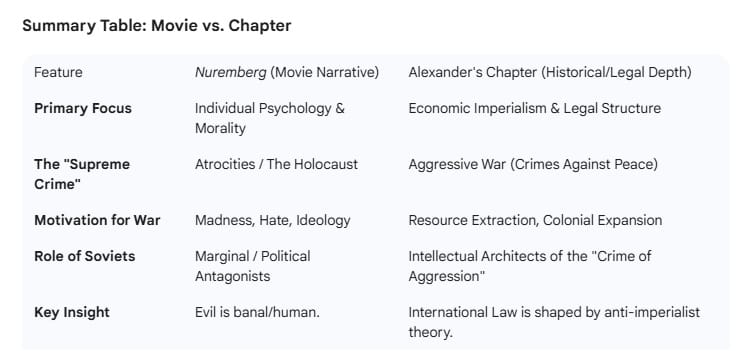
Gemini says: Amanda Alexander’s chapter (“Lenin at Nuremberg: Anti-Imperialism and the Juridification of Crimes”) in the 2021 book Revolutions in International Law: The Legacies of 1917 provides a critical, structural counter-narrative to the individualistic and psychological focus of James Vanderbilt’s upcoming film Nuremberg. While the film (based on Jack El-Hai’s The Nazi and the Psychiatrist) frames the trial as a psychological duel regarding the nature of evil and the Holocaust, Alexander’s historical analysis reveals that the trial’s legal architecture was actually built on a Soviet-influenced theory of imperialism, where the “supreme crime” was not the Holocaust, but aggressive war.

The following sections detail how Alexander’s chapter adds depth and contrast to the cinematic narrative:

1. Reframing the “Crime of Crimes”
The Movie Narrative: The film centers on the psychological profile of Nazis to understand “evil,” with the Holocaust (Crimes Against Humanity) portrayed as the moral center of the trial. The dramatic tension likely revolves around exposing these atrocities to the world.

Alexander’s Contrast: Alexander argues that at the time of the trial, the legal “crime of crimes” was actually Crimes Against Peace (aggressive war). She explains that the trial legally subordinated Crimes Against Humanity to the war itself. The Holocaust was prosecuted not as an independent genocide, but as a method of securing the home front to wage aggressive war. This explains the “odd” legal structure where atrocities were only punishable if linked to the war effort—a nuance often lost in films that center the Holocaust as the primary legal charge.

2. The Soviet Intellectual Contribution vs. Western Heroism
The Movie Narrative: The film highlights American figures like Justice Robert Jackson (Michael Shannon) and psychiatrist Douglas Kelley (Rami Malek) as the architects of justice and insight. The Soviets are typically marginalized or depicted merely as political obstacles.

Alexander’s Contrast: The chapter reveals that the very concept of “Crimes Against Peace”—the centerpiece of the trial—was heavily influenced by the Bolshevik theory of imperialism and specifically the work of Soviet jurist Aron Trainin. Alexander notes that Jackson’s own rhetoric about the “foul doctrine” of imperialist war echoed Trainin’s theories almost verbatim. This adds depth by showing that the “American” victory at Nuremberg relied intellectually on Soviet Marxist legal theory.

3. Nazism as Colonialism vs. Pathological Evil
The Movie Narrative: The film investigates whether the Nazis were “mad” or “bad,” focusing on individual pathology and narcissism (Göring’s ego vs. Kelley’s analysis).

Alexander’s Contrast: Alexander shifts the lens from psychology to economics and colonialism. She argues the trial presented the war as an inevitable result of capitalist imperialism—a struggle for resources (grain, oil, labor). In this view, the Nazis were not just “evil” individuals, but radical colonizers attempting to turn Eastern Europe into a colonial empire for economic exploitation. This provides a structural motivation for the war that a psychological profile of Göring misses.

4. The Narrative of the Holocaust
The Movie Narrative: The Holocaust is treated as the horrific climax of Nazi racial ideology, often separated from the war effort itself.

Alexander’s Contrast: The chapter explains that the prosecution framed the persecution of Jews specifically as a preparation for war. By viewing the Holocaust through the lens of imperialist expansion (clearing land for German settlement and resource extraction), the trial actually “distorted” the history of the Holocaust to make it fit the legal charge of aggressive war. This offers a darker, more complex legal reality: the victims were vindicated in court only insofar as their suffering could be tied to the “supreme crime” of breaching the peace.

LF: “Am I missing something? It didn’t feel like there were any heroes in the 2025 movie Nuremberg?”

You’re not missing anything. The 2025 Nuremberg goes out of its way not to give you heroes. That’s actually the core of its tone. It’s not a “victors bring justice to the wicked” film. It’s a bleak, procedural, psychologically claustrophobic drama. And that choice shapes how the story lands.

Here’s why it feels hero-less.

I. The film centers on a compromised protagonist
Rami Malek’s psychiatrist isn’t a traditional moral anchor. He’s anxious, self-doubting, and often overwhelmed. The movie strips him of the usual Hollywood aura. He’s just a guy trying to figure out if monsters are sane enough to prosecute. That’s deliberately unheroic. His job is bureaucratic and morally ambiguous, not triumphant.

II. Jackson isn’t filmed as a savior either
Michael Shannon’s Robert Jackson is stern, troubled, and burdened by the political compromises behind the trial. The movie refuses to paint him as righteous. He’s competent and committed, but not shining. There are no swelling speeches asking the audience to believe in the system.

III. The emotional center is Göring
That alone kills any heroic framing. Russell Crowe’s Göring is charismatic, manipulative, and theatrically self-possessed. He dominates the screen in a way designed to unsettle the viewer. The film is fascinated with him, not with the men prosecuting him.
When the villain is the most compelling presence in the room, the story can’t easily generate heroes.

IV. The film treats trial procedure like moral quicksand
Nothing in the courtroom feels uplifting. Everything feels procedural, constrained, and compromised. Nobody comes out looking noble. You don’t get the catharsis that old Nuremberg portrayals gave you. It’s almost the opposite of Judgment at Nuremberg. It’s a portrait of a process, not a morality play.

V. The movie’s thesis: Nuremberg wasn’t clean
The tone suggests that the trial was necessary but also deeply fraught. It doesn’t let anyone feel morally uncomplicated. The Allies don’t get halo lighting. The lawyers don’t get redemption arcs. The psychiatrist doesn’t get personal closure. The ending isn’t triumphant.

This is exactly where Amanda Alexander’s chapter helps.
She shows that Nuremberg wasn’t built on heroic liberal humanitarianism. It was built out of political compromises, ideological tensions, anti-imperial critiques, and a messy attempt to criminalize war itself. There were no clean heroes in the historical structure either.

The film feels hero-less because it quietly matches that reality. It strips away the comforting myth.

Gemini says: You aren’t missing anything; your observation aligns with the core intent of the filmmakers and the reaction of many critics. The 2025 film Nuremberg deliberately subverts the traditional “hero vs. villain” narrative to explore moral ambiguity and the uncomfortable reality that evil is often banal and human.

Here is a breakdown of why the film avoids presenting clear-cut heroes:

1. The “Protagonist” is Compromised
While Dr. Douglas Kelley (Rami Malek) is technically the protagonist, the film portrays him as deeply flawed rather than heroic.

Ambition over Justice: Kelley is often depicted as an “overconfident opportunist” who is less motivated by justice than by the desire to write a bestselling book and achieve personal glory.

Moral Greyness: He crosses professional and ethical lines to gain Göring’s trust, leading to a dynamic that feels more like a “friendship” or a “cat-and-mouse game” than a righteous interrogation.

Lack of Rooting Interest: As one review noted, “Are we rooting for him, though? Not exactly.” His motivations are self-serving, and his manipulation by Göring makes him seem naive rather than triumphant.

2. The “Villain” is Humanized (Uncomfortably so)
The portrayal of Hermann Göring (Russell Crowe) further blurs the lines by making the central villain charismatic and complex.

Manipulative Charm: Göring is portrayed as witty, intelligent, and a devoted family man, which can be disarming and “chilling”.

Dominating the Narrative: He often outwits Kelley and controls the conversations, which deprives the audience of the satisfaction of seeing the “good guy” win the intellectual battle.

3. Justice Robert Jackson: A Hero by Default?
The closest figure to a traditional hero is U.S. Chief Prosecutor Robert H. Jackson (Michael Shannon).

The Voice of Law: He represents the ideal of the rule of law over vengeance, fighting against summary executions in favor of a fair trial.

A Hollow Victory: However, even his “victory” is portrayed by some critics as “hollow” or “predictable,” lacking the emotional payoff of a typical cinematic triumph because the ultimate outcome (death) is already known and inevitable.

Conclusion
The film appears designed to leave you with a sense of unease rather than triumph. By stripping away the clear hero archetypes, Nuremberg forces the audience to confront the fact that the Nazis were not cartoon monsters, but human beings, and that the people who defeated them were also flawed individuals driven by complex motives. Your feeling that there were “no heroes” is a valid interpretation of the film’s “morally murky territory”.

Amanda Alexander writes in this 2021 book:

Lenin at Nuremberg: Anti-Imperialism and the Juridification of Crimes against Humanity

The Nuremberg trials stand as a pivotal moment in any history of international law, international humanitarian law, international criminal law and international human rights.1 As Teitel writes, ‘the trials at Nuremberg represented a unique historical crossroads for the three legal orders that form the humanity law framework’.2 By introducing crimes
against humanity into international law, the trials are said to have contributed to the creation of a new normative order, aimed at protecting vulnerable humanity.3 For prosecuting individuals for these and other war crimes, they are presented as an example of the rationality and calm procedure of international law overcoming violence, power and the baser instincts of revenge.

These accounts of international criminal or international humanitarian law relate what could be described as a liberal or Enlightenment narrative of international law. International law, in these narratives, embodies the enlightened values of rationality, legality and humanity – and the Nuremberg trials represent an important moment in the (slow) movement towards the advancement and realisation of these values….

This approach to the Nuremberg trials not only places the International Military Tribunal (IMT) in an Enlightenment narrative about international law, it also looks to the trials to tell this narrative. The pedagogical role of the Nuremberg trials, and other war crimes trials, has been noted by a number of observers.6 Such trials are expected to relate an accurate, impartial history while demonstrating enlightened values through the ‘civilised institutional drama of a trial at law’.7 Mark Osiel termed such trials ‘liberal show trials’.8

…The Nuremberg trials therefore have an important place in any account of the advancement of humanitarian, liberal values in international law. Yet, when held up against these expectations, the Nuremberg trials often seem to fall short – both as a legal institution and as an historical account. The Nuremberg trials bear the stain of victors’ justice and they stir doubts about retrospective law.9 The trials were uninspiring;10 they relied too much on documentary evidence and listened too little to the voices of victims.11 Most importantly, crimes against humanity, observers note, were oddly limited.12 Under the Charter, they had to be linked to crimes against peace or war crimes.13 As a result, the IMT told a distorted history.14

In this chapter, I suggest that the IMT falls short when assessed according to these measures because it did not just tell the expected Enlightenment narrative and it did not intend to prosecute crimes against humanity in the way we understand them now. Rather, I will argue that the way the crimes were codified and then described at the
trials shows that another narrative was also at work. This was an antiimperial narrative that drew on Marxist theory and was given a practical impetus by the Bolshevik Revolution. It spread, in a diluted form, to ‘advanced opinion’ throughout the West.15 The Marxist approach described war, even European wars, as the result and expression of
imperialism. Imperialism was an economic institution, and its depredations were depicted primarily in economic terms. Aggressive, imperialist war was, in this narrative, the worst crime – the crime that led to all the other horrors of war. An international legal regime that condoned imperialist war was, therefore, so ethically misguided that it should be changed.

…There are lingering doubts about the legality of the new crimes that the IMT introduced – crimes against peace and crimes against humanity.25 Both lacked a clear pedigree in
international law…

…The exclusion of Allied crimes meant a partial historical account.31 The ‘peculiarity’32 of the decision to link crimes against humanity to crimes against peace, and the odd focus on aggressive war,33 meant that the prosecution had to distort the history of the persecution of the German Jews before the war, making it appear as part of the preparations for aggressive war.34 Indeed, as scholars have pointed out, the IMT did not relate the history of crimes that we now associate with the Second World War.35 It was not, in the main, a history of the Jewish Holocaust nor a record of the victims of the war. Victims’ voices were seldom heard in a trial that prioritised the probative value of
documentary evidence.36 These choices undermined the ability of the IMT to write a history that emphasised the value of humanity. They also made for a ‘boring’ trial37 that failed to produce the ‘compelling’ liberal narrative that Osiel expects war crimes trials to strive for.

…”crimes against humanity, has, from the very beginning, caught the imagination of international lawyers as laying down, prima facie, a set of novel principles of law. The
provisions relating to crimes against humanity have been acclaimed as ‘a revolution in international criminal law’. Others have described it as an innovation inconsistent with international law…”

…Crimes against peace were equally problematic. The UK90 and French91 delegations at the London Conference stated clearly that they did not consider aggression or crimes against peace to be part of international law.

…the initiation of a war was not deemed an international crime at the time…

…Sir David Maxwell Fyfe: “I have been approached by various Jewish organizations and should like to satisfy them if possible. I have in mind only such general treatment of the Jews as showed itself as a part of the general plan of aggression…”

…Robert Jackson: “The reason that this program of extermination of Jews and destruction of the rights of minorities becomes an international concern is this: it was a part of a plan for making an illegal war. Unless we have a war connection as a basis for reaching them, I would think we have no basis for dealing with atrocities.”

…that aggressive war was criminal, that there could be unjust, unlawful wars, did entail a significant change to international law. It was, however, a justified change; it meant leaving behind an imperial era where colonisation was acceptable and acknowledging the injustice of colonial wars. This would change the international order from an unethical order to a better one. The similarity of these sentiments in US thought and Soviet literature shows that the idea of a crime against peace was not just a bizarre obsession urged by Robert Jackson. Rather it was a widespread sensibility, found in Marxist and Western anti-imperial literature, that informed the way war could be described, understood and condemned.

…This was the story, the story of aggressive, imperialist war, that was presented at the Nuremberg trials. Once the trial began, the Soviet, English and US prosecution stifled any of their doubts about crimes against peace. Together, they agreed on the legal provenance of aggression.

…Aggressive war was, the Soviets, British and Americans insisted, the central and principal crime from which the other crimes stemmed.

…it was unwavering in its efforts to fit the events of the Nazi period into an overarching story of aggressive war. Nor was this just any aggressive war that the court described – it was an aggressive colonial war, and the crimes it produced were shown to be the consequences of imperialism…

Gemini: Amanda Alexander’s chapter offers a compelling revisionist history of the Nuremberg Trials (the International Military Tribunal or IMT). She challenges the orthodox “Enlightenment narrative” which portrays Nuremberg as the moment liberal internationalism and human rights triumphed over tyranny .

Instead, Alexander argues that the legal architecture of Nuremberg was fundamentally shaped by a Bolshevik and Marxist theory of imperialism. She suggests that the trial was not primarily about the Holocaust or human rights in the modern sense, but about criminalizing “Imperialist War” (Crimes against Peace), viewing atrocities against civilians (Crimes against Humanity) as merely a byproduct of economic aggression.

Key Strengths and Arguments

1. Solving the “Puzzle” of the Nexus Requirement One of the most persistent questions in international law is why the Nuremberg Charter required “Crimes against Humanity” to be linked to the war (the nexus requirement), rather than treating them as standalone atrocities. Alexander provides a robust answer: the drafters viewed the world through an anti-imperialist lens where aggressive war was the root evil.

She traces this to the Marxist theory (via Lenin and Hobson) that imperialism is an economic institution that inevitably leads to war for resources and markets.

Consequently, the atrocities committed by the Nazis were legally conceptualized not as racial genocide per se, but as tools of imperial expansion and colonial administration.

2. The Soviet Influence on Western Legal Thought Alexander persuasively argues that Soviet legal theorist A.N. Trainin had a profound influence on the trial’s structure, specifically the concept of “Crimes against Peace.”

She highlights that Trainin’s work, The Criminal Responsibility of the Hitlerites, argued that international law had failed because it protected imperialist aggression.

Crucially, she demonstrates that this was not just a Soviet imposition. Western figures like Robert Jackson (US Chief Prosecutor) and William Chanler shared a similar “sensibility”—a distrust of the “age of imperialism” and a belief that war was caused by economic greed. This convergence allowed Soviet concepts to permeate the trial.

3. Reframing the Holocaust as a Colonial Project The chapter offers a fascinating analysis of how the IMT described Nazi crimes. Alexander points out that the prosecution and judges framed the extermination in the East and the slave labor programs as methods of economic spoliation and colonization.

The trial record is filled with references to Germany seeking a “colonial empire” and treating Poland and the Soviet Union as colonies for economic exploitation.

This explains why the Holocaust was distorted in the trial record; it was shoehorned into a narrative about economic imperialism to fit the legal theory that “aggressive war” was the supreme crime.

This chapter is highly successful in displacing the romanticized view of Nuremberg. It convincingly argues that the trial was not a pure expression of liberal humanism but a specific product of 1945 political thought, where the “horror” being addressed was not just mass murder, but the economic devastation of imperial war.

It explains the “failures” of the IMT (such as ignoring the pre-1939 persecution of Jews) not as oversight, but as a faithful application of the anti-imperialist narrative: if the crime is the war, domestic atrocities are only relevant if they are preparations for war.

Implications for International Law Alexander’s conclusion is provocative: Crimes against Humanity entered international law through the “back door” of anti-imperialism. They were not the primary goal of the trial but were dragged in as secondary consequences of the primary crime: Aggression.

This challenges modern international lawyers to recognize that the foundational moment of their discipline was rooted in a Marxist-influenced critique of capitalism and empire, rather than solely in liberal individualism.

“Lenin at Nuremberg” is a sophisticated piece of legal history. It effectively de-centers the Western liberal narrative and restores the visibility of the Soviet contribution to international criminal law. By explaining the economic and anti-imperialist logic that underpinned the trial, Alexander makes sense of the legal anomalies of Nuremberg that continue to confuse modern observers. It is an essential read for understanding why the crime of aggression was once considered the “supreme international crime,” a status it has largely lost in contemporary international law.

Posted in Nazi | Comments Off on Nuremburg: The 2025 Movie Vs History

Why The Right Is Flamboyant While The Left Is Academic

LF: “One reason that the left seem like old fuddy duddies is that they run the institutions, so they have responsibility and have to watch what they say. The right doesn’t run much and so they can be more flamboyant. populism is often popular but rarely good at governing. Now the right runs all three branches of the federal government…”
When you hold the keys, you stop kicking the furniture. That is the basic dynamic you’re pointing to. The left has dominated the institutions for decades. Universities. Newsrooms. Foundations. Arts. Much of the bureaucracy. Once you sit in those seats, you inherit guardrails. You represent budgets, employees, reputations, and norms. You worry about lawsuits. You worry about HR. You think twice before speaking freely. You can still be radical in vision, but not in tone.
The right, for a long time, didn’t have that burden. It lived outside the institutions. It cultivated a countercultural vibe. It was free to be theatrical. Free to punch up. Free to mock the establishment because it wasn’t running anything. That dynamic is why so many right-wing influencers still sound like insurgents. There’s no real cost to being provocative when you’re not responsible for anything.
Now the terrain shifts. If the right controls the White House, Congress, and the Court, it inherits responsibility. That usually forces a tone change. Governing is slow, procedural, and full of tradeoffs. It exposes you to scrutiny and accountability. It pushes the flamboyant instinct into collision with reality. You can’t scream about “burning down the deep state” when you are the deep state.
Two consequences tend to follow.
First, the right’s populist energy becomes harder to sustain because governance requires compromise. Populism thrives on simplicity and emotional clarity. Governing thrives on complexity and coalition building. The two rarely coexist comfortably. That is why populist movements usually fall apart once they taste real power. The purity tests begin. The influencers turn on the office holders. The base feels betrayed. The machinery bogs down.
Second, the left suddenly has more room to rediscover its own countercultural voice. When you’re out of power, you get your swagger back. You attack. You don’t have to protect the bureaucracy or justify administrative drift. You can sound younger, fresher, looser. People forget that the left once had a rebellious, creative tone. Being shut out of power tends to revive that.
All of this makes the current moment volatile. A right-wing government that carries the populist style into power risks governing poorly because the theatrics encourage unrealistic expectations. A right-wing government that drops the populist style to govern competently risks alienating the very movement that put it there. That tension is already visible in the influencers who are sniffing for betrayal before the first major bill is even drafted.
The irony is simple. Power ages you. You become the adult in the room whether you want it or not. And the people who used to rage against the establishment now have to decide if they want to actually run it or keep performing rebellion from inside the building.

Posted in America | Comments Off on Why The Right Is Flamboyant While The Left Is Academic