Orthodox Jewish Universalism

Alan Brill writes: The Mishnah (Sanhedrin 4:5) teaches the universal doctrine that God began humanity by creating an individual human being, Adam, “to teach that if anyone destroy a single soul from humankind, Scripture charges him as though he had destroyed a whole world, and whoever saves a single soul from humankind, Scripture credits him as though he had saved a whole world.” However, at a later date, the text of this Mishnah was revised to be particularistic, so that many editions currently read that Adam was created alone “to teach that if anyone destroy a single soul from Israel… and whoever saves a single soul from Israel…” A universal teaching has thus been transformed to a particularist view valuing Jewish life, rather than the value of all human life.

Menachem Kellner has devoted the last decades to writing a series of books defending the universal voice in Judaism. Kellner currently teaches Jewish philosophy at Shalem College, integrating Western and Jewish texts, after having spent thirty years teaching at the University of Haifa, where he held the Sir Isaac and Lady Edith Wolfson Chair of Jewish Religious Thought. For more information, I interviewed him in the past on his views of belief and his friend Prof. James Diamond wrote a detailed laudatory intellectual biography of Kellner.

Kellner has authored nineteen books most of them devoted to his project of advocating that Maimonides’ rationalist universalism should serve as the ideal for contemporary modern Orthodoxy and Religious Zionist life.

Recently, he has written They Too are Called Human: Gentiles in the Eyes of Maimonides [In Hebrew] arguing that Maimonides was convinced that Jewish doctrine teaches that there is no essential difference between Israel and the other nations of the world. For Kellner, the distortion of Maimonides by later Rabbis is a tragic distortion, the differences between the nations and Israel, are solely at the level of laws, of history, of destiny. The work is a presentation of the universalism on Maimonides showing the reader the proof texts for such a thesis and answering those who read the texts in different way focusing on three texts in the Mishnah Torah, Foundation of the Torah 1:1-6, Sabbatical Year 13:12-13; Kings 12:5. Much of this discussion has already appeared in his articles and has been debated in the field. See Table of Contents in English here. The work was published by Bar Ilan Press as part of very good series on Jewish thought.

Orthodox Jewish universalism is not new. Rabbi Samson Raphael Hirsch and his son Dr. Mendel Hirsch advocated a Romantic brotherhood of mankind, (see the volume Humanism and Judaism by Mendel Hirsch), but the Hirschian approach is not followed anymore. Moshe Unna (1902–1989) brought a universal position to the Mizrachi Worker’s party and the Mafdal, arguing for liberal democracy as a pillar of Jewish humanism, but that too has been eclipsed (see the fine article by Moshe Hellinger and this book).

Orthodox Maimonidean scholars such as Isadore Twersky already pointed out how Maimonides was always careful to distinguish the universal elements in philosophy and religion from the particular legal aspect. Hence, there is an Aristotelian ethic of the wise available to all to follow the ethical mean and the particular Jewish ethic for select Jews of the saint to go to an extreme against anger or pride. Or that the Mishnah Torah distinguishes between the universal knowledge of a first cause divinity and the specifics of accepting the prophecy of Moses. Yet, Maimonides wrote in his letter to R. Samuel ibn Tibbon, that Aristotle had reached the highest level of perfection available to human beings short of prophecy, placing the philosopher above almost all Jews.

Even the Yemenite rationalist scholar Rabbi Yosef Qafiḥ (Kapach) (1917 –2000) made these distinctions in his fine editions of the medieval Jewish rational classics. But a serious reading of these essential works in their philosophic context has been obscured by contemporary Rabbis in their misquotations of Maimonides.

This latter point motivated Kellner, who is upset by the turn among religious Jews towards particularism with its concurrent preaching of irrationality, essentialism, and dogmatism. Hence, as expressed in his preface, his works are an explicit polemic against these positions and the rabbis who hold them, in that, he considers these particularistic thoughts, to capture his rather colloquial style, fakrimt, farfallen, farblonjet, farfoilt, farshlugginner, as well as dangerous.

In prior works, Kellner directly condemned the rabbis who are anti-science and in favor of superstition by showing that Maimonides advocated science and condemned superstition. When rabbis speak of the essentialist metaphysical nature of ritual, land, Torah, and Jews, Kellner responds by showing that Maimonides treated all these as instrumental, sociological, and based their value toward human perfection.

To emphasize his point for the contemporary reader, Kellner even creates an ahistoric dichotomy of mystic irrational essentialists and anti-mystical universal rationalists. Out of bounds of the discussion would be the Universalism of mystic essentialism of Rav Kook who wrote, “The love for Israel entails a love for all humankind” since he would fall into the wrong side of the dichotomy.

Posted in Orthodoxy | Comments Off on Orthodox Jewish Universalism

Book Review: Changing the Immutable: How Orthodox Judaism Rewrites Its History

Adam Ferziger writes: As such, from the outset of his prolific academic career Shapiro directed his energies toward exposing the underbelly of the picture that Schwab and his like-minded Orthodox compatriots sought to paint. He is by no means the only scholar to examine “Orthodox historiography” or to call attention to examples of intentional censorship. All the same, the scope and sheer quantity of material that he has collected, and for that matter the persistence with which Shapiro has been exploring this subject for over twenty-five years, is incomparable.

His first book (1999), which emanated from his Harvard doctoral dissertation, was an intellectual biography of the leading Orthodox rabbinical authority in Germany in the years leading up to World War II, Jehiel Jacob Weinberg (1884-1966). After the war, Weinberg was venerated by Haredi Orthodoxy as one of the few remaining vestiges of the European “Torah greats.” Shapiro depicted Weinberg’s Talmudic brilliance but also explored his intrepid efforts to bridge the gap between modern culture and Jewish tradition. More dramatically, Shapiro did not hesitate to detail Weinberg’s thorny personal life, his initial apologetic attitude toward the Nazi regime, and his ongoing close friendship with a leading faculty member of the Reform Hebrew Union College. In his second book, The Limits of Orthodox Theology (2004), Shapiro aimed his sights on the “Thirteen Principles of Faith” authored by the famed medieval Jewish philosopher and legal codifier Maimonides (1138-1204). The goal of the study was to demonstrate that, notwithstanding their canonical stature in current Orthodox Judaism, each of the individual tenets was disputed by contemporaries of Maimonides, as well as by authoritative rabbinical figures that lived well after him. It was only in response to the fundamental reevaluation of Judaism initiated by the “enlightened” Jews and by the founders of Reform Judaism in the late eighteenth and early nineteenth centuries, that Orthodoxy adopted Maimonides’ doctrines as unconditional fundamental beliefs. Shapiro also published, among others, a short volume entitled Saul Lieberman and the Orthodox (2006). Lieberman (1898-1983), who stemmed from preeminent Lithuanian rabbinical pedigree and was acknowledged to be the outstanding academic Talmud scholar of the twentieth century, committed denominational “treason” in 1940 by accepting a position at the nascent Conservative movement’s flagship Jewish Theological Seminary of America.

Concurrent with his numerous “scientific” publications, Shapiro has produced two editions of Weinberg’s religious writings based on previously unavailable archival materials (1998 and 2003). He did so under his Jewish forename Melekh [Shapira], seemingly in order to lower the defenses of potential Haredi readers. He has also long been an active blogger on Jewish literary and legal issues, developing a loyal following among rabbinic bibliophiles — whose ranks, protected by the anonymity of the web, range from ardent Hasidic Jews to avowed secularists — who search high and low for newly-revealed manuscripts and long-concealed religious controversies. In fact, various sections of his new book first appeared in blog essays, and numerous footnotes cite the contributions of fellow members of this virtual community in which loyal practitioners interface with university-trained scholars. These efforts testify to Shapiro’s desire to reach beyond the “academy” and engage the Orthodox Jewish community head on.

The writing in Shapiro’s latest full-length exposition is not overly elegant, but it is lucid, accessible, and argument-driven. He does not introduce elaborate theoretical models of analysis. Instead his method is straightforward and thorough: painstaking close readings and comparisons of texts predicated on his meticulous command of the full gamut of rabbinical literature through the ages, his resolute ability to procure the most obscure sources, and his awareness of the social and historical contexts in which the authors lived and produced their works. Indeed, the range of Jewish disciplines and subjects that he investigates, each with the same rigorousness and attentiveness, is astounding.

Changing the Immutable begins by defining the parameters of the phenomenon of Orthodox censorship. The author argues that, notwithstanding the postmodern critique of the subjectivity of all historical narratives (and the well-trodden debates over what distinguishes history from memory), the “distortion of the facts” detailed in the book is categorically different. He then goes on to delineate the variety of tactics drafted by the Orthodox — mostly of the Haredi ilk — to achieve these ends, including “deleting passages,” “rewriting,” “removal from pictures,” and “mistranslation.” Here I would add that another, more subtle, form of censorship, is to print the full original text but to introduce a misleading title beforehand. For example, when publishing posthumously some of the more contested rulings of the renowned German rabbinical authority, Jacob Ettlinger (1798-1871), his son took it upon himself to group them together under the heading, “These responsa are theoretical and not intended for practical application.”

The core six chapters of Shapiro’s work explore the application of this range of censorship techniques through the following topics: “Jewish Thought,” “Halakhah,” “Rabbi Samson Raphael Hirsch,” “Rabbi Abraham Isaac Kook,” “Sexual Matters and More” (wife-beating, misogyny), and “Other Censored Matters” (relations with non-Jews, enlightenment, Hasidism, and Zionism). Not only does Shapiro offer unimpeachable documentary evidence to support the multiplicity of examples that he cites in each chapter; in many cases he includes copies of the original texts and pictures side by side with the republished ones. Thus we learn, for example, that: a line in Joseph Caro’s (1488-1575) authoritative Shulhan Arukh (“Set Table”) that refers to the prevailing pre-Yom Kippur (Day of Atonement) Ashkenazi ritual of kapparot (swinging a chicken around one’s head for vicarious atonement) as “minhag shel shetut” (a foolish custom) was omitted with rabbinic approval from the new and most exacting version of this universally recognized code of Jewish law; a bareheaded photograph of a thirty-nine year-old Menachem Mendel Schneersohn (1902-1994), who later became the seventh Lubavitcher Rebbe (leader of Chabad Hasidism), was reprinted with a large black yarmulkah adorning his scalp; and a leniency originally presented as no longer in practice regarding when the Sabbath begins on Friday evenings appears as a legitimate option in the Talmud commentary of Moses Sofer (Hatam Sofer, 1762-1839). The latter was the most influential central European rabbinic adjudicator of the nineteenth century; Joel Teitelbaum (1887-1979), the leader of the Ultra-Orthodox Satmar Hasidic sect, requested that this ruling be left out of a 1954 photo-offset reprinting of the original text.

The increase in quantity and enterprise of Orthodox censorship in the last few decades, opines Shapiro, “is a reflection of the extremism that has taken root in Haredi Judaism.” There is certainly merit to the basic tenor of Shapiro’s explanation. The book, however, would have benefitted greatly from a more in-depth examination of the correlation between “rewriting history” and religious fundamentalism in general, as well as attentiveness to the varieties of zealous Jewish responses to societal change over the past two centuries. This is especially so since Shapiro, to his credit, does not limit himself to examples from Haredi Orthodoxy. Although the majority stem from this sector, he also supplies the reader with instances of blatant Jewish internal censorship from the time of the invention of the printing press in 1440 onwards including more recent examples among Modern Orthodox authorities, religious Zionist followers of Rabbi Kook, and even the Nobel Prize-winning Holocaust chronicler, Elie Wiesel. If the Haredi Orthodox are nevertheless the most active in this endeavor, nearly 300 pages of text would have been enhanced by a more involved and incisive elucidation as to why different groups of entirely different stripe resorted to censorship, even at the cost of offering a slightly less exhaustive collection of testimony. Those especially interested in additional materials could easily turn to the vast array of Shapiro’s bountiful, but more freely associative, blog presentations.

I will raise briefly two fruitful directions for further consideration of the Haredi proclivity toward censorship that Shapiro so ably catalogues, but minimally analyzes. The first relates to attitudes toward secular approaches to acquiring knowledge. Although more American Haredi Jews are attending college than in the past, there is still considerable ambivalence regarding scientific methods of reaching “truths,” be they biological, archeological, psychological, or historical. On the contrary, for them religious truths are the only absolute ones, and when they undertake research or disseminate information, it is under the assumption that it will not contradict certain paradigmatic beliefs and practices. Therefore, as Shapiro emphasizes, Haredi consider censorship a justifiable means for ensuring that the “eternal” understanding or tradition remains unqualified. This, of course, highlights the irony that so many of the Haredi English-language books that have recently flooded the market adopt the “facade” of academic writing including a scholarly style, footnotes, and bibliographies.

A second path for understanding Haredi censorship is predicated on the now-classic works from the 1990s of historian Haym Soloveitchik and sociologist Menachem Friedman. Both reached common conclusions regarding the cause for the gradual increase in legal stringency that has characterized Haredi Orthodoxy since the mid-twentieth century. They pointed to the disintegration from World War I onwards of centuries-old European centers where local customs held sway, and the consequent displacement of the majority of their inhabitants to Israel and North America. Under such circumstances, there was a marked decline in the process by which long-held “mimetic” traditions were internalized in the home and in communal surroundings and seamlessly adopted as the authoritative foundations for proper religious behavior. The alternative resource that stepped into the void were legal and moral “texts” that spelled out a more uniform code of conduct, often based on what were formerly considered elite standards. The new power given to the printed word may account in part for the manner depicted by Shapiro by which the contemporary Orthodox subject books to censorship. In a society predicated on mimetic authority there is less danger that a multiplicity of printed views will undermine the commitment of the believing public. But the more books become the prime vehicle for communicating how Orthodox Judaism is to be lived, the more important it is to remove or edit out materials that can confuse the reader as to the proper way to think or behave.

As dramatized by the episode in the Harvard library with which I started, Shapiro is an indefatigable and uncompromising fact finder, who calls to task those — regardless of their stature — who are found to have acted or ruled in ways aimed at hiding inconvenient and controversial information. His underlying project, be it in his academic or popular frameworks, is to bring to light the most precise renditions of Jewish historical events, rabbinical biographies, theological and legal debates, and sacred texts. His chief concerns are accuracy and honesty, without fear for the political or ideological fallout that may ensue. Indeed, it appears that the current work was designed to serve as the culmination of Shapiro’s decades-long “truth mission.”


Posted in Censorship, Marc B. Shapiro, Orthodoxy | Comments Off on Book Review: Changing the Immutable: How Orthodox Judaism Rewrites Its History

Subversive Jews

Scholar Jonathan Sarna describes a minority of Jews in early America as “critics, subversives and dissenters.”

Why would they act that way? Perhaps it’s a simple function of identity theory. The more strongly you identify with your group, such as Jewish, the more likely you are to view negatively out-groups (gentiles).

The greater society affects how minority group express their identity. In America prior the 1960s, it was socially unacceptable to publicly display greater loyalty to your minority group, or a foreign nation, than to America.

Minority group are not likely to be as patriotic as the majority (though Jews come closer than any other minority group in America) who have organized the country to their benefit.

Why would any society want a group within it that has many members bent on subversion? I guess there are many benefits to the majority to house subversive minorities. I can’t think of any right off-hand. I know Israel is not thrilled with having non-Jewish citizens who subvert it. Rabbis are very careful about who they convert (and they make the Orthodox process arduous) to avoid bringing subverters into the Jewish people.

I might be missing something, but it is not at all clear to me that the subversives listed in Dr. Sarna’s essay below made America better.

Jews who make porn are also being “subversive.”

To quote Mark Twain, the Jew is everywhere a stranger and not even the angels like strangers. The more Jews set themselves apart in a gentile country, the less likely they will be viewed by the majority as fellow citizens engaged in a common enterprise.

How does any group react to people who join it and then subvert? I am unaware of any countries and peoples that are thrilled by that.

Jonathan Sarna writes:

… Jews did impact upon early American culture is where they cast themselves as critics, subversives and dissenters. As non-Christians, Jews at that time in the United States, however white and wealthy they may have been, were by their very existence cultural outsiders and religious non-conformists. If, following the Oxford English Dictionary, to be culturally subversive means to challenge and undermine “a conventional idea, form, genre, etc., especially by using or presenting it in a new or unorthodox way,” then Jews of that time were disproportionately subversive. Indeed, some of the most important works in the Milberg collection reflect precisely that kind of oppositional stance.

The best known Jews of the era dissented from the mainstream in their persons, by being Jews, and in their writings, by setting themselves apart from those with whom they disagreed, but still observed strict limits. People like the journalist-politician-playwrights Mordecai Noah (1785-1851) and Isaac Harby (1788-1828), and the journalist-religious-and-communal-leaders, Isaac Leeser (1806-1868), and Isaac M. Wise (1819-1900), all of them well-represented in “By Dawn’s Early Light,” were careful not unduly to shock or outrage non-Jewish readers for fear of being marginalized. Noah, for example, was known for never failing “to resent the least aggression on the character of his people.” Nevertheless, he defended a Charleston “blue law,” forbidding the sale and exposure for sale of goods on Sunday, as “a mere local or police regulation, which should be carried into effect by all religious denominations.” “Respect to the laws of the land we live in,” he reminded his fellow Jews, “is the first duty of good citizens of all denominations.” Isaac Leeser similarly reassured Christians in his early work, The Claims of the Jews to an Equality of Rights (1841), that “we wish not to interfere with you, we wish not…to unsettle your hopes and convictions,” even as he understood that in presenting Jewish “claims” he was distancing himself from many of his neighbors. Later, in discussing the messiah in one of his discourses, he expressed a willingness “to attack, to a certain extent, the opinions of the majority of the people among whom we live,” but did so only after a prolonged apologia and with the utmost of caution.

Instead of focusing on these better known interlocutors, here I want to focus on culturally creative Jews of this era who dissented more openly from the mainstream—and in a few cases paid a price. These “subversive Jews” never became household names, even in American Jewish historical circles, and some, until rescued by this exhibit, have been almost totally forgotten. Their bold challenges to the norms of their time nevertheless pushed boundaries. Freedoms that we enjoy today are in some part due to their audacity and courage…

Ernestine Rose (1810-1892), the best known Jewish atheist and women’s rights leader of her day, would soon spurn that advice. Born in Poland, where her father was a rabbi, she refused a marriage arranged by her father, and after stints in France and Holland, moved to England in 1830, where she fell under the spell of the socialist reformer, Robert Owen, and married a fellow Owenite in a civil ceremony. Arriving in New York in 1836 accompanied by her husband, she quickly won success on the speaking circuit and became a celebrated women’s rights and human rights advocate as well as a proponent of radical freethought. She described herself as “but a daughter of poor, crushed Poland, and the down-trodden and persecuted people called the Jews, ‘a child of Israel,’” when she pleaded for the “equal rights of her sex,” in 1852 in an address to the Third National Woman’s Rights Convention. A year later, addressing her “sisters” at a debate between supporters of the Bible and infidels, she created an uproar when she asked “do you wish to be free? Then you must trample the Bible, the church, and the priests under your feet.” To her mind, freedom for slaves, women and Jews were intertwined: “I go for emancipation of all kinds,” she explained, “white and black, man and woman. … I go for the recognition of human rights, without distinction of sect, party, sex or color.” Her motto, which she recommended to social reformers everywhere, was “Agitate! Agitate!”

Ernestine Rose was both conscious and proud of her subversive stance. “I know but too well what it is to go against the long-cherished and time-honored prejudices and superstitions,” she admitted in an 1853 speech. “It is no pleasant task to go against the current, but there is a sense of duty that balances all unpleasantness.” Perhaps because she was so unorthodox in advocating full equality for women, opposing slavery, and defending atheism, the Jewish community of her day completely ignored her. Not one mention of her name has so far turned up in any pre-Civil War Jewish newspaper. Years later, in 1890, when her name was brought to the attention of the editor of the American Israelite, he confessed with some surprise that “we never heard of Mrs. Rose before.” Nevertheless, Rose continued to identify herself with the Jewish people, and during the Civil War she vigorously and repeatedly defended them against attacks by Horace Seaver editor of the freethought weekly, The Boston Investigator.

Ernestine Rose was far from being a “typical” American Jew of her time. Samuel B.H. Judah, Isaac Gomez, Solomon Henry Jackson, Uriah P. Levy, and the other subversive Jews who, we have seen, violated the cultural conventions of their day were far from typical either. All alike, pushed the bounds of propriety—speaking out against hypocrisy, prejudice, and against the social and religious norms of their time. Even if ignored or persecuted by those around them, we know, in retrospect, that these men and women broadened and enlivened American culture. Some paid a heavy price for doing so.

The bulk of Jews in antebellum America, even if they differed from the mainstream in matters of religion, were, of course, far from subversive. They kept their heads down and their mouths shut. Seeking to win their neighbors’ respect, they strove mightily to behave well. But they too paid a price. Their names go unrecorded in the annals of American Jewish culture and they left nothing for Leonard Milberg to collect. The moral, proclaimed by Laurel Thatcher Ulrich with respect to women, is no less true with respect to Jews: the well-behaved ones seldom made history.

Posted in America, Jews | Comments Off on Subversive Jews

Why Anguish Over AIPAC’s Invitation to Donald Trump Is Misplaced

J.J. Goldberg writes: The core mission of the powerhouse pro-Israel lobby is to ensure good relations between the American and Israeli governments. Those relations begin at the top, with the White House and its occupant. And the voting on Super Tuesday greatly increased the odds that Trump will be one of the two candidates contending to win the presidency next fall, like it or not. Now is the time for the lobby to start, well, lobbying.
It’s a safe bet that most readers won’t like it. Twitter and the blogosphere are filled with condemnations of the AIPAC invitation. Some come from critics who say the lobby — or Israel — has shown its true colors. Others come from anguished citizens who believe AIPAC has implicated the Jewish community and Israel in Trump’s bigotry. Rob Eshman, editor in chief of the Jewish Journal of Los Angeles, wrote in a stern column that the lobby made a “core moral mistake” by inviting the billionaire candidate, thereby lending its “imprimatur” to his bigotry and offending key constituencies whose support we need, particularly Muslims and Latinos.

Eshman wrote that while AIPAC can’t “necessarily” retract, it could salvage the situation by condemning the candidate’s “incendiary statements” about various groups, denouncing his “clear incitement to physical violence” and making clear that “those who foment hate and violence have no place in American politics, or on an AIPAC dais.” Making clear, that is, that Trump shouldn’t be appearing on the dais on which he’s been invited to appear.
The anguish is understandable, but the hard truth is that it’s misplaced. If AIPAC were a different Jewish organization — say, a federation of congregations, an institution of religious education, or a league for combating bigotry or promoting intergroup relations — then the thought of honoring Trump by offering him a platform should indeed appall us. Trump’s message, his behavior and the very fact of his candidacy fly in the face of Jewish values as the vast majority of us understand them.
To expect that of AIPAC, though, is to mistake the purpose of the lobby — and, in a way, to misunderstand the nature of Jewish organizational activity. Though it’s not always apparent from their public statements, the main Jewish organizations constitute a rough sort of governing structure in which each component has a job to do. Many are tasked with examining, teaching or advancing the values of our heritage, as variously interpreted. Others act on them by caring for the poor or sick. AIPAC’s job is to ensure that America stands with Israel. It’s pretty good at it.

Some fret that it protects Israel from paying a price for its mistakes and thus perpetuates those mistakes. But the alternative — leaving Israel defenseless in the face of very real threats — is far worse. And given its mission, it’s important that the lobby keep itself on decent terms with whatever powers govern in Washington. Who holds those powers is an important question, never more so than this year, but it’s not a question AIPAC exists to answer.

RABBI URI PILOCHOWSKI FROM NCSY COMMENTS ON ROB ESHMAN’S COLUMN:

“I am a realist and I live in Israel. While plenty of my neighbors assume all will be well in Israel since the IDF arms itself with magic dust having nothing to do with American military aid, and others in America get to sit in safety from rockets and stabbings and debate the morality of AIPAC inviting someone who makes racist and antisemitic comments like Donald Trump, I don’t have that luxury. I am constantly threatened by people who want to kill me, and am protected by soldiers carrying weapons and flying helicopters and planes that say, “Made in the USA” on them. Donald Trump could very well be the next President and if so, will have a very significant influence on my family’s safety. If nothing else, AIPAC is about effective political advocacy on behalf of the U.S.-Israel relationship. Ensuring that all aspiring elected officials are Pro-Israel is one of AIPAC’s missions and greatest achievements.
For all who think that we’ll be fine as long as we’re in Israel, that America will continue to help Israel whether or not we lobby, and who think making a point is more important than being effective, please, go ahead and preach. The other 18,000 of us will head to Washington next week and hope to strengthen the U.S.-Israel relationship by talking and listening to anyone who aspires to hold office in the United States. It’s called effective political advocacy, and it’s what we practice.”

Y. emails: “Just saw your recent quote by Uri Pilichowski about Trump’s supposedly anti-Semitic statements. I have never seen an anti-Semitic statement by Trump. The most controversial statement he has ever made to a Jewish audience was that he would never be swayed by Jewish organizations’ contributions because he won’t take any; to me, that means he thinks he knows what’s right when it comes to American-Israeli relations. I’m sure he wouldn’t be swayed by Islamic organizations’ contributions either.

Unless Little Uri hacked into Trump’s e-mail account and found some Jewish stereotype jokes that Trump shared with a friend, I have no idea what he’s talking about. Can anyone point to an anti-Semitic statement that the man has ever made?”

Posted in AIPAC, Donald Trump | Comments Off on Why Anguish Over AIPAC’s Invitation to Donald Trump Is Misplaced

Sheldon Adelson Warming To Donald Trump

From the Forward, a reliably anti-Trump paper:

Adelson is spreading hints in recent weeks, and they all point toward Donald Trump, the only candidate in the race who doesn’t really need Adelson’s oversized campaign donations.
One way of gauging Adelson’s political leaning is by following the coverage on the pages of his Israeli daily newspaper Israel Hayom. And in recent weeks Adelson’s publication clearly indicating a warming up to the New York businessman.

The paper’s headline today was unmistakable: “Your Friend is Leading the Race,” Trump is quoted telling the Israel Hayom. “I was always your friend even in the toughest moments and that’s not going to change,” Trump is further quoted. Highlighted on the front page is a photo of Trump with Israel Hayon’s foreign news editor Boaz Bismuth, during the brief interview at Trump’s Mar-a-Lago estate in Palm Beach, Florida.
What follows is a fawning quick interview, conducted at the entrance of Trump’s mansion after the conclusion of his victory speech summing up Tuesday’s round of primary votes.
“As I went up the stairs, I heard a familiar voice. A tall, broad man was standing there with his back to me, talking, laughing, and being photographed. I recognized Trump’s back and approached him,” Bismuth describes the moments leading up to his encounter with Trump.
“Nice to see you. This is a big day for you,” Bismuth shoots off the first question, only to hear Trump agree that it was indeed a big day for him. “No one gave me a chance, you remember. We talked about it. And now support for me is only growing,” Trump added, referring to a previous interview he had given Bismuth last month in Las Vegas.
“Is your success good news for Israel?” the Israeli journalist continues, to which Trump promises that it’s “tremendous news for Israel.”
The interview then touches briefly on Trump’s comments regarding his opposition to the nuclear deal signed with Iran, and ends without a mention of Trump’s pledge to remain neutral on the Israeli – Palestinian issue, or of other burning questions regarding violence in his campaign events or of his comments deemed by many in the Jewish community as tinged with racism.
Bismuth, who during the February 23 Las Vegas Republican caucuses was photographed next to Sheldon and Miriam Adelson when they went to cast their vote, was profoundly impressed by his visit to Trump’s Florida estate. “Each new meeting with Trump is just as fascinating as the previous one,” he wrote. “What journalist would not want a one-on-one interview with this man? And who would not want an invite to the lavish and exclusive Mar-a-Lago Club?”
All Ears: Casino magnate Sheldon Adelson listens as Jewish Republicans gathered for their annual conference in Las Vegas.
Jewish Republicans Focus on Israel at ‘Sheldon Adelson Primary’ in Las Vegas
Anthony WeissMarch 31, 2014
Bismuth’s article comes on the heels of an interview the Israel Hayom ran on March 13 with former New York mayor Rudy Giuliani, in which he showered praised on Trump, calling him “a very good man” and accusing the press on focusing negatively on the Republican frontrunner. The paper also ran another interview with Trump in February. Trump then promised to be a “true friend of Israel in the White House.”
While interviews with the Republican frontrunner are clearly a worthy news item for any international publication and are of great interest for Israelis who follow American politics closely, the choice of featuring these interviews so prominently and avoiding any critical mention when writing about the controversial candidate, can be easily interpreted as a signal indicating the political preference of the paper’s owners.
Adelson, who played a major role in the 2012 primary race, decided to sit out this campaign and wait until the field clears and a frontrunner emerges. Now, he may be indicating that Trump is his man.
Another clue provided by Adelson was in an off-the-cuff comment he made during a February 27 event at his Venetian hotel in Vegas and first reported yesterday by Israeli political writer Tal Schneider. “Trump is a businessman. I am a businessman. He employs a lot of people. I employed 50,000 people. Why not?” Adelson said, apparently after being asked about possibly supporting Trump. Adelson then went on to tell an old joke about Jews always answering questions with another question.

Posted in Donald Trump | Comments Off on Sheldon Adelson Warming To Donald Trump

Stamina – Trump’s Lingistic Kill Shot for Clinton (Master Persuader Series)

Scott Adams blogs: Donald Trump has been saying lots of bad things about Hillary Clinton for months, but the one that will stick is “stamina.” I’ll tell you why.

The best Trump kill shots have the following qualities.

1. Fresh word that is not generally used in politics

2. Relates to the physicality of the subject (so you are always reminded)

Clinton has already experienced some coughing fits on the campaign trail. And her voice often sounds hoarse, which is to be expected when you give speeches every day. Neither of those things mean much. But add the Internet rumors that Clinton has some lingering brain issues from a concussion, plus her long bathroom break during that one debate, and some rumors that she has trouble with balance, and there you go. That’s enough circumstantial “evidence” to convict her of being unhealthy.

Well, maybe.

The so-called evidence in this case is probably a mix of true facts that might not matter too much plus rumors and speculation. If you looked at any one piece of “evidence” on its own, it would mean nothing. But put it all together and you have…confirmation bias.

Confirmation bias is what makes you see any kind of evidence as supporting your point of view. Once Trump puts in our heads the idea that Clinton might have some stamina (health) issues, that’s all we will see in the evidence, even if it doesn’t exist.

And that is why “stamina” is such a well-engineered kill shot. Between now and November, the odds of Clinton having another coughing fit, losing her balance, forgetting something, or having some other health issue is nearly 100%. Trump has primed his “stamina” kill shot to get stronger as time goes by. Confirmation bias will keep adding “evidence” to his suggestion even if that evidence is imaginary.

Some folks reminded me that Trump has been using the stamina kill shot for months with no real effect. But stamina is a sleeper word. It gets reactivated every time the real world triggers it in your brain. And the real world is certain to deliver.

What happens the next time you see Hillary Clinton looking tired? Under normal circumstances you might tell yourself that all candidates look tired. And they should, given the workload. But Trump primed you to see any bit of fatigue in Clinton as a health issue. So you will.

Keep in mind that Trump always goes where he has an advantage against an opponent. Trump’s big advantage (I think) is that he appears to be managing his physical energy better. I’ll bet he spends fewer hours campaigning but uses those hours better because he draws big crowds.

In my book, I talk about using “energy” as the primary metric for you own life. When you do things that keep your energy high, the rest of your life works out better. You are more fun to be around, better looking, more productive, and more credible. Trump seems to be managing his energy whereas his opponents are trying to maximize voter contact. They probably spend more time prepping for debates than Trump does, trying to memorize important facts that Trump doesn’t care about. If I’m right, Trump will keep his energy high and Clinton will fade over the months from exhaustion. Voters will see it.

You won’t remember that Clinton worked harder on the campaign trail, or that she did more studying to command the facts. You stopped caring about that stuff a thousand campaign lies ago. But you will remember any health or energy issues that Clinton might experience in the coming months.

What if Clinton copies Trump and reduces her schedule to keep her energy high? That would look to the public and the pundits as if Clinton doesn’t have the stamina. Trump wins either way. And that’s another tell for a Trump strategy. He creates two ways to win and no way to lose.

Another advantage of “stamina” as a kill shot is that it reminds you of sex without being a sexual word. It makes you think Trump has this stamina thing (sexual power) and Clinton does not. And when Trump shows up with his model wife, the message is reinforced. Add a shaky and unhealthy Bill Clinton to the mix and the contrast is even bigger. Stamina works in Trump’s favor on every level.

On a related topic, many of you asked my opinion on Trump’s anti-Clinton ad that shows Hillary Clinton barking like a dog and Putin laughing. I give the ad an A+ for persuasion. It was funny and doesn’t take itself too seriously, but at the same time it appealed to our irrational minds just as Trump intends. Your rational mind knows that Clinton’s “barking” has nothing to do with anything. But your irrational mind sees Putin and ISIS looking powerful on the video while Clinton barks like a chihuahua.

The humor in the ad is what makes it work. Without the humor it would look like a lame comparison. And people equate a good sense of humor with high intelligence, whether or not that is true. The ad leaves us feeling that Trump is funny-smart and Clinton is ridiculous.

You know who wasn’t funny? Hitler, that’s who. Every time Trump makes us laugh he chips away at the Hitler meme that has been dogging him. So it works on a branding level too.

Don’t listen to the 2D pundits who say the ad looked like it was created by a college student. Ignore anyone who says it lacks content. That video is a masterpiece of viral persuasion.

Posted in Donald Trump | Comments Off on Stamina – Trump’s Lingistic Kill Shot for Clinton (Master Persuader Series)

Conservatives Have Concentric Loyalties

Comments:

* Concentric loyalties run along the lines of “me against my family, my family against the tribe, my tribe against the world.” Your loyalty in such a world view is firmly centered in the most immediate and local context and the further out someone or some entity is, the less claim it has upon your blood, treasure or political concern. This describes the conservative position.

leapfrogging loyalties characterize the SJW worldview. By definition in this schema, the further out a person or nation is physically or politically from me, the more sacred it is. For a white SJW living in Chicago, it’s axiomatic to care more about, for example, third world immigrants in far flung Djibouti than to care about a like-skinned neighbor right next door who might well be unemployed and malnourished. The SJW is blind to the people around him because compassion for people who are nearby and familiar is simply too boring to be thought of; his SJW concern leapfrogs all whites, especially poor whites (who can’t seem to keep up with the importance of stylish clothes or virtue signalling) and skips across the ocean to the presumably oppressed blacks and browns of other continents.

Leapfroggers all tend to inhabit majority-white gated communities.

*
Southerners had at one time a reputation for being lanky. The stereotypical redneck was lanky. Nobody would have accused those mesomorphs of being liberals. Think also of the dour, lanky, clannish and/or Calvinist exclusivist Scotsman. Of course, Celts also have a reputation of being impractical dreamers, although that is more of an Irish stereotype.

That said, the stocky no-nonsense character is an enduring figure in literature Also shows up in cartoons. Is this an example of writers unconsciously replicating what they were exposed to or an observation of human nature? They would probably be horrified to realize that such characterizations actually reinforce the notion that race, or geographically and genetically defined populations if one is squeamish, have real implications for personality, etc.

Has anyone ever seen a work in which a short, stocky figure is a poetic dreamer or otherwise impractical, while his lanky friend is an exuberant and/or earthy realist? I can only think of George R.R. Martin’s Quentyn Martell. I suspect Martin is channeling himself in Quentyn, as he also channels himself in Tyrion.

In 19th-century anthropology, the sturdy Alpinoid fit Steve’s ectomorph description. But back then “scientists” all made stuff up to justify colonial exploitation and none of their insights equal the musings of our learned humanities majors, i.e. our clergy.

* I need to set up interviews with casting directors. They must have the most accurate perceptions of what kinds of faces and bodies audiences will find plausible in different kinds of roles.

Posted in Conservatives | Comments Off on Conservatives Have Concentric Loyalties

Another Trayvon Killed In Action

News: Relatives of a 17-year-old are angry the teenager was shot and killed by a homeowner who police say was protecting her property.

The sister of the teen who died identified him as Trevon Johnson. She said he was a student at D. A. Dorsey Technical College.

“I don’t care if she have her gun license or any of that. That is way beyond the law… way beyond,” said Johnson’s cousin Nautika Harris. “He was not supposed to die like this. He had a future ahead of him. Trevon had goals… he was a funny guy, very big on education, loved learning.”

On Thursday, police say Johnson burglarized a home south of 79th Street near I-95 — just blocks away from where he lives. . . . . .

“You have to look at it from every child’s point of view that was raised in the hood,” said Harris. “You have to understand… how he gonna get his money to have clothes to go to school? You have to look at it from his point-of-view.”

dead-criminal-trevon-johnson-shot-killed-while-breaking-entering-florida-home-590x600

COMMENTS:

* This is hilarious. It should be spread across the Internet and archived multiple times before CBS realizes what’s going on and takes it down. It reads exactly like something from the Onion but it isn’t. I think somebody at CBS Miami got fed up with PC and decided to do a little truth-telling in a way that got under the radar. I hope they don’t end up firing the one real reporter they have in-house.

The names: Trevon, Nautika, Nisha

The relative’s excuses for the defunct punk: “You have to look at it from every child’s point of view that was raised in the hood … You have to understand… how he gonna get his money to have clothes to go to school? You have to look at it from his point-of-view.”

And, of course, the picture.

Posted in Blacks, Crime | Comments Off on Another Trayvon Killed In Action

Chicago Riots

Comments to Steve Sailer:

* Security at the pavilion is run by Monterrig Security which is owned by Santiago Solis. His brother is Alderman Danny Solis. His sister is Patti Solis Doyle. She was the head of the Hillary Clinton campaign in 2008 and an adviser to Obama.
I believe that Trump was being set up. Many of the protesters in the building did not have tickets. I believe they were let in. By canceling this event, Trump has shown good judgement and wisdom. He has proven he is a leader. He is like the Duke of Wellington who retreated from Quatras Bras to the ridge line at Waterloo.

Posted in America | Comments Off on Chicago Riots

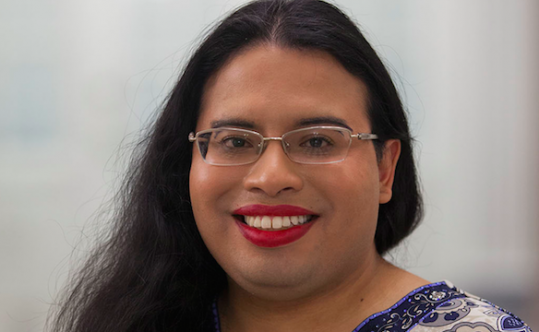
Jewish trans woman named senior White House LGBT liaison

This makes me proud to be Jewish.

JTA: Less than a year after becoming the first openly transgender person to serve in the White House, Raffi Freedman-Gurspan has been promoted to serve as its senior liaison to the LGBT community.
Freedman-Gurspan, a Honduras native who was raised in Brookline, Massachusetts, by Jewish parents, will serve as the White House’s “lead point of contact” for LGBT groups, BuzzFeed News reported Monday.
Mara Keisling, executive director of the National Center for Transgender Equality, Freedman-Gurspan’s former employer, praised the appointment.
“Raffi’s skills and personality make her the exact right person for this important job,” Keislin told BuzzFeed.
Freedman-Gurspan, who is in her late 20s, was “a powerful leader for trans inclusion” in her Brookline synagogue, Temple Beth Zion, according to the Jewish LGBT advocacy group Keshet. She also was active in the Jewish Student Union as an undergraduate at St. Olaf College in Minneapolis.
Although Freedman-Gurspan was the first transgender White House staffer, another Jewish woman, Amanda Simpson, was the first transgender individual to hold a position in the U.S. executive branch. President Barack Obama appointed Simpson in 2010 to senior technical adviser in the Bureau of Industry and Security at the Department of Commerce.

raffi_539_332_c1

Posted in Trans | Comments Off on Jewish trans woman named senior White House LGBT liaison