
A Jewish Perspective On Carl Schmitt

Paul Gottfried writes in 2015:

Carl Schmitt: A Biography, Reinhard Mehring, Polity, 700 pages

Reinhard Mehring’s study of the long-lived German political and legal theorist Carl Schmitt (1888-1985) is the most exhaustive biography known to me of a deeply fascinating subject. Given his opportunistic embrace of the Nazis in 1933, Schmitt does not fit the image that postwar Germans have worked to create for themselves. Yet Schmitt’s Concept of the Political, Legality and Legitimacy, Dictatorship, Law of the Earth, and Political Theology continue to be read because of their conceptual depth and stylistic brilliance.

These elegantly phrased works cannot be reduced to the circumstances that inspired them—Weimar Germany, the Nazi regime, and the postwar American order—any more than Hobbes’s masterpiece Leviathan can be seen purely as an artifact of the English Civil War. Indeed, aphorisms can be found in Schmitt’s works that are so pregnant with meaning that they invariably fail in translation: “Sovereign is the one who determines the challenge of the exception,” “All modern political teachings are secularized theological concepts,” and “Historical truths are true only once.”

Schmitt has always appealed to the political outliers, from the revolutionary right to the anti-capitalist, anti-liberal left. Geoffrey Barraclough’s observation that the Hegelian right and the Hegelian left clashed at Stalingrad in 1943 might be applied even more appropriately to Schmitt, if we allow for a certain hyperbole. The Frankfurt School Marxist Walter Benjamin devoted one of his most famous essays to an elaboration of Schmitt’s observations about Renaissance politics. Otto Kirchheimer—who was Schmitt’s graduate student at Bonn—and the young Jürgen Habermas were only two of the numerous German socialists who tried to adapt Schmitt’s critical studies of Weimar German politics for leftist agendas. It was hardly accidental that Leo Strauss’s first published work was a commentary on Schmitt’s Concept of the Political, which Schmitt graciously appended to the second edition of his work.

In interwar Germany, Schmitt enjoyed indisputable renown. Leading jurists of the time like Hans Kelsen and Rudolf Smend, who had sharp disagreements with him, readily conceded his mental acuity and gift for language. It may have been almost incidental that Schmitt held a professorship in Bonn and eventually one in Berlin, or that he became the major legal advisor to the Catholic Center Party in the Reichstag during the Weimar era. As a literary and scholarly star he operated on a different level from the professional posts he held.

The details of his life of more than 96 years are truly staggering. Although the author of an intellectual biography of Schmitt, I learnt from Mehring things about Schmitt’s life I encountered nowhere else. Even longtime Schmitt-researchers may be surprised, or shocked, by some of these revelations. Schmitt’s first wife, for example, whom he divorced in 1922, was not, as is often believed, a Serb or Croatian from a prominent family but a thief and embezzler from Vienna who may have been involved in a prostitution ring.

The womanizing Schmitt became involved in an affair with an Australian teaching English, Kathleen Murray, while his divorce was still pending. At one point he promised to marry her, but she returned to Australia, having used Schmitt to complete her German-language dissertation. Later Schmitt plunged into other liaisons, perhaps most passionately with a certain “Magda” while he was still a professor in Bonn.

Teaching in Berlin while his second wife was in a sanitarium, he became so sexually promiscuous that Mehring refers to this period in his life as an “erotic state of the exception.” Just as Schmitt argued that constitutional government required an awareness of “exceptional circumstances” in order to function even in normal times, so too did the survival of Schmitt’s conjugal life depend on his liberty to plunge into serial affairs.

Perhaps curiously, given his sexual passion, Schmitt had chosen for his second wife a gravely ill, tubercular woman. The union brought Schmitt high medical expenses but minimal sexual satisfaction. This remarriage after a divorce also led to his excommunication. Mehring suggests that Schmitt’s straying from his strict Catholic upbringing, a development hastened by his unsatisfied sexual desires, intensified his amoral careerism, culminating in his kowtowing to the Nazis. Although this causal connection is not provable, Schmitt’s Catholic students and colleagues brought it up after 1933 when they attempted to explain their teacher’s unexpected accommodation of the Third Reich…

Mehring understandably questions whether Schmitt really believed in Catholic Christian doctrines. Here one should note Thomas Molnar’s observation that Schmitt was a Catholic of sorts but certainly not a Christian. The inverse may also apply: Schmitt was intermittently some kind of a Christian but not a believing Catholic. In Concept of the Political—which interpreted the “political” as the most intense of human relations, characterized by friend-enemy relations—there is no underlying Catholic theme. Among the outraged critics of this work, as Mehring points out, were Catholic theologians. One surely discerns no Catholic leanings in Schmitt’s praise for Hobbes as “the completer of the Protestant Reformation.” Hobbes, as Schmitt reminds us, was the thinker who characterized papal influence over European sovereign states as “the kingdom of darkness.” It is far from clear that Schmitt found this judgment to be objectionable.

Even more illuminating are the parts of Mehring’s work dealing with Schmitt’s attitude toward his Jewish connections. Attempts to find anti-Semitism in his writings and personal relations before his fateful decision to join the Nazi Party in May 1933 have turned up, as far as I can judge, nothing of consequence. Indeed, the Nazis had every reason to suspect Schmitt of dissembling in his anti-Semitic statements after 1933, given his longtime intimate association with Jewish mentors, benefactors, colleagues, and students.

Leo Strauss may have approached this academic luminary in the hope of obtaining a Rockefeller grant to do research in England precisely because Schmitt seemed especially friendly toward Jews. He also warned sternly against the Nazis before they came to power and had called on the German government in 1931 and 1932 to ban Hitler’s party.

After 1933, however, Schmitt went out of his way to inject anti-Semitic remarks into his writings, while unceremoniously cutting off relations with his numerous Jewish acquaintances. Although the SS kept surveillance on him, as a suspect party member married to an ethnic Serb—his second wife—he nonetheless continued to flatter the regime. He even organized a conference of jurists in 1934 to discuss ways of removing Jewish influence from the German legal profession. Despite these gestures, Schmitt was upset that his onetime Jewish colleagues and students would not associate with him after the war. In letters and diaries he complained that he was being unfairly targeted for having decided to remain in Germany after 1933.

Schmitt was not the only amoral careerist who ever entered the academic world, but his character flaw was all the more shocking because of his greatness as a thinker and how he treated longtime friends. As a law student in Strasbourg he had been befriended by the son of a Jewish press magnate from Hamburg, Heinrich Eisler. Heinrich’s son Fritz was his closest companion, and Fritz’s soldier’s death near the Marne in September 1914 left Schmitt bereaved. Almost 10 years later he dedicated a book to his fallen comrade, and in the intervening time Fritz’s brother Georg became Schmitt’s bosom friend, particularly when the latter was between wives.

The elder Eisler had sent Schmitt, while he was an impoverished student and poorly paid legal clerk, regular gifts of money and had entertained him repeatedly at his sumptuous home in Hamburg. In his diaries Schmitt contrasted his admiration for the Eisler family, including the mother of Fritz and Georg, with his estimation of his own less generous and less well educated parents. But Schmitt suspended his relation with Georg in 1933, as well as cutting ties with Georg’s sister, who had been his private secretary in Berlin.

There are two problems with Mehring’s biography, other than the baffling absence of my writings on Schmitt in the extensive bibliography. One, the author provides such a mass of details that one sometimes loses sight of the forest for the trees. The chronological framework may not suffice to bear the crushing weight of all the data assembled. The author also shows a tendency to dart back and forth between discussions of Schmitt’s writings and his personal and political life. In some chapters the result can be chaotic.

Two, Mehring never explains, certainly not to my satisfaction, why any of Schmitt’s writings made such a profound impression on his contemporaries. Why would his Jewish editor Ludwig Feuchtwanger, who did not share Schmitt’s political views, consider Concept of the Political a conceptual masterpiece? Mehring approaches Schmitt’s work with painful reservations, as a “problem” in the history of German illiberalism. He dutifully quotes Schmitt’s liberal and Catholic critics, but he never really explains why his subject’s work bedazzled readers from across the political spectrum. As one of the bedazzled multitude, I would have appreciated a treatment of Schmitt’s work that recognized more fully what made it so compelling. Although Schmitt was a morally flawed genius, one would have liked to find more in the biography about his genius and perhaps a bit less about the unmistakable moral defects.

But it may be hard for German academics, driven to engage “the burden of German history,” to provide such perspective in writing about someone like Schmitt. We should therefore take what Mehring offers and attribute the resulting thematic imbalance to the burden of being a German academic historian.
Posted in Carl Schmitt | Comments Off on A Jewish Perspective On Carl Schmitt

America’s Diminishing Social Capital

David Brooks gets it:

Sitting out the anthem takes place in the context of looming post-nationalism. When we sing the national anthem, we’re not commenting on the state of America. We’re fortifying our foundational creed. We’re expressing gratitude for our ancestors and what they left us. We’re expressing commitment to the nation’s ideals, which we have not yet fulfilled.

If we don’t transmit that creed through shared displays of reverence we will have lost the idea system that has always motivated reform. We will lose the sense that we’re all in this together. We’ll lose the sense of shared loyalty to ideas bigger and more transcendent than our own short lives.

If these common rituals are insulted, other people won’t be motivated to right your injustices because they’ll be less likely to feel that you are part of their story. People will become strangers to one another and will interact in cold instrumentalist terms.

You will strengthen Donald Trump’s ethnic nationalism, which erects barriers between Americans and which is the dark opposite of America’s traditional universal nationalism.

I hear you when you say you are unhappy with the way things are going in America. But the answer to what’s wrong in America is America — the aspirations passed down generation after generation and sung in unison week by week.

We have a crisis of solidarity. That makes it hard to solve every other problem we have. When you stand and sing the national anthem, you are building a little solidarity, and you’re singing a radical song about a radical place.

Posted in America, Blacks | Comments Off on America’s Diminishing Social Capital

The Wandering AltJew

Blog post: What made me seek out and research diverse opinions was the blithering stigmatization of other Jews like Benjamin Freedman or Gliad Atzmon- that hysterical stigmatization only drew my curiosity – and later helped me realize Jews have the worst “in group, out group politics” of any tribe on Earth – this is our curse and why I call myself “the wandering altjew” – I will continue to wander politically because who else would call their ppl “self-hating” for political opinions? We saw it done to Jon Stewart – why should it be different for Jews on the right like Stefan Molyneux or Paul Gottfried? I can’t think of any other tribe that calls its own political dissent “self haters” – We have zero self-awareness as a tribe – and when we get honest criticism more often than not we arrogantly dismiss it as antisemitism. In America, we call that being able to dish it out but not take it.
Another redpilling event – listening to podcasts of the altright – I believe for the first time I heard someone describe racism as a spiritual problem, not a political one. Wait? I thought they were horrible? Why are they concerned with racism? Because they realize it to be a byproduct of a materialistic society. So that too – was a stepping stone. Realizing that the politics of racism was completely different than the psychological instincts to help your fellow man. Understanding what a scarcity mindset is – and how competing for resources contributes more to tribalism than “hate speech” – that was eye opening
So basically you extrapolate that and the entire tolerant Jewish left is a scam – they’re leveraging their minor civil rights contributions from 60 years ago to usher in a third world socialist America. It’s a total bait and switch. Jewish orgs are not pursuing civil rights – they are pursuing political hegemony with the men who rule from behind the shadows. When Bill Clinton mentioned using Syrian refugees to rebuild Detroit, I knew the left, just like the Bush era GOP, was openly seeking a new world global order. Most Americans can’t comprehend the coup de etat is from the inside. Do I subscribe to that? Not exactly. Is it alarmist? Perhaps.
I now see a tidal wave of counter-semitism from the altright -what is counter-semitism? It is reasoned civil debate & argument against leftist identity politics promulgated by Jewish elitists. The altright have a better grasp on history and stronger arguments regarding how American leftist Jewish politics has metastasized into a formidable elitist entity hell bent on globalism. This awareness is called “Jew-wise” and the willingness to say this in public despite the stigmatizing labels – is called “naming the Jew” – so as an AltJew – I must be adept at recognizing these terms and not try to correct them or feel insulted by them.
The altright has correctly identified that societal institutions are used as social political arms for the elite – and those institutions will continually run psychological operations that influence the public domain until they are named and shamed. These institutions help disseminate information that ultimately help the political class achieve greater control…. either through manipulating public support for constant war or increased degradation of civil liberties.
Now, the simple fact remains that a great number of leftist Jews are completely brainwashed into genuflecting for other identities based on a hysterical interpretation of the holocaust – this genetically inherited trauma has warped American Jews to view ourselves as the nom de facto political overseers of lecturing American whites on tolerance while subconsciously subverting nationalism. American Jews have a strong aversion to nationalism because we perceive all forms of it to be a literal reincarnation of Hitler. So until the American left can admit some nationalism is required to adapt a coherent policy on border controls, illegal immigration, currency protection, trade, and the economy – the alright will continue to gain momentum
The year and a half I studied my Torah portion for my bar-mitzvah, the learning of Hebrew, the songs – the stories of Old Testament, it was all important to my upbringing and forming a link to the broader community as a whole. However, after my bar-mitzvah, that inspiration wained and there was little motivation to continue spending energy in that direction and a secular life quickly took over. As of now, I consider myself fairly isolated from the Jewish community, as my life demands and dwindling energy easily overwhelm any small urge to sit and pray in a room with people who would rather exile me if they knew of my disdain for Jewish politics in America today.
However, on social media – a fair amount of Jews still follow me despite my opposing of Jewish political dogma because they can tell I have no hostility or hate toward myself or other Jews – it’s 100% contrarian political opinion derived from a contrarian investment sense I developed from my finance days.
I notice a great divide in the Jewish community – it’s more acceptable to challenge the idea of G-d than the politics of the Jewish community. American Jews have little self awareness of what it looks like to have culturally divisive politics and at the same time stigmatize their detractors. I see all types of Jews claiming Islamophobia is a farce but then shriek antisemitism at the slightest provocation. I see Jews ready to besmirch Islam but not ready to admit most versions of Sunni Islam is rabbinical Judaism on steroids – I see some Orthodox Jews in New York are still hysterical about Christians, refusing to wear ties because they might look like a cross – yet sign up their synagogues as supporters for Syrian refugees – even if they undoubtedly contain some ISIS members. I also see liberal reform Jews using Judaism as a club to usher in leftist globalist policies – the same policies they know would be laughed out of the Knesset. I see liberal Jewish rabbis saying Americans building a wall is racist – but Israel is surrounded by enemies, so it’s wall is morally different. And when you challenge this blatant hypocrisy? Only stigmatization, no debate.
So should Jews shift to the neocon Jewish right? No! The neocon right is simply Marxism gesticulating under the guise of neoconservatism. War-profiteering is the only legacy of Jewish neoconservatism – and it hurts the reputation of Zionism if these warmongering policies on Iraq are to be associated with American Jews – and now since neocons are aligned with Hillary – you know they never had a political identity – it was merely a scam to hammer in Middle East policy. The neocons were so aggressive with their war dogma- it woke up Americans how war is sold. War is sold through outright intimidation, lies and fear. So the AltJew recognizes these political hypocrisies and is self aware that a diaspora Jew might think of themselves as a perpetual “other” and have an innate dogged instinct to protect their ancestral homeland- and these characteristics might have some behavioral patterns and conflicts of interest in the political arena.
So an AltJew lives an alternative lifestyle – away from material dedication. An AltJew believes in alternative medicine – alternative nutrition and basically getting off the grid and becoming an agriculturalist who can defend his home and food supply in the pursuit of becoming as self sufficient as possible. An AltJew is and always aware that the veneer of civil society is only 9 meals deep.
The Jewish population started off as mostly Kairites – and only after some time was there a split between Kairites and the rabbinical Sanhedrin – who achieved their political power by brown-nosing the Romans. And thus “elite rabbinical Judaism” was born – and after the Shoah – the lopsidedness of the Ashkenazi population gave most Jews the impression that rabbinical Judaism was always dominant. Now we know that was not always the case.
Personally I identify as Jewish, I do try to keep kosher in a sense, as food is a drug and needs moderation and balance like anything else – my interpretation of kosher is not based on rabbinical sources – as its my responsibility in a “Kairite” Jewish sense to figure it out on my own – and I also believe in the Kairite views of patriarchal descent – so as an AltJew I feel the main distinction is a complete and total rejection of rabbinical Judaism and a personal sacred duty to study and interpret the Old Testament based on my own understanding – that’s how you develop your mind – a mind that draws upon its own spiritual experiences and relates them to ancient scripture as a guideline – not a puritanical fanatical interpretation – so to succumb to rabbinical Judaism is to reject views from those who would wish to manipulate me for political and financial gain – also it is my duty to create an individual definition of kosher – for kosher is a mindset, not a set of rules – from modern personal health to digestion and allergic needs, figuring out your own diet is the greatest key to liberation. Although I avoid mixing meats because I am cognizant that stacking dead animals and their byproducts on a sandwich is gross opulence – how convenient it is that it is unhealthy too – no rabbinical source is needed to see the glorious pattern of nutrition and godliness for yourself.
I also recognize Shabbat as a recreational cleansing from modernity and all its constraints – i do not require guidelines more than from Friday sun down to Saturday sun down, I make an effort to decompress and lay off the tech. If I turn a light on or walk a certain amount of steps – it doesn’t concern me.
In Conclusion:
As far as the altright and their “antisemitism” – it’d be more constructive to associate their political arguments with “counter-semitism” – the reasoned debate against leftist Jewish politics. Most Jews still believe “anti-semites” hate us for lighting Shabbat candles or our “semiteness”- and that is simply not true. Some anti-Jewish opinions stem from the complete and utter shut down of certain alternative views of politics or historical events –
So if someone implies that the holocaust was not some isolated event in a hate vacuum – I will not scream Nazi and run from the debate.
If someone implies that World War 2 Germany had the equivalent of 100 George Soros actively working to destroy it, I won’t be triggered and try to shame my detractor into another opinion.
If someone suggests that Russian pogroms were a reaction to the Jewish elitism of Marxism and the starvation and genocide of Russian Christains – I won’t see that critique as the second coming of Hitler –
If someone sees the Pharisees who petitioned the Romans to kill Jesus as bad Jews – I won’t cry blood libel and beg for my detractors to blame the Romans –
If someone says 9/11 was a Jewish plot, I will not freak out as I have in the past.
I understand why these beliefs exist in this informational age and I don’t take these accusations personal and I don’t consider them a threat.
Although I am NOT a holocaust denier – I do not wish to stigmatize “denying” or make any law against their opinions. I want the debate out in the open, because stifling it creates undercurrents of resentment that when suppressed – can ultimately create more chaos. Removing holocaust history laws will make the Jewish community stronger in the long run by fostering a transparency that implies the truth is on our side.
The alright is a reactionary event to leftist Jewish politics in America- an AltJew can laugh at merchant memes because I associate them with Jewish globalist elitists – not myself. An AltJew is not triggered by the overt Nazi references or Shoah references in Pepe memes because if we have Broadway plays like Springtime for Hitler or comedians like Joan Rivers making holocaust jokes – the cat is out of the bag. If altright claim there is a Jewish ethnic cronyism in Hollywood – I have to laugh in agreement. How else can we explain Amy Schumer and Seth Rogen? This is all part of a healthy inoculation of Jewish political criticism necessary for all Jews in the future – for both the left and right in the USA are forming a hostile attitude toward Jewish politics – not our Shabbat candles. It’s time we teach Jews what this is about and how to intelligently respond – the days of simply calling our opponents Nazis and patting ourselves on the back are over.

Posted in Alt Right, Anti-Semitism, Jews | Comments Off on The Wandering AltJew

Does religion make blacks and Hispanics better citizens?

F.C. Stoughton writes:

W. Bradford Wilcox and Nicholas H. Wolfinger, Soul Mates: Religion, Sex, Love, and Marriage among African Americans and Latinos, Oxford University Press, 2016, 248 pp., $27.95.

Soul Mates, by academic sociologists W. Bradford Wilcox and Nicholas H. Wolfinger, has one central message: Religious blacks and Hispanics lead more upright, family-oriented lives than their irreligious peers. The authors use an impressive array of statistics, along with personal interview data, to conclude that religion is associated with less violence, criminality, infidelity, and idleness, and with more civility, hard work, honesty, and monogamy.

This is no doubt true, and holds for whites as well. However, irreligious whites are almost always better citizens by these measures than religious blacks and Hispanics, and the associations the authors find between religion and morality are sometimes small.

For example, according to a 2006 study (see Table 1 below), 20 percent of non-churchgoing African-American men aged 18 to 60 reported being in an adulterous relationship, while only 15 percent of more religious black men did.

For black women, 26 percent of non-churchgoers and 20 percent of churchgoers reported marital infidelity. Still, it is striking to learn that one in five black women who regularly sit in the pews admits to having an extramarital affair. For white churchgoers, the same study found only five percent of men and seven percent of women admitting they were unfaithful. The rates for secular whites–seven percent for men and 10 percent for women–are still lower than for non-white churchgoers. The authors say little about the racial differences, focusing instead on the conclusion that “for all three groups, regular church attendance makes infidelity less likely.”

Other data show even greater racial disparities. As is shown in Table 2 below, black men are 249 percent more likely to father a child out of wedlock than white men, and are still 142 percent more likely even after the authors “adjust for economic differences.”

The authors also report a negative correlation between church attendance and having an illegitimate child (see Table 3). Here we find that the group most likely to have out-of-wedlock births–black men–are second-to-last in terms of the how much churchgoing relates to them waiting until they are married. White women who attend church frequently reduce their odds of having an illegitimate child by 60 percent, but churchgoing black men decrease their odds by only 23 percent.

These persistent disparities could be seen as undercutting the author’ thesis about the importance of churchgoing, since whites attend church less often then blacks (see Table 4).

White men, who have the lowest rate of marital infidelity, also have the lowest rate of church attendance (21 percent), while black women, who report the highest rates of infidelity, have the highest attendance rate (42 percent). If one ignored race entirely, it would be logical to conclude that churchgoing is associated with less family-oriented lives!

Most of the data in this book show that whites are more likely than blacks or Hispanics to lead productive, family-oriented lives.

Such was the case in a study of “idleness” among young men, i.e. those who are neither working nor in school (see Table 5). A survey of young men aged 22-26 found that while church attendance corresponded to lower rates of idleness across the board, the percentage of non-churchgoing whites who are “idle” is still lower than the percent of churchgoing “idle” blacks. Interestingly, the rates for Hispanics are very close to those for whites.

Posted in Blacks, Christianity, Latino | Comments Off on Does religion make blacks and Hispanics better citizens?

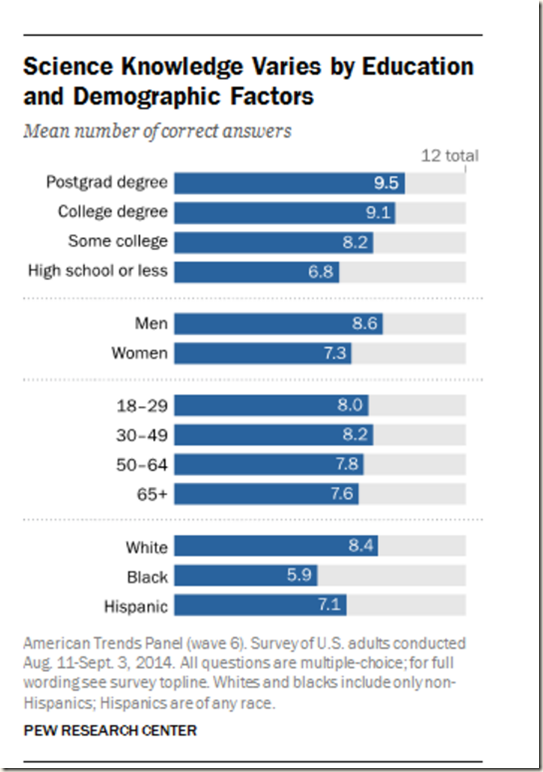
Scientific Knowledge By Demographics

pew-research-science-knowledge_thumb2-1

Dr. James Thompson writes: “The overall difference amounts to 15% less science knowledge for women, and because of some of the weak items chosen that may be an under-estimate.”

Posted in Science | Comments Off on Scientific Knowledge By Demographics

Awkward Timing: Hillary Clinton Featured In New Issue Of ‘Women’s Health’

Charles Spiering writes:

Before her collapse and health scare in New York City, Democratic presidential nominee Hillary Clinton was interviewed for the latest issue of Women’s Health magazine.
The October issue of the magazine features a glossy photo of a glowing Hillary Clinton in an article that talks about her plans to help women if she’s elected president.
When asked about the biggest obstacle she faced during her campaign, Clinton said it was the new media culture.

“In the heat of a campaign, in a culture that rewards brevity and clever phrases on social media, it can be really tempting to give simple answers to complex problems,” she said. “That’s never been my style.”

She asserted that she was “a little wonky” but believed in discussing specifics in her proposals.

Clinton called for women across the country to work for change in America, to make it more equal between women and men.

“As first lady, senator, and secretary of state, I would watch world leaders roll their eyes whenever I brought up issues that affect women and girls,” she said. “But with persistence – and data – I’ve watched it dawn on more than a few men that women’s issues are their issues too.”

Posted in Hillary Clinton | Comments Off on Awkward Timing: Hillary Clinton Featured In New Issue Of ‘Women’s Health’

You Can Predict Life Success From A Genetic Test At Birth

Dr. James Thompson blogs:

Stuart Ritchie (as in Intelligence: All that Matters) has done a guest post on the British Psychological Society Research Digest. This has wide readership among psychologists, so that it is very good news that they will be getting an update on contemporary research by an active researcher. I hope that they will consider the inheritance of characteristics in all their research.

This is intended to be a very brief post, just directing you to Stuart’s article, and adding a few links.

https://digest.bps.org.uk/2016/09/12/its-now-possible-in-theory-to-predict-life-success-from-a-genetic-test-at-birth/

A few points to add: Stuart mentions the marvellous Dunedin study, so here is a link to those researchers, and the questions they set the ISIR conference in 2014:

https://drjamesthompson.blogspot.co.uk/2014/12/are-you-nuisance.html

Here is a post about recent work done on polygenic scores and human behaviours:

https://drjamesthompson.blogspot.co.uk/2015/11/genetic-story-jumps-ahead.html

Here is a link to the Belsky paper Stuart mentioned, from which the above graph was drawn:

https://drive.google.com/file/d/0B3c4TxciNeJZV3BBaVcxb1FpVHM/view?usp=sharing

As Stuart says, only 1 or 2% of the variance in these behaviours is explained by the polygenic score. This sound little, and is, but the miracle is that any link can be shown between gene sequences and complex human outcomes.

The next paper by Selzam boosts the variance-accounted-for to 9.1%. Stuart says: The polygenic scores are already pretty good predictors: in Selzam’s study, they have just about half of the predictive value of asking about the parent&#82#8217;s socio-economic status, or testing the child’s IQ at age 7 (and the scores are based on DNA variants that are unchanged since birth and can be measured with a simple saliva or blood test).

Of course, parent’s socio-economic status is not random. Higher status is achieved by brighter persons. IQ at age 7 is usually a better predictor of adult success than class of origin, though the two are confounded, and quite properly so.

Stuart adds: Using an even newer polygenic education estimate from a more recent gene-finding study (published in Nature this year), Saskia Selzam and colleagues found that their polygenic score explained a remarkable 9.1 per cent of the variance in age-16 GCSE results in a sample of 4,300 British teenagers

It is worth noticing that the most easily available and most often used educational achievement measure is very crude: years of schooling. Once proper scholastic and intellectual assessment measures are used on much larger genetic samples the power of the predictive polygenetic scores can very probably be considerably refined.

Here is the full paper: http://www.nature.com/mp/journal/vaop/ncurrent/full/mp2016107a.html

It requires detailed reading, and links to other recent studies on educational attainment.

In summary, we now have an incredible advance. We can now understand a bit more about how DNA, the ultimate cause of how we are built, contributes causally to an important aspect of our behaviour.

Posted in IQ | Comments Off on You Can Predict Life Success From A Genetic Test At Birth

Sex differences in intelligence – Richard Lynn

Posted in IQ | Comments Off on Sex differences in intelligence – Richard Lynn

Paul Gottfried and John Derbyshire on the future of American conservatism

Joseph Cotto writes in 2014: What impact has political correctness had on the modern conservative movement?

“Poisonous,” Derbyshire states. “It has been the Cultural Marxists’ most brilliant strategy — a judo move, making key conservative virtues work against conservative group interests.

“Conservatives are nice people, well-mannered and well-socialized. They hate to think they are giving offense; they hate to think that people see them as not-nice.

“To escape the trap, conservatives need to be meaner. That goes against the grain, though.

“Conservatism needs more sociopaths.”

Posted in America, Conservatives | Comments Off on Paul Gottfried and John Derbyshire on the future of American conservatism

Do Immigrants Import Their Economic Destiny?

By Garett Jones

Why do some countries have relatively liberal, pro-market institutions while others are plagued by corruption, statism, and incompetence? Three lines of research point the way to a substantial answer:

  • The Deep Roots literature on how ancestry predicts modern economic development,
  • The Attitude Migration literature, which shows that migrants tend to bring a lot of their worldview with them when they move from one country to another,
  • The New Voters-New Policies literature, which shows that expanding the franchise to new voters really does change the nature of government.

Together, these three data-driven literatures suggest that if you want to predict how a nation’s economic rules and norms are likely to change over the next few decades, you’ll want to keep an eye on where that country’s recent immigrants hail from.

The Deep Roots of Prosperity

A glance at the map tells much of the tale: Today’s rich countries tend to be in East Asia, Northern and Western Europe, or are heavily populated by people who came from those two regions. The major exceptions are oil-rich countries. East Asia and Northwest Europe are precisely the areas of the world that made the biggest technological advances over the past few hundred years. These two regions experienced “civilization,” an ill-defined but unmistakable combination of urban living, elite prosperity, literary culture, and sophisticated technology. Civilization doesn’t mean kindness, it doesn’t mean respect for modern human rights: It means the frontier of human artistic and technological achievement. And over the extremely long run, a good predictor of your nation’s current economic behavior is your nation’s ancestors’ past behavior. Exceptions exist, but so does the rule.

Recently, a small group of economists have found more systematic evidence on how the past predicts the present. Overall, they find that where your nation’s citizens come from matters a lot. From “How deep are the roots of economic development?” published in the prestigious Journal of Economic Literature:

A growing body of new empirical work focuses on the measurement and estimation of the effects of historical variables on contemporary income by explicitly taking into account the ancestral composition of current populations. The evidence suggests that economic development is affected by traits that have been transmitted across generations over the very long run.

From “Was the Wealth of Nations determined in 1000 B.C.?” (coauthored by the legendary William Easterly):

[W]e are measuring the association of the place’s technology today with the technology in 1500 AD of the places from where the ancestors of the current population came from…[W]e strongly confirm…that history of peoples matters more than history of places.

And finally, from “Post-1500 Population Flows and the Economic Determinants of Economic Growth and Inequality,” published in Harvard’s Quarterly Journal of Economics:

The positive effect of ancestry-adjusted early development on current income is robust…The most likely explanation for this finding is that people whose ancestors were living in countries that developed earlier (in the sense of implementing agriculture or creating organized states) brought with them some advantage—such as human capital, knowledge, culture, or institutions—that raises the level of income today.

To sum up some of the key findings of this new empirical literature: There are three major long-run predictors of a nation’s current prosperity, which combine to make up a nation’s SAT score:

S: How long ago the nation’s ancestors lived under an organized state.

A: How long ago the nation’s ancestors began to use Neolithic agriculture techniques.

T: How much of the world’s available technology the nation’s ancestors were using in 1000 B.C., 0 B.C., or 1500 A.D.

On average, nations with high migration-adjusted SAT scores are vastly richer than nations with lower SAT scores: Countries in the top 10% of migration-adjusted technology (T) in 1500 are typically at least 10 times richer than countries in the bottom 10%. If instead you mistakenly tried to predict a country’s income today based on who lived there in 1500, the relationship would only be about one-third that size. The migration adjustment matters crucially: Whether in the New World, across Southeast Asia, or in Southern Africa, one can do a better job predicting today’s prosperity when you keep track of who moved where. It looks like at least in the distant past, migrants shaped today’s prosperity.

Do migrants bring their institutions with them?

So migration from high-SAT countries bring the seeds of prosperity: But what exactly are they bringing? As the authors of the Quarterly Journal of Economics article speculated, did they bring along a tendency to establish good institutions—the rule of law, low corruption, and competent government? Fortunately, an economist has already checked to see whether SAT-type scores drive good institutions. James T. Ang recently published a truly remarkable paper in the Journal of Development Economics, “Institutions and the Long-Run Impact of Early Development.” Ang ran a variety of statistical tests to see if ancestry-adjusted SAT-like scores had a strong relationship with good institutions. Overall, Ang’s findings are quite clear:

[N]ations that were more developed in the pre-modern era tend to have better institutions today.

He goes on to note:

[M]easures adjusted for the global migration effect perform significantly better than their unadjusted counterparts in explaining the variation in institutions across countries, thus highlighting the fact that migration has played a significant part in shaping current economic performance.

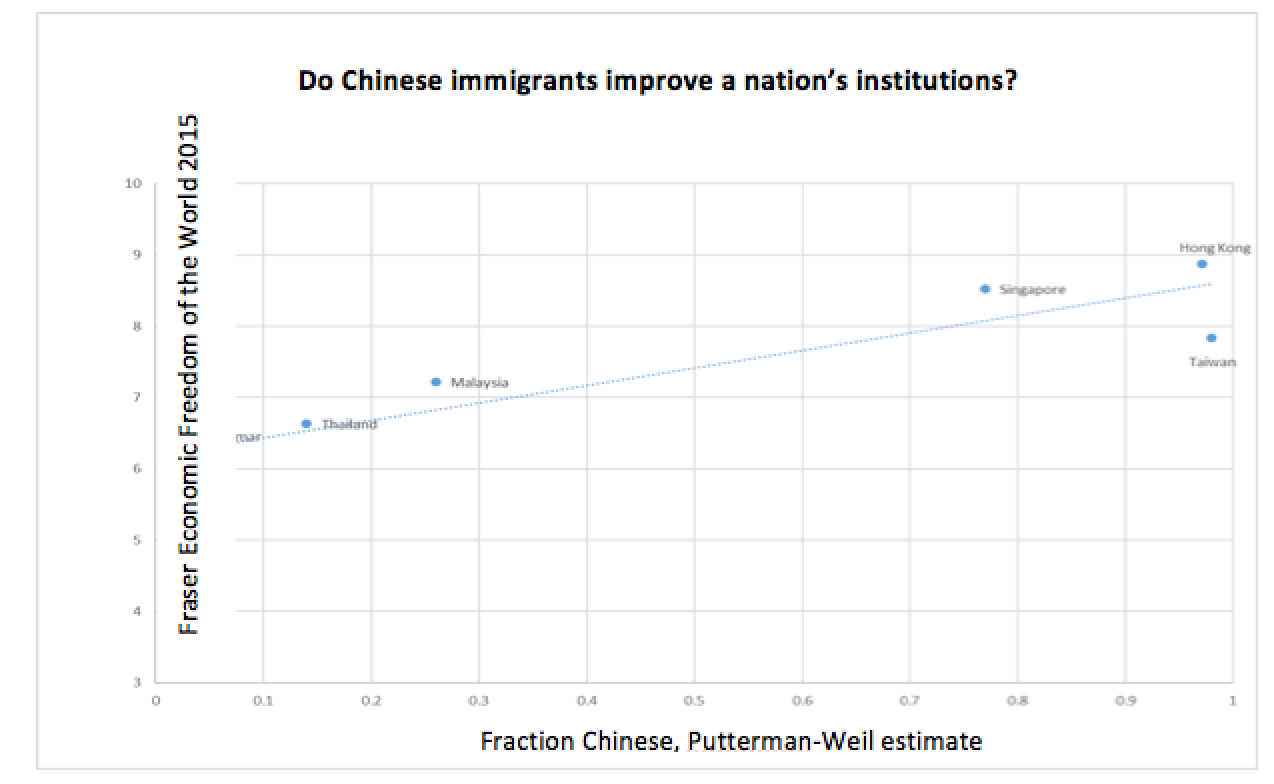
…Let’s consider the case of Chinese migration throughout Asia. By the standards of European colonization, Chinese migration post-1500 has been relatively (I emphasize relatively) peaceful. The non-Chinese residents of these countries tended to have lower ancestral SAT scores than Chinese residents, so we can ask: did Asian countries with a higher percentage of Chinese-descended migrants end up economically freer? Of course, since this is a question about migration from China, China itself should be left out of the analysis. The graph below tells the story. It compares Chinese ancestry data from the Putterman-Weil global migration matrix with the Fraser Economic Freedom of the World Index for Asian countries with substantial numbers of Chinese immigrants:

Notes: The x-axis data come from the Putterman-Weil global migration matrix, reflecting post-1500 flows of Chinese migrants to these nations. The y-axis data come from the Fraser Economic Freedom of the World Index. The correlation is 0.9, significant at conventional levels with a sample size of seven. Results are little-changed if the Rauch/Trinidade Chinese ethnicity measures are used instead of Putterman-Weil. The graph is truncated at three because no nation on earth has an economic freedom score below three.

Overall, the relationship between a nation’s percent population of Chinese descent in 1980 and current economic freedom is strongly positive. Singapore, Hong Kong, and Taiwan, the countries with the largest percentage of post-1500 Chinese immigrants, are the freest. Hong Kong, which had only a few thousand Chinese residents before the British arrival, is now the economically freest country in the world. Malaysia (a third of whose residents are of Chinese descent) and Thailand (10 percent) are next, and Malaysia is clearly the freer of the two. The remaining countries, Laos and Myanmar, are substantially less economically free than Singapore. Of course, including China in this graph would weaken the relationship, but to repeat: we aren’t interested in ancestry per se, but in relatively peaceful migration.

Economists have long known that some of the strongest statistical predictors of long-run national prosperity have been “percent Confucian” and “percent Buddhist.” A famed paper coauthored by Xavier Sala-i-Martin demonstrated that conclusively. It’s time for scholars to investigate whether, for most countries, a pro-Confucian migration policy is a good option.

Migrating Attitudes

So, how do migrants change the governments in countries they move to? For a partial answer, we can look at the Attitude Migration literature. The simplest approach is to see if the descendants of, say, Italian migrants to America tend to have the same attitudes toward government as Italians living back in Italy. If they do have similar attitudes, then there really is such a thing as “Italian attitudes toward government,” portable and relatively durable around the globe.

Since public opinion surveys are common around the world, this is an easy topic to investigate. One study looks at attitudes toward income redistribution, finding that second-generation immigrants to the U.S. are more likely to favor income redistribution policies if they come from a country where the average citizen today also favors more redistribution. In this case, attitudes migrate, so heavy immigration from pro-redistribution cultures will tend to boost a nation’s number of pro-redistribution citizens decades later. More importantly, the same holds for trusting behavior: A study published in the American Economic Review, provocatively entitled “Inherited Trust and Growth,” finds that

…inherited trust of descendants of US-immigrants is significantly influenced by the country of origin…of their forbears…

So trusting attitudes migrate. And the link from trust to economic performance is well-accepted at this point: One famous paper, “Does Social Capital Have an Economic Payoff?” [Answer: Yes] is now routinely cited in economics textbooks. And why do low-trust societies generate worse economic performance? One reason is that low-trust individuals demand more government regulation. In “Regulation and Distrust” the authors report:

Using the World Values Survey, we show both in a cross-section of countries, and in a sample of individuals from around the world, that distrust fuels support for government control over the economy.

The authors suggest that this happens because in low-trust societies, people want someone checking up on untrustworthy businesses and individuals, and a strong government is one way to do just that. Together, this literature suggests that migration from low-trust societies will tend to hurt long-run economic performance, partly because low-trust individuals demand more government regulation.

One particular attitude has been well-studied in the migration literature: Strong family ties. This is often known as “amoral familism,” the view that you should help out your family, right or wrong. In comparative anthropology and sociology, it’s well known that cultures strong in amoral familism tend to be places where children live with their parents into adulthood, where corruption is common, and where identity is heavily shaped by one’s extended family. A remarkable handbook chapter by Alesina and Giuliano finds that:

…on average familistic values are associated with lower political participation and political action. They are also related to a lower level of trust, more emphasis on job security, less desire for innovation and more traditional attitudes toward working women.

It’s safe to predict that voters and politicians with these traits are unlikely to support much Schumpeterian creative destruction. And, unsurprisingly at this point, amoral familism itself tends to migrate:

…family values are quite stable over time and could be among the drivers of institutional differences and level of development across countries: family values inherited by children of immigrants whose forebears arrived in various European countries before 1940 [!] are related to a lower quality of institutions and lower level of development today.

At this point, it’s clear that attitudes migrate to a substantial degree, and at least in democracies, they’re likely to take those attitudes into the voting booth. There’s an old saying in the migration policy world, a line by Max Frisch: “We wanted workers, we got people instead.” It looks like that saying needs updating: “We wanted workers, we got voters instead.”

Attitude Convergence: A two-way street

Of course immigrants don’t just become voters: they sometimes become taste-makers, opinion-setters. As immigrants join the culture, they start to shape the culture. That means that immigrants and their descendants may shape political opinions the way they often shape people’s opinion about food: Migrants start eating some of the foods of the country they move to, but at the same time older residents start trying some foods from immigrant cultures. There’s a mutual exchange, and behavior meets somewhere in the middle. As students of migration repeatedly claim, acculturation is a two-way street: America is different because of Italian and Irish migration, and not just because of the food we eat.

To some extent, this point is obvious, but it has far-reaching implications. It means that one important way that immigrants and their descendants will shape a political system isn’t by directly bringing their own attitudes into the voting booth: It’s also by shaping the political attitudes of their fellow citizens. That’s what happens in a melting pot: We all become a little like each other. So if we really are shaped by our neighbors, then we have yet another good reason to choose our neighbors wisely.

This means that the Attitude Migration channel is perhaps only half the story, but it also means that the other part of the story will be harder to detect. If a nation of 100 million has, say, a million migrants from a particular country, it would be hard to pick out the effect of those migrants on “native” attitudes: the effect of the migrants would be diluted partly because they’re only 1% of the population, and partly because the change in “native” attitudes will occur slowly over the decades.

So while it’s important to know whether migrants assimilate completely or partially, it’s just as important to know how much do migrants change their fellow citizens. Past researchers have documented two quite separate findings:

  • Many migrant attitudes persist to their descendants
  • Migrants and their descendants seem to make their new homes quite a bit like their old homes.

The first point need not be the only cause of the second point. There’s a third point suggested by the common-sense claim that we’re all shaped at least a bit by the attitudes of those around us:

  • Migrants and their descendants tend to influence the attitudes of their new fellow citizens, so that all groups in society become at least a bit more like each other.

New Voters = New Policies

We’ve seen that in the extremely long run immigrants have dramatically changed the countries they’ve moved to; and in the medium run we’ve seen that immigrants and their children bring home-country attitudes along for the ride. But as I’ve already noted, some critics will argue that perhaps “this time is different”, and that even if immigrants import their cultural attitudes to their new homes, maybe they’ll leave those views just outside the voting booth. Perhaps, when it comes time to vote, migrants completely conform to their new home countries.

Here’s one way to check this “New Voters = No Change” theory: Look at times when large groups of individuals were suddenly given the vote, and then check to see if government policies changed within a few years. Even better, only look at large groups of individuals who had been living somewhat peacefully in the nation for decades. Here’s one such case: The women’s suffrage movement across Western civilization. This extension of the franchise has been heavily studied by economists: The best-known paper draws on the fact that different U.S. states extended the vote at different times to create a kind of natural experiment. It turns out that, contrary to the “New voters = No change” theory, giving the vote to women really did change government in a more progressive, expansionist direction:

Suffrage coincided with immediate increases in state government
expenditures and revenue and more liberal voting patterns
for federal representatives, and these effects continued growing
over time as more women took advantage of the franchise…On the basis
of these estimates, granting women the right to vote caused expenditures
to rise immediately by 14 percent…by 21 percent after 25 years, and by 28 percent after 45 years.

Women did not quietly, meekly vote for whatever the men around them supported. They had their own minds, and those minds, when empowered by the vote, moved policy in a more progressive direction. And notice that the longer-run effect was twice the immediate effect: Expanding the franchise to a group that favored more government spending indeed increased government spending, but it took decades to see the full effect. In U.S. history, new voters have mattered.

And this is no one-off study: the policy impact of female suffrage has been studied extensively. To quote a study focused on Europe:

Using historical data from six Western European countries for the period 1869-1960, we provide evidence that social spending out of GDP increased by 0.6-1.2% in the short-run as a consequence of women’s suffrage, while the long-run effect is three to eight times larger.

Again, the long run effect matters more than the short run effect. New voters, new policies: NVNP.

Which brings us to one last test of the NVNP hypothesis: The increase in voting rights for when poll taxes were eliminated in the United States. Here again, evidence supports NVNP: the University of Chicago’s Journal of Political Economy reports that “eliminating poll taxes raised welfare spending by 11 to 20 percent” among other findings, so once again, new voters made important progressive policy change a reality.

How immigrants shape institutions

We now have the key pieces of the puzzle:

  • The Deep Roots literature which shows that in the long run, migration deeply shapes a nation’s level of pro-market institutions, and that a nation’s ancestry-adjusted SAT score (States, Agriculture, Technology) is a good predictor of prosperity.
  • The Attitude Migration literature, which shows that migrants bring a substantial portion of their attitudes toward markets, trust, and social safety nets with them from their home country.
  • The New Voters = New Policies literature, which shows that governments really do change when new voters show up, and that the changes start to show up in just a few years.

Government policies don’t radiate from subterranean mineral deposits: they are in large part the product of its voting citizens. And in the long run, new citizens lead to new policies.

Posted in Immigration | Comments Off on Do Immigrants Import Their Economic Destiny?