Where Is Dead Man’s Curve On Sunset Blvd?

Steve Sailer writes: In 1982 I was driving with a college friend from Houston through Dead Man’s Curve on Sunset Blvd but there was a traffic jam. Eventually, we saw why: Scott Baio, star of the then hot new show “Joanie Loves Chachi,” had smashed his brand new sports car (with dealer paper plates into a tree) and he was standing on the curb talking into a pre-cellular radio phone in an agitated manner.

My friend went home to Texas feeling his first trip to L.A. had fulfilled all of his hopes for what L.A. was like.

According to Snopes: “Exactly where Los Angeles’ version of “dead man’s curve” can be found is the subject of some debate, but by general consensus it’s a tight corner of Sunset Boulevard near the Bel-Air Estates north of UCLA’s Drake Stadium. (In this map of the UCLA campus, it’s the curve of Sunset just above Drake Stadium, which is identified with a yellow number 78.) This turn is particularly tricky for persons driving eastbound (left to right on the map above) on Sunset, as a long downhill stretch on which it’s all too easy to spurt well over the 35 MPH speed limit leads up to the curve, where a driver suddenly finds he must bank sharply left or centrifugal force will send his car crashing through a wall of trees bordering the UCLA campus. Motorists unfamiliar with this part of Sunset Blvd. (or those who know about it but opt to tempt fate and test their driving abilities by approaching the turn without slowing down) can easily find themselves yanking the steering wheel too hard to the left and spinning off the road or into oncoming traffic.”

* It’s funny, the first time I rolled around dead mans curve, I thought, “this is a curve designed to kill people,” having no idea it was the famed curve. It would be worth shutting down Sunset to get that curve graded correctly. Whomever allowed it should have been shot.

* In the clip below, after the line, “let’s see if you still have balls, terry,” you’ll see a shot of “dead man’s curve” on Sunset.

Note the angle of the road, and how it can effect high-speed drivers like those depicted in the movie. Most of Sunset is graded very well for high speed driving, except “dead man’s curve.” Many asses have been kicked there. Scared the hell out of me the first time I rounded it.

Posted in Los Angeles | Comments Off on Where Is Dead Man’s Curve On Sunset Blvd?

The Donald Trump Hat Shortage

Comments to Steve Sailer:

* I attended today’s [Trump] event at Fountain Hills, first time ever at a political rally.

I was impressed by how many young people there were. Nice small talk in the crowd, joking a bit about the protesters who blocked the road for half an hour. Most of us had already been there for hours. There was a little crowd of protesters circling around behind a few fences, but they didn’t seem very organized. Some chants and banter back and forth, but nobody was really getting under anybody’s skin.

Maybe it was wild in Tucson, but you’d have to use some creative camera angles to make it look bad. Arizona is pretty laid-back, I’d say. Fair weather fans kind of thing.

You couldn’t buy an official hat or campaign gear. Volunteers explained that the real ones are expensive and too hard to keep in stock, being made in America. Sad!

The volunteers who explained the hat shortage were two teenage kids handing out bumper stickers, so I don’t know if it’s the official story.

But here you have a genius business man who’s had 12 months to figure out how to source these things, and I had to buy a hat from a Bulgarian lady on the side of the road.

For the record, I like Donald a lot. Also for the record, the crowd was diverse for Arizona, and I stood next to a black university student at the rally. Behind me were four girls who were pretty obviously there to protest (believe me it was obvious). People were nice and gave them water. Then, a few minutes into the speech, they did their thing and were escorted to the gate. Trump didn’t flinch. I honestly expected more vitriol.

It was a short speech, but he used one line I hadn’t heard before, something to the effect of “For a while anyway, I’m the kinda guy we need. For a while is all I’m saying.”

He’s giving people a good excuse: “In 2020 or 2024 we can go back to voting for sober statesmen types, but, desperate times. . . just for a while, maybe we could use a bit of this east coast bull in a china shop type thing.”

* I call that the Diminishing Marginal Utility theory. Trump’s way of saying that is a lot more comprehensible.

* What irks me is that the Left is unable to protest without infringing upon other’s rights. By blocking that road, those protesters where preventing people from using public roads. Additionally had an ambulance been trying to transport someone to the hospital, it would have been prevented which could have had catastrophic results. Additionally the initial roadblock could have resulted in accidents as high speed vehicles would have had to come to an unexpected stop. Their protest put people’s lives in danger. Yet they are never held to account for this.

* Trump said something very similar back in Clear Lake, IA during that now infamous takedown of Ben Carson the day before the Paris Attacks. He even expanded on it slightly, dabbling, you might dare say in a bit of political philosophy. Quoting from memory:

“Hillary said she doesn’t like my tone. Jeb said the same thing. I tell you what, don’t worry about it folks. We can go back to the guys with the nice easy tone later but let me straighten things out first and then I promise I’ll leave you alone. And then you’ll go and blow it all for the next 20 years and you’ll get someone else like me in there again.”

* We were in Tucson, on the floor in front of the podium. The whole rally was very last minute – announced the day before. There was, weirdly, an anime convention also at the Tucson Convention Center, so there were some cos-players milling about. Made for some interesting pics.

The protesters were marching around and beating drums, but we got there early before they really got going. By the time we went through security they were outside the doors screaming “Shut it down.” The crowd was for the most part low-key, and you could definitely tell who the protesters were going to be. There were two punk-rock dressed girls with a folded up sign that were standing off to one side on the floor. After Trump got to the stage they started waving their sign, and a huge veteran (he raised his hand when one of the speakers before Trump asked how many vets there were) ripped the sign out of their hands and kept it.

There were a bunch of protesters seated behind the podium with anti-Trump / BLM signs that refused to leave for a long time, but overall the police/security were good about getting them out of there. The biggest thing was of course the one protester getting beaten pretty bad by a black man in the audience. He and his female counterpart were on the floor near us, and the guy looked very nervous before they started doing their protesting. The girl put on a KKK cap and was wearing it while they were escorted out. Some are saying the black guy might have been a false flag, but Tucson’s (small) black population is largely military, so I wouldn’t be surprised if he was a real Trump supporter. Most of the people selling Trump swag outside were black, weirdly.

Towards the end of the speech Trump brought a latina on stage who had a “Latinos for Trump” sign, which everybody loved. After the speech was over we went out the back entrance, and the protests near the front entrance wen ton for a long time. A lot of Native people and Latinos, as well as whites, but for the most part the Trump supporters ignored them as they left – no scuffles that we could see. Very different environment than Chicago.

* When it came to his healthcare plan, one thing Obama didn’t want to talk about was tort reform. Of course, the trial lawyers are one of the biggest pro-Democrat lobbies. Maybe with a president who’s not beholden to them we could get tort reform?

Posted in Donald Trump | Comments Off on The Donald Trump Hat Shortage

Is Trump Too Vulgar?

Comments to Steve Sailer:

* Then there are people like my friend who have voted GOP for decades but thinks Trump too “vulgar” and “unqualified” and “doesn’t mean anything he says.”

Honestly the entire thing is taking a real toll on our friendship because, as flawed as Trump is, he is the only non-cucked option. But my friend sounds absolutely indistinguishable from my loopy hyperliberal sister who wouldn’t vote for Trump if her eight year old daughter were gang raped by an illegal, a BLMer and a Muslim right in front of her face.

* Paul Ryan is the typical Republican “palooka” that Hillary and Bill have been meeting and disposing of for decades. He is a guaranteed GOP defeat and the bitterness among Trump supporters that would result from Trump being denied the nomination at the convention would probably mean a 45-48 state Hillary blowout. But, as other commenters have pointed out, the cucks in charge of the GOP would prefer that to a Trump victory.

* I’ve told a couple of friends I really don’t want them coming around the house anymore because the family doesn’t need to hear the “anyone who considers Trump is a dumba$$” smack talk. It has become my own personal secession plan, dump the negative ninnies in my personal and business life.

Posted in Donald Trump | Comments Off on Is Trump Too Vulgar?

Jack Dorsey: You’re A Liar. Censorship Is Rampant On Twitter

Milo writes: In Shakespearean times, cuckolds were referred to as “he who has horns” — an issue everyone else can see, that’s not obvious to them. Everyone else sees his shame immediately, but the cuckold can only tell by looking closely in a mirror. Perhaps the same is true for censors, who insist that they adore free speech while mercilessly trampling it at the slightest opportunity.

Twitter CEO Jack Dorsey, whom I wouldn’t even right-swipe on Grindr (ironically one of the few social platforms left without Orwellian speech suppression), recently made a visit to The Today Show where he firmly proclaimed that his site doesn’t censor its users. Dorsey made his extraordinary statement following Matt Lauer’s claim that his Twitter followers named censorship as one of the most important issues facing the social media platform.

Jack is the CEO of two companies, and bad at running both, but Twitter has really been the worst of his two failures. Imagine taking a company from the “free speech wing of the free speech party” to shadowbanning, politically motivated de-verifications and banning “problematic” accounts (usually conservative or libertarian).

Since Dorsey returned to the company that he considers his “first born son,” the site has transformed from the public’s megaphone into the public’s muzzle. He’s calmly drowning free speech in the bathtub while adding unwanted features like algorithmic timelines and sponsored tweets.

Dorsey, who once was fired from his role as Twitter’s chief executive for an obsession with hot yoga and shirt-making, noted that Twitter only censors speech that “promotes violence.” Of course, this fails to explain my own unverification, Twitter’s rampant shadow-banning, and the suspension of Adam Baldwin over innocuous tweets that were interpreted as insults by easily-offended snowflakes. It seems Dorsey weaves fibs and half-truths as enthusiastically as he weaves straight-cut hemp outerwear.

Verified Twitter accounts are given to significant individuals (like me) who are likely to be impersonated on the platform. I’m probably the most impersonated person on the internet who isn’t Beyoncé. The blue check society is a club to which I once belonged, but since Twitter has revealed its willingness to censor and “shawdow-ban,” it’s a club I’m a lot less interested in rejoining.

If Dorsey won’t address his platform’s blatant bias, he might one day have to answer to the courts. On March 4, I asked White House Press Secretary Josh Earnest about the role that President Obama might play in reminding social media platforms about the importance of protecting free expression.

Earnest made it clear the President believes that the success of social media platforms is “predicated on the important protection of First Amendment rights to self-expression.” He also recommended that Twitter users who feel aggrieved by the platform’s policies should turn to lawsuits as a response. I’m betting that’s a future the site’s investors, already worried by the company’s tanking stock value, would want to avoid.

Although Twitter’s appeal for many has been the absence of internal algorithms that control what you see and what you don’t see, Dorsey and co. in a recent change added a platform-wide filter that aims to weed out harassment and abuse. Jack, do you find conservative and libertarian thought so radical and fringe that its mere existence is on par with actual harassment and abuse? Do you think a gay conservative with an opinion is too dangerous to be legitimized on social media with your coveted blue check mark?

If Twitter really isn’t interested in ideological censorship, as Dorsey claims, then they should launch an immediate crackdown on employees who are. They should start with Michael Margolis, the man who allegedly asked his bosses at Twitter to unverify me and was pictured with feminist games critic Anita Sarkeesian just a few weeks later, donning his best in Sarkeesian apparel.

Does Twitter believe his political sympathies had nothing to do with his determination to target my account?

Twitter might not have had to go the censorious route if it properly managed and staffed its in-house anti-abuse team like the grown-up social networks do, instead of farming it out to feminist groups like “Women, Action and Media” and the laughably ideological “Trust and Safety” council.

Twitter desperately needs to improve its user experience to revive flagging numbers, but it won’t invest in basic necessities like employing enough staff with time to deal with contextual issues of speech. Twitter hoards its cash like a bad landlord ignoring necessary repairs — kicking out the people who make legitimate complaints and rewarding the snitches. It has become an Orwellian paradise.

That isn’t to say that the censorship attempts of Twitter employees are ever particularly effective. In the 24 hours following the change, I gained 7,000 new followers, and #JeSuisMilo trended in the U.S., Canada, and in the U.K. Someone should tell them to find a more effective way to fulfil their virtual book-burning fantasies.

It hasn’t just been me who has been on the receiving end of Twitter’s censoring spree. Hollywood actor Adam Baldwin called for Jack’s resignation from his chief executive post after conservative blogger Robert Stacy McCain was suspended from the platform without reason.

“They are very good at hiding whatever algorithms they have,” said Baldwin at the time. “They don’t explain themselves and they are not transparent. The onus is on Twitter to explain exactly why they ban people. It’s their company. I just choose not to participate in the suppression of ideas any more.”

Even Slate’s Amanda Hess has taken to criticizing Twitter for its double standard, after they suspended controversial provocateur Chuck C. Johnson. Meanwhile, as Twitter employees scrambled to rid the site of anti-feminist thought and humour, in 2015 nearly 50,000 accounts were held by active members of the Islamic State.

I’m not so sure why Jack Dorsey refuses to understand that Twitter’s demise is inevitable if they don’t allow society’s most significant, compelling and attractive individuals — like me! — to use the platform to freely express themselves. This cautionary warning doesn’t just come from me, but from President Obama too.

Speaking of politicians, it’s worth noting that Dorsey’s aspirations include becoming mayor of New York City. The social media guru who decides restricts content on his platform would feel right at home running a city that places restrictions on the size of your soda cup.

Still, politics can be difficult if you have a string of business failures behind you. As the social media platform’s stock price continues to plummet and advertisers continue to flee, maybe Dorsey will realize that taking away my check mark was the first step towards the death of his first born. Still, it could be worse for Jack. At least he’s not Nick Denton.

Follow Milo Yiannopoulos (@Nero) on Twitter and Facebook, or write to him at [email protected]. Android users can download Milo Alert! to be notified about new articles when they are published.

Posted in Censorship, Twitter | Comments Off on Jack Dorsey: You’re A Liar. Censorship Is Rampant On Twitter

Jewish Law & Ideology

Historian Marc B. Shapiro writes:

Let me now return to the matter of halakhic decisions and ideology. As mentioned, Rabbi Gordimer is mistaken in stating that Modern Orthodox poskim evaluate matters the same way as haredi poskim. They don’t, and this isn’t even something that they should aspire to. Does this mean that a posek’s general ideology should disqualify him in some people’s eyes? For example, if someone is a recognized posek, does the fact that his ideology on Zionism is diametrically opposed to yours (e.g., R. Moshe Sternbuch) mean that you shouldn’t ask him questions?
Historically, ideological matters were kept separate from halakhah. The various rabbinic organizations in Europe and the United States were comprised of rabbis who held different views about Zionism and other matters. If you were a Mizrachi supporter but the rav of your town was an Agudist, you still asked him all of your halakhic questions, because he was your rav. By the same token, if you were an Agudist and the rav of the town was Mizrachi, he was still the one to answer your halakhic questions. This is how matters worked in Lithuania and Poland and then in the United States. One of the unfortunate results of modern haredi Judaism (and it has precedents in Germany and Hungary) is that this model was destroyed.
A basic feature of “official” haredism, especially in Israel, is the attitude that even if someone is a great posek, he is still disqualified if he doesn’t follow the correct Da’as Torah. It is hard to imagine a greater degrading of respect for Torah scholars than this (which thankfully is not shared by all who identify as haredim, even though it is reflected in all the Israeli haredi newspapers and “official” publications). It is precisely this approach, that of degrading one’s ideological opponents despite their great Torah knowledge, that stands at the root of all the terrible disputes in the haredi world. It also explains why, in recent years, haredi figures and newspapers felt that it was OK to speak so inappropriately about outstanding sages such as R. Ovadiah Yosef, R. Meir Mazuz, R. Shlomo Amar, R. Aharon Leib Steinman, and R. Shmuel Auerbach.
Unfortunately, this approach has now entered the Sephardic world as well, where in the last Israeli elections we saw the worst aspects of Ashkenazic haredi society, i.e., personal denigration for ideological reasons, arise for the first time in the Sephardic world. I will discuss this in detail in a future post when I speak about R. Mazuz’s religious and political outlook, his role in the last Israeli elections, and the vicious things said about him and his yeshiva.
While it is true that it was Ashkenazim who began the personal denigrations, it is a Sephardi, R. Shalom Cohen, who brought it to a new low. I will discuss this in the upcoming post, but for now, suffice it to say that for all the Ashkenazic haredi disrespect for opponents, I don’t know of anyone who has referred to an opponent’s yeshiva in the way R. Cohen referred to R Mazuz’s Yeshivat Kise Rahamim, a yeshiva that has educated thousands of students and today is of much greater significance than R. Cohen’s Porat Yosef. For those who haven’t heard, and it is difficult for me to even repeat this, R. Cohen publicly referred to the great Kise Rahamim yeshiva as a בית הכסא. Can anyone imagine a more disgraceful statement about a place of Torah? This is what happens when people think that they can degrade those who don’t adopt a certain Da’as Torah perspective.
Here is a letter I recently received from R. Mazuz, which I publicize with his permission. 


In it he states:

 גדולה שנאה ששונאים חרדים את החרדים משנאה ששונאים חילונים את החרדים.
It is unfortunate that the disqualification of great Torah scholars due to ideological reasons has also been seen in the Religious Zionist world, though not to the extent that it is found in the haredi world. For some Religious Zionist figures, haredi poskim are disqualified in the exact same way that haredim disqualify Religious Zionist poskim. R. Dov Lior quotes R. Kook as stating that the rabbis we today refer to as haredim cannot arrive at the truth of Torah in any matter.[20]
שמי שחי בדור שלנו ואינו מביט אל האור הזרוע של תהליך גאולת עם ישראל, לא יוכל לכוון בשום דבר לאמתה של תורה. גם אם הם יכולים להתפלפל בעניייני שור שנגח את הפרה, בענייני ההנהגה של כלל ישראל הם לא מכוונים לאמיתתה של תורה.
R. Lior’s statement was made in response to haredi indifference to the Gush Katif expulsion, and he claims to be simply citing R. Kook. Yet if we look at R. Kook, Iggerot ha-Re’iyah, vol. 2, no. 378 (p. 37), we find that R. Kook’s statement is much narrower, and I have underlined the point that R. Kook focuses on.
ואם יבא אדם לחדש דברים עליונים בעסקי התשובה בזמן הזה, ואל דברת קץ המגולה ואור הישועה הזרוחה לא יביט, לא יוכל לכוין שום דבר לאמתתה של תורת אמת.
Even R. Lior’s statement is not entirely clear, since he begins by saying that the haredi rabbis can never arrive at Torah truth, but in the end he only seems to be referring to Torah truth when dealing with communal and national matters. R. Kook would agree with this latter point, but I know of no evidence that he would say that in general the haredi rabbis can never arrive at Torah truth.
R. Zvi Yehudah Kook, basing himself on the same letter of R. Kook cited by R. Lior, stated that one should not ask a haredi posek any halakhic questions.[21]
רבנו לימד את אגרת שע”ח: “ואשר יבוא לחדש דברים עליונים בעסקי התשובה ואל דברת הקץ המגולה ואור הישועה הזרוחה לא יביט, לא יוכל לכוון שום דבר לאמתתה של תורת אמת”. הוא הסביר: “עסקי תשובה – הכוונה לדברים כלליים”. תלמיד שאל: “האם בהלכות שאינן נוגעות לענייני תשובה ואמונה ושאר דברים כלליים – אפשר לשאול רב חרדי”? רבנו הגיב חדות: “הדברים ברורים! מה כוונתך?” התלמיד חזר ושאל: “למשל, האם אפשר לשאול רב חרדי בהלכות בשר וחלב”? רבנו דפק על השולחן והגיב בתקיפות: “חרדיות זה מיעוט אמונה, ומיעוט אמונה זה עקמומיות בשכל, ועקמומיות בשכל צריכה בדיקה.”

This is just the flip-side of the common haredi position that one should not ask a Religious Zionist posek any halakhic questions. As mentioned already, the haredim were the first to push this approach, and I find it unfortunate that some Religious Zionist leaders have responded in kind.
Posted in Marc B. Shapiro, Rabbis | Comments Off on Jewish Law & Ideology

Can Women Be Orthodox Rabbis?

Historian Marc B. Shapiro writes:

I have found a number of statements by mainstream rabbinic figures that, if one didn’t know better, one would think that they were said by liberal Orthodox figures. For example:
ומה אעשה ולבי מרחם על אלמנה [ובפרט בימינו] רחמים גדולים, ואולי אפשר לערער אם אני כשר לדון דין אלמנה, אבל מצד הדין אינני רואה פסול לעצמי.
If a liberal Orthodox rabbi made this statement, I think many would say that he was not “objective” and thus not suitable to serve as a dayan. Yet the statement I just quoted was made by R. Isaac Herzog.[1]
I was surprised to see that R. Ovadiah Yosef stated that had the Hazon Ish been a dayan and seen the pain of agunot first-hand then he would have been more lenient.[2]
רבנו דיבר על החזון איש שהחמיר בענין תרי רובי בעגונות, והחמיר עוד בעניינים אחרים, ואמר רבנו אודות החזון איש, שאם החזון איש היה אב בית דין היה מוכרח להקל, כי כך אמרו הרבה שכאשר הרב מוכרח לומר דברים למעשה הוא מוכרח יותר להקל, ואמר רבנו חבל שלא עשו את החזון איש אב בית דין, כי אם היו ממנים אותו אב בית דין היה מוכרח להקל, כי הוא יושב בביתו וכותב, אם היה יושב בבית דין, והיה רואה את הנשים שבוכות כשבאות לבקש להתיר אותן וכו’ היה מוכרח למצוא צדדים להקל. ובספר אבי הישיבות אמרו על רבי חיים מוולוזין שהיה אומר בתחלה שכל עוד שלא נתמנה לאב”ד היה מחמיר בתרי רובי, ועכשיו שמינו אותו לדיין הוא מיקל בתרי רובי בעגונה.
Regarding R. Hayyim of Volozhin, who is mentioned by R. Ovadiah, see what he writes in Hut ha-Meshulash, no. 8.
שכת”ר נוטה אל החומרא מחמת שאין הדבר מוטל עליו ואף אני כמוהו לא פניתי אל צדדי היתרים העולים מתוך העיון טרם הוחלה עלי עול ההוראה והן עתה שבעוה”ר בסביבותינו נתייתם הדור מחכמים והעלו על צוארי עול הוראה מכל הסביבה שאינם מתירים בשום אופן בלתי הסכמת דעתי הקלה וחשבתי עם קוני וראיתי חובה לעצמי להתחזק בכל כחי לשקוד על תקנת עגונות.
Some people will think that the following statement, which appeals to a dayan’s emotion, is problematic:
והוא הדבר גם כאן על הדיין לראות מעצמו אם היה ענין כזה באחת מבנותיו ח”ו, ובא הבעל נגדה בטענה כזו, האם ירצה שביה”ד יפסקו עליה להוציאה בע”כ מבלי כתובה.
Yet this was said by R. Ovadiah Hadaya.[3] 
In fact, words very similar to those of R. Hadaya were earlier stated by R. Hayyim Palache.[4] He explains that the Sages referred to Jewish women as בנות ישראל and not נשי ישראל in order to teach us that when a dayan and beit din deal with women in difficult halakhic circumstances, they should treat them just like their own daughters. Just like they would move heaven and earth to try to find a heter for their own daughters, so too they should do this with every woman who comes appears before them. Here are some of his words, and I wouldn’t be surprised if they are soon emblazoned on the website of ORA.
שירחם הדיין והב”ד וכל מי שהוא חכם בעל הוראה להשתדל על נשי ישראל כאלו הם בנותיו שיצאו מיריכו ובכן בבא עליהן צרה וצוקה שנעלמו בעליהן באיזה אופן שיהיה ותהיינה צרורות שישים כל מגמתו לחפש בספרי הפוסקים חיפוש מחיפוש עד מקום שידו מגעת וידיעתו מכרעת בינו לשמים אם המצא ימצא להפוך בזכותן כאלו היתה בתו ממש כדי שלא תשאר עגונא כמו שמשתדל האב על בתו?:
.The following sentence sounds very 20th century


כנראה שהר’ ז”ל [רש”י] כאב הבנות הפך בזכותן בכל ואולי מזה הצד הוסיף כפייה לחליצה שלא כדברי שאר הפוסקים.

It states that because Rashi had daughters he was led to decide the halakhah in a certain way. Although it sounds modern, it was actually stated by R. Levi Ibn Habib.[5]
Look at the following sentences that explain a dispute among rishonim about the messianic era based on the environments they were living in.
וכפי הנראה החלוקה באה מסיבת חלוקת הזמנים והמקומות שהיה לכל אחד ואחד, שהרמב”ן ז”ל היה בעת המצור והמצוק שהציקו את ישראל ואכלום בכל פה בימי הבינים בין הקתולים, לכן לא מצא מקום למלאות תקות הגאולה אם לא ביד חזקה וכפיות הרצון הנעשה ע”י נפלאות כבימי פרעה מלך מצרים. אבל הרד”ק ז”ל היה בשעתו ומקומו בין מלכי חסד ועמים רודפי צדק אשר לא שנאו את ישראל והיתה תקוה קרובה, כי ישוב לבם לטוב על ישראל.
This definitely sounds like a liberal Orthodox approach, since traditionalists do not usually say that rishonim are influenced by their environment when it comes to such an important thing as their vision of the End of Days. Yet the passage I quoted actually comes from R. Jonathan Eliasberg, Shevil ha-Zahav (Warsaw, 1897), pp. 64-65.
What about someone who writes words of praise for the woman who does not ask the rabbis if she can wear tallit and tefillin, but simply does it on her own? Believe it or not, such a sentiment is found in the writings of R. Yom Tov Algazi, who served as Rishon le-Tziyon in the 18th century.[6]
והנה בפ”ק דברכות אמרו אין עוז אלא תפילין שנא’ נשבע ה’ בימינו ובזרוע עוזו ועוד אמרי’ התם האי מאן דבעי למהוי חסידא לקיים מילי דברכות מפני שהברכות הן להמשכת החסדים כנודע והוא הנרצה באומרו עוז והדר לבושה שהית’ לובשת תפילין וטלית שנקרא עז והדר ומעיד עליה הכתוב לאמר ותשחק ליום אחרון דשכרה איתה ליום אחרון בעה”ב דאע”ג דאינה מצוו’ ועושה מ”מ יש לה שכר, דגדול המצווה אמרו מכלל דמי שאינו מצוו’ ועוש’ נמי נוטל שכר אבל אף חכמת’ עמדה לה שלא באת’ לשאול לחכמי’ אם תהי’ מנחת או”ל אלא היא מעצמה פיה פתחה בחכמ’ ותור’ חסד על לשונה שהית’ עוש’ מ”ע שה”ג שלא נצטו’ בהם מעצמ’.
If someone says that the Talmud was written by men for men and reflects a male approach in the way it is written, I would normally assume that this person is a feminist who sees patriarchy at every corner and interprets everything through the prism of gender. Yet in fact this was actually said by R. Avrohom Chaim Levin of Chicago.[7]
Even when it comes to women rabbis, I have been surprised by some of what I have found. Take a look at this rabbi’s response to a question:
אישה תוכל לכהן כרבנית קהילה?
אני לא יודע. ברור שיש ראשונים שחשבו שזה בסדר ויש כאלו שסלדו מהרעיון. רש”י על התורה מביא את דברי ‘הספרי’ על הציווי למנות שופטים: התורה אומרת ‘הבו לכם אנשים’, והספרי תמה ‘וכי יעלה על דעתך נשים?’. אנחנו אומרים: רש”י, מורנו ורבנו, על דעתך זה לא עולה? על דעתנו זה עולה. אחרי שזה עולה יכול להיות שאנחנו נוריד את זה, אבל אנחנו לא חושבים שמדובר בשיגעון או טירוף. הציווי לבנות עולם ניתן גם לנשים וגם לגברים, ‘לעבדה ולשמרה’.
This was not said by a liberal rabbi but by R. Aharon Lichtenstein.[8] R. Lichtenstein also deals with this matter in his conversations with R. Haim Sabato.[9] Here he tells us that he simply doesn’t know what will be in thirty years when it comes to women’s ordination. 


איני יודע מה יפסקו פוסקי הדור בעוד שלושים שנה בשאלות סמכות נשים וכדומה. אין לי מושג . . . ידועים דברי הרמב”ם, על סמך הספרי, בעניין המינויים הפורמליים, אך יש פוסקים שלא נרתעו מכך. מה יהיה בעתיד איני יודע. אבל מה שאני יודע זה שהיום חשוב שבנות ישראל תדענה תורה, שתהיינה דבקות בתורה. לגבי כל השאר איני אומר בדיוק. בהדי כבשי דרחמנא למה לך


His position, which recognizes the possibility of change in this matter guided by Modern Orthodox/Religious Zionist halakhic authorities, is much more nuanced than what we have been hearing recently. R. Lichtenstein recognized that changes occur and he was honest enough to admit that he didn’t know what the future will bring.

R. Norman Lamm has also stated that he doesn’t know if women will be ordained, and that his opposition to women’s ordination is “social, not religious.”[10] In another interview he took the middle ground, saying that he doesn’t know if it is halakhically permissible for women to become rabbis, but he also doesn’t know if this is forbidden.[11]
Regarding the general matter of women’s ordination, I have already commented on it here.[12] Let me just add that I think I have read everything coming out of the RCA and its people in the last few months, and I confess that I still don’t see the objection to female clergy. I am not talking about women pulpit rabbis, but what is the problem with a woman chaplain at a hospital or a woman teacher of advanced Torah studies or even a woman posek (poseket)? I realize that there are objections to using the title of “rabbi” for women, and Saul Liebeman focused on this in his letter of opposition. So why not just come up with a different title?
The RCA is apparently opposed to giving learned women any title. However, titles are important, as they are community recognition that someone has reached a certain level. There are women who are learned and it is only fitting that they too have a title. In fact, some women who went into academic Jewish studies would have been just as happy to remain in traditional Jewish studies if there was some way of recognizing their achievements. And before you start putting down the importance of titles, I can tell you that there are learned (and not so learned) men who use the title “rabbi”, even though they have never received semikhah. They do so because they feel the title is important for their community work. By the same token, a title can also be important for women who are involved in teaching Torah and community leadership.
As for the title of “rebbetzin”, or “rabbanit” in modern Hebrew,[13] this has no appeal for many of the Modern Orthodox, as I have mentioned here. This point is also seen in a recent comment by Yakir Englander and Avi Sagi, that the title “rabbanit” is used to create a halo of authority where none exists.[14] Yet as I note in the just mentioned post, there is biblical precedent for calling women by their husband’s title. I subsequently saw that in Shabbat 95a, Rashi, s.v. אשה חכמה claims that אשה חכמה here does not mean a learned woman but the wife or daughter of a scholar who would have picked up some knowledge by virtue of her family situation.[15] Isn’t this the same thing with rebbetzins in the haredi world? Simply by being married to a rabbi they end up more Jewishly learned, especially in practical halakhah, than the typical haredi woman.
For a long time the ones pushing women’s ordination have pointed to a responsum by R. Eliyahu Bakshi-Doron, Binyan Av, vol. 1, no. 65, in which he affirmed that women could be poskot. Here is his conclusion.
I have already noted here that very few rabbis are poskim, but every posek is by definition a rabbi. And since R. Bakshi-Doron is telling us that a women can be a posek, it is easy to see why this responsum has been cited again and again in support of women rabbis. This led the RCA to turn to R. Bakshi-Doron for clarification as to whether he indeed supports women’s ordination. Here is the RCA letter[16] and R. Bakshi-Doron’s response
As you can see, he strongly rejects the notion of women rabbis, seeing this as a Reform innovation. He also says that while women can function as poskot, they cannot be appointed to any such position in an official way, and thus a rabbinic position is also out of the question. (So again I ask, what would be the problem with a woman being given a title if she served as a chaplain or teacher? This does not contradict what R. Bakshi-Doron says.[17]) R. Bakshi-Doron concludes his letter as follows:
ויש להבהיר להם שלא יהא יהירות לנשים כדברי הגמ’ במגילה, וחשך דרא דמברא איתתא. ויש בדבר חוסר צניעות בפרט בדורנו שפרוץ מרובה על העומד ותורה על מכתבכם שיש בו כדי להסיר מכשול.
Rabbi Gordimer did a post on R. Bakshi-Doron’s reply. In it, he translated the last sentence of the final paragraph of R. Bakshi-Doron’s letter.
There inheres in the matter (of women serving as rabbis and licensed halachic authorities) a lack of modesty, especially in our generation, in which immodesty is more prevalent than modesty. I thank you for your letter, which has enabled me to remove a source of misinformation.
Rabbi Gordimer did not translate the final paragraph in its entirety. The first part of it states: “It should be explained to them that haughtiness is not fitting for women, as stated by the Gemara in Megillah.” The exact reference is Megillah 14b.
If this wasn’t enough for the Orthodox feminists to stop citing R. Bakshi-Doron, then his next words will be. He wrote וחשך דרא דמברא איתתא. The first thing to note is that there is a typo here and דמברא should read דמדברא. The source of this passage is Midrash Tehillim 22:20 where it states: חשיך דרא דאתתא דברייתא. This means, “Woe unto the generation whose leader is a woman.” This is definitely not the sort of thing that a typical RCA rabbi would feel comfortable putting in print, or announcing from the pulpit. For those arguing against women rabbis this kind of sentiment would hurt, not help, the cause. I think this is the reason why the RCA has not released a translation of R. Bakshi-Doron’s letter, and as noted, Rabbi Gordimer didn’t provide a complete translation either.
To give an example of how this passage from Midrash Tehillin has been used in the past, R. Yisrael Zev Mintzberg published his Zot Hukat ha-Torah in Jerusalem in 1920. This work is devoted to showing that women are not permitted to vote. Look how he cites the passage in his conclusion on p. 33.
R. Hayyim Hirschensohn referred to this passage as well, in his strong attack on R. Mintzberg in which he goes so far as to say that the latter does not even permit women to be women.[18]
ואחד מרבני ירושלים הרה”ג מוהר”ר ישראל זאב מינצבערג נ”י יצא בקונטרס “זאת חוקת התורה” אשר חוקה הוא חוקק גזרה הוא גוזר בכח הפלפול ובכח הקבלה ובכח האגדה לשלול כל זכיה מנשים אפי’ מלהיות נשים, כל ההולך בעצת אשתו נופל בגהינם, אינון מסיטרא דדינא קשיא, חשיך דרא דאיתתא דבריתא, דא היא גזירת אורייתא, ואי אתה רשאי להרהר אחריה.
R. Shlomo Zalman Ehrenreich also cites the phrase חשיך דרא דאיתתא דברייתא in order to make the following point:[19] Women were not created to bring others to Torah. Rather, their role is to enable their husbands to reach perfection.
האשה לא נבראת לטהר אחרים לאביהם שבשמים כדאיתא במגילה י”ד לא יאי יוהרא לנשי ובמדרש שוח”ט חשיך דרא דאיתתא דברייתא הובא בילקוט שמעוני שופטים ב’ ע”ש. ולפמש”כ דכל עיקר האשה הוא רק לתכלית שהבעל יתקדש על ידה.
Finally, when it comes to the matter of women rabbis, I think people will find the following amusing, or disturbing. There are liberal Muslims in Israel, and these are the people that Israel should be supporting. Recently, a Muslim member of Kenesset, Issawi Frej, journeyed to Bnei Brak to try to convince some leading rabbis to support the appointment of women qadis. The problem is that Minister Yaakov Litzman of the Yahadut ha-Torah bloc is strongly opposed to appointing women as qadis, because he fears that this will then lead to pressure for recognition of women rabbis. Knowing that Litzman and the other haredi Kenesset members take their orders from the rabbis, Frej understood that he had to convince the rabbis of his position. Yet unfortunately for Frej and liberal Muslims as whole, and I think for the rest of us as well, the Bnei Brak rabbis he met with refused to budge. See the story here.
Regarding the issue of yoatzot, I don’t want to get into that in any detail, but I do want to call readers’ attention to the following which surprisingly has not been referred to by any of the supporters of yoatzot. In the Leket Yosher (pp. 35-37 in the Machon Yerushalayim edition) we can see a yoetzet in action. A woman wrote to the wife of R. Israel Isserlein with a halakhic question. The wife inquired from her husband, R. Isserlein, and then replied to the woman. Had she already known the answer she would not have had to ask her husband. This is exactly what yoatzot do in the 21st century. Here is the text.
There is also a text in Niddah 13b that refers to what we can term a yoetzet, yet I have also not seen it cited.
אמר רבי חרשת היתה בשכונתינו לא דיה שבודקת לעצמה אלא שחברותיה רואות ומראות לה.
Rashi explains:
ומראות לה: שהיתה בקיאה במראה דם טמא ודם טהור.
Posted in Rabbis | Comments Off on Can Women Be Orthodox Rabbis?

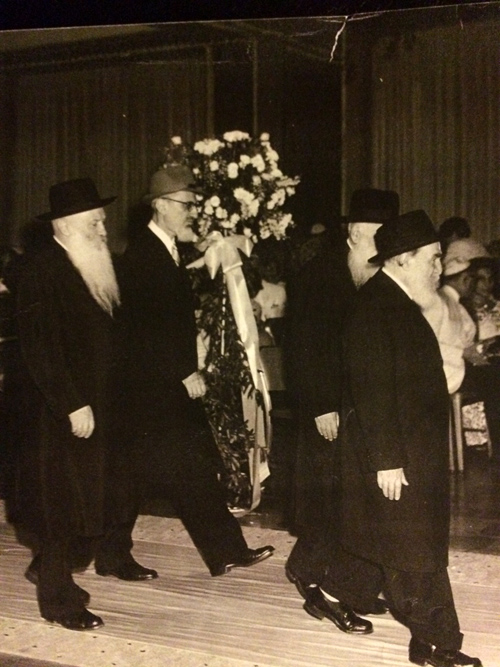
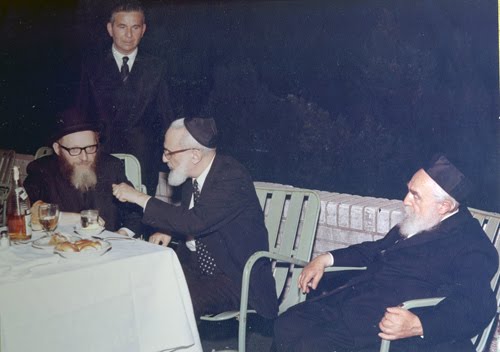
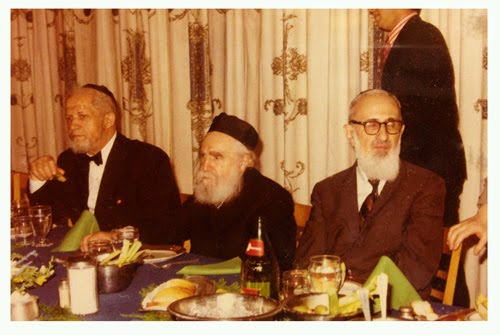
Marc Shapiro: ‘In older pictures you find rabbis walking down the aisle at weddings. Has anyone been to a wedding where this is still done?’

R. Soloveitchik and R. Samuel Walkin_small

Marc posts another picture of R. Moshe, the Rav, and R. Shneur Kotler:

R. Soloveitchik, R. Feinstein, R. S. Kotler_small

R. Soloveitchik and R.  Feinstein and R. Isaac Tendler 1_small

“It was taken at the wedding of R. Moshe Dovid Tendler’s daughter, Rivka, to R. Shabtai Rappaport. The man on the left is R. Isaac Tendler, R. Moshe Dovid’s father. The wedding took place at the Pioneer Country Club, Greenfield Park, N.Y., on June 17, 1971.”

Dr. Shapiro writes:

I would also like to call attention to the wonderful introduction to the book by R. Ovadiah Hoffman. He speaks about the need to reject religious extremism that leads to the delegitimization of Torah scholars just because they belong to a different camp. As I mentioned in my last post, this is a great problem in Israeli haredi society, and R. Ovadiah Yosef in particular was subjected to all sorts of attacks from small-minded people who could not recognize the simple truth R. Ovadiah Hoffman speaks about…

The ever-productive Menachem Kellner has just published a new book, Gam Hem Nikraim Adam: Ha-Nokhri be-Einei ha-Rambam, available here. This is not just a work of academic scholarship, but is what we can call “engaged scholarship,” in other words, scholarship that is also intent on making a difference in the real world. One of the things that troubles Kellner about contemporary Orthodox Judaism (and he specifically deals with such figures as R. Shlomo Aviner, R. Hershel Schachter, and the authors of Torat ha-Melekh) is the recent turn (or perhaps better, return) to negative portrayals of non-Jews and their spiritual worth. Kellner discusses this in the first section of the book which is titled גילוי דעת, and you can read it here. See also his interview with Alan Brill here.

In the book, Kellner argues that Maimonides sees no essential difference between Jews and non-Jews, and it is this view that Kellner wishes his readers to adopt. He refers to it as “Maimonides’ universalism.” Responses to Kellner’s book will be of two types: Those that deal with his interpretation of Maimonides and those that focus on what Kellner has to say about the contemporary scene and how Maimonides relates to it. This is a very exciting book which further establishes Kellner as an important public intellectual, and shows us once again why Kellner’s work has had a significant impact on the study of medieval Jewish philosophy. I hope to take up some of Kellner’s points in a future post…

R. Simcha Feuerman has recently published Et Lifrosh ve-Et le-Ehov. This small book, available at Biegeleisen, focuses on issues of shelom bayit. What makes this book significant is that R. Feuerman is also a licensed social worker with great experience in the field. This makes his book different than many previous books on the topic authored by well-intentioned people who never actually had any practical experience. As is fitting for a book like this, sexual matters are also discussed, and R. Feuerman mentions (p. 13) that the book was shown to rabbis and dayanim. Yet other than R. Gavriel Zinner, who penned a haskamah, none of the other rabbis chose to be public in their support because of their fear of being attacked by extremists who don’t think that these matters should be publicly discussed.

R. Feuerman also deals with the matter of psychological counseling and possible conflicts between the role of the psychologist, who is not supposed to be judgmental, and the traditional obligation to rebuke those who are sinning. As part of this essay (pp. 88ff.), R. Feuerman discusses the value of Freud’s insights (and notes the advances that have been made since his time). I find this significant since for many in the haredi world, and they are the ones who will be reading this book, Freud is almost up there with Darwin when it comes to objects of derision. It is also worth noting that the author uses “lomdus” to make psychological arguments.

Posted in Marc B. Shapiro, Rabbis | Comments Off on Marc Shapiro: ‘In older pictures you find rabbis walking down the aisle at weddings. Has anyone been to a wedding where this is still done?’

Protesting Bigots and Demagogues at AIPAC? Don’t Stop at Trump. Call Out Netanyahu

It’s very easy to call the goyim bigoted, but what about Jewish leaders? Should they have to pass the sort of purity test that Jewish organizations apply to goyisha leaders?

From Haaretz:

Many American Jews are angered at the prospect of Donald Trump addressing the AIPAC policy conference in Washington this coming week and are promising to abstain from attending, walk out of the hall or protest his presence in other ways.
“Throughout his campaign Trump has made statements that have been bigoted, racist, misogynistic, and Islamophobic – some could argue even statements that were anti-Semitic,” wrote Rabbi Jesse Olitzky, representing a group of professionals and clergy which calls itself Come Together Against Hate.
“If we sit around and do nothing, even if we sit in silence, that shows complacency and that, by default, we agree with what he says,” Olitzky wrote. “It is imperative to me as a communal leader, and to all Jews there who are going, that we stand up to his demagoguery.”
Which would make perfect sense, were it not for the fact that the American community, both as individuals and as communal leaders, has been sitting in silence and showing complacency in the face of demagoguery and racism for years already, without feeling the need to stand up and do something about it.
AIPAC, that bastion of Jewish values, has gone even further. Rather than sitting in complacent silence, it has given repeated and resounding standing ovations, year after year, to Benjamin Netanyahu and other Israeli demagogues and racists, who not only talk the talk – as Trump has done so far – but walk the walk, as well…

What perversion allows American Jews – or the majority of them, it would seem – to regard Donald Trump as the antithesis of their Jewish values and Benjamin Netanyahu as their exemplar? What cognitive bypass enables them to recognize the potential fascism of Trump, but not the existing tyranny of Israel’s rule over the Palestinians, under the decade-long leadership of Netanyahu?
Trump’s values, according to Rabbi Olitzky of Come Together Against Hate, “are not the values of the Jewish community. They are not the values of our founders’ vision of an America where all citizens are ‘endowed by their Creator with certain unalienable rights.’”
Does that mean that those unlucky enough to be born outside America weren’t endowed by the creator with unalienable rights? Does it mean that Jews in America, basking in the glory of their founders’ vision, need not be concerned when Jews in Israel deny others those same unalienable rights?
While Trump is addressing AIPAC in Washington, according to Olitzky, the members of Come Together Against Hate will be “gathering and learning Torah. We will be learning about sinat chinam (senseless hatred) and derech eretz (common decency).”
Touching. As if those righteous Jews have never heard of the sinat chinam practised by their fellow Jews in Israel or of the current state of siege that Netanyahu and his lieutenants have imposed on Israeli derech eretz. With Trumpism flourishing in the state of the Jewish people, the absurdity of studying Bible in order to ward off the evil billionaire is awe-inspiring.
Netanyahu himself has declined AIPAC’s invitation to address the conference in person, explaining first that he hadn’t been invited to meet with President Barack Obama while in Washington (a lie, according to the White House) and then that such an appearance would not be proper at the height of the American election campaign. 
Coming from the man who thought it appropriate to address Congress at the height of the struggle over the Iran nuclear agreement, Netanyahu’s explanation exudes the sort of hypocrisy that AIPAC appreciates. Olitzky and his Come Together friends may be well-meaning, but they are no less hypocritical.
Still, it’s a pity. Having both Trump and Netanyahu address the assembled ranks of Israel’s apologists at AIPAC would be a fitting tribute to an organization dedicated to dishonesty and myopia. It would cast American Jewish values in their true and unambiguous light – a value system that exempts Israel from every value it purports to hold dear.
It is entirely fitting to have Trump attend the AIPAC congress, while Bernie Sanders stays away. The Democratic candidate may have been invited out of obligation, but his honesty, decency and barely-concealed skepticism about Israel are not welcome at AIPAC. The pomposity and bluster of the Trump-Netanyahu duo are a much better fit.

Posted in AIPAC | Comments Off on Protesting Bigots and Demagogues at AIPAC? Don’t Stop at Trump. Call Out Netanyahu

ADL to Redirect Donations From Trump to Anti-bias Education

If the ADL is opposed to bias, it must hate the Torah, because the Torah is the blueprint for creating God’s Chosen People and allowing them to thrive by actively practicing discrimination in favor of their own group.

There’s no objective definition of hate speech that won’t forbid much of Torah. Jews should be careful about castigating goyim for prejudice and bigotry because the goyim might wake up and apply those same standards to Jewish texts.

The number of rabbis I’ve met who were choosy about the moral quality of money donated to them I could count on one hand.

From Haaretz: Ahead of the controversial candidate’s AIPAC speech, Anti-Defamation League CEO Jonathan Greenblatt says the group no longer wants the money he once contributed ‘in light of how Trump has changed.’

Anti-Defamation League CEO Jonathan A. Greenblatt writes in TIME Magazine on Sunday that the organization will redirect some $56,000 contributed by Trump to anti-bias education programs.
Greenblatt says the funds will go to groups “that address exactly the kind of stereotyping and scapegoating he has injected into this political season.”
“For starters, we plan to use these funds to expand our nationally renowned No Place for Hate educational program and enable schools in 10 regions across the country to increase their anti-bias and anti-bullying work,” Greenblatt writes.

Posted in ADL | Comments Off on ADL to Redirect Donations From Trump to Anti-bias Education

Why Do Americans Join The IDF?

Ryan Landry tweets: Hey @nytdavidbrooks write an oped why your son joined the IDF instead of the USMil when America had multiple active wars?
We’ll wait.

Paul Ciotti: These Americans who join the IDF (instead of the US marines) all say the same thing when you ask them why–“I wanted to give something back.” We’ll, that’s fine, giving something back shows a noble sense of gratitude. The only problem is all these guys want to give it back to Israel, not the United States.

Posted in IDF | Comments Off on Why Do Americans Join The IDF?