The Battle Of Indiana

Comments to Steve Sailer:

* On the day after The Battle of Indiana, this is not a coincidence. The Donald does tend to generate energy wherever he goes, like swelling the ranks of Republican voters in primaries.

Let us hope he reinvigorates the nation as a whole. One grows weary of defeatism and despair.

And thank you, Mr. Sailer, for hosting a site so worthy of careful perusal.

* Now that Trump has it in the bag, my Trump news addiction is causing me to refresh everywhere hoping for a fix. It reminds me of the days following 9/11 on wnd. Maybe that is part of the reason for the comment record… people coming online in search of news and then posting.

* Steve is awakening more and more synapses in the American part of the global brain.

Smell the coffee.

(I only discovered this blog less than two years ago. Can’t remember how I stumbled upon it. Some cool black guy in sunglasses gave me a red pill…)

* WaPo’s Charles Lane does his best impression of Conservative Pundit. If you read this article, you can see why our betters want to replace us with a different electorate. Frankly, we’re stupid and dangerous as opposed to stupid and lethargic.

According to Lane, we shouldn’t blame the establishment for Trump’s rise. No, it’s those pesky voters who need to change their ways.

Here are some choice quotes:

“But there hasn’t been nearly enough blaming of the people most responsible for The Donald’s rise: his voters.

They are perpetually — indulgently — described as “angry,” or “frustrated,” or “fed up,” and no doubt they are. But exactly how reasonable are those feelings, and how rational a response to them is a vote for Trump?

The answers, respectively, are “only somewhat” and “not at all.””

Translation: The voters are just wrong, and we shouldn’t have to listen to them.

—–

“Trump’s voters are bitterly disenchanted because they think society puts the grievances of others above their own.”

The nerve!

—–

“I’m not sure what non-work has to do with it, since whatever else can be said about them, 91 percent of unauthorized immigrant men, Trump’s scapegoats, were either working or seeking work in 2012 — compared with 79 percent of U.S.-born men.”

Mr. Lane can’t seem to make the connection and notice that the latter number may be influenced by the former. Basically, he’s bringing up the Jeb mantra that American workers should quit complaining and act like Mexicans just happy to have a job and live at slightly above poverty levels.

* OT, from today’s NYTimes:

Shootings by preschoolers are happening at a pace of about two per week. Here are the stories of Holston, Kiyan, Za’veon and Sha’Quille.

And from the top comments:

“When I had toddlers I child locked all the kitchen and bathroom cabinets, I gated off the stairs, I child proofed the house. I put them in car seats and strollers with straps. They slept in cribs with high rails and bumpers. I tested the temperature of their bottles. I treated them like the fragile precious beings that they were. My number one job for the first 5 or 6 years of their lives was to make sure they didn’t accidentally kill themselves. The thought of leaving anything dangerous within their grasp let alone a gun gave me anxiety. What kind of person leaves a gun anywhere near a child?”

I have no idea. Could there be any common thread that connects these parents? I don’t see any patterns. Is it possible that they were all Japanese?

* There are 26 articles about Donald Trump on salon.com today, including a laughable “How the Media Got Trump Wrong” essay.

He is the last thing keeping many liberal media outlets afloat.

* Recall that AZ passed the tough immigration laws, and earlier this year reports came out that AZ GDP fell about 2 percent. The MSM was trying to make the link that removing illegals would cost economic growth. But several commenters pointed out that after you account for the departed illegals, the per capita GDP of AZ was the same or even higher.

Today Reuters is running a story that Trump’s deportation plan would cost the US economy 2 percent in lost GDP.

* The Keating family is full of odd ducks. Anti pornography crusaders who were business criminals, a gold medalist swimmer who was a butcher of an ophthalmologist, a show boat gold medalist swimmer and a Navy seal.

* And not one post about golf course architecture? Man, how did you reel in those numbers without such crowd-baiting posts?

* OT: some big verdicts against Johnson & Johnson (talc) with the plaintiff attorney claiming, “Johnson & Johnson’s marketing targeted overweight women, blacks and Hispanics, knowing that those groups were most at-risk for talc-related ovarian cancer…”

Biodiversity: good for the tort industry, apparently.

MORE COMMENTS:

* Here’s a 1+ hour discussion focused largely on white working class economic insecurity between Robert Putnam and Charles Murray, in which immigration is never mentioned, except that moderator David Gergen says how CEOs tell him Mexican men work much harder than white men.

* I was surprised to see this comment as a NYT pick:

Tom Honolulu 23 hours ago

You also underestimated the popularity of Trump’s position on immigration, his number one issue. There seems to be a huge gap between how many of the political/media/business elite view immigration and how many working people view immigration.

I also agree that Trump’s media savvy is a big part of his success. Someone on Bill Maher’s show recently noted the parallels with FDR in the 1930s who utilized the new technology of radio, and with JFK who utilized TV in 1960. Trump understands reality TV and social media in an intuitive way that the other candidates cannot match.

* What Silver fails to mention is that everyone has embraced identity politics and racial bloc voting, it’s just that whites are late to the party. It looks like the uppity goyim are revolting, despite all our soft power efforts (as the article alludes to). The other thing is that Trump supporters aren’t just aggrieved by immigrants, it’s the intentional flooding of our country with non-whites for the intent of diluting our power and our unity permanently that pisses a lot of us off.

Take a leaf from (((Brin))) and (((Page))). Adopt a “Don’t be evil” philosophy. The pogrom you prevent may be your own.

* So long as their paymasters make money off unchecked immigration, the media whores will never talk about immigration restriction as a serious or good thing.

They are under strict orders not to mention it unless absolutely necessary.

* Trump is like Obama. For the lion’s share of his support, he relies on a vague message (“make America great again”/”change”) that invites people to imagine he’s saying whatever they themselves believe. While for another group, smaller in numbers but greater in enthusiasm, he dogwhistles a harsher message (immigrants are bad/whitey must die).
Posted in Donald Trump | Comments Off on The Battle Of Indiana

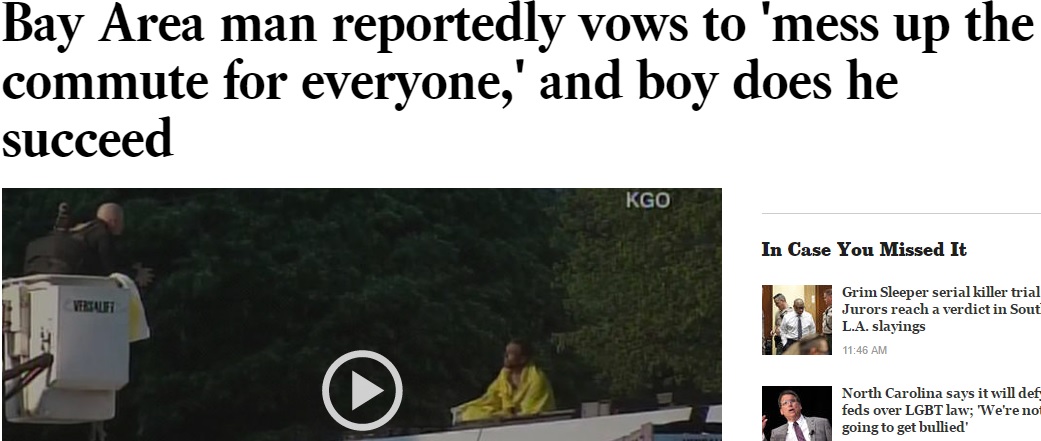
LAT: Bay Area man reportedly vows to ‘mess up the commute for everyone,’ and boy does he succeed

succeed

If I ran America, I’d have the guy shot. It just takes one bad apple to ruin things for thousands of people. Best not to have these types around.

Los Angeles Times: An hours-long standoff Thursday between police and a man with an apparent grudge against commuters is continuing to disrupt light rail service in the San Francisco Bay Area.

Standing atop a train in San Jose, the man refused to come down and told Santa Clara County sheriff’s deputies he “wants to mess up the commute for everyone,” KGO-TV reported. Bay Area news stations have reported that the man spat at officers and had fallen asleep at one point during the more than nine-hour standoff.

Sheriff’s officials told KTVU-TV that they planned to wait the man out. Authorities were trying to negotiate with the man.

A train operator first spotted the man on the tracks just after 1 a.m. The man then apparently climbed onto the roof of the train and has remained there since early Thursday.

The Santa Clara Valley Transportation Authority reported “major light rail service impacts” near North 1st Street and Component Drive.

“This activity prevents us from getting trains into service north of Metro station,” train service said in a statement.

Posted in California, Crime | Comments Off on LAT: Bay Area man reportedly vows to ‘mess up the commute for everyone,’ and boy does he succeed

Donald Trump: No message for followers who flooded reporter with anti-Semitic abuse

I am glad to see the Donald does not grovel.

WASHINGTON (JTA) — Donald Trump said he had no message for supporters who deluged a reporter with anti-Semitic comments after she wrote a critical profile of his wife.

“You’ll have to talk to them about it,” the presumptive Republican presidential nominee said Wednesday on CNN when told of the abusive phone calls, emails and social media posts received by Julia Ioffe after her story appeared in GQ.

“I don’t have a message to the fans, a woman wrote an article that was inaccurate,” he said.

Trump, a real estate magnate, said he had not read the article but had heard it was “nasty.”

“I’d like to see my family treated fairly and nicely,” he said.

Melania Trump in a Facebook post last week said the article was inaccurate. The one-time model, who is from Slovenia, also singled out for criticism Ioffe’s revelation of a half-brother born out of wedlock from a relationship her father had before he met her mother.

“My parents are private citizens and should not be subject to Ms. Ioffe’s unfair scrutiny,” she said.

Posted in Anti-Semitism | Comments Off on Donald Trump: No message for followers who flooded reporter with anti-Semitic abuse

Why Are Jews Hated?

Why are Japanese hated? Why are Gypsies hated? Why are blacks hated? Why are Nazis hated? Why are Muslims hated? Why are Seventh-Day Adventists hated? Why are whites hated? Why are Chinese hated? Why are Jews hated?

All groups are engaged in a struggle for survival and when another group threatens your group, your rational reaction is to hate it.

Jews are hated for the same reasons that other groups are hated — because they are a threat or a competition to somebody else. For instance, it would be a very weird and unhealthy Arab or Muslim who does not have some negative feelings about Jews because of the Jewish state of Israel occupying land they believe belongs to them. It would be a weird Christian who does not have some negative feelings about Jews given that Christianity came from Judaism and yet Jews resist its claims.

I love the quote at the top of my website: “Anti-Semitism is as natural to Western civilization as anti-Christianity is to Jewish civilization, Islamic civilization and Japanese civilization.”

The more intensely you identify with your group, the more likely you are to have negative feelings about out-groups. That’s why Jews fear when non-Jews develop their racial, religious and national identities. A strongly racial or specifically Christian or nationalistic America is likely to be less friendly to Jews than a multi-cultural multi-racial America.

Shmuel Rosner writes:

Are the Jews “absolutely righteous, or are they also partly to blame for the calamities they have suffered?”
This is a disturbing question, one that is at the root of Jewish existence in a world that is not always supportive. It’s a question that can be asked about Jews in general, like Talmon did, and one that can also be asked, more particularly, in reference to the state of Israel. This is so because today’s Anti-Semites do not present ‘the Jews’ as the official cause for their hatred – that designation is reserved for the state of Israel, its policies, its actions, its attitude. In that sense, Israel is a disappointing country, but there’s a certain element of relief in this disappointment. Israel is disappointing because it hasn’t solved the problem of antisemitism. On the other hand, there is some relief in that: it gives us evidence that the Jews are not to blame for antisemitism.
Like many of the anti-Semites, the early Zionist leaders had a tendency to put a lot of blame on the Jews themselves when they tried to explain the roots of the hatred they faced. Micha Josef Berdyczewski blamed their insistence on “the ethics of the book” instead of “the ethics of the sword.” Their submissiveness, their meekness, their piousness, the fact that they had become, in the words of Herzl, “unable to assimilate completely” – all of these are reasons for the hatred of the people among which they dwelled. Early Zionism hoped to cure the world of the malady of antisemitism by a chirurgical procedure – an operation that would separate between the Jews and their haters. The moment they are separated, so the theory went, the Jews will be cured of the illness of the diaspora and the non-Jews will be cured of the illness of antisemitism.

Posted in Anti-Semitism | Comments Off on Why Are Jews Hated?

Is crime genetic? Scientists don’t know because they’re afraid to ask

Brian Boutwell writes in the Boston Globe:

THE COUNTRY HAS made unprecedented strides in the fight against crime. Both violent and non-violent crime are way down from their highs in decades past. This is great news, of course, but the success could easily lull us into a false sense of security, believing that we have the problem solved. Indeed, what if much of what we know about the causes of crime is either deeply flawed or flat out wrong?

Imagine the trial of a new drug for an ailment that is as intractable as it is lethal. Researchers find 100 people with the disease and give the new drug to the first 50 patients who show up to the clinic. The next 50 trial participants are placed into a control group and given no treatment. The drug has a truly shimmering success rate.

As you may have guessed, problems abound with this experimental design. For starters, because it isn’t randomized and because preexisting differences among the participants aren’t taken into account, the study can’t answer the question: Did the new drug cause anyone to get better? Such a study would be laughed out of the medical research community. And yet much of the knowledge concerning the causes of crime (as well as a host of other issues in the social sciences) stems from designs that aren’t much better than the poorly executed drug trial example.

Social scientists generally, and criminologists especially, often lack the ability (usually due to both ethical and practical concerns) to perform randomized controlled trials, the gold standard of research. We might expect, for instance, that having low levels of self-control is a cause of criminal behavior. In fact, some of the most powerful explanations of crime have been built on this idea, and there is much evidence to support it. We might also hypothesize that bad parenting causes children to develop low levels of self-control. Yet we can’t randomly assign people to have different levels of self-control, and we most assuredly can’t randomly assign kids to parents. All of this is to say that criminologists may never know for sure whether parenting causes self-control and whether, in turn, self-control causes crime.

While criminologists typically can’t use randomized trials, they do use a variety of statistical methods to study parenting and self-control, and self-control and crime. They attempt to rule out the most likely alternative explanations for why bad parenting leads to less self-control and why less self-control leads to criminal behavior. This research has consistently revealed that parenting styles correlate with self-control development in children, and self-control in childhood predicts a variety of important outcomes, including criminal behavior. Criminologists make their living uncovering precisely these types of associations.

Yet these studies will never achieve the accuracy of a randomized controlled trial, because all of those factors, like self-control, delinquent peer affiliation, etc., are also, to some degree, heritable.

Ah, heritability. A term that is much maligned in disciplines like criminology and often serves as a wellspring of confusion. Humans differ in height, weight, personality style, and behavioral tendencies — not everyone is nice and outgoing, just like not everyone is as tall as a professional basketball player. But here’s the important part, heritability has to do with the origins of these differences. To say that something is heritable is to say that genetic differences play a role in creating observable differences.

Variety in our gene pool matters when we seek to understand why some people can dunk a basketball or compose a sonnet, and why some people persistently break the law. The effects of genetic differences make some people more impulsive and shortsighted than others, some people more healthy or infirm than others, and, despite how uncomfortable it might be to admit, genes also make some folks more likely to break the law than others.

Posted in Crime | Comments Off on Is crime genetic? Scientists don’t know because they’re afraid to ask

The Bermuda Triangle Part II: Dangerous Research & The Risks Worth Taking

Professor Brian Boutwell writes:

The late J.P. Rushton represents one of the most brilliant, yet oddly obscure, psychologists in the last several decades. Few would deny that Phil Rushton possessed a stunning intellect; his work on human altruism, in fact, was awarded a Guggenheim Fellowship in 1988. Yet, when he is spoken of in circles both within and outside of academia now, brilliance is not the first adjective that gets tossed around. Rushton’s interest in differences among human population groups would lead him to begin asking “dangerous” questions about how those differences arose. His book, Race, Evolution, and Behavior: A Life History Perspective (published in 1995) represented the culmination of much of his work on the topic to that point in his career.

For Rushton, the book was his opus, but for many, it represented the detonation of an academic land mine. Make no mistake — Rushton was controversial before his book came out — but he was positively radioactive in the years following.

The crux of what Rushton argued was, as you might have guessed, hardly politically correct. Human differences across a host of important traits — from reproductive behaviors to intelligence — “had its roots,” he said (p.31), “not only in economic, cultural, familial, and other environmental forces but also, to a far greater extent than mainstream social science would suggest, in ancient, gene-mediated evolutionary ones.”

Critical rebuke was stinging and unrestrained. Consider the following from a review written shortly after publication by David Barash, a psychologist at the University of Washington. In the course of excoriating Rushton, Barash proclaimed: “Bad science and virulent racial prejudice drip like pus from nearly every page of this despicable book.”

For the rest of Rushton’s life, and even after he died, in 2012, the disparagement would continue; his death renewed a discussion regarding his legacy, which to many amounts to nothing more than a wasteland of racist pseudoscience.

Critique is fundamental to the scientific enterprise. But critiques of “triangle science” (i.e., race scholarship) take a decidedly different tone. Critiques like the one leveled by Barash only serve to vilify people like Rushton. Barash could have said almost anything he wanted, so long as he made it clear that Rushton was the enemy. It wouldn’t even matter that in the course of criticizing Rushton, he (Barash) unleashed his own misunderstandings upon the reader. Consider the following (p. 1132):

For example, speaking of the causation of human phenotypes, Rushton breezily announces ‘I would hold, on the currently available evidence, that the genetic and environmental contributions are about equal’ (page xv). He seems not to understand that the ‘genetic and environmental contributions’ are in fact inseparable, thus neither equal nor unequal.” Clearly, the reader must assume, Rushton was inept.

There’s a problem, though. That bit about “not being able to separate genetic and environmental effects” is utter hogwash. Behavioral geneticists parse these two sources of variation using twin studies — its done all the time. My colleagues and I, moreover, have found that these techniques estimate the relative contributions of genes and environment quite effectively (and without appreciable bias). Recently, a magnificent overview analyzing five decades of twin research further validated the proposition that about half of the variance in most human outcomes is the result of genetic differences. I would be remiss not to mention, of course, that the heritability of individual differences does not by definition mean that group differences — such as group differences in cognitive ability — are also explained by genes. But whether they are, or aren’t, is an empirical question, not a philosophical one. It’s a question we can answer.

In fact, if you’ve read until now and think that the essay is about whether Rushton was right or wrong in his arguments, you’ve completely missed the point. Whether Rushton was right in some respects, and wrong in others is a non-issue for our purposes. Rushton could have been wrong about everything, and his work would still have been of great value. Why? In proposing testable ideas, ones that could be falsified, it allowed other scientists, like me, to mine for the truth. Eventually, we might have to toss out every single one of Rushton’s propositions to get an accurate understanding of reality — or we may not. Either way, if one were to list out the criteria for evaluating the truthfulness of an idea, being inoffensive would not (and should not) be on the roster.

As I’ve written about in part one of this series, no one knows this better than Linda Gottfredson, a distinguished psychologist at the University of Delaware. Linda has received a torrent of criticism over the years for her work on general intelligence — not only from the public, but also from her own university. Over the course of a handful of years in the late 1980s and early 1990s, her and her collaborators’ academic freedom was violated in a cavalcade of innovative attempts at censorship (not the least of which involved denial of funding and promotion). In 2010, Linda chronicled those experiences in an essay entitled, “Lessons in Academic Freedom as Lived Experience,” detailing the consequences of being ideologically controversial in science.

In the confines of that essay, she described how critics strategically maneuver in order to take certain types of research (more often than not involving the genetic basis of group differences) off the table (p. 276): “Labeling an idea dangerous makes it a target, and the label simultaneously provides moral justification for suppressing it.” she wrote. “Thus does suppression claim the moral high ground: danger and evil require such suppression in the name of the greater good.”

Doubtless drawing on her own experience with baseless accusations of racism, Gottfredson wrote in defense of Rushton in 2013, describing the machinations of (p. 218) “how mob science works to ‘discredit’ valid research and enforce collective ignorance about entire bodies of evidence.”

The strategies of mob science are uncomplicated and as both Rushton and Gottfredson would learn first hand, they are terrifyingly effective. The use of emotionally evocative words, like when Barash tossed out the descriptor “pus” to describe Phil Rushton’s work, represent a classic method for alerting the reader that something nefarious must be going on. Other examples, like using the monikers of (p.221) “diseased”, “sorry mess”, “dangerous”, “odios” and “same old lies,” similarly just stir our emotions; they don’t shift any real cognitive gears; they are “high talk, and low blows” to borrow Gottfredson’s words (p.221).

Today, the most straightforward approach for dealing with research on race is to simply decry the topic of race differences as being a “non-topic” altogether. If science really has shown that race is a social construct, the argument goes, then anyone talking about race must simply be trying to resurrect a scientifically defunct — and insidious — topic.

The trouble with this argument is that it’s not exactly honest. The roadmap of our ancestry exists in our DNA; our genes provide evidence of where we come from. Though self-identified race doesn’t always fully capture our geographic ancestry, the two undoubtedly overlap. In 2005, for instance, one study demonstrated that our (p.268): “ancient geographic ancestry, which is highly correlated with self-identified race/ethnicity — as opposed to current residence — is the major determinant of genetic structure in the U.S. population.” An individual’s self-identified race, in other words, doesn’t move in the opposite direction of their genetic ancestry — the two align to some degree. There is no doubt that future studies will continue, and should continue, forcing us to remold our notions of human ancestry and race. But at the same time, they haven’t yet laid waste to the idea that population groups differ for reasons other than culture alone (just as Phil Rushton suggested).

I’ve experienced a taste of “mob science” strategies first hand. My co-authors and I have drawn on some of Rushton’s insights in order to propose an evolutionary theory of criminal behavior. Reviewers were not shy about insinuating that only a cadre of bigots would suggest that criminal behavior might have anything at all to do with genetics, as we did in the paper. Some colleagues balked at the idea that we would even cite Rushton, as if including his name would somehow taint our research, our reputations, and me in general. Maybe it has; maybe I’ll never fully realize the damage that has been done. I do know that I’ve lost count of how many times senior colleagues (many of whom I respect greatly) have implored me to study anything else but race. What possible good comes from taking such a risk? Just don’t talk about it, they suggest, at least not until you’re tenured. I cannot in good conscience steer away from a topic that interests me, though, only because it is politically incorrect.

Gottfredson’s thoughts on the matter in 2010 are perhaps the best way to encapsulate my thinking about Rushton, race, and controversial science in general (p.279):

When the profession selectively impedes ideas that fail some non-scientific standard, such as alleged social harm, it breaks the covenant between society and academe that accords scholars freedom of inquiry.

Posted in Phil Rushton, Race | Comments Off on The Bermuda Triangle Part II: Dangerous Research & The Risks Worth Taking

The Bermuda Triangle of Science

Professor Brian Boutwell writes:

This is an essay about how to avoid carpet-bombing your career as a scientist. The academy, in general, is a wonderful place to work, but not everyone plays nice. Veer too far from carefully charted courses and someone may slip quietly up behind you and slide a cold piece of steel in between the ribs of your budding research career.

They’ll do this believing that they are serving public interest by snuffing out dangerous research agendas, but that won’t make any difference to you. It’ll be your reputation that will suffer grievous injury. What in the world might elicit such harsh rebuke from a community of otherwise broadminded, free speech spouting scholars? What is so verboten that it constitutes academia’s Bermuda Triangle, a place where careers disappear more often than ships in the actual Bermuda Triangle? In one word, it’s race.

Now, had I written this a decade or more ago, general intelligence would have topped the list of forbidden academic fruit. This is not to say that intelligence research has magically become mainstream. It still carries its fair share of controversy. On one level, the continued debate about intelligence strikes me as quite funny, honestly. If you want to watch academics glorify a trait that many still think, “doesn’t exist” or “doesn’t matter”, hang around them when student applications are being reviewed. It’s hilarious to watch folks froth at the mouth over sky-high test scores that they would otherwise tell you measure nothing at all.

Nonetheless, the evidentiary base regarding the existence of general intelligence and its ability to predict important life outcomes — including health, longevity and mortality, as well as other key variables — is beyond compelling, it’s overwhelming. And if you find yourself feeling like you can do damage to this evidence base by invoking arguments about “multiple intelligences” or something of the sort, let me save you the effort. Those urges illustrate unfamiliarity with any of the serious research done on the topic in the last several decades. If those urges haunt you, I’d recommend Stuart Ritchie’s excellent primer on the topic. The waters of intelligence research, though controversial, no longer require that you be Magellan to navigate them. As we will see below, however, it is only one small step from banal psychometric work on IQ, to the mother-load of academic controversy. Stay tuned.

Quantitative genetic work on human behavior has also had its time in the spotlight as arguably the most controversial subject in science. Like intelligence, the evidence base regarding the heritability of human outcomes is beyond reasonable dispute. However it hasn’t always been like that, as folks like Thomas Bouchard can rightly attest. Some controversy still erupts from time to time, but the general themes of these controversies often have more to do with fine-grained methodological points, and not the wholesale dismissal of the notion that human behavior is heritable. So, while not exactly free from rancor, behavior and molecular genetics represents a sea of much calmer waters than in prior years.

Evolution, as it applies to the social sciences, would have also made the list some decades back. But pioneers like E.O. Wilson, Leda Cosmides, John Tooby, David Buss, Margot Wilson, and Martin Daly (as well as a number of others) have absorbed many punches and blows for us younger generation of scholars. Their efforts produced a sizeable evidentiary base regarding the role that evolutionary processes have played (and continue to play) in sculpting human psychology. Debates still rage, and controversies still exist, but nowadays arguing that natural selection played some role in molding human psychology will no longer jeopardize your career.

There have, of course, been other controversial issues that have popped up. I might have talked about the study of sex differences for example, which has drawn the ire of critical scholars for years. Yet much of that discontent was because people were approaching the subject in an evolutionary/biologically informed framework (for more broad insight on academic controversies see Steven Pinker’s discussion in The Blank Slate).

So this brings us back to the notion that race represents academia’s true Bermuda Triangle. Perhaps never has the topic of genetic ancestry been so important, yet despite its relevance, bright scholars continue to stay away from it in droves. Who can blame them, really? As John McWhorter has pointed out, screaming “racist” at every one who dives off into this topic has become a religious rite, of sorts. It will not matter how noble you think your motives are, if you factor in race as a variable, your actions are subject to impeachment, and your reputation may be sacrificed as a burnt offering to our new religion. Let me give you an example.

Linda Gottfredson is a brilliant, productive, and innovative scholar. Dr. Gottfredson, however, found herself in the Bermuda Triangle some years back, and her story should serve as a lighthouse for those looking to avoid the same fate. In an article published in the academic journal Personality and Individual Differences a few years ago, Gottfredson described her ordeal with the University of Delaware. I would encourage you to read her paper; it’s very accessible and non-technical. In it, Gottfredson unleashes an account of gross academic freedom violations, owing to a research program tainted with the stain of connections to race. After having grant dollars denied, which resulted in an initial complaint filed against the university, four more separate cases were also filed by Gottfredson and her collaborator Jan Blits. All told, the cases levied against the university detailed instances of denied promotions, removal of a course from course listings, and an atmosphere of general harassment on the part of the chair.

As I write about Gottfredson and Blits, and again read about their ordeal, I can’t help but recall many of the more recent, yet equally obscene, violations of free speech on college campuses. I am nonetheless encouraged of late to witness what seems to be a rising tide of support for the fundamental principals that should govern academic life; classical liberalism, freedom of thought, and freedom of speech. Yet, should those voices only be selectively employed? Should they only apply to topics that are fashionably controversial? I can assure you that few rush to the defense of someone who has drifted out into the Bermuda Triangle of academia. No flare is strong enough to cut the fog, no distress beacon can be seen, and no one is likely to welcome the call for assistance that crackles in over a weak radio signal; but why not?

For starters, crossing the boundaries of the Triangle (even if only to defend a colleague) can be frightening. Angry invectives hurled in your direction will come so fast, and so fierce, it will likely leave your head spinning…

Read on.

Posted in Crime, Race | Comments Off on The Bermuda Triangle of Science

The Best Of My Twitter Feed Today

* I follow @henrydampier because he’s a genius, & I follow @AliceTeller for novelty of a woman whose political opinions aren’t idiotic.

* Haven’t heard of any terror strikes on Europe in weeks. I bet, contra the doomsayers, all their Muslims are peacefully assimilated by now.

* No one notices that thousands show up for Trump for free but protestors are paid hundreds to show up.

* As a true Constitutional conservative, I look forward to conserving all the bold, new ideas Clinton’s SCOTUS picks put in the Constitution.

* NPR w/ Buchanan: Great example of msm condesension: on trade–“all the experts…” horror at hint of White identity

ChtA-cbUYAAi4lV

ChtGO5nUoAAHRHR

Posted in Twitter | Comments Off on The Best Of My Twitter Feed Today

There Have Been over 100 Hate Crime Hoaxes in the Past Decade

From Milo Yiannopoulos, Breitbart, May 2, 2016:

Victimhood is profitable. On the internet, it can get you thousands of dollars in crowdfunding donations. In the media, it can win you national prominence and a cooing audience of credulous sycophants. On campus, it can get you attention and plaudits from fellow grievance-mongers.

Convince enough people you’re a victim, and everyone from presidential candidates to celebrities will come rushing to support you.

So it’s little wonder that charlatans and opportunists regularly seek to take advantage of our species’ natural instinct for empathy. False flags, in which people deliberately stage attacks on themselves to win the support of society, are as old as history itself.

{snip}

{snip} The typical victim hoax is so clumsily implemented that it is only believable to those that are well trained to embrace their victimhood status and, as is also necessary, suspend their critical faculties.

{snip}

Victimhood isn’t just used to push agendas and win power. It can also be used to make money. Professional victims like feminist pest Anita Sarkeesian have received thousands of dollars in donations after complaints about unkind words on the internet.

Little wonder that there’s been such an epidemic of hate crime hoaxes in the past few years, particularly among regressive activists on university campuses. We’ve seen students scrawl swastikas on the doors of their own dorm rooms, send themselves anonymous rape threats, and falsely accuse fraternities of queer-bashing.

Posted in Fraud | Comments Off on There Have Been over 100 Hate Crime Hoaxes in the Past Decade

Trump: Muslim Migration “Destroying Europe, I’m Not Gonna Let That Happen to the U.S.”

From Paul Joseph Watson, Infowars, May 4, 2016:

Fresh off his massive victory in Indiana, presumptive Republican nominee Donald Trump told MSNBC’s Morning Joe earlier today that he would stick by his controversial policy on Muslim immigration because the migrant crisis is “destroying Europe”.

Trump’s proposal to place a temporary halt on Muslim immigration to the United States was perhaps his most incendiary of the campaign, but the New York billionaire shows no signs of walking it back.

Asked if he still believed “Muslims should be banned from entering the country until we can figure out what’s going on,” Trump said that he didn’t care if the policy hurt his chances in a general election.

“Look at what’s happening. It’s terrible what they have done to some of these countries of they are going to destroy–they are destroying Europe. I’m not going to let that happen to the United States,” said Trump, chiding Obama for refusing to even use the term “radical Islamic terrorism”.

Posted in America | Comments Off on Trump: Muslim Migration “Destroying Europe, I’m Not Gonna Let That Happen to the U.S.”