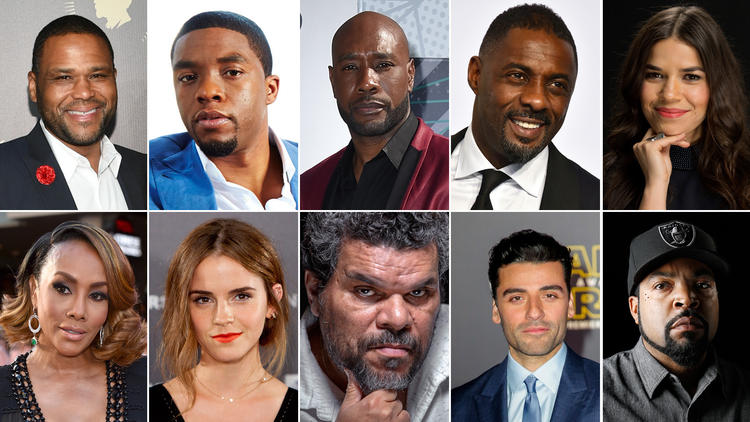
LAT: Idris Elba, Emma Watson, Ice Cube among 683 invited to join the movie academy — the largest, most diverse class ever

What about the goyim? Won’t anyone think about the goyim? What percentage of the Academy are goyim?

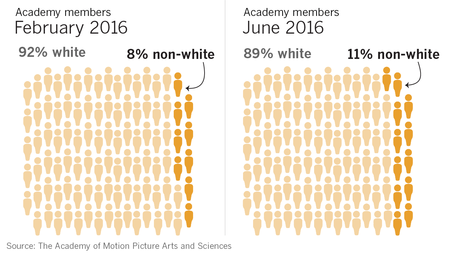
Los Angeles Times: “In 2012, The Times reported that Oscar voters were 94% white and 77% male, and by this year those numbers had budged only slightly.”

We hear a great deal about white over-representation in Hollywood, but what about Jewish over-representation? How come that is not fit for public discussion?

la-et-g-academy-diversity-1-20160629

Joel Stein wrote in the Los Angeles Times in 2008:

The Jews are so dominant, I had to scour the trades to come up with six Gentiles in high positions at entertainment companies. When I called them to talk about their incredible advancement, five of them refused to talk to me, apparently out of fear of insulting Jews. The sixth, AMC President Charlie Collier, turned out to be Jewish.

As a proud Jew, I want America to know about our accomplishment. Yes, we control Hollywood.

Los Angeles Times editor Davan Maharaj writes June 30, 2016:

The Film Academy’s Chosen Ones

Tears of joy. We can’t vouch for everyone, but that was a common reaction among the 683 actors, directors and other movie pros who were invited to the Academy of Motion Picture Arts and Sciences. After enduring the #OscarsSoWhite uproar, the academy selected a class of 2016 that is 46% female and 41% people of color. Overall, though, it moves the needle only a few percentage points for both groups. Check out the full list and how The Times’ own suggestions for members stacked up.

la-1467233212-snap-photo

I think he’s signalling he’d like to publish more about the Jewish angle on this story but can’t.

Posted in Hollywood, Jews | Comments Off on LAT: Idris Elba, Emma Watson, Ice Cube among 683 invited to join the movie academy — the largest, most diverse class ever

Sam Francis On George Will

From 1986: Will’s defense of the civil rights revolution in terms of classical conservatism is an erroneous application of a traditionalist principle. “But the enforcement of the law,” he writes, “by making visible and sometimes vivid the community values that are deemed important enough to support by law, can bolster these values.. . . Of course, nothing in a society, least of all moral sentiment, is permanent and final. Indeed, there have been occasions when the law rightfully set out to change important and passionately held sentiments, and the law proved to be a web of iron.” One such occasion was the abrogation of the rights of owners of public accommodations to deny service to blacks, enacted in the civil rights legislation of the 1960s. The exercise of this right became “intolerably divisive” and therefore had to be abridged by congressional action.

“The most admirable achievements of modem liberalism — desegregation, and the civil rights act — were explicit and successful attempts to change (among other things) individuals’ moral beliefs by compelling them to change their behavior. The theory was that if government compelled people to eat and work and study and play together, government would improve the inner lives of those people.”

“Moral sentiment” does indeed change, but absolute moral values do not, and only if we believe that egalitarian values are superior to the rights of property can we accept the legislation Will is defending as legitimate. Nor it is clear that the civil rights revolution has really improved our inner lives or even changed our external conduct to any great degree, and if it has, the change has derived not only from government but also from social and nonpublic sanctions as well.

That “stateways” can make “folkways,” that coercive imposition by an apparatus of power can eventually alter patterns of thinking and conduct, is true. The Christian emperors of Rome after Constantine certainly did so, as did Henry VIII and his successors in the English Reformation. What the conservative wants to know, however, is by what authority a state undertakes such massive transformations and whether what is gained adequately compensates for the damage that is inevitably done. In the case of the suppression of paganism and its replacement by Christianity, Christian conservatives will have little doubt of the authority and ultimate value of the revolution. The processes by which the civil rights revolution was accomplished are more questionable. It is not clear that they have led or will lead to more justice and tolerance or to greater racial harmony. They certainly did damage to the Constitution by allowing the national legislative branch to ovemde state and local laws. They also damaged the political culture by popularizing and legitimizing the idea that every conceivable “minority” (women, sexual deviants, and all racial and ethnic groups) may use the federal government to satisfy its ambitions at the expense of local jurisdictions, the public treasury, and the social order. Nor is it clear on what authority Congress overrode traditional property rights to impose new rights. The exploitation of the national government to abrogate and create rights by which the ambitions and private dogmas of a faction may be satisfied is no less an instance of the degeneration of modernism than the abuse of government by the constituencies of the welfare state. The civil rights revolution and the welfare state are not, then, reactions against the tendencies of modernism as Will presents them, but rather their fulfillment.

Indeed, for all his expostulations in favor of the high-minded and aristocratic enforcement of virtue, Will repeatedly expresses his deference to the conventional and the popular. The rights of proprietors in 1964 “had become intolerably divisive,” so conservatism properly understood accepts the will of those who initiated the division. “An American majority was unusually aroused,” so authority must follow the majority. The welfare state is an idea whose time “has now come,” so conservatives must accept the idea and must not resist the times. “If conservatism is to engage itself with the way we live now,” it must adapt itself to current circumstances, and perish the thought that we might really change the way we live now by rejecting the legacies of liberalism, dismantling its power structure, and enforcing and protecting the real traditions of the West rather than indulging in Will’s elegant pretense that that is what he is doing and expressing open contempt for the only force in American politics that has ever seriously sought to do it…

Although Will is sometimes called a “neo-conservative,” he is not one. Neoconservatives typically derive more or less conservative policy positions from essentially liberal premises. Will in fact does the opposite: he derives from more or less unexceptionable premises of classical conservatism policy positions that are often congruent with the current liberal agenda. It is because he accepts, and wants to be accepted by, the “achievements” of modem liberalism that he ignores or sneers at the serious conservative thinkers and leaders of our time who have sought to break liberal idols and that he voices no criticism of the powers that support liberalism. It is therefore not surprising that his commentary is welcomed in and rewarded by liberal power centers. They have little to fear from him and his ideas and much to gain if his version of “conservatism” should gain currency. He enjoys every prospect of a bright future in their company.

COMMENTS AT RADIX:

* The key phrase that gives away Will’s thought process is where he says, “Once politics is defined negatively…” Politics has supplanted theology as the so-called queen of the sciences, but it uses the same methods, terminology, and metaphysics that the former queen used, and largely written by the same philosophers. Defining God apophatically is the theological equivalent to Will’s expression of a negative definition of politics. And apophatic theology is the most humble and conservative ways of approaching God. It is also the most humble and conservative way of approaching politics. The unspoken alternative offered up by Will is cataphatic, or positive theology/politics, in which positive declarations are made about the nature of God and the world. It is brash and unconservative. And Will’s method of justifying this change (!) in approach is not to justify it on it’s merits, but to punch to the right. He knows in his heart, if one indeed he has, that what he is doing is against all tradition and solid thought, and that in order to get his way he cannot rely on argument, but must destroy any as yet unseen opposition by preemptive proscription. This methodology is the mark of a truly evil man. I wish I could have seen this more clearly years ago.

Posted in George Will | Comments Off on Sam Francis On George Will

Jewish Tears Over Brexit

About half of British Jews voted to leave the EU, but most Jewish elites, like gentile elites, wanted Britain to remain in the European Union.

I wonder if those Jews who wanted Britain to remain would want Israel to be part of a similar arrangement in the Middle East?

Why is it fine for Israel to be a Jewish state but it is wrong for England to be an Anglo state?

Rebecca Schischa writes:

Being a liberal-minded, extremely pro-European Londoner, who lived for many years in France, I’ve been in a state of shock and dismay since the referendum results were announced. Would I now need a visa to visit my beloved Paris? French friends I saw over the weekend, who only moved to this country a few months ago, were already worrying what their status would be once the UK’s “divorce” from the EU is finalized.
To me, the Leave victory is representative of a disturbing reactionary trend, of a more insular, less tolerant, “small island” mentality prevailing. Leave supporters were shown on television news crying with emotion, saying: “We’ve got our country back.”
But what “country” have they “got back” exactly? Is this nostalgia for some mythical all-white, Anglo-Saxon, Christian utopia that maybe existed hundreds of years ago – if it ever existed?
As a British Jew – whose grandfathers came to this country in the 1930s from Germany and Hungary respectively to escape the Nazis – the kind of jingoistic, anti-immigrant rhetoric that has characterized some of the Leave campaigning has made me feel distinctly uneasy.
Nigel Farage, leader of UKIP, the far-right United Kingdom Independence Party, unveiled a huge poster during the campaign showing a large line of mainly non-white migrants and refugees, with the caption: “Breaking point: the EU has failed us all.” Although other political leaders condemned this poster as an incitement to racial hatred, the fact that Farage even felt comfortable enough to use this kind of racist publicity stunt speaks for itself.
The whole Brexit campaigning has clearly shown up bitter and divisive splits in the country, with the tragic low-point, the murder of a young, pro-Remain Labour member of parliament, Jo Cox, in broad daylight on the streets of her local constituency.
Mike Katz, National Vice-Chair of the Labour Jewish Movement, an affiliate of the Labour Party, argues that Remain is “the natural position” for progressive-minded Jews. He makes a strong pro-immigrant argument: “Immigrants are the essential glue of society. We understand the huge contribution that immigrants make to our life… we ourselves, our forefathers, benefited in the past from being able to make a life here.”
Katz foresees that British Jews, along with all other ethnic minorities, will be affected by the wave of racism that the Leave campaign seems to have unleashed.
There has already been a sharp spike in hate crimes against ethnic minorities reported since the Leave campaign triumphed. Just over the weekend, cards stating “No more Polish vermin,” and “Leave the EU” were distributed in homes and shops in Cambridgeshire.

Posted in Brexit, Israel, Jews | Comments Off on Jewish Tears Over Brexit

Brexit and the global democracy deficit

UCLA professor David Myers writes in the Jewish Journal:

The results of the vote shocked to the core. Londoners, who voted 60-40 in favor of staying, were despondent and bewildered. All of the employees at the hotel where I stayed, every one of whom was a foreigner, gave voice to a mix of anger and fear. They came to London in search of opportunity, education and stability. They no longer knew where they stood in their adopted country. Similarly, everyone I met in shul and at Shabbat dinner later that evening, to a person, was aghast at the self-inflicted wound of the British, shuddering at the prospect of Boris Johnson as Britain’s next prime minister. Many of us could not avoid asking ourselves: If so many of the British pulled the lever as they did, couldn’t Americans do the same and allow the unimaginable to happen in November?

…What we are witnessing is not the venting of the wrath of British voters alone. We are witnessing a global phenomenon, a wide-scale pushback against the post-World War II ideal of liberal democracy. One sees this throughout the Continent, from Greece to Hungary, Spain to Poland, from Russia to Great Britain, and reaching across the Atlantic to the United States. One can even see the grave threats to the democratic order in Israel, to which politicians such as former Prime Minister Ehud Barak and former Defense Minister Moshe Yaalon have ominously referred, as part of this trend.
The current democracy deficit has many causal factors, though two in particular seem worthy of mention. Each derives from a different version of liberalism. First, globalization, the idea of open global economic borders without national restraints, once upon a time seemed to be the perfect system for the fleet, wireless and borderless 21st century. It turns out, though, that globalization can and has run roughshod over the economic and social orders of old, rendering obsolete the local worker, shop and customs. What Britons who supported the Leave campaign said the day after the vote was that, at last, they had their country back. The sense of ceding power — and of a lost cultural identity — was profound.
That feeling of cultural, economic and political loss results from a second factor: the extraordinary movement of populations in the world todday. Not since World War II have we seen as high a number of refugees: an estimated 65 million in 2015 (compared with 40 million in the 1940s), according to the United Nations. The arrival of new immigrants and refugees into Western countries, often from the Middle East or Central Asia, was initially welcomed — or at least permitted — in the name of a humanitarian, pluralist liberalism. There was a sense that the developed world had a responsibility to the developing world, a moral obligation to extend a hand to the less fortunate as a basic human right.

Posted in Brexit | Comments Off on Brexit and the global democracy deficit

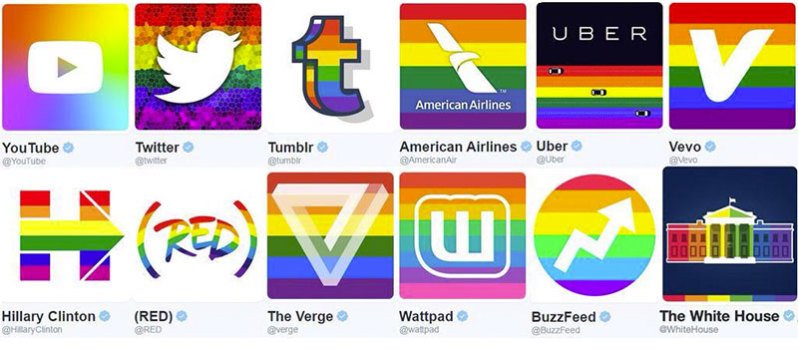
#HeterosexualPrideDay – ’cause it’s good to be normal

CmIo6E1UkAAyZPS

Source.

CmJHeJ5WAAQZE39

Elsewhere in my Twitter feed:

* Pretty soon “our values” will involve having a service economy based on trade in sodomy.

* In days of Ellis Island & putting Americans first, immigrants quarantined before mixed w/population.

* Are we ready for a full blown Obama given epidemic? 7 States reporting dozens of active TB cases in Muslim refugees.

* Trump can try to regulate immigration all he wants, but the simplest way to fight terrorism is to create a world without hate or conflict.

Posted in Homosexuality | Comments Off on #HeterosexualPrideDay – ’cause it’s good to be normal

ADL: ‘With #HeterosexualPrideDay trending, let’s reflect on why #Pride for LGBT is so important’

Strangely, neither the ADL nor the Museum of Tolerance and other such Jewish institutions push for gay marriage in Israel. One would think love is love, after all.

ADL:

June is LGBT Pride Month. To under­stand the LGBT move­ment, it’s impor­tant to appre­ci­ate the mean­ing of pride. Pride, accord­ing to Merriam-Webster, is “a feel­ing that you respect your­self and deserve to be respected by other peo­ple.” How does this trans­late into LGBT pride or pride amongst any other group of peo­ple such as African Amer­i­cans, Jews, women or immi­grants? Espe­cially for groups of peo­ple who have been oppressed, mar­gin­al­ized, dis­crim­i­nated against and tar­geted for bul­ly­ing, harass­ment and vio­lence, pride is key. Pride is a group of peo­ple stand­ing together and affirm­ing their self-worth, their his­tory and accom­plish­ments, their capa­bil­ity, dig­nity and their vis­i­bil­ity. It is a vocal and pow­er­ful state­ment to them­selves and the world that they deserve to be treated with respect and equal­ity. Pride is a way out.

The LGBT Pride Move­ment began at Stonewall in the sum­mer of 1969. On June 28, a police raid of the Stonewall Inn, a gay club in NYC, turned vio­lent when cus­tomers and local sym­pa­thiz­ers rioted against the police. The riot embod­ied the mount­ing of anger and weari­ness the gay com­mu­nity felt about the police depart­ment tar­get­ing gay clubs and engag­ing in dis­crim­i­na­tory prac­tices, which occurred reg­u­larly dur­ing that time. And yes, it also rep­re­sented their pride. The Stonewall riot was fol­lowed by days of demon­stra­tions in NYC and was the impe­tus for the cre­ation of sev­eral gay, les­bian and bisex­ual civil rights orga­ni­za­tions. One year later, the first Gay Pride marches took place in New York, Los Ange­les and Chicago, com­mem­o­rat­ing the Stonewall riots. The Pride move­ment was born.

Posted in ADL, Homosexuality | Comments Off on ADL: ‘With #HeterosexualPrideDay trending, let’s reflect on why #Pride for LGBT is so important’

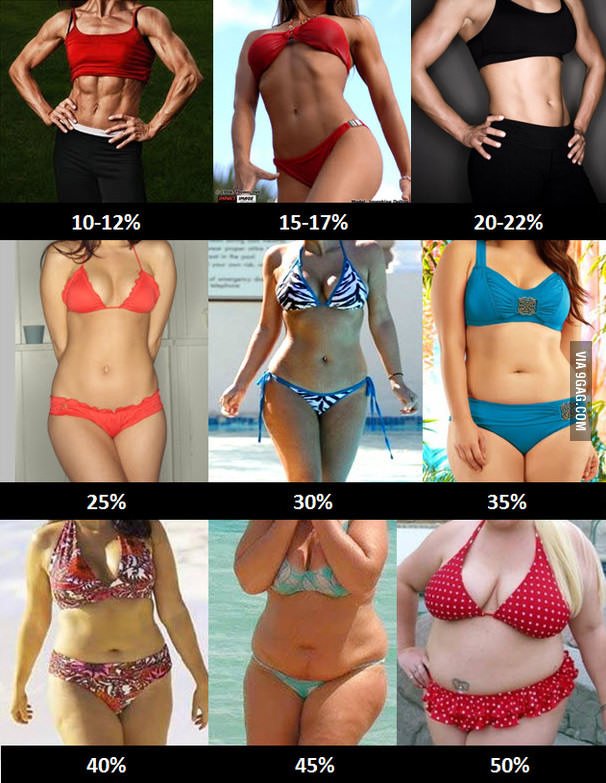
Twitter: ‘Most men want something between 20-30% body fat on their girl’

CmIrczzWAAAc3mM

Source.

Chateau Heartiste: “On most 30% BF girls, losing 5% fat will always look better. 15% BF is uncommon on girls with normal frames. Thin-framed girls pull it off.”

Elsewhere in my twitter feed:

* Those who argue that mass immigration is good for GDP are like Esau, who gave up his inheritance for a mess of pottage.

* School Calls Cops After Kid Makes ‘Racist’ Comment About Brownies…

Posted in Sex | Comments Off on Twitter: ‘Most men want something between 20-30% body fat on their girl’

Yossi Klein Halevi: Why the anti-Israel boycott movement is an immoral threat to peace

This is a clueless op-ed. The point of BDS, just like the point of the pro-Israel advocacy that Yossi Klein Halevi practices, is to promote the interests of one group over other groups.

A Jewish state of Israel is great for Jews and it sucks for Arabs and Muslims. The destruction of the Jewish state of Israel would feel great for Arabs and Muslims. The success of the Jewish state of Israel results in shame and mortification for Arabs and Muslims, who can’t keep up due to their low average IQs.

What is good for one group, such as Jews, is often horrible for other groups.

Judaism and Torah do not accord democracy much respect, but democracy is useful when you are arguing the case for Israel to people who believe in democracy.

What would the pro-Israel crowd prefer? That those opposed to them use violence or use the non-violence of BDS? Or dream that people opposed to Israel do not assert their own interests?

Jews would support a Jewish state even if it was not a democracy, even if it had no Muslims and no freedom to practice any religion but Judaism, and no free press and no universal healthcare. Why? Because a Jewish state is good for Jews.

As far as what is moral here, as far as who God has given the land to, that’s a matter of faith and it is silly to argue about faith.

Yossi Klein Halevi writes:

As the Middle East devours itself, leaving behind the worst human devastation since World War II, an international movement seeks to delegitimize Israel, the region’s only intact society. Israel alone in the Mideast has an independent judiciary, a free press, universal healthcare and religious freedom. Yet the anti-Israel boycott, divestment and sanctions movement, or BDS, has singled out the Jewish state as the world’s most pressing problem in the early 21st century.

BDS is at once immoral and a threat to peace. Immoral, because it perpetuates the lie that Israel is solely or even primarily to blame for the absence of a Palestinian state — rather than the repeated rejection by Palestinian leaders of peace plans presented over the decades. Immoral, too, because it ignores the anti-Israel and anti-Jewish hate education on which generations of Palestinians have been raised, an education that denies any place for a Jewish state in any borders.

Posted in Israel | Comments Off on Yossi Klein Halevi: Why the anti-Israel boycott movement is an immoral threat to peace

Game of States

From Steve Sailer’s new column in Taki’s Magazine:

The near universal response of the punditry to a majority of Brits voting to leave the E.U. has been so enraged that the average voter must have begun by now to notice that their furious elites just plain don’t like them. As a Bizarro World Sally Field might have exclaimed in wonder, “You hate us, you really hate us!”

The past week has been the mirror image of the Stale Pale Male taunting and touchdown dances that followed Obama’s reelection. Then, it was Democracy Rules (because we’ve imported millions of ringers). Now, it’s Democracy Sucks (because voters are stupid).

I’ve long been suggesting that it would be prudent for elites to moderate the policies under which they’ve flourished, such as by scaling back mass immigration. … What has ruined the E.U. is the ideological momentum of elites. Now that the public has twigged to the fact that globalism is basically a scam to allow those who would do pretty well in life anyway to do even better, the globalists have doubled down on their claims to be justified by their more advanced morality of universalism.

Posted in Europe | Comments Off on Game of States

Australia’s Election July 2

Comments at Steve Sailer:

Amidst the admittedly very important events of the Orlando shooting and the Brexit, the Australian election is set to take place in 4 days and has gone overlooked on iSteve. This election is of both the House and Senate, so this is as big as it gets. I spent 2-3 hours writing a post to explain everything, but unfortunately the browser died. (!!!)

In a nutshell, my idea is that Australia lacks a “Numbers USA” style website or ratings of individual Australian politicians on the basis of legal immigration, and needs that and a similar election guide by electorate. There is a “Sustainable Population Party” (formerly Stable Population Party) but they only have 4 candidates. There are about 76 seats in the Senate and 150 seats in the House, so something more extensive is really warranted. The beauty of this approach is that politicians are not monolithic on immigration, and similar approaches have been used to considerable success by Numbers USA, the NRA, AIPAC, etc. Apply the filter and let the politicians get the message. This is the best and quickest approach in a country where both major parties want (on average) high levels of immigration, for who knows what reason.

I am not sure whether something of value might be crowdsourced in 2-3 days, but who knows what is possible. If we could get someone on Breitbart onside it would help a lot, if not in the actual help with the guide, at least with the publicity. The largest countries of origin for immigrants to Australia are China, India and then it trails off after that. These are not majority Muslim countries, so whoever helps would need to understand that it is the overall immigration level that is the problem, not just the Muslim issue.

Australia ties Canada in net migration rate, equal first in the Anglosphere in immigration rate. Amongst white countries, only Spain has a higher level of immigration and population. Australia is a valuable ally of the USA and it would be a shame to let it slip out of the Anglosphere through rapid demographic change.

Unlike the USA, Australia’s primary source of immigration has been legal immigration, not illegal immigration. While Australia has been offered a real choice on illegal immigration which to their credit the Liberals were effective in halting, there has been no choice offered on legal immigration by either of the major parties or for that matter, the Greens.

The government media outlet, the ABC, does not even list immigration as a major policy.

http://www.abc.net.au/news/2016-05-13/election-2016-policy-big-issues/7387588

The Australian Labor Party (ALP) in particular does not want to debate immigration.

http://www.smh.com.au/federal-politics/federal-election-2016/federal-election-2016-coalition-labor-back-away-from-health-immigration-debates-20160623-gpqil1.html

In terms of the world, there are few white countries taking in more migrants per capita than Australia. Of white countries above Australia’s population, there is only Spain ahead of Australia (would make a good story as to who they are taking in and why). Australia is next and practically tied with Canada. Australia is first in the Anglosphere of its size or greater.

Country | Net migration per thousand p.a. | population

Luxembourg 17.16 0.5M

Spain 8.31 47M

Norway 7.25 5M

Belgium 5.87 11M

Canada 5.66 35M

Australia 5.65 23M


United States 3.86 319M

https://en.wikipedia.org/wiki/List_of_countries_by_net_migration_rate

As I said before, most of the immigration is non-white. Most is from India, China and the Phillipines, with some white refugees from the UK and South Africa.

http://blog.id.com.au/2011/population/australian-demographic-trends/australia-newest-migrants/

https://www.border.gov.au/about/corporate/information/fact-sheets/02key

Really, we should be aiming for an immigration moratorium to at least halt the demographic change. There is no white country producing much in the way of surplus, so there is no real point to keeping the borders open in the hope we get some compatible immigration. Taking in more Euro migrants only robs Peter to pay Paul. The only white countries breeding at above replacement levels are Israel at about TFR of 3 depending on source, and Argentina at 2.3. It’s very sad.

https://en.wikipedia.org/wiki/List_of_sovereign_states_and_dependent_territories_by_fertility_rate

Unfortunately, history shows there is no real difference between the major parties on immigration. Liberal Howard’s tenure oversaw a doubling of the immigration rate. Liberals have been in power from 9/2013, previously ALP from 12/2007, previously Liberals from 3/1996, previously ALP from 3/1983, previously Liberals from 11/1975.

https://www.border.gov.au/Factsheets/PublishingImages/02key-graph-2008-12.gif.jpg

Even Liberal Cory Bernardi, who has good views on Muslim immigration, is either not particularly strong on the legal immigration question, or it is not overly evident where he stands.

http://www.corybernardi.com/learning_from_british_mistakes_on_islamic_migration

http://www.afr.com/news/politics/cory-bernardi-branded-an-embarrassment-for-refugee-comments-20150907-gjhb4h

So, while I am not overly hopeful of finding that much difference between candidates, perhaps there will be some and where there is some, that is a start. I am not sure whether it has merit but since Numbers USA has merit, it seems relatively likely that an Australian equivalent may also have merit. Whether this can be done in time… not sure. Perhaps difficult at this late stage. I welcome comment.

Posted in Australia, Immigration | Comments Off on Australia’s Election July 2